
Must Be 21 To Enter
By entering this site you are agreeing that you are at least 21 Years of Age or older.
I AM 21 OR OLDERWhat Is Live Rosin and How It Is Made


Live rosin is a solventless cannabis concentrate made from cannabis frozen at harvest, washed into bubble hash, and pressed with heat and pressure. It isn't the same as live resin.
If a product is solventless, does that automatically make it safer or better medicine? That's the question worth asking before paying for a premium concentrate.
The name tells you how a producer handled the plant and extracted its oil. It doesn't tell you whether the batch passed contaminant testing, how much you should use, or whether your vaporizer will preserve its aroma. Those details matter especially when you're a first-time patient choosing between a dab jar, a cartridge, and an edible.
What Live Rosin Is Compared With Other Concentrates
Live rosin combines fresh-frozen starting material with mechanical extraction. Split the name into its parts: live describes the cannabis before extraction, while rosin describes how the producer separates the oil.
Live doesn't mean the jar contains living plant material. Rosin doesn't mean every product with a similar spelling uses the same process. That last distinction matters because live resin and live rosin can look similar on a menu.
Live rosin beside the concentrates it gets confused with
| Concentrate | Starting material | How it is made | Extraction solvent | What sets it apart |
|---|---|---|---|---|
| Live rosin | Cannabis frozen at harvest | Ice-water bubble hash, then heat and pressure | None added | Fresh-frozen input plus a mechanical press |
| Live resin | Cannabis frozen at harvest | Hydrocarbon extraction | Butane or propane commonly | Same live input, but a chemical solvent is used |
| Cured-flower rosin | Dried and cured flower or hash | Heat and pressure | None added | Solventless, but drying and curing come first |
| Distillate | Processed cannabis oil | Distillation after earlier processing | Solvents may be used upstream | Very high THC; original terpenes are largely removed |
The most useful comparison at the counter is starting material versus extraction method. A patient who wants fresh-frozen cannabis might consider either live resin or live rosin. A patient specifically seeking extraction without added chemical solvents is asking a different question.
Distillate belongs to a refinement category rather than a fresh-frozen category. Our live resin versus distillate comparison helps separate those terms when cartridge labels make them sound interchangeable.
The hash stage makes the difference
Live rosin isn't wet, freshly harvested flower squeezed in a press. The producer first separates the resin-rich glands into bubble hash, then dries and presses that material.
A commonly cited pressing window is approximately 160°F to 210°F, or 71°C to 99°C, although cultivar, moisture content, and desired texture change the setting, according to the Cryo Cure live rosin guide. That's a production range, not a recommended temperature for your dab rig.
For example, someone comparing cured-flower rosin with live rosin shouldn't assume the difference is stronger pressing or a special additive. The meaningful difference starts before extraction, with how the harvested cannabis was handled.
Counter question: Was this made from fresh-frozen ice-water hash, or from dried and cured material?
When someone asks what is live rosin, the repeatable answer is a process description: immediate freezing, solvent-free separation, and relatively low-temperature pressing. None of those choices, by itself, promises stronger effects or greater safety.
How Fresh Frozen Flower Becomes Live Rosin
Think of pressing juice from fruit that was frozen while ripe, rather than extracting it in a chemical bath. The comparison isn't exact, but it captures the basic idea: preserve the starting material, separate the desirable portion, and press it.
This process graphic shows the main stages from harvest to oil.
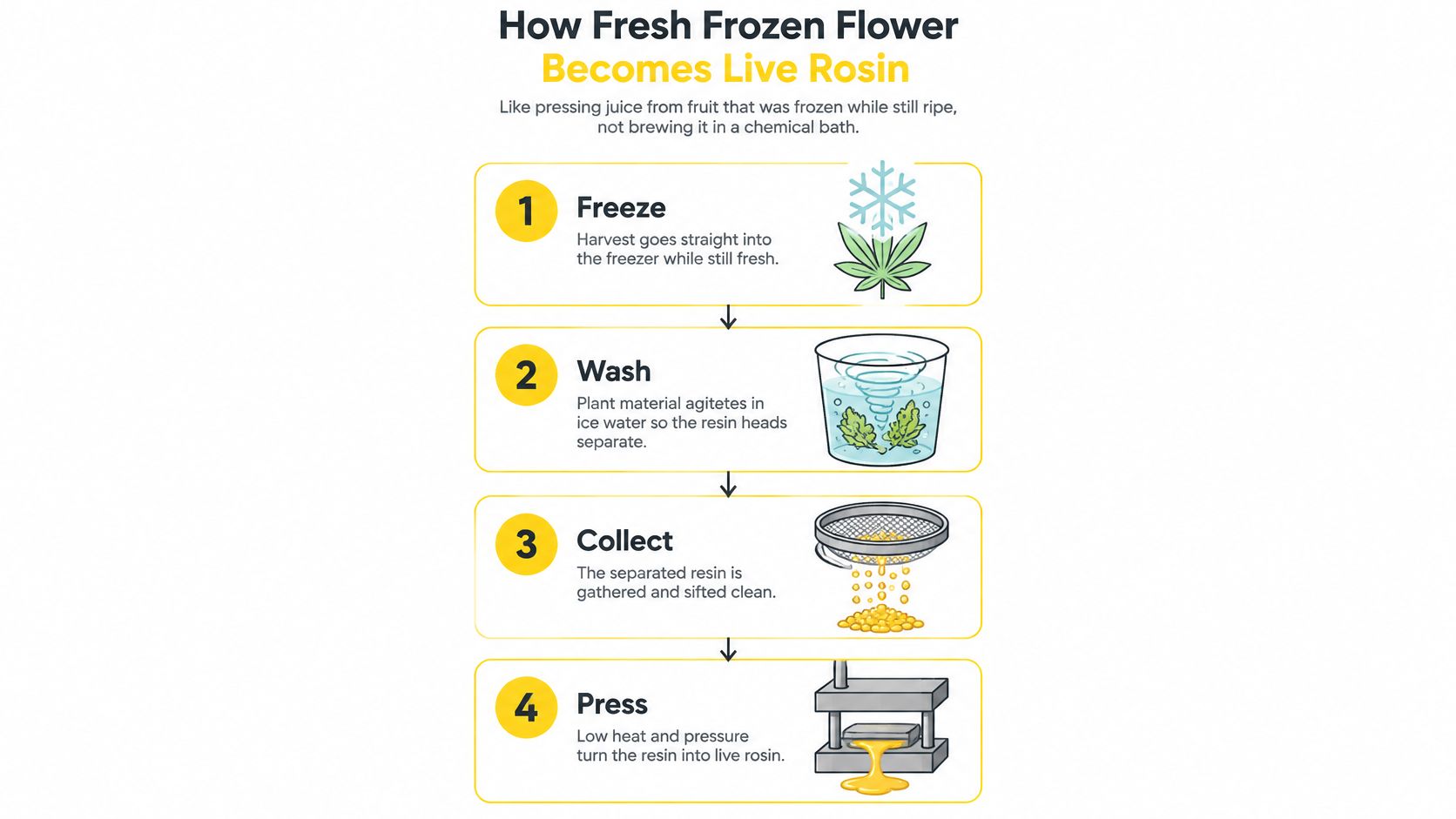
From harvested flower to dry hash
Freeze the harvested cannabis promptly. Producers freeze the flower instead of hanging it to dry and cure. This limits the time that aromatic compounds spend exposed to drying conditions before extraction.
Agitate the material in ice water. Gentle mechanical movement separates trichomes, the small resin-rich glands, from surrounding leaf and stem. The producer wants those resin heads, not a slurry of shredded vegetation.
Filter and collect the bubble hash. Fine mesh screens catch the separated material. The producer assesses how cleanly the resin separated from plant fragments, because unwanted plant material affects what goes into the press.
Dry the hash thoroughly. Freeze-drying is a common approach. Although ice water helps with separation, the collected hash shouldn't remain wet when it moves to pressing.
The distinction between washing and drying can confuse new patients. Water is a processing aid during separation, not something the producer is trying to retain in the finished concentrate.
From dry hash to a sealed batch
Press manageable portions with controlled heat and pressure. The combination allows the oil to move out of the hash through the filter material. More force isn't automatically a better recipe.
Collect the oil and leave the pressed material behind. The producer gathers the rosin, separates it from the remaining puck, and packages the batch for testing and storage.
The Journal of Cannabis Research review of extraction methods describes heat-and-compression extraction and notes that some pneumatic presses can reach 137.8 MPa, approximately 20,000 psi, although working settings differ with the material and equipment. That machine capability isn't a target every producer should chase.
For a concrete production example, a producer freezes fresh flower, washes it into ice-water hash, freeze-dries the collected resin, and presses small portions at a comparatively low temperature. No hydrocarbon or alcohol extraction solvent needs to be introduced along that route.
Watch the handling and separation stages with that sequence in mind.
A clean, properly dried hash portion gives the producer a better starting point than an impressive pressure specification. Material preparation and temperature control matter more than turning the press up.
Why the Freeze Changes Aroma but Not Every Batch
Herbs frozen when they're picked can smell closer to the garden than herbs dried on a rack. That's a useful comparison for understanding live rosin's preservation goal, though it isn't a promise that every frozen product will smell better to every person.
Conventional rosin generally starts with dried and cured flower or hash. Fresh-freezing limits exposure to conditions that encourage terpene evaporation and cannabinoid degradation, helping preserve a more plant-authentic volatile profile, as explained in Halara's live rosin education guide.
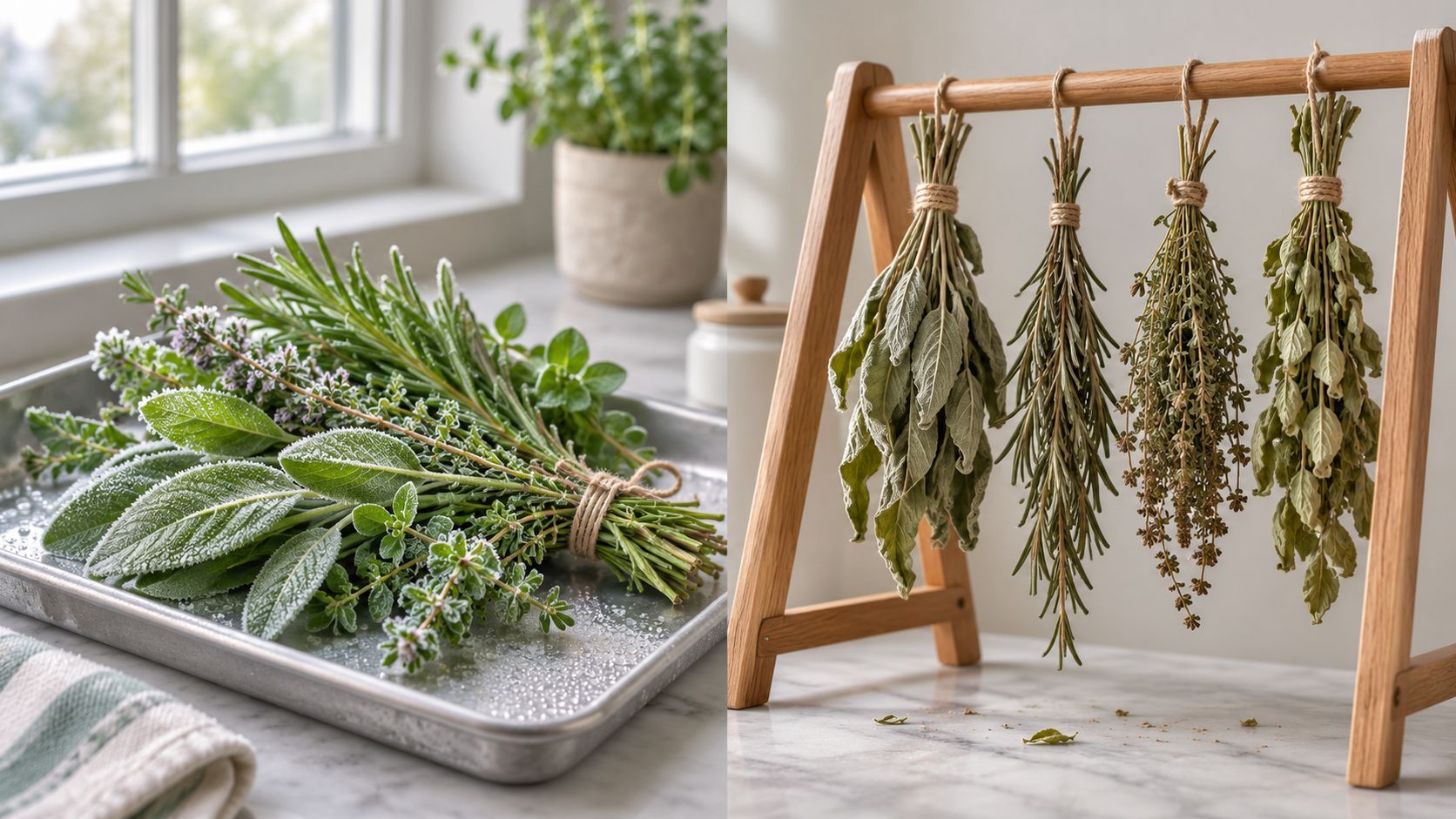
Similar labels can hide different production choices
Say a patient buys a jar with a bright citrus aroma, then returns for another batch with the same cultivar name. The next jar smells less sharp and has a different consistency. That doesn't necessarily mean either label is wrong.
Several choices can change what reaches the jar:
- Cultivar genetics and harvest maturity influence the resin the grower starts with.
- Freezing speed and wash conditions affect preservation and separation.
- Press temperature and later storage influence the finished oil's character.
The patient sees the cultivar name and product category, but not every production decision. Even a careful producer works with biological material that isn't identical from harvest to harvest.
The moisture problem you can't read from a photograph
A glossy product picture can't tell you whether the intermediate hash was sufficiently dry. If a producer presses hash with residual water, that moisture can interfere with texture, stability, and vaporization. A product that initially looks appealing may later separate or sputter during use.
That's why appearance and aroma shouldn't be your only buying criteria. Our cannabis terpenes guide explains the aroma compounds patients commonly encounter without treating a scent description as a prescription.
Treat aroma as a clue about the product, not an instruction for how much to use.
A strongly scented jar doesn't tell you your personal THC tolerance. Nor should you increase a portion because another batch smelled more intense.
Different live rosin batches can feel different because the plant, processing, and handling differed. Neither jar is more live than the other because its aroma is louder.
What Solventless Does Not Guarantee on a Lab Report
Solventless doesn't automatically mean cleaner, stronger, or better medicine. It means no chemical extraction solvent was added during that extraction process.
That's a genuine distinction, but it doesn't erase problems introduced during cultivation or handling. Live rosin can still carry pesticides, mold, heavy metals, or other contaminants from its starting material.
This checklist separates the production claim from the conclusions a patient shouldn't assume.
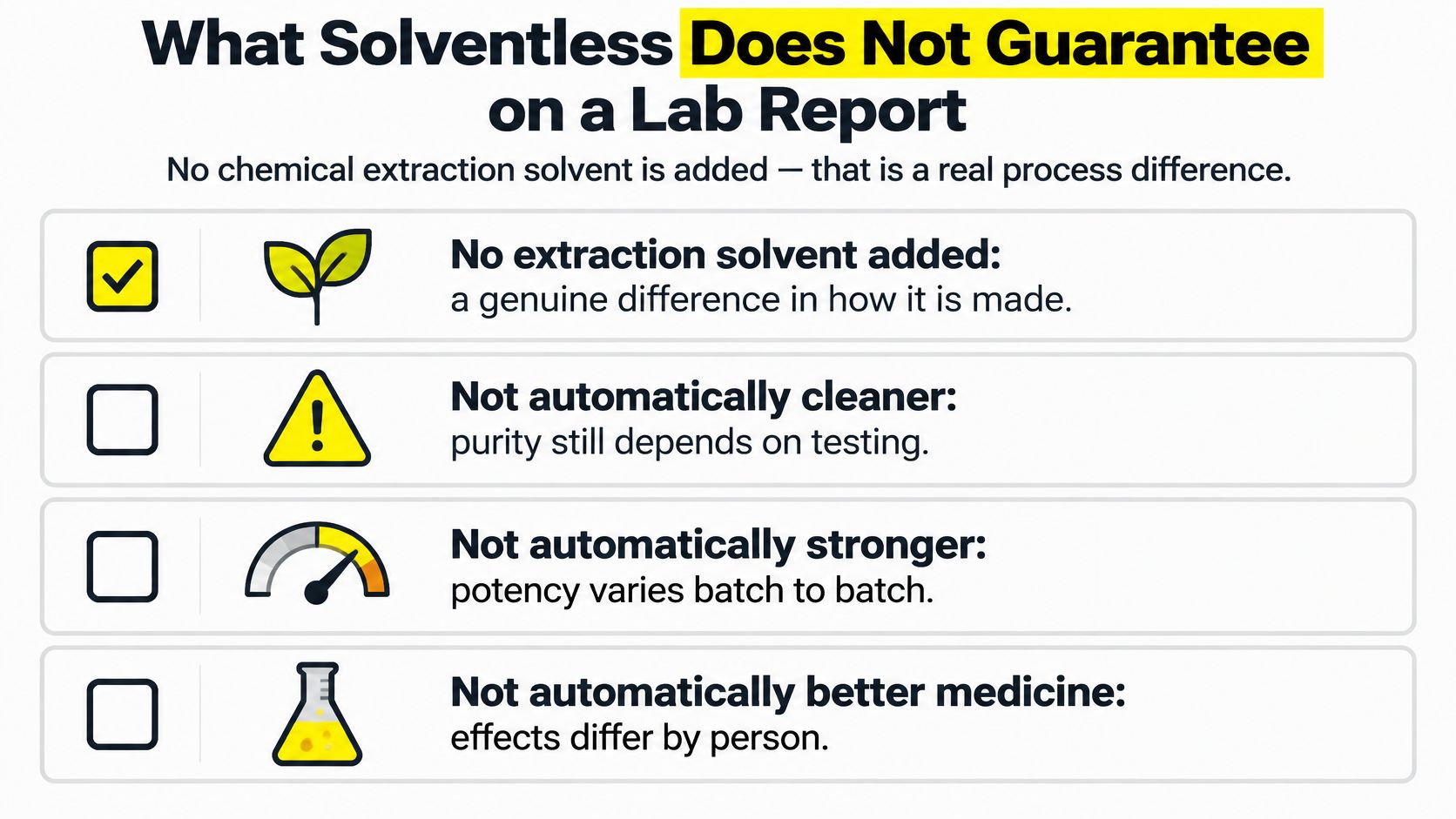
Read the report before trusting the premium label
A certificate of analysis, often shortened to COA, should describe the actual batch you're considering. A report for a different production run doesn't establish what's in your jar.
Use this reading order:
- Cannabinoid values. Find THC and CBD results. Read the units carefully, rather than assuming a large percentage means a suitable first dose.
- Contaminant panels. Look for pesticide, microbial, and heavy-metal results. Check which tests the laboratory performed.
- Production batch. Match the report's batch identifier to the package, not just the cultivar or product name.
- Testing laboratory. Confirm that the document identifies the lab responsible for the results.
- Terpene results, when reported. Use them to understand measured aroma compounds, not as a guaranteed outcome for sleep, pain, or mood.
Our product testing standards guide offers more context for evaluating product documentation. We test every product for pesticides, potency, and more, but patients should still know how to connect a particular package to its report.
Price isn't clinical evidence
The Weedpedia live rosin overview identifies no controlled head-to-head studies comparing live rosin, live resin, and distillate at equivalent THC doses for pain relief, sedation, or euphoria. That limitation matters: a production method isn't proof of a superior medical effect.
Say a first-time patient chooses the most expensive gram because solventless sounds like a purity certification. The better move is to pause, match the batch number, and examine the test results before paying.
Buying rule: If there's no matching batch report, leave the product rather than filling the gap with assumptions.
A lab report also isn't a promise that cannabis will be appropriate for a particular health condition. It answers specific questions about the sample tested. The defensible distinction remains solvent-free production from fresh-frozen material, not universal purity or proven therapeutic superiority.
Practical Examples From a Dab Jar to a Gummy
An experienced dab user opens a jar and places a rice-grain-sized portion on a compatible nail or concentrate device. Inhalation has a fast onset, and the format keeps the experience close to the pressed oil's aroma. But the jar has no milligram lines, and a rice-grain visual isn't a standardized dose.
Another patient wants something more discreet and chooses a live-rosin cartridge. Counting similar puffs can offer more repeatable use than scooping sticky oil, but puff length and device temperature still change what the person inhales.
A patient who doesn't want to inhale chooses a gummy with a printed cannabinoid amount. The slower onset and longer effect require more patience, especially before considering another portion. A measured piece helps with planning, but it doesn't make an excessive dose easy to reverse.
Live rosin formats and how a patient actually uses them
| Format | Onset and duration | Dose control | Storage habit | Fits when |
|---|---|---|---|---|
| Dab jar | Fast inhalation onset, shorter than an edible | Difficult; a rice-grain visual isn't a milligram measurement | Sealed and cold; avoid repeated warming | The person already dabs and wants the pressed oil's aroma |
| Vape cartridge or disposable | Fast inhalation onset; device temperature affects delivery | Count puffs, but puff size and overheating change the draw | Keep cool and out of hot cars | Convenience matters more than scooping from a jar |
| Gummy or other edible | Slower onset and a longer effect | Clearest labeled portion; check milligrams per piece | Follow the edible's storage directions | Inhaling is a poor fit or measured portions are the priority |
For scale, live rosin averaged $51.20 per gram and tested at approximately 73% THC in Cannamonitor's July 2026 sample of 137 concentrate stock-keeping units. That's a sample of listed products, not a promised local price or the potency of every jar.
A gram of potent concentrate should be approached as material for multiple carefully measured uses, not a single serving. The practical problem is how to portion it consistently.
Choose the measuring method first
For a new patient, a familiar-looking gummy may be easier to portion than a sticky dab, but the delayed effect creates a different risk: taking more before the first portion has fully taken effect. Our edible dosage guide helps patients think through that timing.
Rosin also appears in vape formats, so don't assume the word on a cartridge replaces ingredient information or a matching batch test. Ask what the finished device contains and whether its hardware is appropriate for that formulation.
Choose the format around how you'll measure and manage your dose. The most premium-sounding jar isn't automatically the most usable option for your routine.
How Device Heat and Cold Storage Change the Jar
Does live rosin stay meaningfully different if your device overheats it? Its production history doesn't change, but you can lose some of the aromatic qualities you paid to preserve.
An independent live resin and live rosin comparison from Sol Cannabis notes that research hasn't established a peer-reviewed head-to-head terpene comparison between rosin and hydrocarbon extracts, and that high temperatures can degrade terpenes regardless of extraction method. Preserved aroma compounds aren't protected once they reach a hot device.
Separate device performance from product quality
Say a cartridge tastes harsh at a high setting. Increasing the power again to force a bigger cloud may make the problem worse rather than tell you anything useful about the batch.
Use compatible hardware, begin at a lower manufacturer-supported setting, and keep the first inhalation small. Format, device setting, inhalation technique, and personal THC sensitivity can influence the experience as much as the extraction label.
- Check compatibility. Don't assume a dab jar's contents belong in cartridge hardware.
- Avoid chasing vapor volume. A larger cloud isn't proof of better flavor or better dose control.
- Pause when the taste changes. Persistent burnt flavor warrants checking the device rather than continuing to heat it.
Cold storage helps, but colder isn't always better
A peer-reviewed metabolomic storage study found that terpenoid concentrations declined rapidly under every condition tested; 4°C was optimal among the evaluated conditions for whole cannabis inflorescences and extracts, while temperatures below -20°C weren't automatically superior and very low temperatures adversely affected compounds including alpha-pinene. Those findings support careful cold storage, not a universal claim that the deepest freezer setting preserves every product best.
For a dispensary's working inventory, the practical approach is to keep jars sealed and cold while minimizing repeated warming and chilling. At home, take out the portion you need instead of repeatedly leaving the whole jar beside a warm device.
Our cannabis storage container guide can help you choose a suitable container and handling routine. Keep edible storage separate from concentrate storage, and follow device-specific directions for cartridges.
Fresh-freezing at harvest doesn't make finished oil immune to oxidation or temperature-related change. Match a small first portion to the format, and check the device temperature before blaming the batch.
Confirm One Tested Gram Before You Order
Say you're choosing a single gram rather than buying several unfamiliar concentrates. Use a category price average only as a rough budgeting reference, then check the current menu price and the actual batch potency.
For a hypothetical gram labeled 73% THC, the arithmetic gives approximately 730 milligrams of THC in the container. That describes total labeled content, not the amount you absorb or a recommended serving, and it illustrates why a small concentrate portion deserves more caution than a familiar-looking amount of flower.
Make a specific counter request
Ask for fresh-frozen hash rosin. Set aside items labeled live resin or cured rosin if they don't match the process you want.
Then make the purchase conditional on a few concrete checks:
- Identify the in-stock item. Ask which option is live rosin rather than relying on the word live alone.
- Match the documentation. Request the certificate for the batch number printed on that package.
- Choose one usable format. Decide between a carefully portioned dab, a compatible lower-temperature cartridge, or an edible with clearly printed milligrams.
- Plan the trip home. Have a sealed, cool storage location ready instead of leaving the purchase in a warm car.
Our Rockville selection includes concentrates, but availability of a particular live rosin item needs confirmation. Don't substitute another extract just because its name sounds close.
Commit only after the details match
If the report is missing or the batch numbers don't agree, leave that gram. A helpful explanation doesn't replace product-specific documentation.
Choose the format before confirming pickup or delivery. You should know what you're buying, how you'll portion it, and where you'll store it before the order is complete.
At Mr. Nice Guys DC, we offer concentrates, vapes, edibles, and patient guidance to help you compare formats without treating a premium label as a medical promise. Visit us to ask about current live rosin availability, review the matching batch information, and choose a format you can use and store confidently.
Mr Nice Guys DC
At Mr. Nice Guys DC, we’re more than just a cannabis delivery service — we’re passionate advocates for quality, convenience, and community. With years of experience in the cannabis industry, our team is dedicated to educating and empowering customers across Washington, D.C. Whether you're a seasoned user or just starting your cannabis journey, our blog delivers trusted tips, product insights, and the latest updates from the world of weed. Stay informed, stay elevated.
