
Must Be 21 To Enter
By entering this site you are agreeing that you are at least 21 Years of Age or older.
I AM 21 OR OLDEREdible Dosage Guide for Medical Cannabis Patients
.svg)

.png)
You're probably here because an edible sounds simpler than smoking, but the dosing feels less forgiving. That instinct is correct. Patients in DC often tell me the same thing: they're comfortable with flower or a vape, then freeze when they see a gummy and realize one piece may last most of the day.
Edibles reward precision and punish guesswork. A careful plan usually works well. An impatient second dose usually doesn't. A good edible dosage guide isn't just about picking a milligram number. It's about choosing the right product, understanding the ratio, and matching the experience to your actual medical goal.
Understanding edible dosing basics
A common DC patient scenario looks like this. Someone uses cannabis regularly by inhalation, buys their first edible for evening pain or sleep, and assumes their tolerance will carry over. Then they take too much because edible tolerance often doesn't match flower tolerance.
The baseline rule is still the one that matters most. Start low and go slow. For first-time users or people with low tolerance, the standard recommendation is to begin with 2.5 mg to 5 mg of THC according to this edible dosing reference. In practice, that range exists for a reason. 2.5 mg is often a microdose or half-dose level, while 5 mg is usually where a beginner starts to notice a clearer psychoactive effect.
Even heavy smokers can get surprised by edibles. THC in an edible takes a different path through the body than inhaled cannabis, so prior comfort with flower doesn't automatically mean comfort with a gummy or chocolate.
Why the first dose should feel modest
The smartest first edible often feels almost underwhelming. That's fine. You're not trying to prove anything. You're trying to find a repeatable dose you can trust on a work night, a pain flare day, or a quiet weekend.
Practical rule: If you're unsure whether to start at 2.5 mg or 5 mg, choose the lower number and learn from it.
Body size and metabolism matter too, but they don't replace caution. Health Canada benchmarks cited in the same dosing guide suggest 0.1 to 0.3 mg of THC per kilogram of body weight as a personalized starting framework. That's useful as a reference point, not a license to jump higher.
What works and what usually fails
A patient who buys a clearly labeled low-dose gummy and takes one measured serving usually gets useful information from the first session. A patient who starts with a mystery brownie rarely does.
What works:
- Measured products: Choose lab-tested edibles with exact milligram labeling.
- Low-entry doses: Start at the low end, especially if anxiety is part of the medical picture.
- Single-variable testing: Try one product, one dose, one setting.
What doesn't:
- Estimating by size: Bigger cookie doesn't mean predictable dosing.
- Matching vape tolerance to edibles: Those are different experiences.
- Treating the first try like a recreational challenge: Medical use needs consistency, not bravado.
Calculating your dose per serving
If the label is clear, dosing becomes manageable. If the label is vague, the product becomes a gamble. That's the difference between a 10 mg gummy you can divide with confidence and a homemade edible that may not be mixed evenly.
Commercial products are standardized for a reason. 10 mg is widely recognized as the standard THC dose per serving in legal markets, while 1 to 2.5 mg products are treated as microdose options, as outlined in the Los Angeles Times THC calculator guide.
Read the label before you read the flavor
Start with three questions:
- How many milligrams are in one serving?
- How many servings are in the package?
- Is the product THC-only or does it include CBD?
A real-world example is simple. If a gummy is labeled 10 mg THC per piece, that is not a beginner dose for most first-time medical patients. It is often a dose to divide. Cutting it into quarters gives roughly 2.5 mg pieces. Cutting it in half gives roughly 5 mg pieces.
That's how a standard market product becomes a measured beginner tool.
Common edible potency tiers
| Product Type | Dose Range | Recommended User Level |
|---|---|---|
| Low-dose gummies or mints | 1 to 2.5 mg | Microdosing, first-time users |
| Standard gummies and chocolates | 3 to 5 mg | Cautious beginners, low tolerance |
| Standard legal-market serving | 10 mg | Not ideal for beginners |
| Higher-potency products | 20 to 30 mg | Experienced users |
| Specialty high-dose products | 50 to 100+ mg | Expert or medical-use situations |
If you're checking consistency before buying, it helps to understand how cannabis potency testing supports accurate labeling and more predictable servings.
Buy the label, not the marketing. The milligrams matter more than the flavor name.
Homemade edible math
Homemade dosing only makes sense if you calculate it. The formula for THC per serving is:
(milligrams of wax concentrate × percent THC of wax) ÷ number of edibles made
The verified example is straightforward. Using 1 gram (1,000 mg) of wax at 80% THC to make 20 cookies produces 40 mg of THC per cookie according to this homemade edible calculation example.
That number shows why homemade batches get people into trouble. One cookie can land far above what a beginner intended.
A second example matters just as much. If you want 50 mg per edible and you're making 20 cookies with 80% THC wax, you'd need 1,250 mg (1.25 g) of concentrate for the batch according to the same calculation walkthrough. The math is clear. The dosing is not beginner-friendly.
A practical way to divide a serving
If you buy a 10 mg gummy:
- Cut it into four pieces for a roughly 2.5 mg starting option
- Cut it into two pieces for a roughly 5 mg option
- Keep the rest for another day instead of redosing impulsively
That's a boring strategy. It's also the one that keeps dosing useful.
Titration schedules for beginners and advanced users
Titration is where most patients either get control or lose it. The standard rule is simple. Wait at least 2 hours after your initial dose before even considering an increase, and if you want to go higher, add only 1 to 2.5 mg to the next session, not the current one, according to this edible titration guide.
Start with the visual version first.
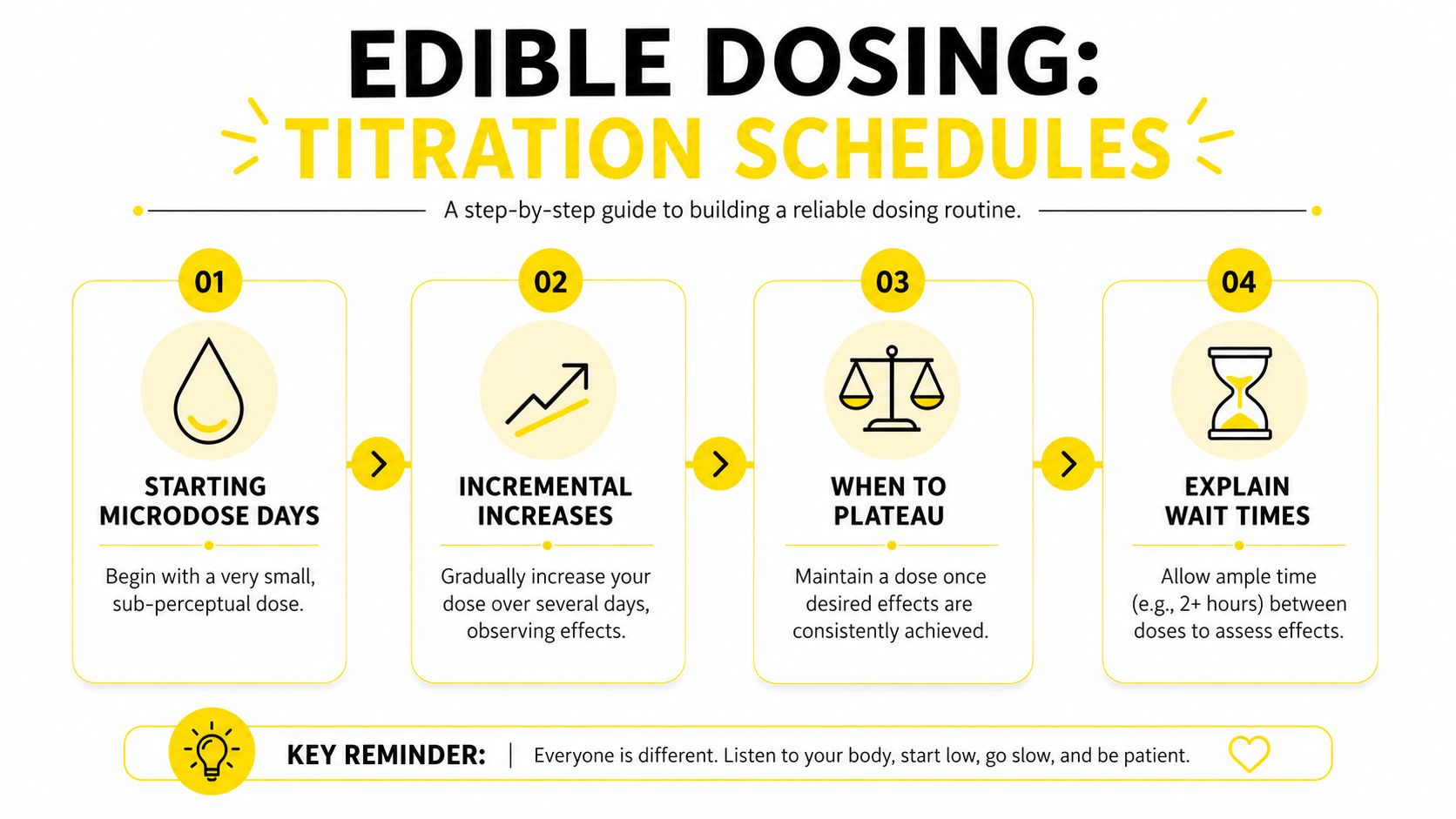
Beginner schedule
For a brand-new edible patient, I'd keep the first few sessions very plain:
- Session one: Take 2.5 mg once. Wait. Record what happens.
- Session two: Repeat the same dose if the first session gave partial benefit and no meaningful discomfort.
- Session three: If the first two sessions were too subtle, move up by only 1 to 2.5 mg in the next session.
The mistake is taking 2.5 mg, waiting a short time, then stacking another dose because “nothing's happening yet.” That turns a careful test into an uncontrolled one.
A practical example from the verified guidance is a casual user taking 5 mg, waiting 2 hours, and if nothing is felt, waiting until the next day to try 6.5 mg or 7.5 mg instead of taking another 5 mg immediately, as described in the same dosing progression guide.
Intermediate and advanced patterns
Patients who already know their baseline can still benefit from structure.
- Intermediate users: Hold one known-effective dose across multiple sessions before changing anything.
- Advanced users: Increase only when the current dose is consistently too weak for the same goal.
- Medical users with changing symptoms: Keep one target at a time. Don't raise the dose just because one bad night happened.
If you want a product-specific framework, this guide on how to microdose edibles is useful for thinking through low-dose progression.
Here's the process in motion:
What to track in a dosing journal
A simple journal beats memory. Track:
- Dose taken: Write the exact milligrams.
- Ratio used: Note whether it was THC-only or included CBD.
- Timing: Record when you ate it and when effects became noticeable.
- Outcome: Pain relief, anxiety shift, sedation, dry mouth, racing thoughts, next-day grogginess.
Don't change the dose and the product at the same time. If the result is bad, you won't know which variable caused it.
Plateauing is a good sign. If a dose reliably delivers the effect you want, stop climbing. Bigger isn't more medical. Bigger is just bigger.
Onset and duration expectations
The timeline matters almost as much as the dose. For beginners with no prior edible experience, effects can begin in 30 to 90 minutes, peak at 2 to 4 hours, and last 6 to 8 hours, based on Leafly's edible dosing guidance.
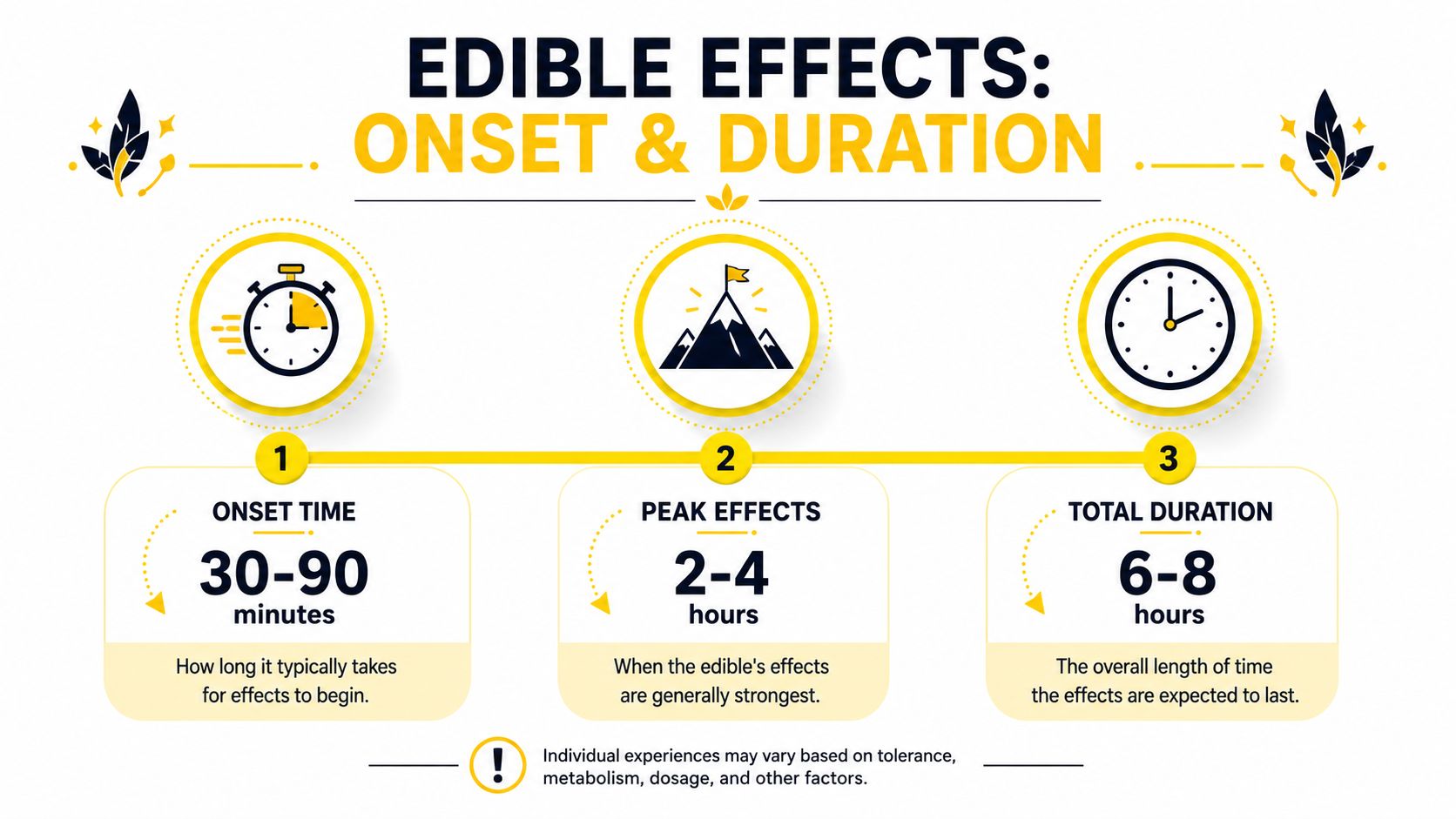
How to plan around that timeline
This is why edibles work well for some medical goals and poorly for others. If you need steady evening relief, a longer arc can help. If you need something that changes quickly minute to minute, edibles can feel too slow and too committed.
Patients often get fooled during the quiet window before onset. The edible hasn't “failed.” It may still be building. That's why impulsive redosing causes so many bad experiences.
A practical example: if you're taking an edible for nighttime discomfort, don't wait until you need immediate relief. Build in enough time for onset and peak so the product lines up with the part of the evening when you most need it.
Factors that can shift the experience
Even with a careful dose, the feel of the session changes based on context.
- Food intake: Taking an edible with food may make the experience feel more gradual.
- Metabolism: Some patients notice effects sooner, others later.
- Dose size: Lower doses are easier to integrate into a normal routine. Higher doses can dominate the day.
If you need a practical breakdown of timing scenarios, this article on how long edibles take helps frame what to expect in real use.
Build your schedule around the peak, not just the onset. The strongest part often comes later than people expect.
Safety tips interactions and storage
Edibles need a stricter safety routine than many patients expect. The first rule is product quality. Lab-tested products with clearly marked low doses are mandatory for safety, and unlabeled homemade edibles can contain unknown and potentially dangerous THC amounts according to this edible safety guide.
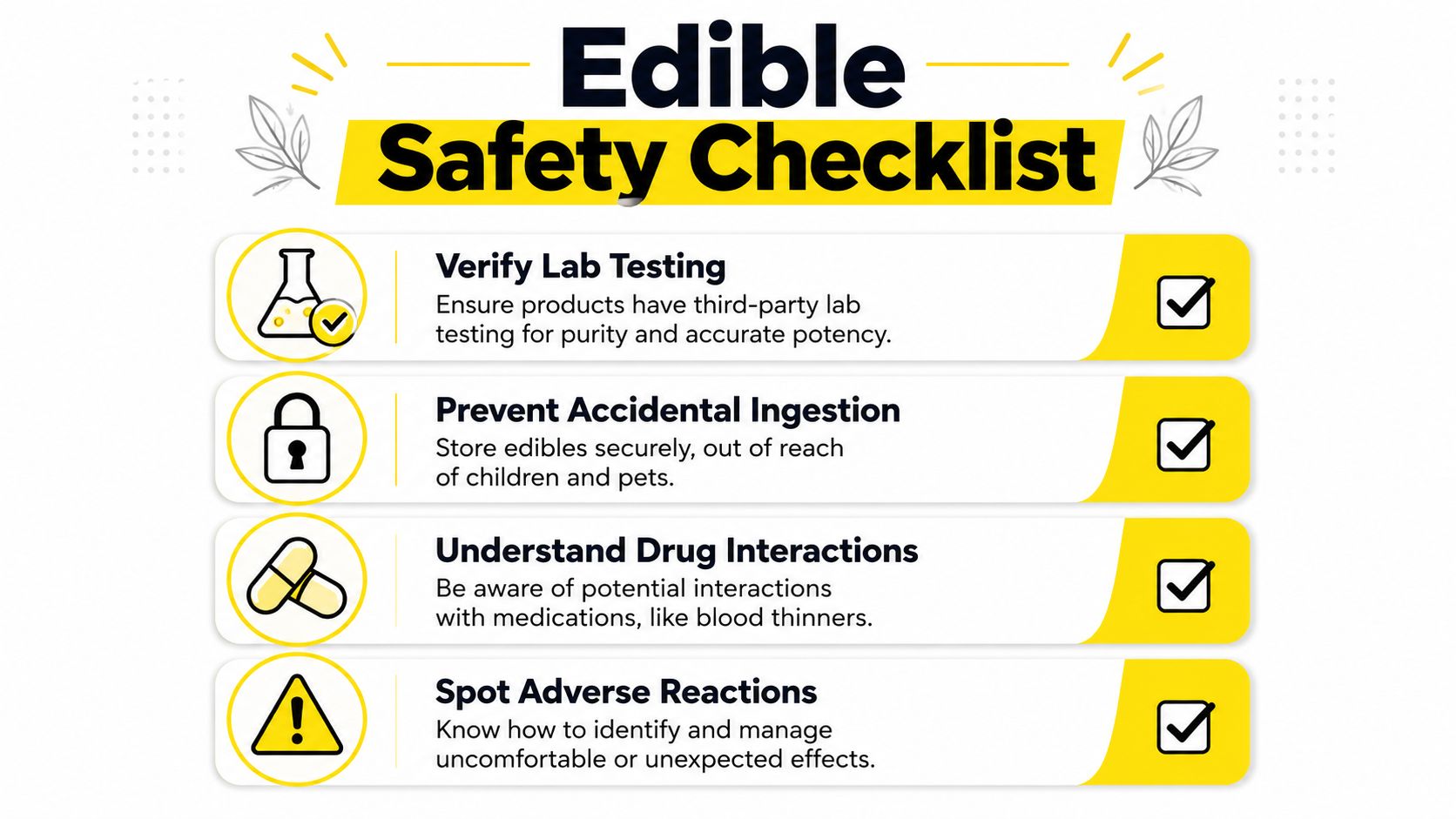
Safety checklist that actually matters
- Verify the label: Check the exact milligrams per serving before you eat anything.
- Store it like medication: Use child-resistant packaging and keep it away from pets and anyone who may mistake it for candy.
- Watch medication overlap: If you take prescription medication, especially anything that affects bleeding, sedation, or alertness, review compatibility with a clinician.
- Separate homemade from measured use: If you didn't make it and can't verify the potency, don't use it as a dosing experiment.
If you're taking other medications, this medication compatibility check can help you frame the right questions before combining products.
Red flags and damage control
Most uncomfortable edible experiences improve with time, calm surroundings, hydration, and no further dosing. The problem is usually overconsumption, not product failure.
Look out for:
- Unexpected intensity: More psychoactivity than planned
- Anxiety or panic: Often tied to too much THC too quickly
- Severe sedation or confusion: A sign to stop and rest in a safe place
A basic storage habit also helps dose consistency. Keep edibles sealed, dry, and clearly separated from regular snacks. Patients lose more control from mix-ups and casual handling than from complex chemistry.
Local DC considerations with real examples
DC patients have one extra layer to think about beyond milligrams. CBD:THC ratio changes the effective experience. That point gets missed in many edible dosage guides, even though medical literature indicates that a 1:1 ratio can significantly change THC's psychoactivity, which matters for patients managing anxiety or pain, as discussed in this ratio-focused edible guide.
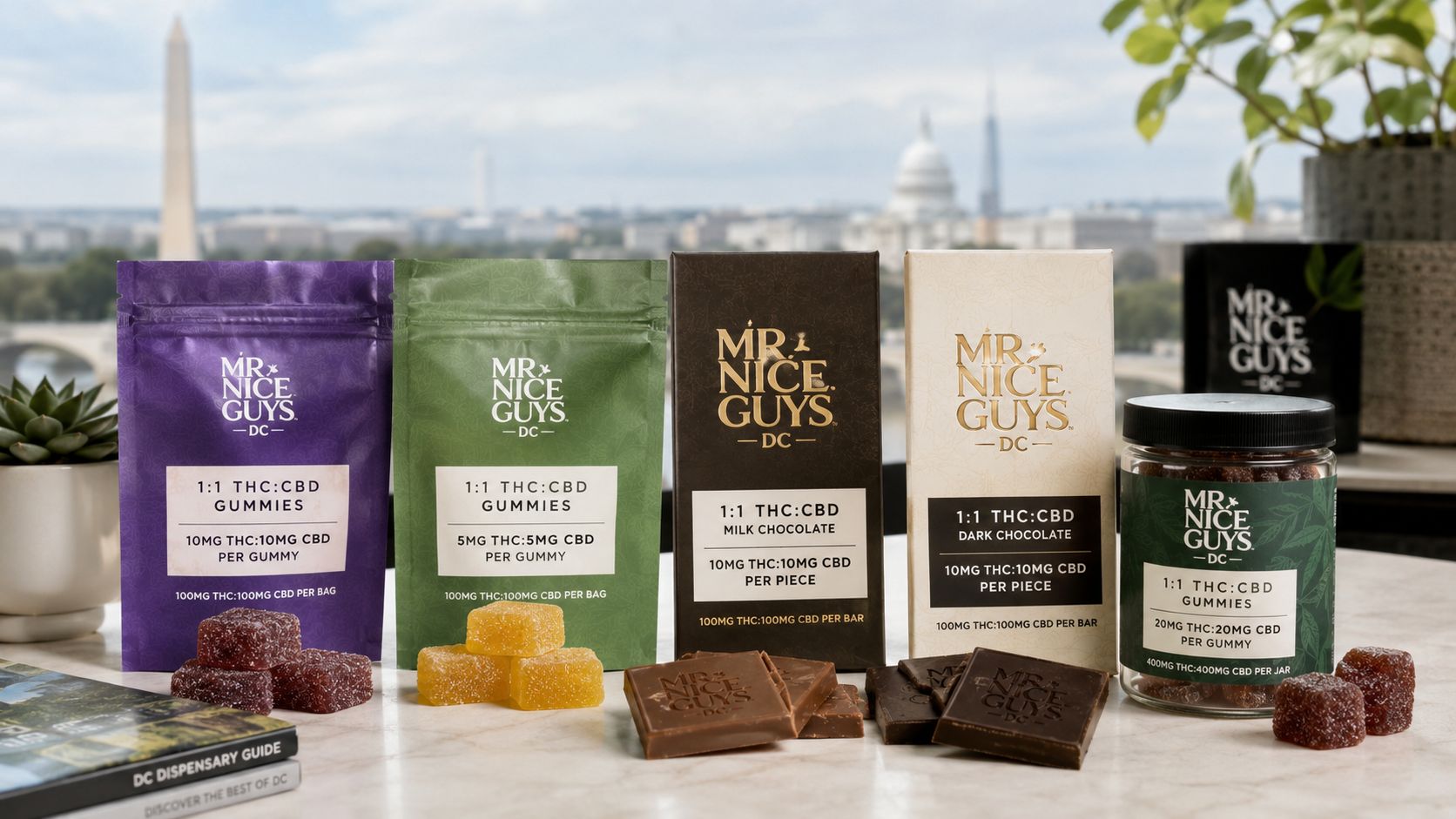
Why ratio matters more than patients expect
A 10 mg THC-only gummy and a 10 mg THC plus 10 mg CBD edible don't feel the same, even though the THC number matches. For many medical patients, the second product may feel more manageable and more functional.
That matters in real life. A patient treating evening anxiety may do poorly with THC-only edibles at a level that would be fine for someone using cannabis mainly for sleep. A patient treating pain may also prefer a ratio product because the goal isn't always maximum intoxication. Often it's symptom relief with less mental disruption.
A ratio product can change the practical dose, even when the THC milligrams on the label look identical.
Local planning and product selection
Commercial edible products are also shaped by legal-market standards. New York State, for example, limits adult-use edible packages to 100 mg of THC per package and 10 mg per individual serving, as noted in the Los Angeles Times dosage overview. Even if you're shopping in DC's medical context, those broader market conventions help explain why so many products cluster around standard serving sizes.
A practical DC approach looks like this:
- For anxiety-sensitive patients: Start with a lower THC amount and consider a 1:1 product rather than THC alone.
- For pain patients who need daytime function: Choose a low-dose serving and test it on a day without major obligations.
- For experienced evening users: A standard serving may still be too much if the ratio shifts toward THC-only.
If you're comparing compliant local options, where to buy edibles in DC is a useful starting point for checking formats, labels, and availability.
The biggest local advantage is access to labeled products that let you plan instead of guessing. For medical cannabis patients, that's the difference between dosing and gambling.
If you want help choosing a measured edible, comparing THC-only versus 1:1 options, or figuring out a realistic starting point, Mr. Nice Guys DC offers medical cannabis products with clear labeling for pickup, curbside, and delivery in Washington, DC.
Mr Nice Guys DC
At Mr. Nice Guys DC, we’re more than just a cannabis delivery service — we’re passionate advocates for quality, convenience, and community. With years of experience in the cannabis industry, our team is dedicated to educating and empowering customers across Washington, D.C. Whether you're a seasoned user or just starting your cannabis journey, our blog delivers trusted tips, product insights, and the latest updates from the world of weed. Stay informed, stay elevated.
