
Must Be 21 To Enter
By entering this site you are agreeing that you are at least 21 Years of Age or older.
I AM 21 OR OLDERHow to Microdose Edibles: A Practical DC Guide
.svg)

.png)
You're probably here because you want the benefits of cannabis without feeling glued to the couch, foggy in a meeting, or unexpectedly too high from “just half a gummy.” That's exactly where microdosing helps. The method is simple in theory: take a very small edible dose, stay below the point of obvious intoxication, and pay attention to how your body responds.
In practice, though, users often get tripped up by the same things. They buy the wrong product, cut it unevenly, redose too soon, or assume “nothing happened” when the dose was doing its job in a subtle way. Learning how to microdose edibles safely comes down to precision, patience, and using products that make low-dose use realistic.
Cannabis microdosing is no longer some fringe experiment. Cannabis is the most commonly microdosed substance in the United States, with about 9.4% of adults, or roughly 24.1 million people, reporting lifetime microdosing use in a national survey highlighted by UC San Diego. What matters for you is not the trend. It's getting your own dose right.
Finding Your Ideal Microdosing Product
A customer comes into Mr. Nice Guys DC with a common problem. They bought a 10 mg gummy somewhere else, tried cutting it into quarters on a plate, and ended up with one big chunk, two sticky scraps, and no real idea how much THC was in any piece. That is usually where microdosing goes off course. The product was wrong for the job before the first dose was even taken.
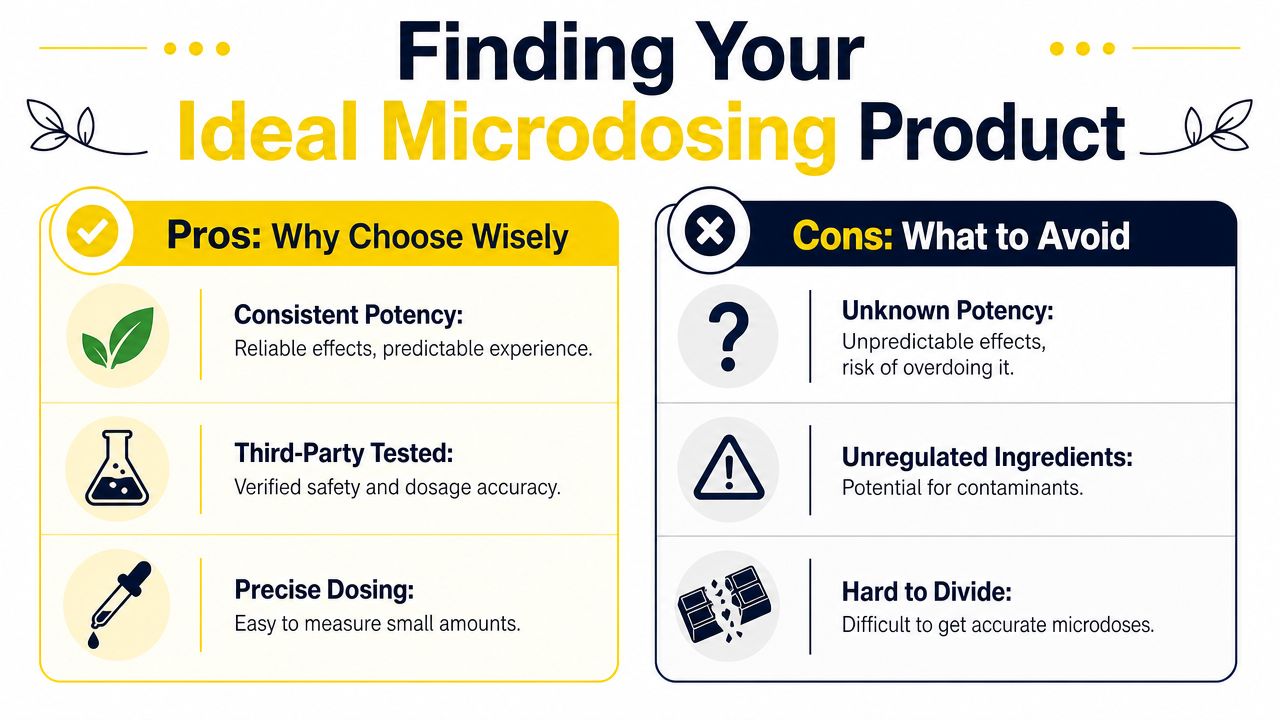
A good microdosing product should make low-dose use simple. Clear labeling matters. Repeatable serving sizes matter. A format that does not force you to play pharmacist with a kitchen knife matters just as much.
What to look for on the label
For microdosing, the easiest products usually land in the low-dose range per piece. A gummy or mint with 1 mg, 2.5 mg, or 5 mg per serving gives you far more control than a high-potency edible meant for someone chasing a heavy effect.
Check the label for three things right away:
- THC per piece. This tells you whether the product is workable for small-dose use.
- CBD content. Some people prefer a balanced ratio because it can feel less sharp or edgy than THC alone.
- Lab testing and batch information. You want a product with verified cannabinoid content, not vague packaging and guesswork.
CBD can play a useful role here. Conbud's microdosing overview notes that many consumers do better with a 1:1 THC:CBD ratio, especially if they want a gentler effect or are trying to avoid feeling overstimulated.
One practical rule from the sales floor. If you already know you are sensitive to THC, skip the “strongest gummy for the money” logic. Saving a few dollars up front is not worth a long, uncomfortable afternoon.
Products that work better than others
Some edible formats are easier to handle with precision.
| Product type | Good for microdosing | Why |
|---|---|---|
| Low-dose gummies | Yes | Easy to count by piece |
| Scored chocolate bars | Usually | Cleaner portions if the segments are uniform |
| Tinctures | Excellent | Best for precise, repeatable adjustments |
| Large single-dose gummies | Risky | Harder to divide accurately |
| Homemade edibles | Unpredictable | Potency can vary from bite to bite |
Tinctures deserve special mention. They are not always a first-timer's first choice, but they solve one of the biggest real-world problems with edibles. Precision. If a dropper is marked clearly and the bottle shows milligrams per milliliter, small adjustments are much easier than trying to split a soft gummy into equal pieces.
Low-dose gummies are still the most approachable option for many people. They are familiar, discreet, and easy to count. The catch is choosing gummies that are already dosed low enough to avoid awkward cutting.
If you are still comparing formats, this guide on choosing between edibles, vapes, and flower at Mr. Nice Guys DC gives a broader look at where edibles fit and why they require more patience than inhaled products.
A simple buying example
Say you want light daytime calm and enough control to stay functional. A 2.5 mg THC gummy with matching CBD is usually a cleaner buy than a 10 mg THC gummy that has to be cut into uneven pieces. The lower-dose product gives you a real serving size you can repeat. The stronger gummy gives you a math problem.
For someone with more experience, a 5 mg piece can still work well if the label is clear and the product is consistent from piece to piece. What usually fails is buying a novelty edible with a high THC load and trying to turn it into a precision tool at home.
At the shop, this is often the most useful guidance we give. Buy for the dose you need, not the dose you hope to carve down later.
Calculating Your Precise Starting Dose
Most microdosing mistakes happen in the math. Not because the math is hard, but because edibles make people casual. “I'll just take a corner” sounds harmless until that corner hits much harder than expected.
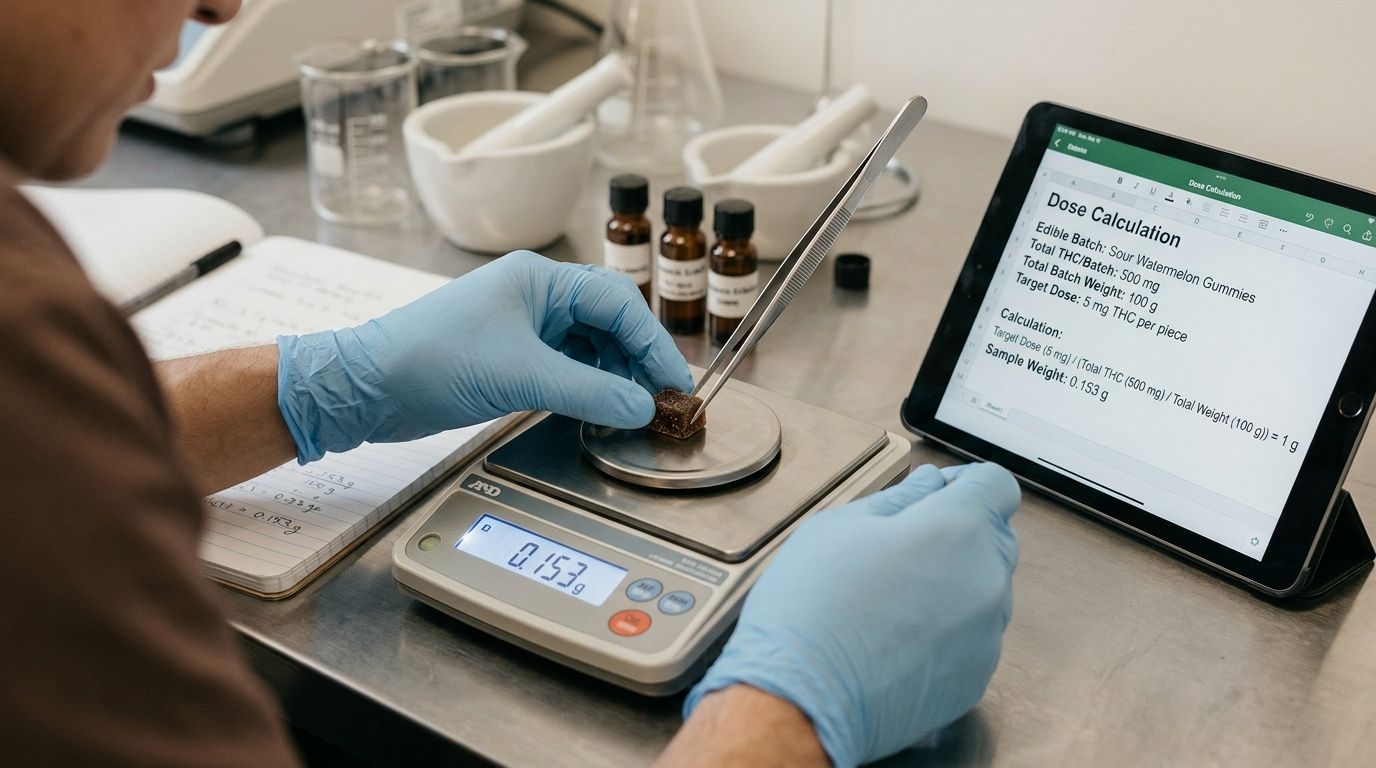
Start with the serving size, not the package size
Read the edible in this order:
- THC per piece
- Number of pieces
- THC in the whole package
That keeps you focused on what you'll consume.
For novice users, the recommended starting dose is 1 to 2 mg of THC, with increases made in 0.5 to 1 mg increments according to Mr. Moxey's guide to microdosing gummies. A practical example they give is starting with half of a 5 mg gummy to reach 2.5 mg, then adjusting gradually if needed.
The real problem with cutting gummies
Cutting sounds easy. It often isn't. Texture fights you. Sugary coating flakes off. Pieces don't match. Then there's a bigger, often overlooked issue. A 2025 industry report from Canopy Growth indicates that 38% of edibles have inconsistent THC distribution across servings, which means simple portion-splitting can be unreliable for precise microdosing, as noted by The Social Cannabis.
That matters a lot if you're turning one stronger edible into several smaller doses.
If you cut one gummy into four pieces, those four pieces may not behave exactly the same.
Here's a practical way to think about common products:
- A 5 mg gummy cut in half gives you two pieces that are easier to manage than tiny slivers from a stronger edible.
- A 10 mg gummy cut into quarters can work visually, but it's less reliable if the gummy isn't uniform.
- A tincture removes the cutting problem entirely and is often the cleanest choice for people who want repeatability.
Better ways to get accuracy
If the only edible available is stronger than your target dose, try one of these approaches:
- Choose scored products first. Chocolate bars with marked squares are often easier to portion than sticky gummies.
- Use tinctures for fine adjustments. They're especially useful when you want to move up in small steps instead of jumping from one full gummy to the next.
- Avoid random corner-biting. That's the fast path to inconsistent experiences.
For readers who want help converting package labels into usable doses, the edible dosage calculator is useful for checking your math before you take anything.
A short walkthrough can help if you're visual. Watch this before you start cutting products at home.
Your First Week A Safe Titration Protocol
You take a carefully cut gummy on Monday morning, feel nothing at 45 minutes, and start wondering if you measured it wrong. That moment is where many first-time microdosers overshoot. A good first week prevents that.
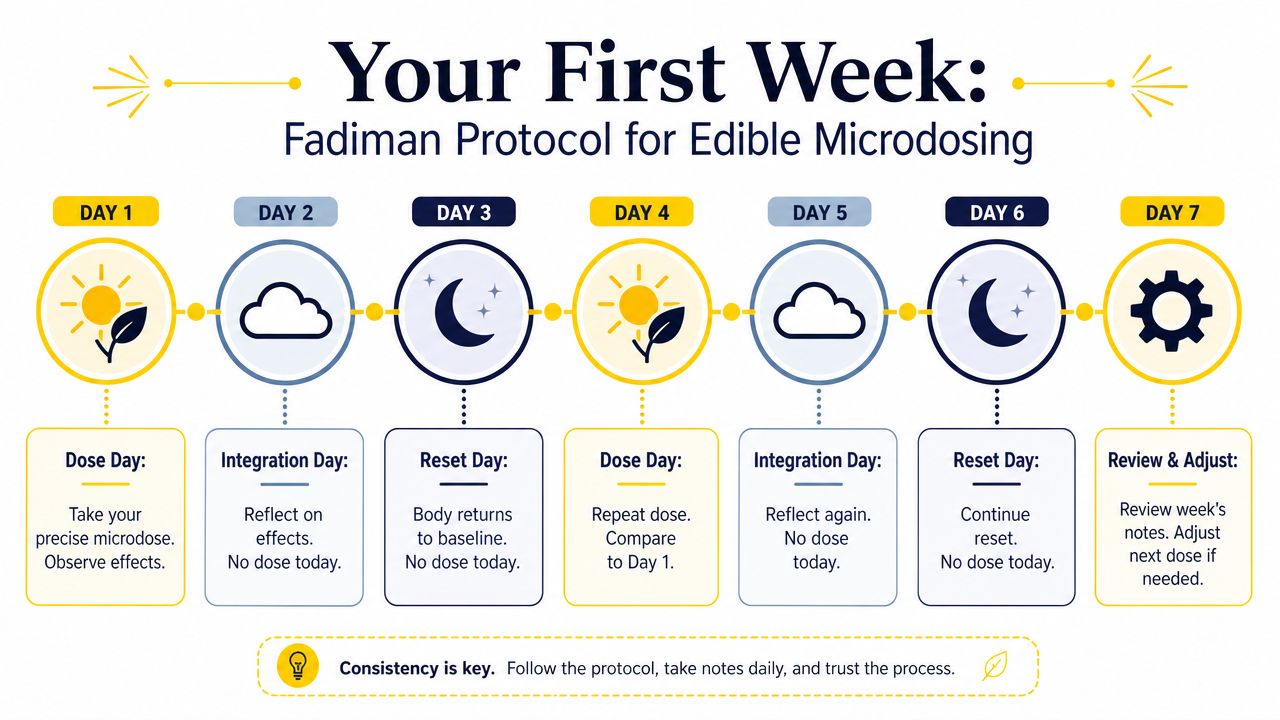
The goal for week one is consistency. Use the same product, keep the dose the same, and pick a dosing window you can observe. For many people, that means after breakfast on a day off, or in the early evening when there is no need to drive, work, or make fast decisions.
A simple first-week schedule
A common starting rhythm is one day on and two days off. VIIA Hemp's guide uses that pattern in its example of taking a low THC dose on Monday, then waiting until Thursday to repeat it. The spacing gives you a cleaner read on whether the dose helped, did nothing, or felt too strong.
A practical first week can look like this:
- Day 1, Monday: Take your planned low dose at a set time.
- Day 2, Tuesday: No dose. Pay attention to mood, tension, focus, and sleep.
- Day 3, Wednesday: No dose again. Keep the day ordinary if you can.
- Day 4, Thursday: Repeat the exact same product, dose, and timing.
- Day 5, Friday: No dose.
- Day 6, Saturday: No dose.
- Day 7, Sunday: Review the week before changing anything.
That pace can feel slow. Slow is useful here.
Hold the line on redosing
The hardest part of edible microdosing is waiting long enough. Effects often arrive gradually, and people who are used to inhaled cannabis can mistake that delay for a weak dose.
For week one, take one measured dose and leave it alone for the rest of that session. Do not stack another piece on top because the first hour felt quiet. If you started with a gummy you had to cut yourself, this matters even more. Uneven portions can turn a “small top-up” into a much bigger jump than intended.
A good rule in the shop and at home is simple. Dose once, then give the edible a full window to develop before you judge it. If you need help planning around work, errands, or sleep, this guide on how long edibles can last in your system and daily routine gives the timing in plain English.
What success looks like in week one
A productive first week is often uneventful. You might notice less body tension, a steadier mood, or easier wind-down at night. You also might notice very little. That does not mean the process failed.
At Mr. Nice Guys DC, one of the most common real-world problems we see is people changing three variables at once. They cut a different gummy, take it at a different time, then eat it on a different kind of day and try to judge the result. Keep week one tighter than that. One product. One dose. Two trial days.
If Monday felt clean and Thursday felt the same, you have a baseline. That is what you need before making any adjustment.
Tracking Effects and Refining Your Dose
By this point, the hard part is usually not taking the edible. It is reading the result accurately.
A lot of people get tripped up here for practical reasons, not because microdosing is complicated. A gummy was cut a little unevenly. Breakfast was heavier one day than the next. The dose felt calm at home but flat during a busy afternoon. If you want a dose you can trust, keep the setup boring for a little longer and track what happened.
Use a three-column journal
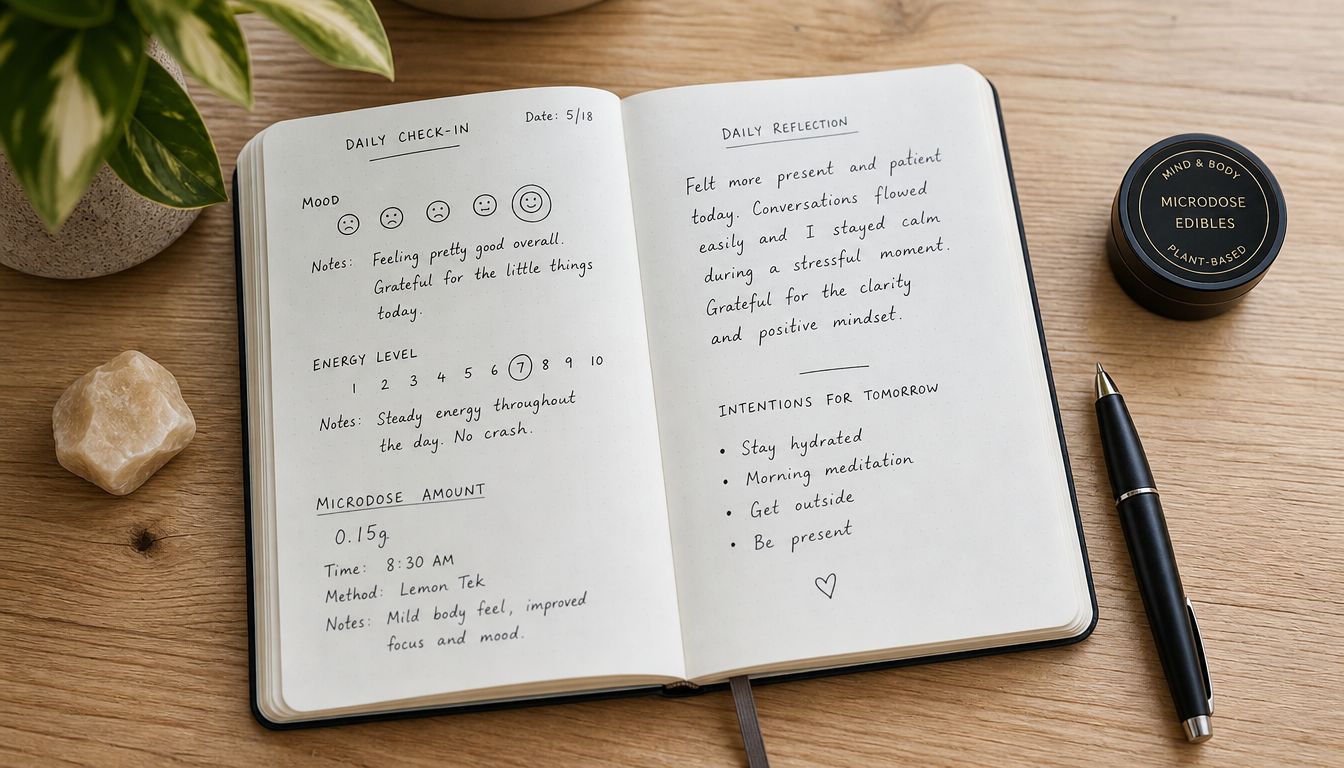
The simplest method is a three-column journal. Write down the dose and time, what you noticed, and anything that could have changed the experience, like food, stress, or setting. That is enough to spot patterns without turning the process into homework.
Your journal can look like this:
| Dose and time | Subjective response | Notes |
|---|---|---|
| 2.5 mg at 8:30 a.m. | Anxiety eased, focus felt steadier | No intoxication, slight dry mouth |
| 2.5 mg at 7:00 p.m. | Body relaxation, less mental chatter | Felt best after dinner |
| 5 mg at 8:30 a.m. | Too spacey for work | Dose likely too high for daytime |
At Mr. Nice Guys DC, this is one of the biggest real-world differences between someone who finds a reliable microdose and someone who keeps guessing. The people who write down a few notes usually figure out pretty quickly whether the issue is the amount, the timing, or the product itself.
If you are still experimenting with formats, start with accurately labeled options from a shop that can walk you through strengths and serving sizes. Our guide to where to buy edibles in DC with clearly labeled dose options can help narrow that down.
What subtle success actually looks like
A good microdose often feels quiet.
You may not get a clear “high” signal. You might just notice that your shoulders stay looser during your commute, your thoughts are less sticky, or a task that usually feels irritating is easier to finish. For many people, that is the target. Relief with function intact.
“I felt nothing” needs a little context. If your notes show less tension, less reactivity, or an easier evening routine, the dose may have done its job without obvious intoxication. If nothing improved and nothing changed across a few separate trials, that is more useful information than a strong sensation would be.
How to refine the dose without chasing it
Change one variable at a time.
- If the dose helped and you stayed clear-headed, keep it where it is.
- If the dose felt too soft across multiple test days, make a small increase next time.
- If you felt foggy, detached, or less social than you wanted, lower the dose.
- If the amount seemed right but the moment was wrong, keep the dose and change the hour.
Timing solves more problems than people expect. I have seen plenty of customers do poorly with a low dose before work, then do very well with that same amount after dinner. I have also seen the opposite. The dose was fine. The schedule was wrong.
One more practical note. If your starting product was a hand-cut gummy and your results seem inconsistent, the problem may be the piece, not your tolerance. That is a common issue in the shop. A precisely dosed edible gives you cleaner feedback, which makes refinement much easier.
Safety Legality and Sourcing in Washington DC
You get home, cut a gummy into quarters on the kitchen counter, and tell yourself each piece should be close enough. Then one night feels light, the next feels stronger, and now you are not sure whether the issue is your dose, the product, or your timing. In DC, safety starts with removing that kind of guesswork.
Low-dose THC still deserves respect. A microdose can be useful and still be the wrong fit for a given person, medication, or setting.
When to pause and ask a professional
Hold off and get personalized medical guidance first if you are pregnant, have a history of psychosis, or take medications that may interact with cannabinoids. The same caution applies if you have had strong anxiety, panic, or disorientation from cannabis in the past.
Storage matters just as much as dose. If children, roommates, or pets are in the home, keep edibles sealed, labeled, and stored like medicine. Products that look like candy cause problems fast when someone mistakes them for a snack.
Staying inside the useful dose range
For microdosing, the goal is a small, controlled effect that fits into real life. Once the dose gets high enough to make you foggy, sleepy, or mentally overstimulated, you are no longer getting clean feedback. You are just managing a stronger edible experience.
That is why I usually steer first-timers toward products that make precision easier, not products that require guesswork with a knife. Hand-cut gummies can work, but they are one of the biggest reasons people think microdosing is inconsistent. Uneven pieces produce uneven results. A low-dose edible with clear labeling, or a tincture with measured servings, gives you a much better shot at repeating the same experience on purpose.
Sourcing in Washington DC
Adults 21 and older in Washington, DC should buy from sources that clearly explain what the product is, how much THC is in each serving, and how the item is packaged. If a seller cannot answer basic dosing questions or the labeling is vague, that is a problem for anyone trying to microdose carefully.
If you are comparing options, this guide on where to buy edibles in DC gives a practical overview of formats and shopping considerations. Mr. Nice Guys DC is one local option where adults can browse low-dose edibles, tinctures, and other cannabis products with menu transparency, plus pickup, curbside, and delivery through the ordering system.
Start with the product that gives you the fewest variables. In practice, that simple choice prevents a lot of bad edible nights.
Frequently Asked Questions About Microdosing
What if I feel absolutely nothing
That can mean a few different things. The dose may be too low for your body, the timing may be off, or the effect may be subtle enough that you only notice it when you compare your day to a non-dose day. Look at your journal before you decide the dose failed.
If there was no benefit across repeated sessions, increase carefully rather than jumping to a full standard edible serving.
Can I microdose every day
Some people do, but many run into tolerance or lose the ability to tell what's helping. A structured rhythm tends to give cleaner feedback. If you want a schedule with more breathing room, the every-third-day model discussed earlier is a useful place to begin.
Is a tincture better than a gummy for microdosing
For precision, often yes. Tinctures make small adjustments easier and remove the problem of uneven cutting. Gummies are still convenient, especially when each piece is already low dose and clearly labeled.
A practical example: if you keep wishing your gummy was “just a little less” or “just a little more,” a tincture may fit your routine better.
What if I accidentally took too much
Don't panic. Slow things down. Hydrate, stay somewhere comfortable, and avoid stacking more cannabis on top of it. CBD-rich products may feel gentler for some people, but the main fix is time, rest, and not fighting the experience.
If you routinely feel too much from low doses, the answer is usually to lower the amount, choose a more balanced product, or stop cutting stronger edibles and switch to a format built for precision.
Can I microdose while taking other medications
That depends on the medication and your health history. Cannabis can interact with some medications, and it's worth checking before you experiment. If you want a starting point for that conversation, this medication compatibility check is a helpful screening resource.
What's the biggest mistake beginners make
Redosing too early is high on the list. So is treating all edibles like they're interchangeable. The best results usually come from boring consistency: same product, same dose, same timing, and good notes.
If you want help choosing a low-dose gummy, a balanced THC:CBD edible, or a tincture that's easier to measure, Mr. Nice Guys DC is a practical place to start. The menu and educational resources make it easier to compare formats, and if you're in DC, pickup, curbside, and delivery can simplify the process while you dial in a routine that stays gentle and predictable.
Mr Nice Guys DC
At Mr. Nice Guys DC, we’re more than just a cannabis delivery service — we’re passionate advocates for quality, convenience, and community. With years of experience in the cannabis industry, our team is dedicated to educating and empowering customers across Washington, D.C. Whether you're a seasoned user or just starting your cannabis journey, our blog delivers trusted tips, product insights, and the latest updates from the world of weed. Stay informed, stay elevated.
