
Must Be 21 To Enter
By entering this site you are agreeing that you are at least 21 Years of Age or older.
I AM 21 OR OLDERHow Long Do Edibles Last A Guide to Effects and Dosing
.svg)

.png)
Thinking about trying an edible? The first and most important question on anyone's mind is usually the simplest: how long is this going to last?
While everyone's experience is a little different, you can generally expect the effects to last anywhere from 4 to 12 hours. That’s a whole lot longer than smoking or vaping. Think of it less like a quick trip around the block and more like a cross-country road trip. For example, if you take an edible at 6 PM hoping for a fun evening, you might still feel its gentle effects when you wake up the next morning.
The Edible Experience from Start to Finish
Understanding how edibles work is all about mapping out the journey. Unlike smoking, where the effects hit you almost instantly, edibles take a much slower, more scenic route through your system. The whole thing unfolds in three distinct phases, each with its own timing and feeling.
Getting a handle on this timeline is the key to having a good time. It's what keeps you from making the classic rookie mistake: thinking it’s not working and taking a second dose way too soon. Knowing what's coming and when it's supposed to arrive puts you in the driver's seat.
Breaking Down the Three Phases
The entire edible journey can be split into three main parts: the onset, the peak, and the duration. Each one represents a different stage of how your body is processing the good stuff.
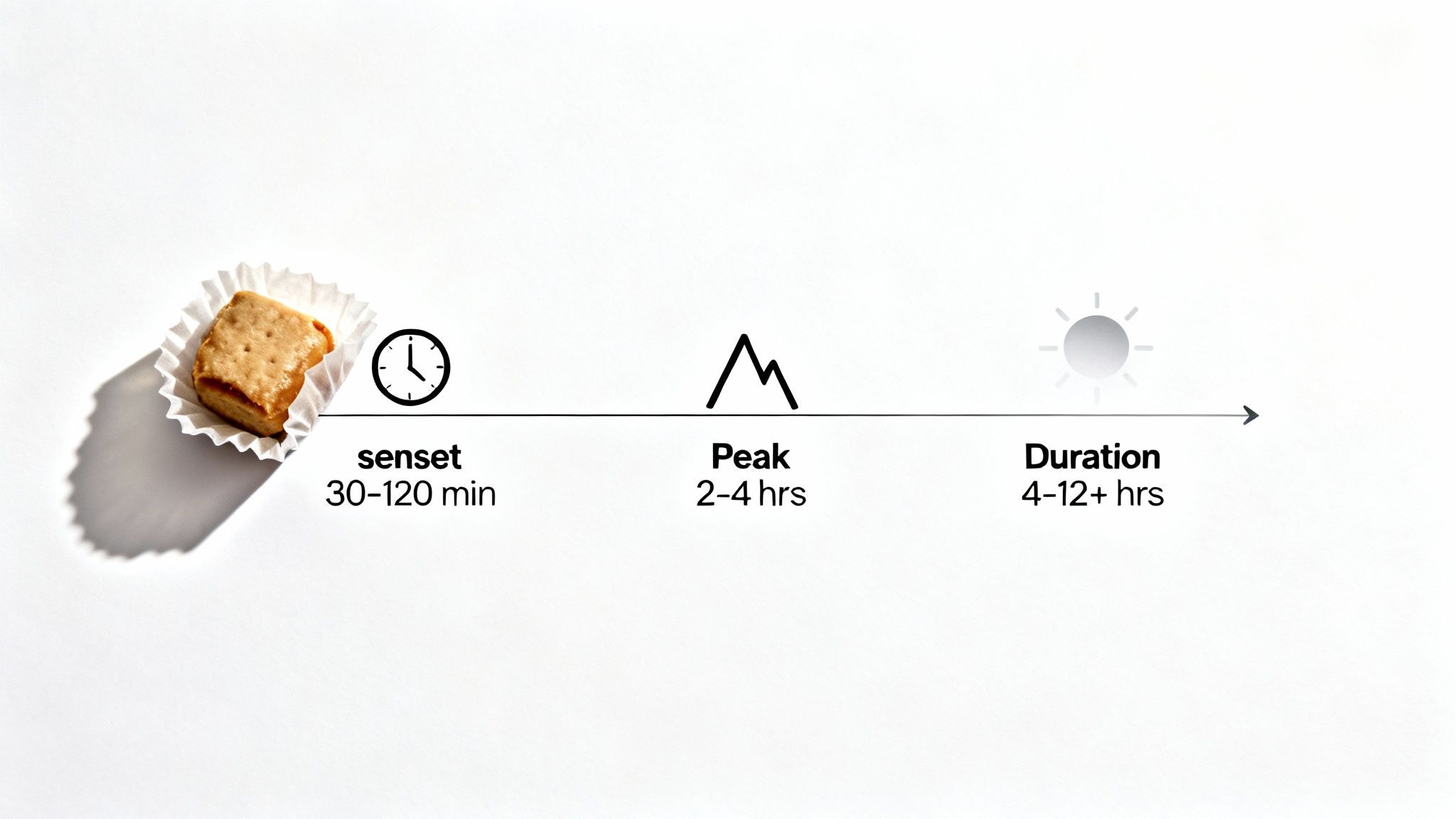
- The Onset (30-90 Minutes): This is the waiting game. After you eat your edible, it has to make its way through your digestive system before your liver metabolizes it. For example, you might eat a gummy after dinner and not feel a single thing for the first hour. This process can take anywhere from 30 minutes to two hours before you even start to feel the first hints of an effect.
- The Peak (2-4 Hours): Once things get going, the effects will slowly build up to their strongest point. You'll typically hit this peak about two to four hours after you first took the edible. This is when the experience will be at its most intense. So, if you took that gummy at 7 PM, you'd likely feel the strongest effects between 9 PM and 11 PM.
- The Duration (4-8+ Hours): After the peak, you're on the long, slow coast back to baseline. The effects will gently fade away over the next several hours. The total ride from an edible is way longer than other methods, lasting anywhere from 4 to 12 hours, and sometimes even longer depending on the dose and your own body.
This visual timeline gives you a great snapshot of what to expect, from the first bite to the final, gentle fade.

As you can see, the edible experience is a marathon, not a sprint. It starts slow, builds to a sustained peak, and then carries you through a long-lasting journey.
To make it even clearer, here’s a quick rundown of what a typical edible timeline looks like.
Typical Edible Effects Timeline
Remember, this is just a general guide. Your own experience could be a bit different.
How Long Edibles Stay In Your System
While the high itself lasts for hours, the story doesn't end there. The cannabinoids from edibles can hang around in your system for a lot longer.
For casual users, traces can be detected in urine for up to 3-4 days. If you’re a daily consumer, that window can stretch to 30 days or more. For instance, someone who enjoys a gummy every weekend might test positive a few days later, while a medical patient using edibles daily could test positive for a month after stopping. It's a crucial difference to keep in mind.
It’s also interesting to see how edibles stack up against other methods, like tinctures. While they're both ingested, tinctures can have a slightly different timeline. If you're curious about that, check out our guide on weed tincture effects.
Why Your Experience Is Different From Everyone Else
Ever wonder why the same 10mg gummy sends one friend to the moon while another barely feels a thing? The answer isn't in the edible itself—it's in you. Figuring out how long an edible will last is less about a universal clock and more about your own unique biological blueprint.
A whole bunch of variables come into play, making your experience deeply personal. From your body's internal engine to your history with cannabis, each factor can shift the timeline, intensity, and overall ride.
This is exactly why the "start low and go slow" mantra is so important. Once you get a handle on how these personal factors influence your journey, you gain the power to make smarter, safer, and more predictable choices every single time.
The Role of Your Body's Engine
Think of your metabolism as your body's engine. Some people have a high-performance engine that burns through fuel fast, while others have a more efficient, slow-burning motor. This same idea applies to how your body processes edibles.
Someone with a fast metabolism will likely process THC more quickly. For example, a marathon runner with a high metabolism might feel a gummy kick in after just 45 minutes and find the effects wear off in 5 hours. On the flip side, a person with a slower metabolism may have to wait longer for the effects to show up, but they could find that the journey lasts much longer, maybe 8 or 9 hours.
Your body composition—including things like weight and body fat percentage—also plays a big part. THC is fat-soluble, which means it binds to fat cells. Folks with a higher body fat percentage might store THC metabolites for longer, which can sometimes lead to a more drawn-out, slower-release experience.
Food Is a Major Factor
What you've eaten, and when you ate it, can dramatically change how long an edible lasts. Taking an edible on an empty stomach is like pouring gas right onto a fire. Your body absorbs the THC much faster, often leading to a quicker and more intense onset.
However, eating a meal before your edible, especially one rich in healthy fats, can change the game completely.
Key Insight: Healthy fats can act as a carrier for cannabinoids like THC, potentially boosting their absorption and bioavailability. This might not only make the effects feel stronger but could also extend their duration for a longer, smoother ride.
For instance, taking a gummy after a light salad is going to feel very different than taking it after a meal of salmon and avocado. The fats in the second meal can help your body process the THC more efficiently, leading to a more sustained journey. Understanding this helps you tailor your experience.
Your Personal Cannabis History
Your tolerance is one of the biggest players in your edible experience. If you're a regular cannabis user, your body has adapted to the presence of cannabinoids. This means you'll likely need a higher dose to get the effects you're looking for, and the duration might feel shorter compared to a newcomer.
Here’s a real-world example to spell it out:
- The Seasoned User: Sarah consumes cannabis several times a week. She takes a 10mg edible after a full dinner. She might start to feel mild, relaxing effects after about 90 minutes, with the experience lasting for a comfortable 4 to 6 hours.
- The Newcomer: Mark is trying an edible for the first time. He takes the exact same 10mg edible on an empty stomach. The effects could hit him much faster and more intensely, and the experience could easily last 8 hours or more.
This huge difference shows exactly why you can't base your dosage on someone else's experience. It's crucial to know your own tolerance level to get a good idea of how long edibles will last for you. This is also where knowing about different cannabinoids comes in handy. To learn more about how compounds like THC and CBD differ, check out our detailed guide comparing CBD vs THC.
How the Product Itself Shapes Your Journey
You wouldn't pick a two-seater sports car for a family camping trip, right? In the same way, you can't assume every edible will give you the same ride. The specific product you choose plays a huge part in how long the effects last and what the whole experience feels like. From fast-acting seltzers to classic baked goods, the format itself is the first thing to consider.
The difference isn't just about what's on the ingredient list; it’s about the science behind it. When you eat a traditional edible like a brownie, the THC takes a long trip through your digestive system and into your liver. Once it gets there, it’s converted into a different compound called 11-hydroxy-THC.
This new compound is way more potent and lasts much longer than the THC you get from smoking. This bit of metabolic magic is exactly why edibles feel so different and can stick around for hours, delivering a deep, full-body experience you just can't get any other way.
Comparing Different Edible Formats
The way an edible is made directly impacts how quickly you'll feel it and for how long. A cannabis-infused drink, for example, might use nanoemulsion technology. This breaks the THC down into microscopic, water-friendly particles that your body can absorb super fast, often right through the lining of your mouth and stomach.
On the other hand, a dense, fudgy brownie makes your digestive system put in some real work. The THC is locked up with fats and sugars, which means it takes a lot longer for your body to break it all down and get it into your bloodstream.
Let's break it down with a couple of real-world examples:
- Fast-Acting Seltzer: With one of these, you could start feeling the first whispers of an effect in just 15-20 minutes. The peak might hit within an hour, and the whole ride could be over in about 3-5 hours. This makes it a great choice for social events where you want a bit more control over your timing.
- Classic Gummy or Brownie: Patience is your best friend here. It can take 60-90 minutes to feel anything, and the effects will build slowly to a peak somewhere around the 2-4 hour mark. The total duration is usually much longer, often hanging around for a solid 6-10 hours.
Key Insight: A product's recipe determines its path through your body. Fast-acting options often take a shortcut, bypassing much of the digestive process for a quicker but shorter experience. Traditional edibles take the scenic route through the liver, resulting in a slower, longer-lasting journey.
Knowing this helps you pick the right tool for the job. You can get an even better sense of how different methods compare by checking out our deep dive into edibles vs. vapes vs. flower.
Beyond THC: The Entourage Effect in Edibles
The type of cannabis that goes into your edible also makes a big difference. It’s not just about how much THC is in there. Other cannabinoids and aromatic compounds, known as terpenes, all work together to create a unique vibe—a synergy that folks in the know call the "entourage effect."
An edible made from a sativa-dominant strain might have terpenes like limonene and pinene, which people often connect with uplifting and energetic feelings. For example, taking a sativa gummy could be just the ticket for a creative project or a lively get-together.
On the flip side, an edible made with an indica-dominant strain might be packed with myrcene, a terpene famous for its relaxing, almost sedative qualities. Other cannabinoids can tweak the experience even more:
- CBD (Cannabidiol): When CBD is part of the mix, it can help mellow out the intensity of the THC. This often leads to a less anxious, more clear-headed feeling.
- CBN (Cannabinol): Often called the "sleepy" cannabinoid, CBN is a go-to for its deeply calming effects. An edible with a good amount of CBN is a popular pick for anyone looking to unwind before hitting the hay.
By looking at the full cannabinoid and terpene profile on the label, you can move past just asking "how long do edibles last?" and start asking "what kind of experience am I looking for?" This knowledge gives you the power to choose a product that lines up perfectly with what you want, whether that's relief for a medical issue or just plain old recreational fun.
A Practical Guide to Safe and Smart Dosing
Navigating the world of edibles is all about having a solid game plan. The most important rule is simple, memorable, and absolutely non-negotiable: start low and go slow. This approach is your best defense against the classic rookie mistake—taking too much too soon—which can turn an anticipated good time into an overwhelming one.
This guide is your roadmap to finding the right dose. It’s designed to give you the confidence to manage your experience and stay comfortably in control from start to finish.
Understanding Dosage Levels
Not all doses are created equal, and what works for your buddy might be way too much for you. Edible doses are measured in milligrams (mg) of THC, the main psychoactive compound in cannabis. Getting familiar with these general tiers is the first step toward a positive experience.
By the way, if you've ever wondered about the difference between the THC in edibles and the THCA in flower, we break it all down in our guide on THCA vs THC for DC patients.
Here’s a quick breakdown of what to expect from different dosage levels:
- Microdose (1–2.5 mg THC): This is the perfect starting point for first-timers or anyone looking for mild relief without a significant high. Think gentle mood elevation and symptom management.
- Standard Dose (5 mg THC): Often considered a single serving, 5 mg can produce noticeable effects like euphoria and altered perception. Most regular consumers find this dose offers a balanced, enjoyable experience.
- Experienced Dose (10 mg+ THC): Doses of 10 mg and up are best left to those with a high tolerance. The effects can be very strong and last a long time, so definitely approach with caution.
The Patience Game: A Common Pitfall
One of the biggest mistakes newcomers make is getting impatient. It’s a classic story. Someone takes a 5 mg gummy, waits an hour, and feels nothing. Thinking it didn't work, they pop another 5 mg gummy. An hour later, the first dose finally kicks in, followed shortly by the second. Now they're dealing with the effects of 10 mg—a dose far more intense than they wanted that could last for hours.
Golden Rule of Edibles: Always wait at least two full hours before even thinking about taking a second dose. It can take that long for your body to fully process the first one. Redosing too early is the most common shortcut to a bad time.
This delay happens because the edible has to be digested and then metabolized by your liver before the effects hit. This process is much slower than smoking or vaping, so patience isn't just a virtue—it's a requirement.
How to Read a Product Label
Your best friend for smart dosing is the product label itself. Reputable dispensaries like Mr. Nice Guys DC only carry products that are lab-tested for consistency and safety, so you know what you’re getting.
When you look at a package, you'll typically find two key numbers:
- Total THC in Package: This tells you the total milligrams of THC in the entire product (e.g., 100 mg).
- THC per Serving: This breaks down the dose into individual pieces (e.g., 10 mg per gummy).
Always, always double-check the serving size. If a package has 100 mg of THC and 10 gummies, each one is 10 mg. If you’re a beginner, don't hesitate to cut that single gummy in half or even into quarters to get to a more comfortable 2.5–5 mg dose.
Recommended Edible Dosage Chart
To help you find your footing, we've put together this simple chart. Think of it as a starting guide to match your experience level with the kind of effects you're looking for.
Remember, this is just a guideline. Everyone's body is different, so use this as a reference and listen to how you feel. Your ideal dose is the one that makes you feel good.
How to Keep Your Edibles Fresh and Effective
When people ask "how long do edibles last," they're usually talking about the effects. But there's another side to that question: how long do they last on the shelf? Keeping your edibles fresh is key to making sure the last bite is just as potent and safe as the first. Think of cannabinoids like THC and CBD as delicate ingredients—if you don't store them right, they'll degrade over time.
Your edibles have three main enemies: light, heat, and air. When they're exposed to any of these, a process called oxidation kicks in. For example, leaving a chocolate bar on a sunny windowsill will not only melt it but will also degrade the THC inside, making it less potent. Good storage is your best defense.
Best Practices for Storing Different Edibles
You wouldn't keep ice cream in the pantry, right? The same logic applies here. Different edibles need different storage methods, and it usually comes down to the other ingredients in the product.
Here’s a quick rundown for some common goodies:
- Gummies and Hard Candies: These are pretty sturdy. Just toss them in an airtight container and stick them in a cool, dark spot like a cupboard or a drawer. This keeps humidity and light out, so they won’t get sticky or lose their kick.
- Chocolates and Baked Goods: Heat is the ultimate villain for these. To keep chocolate from melting and to protect the good stuff inside, the fridge is your best bet. For brownies and cookies, an airtight container is non-negotiable to keep them from getting stale. If you're into DIY, you can even make your own with our guide on canna-butter edibles.
- Beverages: Treat cannabis-infused drinks just like any other perishable beverage. Once you open it, keep it in the fridge and finish it within a few days.
The goal is always the same: create a stable environment that keeps the elements out.
Key Takeaway: Treat your edibles like high-quality food. The same rules that keep your groceries fresh—controlling temperature, light, and air—are exactly what you need to do to maintain the potency and safety of your cannabis products.
Understanding Edible Shelf Life
So, how long do you have before your edibles expire? With proper storage, you can really stretch their lifespan. Gummy edibles, for example, can easily last 6 months when kept in an airtight container away from light and heat. If you get them vacuum-sealed, some can even last up to 9-12 months.
Regulatory standards often put specific caps on this. Some guidelines limit gummies to 6 months and chocolate bars to 1 year, but only if the company can prove the potency drops by less than 10% and no microbial growth happens. Bad storage conditions—like humidity over 60% or temps above 77°F—can speed up cannabinoid breakdown by 25-50%.
Your best bet is to always check the package for a "best by" or expiration date. That’s your most reliable guide. When you shop with a trusted source like Mr. Nice Guys DC, you can feel confident that you’re getting fresh, properly labeled products every time.
Find Your Perfect Edible Experience at Mr. Nice Guys DC
So, how long do edibles really last? When you boil it all down, the answer is different for everyone. Your experience could be anywhere from 4 to 12 hours, and it’s all shaped by your own body, what you’ve eaten, and the product you chose. Smart, patient dosing isn't just a friendly tip—it's the secret to having a great time. Here at Mr. Nice Guys DC, we take all that info and help you find a predictable, perfect journey.
Our team is here to walk you through our curated lineup of premium, lab-tested edibles. We’ll help you match the right product and dose to the outcome you're looking for, making sure every experience is exactly what you wanted.
Your Trusted Partner in Cannabis Wellness
Whether you swing by our welcoming dispensary or use our easy delivery service, we make sure you get the education and quality you deserve. We’re big believers that an informed customer is a happy one, which is why we’ll gladly explain every last detail. Our crew can show you how to read product labels, understand lab results, and even check manufacturing dates for freshness and potency.
This focus on freshness is a big deal. Industry standards, which guide local best practices, typically give gummies a shelf life of around 6 months and chocolates about 1 year, as long as THC degradation is kept in check. Here in DC, after the recent medical cannabis expansions, dispensaries are reporting that 85% of their edibles fall within that 6 to 12-month window. That means you’re always getting something fresh and effective. You can read more about cannabis product shelf-life standards to see how these rules protect everyone.
At Mr. Nice Guys DC, our mission is to empower you with knowledge. We help you move beyond asking "how long do edibles last?" to confidently choosing an experience that perfectly suits your wellness and lifestyle needs.
Navigating Our Curated Selection
We keep things simple when it comes to finding the right edible for the right moment. Our experts can help you match a product to your specific goals.
- For Long-Lasting Relief: Need something that will keep working all day or night? For example, someone dealing with chronic pain might choose a classic brownie to get steady relief that lasts for 8 hours.
- For Social Engagement: Looking for a quicker onset and a shorter, more controllable vibe for a party? We can show you fast-acting drinks or lozenges that are perfect for socializing without committing to a full-day experience.
- For Rest and Relaxation: If you’re just trying to unwind and get a solid night’s sleep, we'll guide you to products with calming cannabinoids like CBN. Many people find a CBN-infused gummy taken an hour before bed is the perfect way to drift off.
Let us be your go-to partner in the world of cannabis edibles. From your first question to your final purchase, the Mr. Nice Guys DC team is here to make sure you leave with confidence, quality products, and the know-how to enjoy them safely.
Got Questions About Edibles? We’ve Got Answers.
Jumping into the world of edibles can bring up a few questions. It's totally normal. To make sure you feel confident and ready, we’ve put together answers to some of the most common things people wonder about when they’re figuring out how long edibles last and what to expect.
What Should I Do If I Take Too Much of an Edible?
First thing's first: don't panic. Remind yourself that the intense feeling is only temporary and it will pass. The best thing you can do is find a calm, safe place to chill out, keep some water handy, and maybe have a light snack. Some folks also say that CBD can help take the edge off the anxiety that sometimes comes with too much THC.
For example, if you start feeling overwhelmed, put on a movie you love, sip some water, and just tell yourself that the effects are already starting to fade. Whatever you do, never get behind the wheel or operate any kind of machinery if you feel too high.
Can I Fail a Drug Test From a Single Edible?
Yes, you absolutely can. Even though the high is gone in a few hours, the THC metabolites that drug tests are looking for get stored in your body's fat cells. They can hang around and stay detectable for several days or even longer, even from just one edible.
For someone who rarely partakes, THC from a single edible might show up in a urine test for up to 3-4 days. But for regular users, that window can stretch out to 30 days or more. If you're subject to drug testing, your safest bet is to steer clear of edibles altogether.
Do Edibles Show Up Differently on Drug Tests?
They sure do, and the way your body processes them is the reason why. When you eat cannabis, your liver converts the THC into a different kind of metabolite—one that’s much better at sticking to fat cells compared to the kind produced when you smoke.
This unique metabolic path means THC from edibles can be detectable in your system for a longer stretch of time compared to the same dose from smoking. It definitely increases the odds of a positive test, even long after you’ve come down from the high.
Ready to check out a curated menu of premium, lab-tested edibles with guidance from a team you can actually trust? The crew at Mr. Nice Guys DC is here to help you find exactly what you're looking for. Swing by the shop or check out our menu online for easy pickup and delivery.
Mr Nice Guys DC
At Mr. Nice Guys DC, we’re more than just a cannabis delivery service — we’re passionate advocates for quality, convenience, and community. With years of experience in the cannabis industry, our team is dedicated to educating and empowering customers across Washington, D.C. Whether you're a seasoned user or just starting your cannabis journey, our blog delivers trusted tips, product insights, and the latest updates from the world of weed. Stay informed, stay elevated.
