
Must Be 21 To Enter
By entering this site you are agreeing that you are at least 21 Years of Age or older.
I AM 21 OR OLDERProduct Testing Standards for Cannabis Patients
.svg)

.png)
You're at a Washington, DC dispensary counter, comparing two flower jars that list similar THC percentages. One costs more, one has a different batch number, and both appear polished on the shelf. As a first-time patient, you might reasonably ask, what proves either product is safe, accurately labeled, or consistent from one jar to the next?
That proof begins with product testing standards. A laboratory report doesn't tell you everything about how cannabis will feel, but it can show whether the batch was measured, screened, and documented under a controlled process. The most useful skill isn't memorizing every laboratory term. It's learning how to connect the product in your hand with the correct batch report, the correct contaminant panel, and the correct safety limits for the way you'll use it.
What Product Testing Standards Actually Do for Patients
Product testing standards are the laboratory benchmarks a cannabis batch must meet before sale. They cover cannabinoid accuracy, contaminant screening, sampling, laboratory competence, and documentation. In practical terms, they create a checkpoint between what a cultivator or manufacturer claims and what an independent laboratory can verify.
For a patient, that checkpoint protects against three everyday problems:
- Unpredictable strength: Potency testing measures cannabinoids so the THC and CBD listed on the label have a defensible relationship to the contents. That matters when you're trying to take a consistent amount, especially with edibles or tinctures.
- Hidden contaminants: Screening looks for substances that may be unsafe to inhale or ingest, including pesticides, heavy metals, residual solvents, microbes, and mycotoxins.
- Weak accountability: A batch number connects a physical product to a specific Certificate of Analysis, or COA. If a problem appears later, regulators can trace the product, distributors can identify affected inventory, and patients have a document they can review.
The international framework behind laboratory credibility is ISO/IEC 17025, the core standard for testing and calibration laboratory competence. ISO explains that the standard was first published in 1999, revised in 2005, and updated again in 2017 as technology and market conditions changed. Its requirements address laboratory competence, consistent method execution, and technically valid results, which are central to credible compliance programs across borders and industries. You can review the standard's evolution on ISO's overview of ISO/IEC 17025.
The jar, the report, and the patient
Suppose a flower package shows batch code DC-FL-042. The COA should identify that same code, along with the product type, laboratory, testing date, and results. A report for a different batch, even from the same strain and producer, doesn't establish what's inside the package you're holding.
Practical rule: A passing COA belongs to a specific tested sample and batch. It isn't a blanket approval for every product made by the same brand.
Testing therefore works as a bridge between a producer's claim and your lived experience. It can't promise that a strain will be right for your symptoms, but it can make the product's measurable qualities more transparent and its safety record easier to audit.
The Six Lab Tests Every Cannabis Product Should Pass
A cannabis COA can contain several sections, but patients can organize the information into six core testing categories. Each one addresses a different risk, so a strong result in one category can't replace a missing result in another.
Potency testing
Potency testing measures THC, CBD, and sometimes minor cannabinoids. Laboratories commonly use high-performance liquid chromatography, or HPLC, because it can measure cannabinoids without relying on heat that may change the compounds during analysis. The practical question is whether the label reflects the tested material closely enough for responsible dosing.
A flower label might emphasize total THC, while an edible may list milligrams per serving or package. Read the result in the same format as the label, and remember that a high number isn't automatically a better therapeutic choice.
Pesticide screening
Pesticide panels look for agricultural residues that can remain after cultivation. The panel may include compounds associated with insect or fungal control, including organophosphate and pyrethroid categories. Action limits vary by jurisdiction and route of administration, so “tested for pesticides” is incomplete unless you can see which compounds were included and what limits applied.
Heavy metals
Cannabis plants can absorb elements from soil, water, growing media, or nutrients. A heavy-metals panel commonly examines arsenic, cadmium, lead, and mercury. A dedicated explanation of heavy-metal testing in cannabis can help patients understand why these results deserve separate attention rather than being treated as a footnote.
Residual solvents
Concentrates and extracted products may contain traces of processing solvents. Testing can identify residues such as butane, propane, and ethanol. A solvent result matters most when you're buying a vape, cartridge, dab product, or another extract, because flower hasn't undergone the same extraction process.
Microbial testing
Microbial analysis looks for unwanted biological growth, including yeast, mold, and bacteria such as Salmonella and E. coli. Humid cultivation and poor storage can create conditions that support contamination. Patients with respiratory vulnerabilities or weakened immune systems should take these results seriously.
Mycotoxin screening
Some molds can produce toxic compounds called mycotoxins. Screening for substances such as aflatoxins and ochratoxin adds a layer of protection that a basic visual inspection can't provide. Moldy-looking flower should never be used, but clean appearance alone doesn't establish a passing laboratory result.
| Test | Targets | Patient risk | Common method |
|---|---|---|---|
| Potency | THC, CBD, minor cannabinoids | Unexpected strength or dosing | HPLC |
| Pesticides | Agricultural residues | Exposure to unsafe cultivation chemicals | Chromatographic analysis |
| Heavy metals | Arsenic, cadmium, lead, mercury | Elemental contamination | Elemental analysis |
| Residual solvents | Butane, propane, ethanol | Inhaling or ingesting extraction residues | Chromatographic analysis |
| Microbial | Yeast, mold, Salmonella, E. coli | Infection or respiratory exposure | Culture or molecular methods |
| Mycotoxins | Aflatoxins, ochratoxin | Exposure to toxic mold byproducts | Specialized chemical analysis |
How Federal, State, and DC Rules Shape the System
Cannabis testing operates inside a layered regulatory system. Federal cannabis policy doesn't provide one uniform testing mandate for every state medical or adult-use program, so state and district regulators establish their own laboratory requirements, sampling rules, contaminant panels, and action limits. Hemp-derived products can fall under different federal oversight, which is one reason a product sold in one channel may not follow the same testing pathway as a product sold through a regulated cannabis program.
The shared laboratory language is often ISO/IEC 17025. ISO describes it as the international standard for testing and calibration laboratories, with requirements related to competence, impartiality, and consistent operation. The standard also applies to standard, non-standard, and laboratory-developed methods, including sampling, as outlined in ISO's standard description.
Why local rules matter in the DMV
Washington, DC's medical cannabis program is administered through the Alcoholic Beverage and Cannabis Administration, or ABCA. DC patients should expect regulated products to carry the required registration or compliance markings and should be able to review a current COA associated with the product's batch. The district's requirements don't necessarily match those in nearby Maryland or Virginia, even though patients may shop across the same metropolitan area.
That difference can affect:
- Which contaminants a laboratory must test.
- How low the laboratory must be able to measure a contaminant.
- How samples are selected from a batch.
- Which laboratories may perform regulated testing.
- Which action limits apply to flower, vapes, edibles, or tinctures.
A helpful overview of the local framework is how Washington, DC regulates medical cannabis dispensaries. Use it as a starting point, then verify the current requirements through official district resources because regulations and administrative procedures can change.
The importance of sampling
A lab can only analyze the sample it receives. ISO/IEC 17025:2017 includes sampling within laboratory activities and requires a sampling plan and method designed to preserve valid results. The ISO 2017 revision publication explains why controlling the sample's identity, handling, storage, and chain of custody matters alongside the analytical instrument.
That's why batch-level documentation matters to a DC patient. A COA should identify the material tested, the batch, the lab, and the methods or panels used. A report that lacks those connections gives you less confidence, even if it displays an attractive potency number.
Reading a Certificate of Analysis Without Getting Lost
A COA can look like a wall of abbreviations, but you don't need advanced chemistry to use it. Read it in a fixed order, just as you'd check a prescription label before taking medication.
Start with the identity block
Look at the header first. Confirm the laboratory name, batch or lot ID, test date, product matrix, and product description. The matrix tells you what the lab tested, such as flower, concentrate, vape oil, edible, or tincture.
If the package says “Blue Dream flower” but the COA identifies a vape oil, stop there. You're looking at the wrong report, regardless of how professional the document appears.
Check potency against the label
Next, compare the THC and CBD values with the package claim. The planned comparison should use the applicable tolerance, including the 10% label-claim range described for the purchasing example. A package listing 20% THC should be compared with a result that remains within the permitted range, not with a different product's result or a broad marketing phrase such as “high potency.”
For a deeper explanation of cannabinoid measurement, see cannabis potency testing. Potency is useful for dose planning, but it doesn't tell you whether the product passed pesticides, microbes, solvents, or metals.
Read contaminants by type
Organize the rest of the report into three groups:
- Chemical: Pesticides and residual solvents.
- Biological: Microbial counts, yeast, mold, and mycotoxins.
- Elemental: Heavy metals such as arsenic, cadmium, lead, and mercury.
Pay attention to the language. Not Detected, or ND, usually means the laboratory did not detect the compound above its stated detection capability. It doesn't mean the substance has been proven absent at every possible concentration. Pass means the reported result met the applicable action level, even if a measurable amount was present.
A practical vape example
Suppose a vape COA reports 82.4% total cannabinoids, ND for residual solvents, and 0.8 ppm yeast and mold against a 10 ppm action threshold. The first result helps you compare the cartridge with its label. ND suggests the solvent result was below the laboratory's reporting threshold. The yeast and mold result is measurable, but it remains below the stated limit.
Don't treat that example as a universal pass standard. Limits depend on the product, jurisdiction, route, method, and sample. The checklist is simple: match the batch, confirm the matrix, compare potency, then read every required contaminant panel.
Why Inhalation and Oral Products Use Different Limits
A vape and an edible may contain similar cannabinoids, but your body receives them through different routes. Regulators therefore may apply different action levels to the same contaminant. A limit designed for inhalation reflects direct exposure to the lungs, while an oral limit reflects digestion and metabolism.
Solvents show the difference clearly. Under the inhalation guidance described in the product framework, limits can be around 50 ppm for butane or 100 ppm for ethanol, while oral products may allow limits in the thousands of ppm because the digestive system handles residues differently. Those figures should be read as route-specific guidance, not as a universal cannabis rule.
Heavy metals also vary by route. Inhaled products can carry single-digit microgram daily limits for chromium, copper, nickel, and zinc, while oral products may allow substantially higher amounts. Maryland's 2025 technical authority illustrates route-based distinctions, and Minnesota's 2025 standards similarly separate heavy-metal limits and require product-specific testing. The Maryland technical authority document provides a useful example of why patients shouldn't assume every COA uses one universal threshold.
| Contaminant | Inhalation limit | Oral limit | Why the difference |
|---|---|---|---|
| Butane | Around 50 ppm in the cited inhalation guidance | May be much higher under oral guidance | Direct lung exposure differs from digestion |
| Ethanol | Around 100 ppm in the cited inhalation guidance | May reach the thousands of ppm under oral guidance | The body processes the residue through a different route |
| Certain heavy metals | Single-digit microgram daily limits may apply | Higher allowances may apply | Route-specific exposure assessment changes the action level |
A clean vape COA doesn't clear an edible. The reports must match the product category and intended route. Before buying a cartridge, review the guidance on vape cartridges and pens, then confirm that the actual report covers the product in front of you.
How Mr. Nice Guys DC Vets Products Before They Hit the Shelf
A dispensary's quality habits should make the laboratory record useful at the point of purchase. Mr. Nice Guys DC describes a workflow centered on matching product documentation to the exact inventory being offered, rather than relying on a brand name or a general statement that a product was tested.
That process includes several practical checks:
- Batch matching: Staff verify that each product carries a current COA from an ISO/IEC 17025-accredited laboratory and that the report's batch ID matches the package on the shelf.
- Potency review: Products with potency outside the permitted label range are flagged rather than treated as close enough.
- Concentrate screening: Staff confirm that concentrates and vape products include residual-solvent results, even when oral products may have looser solvent limits.
- Route-specific metals review: Heavy-metal panels are checked against the applicable inhalation or oral framework instead of applying one threshold to every format.
- Microbial attention: Inhaled flower is reviewed for microbial counts above the applicable threshold, including the stated 100 CFU/g flag used in the described quality practice.
The team also cross-checks pesticide panels against the current DC list and uses staff retraining to keep explanations consistent. Patients benefit when a budtender can explain not only that a product passed, but also which batch was tested and which route-specific limits applied.
You can compare the available formats, including flower, edibles, cartridges, concentrates, tinctures, and topicals, through the cannabis products available at Mr. Nice Guys DC. The same habit applies at any regulated dispensary: ask to see the report that belongs to the item you're considering.
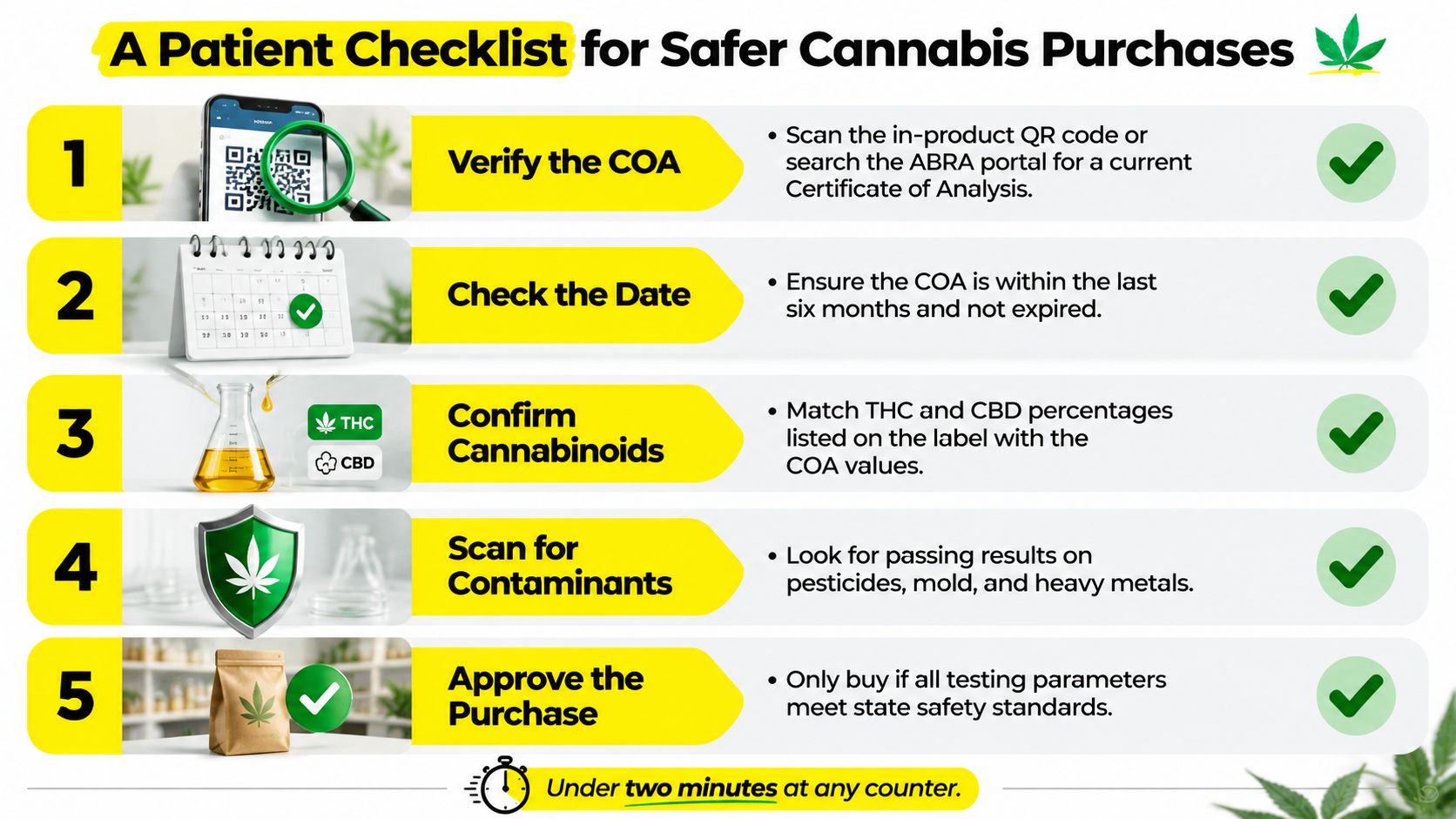
A Patient Checklist for Safer Cannabis Purchases
You can make a meaningful COA check in about two minutes. Treat it as a routine, not a test you perform only when a product looks suspicious.
- Verify the COA. Scan the product's QR code or search the applicable ABRA portal for a current report.
- Check the date. Confirm the report is current and hasn't expired.
- Match the batch. Compare the package lot number with the COA exactly.
- Confirm the panel. Make sure the report covers the product type, potency, pesticides, microbes, mycotoxins, solvents, and heavy metals where applicable.
- Ask before purchasing. If anything is unclear, pause and ask the staff member to explain the result.
Ask the budtender which laboratory ran the panel, when the batch was harvested compared with when it was tested, and whether the product was remediated. Remediation can change how you interpret the history of a product, so a clear answer is better than an assumption.
Watch for missing or expired COAs, vague potency ranges, absent contaminant details, and staff who can't name the testing laboratory. Terpene information can help you compare products, but it shouldn't distract from required safety data. Consistent questions keep dispensaries accountable and help you make decisions based on the actual product, not just the front label.
Clearing Up Common Testing Misconceptions
“Organic means it was fully tested.” Organic growing claims and laboratory contaminant screening aren't the same thing. A product still needs a pesticide panel and the other applicable tests documented on its COA.
“Higher THC is always better.” Potency tells you concentration, not whether the product fits your tolerance, symptoms, or preferred experience. A lower-potency product with a clearer dosing plan may be more useful for a first-time patient than a stronger option.
“If it's on the shelf, it passed every test.” Shelf placement reflects a dispensary's compliance process, but you should still verify the current batch report. A COA for another lot doesn't prove the package in your hand was covered.
“Flower and edibles use identical limits.” They don't necessarily. Inhaled and oral products can have different action levels because exposure routes change the risk assessment. Compare the COA with the intended route instead of transferring a passing result from one format to another.
“ND means zero.” Not Detected means the result was below the laboratory's stated detection or reporting capability. Read the limit of quantitation or detection information when it's provided, especially for pesticide and solvent panels.
A COA is a patient tool, not decoration. Match the batch, check the test date, identify the laboratory, review the complete contaminant panel, and ask how the route of administration affects the limits. Those small habits give you a clearer basis for choosing medical cannabis and encourage dispensaries to explain their standards openly.
Mr. Nice Guys DC offers batch-specific product guidance, current cannabis formats, and staff support for patients comparing flower, vapes, edibles, concentrates, tinctures, and other options. Visit Mr. Nice Guys DC to review available products, ask COA questions, and choose a compliant purchase with more confidence.
Mr Nice Guys DC
At Mr. Nice Guys DC, we’re more than just a cannabis delivery service — we’re passionate advocates for quality, convenience, and community. With years of experience in the cannabis industry, our team is dedicated to educating and empowering customers across Washington, D.C. Whether you're a seasoned user or just starting your cannabis journey, our blog delivers trusted tips, product insights, and the latest updates from the world of weed. Stay informed, stay elevated.
