
Must Be 21 To Enter
By entering this site you are agreeing that you are at least 21 Years of Age or older.
I AM 21 OR OLDERHeavy Metal Testing in Cannabis: What Patients Need to Know
.svg)

.png)
You're standing at a dispensary counter with a COA open on your phone. The cannabinoid numbers are easy enough to spot, but then you reach the heavy metal panel and see abbreviations, detection limits, and unfamiliar units. Most patients skim past that section because it looks like chemistry homework.
That's a mistake, especially when you're choosing between a vape and an edible. Heavy metal testing connects the product in your hand to the soil, water, air, extraction process, and route of administration that shape its safety. Once you know how to read the panel, the COA becomes less like paperwork and more like a practical shopping tool.
What Heavy Metal Testing Really Means for the Patient Holding the Bag
The patient pauses at the counter, COA in hand, trying to decide whether “ND,” “LOQ,” and “pass” mean the same thing. They don't. The heavy-metal section answers a simple question: did the finished cannabis product contain measurable amounts of regulated contaminants, and did those amounts stay below the limit for the way the product will be used?
Cannabis can absorb substances from its growing environment. Soil, irrigation water, dust, fertilizers, and nearby industrial residues can all matter. The plant may look clean, smell fresh, and have attractive trichomes while still requiring laboratory analysis to detect contamination. Human senses aren't analytical instruments.
A useful comparison is a nutrition label. You can't judge a snack's sodium or protein content by looking at the package, and you can't judge a cannabis product's heavy-metal status by looking at the flower. The COA turns an invisible risk into a documented result.
Practical rule: Read the heavy-metal rows before you get distracted by potency, strain names, or flavor notes.
That panel protects more than the original flower. If contaminated plant material becomes trim, rosin, oil, or another concentrate, the finished format still needs appropriate testing. A regulated product should arrive with a batch-specific record that lets you connect the package to its laboratory results, rather than asking you to trust appearance or advertising.
For patients learning how cannabis is grown, processed, and selected, the cannabis education resource library can provide useful background. At the counter, the immediate habit is simpler: find the product's batch number, open the matching COA, and inspect the heavy-metal panel.
How Metals End Up in Cannabis in the First Place
Heavy metals are elements that can harm health when exposure becomes significant. Cannabis laboratories commonly check lead, arsenic, cadmium, and mercury, often listed on a COA by their symbols, Pb, As, Cd, and Hg.
Cannabis absorbs these metals through two main pathways: root uptake from soil and water, and surface deposition from airborne dust. Roots draw in water and dissolved substances from the growing medium. Leaves and flowers can collect particles that settle on their surfaces, so contamination may begin below ground or arrive through the air.
The plant also needs nutrients. Biological processes that help roots absorb useful elements can carry unwanted ones along when soil or irrigation water contains them. A clean-looking growing medium does not confirm a clean harvest. That is why the laboratory result matters more than appearance when a patient reviews the heavy-metal line on a COA.
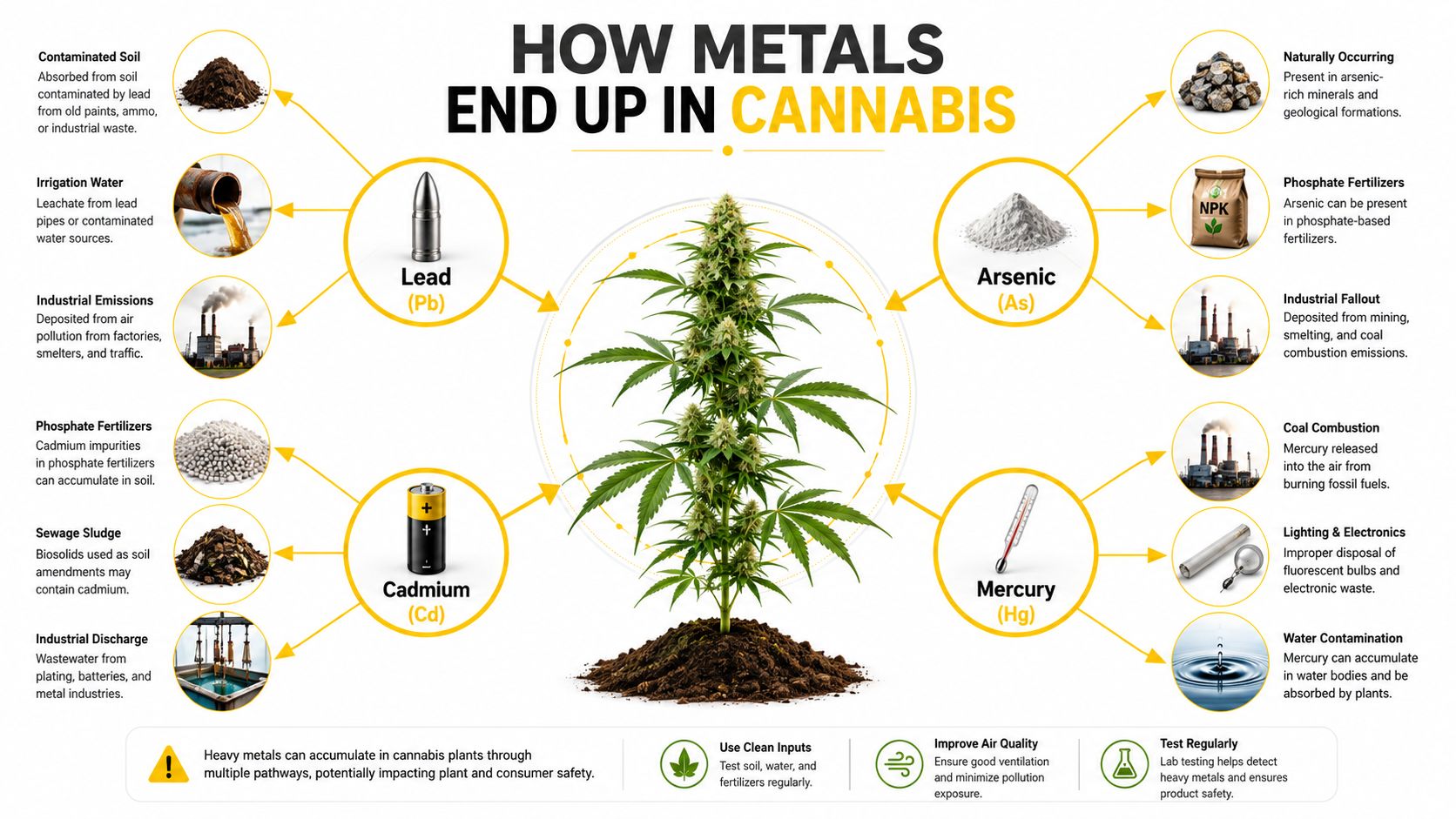
Four metals and their possible paths
- Lead, or Pb: Lead can enter a growing environment through legacy soil contamination, dust, plumbing, or nearby human activity. Urban cultivation sites may require closer attention because earlier land uses can leave residues.
- Arsenic, or As: Arsenic may come from contaminated soil or water, as well as industrial emissions. A patient cannot identify it by smell, color, or appearance.
- Cadmium, or Cd: Cadmium can accompany certain phosphate fertilizers and move into plants through the root zone. Repeated inputs may change the growing medium over time.
- Mercury, or Hg: Mercury may reach soil or air through industrial activity and environmental deposition. Testing must distinguish a very small measured result from a non-detect.
Processing can change how concentrated contaminants are in the material being tested. An extract or vape oil contains a denser portion of the original plant chemistry, so clean-looking flower does not establish that the finished product meets the appropriate limit for inhalation. Route-specific limits explain why a vape and an edible may be evaluated differently. The finished product needs its own appropriate laboratory record.
Inside the Lab and How ICP-MS Catches What the Eye Cannot
Before an instrument measures anything, the laboratory must establish what arrived and whether the tested portion represents the product. Personnel identify the sample, record its batch information, document the chain of custody, and homogenize the material. Homogenization matters because one fragment may be cleaner or more contaminated than the rest.
The prepared sample usually undergoes acid digestion. FDA elemental-analysis guidance for products analyzed with ICP-MS describes using a small sample mass, such as 0.5 grams, with nitric acid, hydrogen peroxide, and hydrochloric acid, and reports limits around 0.2 µg/g in the cited application guidance (elemental analysis guidance on ICP-MS heavy-metal analysis). The acids break apart the plant matrix and move the metals into a liquid that the instrument can analyze.
The instrument's role
ICP-MS means inductively coupled plasma mass spectrometry. The liquid enters an argon plasma, where intense heat converts its elements into ions. A mass spectrometer separates those ions by their mass-to-charge characteristics, then measures the amount associated with each element. The result is a numerical panel that can appear on the COA even when the product looks, smells, and tastes normal.
Published ICP-MS capabilities range from parts per trillion to as low as 1 part per quadrillion in specialized configurations. Method-validation work has reported detection limits between 0.01 and 0.16 ppb and quantification limits between 0.10 and 1.6 ppb (ICP-MS detection and quantification limits). These are instrument and method capabilities, not a promise that every laboratory achieves the same performance for every cannabis product.
| Method | Typical detection limit | Best use case |
|---|---|---|
| ICP-MS | Parts-per-trillion capability, with specialized configurations reaching 1 ppq | Multi-element trace analysis |
| ICP-OES | Varies by element and matrix | Routine elemental screening at higher concentrations |
| AAS | Varies by element and instrument | Focused analysis of selected metals |
| CVAA | Designed for mercury measurement | Mercury-specific analysis and speciation work |
Laboratories also run blanks, calibration checks, duplicate preparations, and controls to catch contamination or drift introduced during preparation and analysis. ISO/IEC 17025 accreditation provides a framework for laboratory competence, while the patient-facing check remains practical: match the COA to the product batch and confirm that its testing route fits the item, especially when comparing an inhaled vape with an edible.
For a broader look at laboratory data on cannabis products, see this guide to cannabis potency testing. Potency and contaminants appear on different panels, but both rely on representative sampling, validated methods, and accurate reporting.
Regulatory Limits in DC and How They Compare to Other States
Regulatory limits function as maximum thresholds, setting the boundary above which a product fails compliance. On a COA, the limit helps determine whether the reported result passes for that product route. It should be read as a safety boundary, not a desired ingredient level.
Route changes the exposure question. Flower, vapes, and concentrates intended for inhalation face stricter thresholds than many oral or topical products because the product reaches the body differently. A vape cartridge and a gummy made from related plant material may therefore be tested against different limits. The package format belongs beside the heavy-metal result.
The supplied regulatory references provide route-specific comparisons for California, Maryland, New York, Maine, Illinois, and Michigan. They do not establish a separate DC table in the verified data, so a neighboring state's numbers cannot automatically be applied in the District. Check the current DC rule or ask the dispensary which standard applies. This DC medical cannabis dispensary regulation guide provides local regulatory context.
A side-by-side view of documented state limits
The table uses California's documented limits because they show the inhalation-versus-non-inhalation distinction clearly. Values are in µg/g, and the comparison comes from California's cannabis heavy-metal action-level regulation.
| State | Route | Lead | Cadmium | Mercury | Arsenic |
|---|---|---|---|---|---|
| California | Inhalable | 0.5 | 0.2 | 0.1 | 0.2 |
| California | Non-inhalable | 0.5 | 0.5 | 3.0 | 1.5 |
New York lists the same route pattern for oral and inhalation products: arsenic at 1.50 µg/g oral and 0.200 µg/g inhalation, cadmium at 0.500 µg/g oral and 0.200 µg/g inhalation, lead at 0.500 µg/g for both routes, and mercury at 3.00 µg/g oral and 0.100 µg/g inhalation (New York cannabis testing limits).
Maryland's technical guidance connects action levels with assumed daily consumption. It lists lead below 1.0 ppm inhalation versus below 0.5 ppm oral, and mercury below 0.2 ppm inhalation versus below 3.0 ppm oral (Maryland route-based cannabis action limits). The practical lesson is simple: read the COA's route, unit, and limit together. A number without that context can be misleading.
Reading a Certificate of Analysis Without a Chemistry Degree
Start at the top of the COA, not the cannabinoid percentage. Confirm that the product name, batch or lot number, sample identification, and product type match the package in your hand.
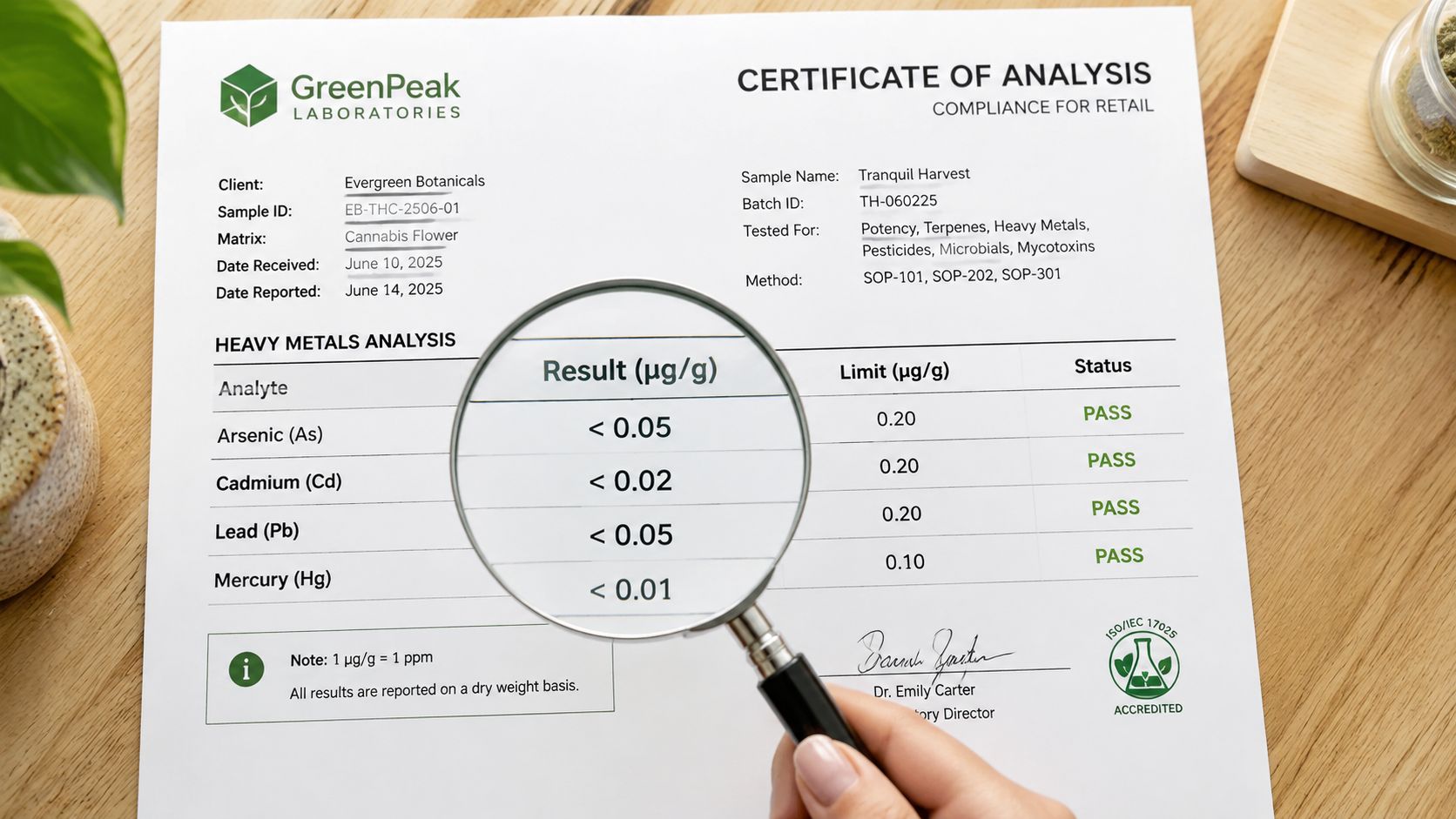
Read the heavy-metal panel row by row
A typical panel may include these fields:
- Analyte: The metal being measured, such as lead, arsenic, cadmium, or mercury.
- Result: The amount detected in the tested sample.
- Limit: The maximum permitted value for the relevant product route.
- LOQ: The limit of quantification, meaning the lowest level the laboratory can reliably quantify under that method.
- Disposition: A pass or fail conclusion based on the reported result and applicable limit.
- Laboratory details: The testing facility, report date, accreditation information, and identifying report number.
The units often create unnecessary confusion. One µg/g equals one ppm, so a result listed as 0.2 µg/g is numerically equivalent to 0.2 ppm. Maine's rules use µg/kg and ppb for reporting, while other state rules may use ppm or µg/g, so always compare like with like and read the unit beside the number (Maine cannabis testing requirements).
A result marked ND, or not detected, means the analyte wasn't detected above the method's reporting capability. It doesn't mean the instrument proved that no atom exists. A detected value far below the route-appropriate limit may pass, while a result close to that limit deserves a careful look at the units, route, and batch.
This video can help patients become more comfortable with laboratory-report language:
Be cautious when a COA omits one of the expected metals, shows a product mismatch, or uses a QR code that leads to a page with no report identifier. Harvest dates, test dates, expiration dates, and lot numbers help you determine whether the document belongs to the package you're considering.
How Mr. Nice Guys DC Approaches Product Safety
At a dispensary counter, product safety should look like a repeated routine, not a single inspection performed once. A patient asks about a new vape, and the staff member should be able to connect that exact product and lot to a current COA rather than pointing to a general brand page.
Mr. Nice Guys DC describes a workflow built around products that provide full-panel COAs and screening for contaminants, including heavy metals. Staff can pull up the heavy-metal portion for a new menu item, check the batch identification, and confirm that the report corresponds to the format being sold.
What the verification looks like
A practical in-store review can include:
- Batch matching: The product's lot or batch ID is compared with the COA.
- QR validation: The QR code is checked to see whether it resolves to a legitimate laboratory domain and an identifiable report.
- Route review: An inhaled product is checked against inhalation requirements, while an edible, tincture, or topical is evaluated under the applicable non-inhaled route.
- Date review: Staff verify testing, harvest, and expiration information before a product is rotated onto the menu.
- Documented rechecks: New lots are reviewed again, even when the same product has appeared previously.
That last point matters because a brand name isn't a batch result. A pre-roll and a tincture may come from different production lots, and a vape cartridge shouldn't inherit the assumptions attached to an edible. The patient-facing benefit is straightforward: you can ask to see the COA and inspect the same information on your phone.
For a current view of formats available through the dispensary, visit the guide to cannabis products available at Mr. Nice Guys DC. Use the product format as the starting point, then verify the matching laboratory document.
A Patient Checklist for Choosing Cleaner Cannabis Products
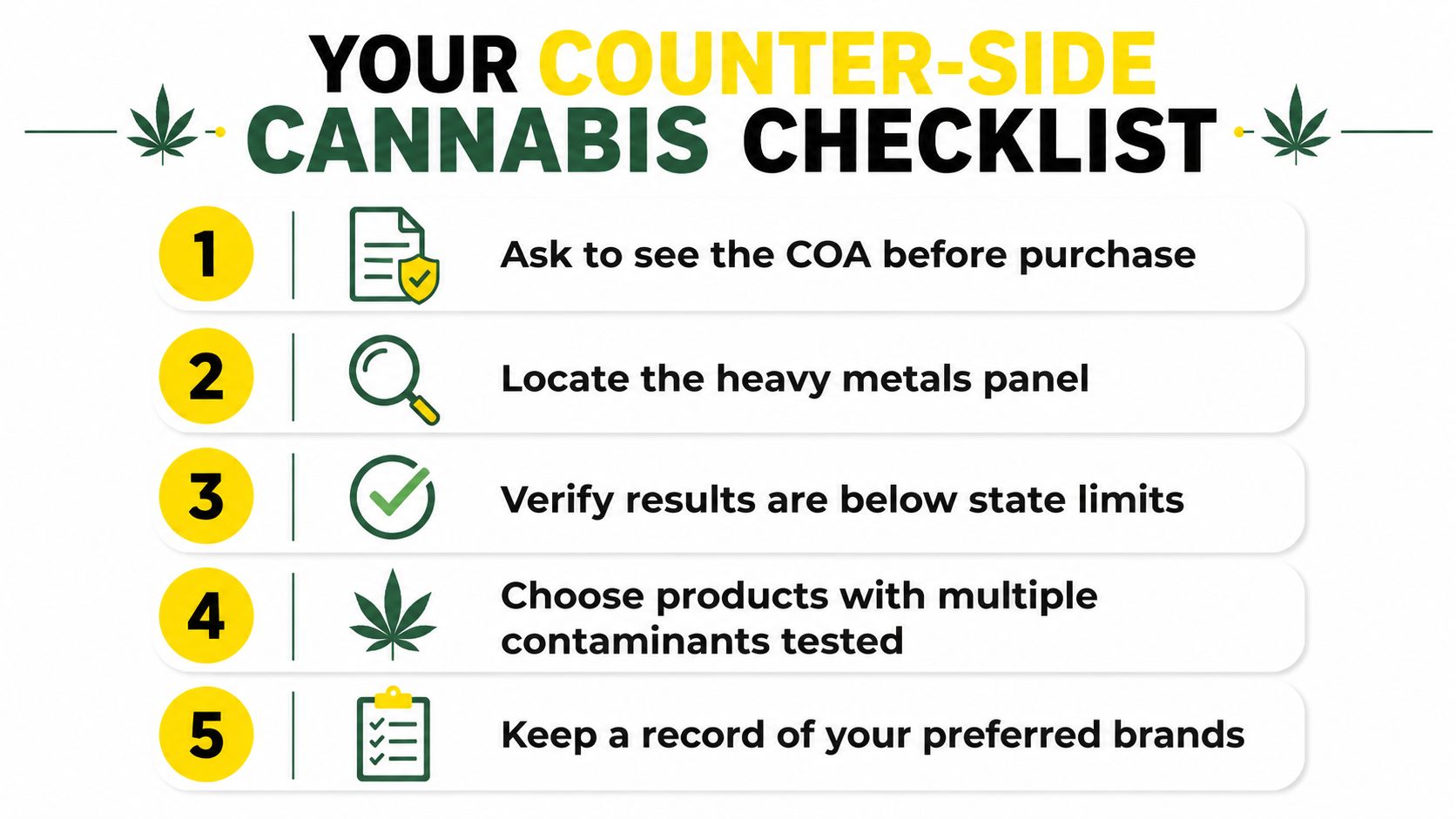
You don't need to memorize laboratory chemistry to make a better choice. Use this counter-side routine and ask the budtender to help when a document is missing or unclear.
- Ask for the COA first. Request the report before purchase, and look for a testing laboratory with ISO/IEC 17025 accreditation. The report should identify the product, lot, laboratory, and test date.
- Find all four metals. Look for arsenic, cadmium, lead, and mercury. “ND” is easy to understand when the report also shows the method's LOQ, while a detected result should be compared with the correct limit.
- Match the route. Flower, pre-rolls, vapes, and concentrates are inhaled products. Edibles, capsules, and tinctures use an oral route. Topicals may have their own category, as shown in Maine's route-specific rules (Maine action levels by route).
- Check the dates. Compare the harvest date, laboratory test date, and expiration date with the package. A patient who rejects lots tested more than 12 months ago is following a cautious screening preference, not a universal laboratory rule. The relevant date policy can vary by jurisdiction and product.
- Ask about remediation. Find out whether the cultivator explains how it prevents contamination and what happens when a lot fails. A brand with no published safety data gives you less information to evaluate.
Three reasons to pause
- Missing panel: The report doesn't list all expected heavy metals.
- Wrong format: The COA describes an edible, but the package is a vape, or the route and limit don't match.
- Unverifiable document: The QR code fails, the laboratory identity is unclear, or the batch number differs from the label.
A passed result is useful only when it belongs to the product you're buying. If the answer to any of these questions is unclear, ask for another lot or choose a product with more complete documentation.
Putting It All Together and Carrying the Right Habits Forward
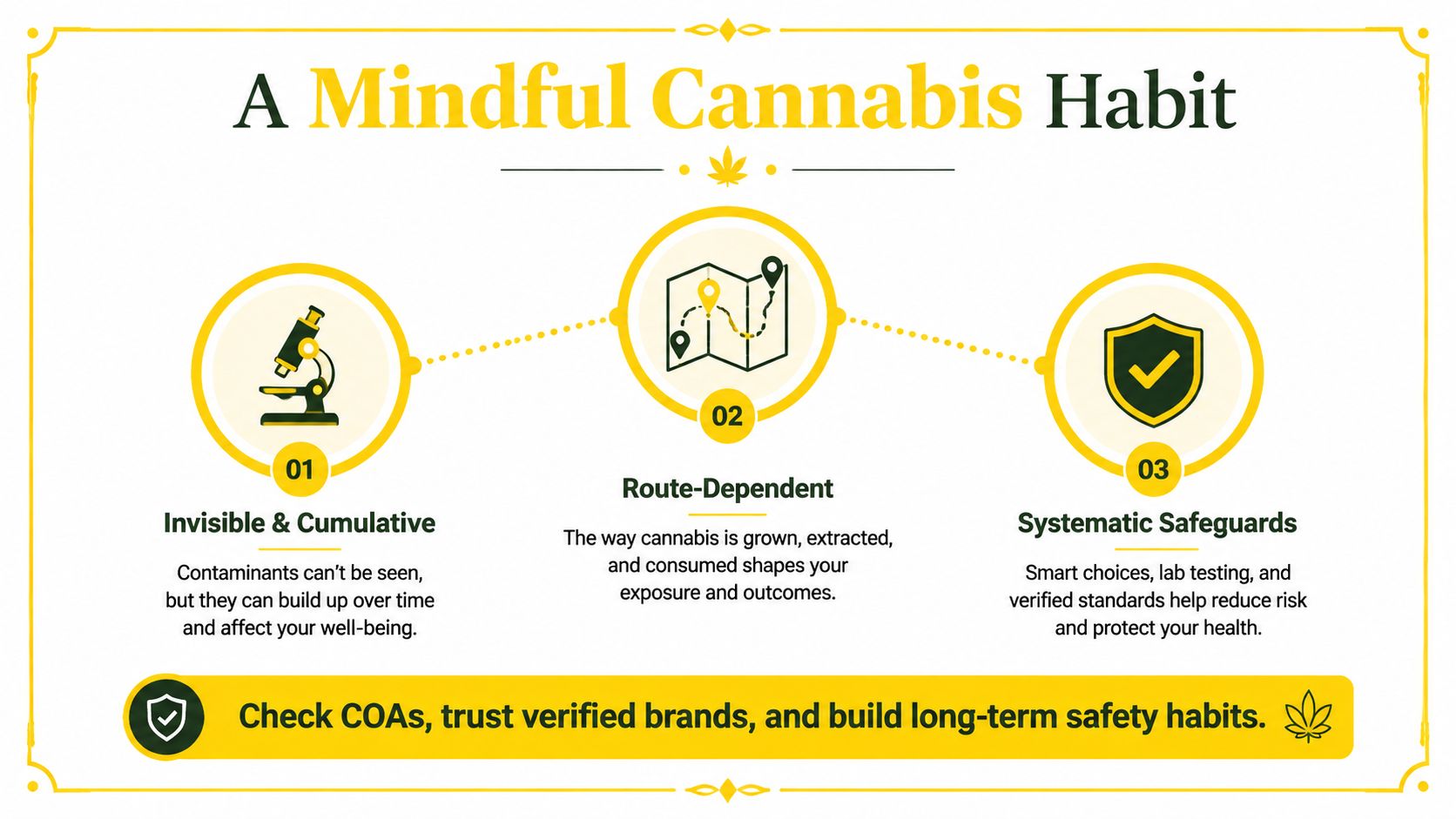
Heavy metal contamination is invisible, but the safeguards don't have to be. Cannabis plants can take up lead, arsenic, cadmium, and mercury through environmental pathways, while laboratory workflows use homogenization, digestion, quality controls, and ICP-MS to identify trace amounts that the eye can't detect.
The rules then add a second layer. Inhalation and oral products aren't treated as interchangeable because the route changes the exposure assumptions. That's why a vape cartridge and an edible require the patient to read different product details, even when both come from cannabis.
The COA's heavy-metal panel is often the least examined part of the document. Make it the first section you check, then confirm the batch, route, laboratory, and date before you compare cannabinoid percentages.
A verified product still deserves sensible storage after purchase. Keep cannabis in a suitable storage container, follow the package directions, and preserve the label so you can identify the lot if questions arise.
A simple habit: Before you check the THC or CBD percentage, check whether the COA matches the package and whether the heavy-metal rows pass for the route you'll use.
That small pause changes the shopping process. You're no longer choosing only by strain, potency, or price. You're choosing a documented product and building a routine that treats laboratory information as part of the experience.
Mr. Nice Guys DC offers lab-tested cannabis formats such as flower, pre-rolls, vapes, edibles, concentrates, topicals, and tinctures, with product information and COA-based safety checks available to help you compare options. Visit Mr. Nice Guys DC and ask the team to help you verify the heavy-metal panel before your next purchase.
Mr Nice Guys DC
At Mr. Nice Guys DC, we’re more than just a cannabis delivery service — we’re passionate advocates for quality, convenience, and community. With years of experience in the cannabis industry, our team is dedicated to educating and empowering customers across Washington, D.C. Whether you're a seasoned user or just starting your cannabis journey, our blog delivers trusted tips, product insights, and the latest updates from the world of weed. Stay informed, stay elevated.
