
Must Be 21 To Enter
By entering this site you are agreeing that you are at least 21 Years of Age or older.
I AM 21 OR OLDERCannabis Terpenes Guide: Smarter Choices for DC Patients
.svg)

.png)
Most cannabis terpene guides make shopping sound simple: myrcene means sleepy, limonene means energetic, and the strain name confirms the result. A patient at a DC dispensary can easily choose a familiar cultivar on that advice, only to find that the flower feels different from a previous purchase.
The problem isn't that terpenes are irrelevant. They shape aroma and help describe the chemical profile of cannabis, but they aren't reliable shortcuts for predicting a medical outcome. This cannabis terpenes guide treats terpene panels as experimental clues, not guarantees. You'll learn what terpenes are, how to recognize common profiles, why the entourage effect remains unsettled, and how to compare batch-specific laboratory data before choosing a product.
Why This Cannabis Terpenes Guide Starts With a Warning
A patient comparing two jars may recognize a familiar cultivar name, hear that one is “calming,” and choose it without looking beyond the label. That shortcut can fail because a cultivar name describes a genetic or marketing category, not necessarily the exact compounds present in the batch in front of you. Terpene profiles can change with cultivation conditions, harvest timing, drying, storage, and extraction, as explained in this review of cannabis terpene chemistry and variation.
Aroma helps, but it doesn't replace measurement. A citrus scent may suggest limonene, while an earthy or peppery smell may point toward other compounds, yet smell can't tell you the complete profile or the concentration of each terpene. Two products with the same name may smell different, test differently, and feel different because their full chemical profiles aren't identical.
Practical rule: Treat a strain name as a starting label, not a prediction.
Terpenes are best used as variables in a careful personal experiment. If you want to explore a myrcene-dominant flower, you can record whether it feels heavier for you, but you shouldn't assume myrcene will cause sedation. If a limonene-forward cartridge seems bright during one session, that experience doesn't prove that limonene will produce the same result at another dose, through another route, or alongside a different cannabinoid profile.
That distinction matters for DC medical patients choosing products for comfort, sleep, appetite, mood, or daily function. The rest of this guide focuses on practical interpretation, including the major terpene families, common aromas, mixed evidence around the entourage effect, certificates of analysis, product formats, and a simple way to compare results at the dispensary. The goal is to make you a careful investigator rather than a believer in strain folklore.
What Cannabis Terpenes Actually Are
Terpenes are aromatic compounds that contribute to the smell and flavor of cannabis and many other plants. They help explain why one flower smells like lemon peel, another like pine needles, and another like black pepper or lavender. A useful kitchen analogy is seasoning: cannabinoids may be central to the strength and character of a product, while terpenes add aromatic detail that helps distinguish one profile from another.
Cannabis research commonly groups terpenes into monoterpenes and sesquiterpenes. Monoterpenes such as myrcene, limonene, alpha-pinene, and linalool are generally lighter and more volatile. Sesquiterpenes such as beta-caryophyllene, caryophyllene oxide, beta-farnesene, and alpha-humulene are generally heavier compounds. Volatility matters because heat, air exposure, drying, and storage can change which aromas remain noticeable in flower or an extract.
You may recognize these compounds from unrelated plants. Limonene is associated with citrus, pinene with pine and rosemary, linalool with lavender, and beta-caryophyllene with black pepper and cloves. Those shared aromas don't mean a cannabis product will produce the same experience as eating a spice or smelling a flower. They show why familiar scent descriptions are useful for communicating a product's profile.
Aroma is a clue, not a measurement
A jar that smells strongly citrusy may contain a meaningful amount of limonene, but your nose can't provide a complete batch analysis. It won't reliably identify minor terpenes, distinguish naturally occurring compounds from added ones, or tell you whether the product has degraded during storage.
The name on the package describes the product category. The certificate of analysis describes what the tested batch contained.
For that reason, a laboratory terpene panel is more useful than a cultivar nickname when you're comparing products. Read this additional explanation of what terpenes are in weed alongside the product's batch information, then use aroma as a sensory check rather than proof of a predicted effect.
The Most Common Cannabis Terpenes and What They Smell Like
A terpene list is easier to use when you connect each compound to three questions: What does it smell like? What association do people commonly report? How strong is the evidence? The first question is sensory. The second reflects preclinical research, surveys, and patient reports. The third keeps you from treating a familiar association as a clinical promise.
The profiles most shoppers recognize
Myrcene usually brings earthy, musky, herbal, or tropical-fruit notes. It is often associated with relaxation and a heavier body feel, which is why guides frequently call it “sleepy.” That label is too certain for medical decision-making. A myrcene-rich product may feel relaxing to one patient and merely earthy or physically noticeable to another.
Limonene smells like citrus peel, lemon, orange, or grapefruit. Patients often describe limonene-forward products as bright or mood-lifting, but an uplifting response isn't guaranteed. Dose, THC level, tolerance, setting, and the rest of the terpene panel can change the experience.
Pinene contributes pine, rosemary, and fresh forest aromas. It is commonly discussed in relation to alertness and mental clarity, with some theoretical discussion around memory. Those ideas come from laboratory and preclinical work rather than settled clinical evidence, so pinene shouldn't be used as a promise that a product will improve focus.
Beta-caryophyllene has a spicy, peppery, clove-like character. It attracts scientific interest because preclinical research has examined its interaction with CB2 receptors, but that interest doesn't establish a predictable treatment effect for patients. You can read a focused overview of caryophyllene terpene benefits, then compare the claims with the actual evidence tier.
Linalool is floral and lavender-like, sometimes with soft herbal or sweet notes. It is often associated with calm and winding down. Those associations are useful for describing why a patient might want to sample a profile, but they aren't proof that linalool will relieve anxiety or improve sleep.
Alpha-humulene tends to smell woody, earthy, herbal, or reminiscent of hops. Discussions sometimes connect it with appetite and inflammation, yet those connections remain more established in laboratory conversations than in reliable human outcomes.
Minor compounds can add character even when they aren't among the top results on a panel. Terpinolene may smell floral, piney, herbal, or citrusy. Ocimene is often described as sweet, fresh, or herbal. Bisabolol can add soft floral or chamomile-like notes, while valencene is associated with sweet citrus and woody aromas. Their presence can help explain a product's complexity, but a minor terpene isn't automatically unimportant, and a detectable terpene isn't automatically therapeutic.
| Terpene | Dominant Aroma | Commonly Reported Association | Evidence Note |
|---|---|---|---|
| Myrcene | Earthy, musky, herbal, tropical fruit | Relaxation or a heavier body feel | Commonly reported association, not a guaranteed sedative effect |
| Limonene | Citrus peel, lemon, orange | Brighter or uplifted mood | Based on reports and preclinical discussion, not settled clinical evidence |
| Pinene | Pine, rosemary, fresh forest | Alertness or mental clarity | Theoretical and preclinical interest does not establish a clinical outcome |
| Beta-caryophyllene | Black pepper, cloves, spice | Physical comfort or stress support | Receptor and preclinical findings remain insufficient for a promise |
| Linalool | Lavender, flowers, soft herbs | Calm or winding down | Common association, not proof of anxiety or sleep treatment |
| Alpha-humulene | Hops, wood, earth | Appetite and inflammation discussions | Evidence is not sufficient to predict a patient response |
| Terpinolene | Floral, piney, herbal, citrus | Uplifted or creative feeling | Sensory and anecdotal association, not a reliable shortcut |
Don't ask, “Which single terpene fixes my problem?” Ask, “Which batch profile is worth testing at a cautious dose, and what result should I record?” That question leads to better decisions than the familiar myrcene-equals-sleepy formula.
The Entourage Effect and Why Evidence Is Mixed
The entourage effect is the hypothesis that cannabinoids, terpenes, and flavonoids may interact in ways that create a different overall experience than an isolated compound would produce. It is a plausible idea, but plausible doesn't mean proven in patients.
Preclinical work has produced reasons to investigate the hypothesis. In a controlled mouse study, alpha-humulene, geraniol, linalool, and beta-pinene produced cannabinoid-like behavioral effects and showed selective additive effects when combined with a cannabinoid agonist. That work also identified CB1 and adenosine A2A receptors as possible terpene targets. At the same time, other receptor-level experiments found that commonly occurring cannabis terpenes didn't change THC activity at human CB1 or CB2 receptors. A review of the evidence describes the overall picture as contradictory and insufficient to establish dependable synergy in patients. These findings are summarized in this review of the entourage effect evidence.
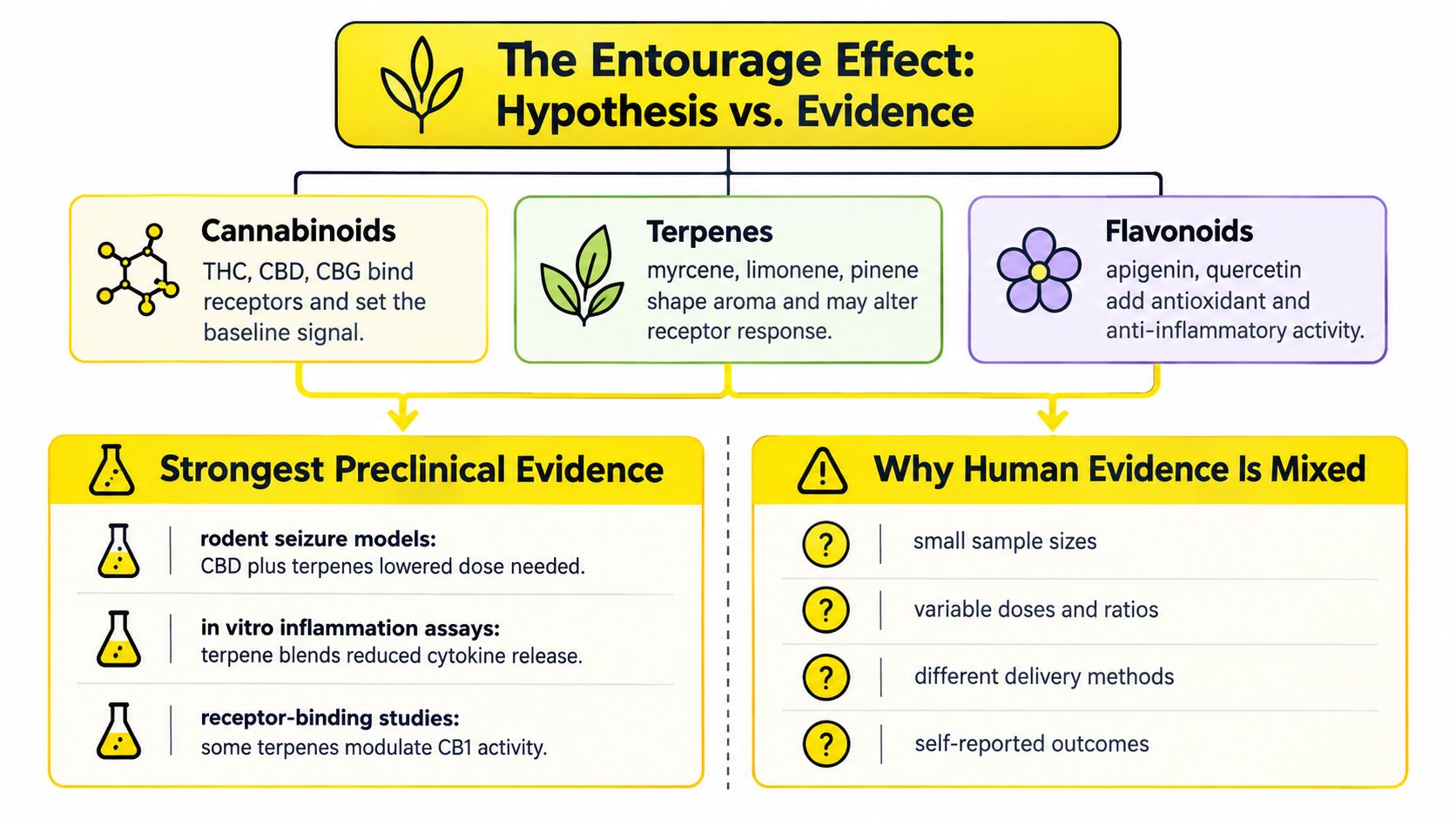
A practical evidence ladder can keep your expectations realistic:
- Tier 1, human clinical data: The strongest basis for a medical conclusion, though terpene-specific evidence remains limited and formulations vary.
- Tier 2, preclinical or anecdotal support: Useful for forming a question, not for guaranteeing an outcome.
- Tier 3, strain-name folklore: The weakest basis, because a name doesn't prove the current batch's chemical profile.
Use the second tier as a reason to test, not a reason to promise. Try one product, keep the dose and route consistent, and record onset, duration, desired effects, and adverse effects. If you change the strain, format, dose, and time of day together, you won't know which variable shaped the result. A short written log turns “this one felt better” into personal information you can use when comparing the next batch.
For more context on products that preserve multiple plant compounds, see this guide to full-spectrum cannabis. Full-spectrum language still doesn't remove the need to check the actual product data.
How to Read a Terpene Lab Report
A certificate of analysis, or COA, is the most useful document for moving beyond strain-name assumptions. Start by confirming that the batch number on the COA matches the batch number on the package. If the numbers don't match, ask for the report associated with the product in your hand.
Next, find the total terpene result and the individual compounds. A large analysis of commercial cannabis products found myrcene, beta-caryophyllene, and limonene among the terpenes with the highest average levels, but individual terpenes were rarely above 0.5% by weight and most appeared below 0.2% in a majority of samples. Those findings come from this analysis of terpene concentrations in cannabis products. A higher number isn't automatically better, and a lower number isn't automatically weak. The full profile, freshness, minor compounds, product format, and your sensitivity all matter.
Read the panel in a consistent order
- Confirm the batch: Match the package identifier to the COA.
- Check total terpenes: Use it as a broad comparison point, not a quality score.
- Identify the top three: The leading compounds usually help explain the dominant aroma.
- Review the supporting compounds: Minor terpenes may add floral, spicy, woody, or citrus detail.
- Check the units: A lab may report results as a percentage or in milligrams per gram. Don't compare values until you've confirmed the units.
- Note the product type: Flower, oil, concentrate, and infused products may have different profiles and may report added terpenes differently.
| Field on COA | Example Value | What It Means |
|---|---|---|
| Batch identifier | Matches package label | The report is relevant to the product being considered |
| Total terpenes | Reported total | A broad profile measure, not a therapeutic score |
| Top terpene | Myrcene, limonene, or another detected compound | Helps explain the leading aroma |
| Supporting terpenes | Several additional detected compounds | Shows whether the profile is simple or layered |
| Reporting unit | Percentage or mg/g | Determines how to compare values correctly |
| Terpene origin | Naturally occurring or added | Indicates whether the profile came from the plant, formulation, or both |
A product may contain terpenes naturally captured during cultivation and processing, while some cartridges and concentrates receive added botanical or cannabis-derived terpenes after extraction. That addition isn't automatically bad, but it changes what the label means. Ask whether the listed compounds were detected in the original plant material or introduced during formulation.
A COA also has limits. Testing methods can lose volatile compounds through heat, and one report represents a tested sample rather than every particle in a package. Use the report as evidence about the batch, not as a guarantee that every inhalation will deliver an identical mixture. You can also review this overview of product testing standards before asking a dispensary for documentation.
Terpenes Across Flower, Vapes, Edibles, and Concentrates
The same terpene name can mean something different depending on the product format. Flower usually offers the clearest view of the plant's native aromatic profile because it hasn't passed through an extraction step. Curing and storage can still reduce volatile aromas, and combustion adds heat that changes some compounds. If you want to compare a batch's natural scent with its panel, flower gives you a direct sensory reference.
Vapes require more questions. A live resin cartridge may retain more of the plant's native terpene character, while a distillate cartridge often relies on added botanical or cannabis-derived terpenes to restore flavor and aroma. Hardware quality, oil formulation, and temperature all affect what reaches you. A cartridge that tastes intensely aromatic isn't automatically more therapeutic, and an untested product can create safety concerns.
Edibles provide a different experiment. Baking and infusion can remove much of the flower's original terpene profile, so the flavor may come from the recipe or added terpenes rather than the native plant material. Digestion also changes the timing and character of the experience, which makes it harder to connect a terpene panel with an immediate sensation. If you take more because you don't feel an effect quickly, you may overshoot before the first dose has fully developed.
Concentrates such as rosin, hash, and live resin can preserve or concentrate aromatic compounds, but their ratios vary. Solventless products may stay closer to the original flower profile, while other extracts may be refined and then reformulated. High terpene loads can taste vivid but may feel harsh for people with sensitive airways.
Choose the format based on more than aroma. Consider whether you tolerate inhalation, how quickly you want feedback, how discreet the product needs to be, and whether a slower edible experience suits your routine. This comparison of edibles, vapes, and flower can help you evaluate the route before you focus on the terpene panel.
Choosing the Right Product at Mr Nice Guys DC
A dispensary visit works better when you treat it as a small decision-making lab. Start with a format you already tolerate, choose a modest exposure, and change only one variable at a time. If you switch from flower to a cartridge while also raising the THC level and changing the time of day, the result won't tell you much about terpenes.
Ask the staff for the batch-specific COA. Mr Nice Guys DC offers flower, cartridges and pens, edibles, pre-rolls, concentrates, topicals, and tinctures, with staff guidance for patients comparing formats and product information. Ask which two terpenes lead the panel, whether the cartridge contains naturally occurring, cannabis-derived, or botanical terpenes, and whether the available report matches the package batch.
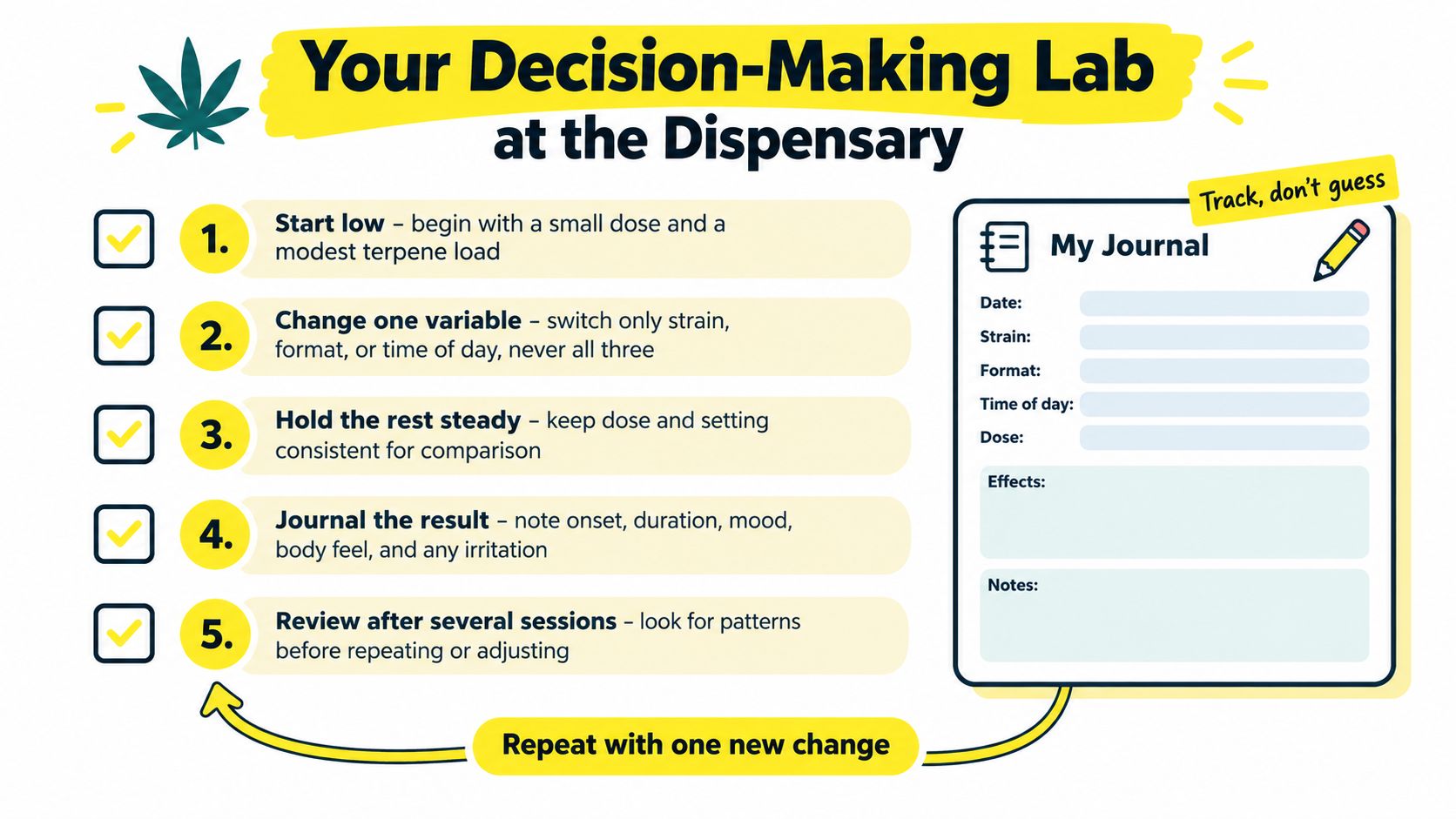
Keep the rest of the experiment steady. Record the product name, format, dose, time of day, onset, duration, mood, body feel, and any irritation or unwanted response. Continue long enough to notice a pattern across two to three sessions, then decide whether the profile deserves another trial or a change.
A simple example is a patient comparing a citrus-forward flower with an earthy, myrcene-forward flower. The patient keeps the route and approximate dose consistent, tests each on separate occasions, and records whether either profile feels more comfortable or functional. The conclusion might be “the citrus profile worked better for daytime use,” but it shouldn't become “limonene always creates energy.” Personal data is valuable precisely because it stays attached to the individual, product, and conditions tested.
Safety, Sensitivities, and Final Takeaways
Terpenes deserve attention because concentrated aromatic mixtures can be irritating. Very high terpene concentrations, especially in dabbing products or untested cartridges, may feel harsh in the throat and airways. People who are sensitive to inhaled products, asthma, or reflux may notice more discomfort, so a strong aroma isn't a reason to increase exposure.
Ingestion has its own uncertainty. Digestion changes how compounds are processed, and a high-fat meal can alter absorption. Edibles also delay feedback, so taking more before the first dose has fully developed can produce an unexpectedly intense experience. Choose a setting where you can wait, avoid mixing variables, and ask a clinician about cannabis use if you have a medical condition, take other medicines, or are unsure whether inhalation or ingestion is appropriate.
Reported associations aren't proven medical outcomes. Limonene may be described as mood-brightening, and myrcene may be described as relaxing, but a recent review notes that terpene research for pain is dominated by preclinical studies, with human evidence limited by small samples, inconsistent formulations, and inadequate pharmacokinetic information. The proposed entourage effect also remains clinically unsettled, so use terpene information to form a cautious question rather than a firm expectation.
Keep these principles in view:
- Read the COA: Match the batch and compare the complete terpene panel.
- Choose the format carefully: Consider tolerance, onset, discretion, and inhalation sensitivity.
- Change one variable: Don't change dose, route, product, and timing all at once.
- Track your response: Record onset, duration, desired effects, and unwanted effects.
- Trust evidence over folklore: Terpenes are useful clues, not guarantees.
Ask the staff at Mr Nice Guys DC to help you compare current batch-specific terpene panels across flower, vapes, edibles, and concentrates. Bring your questions about format and sensitivity, then visit Mr. Nice Guys DC to choose a tested product and begin a careful, written comparison rather than relying on the strain name alone.
Mr Nice Guys DC
At Mr. Nice Guys DC, we’re more than just a cannabis delivery service — we’re passionate advocates for quality, convenience, and community. With years of experience in the cannabis industry, our team is dedicated to educating and empowering customers across Washington, D.C. Whether you're a seasoned user or just starting your cannabis journey, our blog delivers trusted tips, product insights, and the latest updates from the world of weed. Stay informed, stay elevated.
