
Must Be 21 To Enter
By entering this site you are agreeing that you are at least 21 Years of Age or older.
I AM 21 OR OLDERCaryophyllene Terpene Benefits: A Patient's Guide
.svg)

.png)
You're standing at the dispensary counter, looking at a jar label with THC in big print and a terpene panel in tiny type. Most shoppers do what's natural, they chase the cannabinoid number first and skim past the terpene list, even though one of the most interesting names on that list is β-caryophyllene.
That's a mistake worth correcting. Caryophyllene is one of the cannabis terpenes that shows up in familiar foods too, including black pepper, cloves, basil, and hops, and it's been studied for a long time because it behaves less like a simple aroma and more like a biologically active compound. For DC patients trying to match a product to pain, inflammation, mood, or a broader wellness goal, that difference matters.

Why Caryophyllene Is the Terpene Worth Knowing
A patient at a DC dispensary often reaches for the strongest THC number first, then asks what the strain is “supposed to do.” That instinct makes sense, but it skips the part of the label that can help explain why two jars with similar THC can feel different. Caryophyllene is one of the clearest examples of why terpene literacy pays off.
The peppery terpene hiding in plain sight
Caryophyllene gives off a peppery, woody, spicy aroma, the kind you notice when a strain smells like cracked pepper or clove. That scent profile is one reason it shows up in so many cannabis cultivars, and it's also why people who cook with black pepper or cloves often recognize it before they ever hear the name. In other words, this isn't an exotic compound hidden only in rare flower, it's part of everyday taste and smell.
What makes it more interesting is that caryophyllene is not just “nice aroma chemistry.” Modern reviews describe it as a dietary cannabinoid, which is a useful phrase because it hints at why researchers care so much about it. The compound sits at the intersection of food, aroma, and cannabinoid science, which is unusual even in a plant as chemically complex as cannabis.
Practical rule: if a jar smells peppery, woody, or clove-like, caryophyllene may be one of the terpenes doing the work, even if the front label never says so.
Why researchers kept coming back to it
The scientific interest didn't start with dispensary menus. Early experimental work linked caryophyllene to anti-inflammatory activity and pain-related effects, and later reviews kept expanding the list of investigated uses. That's why you'll see it mentioned in conversations about inflammation, discomfort, and even mood, not just flavor.
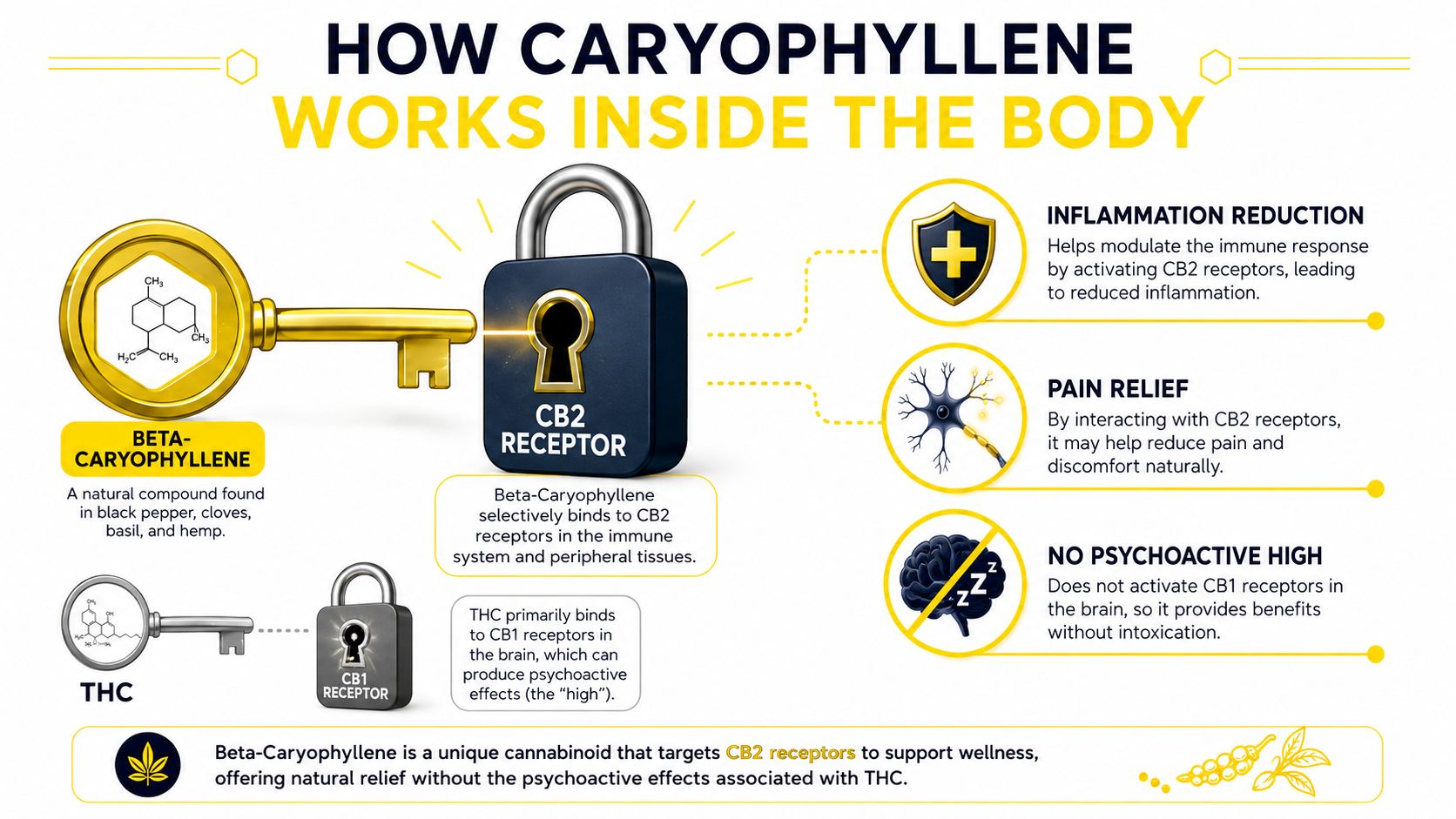
A useful way to think about it is this. THC often gets the spotlight because it produces a noticeable psychoactive effect, while caryophyllene is more like the quiet specialist in the background. It doesn't play the same role, and that's exactly why it's become a major target in cannabis science. For a plain-language primer on terpenes, this DC-focused guide to terpenes in weed helps put the aroma side of the plant in context.
How Caryophyllene Works Inside the Body
The endocannabinoid system sounds technical until you break it down into something physical. Think of receptors like locks and compounds like keys. THC fits the CB1 lock in the brain and nervous system, which is why it can create a high, while β-caryophyllene is CB2 receptor-selective, which pushes its activity toward immune and peripheral tissue instead of intoxication.
The lock-and-key difference that matters
That CB2 bias is the reason caryophyllene keeps showing up in conversations about inflammation. In preclinical literature, CB2 activation by β-caryophyllene is associated with reduced LPS-induced pro-inflammatory cytokine expression and suppression of inflammatory signaling. In plain English, it nudges the body's immune messaging away from “stay inflamed” and toward a calmer response.
For a patient, that means caryophyllene is discussed differently from THC-heavy products. It's not being framed as a compound that should get you high. It's being framed as a compound that may help the body deal with inflammation-related signaling, which is especially relevant when discomfort has an inflammatory component.
Why that distinction changes the conversation
That receptor selectivity also explains why caryophyllene is often called a dietary cannabinoid rather than just another terpene. It acts more like a signaling molecule with cannabinoid behavior than a scent-only accessory. In a product conversation, that matters because you're not asking, “Will this make me feel intoxicated?” You're asking, “Does this product contain a compound that may interact with CB2-linked pathways?”
Practical rule: CB1 is the brain's loud room, CB2 is the quieter body-and-immune room. Caryophyllene mostly walks into the second room.
A full-spectrum cannabis explainer can also help, because caryophyllene often makes more sense when you look at the whole plant rather than one isolated ingredient.
Later in the body, that same receptor bias is part of why researchers discuss caryophyllene in relation to pain, inflammation, and other peripheral effects. The key point is simple. Caryophyllene talks to the body differently than THC does, and that's the foundation for everything else people ask about.
The Best-Supported Therapeutic Benefits
A patient asking about caryophyllene usually starts with a simple question, can this terpene do anything, or is the label just giving me a fragrance note? The strongest answer centers on inflammation and pain-related research, with a smaller but still meaningful body of work pointing toward anxiolytic effects. The evidence is real, but most of it comes from animal studies, cell work, and early preclinical models, not large human trials.
Anti-inflammatory effects are the anchor
Caryophyllene's anti-inflammatory reputation has been around for a while because experimental models described its activity as comparable in potency to the NSAID phenylbutazone. In animal and preclinical work, oral dosing reduced thermal hyperalgesia, mechanical allodynia, spinal neuroinflammation, and neuroinflammation in a mouse model of multiple sclerosis. That gives researchers a plausible mechanism to keep testing, even though it still falls well short of proving a medical treatment on its own.
For a real patient, that means a caryophyllene-rich product may deserve attention when inflammation is part of the symptom picture. The compound has a serious research history rather than a marketing story built on vibes. A cannabis pain relief guide can help frame how inflammation, pain, and terpene content often get discussed together in dispensary conversations.
Pain relief is promising, but the evidence is still early
Pain is where many dispensary shoppers focus, and caryophyllene fits that discussion because CB2 activation is linked to analgesic signaling. The clearest way to read the research is that caryophyllene looks relevant to inflammation-dominant pain, including neuropathic patterns, because it may reduce inflammatory signaling that feeds discomfort. That is a more careful claim than saying it “kills pain” in a general sense.
If you are comparing products for pain support, the terpene belongs in the same conversation as cannabinoids, ratios, and the rest of the plant profile. A product with caryophyllene may fit a pain plan, especially when the goal is to support comfort without chasing intoxication, but the terpene percentage on a label does not act like a guarantee. It is one clue, not a verdict.
Mood effects are interesting, but still not definitive
Modern review literature also describes potential anxiolytic and antidepressant activity. The important caveat is that these claims are still mostly built from preclinical data, so the evidence is suggestive rather than settled. A patient might notice a calmer overall profile in a caryophyllene-rich product, especially when it comes packaged with other calming compounds, but that is not the same as a proven anxiety treatment.
Bottom line: the evidence is strongest for mechanism, anti-inflammatory action, and early pain-related pharmacology. It is encouraging, but it is not a prescription-grade conclusion.
A DC dispensary buying guide on strain selection can help patients connect these benefits to product choices without overstating what the terpene can do.
Emerging Benefits Worth Watching
Caryophyllene has a wider research footprint than you might expect. Reviews describe it with antioxidant, gastroprotective, neuroprotective, hepatoprotective, nephroprotective, cardioprotective, chemopreventive, and immunomodulatory properties, and the list keeps getting longer because researchers keep testing it in different biological settings. That doesn't make every claim equally strong, but it does explain why the terpene keeps showing up in review papers.
Metabolic support is one of the more practical angles
One of the more patient-relevant threads is metabolism. Experimental studies described caryophyllene-related effects such as increasing insulin secretion, improving insulin sensitivity, increasing glucose uptake, reducing glucose absorption, and lowering triglycerides and cholesterol. Those findings have made caryophyllene interesting to people looking at blood-sugar support or broader metabolic wellness, but the evidence is still largely preclinical.
For someone choosing a product for wellness rather than intoxication, that matters. It means caryophyllene may belong in a broader formulation conversation, especially when a patient is already paying attention to inflammation, stress, and metabolic health at the same time. It does not mean a terpene percentage can replace diet, medication, or monitoring.
Organ-protective signals are intriguing, not conclusive
Reviews also discuss caryophyllene in relation to the liver, kidneys, brain, heart, and digestive system. That broad range sounds impressive, and it is, but the right reading is cautious. These are investigational signals from experimental work, not proof that a cannabis product with caryophyllene will deliver organ-specific medical protection in human use.
A patient using a topical for sore joints or an inhaled product for more immediate symptom relief may still care about these signals because they hint at why the terpene is being studied so widely. That said, the use case matters more than the buzzwords on the label. A topical with caryophyllene may make the most sense when the goal is localized support, while an edible may be chosen for longer-lasting systemic coverage.
What this wide footprint really means
A terpene with this many investigated angles is unusual, but breadth is not the same as certainty. The safe reading is that caryophyllene looks biologically active in multiple systems, and researchers have enough reason to keep studying it. The unsafe reading is that every listed effect is already proven in humans.
That distinction helps patients stay grounded. If a product leans on “everything benefits from caryophyllene,” the marketing has moved faster than the science. If a product notes that its terpene profile is caryophyllene-rich, that's a more honest place to start.
Where to Find Caryophyllene in the Dispensary
Caryophyllene becomes easier to use once you stop treating it like a chemistry term and start treating it like a shopping question. You are not only asking whether it shows up on a label. You are asking which product format gives you the kind of experience you want, and which details on the shelf are worth your attention.
Formats that matter for real-world use
Flower and vapes usually make the most sense for patients who want faster onset, because inhalation moves compounds into the body quickly. Tinctures and edibles fit better when someone wants a longer-lasting effect or prefers to avoid inhalation. Topicals belong in the conversation when the goal is localized support on joints, muscles, or skin.
| Product Format | Caryophyllene Behavior | Typical Patient Use Case |
|---|---|---|
| Flower | Present in the plant's native terpene profile, often easiest to smell and compare | Fast-acting sessions, preference for whole-flower aroma |
| Vapes | Can preserve a terpene-forward profile depending on formulation | Quick relief and discreet use |
| Tinctures | Useful when paired with other cannabinoids in a measured oral format | Longer coverage and easier dosing routines |
| Edibles | Oral route may support a slower, longer-lasting experience | All-day planning and non-inhaled use |
| Topicals | Best suited for localized application rather than whole-body effects | Joints, muscles, or skin-focused routines |
What to ask about in a jar
If you are comparing flower, the terpene panel matters more than the strain name alone. Many popular cultivars, including OG Kush, Gelato, Wedding Cake, and Blue Dream expressions, can show caryophyllene in their profiles, but batch results vary, so the same name will not guarantee the same chemistry every time. The practical move is to ask for the current lab sheet and check whether caryophyllene sits near the top of the terpene breakdown.
A strain-selection guide for DC shoppers can help you read what is on the shelf without guessing from the menu name.
The entourage-style idea, handled carefully
Caryophyllene is often discussed as part of an entourage-style effect, meaning it may shape how THC and other cannabinoids feel when they are present together. That fits how many patients describe flower versus isolated compounds, because the full mix can matter more than one ingredient alone. The science is still not standardized dosing science.
The clean takeaway is simple. Choose format by symptom and setting, then use terpene data as a guide rather than a guarantee. Caryophyllene-rich products can be part of a thoughtful selection strategy, but the label alone cannot tell you the whole story.
Can You Actually Feel Caryophyllene Working
This is the question patients ask when they're standing in front of the menu and trying to separate real product knowledge from marketing copy. The honest answer is that most won't feel caryophyllene as a distinct, isolated effect the way they might notice THC's intensity or a strongly sedating product profile. It usually arrives mixed in with other terpenes and cannabinoids, so the experience is blended.
Label numbers help, but they don't settle the issue
Terpene percentages can be informative, but they're not standardized with the same simplicity people expect from cannabinoid numbers. The same flower can test differently across labs, and that makes terpene shopping less exact than many menus suggest. A product with a high caryophyllene number is a useful clue, not a promise.
That's why high-terpene marketing can overstate confidence. A bigger terpene number doesn't automatically mean a stronger or more noticeable effect, especially if the rest of the formulation changes the experience. Patients do better when they treat terpene data as one piece of the puzzle, not the answer key.
Route of use changes what you're likely to notice
Inhaled products may feel more immediate because they act faster, while oral products tend to unfold differently because of digestion and metabolism. Topicals are a separate category again, since people often use them to target a body area rather than chase a whole-body effect. If caryophyllene is doing something noticeable on its own, that's most plausible in a localized topical context, where CB2-linked activity has a clearer practical narrative.
Practical rule: if the label says a product is high in caryophyllene, ask what the full formula looks like, how it's used, and what the lab actually measured.
The healthiest mindset is hopeful but skeptical. Caryophyllene may absolutely be part of why a product feels calmer, warmer, or less edgy, but strain names and terpene percentages can't substitute for careful trial, batch testing, and your own symptom tracking.
Safety, Interactions, and Talking to Your Clinician
Caryophyllene has an appealing safety story because it appears in everyday foods and has GRAS status as a food additive. That doesn't mean every caryophyllene-rich cannabis product is automatically right for every patient, but it does mean the compound itself already lives in familiar dietary territory.

Where caution still matters
The same CB2 and metabolic activity that makes caryophyllene interesting could also matter for drug interactions, especially with medications handled through similar cytochrome pathways. That doesn't mean there's a guaranteed problem, it means transparency matters when you're already taking prescriptions or supplements. If you have a serious liver condition, are pregnant, or use immunosuppressants, that conversation matters even more.
A medication-compatibility guide is useful if you're trying to organize your questions before an appointment. Bring a current medication list, include over-the-counter products, and be specific about how often you use cannabis.
How to bring it up without making it awkward
You don't need a dramatic conversation. You need a clear one. Tell your clinician or pharmacist that you're considering a caryophyllene-rich product because you're looking at inflammation, pain, or another symptom goal, then ask whether that fits with your current regimen.
If you use medical cannabis in DC, the certification process can help document what you're using and keep your care paper trail clean. That's especially useful when you're adjusting products and want your clinician to know what's in the mix. The point is coordination, not permission-seeking.
Practical rule: if you wouldn't hide a prescription bottle, don't hide a cannabis product list either.
That kind of honesty usually makes the rest of the conversation easier, not harder.
Your Next Dispensary Visit, Made Simple
Start with the terpene panel, not just the THC number. Look for β-caryophyllene on the label, ask which current batches test high, and decide whether you want flower, vapes, edibles, tinctures, or topicals based on onset and location of symptoms.
If you're focused on joints or localized discomfort, ask about topicals first. If you want faster, more noticeable effects, ask about inhaled formats. If you want longer coverage, ask about oral products and how they fit into your day.
Most important, treat caryophyllene as a CB2-activating dietary cannabinoid with real preclinical promise, not as a magic terpene that solves everything on its own. The patients who get the most out of it are usually the ones who pay attention to the small print the rest of the room skips.
Mr. Nice Guys DC can help you compare terpene profiles, strain options, and product formats if you're trying to make caryophyllene part of a more intentional routine. Visit Mr. Nice Guys DC to browse current options, ask for guidance on terpene-rich products, and build a plan that fits how you want to feel.
Mr Nice Guys DC
At Mr. Nice Guys DC, we’re more than just a cannabis delivery service — we’re passionate advocates for quality, convenience, and community. With years of experience in the cannabis industry, our team is dedicated to educating and empowering customers across Washington, D.C. Whether you're a seasoned user or just starting your cannabis journey, our blog delivers trusted tips, product insights, and the latest updates from the world of weed. Stay informed, stay elevated.
