
Must Be 21 To Enter
By entering this site you are agreeing that you are at least 21 Years of Age or older.
I AM 21 OR OLDERCannabis Pain Relief: A DC Patient's Guide for 2026
.svg)

.png)
If you're reading this with a heating pad on your back, a sore knee propped on a pillow, or that familiar nerve pain buzzing in your feet at the end of a long day, you're in the right place. A lot of people in Washington, DC reach cannabis after they've already tried plenty of other things. Some are tired of side effects. Some want another option they can layer into an existing routine. Some just want to sleep through the night without pain waking them up.
Cannabis can help, but it helps most when you treat it like a tool, not magic. Success comes from learning which product fits your kind of pain, your schedule, and your tolerance. That's where many first-time patients get stuck. Flower, tinctures, topicals, THC, CBD, balanced formulas. It can feel like too many choices all at once.
Navigating Your Path to Cannabis Pain Relief
Take a common DC scenario. Someone works a desk job near Dupont, their lower back tightens by lunch, and by the commute home their pain has gone from annoying to draining. They may have tried stretching, over-the-counter options, maybe even prescription medication. Relief comes and goes, but the pattern stays the same. They want something practical they can use without feeling like they're guessing.
That interest in cannabis isn't just based on stories from friends. A 2017 meta-analysis by the National Academies of Sciences, Engineering, and Medicine reviewed 28 randomized controlled trials involving 2,454 patients with chronic pain and concluded there is "substantial evidence" that cannabis or cannabinoids are effective for chronic pain in adults, as reported in the National Academies review on chronic pain and cannabinoids.
That doesn't mean cannabis fixes every pain condition for every person. It does mean the conversation has moved past pure anecdote.
What that looks like in real life
A patient with neuropathic pain might find that a balanced tincture takes the edge off enough to sit, work, and sleep more comfortably. A person with an arthritic hand may care less about whole-body effects and more about rubbing on a topical before cooking dinner. Another patient may only need fast relief during flare-ups and choose an inhaled option for those moments.
Practical rule: Match the product to the pain problem you're actually trying to solve.
The goal isn't to chase the strongest product on the menu. The goal is to find the lowest effective dose in the right format.
Here in DC, that matters because access is easier when you know what you're asking for. Instead of walking into a dispensary saying, "I need something strong," you'll do better saying, "I have nerve pain in my legs, I want something non-inhaled, and I need relief that lasts through the evening."
That one change turns cannabis pain relief from trial-and-error into a more informed decision.
How Cannabis Interacts with Your Body for Pain Relief
Your body already has a built-in system involved in pain, mood, appetite, and sleep. It's called the endocannabinoid system, or ECS. The easiest way to think about it is a lock-and-key setup.
Your body has receptors, which act like locks. Cannabis compounds act like keys. When the right key fits the right lock, the body changes how it responds to pain signals.

The locks inside the body
The two names you'll hear most often are CB1 and CB2 receptors. You don't need to memorize them, but the basic idea helps. Some receptors are more tied to the brain and nervous system. Others are more connected to immune and inflammatory responses.
Researchers describe cannabinoids as having antinociceptive and antihyperalgesic effects via peripheral, spinal, and supraspinal mechanisms, which means they can influence pain signaling at several levels in the body, not just one, according to the Journal of Pain discussion of cannabinoid pain mechanisms90082-8/fulltext).
In plain language, cannabis may affect pain where it starts, where it travels, and how strongly your brain interprets it.
The keys from the plant
The two cannabinoids most patients focus on are THC and CBD.
- THC is the compound most associated with intoxication. It can also play a direct role in pain relief, especially when pain has a nerve-related component.
- CBD doesn't produce the same intoxicating effect and is often chosen by people who want a gentler starting point.
- Terpenes are aromatic compounds in cannabis that may shape how a product feels overall. If you want a deeper breakdown, this guide to what terpenes in weed are is a useful next read.
A practical example helps here. If someone uses a CBD-rich topical on a sore shoulder, they may be looking for localized support without much head change. If someone else uses a balanced tincture before bed for fibromyalgia-like discomfort, they may be trying to calm pain and make rest easier at the same time.
Cannabis doesn't "turn off" pain like flipping a switch. For many patients, it lowers the volume enough to make daily life more manageable.
Why one product feels different from another
People often get confused, assuming all cannabis products should feel similar if the label says they're for pain. That's not how it works.
The body responds differently depending on:
- Which cannabinoids are in the product
- How you take it
- How much you take
- What type of pain you're treating
A vape may hit quickly but fade sooner. A tincture may come on more gradually and feel steadier. A topical may help one spot without affecting the rest of your body much.
Once you understand the lock-and-key idea, those differences stop feeling random. They start feeling useful.
Choosing the Right Cannabis Format for Your Pain
The format matters almost as much as the formula. Many patients spend too much time asking, "Should I buy THC or CBD?" when the first question should be, "What delivery method fits my pain pattern?"
That's especially important because non-inhaled formats such as tinctures, topicals, and capsules show moderate-to-high certainty evidence for functional improvement and pain relief, while inhaled cannabis has low-certainty evidence with uncertain clinical benefit for neuropathic pain, based on the BMJ evidence review on medical cannabis formats.
Cannabis delivery methods at a glance
| Method | Onset Time | Duration | Best For |
|---|---|---|---|
| Flower | Fast | Shorter-lasting | Sudden flare-ups when quick feedback matters |
| Vape | Fast | Shorter-lasting | People who want rapid effect and easy dose adjustment |
| Edible | Slower | Longer-lasting | Evening relief or staying comfortable for longer stretches |
| Tincture | Moderate | Moderate to long | Flexible dosing and steadier symptom management |
| Topical | Localized onset varies | Localized relief window varies | Specific joints, muscles, hands, knees, neck, or back |
This table is intentionally simple because labels can get complicated fast. A patient doesn't need a chemistry lecture to make a smart first choice.
Best format for fast relief
If pain spikes suddenly, inhaled products often give the quickest feedback. That's why some patients keep flower or a vape for breakthrough discomfort. You can take a small amount, wait, and judge the effect sooner than you can with an edible.
But speed isn't the same as best evidence. For neuropathic pain in particular, inhaled options don't clearly beat non-inhaled ones in the research cited above. They may still help some people. They just shouldn't be your default choice because they feel more immediate.
A practical example: if your sciatica tends to flare when you're walking home from the Metro, a rapid-onset format may be useful for those episodes. If your pain is predictable every evening, a tincture may make more sense.
Best format for all-day steadiness
Non-inhaled options often fit patients who want a more measured routine.
- Tinctures work well for people who want to start low, adjust carefully, and keep notes.
- Capsules can feel familiar to patients used to standard medications.
- Edibles may suit longer relief windows, though they require patience because they take longer to kick in.
- Topicals are easy to understand for localized pain. Rub it where it hurts. Monitor the result.
For someone with wrist pain from repetitive work, a topical cream before a shift and again later in the day may feel more sensible than taking a whole-body product. For someone with broad, persistent discomfort across the back and hips, a tincture may better match the problem.
A simple decision guide
Use this quick framework when you're choosing:
- Pain comes on suddenly: Try a fast-acting format so you can assess relief quickly.
- Pain stays with you for hours: Consider a non-inhaled option that may last longer.
- Pain is limited to one area: Start with a topical.
- You want the most controlled first-time experience: A tincture is often easier to titrate than an edible.
- You need more help matching product type to symptom pattern: This guide to weed strains for pain can help you narrow the field.
The best cannabis pain relief plan usually uses format on purpose. Fast when you need speed. Steady when you need consistency. Local when the pain stays in one place.
Navigating Cannabinoids THC vs CBD for Pain Management
The next choice is the cannabinoid profile. In this context, labels like THC-dominant, CBD-dominant, and 1:1 balanced start to matter.

A lot of first-time patients assume they need to pick a side. Either THC or CBD. In practice, pain management is often more nuanced than that.
When THC may make more sense
THC tends to be the cannabinoid people notice most clearly. It can change perception, relaxation, and how strongly pain grabs your attention. For some patients, especially those dealing with nerve-related discomfort, that can be useful.
The tradeoff is obvious. THC can also feel impairing if the dose is too high.
A practical example: a patient with burning neuropathic foot pain at night may prefer a low-dose product that includes THC because the goal isn't only lowering pain intensity. It's also making the pain less intrusive so they can settle down and sleep.
When CBD may be the better starting point
CBD often appeals to patients who want to stay clear-headed, start cautiously, or focus on daytime use. It won't feel the same as THC, and some people expect too dramatic an effect from CBD alone. Still, it can be a smart first step, especially for inflammation-linked discomfort or localized use in a topical.
If someone has hand stiffness, mild joint pain, or post-workout soreness, a CBD-leaning topical may be a comfortable introduction to cannabis pain relief.
Good first question: Do you want stronger symptom change, or do you want the gentlest possible starting experience?
Why balanced products often work well
Many patients land in the middle. Products with balanced THC and CBD ratios are associated with small but statistically significant improvements in pain severity, with an approximate 0.5 to 1.0 point reduction on a 10-point pain scale relative to placebo, according to this clinical overview of cannabinoids for pain.
That may sound modest, but it can matter in daily life. If your pain usually sits at an 8 out of 10 and a balanced tincture brings it down toward a 7 or 7.5, that difference may be enough to cook dinner, walk the dog, or fall asleep without constantly repositioning yourself.
Here's a short explainer if you want to compare these two cannabinoids more directly.
For a deeper product-by-product breakdown, this article on CBD vs THC for pain is useful when you're deciding what to try first.
Simple matching examples
- Arthritic knuckles after a long day: CBD-dominant topical
- Fibromyalgia-type widespread discomfort: balanced tincture
- Nighttime nerve pain: low-dose THC-inclusive formula
- Daytime caution, first trial: CBD-forward tincture or capsule
You don't need to pick the strongest cannabinoid. You need the profile that fits your life.
Finding Your Effective Dose and Starting Safely
Dosing is where confidence gets built. It's also where people make the most avoidable mistakes.
The safest mindset is simple. Start low and go slow. That's not just a slogan. It's how you learn what your body responds to without overshooting.
A practical first-time approach
If you're using a tincture, start with the smallest measurable amount listed on the package. If you're using an edible, many patients prefer beginning with a low dose and waiting fully before taking more. A concrete example is a patient starting with 2.5 mg in an edible, then waiting several hours before deciding whether they need more. The point isn't that 2.5 mg is right for everyone. The point is to begin conservatively.
Keep a basic log for the first few sessions:
- What you took
- When you took it
- When you noticed effects
- Whether pain, sleep, or tension changed
- Any side effects
That little notebook can save you a lot of frustration.
Side effects that are common and usually manageable
Short-term side effects happen. That doesn't mean the product is wrong for you forever. It often means the dose, format, or timing needs adjustment.
A review found that non-serious adverse events are common in the short term, with a number needed to harm of seven, meaning one additional patient will experience a non-serious adverse event compared with placebo for every seven treated, as outlined in this PLOS One review of cannabinoid adverse events.
In plain terms, things like dizziness or sedation aren't rare.
If you feel uncomfortable after a first dose, the most likely fix is taking less next time, not giving up immediately.
A practical example: someone tries a CBD-rich oil in the evening, feels transient dizziness after the first dose, and notices it resolves within an hour. That's unpleasant, but it's different from a medical emergency. It tells you to adjust carefully.
A safe routine for beginners
Use these habits from day one:
- Choose one product first: Don't test a vape, edible, and tincture all in the same weekend.
- Avoid stacking doses early: Wait long enough to judge the first dose before adding more.
- Start at home: Your couch is a better testing place than a social event.
- Don't mix with alcohol: Keep your feedback clean so you know what caused what.
- Talk with your clinician if needed: Especially if you take other medications or have a complex medical history.
If you're trying an edible and want help understanding how low-dose starting points work, this edible dosage calculator guide can make the process feel less abstract.
What success actually looks like
Many patients expect a dramatic first experience. Often, good dosing feels subtler than that. Maybe your back still hurts, but you stop fixating on it. Maybe your knee still aches, but you walk upstairs with less hesitation. Maybe your pain isn't gone, but your body finally unclenches enough for sleep.
That's progress. Cannabis pain relief often works best when you respect the dose and let it build into a routine.
Your Guide to Safe Cannabis Access in Washington DC
You finally know what you want to try for pain. Maybe it is a topical for a sore knee, or a low-dose tincture for evening back tension. Then a very DC question shows up fast. Where do you buy it, what do you need, and how do you make sure the product in your bag matches your goal?
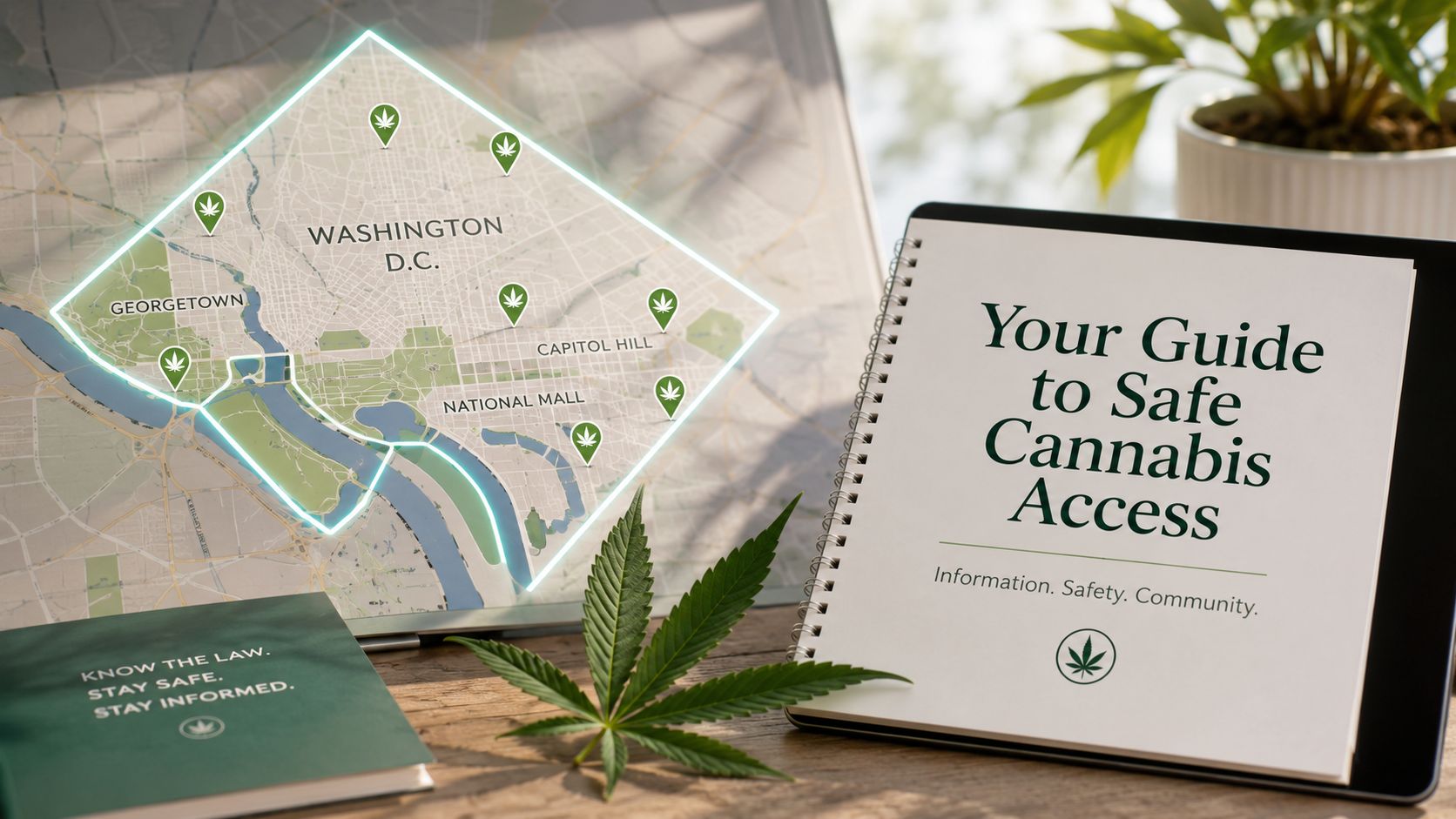
That part confuses plenty of first-time patients. The science can feel manageable once it is broken down. The shopping process is often what creates stress.
Start by treating your dispensary visit like a short doctor-style intake. You do not need a perfect explanation of your pain. You just need a clear, useful one. A few notes on your phone can save you from staring at a menu and guessing.
Write down three things before you shop:
- Where the pain shows up
- What time of day it bothers you most
- What kind of relief you want, such as localized support, longer-lasting body relief, or quicker help during flare-ups
Small details matter here. "Right shoulder pain after desk work, worse at night, want something I can use without feeling too intoxicated" gives staff something concrete to work with. "Need pain relief" does not.
If you are unsure what paperwork or eligibility rules apply, check the current medical card requirements in Washington, DC before you head out.
What a good dispensary conversation should sound like
A helpful interaction should feel calm, clear, and specific. The staff member should ask questions that narrow the options instead of pushing you toward the strongest product on the shelf.
Useful questions often focus on:
- Format, such as topical, tincture, edible, or inhaled product
- Cannabinoid balance, such as CBD-forward, THC-forward, or balanced
- Daily timing, such as daytime use versus bedtime use
- Experience level, especially if this is your first cannabis purchase for pain
Here is a simple way to judge whether the guidance is useful. If you say, "I have hand arthritis, I do not want to smoke, and I still need to function at work," the answer should narrow toward practical options that fit that situation. Usually that means starting with non-inhaled products and discussing how long each option lasts.
How to shop safely in DC
In Washington, DC, safe access means more than finding a place that sells cannabis. It means choosing a dispensary that offers clearly labeled products, answers beginner questions without rushing you, and helps you understand what you are buying before you leave.
That last part matters a lot for pain relief. Two products can sit in the same category and behave very differently. One tincture may be mild and balanced. Another may be much stronger and better suited for an experienced user. Labels, staff guidance, and a patient-friendly conversation help you avoid trial-and-error that feels rougher than it needs to.
Bring your symptom notes. Ask how fast the product tends to kick in. Ask how long the effects usually last. Ask whether it is better suited for a sore spot, broad body discomfort, or nighttime support. If you are brand new, say so right away. That helps the staff guide you toward lower-risk starting points.
A good rule is simple. Do not leave the counter with a product you do not understand.
For DC patients, safe cannabis access is not just about following local rules. It is about walking out with something that fits your pain pattern, your tolerance, and your day-to-day life.
Begin Your Wellness Journey with Confidence
Cannabis pain relief makes more sense when you break it into parts. Your body has a system that responds to cannabinoids. Different formats solve different problems. THC and CBD don't do the same job. The right dose is usually lower than first-time patients expect.
That combination is what turns cannabis from a confusing category into a practical option. A topical may help a sore joint. A tincture may fit evening pain better than an inhaled product. A balanced formula may offer enough relief without feeling too heavy. You won't know your ideal setup on day one, but you can get there with a careful approach.
The most useful mindset is calm and methodical. Pick one product. Start low. Give it time. Pay attention to what changes.
If you're in Washington, DC and you're ready to turn research into a real plan, talk with someone who can help you match your pain pattern to a product you can use safely and confidently.
If you're ready to take the next step, visit Mr. Nice Guys DC and talk through your goals with their team. Bring your questions, your symptom notes, and your preferred format. Whether you're curious about topicals for localized discomfort, tinctures for steadier relief, or how to start low without overdoing it, a clear conversation can make your first purchase much easier.
Mr Nice Guys DC
At Mr. Nice Guys DC, we’re more than just a cannabis delivery service — we’re passionate advocates for quality, convenience, and community. With years of experience in the cannabis industry, our team is dedicated to educating and empowering customers across Washington, D.C. Whether you're a seasoned user or just starting your cannabis journey, our blog delivers trusted tips, product insights, and the latest updates from the world of weed. Stay informed, stay elevated.
