
Must Be 21 To Enter
By entering this site you are agreeing that you are at least 21 Years of Age or older.
I AM 21 OR OLDERCBD vs THC for Pain Which Is Better for Relief
.svg)

.png)
When you're dealing with pain, the cannabis world presents a big choice right off the bat: CBD or THC? It’s a common question we get. While both come from the same plant, they tackle pain in completely different ways, and knowing the difference is key to finding real relief.
Think of it like this: THC is a direct, heavy-hitter, but it comes with the "high." A practical example would be using a THC vape for a sudden, intense migraine. CBD is more of a background supporter, working on inflammation without any intoxicating effects, like applying a CBD cream to a sore knee after a long run. For a lot of people, the sweet spot is actually somewhere in between.
THC: The Direct Approach
Tetrahydrocannabinol, or THC, is the compound in cannabis famous for its psychoactive effects. When it comes to pain, it works by directly connecting with the CB1 receptors in your brain and nervous system.
This interaction essentially tells your brain to turn down the volume on pain signals. That’s why THC can feel so powerful for severe or sudden pain—it changes your perception of the discomfort itself. For example, someone experiencing a sharp flare-up of sciatic nerve pain might find a THC-infused product provides rapid relief by altering how their brain interprets the pain signals.
CBD: The Indirect Route
Cannabidiol, or CBD, takes a different path. It's completely non-psychoactive, so you won't feel a "high." Instead of blocking pain signals head-on, CBD works behind the scenes.
It helps your body’s own endocannabinoid system run more efficiently and directly targets inflammation, which is often the root cause of chronic pain. This makes it a go-to for conditions like arthritis or ongoing muscle soreness. A practical example is a person with chronic arthritis using a daily CBD oil to help manage the underlying inflammation, leading to less pain and stiffness over time.
Quick Comparison: CBD vs. THC for Pain
To make the choice a little clearer, here’s a simple breakdown of how these two cannabinoids stack up for pain management.
| Attribute | CBD (Cannabidiol) | THC (Tetrahydrocannabinol) |
|---|---|---|
| Psychoactive Effect | No "high"; non-intoxicating | Produces a "high"; psychoactive |
| Primary Pain Action | Reduces inflammation and supports the body's pain system | Directly alters pain perception in the brain |
| Best For | Chronic inflammation, localized pain, anxiety-related pain | Severe or acute pain, nerve pain, pain causing sleep issues |
| Common Side Effects | Fatigue, changes in appetite, diarrhea | Dry mouth, increased heart rate, impaired coordination, anxiety |
| Legal Status in DC | Legal if derived from hemp (<0.3% THC) | Legal for medical and adult recreational use |
Ultimately, this table shows two very different tools for two different jobs. One isn’t universally "better" than the other; it’s all about matching the tool to your specific type of pain and lifestyle.
Key Takeaway: Think of THC as a fast-acting pain blocker that changes how you feel pain right now. CBD is more like a long-term anti-inflammatory that helps your body manage pain at the source, without the high.
For example, someone with sharp, debilitating nerve pain might find a tincture with a balanced THC/CBD ratio gives them the immediate relief they need to get through the day. On the other hand, a person with a stiff, arthritic knee could get fantastic results from a potent CBD topical applied right on the joint, with zero psychoactive effects to worry about.
While we're comparing the big two, it's worth noting that even different forms of THC have their own unique properties. To go a bit deeper, check out our guide on THCA vs. THC and what every DC patient needs to know.
In the end, the CBD vs. THC for pain debate isn't about picking a winner. It's about figuring out what works for you.
How Cannabinoids Influence Your Body's Pain Response
To really figure out the "CBD vs. THC for pain" question, you have to get what they’re doing inside your body. Both cannabinoids interact with a network called the endocannabinoid system (ECS), which is basically your body's master control panel for things like pain, mood, and sleep. But they don't work the same way at all.
Think of your ECS like a system of locks (receptors) and keys (cannabinoids). Your body makes its own keys to keep things in balance. THC and CBD are like outside keys that also fit, but they turn the lock in completely different ways.
THC: The Direct Pain Blocker
THC’s method for handling pain is all about direct, powerful action. It locks onto CB1 receptors, which are packed into your brain and central nervous system. This is what gives you that classic psychoactive high.
But for pain, this connection is everything. It acts like a roadblock, cutting off pain signals before your brain can fully register them. It literally changes how you perceive pain, which is why it works so well for that sudden, sharp, or nerve-related stuff.
- Practical Example: Someone with intense, acute back pain from an injury might find that a THC-heavy product brings almost instant relief. It’s not that the injury is gone—it’s that THC is telling the brain to dial down the alarm bells, making the pain feel way less urgent.
CBD: The Indirect System Modulator
CBD is a lot more subtle. It doesn't really bind with CB1 receptors, which is exactly why it won’t get you high. Instead of flipping a switch like THC, CBD acts more like a system-wide manager, influencing your body in a few clever ways.
For one, it stops your body from breaking down its own natural endocannabinoids, letting them hang around and do their calming, balancing job for longer. More importantly for pain, CBD works on other receptors tied to inflammation and pain, like the TRPV1 receptors.
By going after inflammation at the source, CBD is addressing the root cause of a lot of chronic pain, not just hiding the feeling. It's less about turning down the volume and more about quieting the source of the noise.
This approach makes CBD a fantastic choice for managing persistent, nagging pain that's driven by inflammation.
- Practical Example: Think about someone with chronic arthritis in their hands. They might not need the immediate, head-on relief THC offers. Instead, using a high-CBD tincture or topical consistently can help lower the underlying inflammation over time, leading to a slow but steady drop in pain, stiffness, and swelling.
This difference is the key. THC offers a potent, fast-acting way to block your perception of pain, while CBD brings a non-intoxicating, anti-inflammatory approach for long-term management. For a lot of people, the best move is actually using both.
Products combining CBD and THC, often called full-spectrum, can give you the best of both worlds. You can dive deeper into how these compounds work together in our article explaining what full-spectrum cannabis is. Getting these fundamental differences is the first step to picking the right product for your specific pain.
What Science Says About Cannabinoids and Pain
Personal stories about cannabis helping with pain are everywhere, and they're powerful. But when you’re trying to choose between CBD and THC, you need to look past the anecdotes and get into the real data. The clinical evidence is where we separate marketing hype from what actually works, and what researchers are finding is pretty surprising.
When it comes to THC, especially when taken orally, the studies show it does provide pain relief. It's often described as a modest improvement, but it’s consistent and measurable. That alone gives it a solid footing as a real option for managing certain kinds of pain.
The catch? THC’s side effects, like dizziness or feeling "out of it," are a dealbreaker for a lot of people. This is where the whole CBD vs. THC debate gets tricky, forcing you to weigh genuine relief against some potentially unwanted effects.
A Closer Look at the Research on THC and CBD
Recent studies are finally giving us a clearer picture of how these two cannabinoids stack up, and the results often go against what you might think—especially when it comes to CBD’s reputation as a standalone painkiller.
A major 2026 review from Oregon Health & Science University really laid it out. Researchers found that products with only oral THC gave patients a modest but definite improvement, knocking their pain scores down by about 0.5 to 1.0 points on a 10-point scale. On the flip side, the same review concluded that products with only CBD were basically no better than a placebo for directly reducing pain. You can read up on the findings on cannabinoid efficacy from OHSU for yourself.
This tells us that if you're looking for direct, noticeable pain relief, THC has the stronger scientific backing. So, if CBD isn't a great painkiller on its own, where does it fit into the picture?
The Power of Working Together
Things get a lot more interesting when you combine CBD and THC. This is where the whole "entourage effect" stops being a theory and becomes a practical strategy. The two cannabinoids work together in some pretty powerful ways.
When you take them together, CBD can actually dial down the intense psychoactive buzz from THC, making it a much more tolerable experience for more people. Even better, the combination seems to deliver way more pain relief than either one could on its own. The science behind it is complicated, but for people dealing with chronic pain, the results speak for themselves. We get into this more in our article on the science behind marijuana tinctures and their effects.
One clinical analysis found a huge difference: a THC and CBD combo helped 90% of patients get at least a 30% reduction in pain. For comparison, only 55% of patients using just CBD hit that same level of relief.
This is a pretty strong signal that for a lot of us, the best move isn't picking one cannabinoid over the other. It's about figuring out the right ratio of both.
Real-World Examples:
- For Nerve Pain: Someone with sciatic pain might find a 1:1 ratio of THC to CBD in an edible gives them steady relief without making them feel too high. The THC goes after the nerve pain signals, while the CBD helps with inflammation and takes the edge off the psychoactivity.
- For Widespread Arthritis: A person with inflammatory arthritis across multiple joints could do well with a tincture that has more CBD than THC, maybe a 4:1 ratio. This focuses on fighting inflammation while still getting that small, synergistic hit of direct pain relief from the THC.
At the end of the day, the science steers us away from a simple "CBD vs. THC" fight. It points us toward a smarter, more personalized strategy of using them together.
Matching the Right Product to Your Pain Type
So, you've started to figure out the difference between CBD and THC for pain. That's a great start, but it's only half the story. The real secret to getting results is matching the right product format to your specific kind of pain.
You can have the perfect cannabinoid, but if it’s in the wrong format—say, an edible when you need a cream—you’re not going to get the relief you’re looking for. Deciding between topicals, tinctures, vapes, and edibles depends entirely on what hurts, how fast you need relief, and how long you need that relief to stick around.
Localized vs Systemic Pain Relief
First things first: where does it hurt? Is your pain pinned to one spot, like a cranky knee, or is it a more widespread issue, like the body-wide aches from fibromyalgia? Answering this question is your first step.
For Localized Pain (e.g., Arthritis, Muscle Soreness, Joint Pain): Topicals are your best bet. These are the balms, creams, and gels you apply right onto the skin where it hurts. They go to work on that specific area without ever entering your bloodstream. That means zero psychoactive effects and nothing to worry about on a drug test. A practical example is a cyclist rubbing a CBD balm on their sore quads after a long ride.
For Systemic Pain (e.g., Fibromyalgia, Nerve Pain, Widespread Inflammation): This is where tinctures, edibles, or vapes come in. These methods get the cannabinoids into your system, letting them travel throughout your body to tackle pain from the inside out. For instance, someone with fibromyalgia might use a balanced THC/CBD tincture under their tongue for body-wide relief.
The visual guide below shows how you can think about combining cannabinoids for this kind of systemic pain.
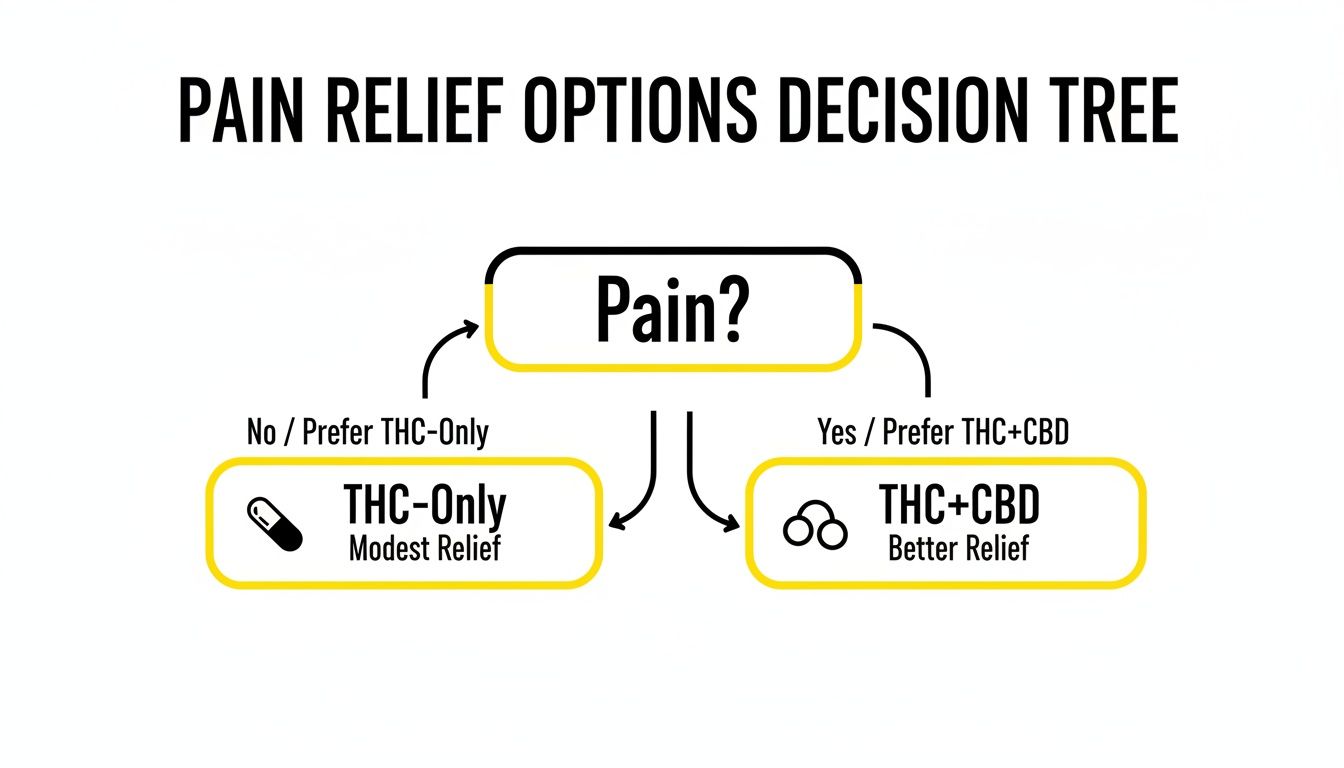
As you can see, a lot of people find that while THC does a decent job on its own, adding CBD into the mix often takes the relief to another level.
The Power of Topical Applications
We've seen it time and again: people get incredible results from a good CBD topical for localized pain, even after being let down by oral CBD products. It makes sense when you think about it. Applying a topical directly to the source lets the cannabinoids get straight to the receptors in your skin and tissue, bypassing your digestive system entirely.
Don't just take our word for it. A 2023 clinical analysis showed just how much the right format matters. In one study, 18 patients with thumb osteoarthritis used a topical CBD gel twice a day for two weeks. Their pain scores plummeted from 5.0 to 2.2 on a 10-point scale—a massive improvement compared to the placebo group. Plus, there were no side effects or skin irritation reported. You can read the full research about these topical CBD findings for yourself.
Practical Example: Someone with a painful, arthritic knee is the perfect candidate for a high-potency CBD topical. They can rub the balm right onto the joint to fight inflammation at the source. Best of all, they can do it throughout the day and stay completely clear-headed and functional.
Aligning Product Format with Your Needs
Beyond just where the pain is, you also have to consider how quickly you need relief and how long it needs to last. This is where the different formats really show their strengths.
| Delivery Method | Onset Time | Duration | Best For |
|---|---|---|---|
| Vaping/Inhalation | 1-5 Minutes | 1-3 Hours | Immediate help for sudden, sharp pain flare-ups. |
| Tinctures (Sublingual) | 15-45 Minutes | 4-6 Hours | Quick, easy-to-adjust relief for daily pain management. |
| Edibles/Capsules | 60-120 Minutes | 6-8+ Hours | Long-lasting, all-day (or all-night) relief for chronic pain. |
| Topicals | 20-40 Minutes | 4-6 Hours | Targeted, non-psychoactive relief for a specific muscle or joint. |
For someone dealing with widespread fibromyalgia, a balanced 1:1 THC:CBD tincture could be a game-changer. It delivers THC's direct pain-fighting ability along with CBD's powerful anti-inflammatory action. If you want to go even deeper on finding the right product, check out our guide on choosing the right weed strains for pain. Getting this match right is the most critical part of your journey to feeling better.
Real Stories of Pain Relief With Cannabis

Clinical trials give us the hard data, but they don't always paint the full picture of what it's like to live with chronic pain every day. The real-world stories from people using cannabis are where you see the true impact—and it’s often about so much more than just a number on a pain scale.
For a lot of folks, successful pain management isn't just about dulling a persistent ache. It’s about finally sleeping through the night, shaking off the anxiety that comes with pain, and getting back to doing the things they love.
More Than Just Painkillers
The debate over CBD vs. THC usually gets stuck on which one is a better painkiller, but people’s actual experiences tell a much bigger story. Many find that cannabis really shines by improving their overall quality of life, which, in turn, helps them handle their pain better.
Think about someone with chronic lower back pain. A balanced THC/CBD edible might not make the pain vanish completely, but it can ease it enough to allow for a solid night of sleep. That rest makes a huge difference, reducing the fatigue and stress that make pain feel so much worse the next day.
This is a common theme we hear again and again. By helping with related problems like insomnia or anxiety, cannabis products often give people a sense of wellness that directly contributes to their pain relief.
Cutting Back on Pills
One of the clearest signs that cannabis is working is when people can start reducing their other pain meds, especially opioids. For anyone stuck in a cycle of prescriptions, this is a massive win.
And it's not just talk. Survey data backs this up in a big way. In one study of chronic pain patients, 62% said they had tried CBD. Out of that group, 59% felt it helped with their pain.
Even more telling? A whopping 67.6% reported that using CBD allowed them to cut back on other pain medications, and 53.7% specifically reduced their opioid use. You can read the full research about these patient-reported outcomes to see the details for yourself.
When asked what conditions improved the most, patients pointed to back pain (67.3%), nerve pain (46.7%), and neck pain (44.7%).
These numbers give a voice to the countless people who have found a better way to manage their pain with cannabis. For someone with stubborn nerve pain, swapping an opioid prescription for a nightly cannabis tincture can completely change their life for the better.
What all this really shows is that there's no single "best" way to manage pain. It's deeply personal. The CBD vs. THC question isn't always about picking a winner. More often, it's about finding the right product or combination that helps you live a better, more balanced life.
Finding Your Solution at Mr. Nice Guys DC
All this info on CBD vs. THC is great, but how do you actually turn it into a product that works for you? That’s where we come in. At Mr. Nice Guys DC, we help you connect the dots and find something that genuinely helps.
The golden rule, especially if you’re new to this or trying something with THC, is simple: start low and go slow.
Seriously. Take a small dose, wait to feel the full effects, and only increase it if you need to. A practical example: if you're trying a new edible, start with a 2.5mg or 5mg piece, wait a full two hours, and then decide if you need more. It’s the best way to find that perfect balance for pain relief without any unwanted surprises.
Getting the Right Recommendation in DC
Our budtenders are here to have a real conversation about what you need for your pain and your lifestyle. We’re not just here to sell you something; we want to be your partners in figuring this out.
Here’s what that actually looks like when you walk into our shop:
For daytime arthritis pain: Say you’re dealing with stiff, inflamed hands but need to stay sharp for work. We’d probably point you toward a high-CBD topical you can apply right where it hurts. Or maybe a tincture with a 20:1 CBD-to-THC ratio to kill the inflammation without making you feel fuzzy.
For nerve pain that wrecks your sleep: This needs a totally different game plan. If nerve pain is keeping you up at night, a 1:1 THC:CBD edible or tincture taken an hour before bed could be a game-changer. The THC targets the nerve signals, while the CBD tames inflammation and smoothes out the high, helping you get some real, deep rest.
As you can see, it’s not just about the type of pain. It’s about your life—what you do during the day and what you need at night.
The goal isn't just to cover up pain. It's about getting your quality of life back. We listen to what you need so we can recommend a product that helps you stay on your feet during the day or finally get the sleep you’ve been missing.
Your wellness journey is a team effort. Always talk to your doctor before adding cannabis to your routine. They know your health history and can give you the green light, especially regarding other medications.
Once you’ve got their advice, our crew is here to help you sort through the options. If you want to get a head start, check out our guide on what to know before your first medical cannabis visit to Mr. Nice Guys DC.
Ready to find what works? Swing by the dispensary for a one-on-one chat or browse our online menu. We’re here to help you find the right path to relief.
Frequently Asked Questions About Cannabis for Pain
Stepping into the world of cannabis for pain relief can bring up a lot of questions. We get it. From safety concerns to figuring out the right dose, you need straight answers to feel confident. Here’s the real talk on the most common questions we hear every day.
Can I Build a Tolerance to CBD or THC?
Yes, building a tolerance is a real thing, especially when it comes to THC. You might notice that over time, you need a bit more to get the same level of pain relief. It’s a common experience.
If this happens, you don't need to do anything drastic. A quick “tolerance break” of just 48-72 hours is often enough to reset your system. Another move is to simply switch things up by trying a product with a different CBD-to-THC ratio. For example, if you've been using a 1:1 product, try a 4:1 CBD:THC product for a few days. While tolerance to CBD is far less common, rotating your products is always a solid practice.
Will CBD or THC Interact with My Other Medications?
This is a big one, and the short answer is yes, they absolutely can. You have to be careful here. Both cannabinoids, but especially CBD, can change how your body processes other drugs. This is particularly true for things like blood thinners (like Warfarin), certain antidepressants, and some heart medications.
CBD can actually change the concentration of these other meds in your bloodstream, which can be risky. For example, it can make a blood thinner more potent, increasing the risk of bleeding.
We can’t stress this enough: always talk to your doctor or a pharmacist before you start using any cannabis product if you’re on prescription medication. They can help you understand the specific risks and make sure you’re staying safe.
What Is the Best CBD to THC Ratio for Chronic Pain?
There’s no magic number here—the "best" ratio is different for everyone. It all comes down to your type of pain, your personal tolerance, and what you need to get done during the day.
A 1:1 ratio of CBD to THC is a popular starting point for chronic pain. The CBD is great for managing the high from THC while adding its own anti-inflammatory power. For daytime use when you need to stay sharp, a lot of people lean towards high-CBD ratios like 10:1 or 20:1. On the flip side, if you're dealing with severe pain or need help sleeping, a product with more THC might be what you need. The key is to start low, go slow, and see what feels right for your body.
Ready to explore your options with guidance from experts? The team at Mr. Nice Guys DC is here to help you find the right product for your pain management needs. Visit our dispensary or browse our online menu today.
Mr Nice Guys DC
At Mr. Nice Guys DC, we’re more than just a cannabis delivery service — we’re passionate advocates for quality, convenience, and community. With years of experience in the cannabis industry, our team is dedicated to educating and empowering customers across Washington, D.C. Whether you're a seasoned user or just starting your cannabis journey, our blog delivers trusted tips, product insights, and the latest updates from the world of weed. Stay informed, stay elevated.
