
Must Be 21 To Enter
By entering this site you are agreeing that you are at least 21 Years of Age or older.
I AM 21 OR OLDERWhat Is Couch Lock? Effects, Causes and How to Avoid It


You sat down at 8:40 for one episode. It's 10:15, the credits have rolled twice, your hand is somewhere at the bottom of an empty popcorn bowl, and standing up has turned into a project you keep postponing.
That's couch lock, and it's one of the more predictable things about cannabis once you know what you're looking at. It isn't a personality trait of a strain, and it isn't proof you bought something exceptionally strong. It's what happens when THC arrives faster or in a larger amount than your body wants at that moment, and it clears on a timeline you can plan around.
What Couch Lock Actually Means
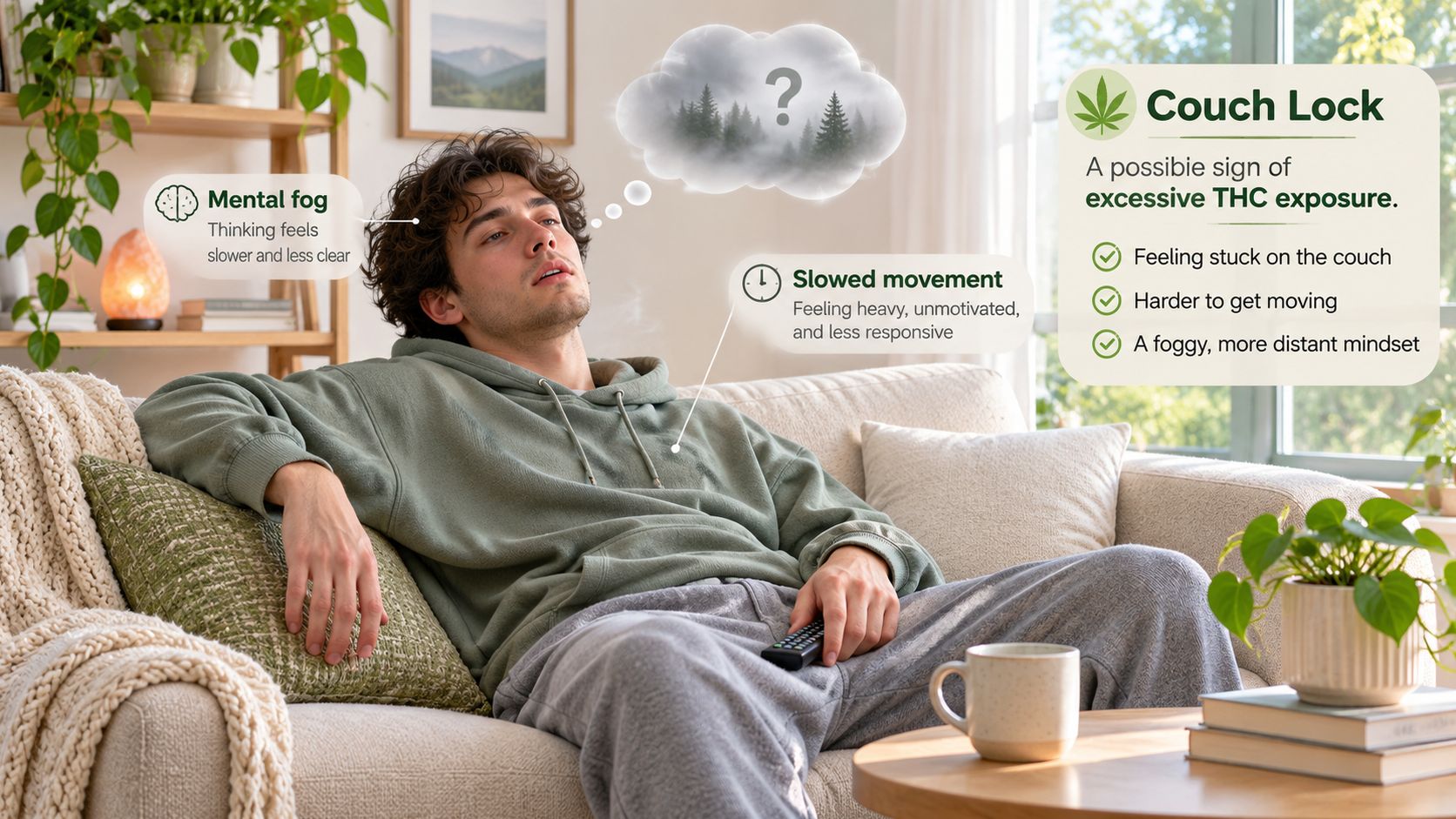
Ask a room of regular cannabis users to describe couch lock and the stories converge fast. The film is still running, your limbs feel heavier than they did an hour ago, and a trip to the kitchen has become optional in a way that surprises you. Warm, comfortable, stuck: standing up has turned into a decision rather than a movement.
Couch lock is the informal name for that state. It describes a subjective mix of pronounced relaxation, physical heaviness, reduced motivation, drowsiness and a real unwillingness or inability to leave a chair or sofa, as Ganjapreneur's cannabis vocabulary entry explains. Researchers never adopted the slang term. They describe its components instead: sedation, somnolence, impaired alertness and slowed movement.

The phrase spread through cannabis forums and seed-bank catalogues as growers began sorting cultivars by the experience buyers reported. It stuck because the state it names is so easy to recognize.
Couch lock works like a dial. A small amount turns it toward calm: shoulders drop, conversation slows, you stay yourself. Push further and the same dial passes into sofa-bound sedation, where the body feels weighted and the brain has stopped taking requests.
Where the dial lands depends on the person as much as the product. Dose, THC potency, route of administration, tolerance, sleep, metabolism and the product's overall chemistry all move the setting, which is why one session can feel easy and the next immobilizing.
A concrete comparison makes that clearer. A 2.5-milligram vape hit before a film often lands as relaxed but mobile: you can get up for a snack, answer a text, follow the plot. A 10-milligram edible taken at the same hour behaves differently, arriving later and deeper, and the snack trip may not happen until the credits.
Wondering what couch lock is at midnight usually means you want three answers: how long it lasts, what drives it, and how to avoid it when you don't want it, or invite it when you do. Either way, the evening itself is already telling you something. A sofa-bound night is feedback about dose and timing, a signal that the session overshot the mark, and one you can act on the next time you choose a product and portion.
How Long Couch Lock Lasts by Route
Timing is the first thing people want and the last thing a label tells them. Route changes the schedule more than strain ever does. Inhaled cannabis commonly impairs for several hours, and the window stretches at higher doses: Colorado's transportation guidance recommends waiting at least six hours before driving after smoking up to 35 milligrams, and at least eight hours after edible cannabis (Colorado DOT guidance on how long to wait after getting high).
| Route | Typical onset | Peak | Impairment window |
|---|---|---|---|
| Smoked, dabbed or vaped | Within a few minutes | Inside the first hour | Several hours; at least six before driving at typical doses |
| Edibles and drinks | 45 to 90 minutes | Later than expected, often two to four hours in | At least eight hours |
| Tinctures and oils | 15 to 45 minutes under the tongue, longer if swallowed | Around the two-hour mark | Plan it like an edible |
The impairment column is the safety figure. Onset and peak are working estimates you'll calibrate to your own body over a few sessions.
Inhaled products hit while the device is still in your hand, which makes them easy to stop but harder to measure: you're counting puffs rather than milligrams. Edibles invert that trade. The dose is precise, the timing isn't, and the late peak is what catches people who feel nothing at the 45-minute mark and take a second serving. If you're choosing between the two routes for a given night, the edibles vs smoking breakdown shows how onset and duration differ in practice. Tinctures sit in between, faster than a chewed gummy, slower than a vape, and the difference between holding the oil under your tongue and swallowing it is real.
Where the clinical numbers land
The two sensations people describe most often, sleepiness and unsteadiness, are well documented. A living systematic review covering 6 randomized controlled trials and 866 participants found sedation in 22% of people given cannabis-based products versus 4% on placebo, a relative risk of 5.04 with a 95% confidence interval of 2.10 to 11.89. Dizziness appeared in 30% versus 8%, a relative risk of 3.57 and a confidence interval of 2.42 to 5.60 (the evidence review summarized by NCBI Bookshelf). A separate assessment in the same report put sedation at 24% with synthetic or plant-purified THC against 16% with placebo across 5 trials and 458 participants, a relative risk of 1.57.
Neither figure measures couch lock directly, because the term has no clinical scale. They measure its ingredients. They also appeared across different preparations, including products with similar THC-to-CBD ratios and purified THC, so no strain category owns them.
Here's how the timing plays out in practice. Say you take a 5-milligram vaped dose at 7 p.m. and it feels mild at 10 minutes, just a pleasant looseness in the shoulders. By 90 minutes the same dose has you sunk into the cushions, and nothing about the product changed. The dose was the same; the curve kept climbing after you'd already judged it.
Treat every window as a planning estimate rather than a promise. The stretch where you're impaired can run longer than the stretch where you feel high, and feeling awake isn't evidence that your reaction time, judgment and coordination have fully returned. When the heavy stretch outlasts your plan, read it as a dose signal for next session rather than a trait of the product.
What Causes the Heavy, Stuck Feeling
The heavy feeling starts with THC reaching the brain, and everything else adjusts how much arrives and how fast. That framing matters, because it turns a mysterious strain property into a set of variables you can change. A clinical review of cannabis effects puts it plainly: the experience is best explained by THC exposure interacting with dose, route, tolerance, sleep status and individual physiology (a review of cannabis effects and dosing).
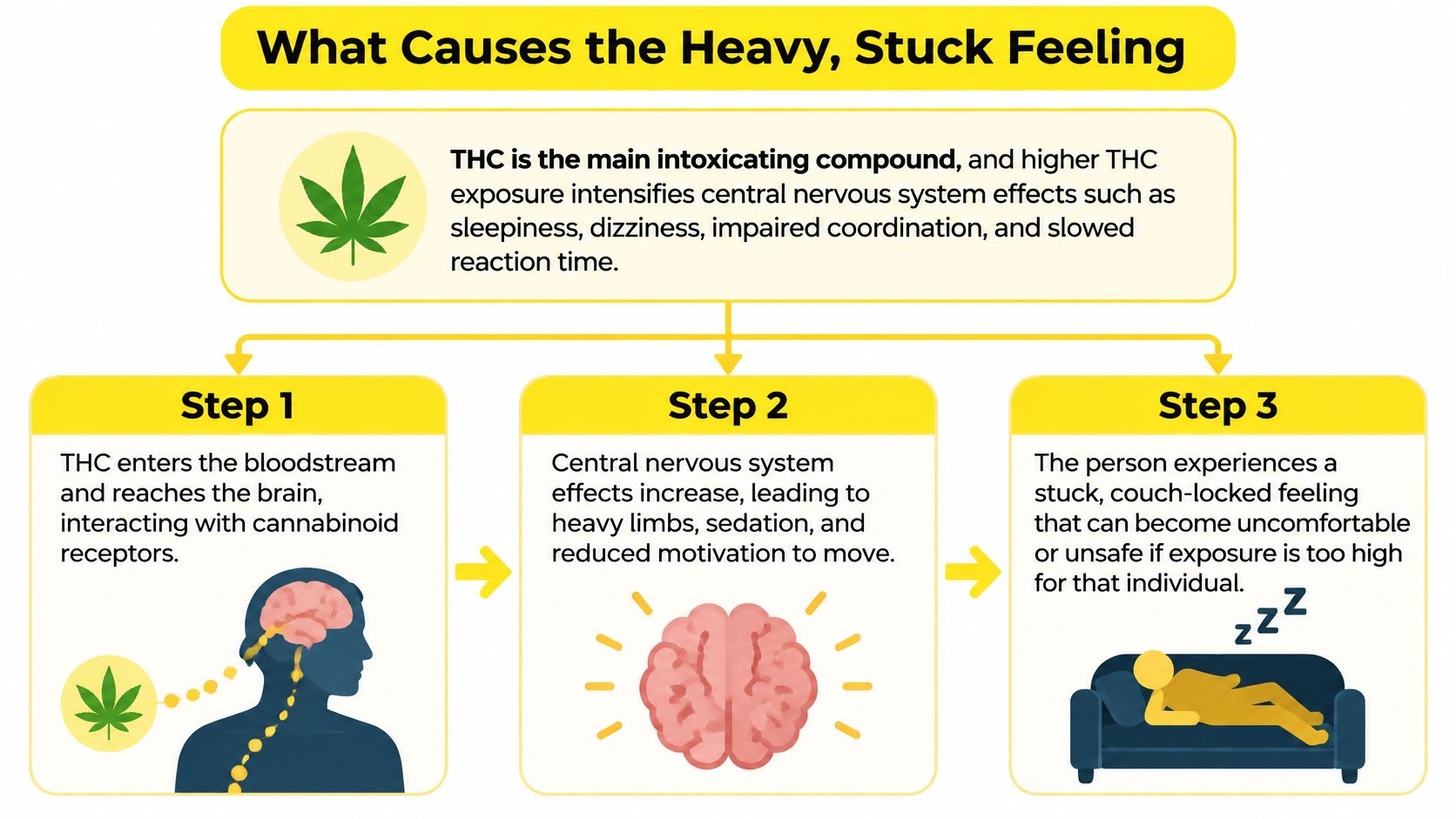
Step one is the molecule. THC is the main intoxicating compound in cannabis, and higher exposure intensifies central nervous system effects, including impaired coordination, slower reaction time and sleepiness. There's no separate "couch lock chemical" waiting to be found.
Step two is the layering. Dose and potency set the ceiling. Route sets the speed. Tolerance lowers the response, sometimes a lot. Sleep debt raises it. A regular user who slept five hours may feel a modest dose far more heavily than usual, then feel almost nothing on a well-rested day from the same amount.
The layers explain why two people sharing one joint can end up in completely different states, and why your own tolerance from last month is a poor guide to tonight.
Stacking is what turns calm into stuck
The third step is combination. Alcohol, sleep aids, antihistamines and other sedating medications add their own depressant load on top of the THC, so a dose that felt light last week can flatten you this week without changing at all. The cannabis didn't get stronger. The total sedative burden did.
Terpenes and other plant compounds may shape how a product feels, an idea usually described as the entourage effect, though the human evidence for a sedating effect from any single terpene is thin (what the entourage effect does and doesn't explain).
Because purified and synthetic THC produce the same sleepiness and unsteadiness, the mechanism can't belong to one plant variety. It belongs to the molecule and the amount of it that reached you.
Strain Names, Terpenes and the Indica Myth
Ask ten experienced consumers why some cannabis glues you to the sofa and most will give you the same answer: it's an indica, and it's the myrcene. Both halves of that answer are weaker than they sound.
Research doesn't support a simple rule that "indica" automatically causes couch lock, and no one has identified a single definitive chemical trigger. Myrcene, the terpene most often blamed, has evidence behind it that is almost entirely preclinical.
What the myrcene evidence actually shows
The most-cited experiment used injected beta-myrcene at 100 to 200 mg/kg in mice, which reduced movement and muscle activity and lengthened barbiturate-induced sleep. Those doses and that intraperitoneal route aren't comparable to the far smaller, more variable exposure from ordinary cannabis use. A later zebrafish study reported behaviour consistent with sedative or anxiolytic activity while explicitly calling for human research. Laboratory work has also found that common terpenes, beta-myrcene included, did not directly activate CB1 or CB2 receptors or measurably alter THC signalling in those assays (a review of the myrcene and couch lock evidence).
No controlled human trial links cannabis myrcene concentration to couch lock. That's the whole finding.
A terpene percentage tells you what a product smells and tastes like. It doesn't tell you how heavy it will feel.
So what should you read on a label? Use this instead of the strain-name shortcut.
| Label signal | What it suggests | What it does not establish |
|---|---|---|
| Indica or sativa name | General growth-type category | Does not reliably predict couch lock |
| THC percentage | Potency of the flower or product | Dose per serving matters more than the percentage |
| Myrcene percentage | Terpene content, mainly aroma and flavour | Does not establish sedation in people; no controlled human trial |
| Serving size in milligrams | How much THC you are taking | Individual response still varies, so start low |
| Strain name alone | Marketing description | Not a dosing guide |
Treat terpene percentages as aroma and flavour information, and build your expectations from THC dose, product format and your own response. Indica and sativa still work as a rough starting filter, but they're a filter, not a forecast (how indica and sativa effects differ in practice).
How to Dose to Avoid or Seek the Effect
Two people eat the same 10-milligram gummy. The first took it at 6 pm with a clear evening ahead and rides out a heavy, settled feeling by 9. The second took it at 9 pm on top of an earlier serving and wonders why the room won't let go at midnight. Same product, different dose-and-timing math. Dose and timing are the variables you fully control, and they decide whether couch lock shows up at all.
The useful numbers come from state public-health guidance, not budtender folklore. Colorado treats 10 milligrams of THC as a meaningful dose, one likely to cause impairment in occasional consumers, and notes edible effects may peak as late as four hours after eating and last up to 10 hours. Its wait times run to at least six hours before driving after smoking up to 35 milligrams, and at least eight hours after eating or drinking up to 18 milligrams (Colorado Cannabis Drives Smart guidance).
Six steps that keep the dose honest
- Read milligrams, not names. The THC number per serving is the only figure that tells you how much intoxicant you're taking. A strain name tells you nothing you can measure.
- Treat 10 milligrams as a real dose. For someone who uses occasionally, a single 10-milligram serving can produce impairment on its own. That's the benchmark, not the starting point.
- Choose the route on purpose. Vapes and flower arrive fast and stop fast, which makes them easier to steer. Edibles are delayed and longer, which suits a planned evening and punishes a spontaneous one. If edibles are your format, build up from a low-dose starting point over several sessions (how low-dose edibles change the timing curve).
- Wait the full window before redosing. If a gummy feels weak at 45 minutes, that's absorption lag, not a weak product. A second serving taken before the first has fully kicked in can stack on top of it, and the combined effect often feels much stronger than expected an hour or two later.
- Skip the sedatives. Alcohol, sleep aids and antihistamines deepen a mild effect into a heavy one. One variable at a time keeps the outcome predictable.
- Book the transport before you consume. Decide who's driving, or that nobody is, while you're still clear-headed enough to make the call.
Reverse the logic when you want to stay mobile. A lower dose through a faster route gives you a shorter, more controllable timeline. A higher dose through an edible gives you the longest one available.
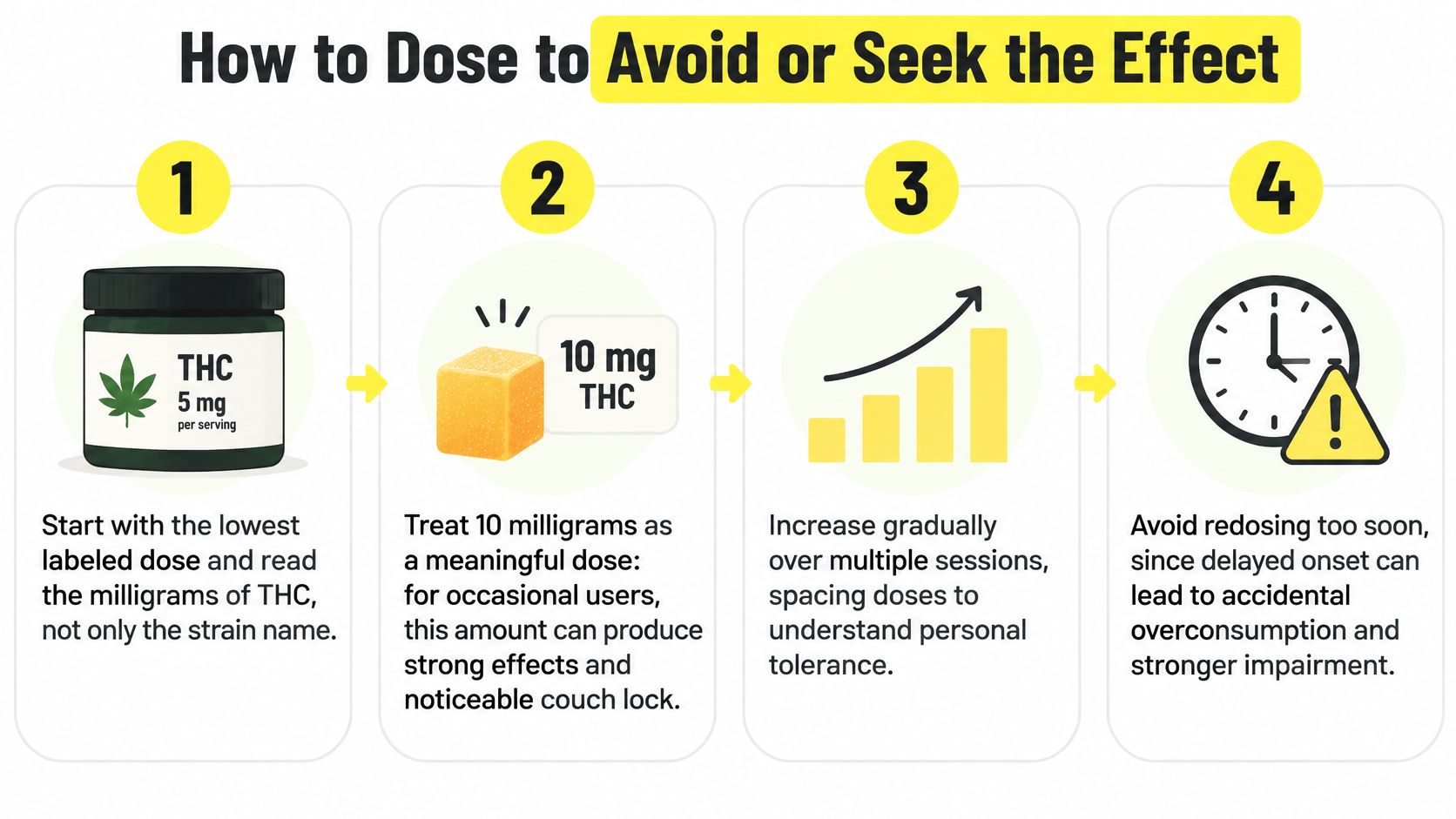
The same math works in reverse for someone who wants the effect. A deliberate higher dose, taken early in an evening with nothing else scheduled, is how you end up on the sofa on purpose rather than by accident. Either way, the plan is the same three numbers: milligrams, route, and the clock. If you can't state your dose out loud, you don't have a plan yet.
When Couch Lock Becomes a Safety Problem
Couch lock isn't evidence of superior potency or better quality. It's a signal that the dose was more than your body wanted at that moment, and sometimes it tips past comfort into genuine impairment.
Public-health guidance identifies sedation, dizziness and nausea as common adverse events that become more likely with higher-THC products, and notes that cannabis can impair reaction time and attention. The same guidance advises against cannabinoid use while driving, operating heavy equipment or doing other safety-critical work (Oregon Health Authority cannabis public health statements).
A government review of medical cannabis and road safety goes further, listing drowsiness, sedation, impaired judgment, slower reaction time, poorer motor control, reduced concentration, confusion and blurred vision among the effects that compromise safety (the UK review of medical cannabis and road safety).
The stop-and-settle plan
When the effect turns uncomfortable, the response is boring and effective.
- Stop consuming. No more hits, no more gummies, no top-ups while you wait to see how you feel.
- Stay put and stay safe. Sit or lie somewhere familiar, and keep someone nearby if you can.
- Don't drive, cycle or operate anything. Coordination lags behind how alert you feel.
- Skip alcohol and other sedatives. They add to the load instead of easing it.
- Drink water normally and eat something light. You're not flushing THC out; you're keeping yourself comfortable while it clears.
First-time users, older adults and anyone taking other medications should start lower than they think necessary, because their response is the least predictable.
Get medical help for confusion that doesn't clear, fainting, chest pain, difficulty breathing, persistent vomiting, or symptoms that keep worsening instead of fading.
If you feel pale, sweaty, nauseated and lightheaded rather than heavy, that's closer to a greenout than couch lock, and it needs a different response (what helps when you've greened out).
Plan Your Next Session Before You Buy
Four lines written down before you buy anything will do more than any strain recommendation. First, the THC milligrams per serving you plan to use, read off the label. Second, the route, whether that's one vape session or a 5-milligram edible. Third, the time you must be alert, such as a 9 a.m. shift, plus the earliest safe point after it using the wait windows above. Fourth, whether you'll drink alcohol that evening. A yes means a lower planned dose and a longer wait.
Run it as a worked example. Someone with a 7 p.m. dinner that includes wine and an 8 a.m. meeting should pick a low-milligram product, skip the second serving entirely, and leave the car at home that night. The plan was never about willpower at 9 p.m. It's about the choices made at 6 p.m.
Tell the person at the counter what you want, whether that's pain relief, help sleeping or anxiety support. Our budtenders ask that question before recommending anything, and it's the difference between a product that fits your plan and one that overrides it. Then compare milligrams per serving across the options in front of you rather than comparing strain names or myrcene percentages.
Write down the time you'll stop, and stop there even if the product still feels mild. Couch lock is a dose and timing question you can plan for, not a fixed trait of a strain.
Mr. Nice Guys DC carries flower, edibles, vapes, pre-rolls, concentrates, topicals and tinctures chosen for consistent potency, so the milligram number on the label means something when you sit down to plan a session. Our team talks through serving sizes and formats with first-time and experienced patients alike, and DC residents can self-certify their need for medical cannabis without a healthcare provider's recommendation. Visit Mr. Nice Guys DC to browse the menu, or arrange pickup, curbside or delivery across DC and nearby Maryland neighborhoods.
Mr Nice Guys DC
At Mr. Nice Guys DC, we’re more than just a cannabis delivery service — we’re passionate advocates for quality, convenience, and community. With years of experience in the cannabis industry, our team is dedicated to educating and empowering customers across Washington, D.C. Whether you're a seasoned user or just starting your cannabis journey, our blog delivers trusted tips, product insights, and the latest updates from the world of weed. Stay informed, stay elevated.
