
Must Be 21 To Enter
By entering this site you are agreeing that you are at least 21 Years of Age or older.
I AM 21 OR OLDEREdibles vs Smoking: A Patient’s Guide to Choosing Right
.svg)

.png)
You're standing at the dispensary counter, looking at two very different options. One is familiar: flower, pre-rolls, something you can feel quickly and adjust puff by puff. The other looks simple but less obvious: gummies, chocolates, maybe a beverage that promises a longer ride.
That moment is where a lot of patients get stuck. They're not really asking which product is “better.” They're asking which one fits their body, their symptoms, their schedule, and their comfort level.
The answer in edibles vs Smoking isn't one-size-fits-all. Some people want quick relief and tight dose control. Others want something discreet, longer-lasting, and easier on the lungs. If you're brand new to the process, a first dispensary visit guide for DC patients can make that first decision feel much less intimidating.
Here's the short version before we dig in: smoking tends to hit fast and wear off faster. Edibles take longer, last longer, and often feel stronger than people expect. The details matter, because that difference changes how you dose, how you plan your day, and how safely you use cannabis.
Your First Choice at the Dispensary
Patients usually walk in with one of two goals. They either want relief right now, or they want relief that stays with them for a while. That one difference often decides whether flower or edibles make more sense.
A simple comparison helps:
| Factor | Smoking Flower | Edibles |
|---|---|---|
| Onset | Within minutes | Delayed, often 30 to 90 minutes or longer |
| Duration | Usually 1 to 3 hours | Often 4 to 8 hours and sometimes longer |
| Dose control | Easier to adjust in real time | Harder to predict at first |
| Experience | Faster, easier to “check in” with | Slower build, often stronger body feel |
| Discretion | Noticeable smell | More discreet |
What confuses most patients
People often assume equal THC means equal experience. It doesn't. A gummy labeled 10 mg and flower containing 10 mg THC won't necessarily feel alike.
That's why this choice matters more than packaging. A patient dealing with sudden nausea, a migraine, or a fast-moving anxiety spike may prefer something inhaled because the feedback is quick. A patient trying to sleep through the night may prefer an edible because it stays active much longer.
Practical rule: Pick your format based on the problem you're solving, not just the product that sounds strongest.
A useful way to decide
Start with three questions:
- How fast do you need relief? If the answer is “as soon as possible,” smoking usually fits better.
- How long do you need relief to last? If you want coverage through an evening or overnight, edibles often fit better.
- How comfortable are you with uncertainty? Smoking usually gives clearer moment-to-moment control, while edibles require more patience.
A practical example: if you get home from work with back pain and want to unwind for the whole evening, a gummy may line up with that goal. If you wake up with stress before a meeting and need to assess your response quickly, flower may be easier to manage.
The Science Behind How Your Body Processes Cannabis
You buy a gummy and a pre-roll with similar THC numbers. Later, they do not feel remotely the same. That difference starts in your body, not on the label.
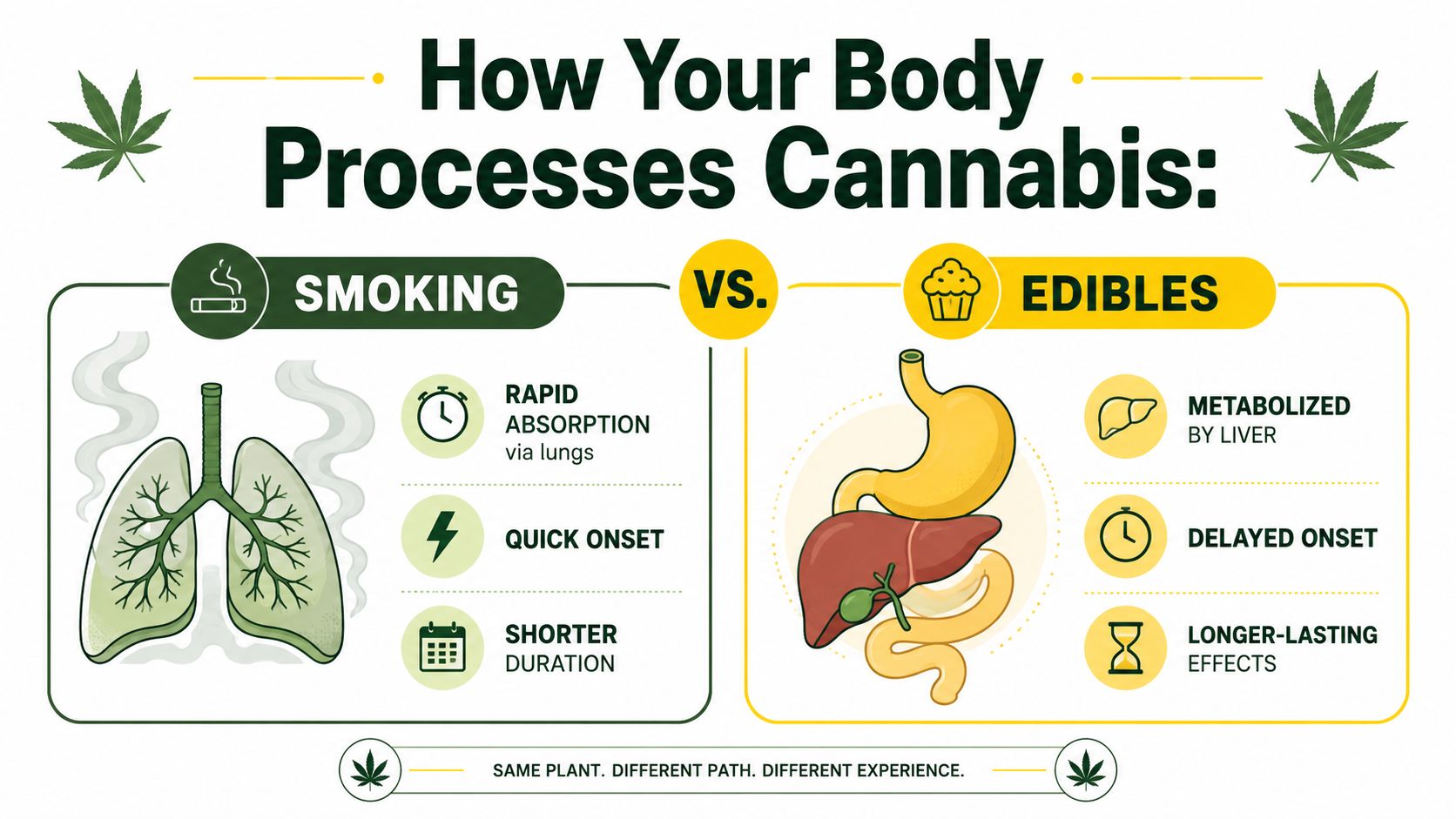
For patients at Mr. Nice Guys DC, this is often the missing piece in the decision. The better question is not “Which one is stronger?” It is “How does my body process this format, and does that match the kind of relief I need?”
Smoking takes the faster route
When you smoke flower, THC passes through the lungs and enters the bloodstream quickly. That is why the effects usually show up fast and why many patients find inhaled cannabis easier to read in the moment.
A simple way to picture it: smoking gives you feedback while the experience is still building. You can pause, check how you feel, and decide whether to stop. For someone with a body that is sensitive to THC, that quick feedback can make a big difference.
This route also helps explain why two patients can use the same flower and still have different experiences. Lung capacity, inhalation style, tolerance, and even whether you have eaten recently can shift how the effects feel.
Edibles take the digestive route
Edibles go through a slower system. You swallow the THC first. Then your stomach and intestines absorb it, and your liver processes it before much of it reaches circulation.
That liver step changes the experience. During digestion, the body converts Delta-9-THC into 11-hydroxy-THC, a form many patients describe as heavier, deeper, and longer-lasting. This is one reason an edible can feel stronger than its THC number suggests.
The delay causes a lot of confusion.
A patient may take a gummy, feel very little after a while, and assume it did not work. In reality, the body may still be in the middle of processing it. People with slower digestion, a larger meal in their stomach, or a naturally different metabolism may feel that delay even more.
Why metabolism matters more than many labels suggest
Consequently, a simple pros and cons chart falls short. Your body is part of the dose.
If you have a fast metabolism, some edibles may seem to arrive sooner or fade sooner. If you digest slowly, the onset may feel drawn out, which can tempt you to take more too early. If you use cannabis to manage pain overnight, that longer arc may be useful. If you need quick feedback before committing to more THC, flower may fit your routine better.
Body chemistry also helps explain why one patient says, “Edibles barely affect me,” while another says, “Five milligrams is plenty.” Both can be telling the truth.
Why the same THC number can lead to different experiences
A package tells you how much THC is in the product. It does not tell you how your body will handle that THC.
Smoking usually feels easier to steer because the rise is faster and easier to notice. Edibles often feel more layered because digestion stretches the timeline and liver metabolism changes the form of THC along the way. One route is more like adjusting a faucet little by little. The other is more like setting a slow cooker and waiting to see how strong the final result becomes.
That distinction matters when you are choosing in DC. A patient shopping for quick evening relief after work may choose differently from a patient who wants a longer runway for sleep or persistent pain. If you are comparing other non-inhaled options, our guide to how marijuana tinctures work in the body can help you understand where tinctures may fit between flower and edibles.
A Practical Guide to Dosing Edibles and Flower
Dosing is where good experiences and rough experiences often split apart. The safest mindset is simple: start low and go slow.
Why edible dosing needs more patience
A laboratory analysis found that 1 mg of Δ⁹-THC in an edible produces a behavioral effect equivalent to about 5.71 mg of Δ⁹-THC in smokable cannabis, as described in this Colorado-based analysis of edible potency and delayed overconsumption risk. That same research explains why people who take more before the 30 to 120 minute onset can end up with peak intoxication 4 to 5 times stronger than expected.
That's the key safety issue with edibles. The second dose often lands before the first one has finished arriving.
A simple way to approach each format
For a new edible user, lower is usually smarter. Many patients do best starting with a small portion and then waiting long enough to judge its effects before taking more.
For flower, the process is different because the feedback is fast. You can take one inhale, pause, and assess. That makes flower easier for people who want more control in the moment.
Here's a practical framework:
- If you're trying an edible for the first time: Choose the lowest clearly measurable portion available and wait a full two hours before even thinking about more.
- If you're trying flower for the first time: Take one small puff, then sit with it for several minutes before deciding on another.
- If you're sensitive to THC: Avoid comparing yourself to friends. Your body may react much more strongly to the same label dose.
- If you're tired, stressed, or haven't eaten normally: Be extra careful. Those situations can make a dose feel different.
Two real-world examples
A first-time patient eats a 10 mg gummy expecting something mild. Because of liver metabolism, that experience may feel much stronger than expected. That same person smoking an amount containing 10 mg THC may feel a more manageable rise because they can stop after one or two puffs if they've had enough.
Another patient with nighttime pain may prefer the slower edible curve. They can take a low dose with dinner, wait, and let the effects carry into bedtime rather than needing repeated inhalations.
If you want help thinking through portions and timing, an edible dosage calculator for beginners can help you map out a more cautious plan.
Understanding the Health and Safety Trade-Offs
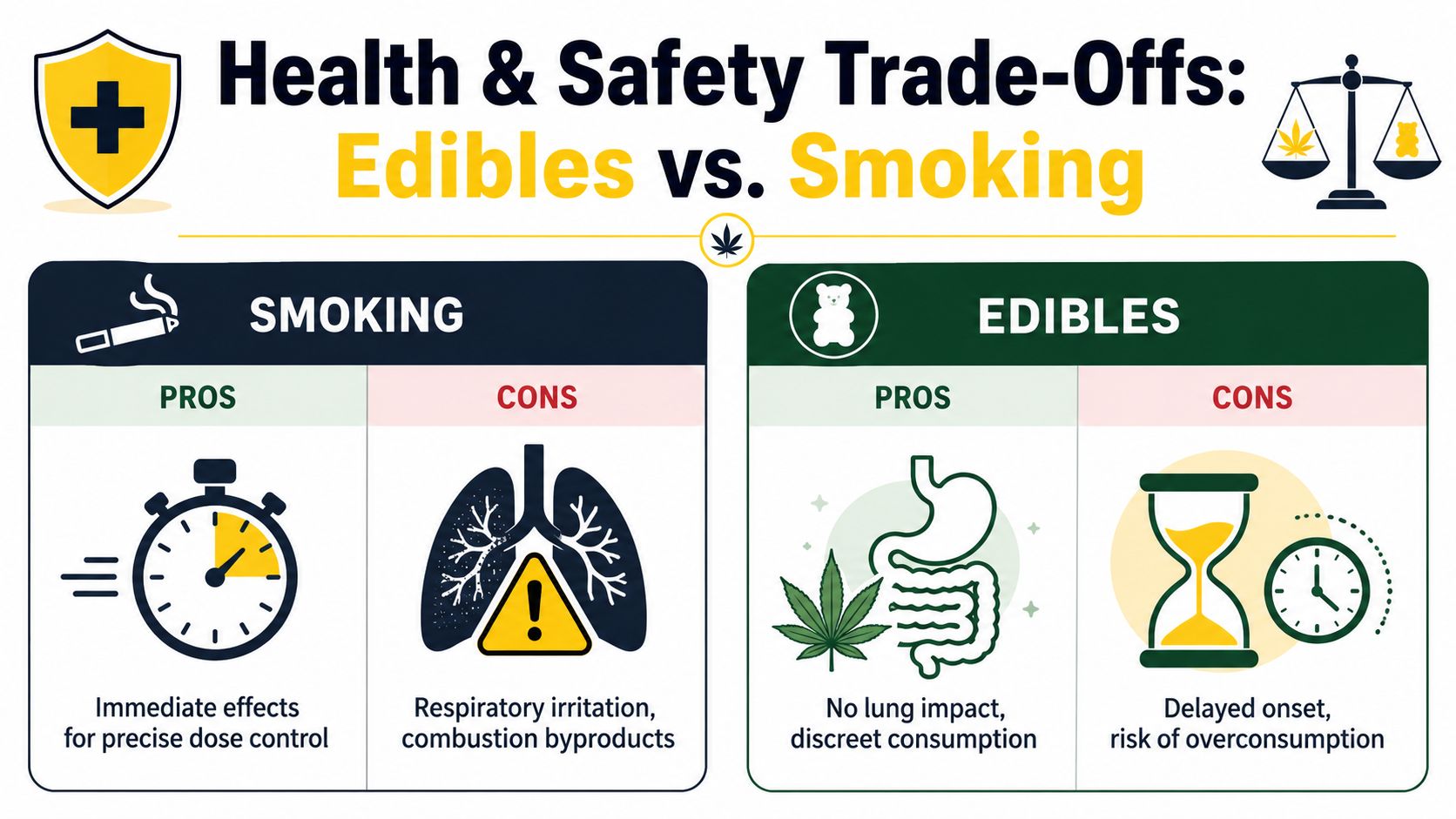
It's common to reduce this conversation to one point: smoking affects the lungs, edibles don't. That's true, but it's not the whole picture.
There are two separate questions to ask. First, what happens right away if you use too much or use too quickly? Second, what happens with regular long-term use?
The immediate safety difference
Smoking gives you faster feedback. That can lower the chance of accidental overconsumption because you usually know within minutes whether you've had enough.
Edibles remove that quick feedback. The main risk isn't combustion. It's misjudging the delay, taking more, and then dealing with anxiety, racing thoughts, rapid heart rate, or panic once the full effect arrives.
A practical example: if a patient wants relief before a movie and eats extra gummies because the first one hasn't kicked in by the previews, they may spend the middle of the film feeling overstimulated rather than relaxed.
Keep this in mind: If your goal is precision, the slower format is not always the simpler one.
The longer-term health question
For long-term use, the discussion gets more nuanced. A University of California summary of JAMA Cardiology findings on cannabis and vascular function reported that both chronic smoking and edible use can reduce vascular function by about 50%. The same report noted an important distinction: smoking uniquely harms endothelial cells via blood serum changes, while that specific risk was not observed in edible users.
That matters for patients with heart concerns. It doesn't mean edibles are harmless. It means the risk profile is different, not identical.
How to think about trade-offs clearly
Use this framework instead of asking which format is “safe.”
| If this concern matters most to you | Smoking may be harder because | Edibles may be harder because |
|---|---|---|
| Respiratory comfort | Combustion can irritate the lungs | No combustion, so this issue is reduced |
| Dose precision | Fast feedback helps dose control | Delay makes mistakes easier |
| Long sessions of relief | May require repeat use | Longer duration can be an advantage |
| Cardiac caution | Smoking has a distinct endothelial concern | Long-term cardiovascular concerns still matter |
Who should be especially cautious
- New users: You're more likely to mistake delayed onset for weak product.
- Patients with heart concerns: Both forms deserve caution. The mechanism may differ, but that doesn't erase risk.
- Patients who dislike uncertainty: Flower is often easier to manage because the feedback is immediate.
- Anyone using high-dose products casually: A single gummy can be much more than a beginner expects.
The best choice isn't the one with the strongest marketing. It's the one whose risks you can realistically manage.
Which Is Right for Your Symptoms and Lifestyle
The most useful way to think about edibles vs smoking is to match the format to the job. Your symptoms matter, but so does your daily routine.

When edibles often make more sense
A study comparing ad libitum edible and flower use found that subjective intoxication and memory impairment were comparable between edible users averaging 15.97 mg THC and flower users averaging 51.25 mg THC, suggesting people often self-titrate to similar effect levels. The same paper notes that 16 to 26% of medical users prefer edibles for longer duration, up to 12 hours, and lung safety, as discussed in this comparison of edible and flower use patterns among medical users.
That preference makes sense in certain situations.
For example, a patient dealing with sleep trouble may want something that builds slowly and stays active through the evening. Someone with chronic pain may also prefer an edible because they don't want to interrupt the night or repeatedly step outside to smoke.
When smoking often makes more sense
Smoking usually fits better when relief needs to be quick and adjustable.
A practical example: if you feel a migraine building, a delayed product may miss the window where fast relief matters most. In that situation, inhalation gives you a quicker read on whether it's helping. The same logic can apply to situational stress, appetite support, or sudden discomfort.
Some patients don't need the longest effect. They need the most controllable effect.
Match the format to your real life
Here are common decision points:
- Need privacy at home or on the go: Edibles are usually more discreet because there's no smoke smell.
- Want a bedtime option: Edibles often fit better because they can last into the night.
- Want a social ritual: Flower can feel more familiar and communal.
- Need to stay conservative: Smoking may be easier to limit because you can stop as soon as you feel enough.
A few mini-scenarios make this clearer:
A patient living in a shared apartment may choose gummies because they don't want lingering odor. Another patient with evening joint pain but a low tolerance may still choose flower because they trust that quick feedback more than a delayed edible curve.
Someone managing both sleep and pain might even reserve each format for a different role. Flower for occasional breakthrough symptoms. Edibles for nights when long duration matters most.
If you're choosing by symptom rather than by trend, this guide to cannabis for sleep, pain, and anxiety can help narrow the field.
How to Purchase Edibles and Flower in DC
Buying cannabis in DC is easier when you know what you're looking for before you browse. The biggest advantage of planning ahead is that you're less likely to choose based on packaging alone.
Shop by outcome, not category
If you know you want fast relief, start by looking at flower, pre-rolls, or other inhaled formats. If you want longer duration and discretion, start with gummies, chocolates, or beverages.
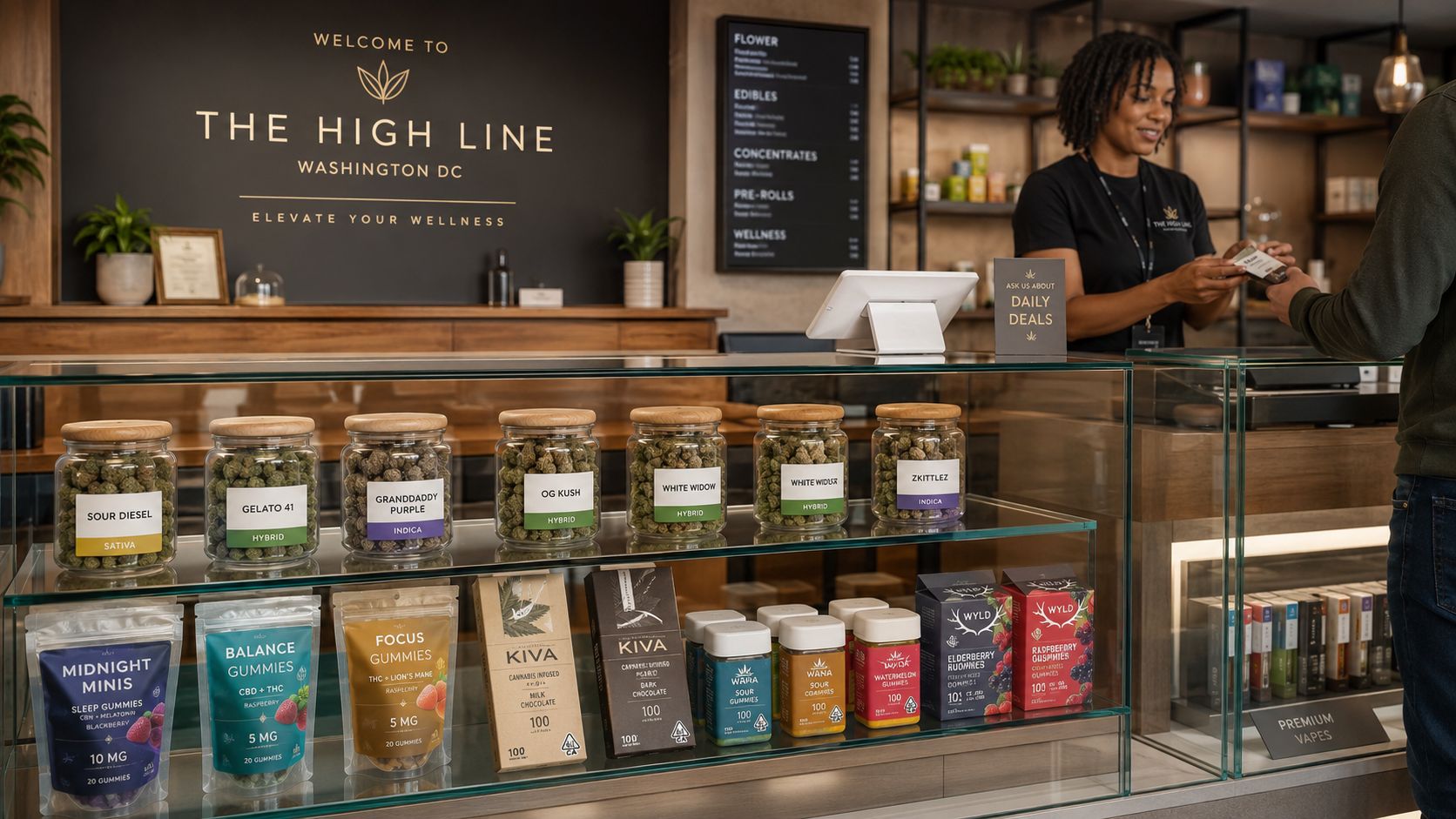
Specific strain and product names can also help organize your thinking. Patients often browse flower options such as OG Kush, Runtz, Gelato, Blue Dream, or Wedding Cake, while edible shoppers often compare products by flavor, format, and clearly marked THC per piece.
What to check before you buy
Use a short checklist:
- Read the serving size: One package may contain multiple servings.
- Check the format: A gummy, chocolate, and beverage can feel different in practice because people consume them differently.
- Ask about timing: If you need evening relief, say so. If you need quick feedback, say that too.
- Consider convenience: Pickup, curbside, and delivery can make repeat purchases much easier once you know your preferred format.
A practical example: a first-time patient who says “I just want something relaxing” may walk away with the wrong product. A patient who says “I want discreet evening relief that lasts through dinner and bedtime” gives the staff a much more useful target.
If you're specifically exploring non-inhaled options, this local guide on where to buy edibles in DC can help you understand what to look for before you order.
Frequently Asked Questions
What should I do if I take too much of an edible
Stay calm first. Most difficult edible experiences are unpleasant, but they pass with time. Try to rest in a quiet place, sip water, avoid taking more cannabis, and remind yourself that the feeling will wear off.
A practical example: if someone took an extra gummy too early and now feels overwhelmed, it's usually better to settle into a safe, low-stimulation environment than to keep moving around or panic-search for a fix.
Sit down, hydrate, and give the dose time to move through your system.
Why don't edibles affect me the same way they affect other people
Body chemistry plays a huge role. According to AARP's discussion of metabolic differences and edible response, allele-specific metabolic variance can make edible highs unpredictable. Some people have slow CYP2C9 enzyme activity, which affects how the liver converts THC into 11-hydroxy-THC, leading to inconsistent, underwhelming, or sometimes extreme effects.
That's why one patient may feel a small gummy strongly while another says the same product barely registers.
Can I combine smoking and edibles
You can, but it takes caution. Stacking formats can make it harder to judge your total effect because the smoked portion arrives first while the edible is still building.
A practical example: someone may smoke because the gummy “isn't working,” then end up far more intoxicated once the edible fully kicks in later. If you combine formats, keep doses conservative and space them carefully.
Which is better for beginners
Usually, the better choice is the one you can control most confidently. For many beginners, smoking offers clearer feedback. For others, a very low-dose edible used patiently at home feels more approachable.
The format matters less than the habits. Start low. Don't rush. Choose a time when you don't need to drive, work, or make complicated decisions.
If you're weighing flower against gummies and want help choosing the right fit, Mr. Nice Guys DC offers a wide selection of premium cannabis products along with the kind of practical guidance that makes first purchases and repeat visits much easier. Whether you want fast relief, longer-lasting effects, discreet options, or help understanding dose labels, their team can help you make a more informed decision.
Mr Nice Guys DC
At Mr. Nice Guys DC, we’re more than just a cannabis delivery service — we’re passionate advocates for quality, convenience, and community. With years of experience in the cannabis industry, our team is dedicated to educating and empowering customers across Washington, D.C. Whether you're a seasoned user or just starting your cannabis journey, our blog delivers trusted tips, product insights, and the latest updates from the world of weed. Stay informed, stay elevated.
