
Must Be 21 To Enter
By entering this site you are agreeing that you are at least 21 Years of Age or older.
I AM 21 OR OLDERWhat Is the Entourage Effect and Why It Matters


The entourage effect is the hypothesis that THC, CBD, minor cannabinoids, and terpenes can change one another's effects when combined, but it isn't a guarantee for every product. The familiar advice to choose full-spectrum cannabis because it always works better goes further than the human evidence supports.
For a patient, the useful question isn't whether a product has an entourage. It's whether its particular combination, at the dose and in the format you use, produces a helpful result without unacceptable side effects.
What the Entourage Effect Actually Means
A longer ingredient list can make a cannabis product look smarter without making it better. The entourage effect is the narrower, testable idea that THC, CBD, minor cannabinoids, and terpenes may alter one another's effects when they occur together. The result could be stronger, weaker, differently timed, or indistinguishable.
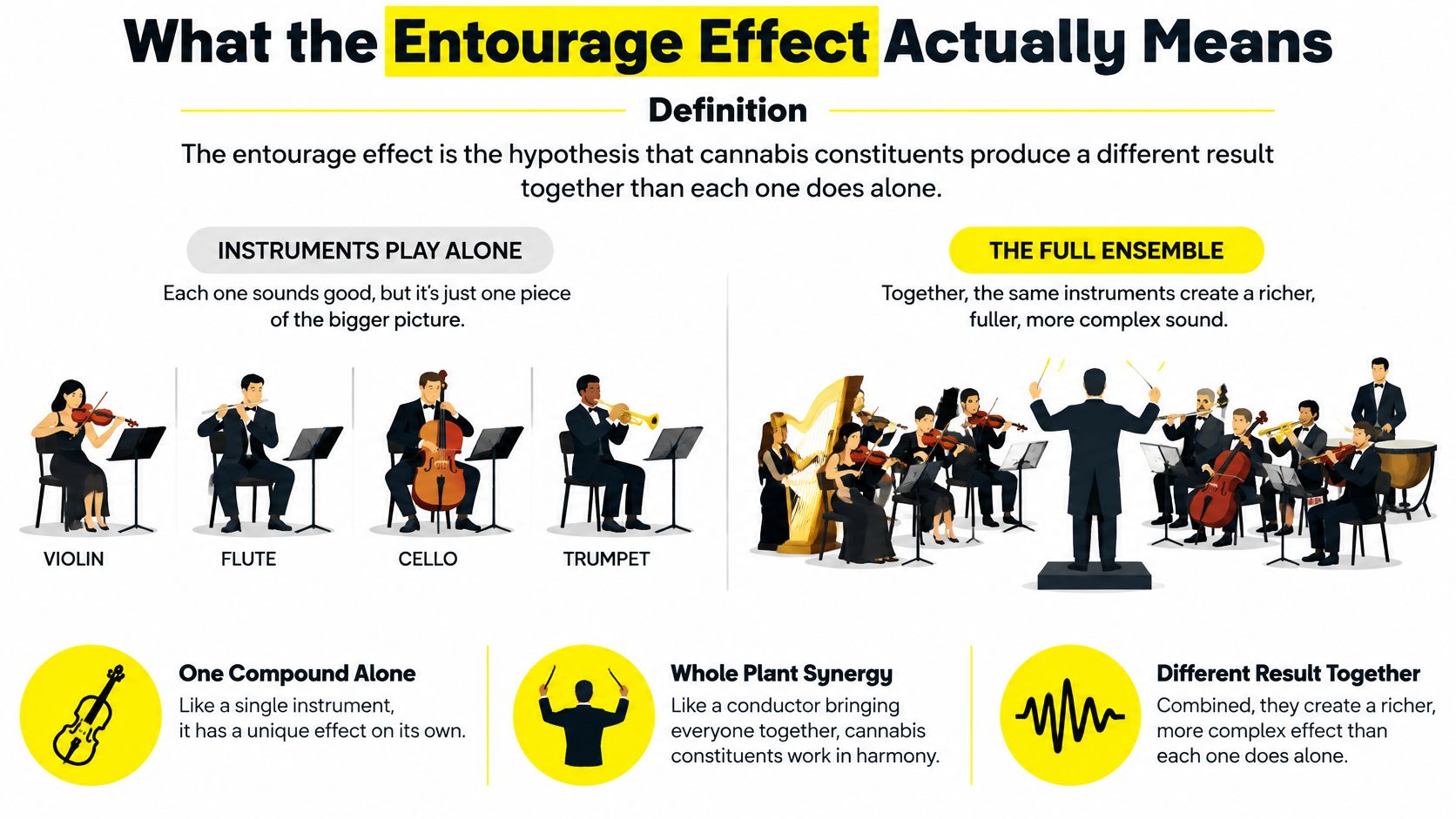
An orchestra gives the right shape for the analogy. THC may carry the lead line, while CBD, minor cannabinoids, and aromatic terpenes change the balance around it. More instruments change the arrangement. They do not promise a better song.
Say you're comparing flower at a Washington, DC dispensary. Two jars show the same THC percentage, yet their cannabinoid and terpene profiles differ. That gap is a reason to compare dose, route, and effects carefully. It is not enough to predict the better jar from the label alone.
Where the Idea Started
The phrase grew out of research on the body's own endocannabinoid 2-arachidonoylglycerol, or 2-AG. In laboratory and animal experiments, fatty-acid glycerol esters with little activity by themselves enhanced 2-AG activity.
That origin is narrower than the modern sales pitch. The early work did not compare cannabis strains, and it did not run a human trial proving aromatic flower relieves symptoms better than isolated THC. It asked whether quiet molecules could change the behavior of a more active one when both were present.
From Endocannabinoids to Cannabis Products
Cannabis discussions later stretched the idea to THC, CBD, minor cannabinoids, and terpenes such as limonene, myrcene, and beta-caryophyllene. The extension is biologically plausible. Plausibility still leaves open whether a given product helps a patient at the dose and route being used.
The orchestra comparison also has a boundary. An ensemble follows a conductor and a score; a cannabis product does not arrive with a clinically validated script for your response. Labels can list compounds. They cannot certify how those compounds will combine in your body.
Compounds can influence one another, but a label is not a clinical prediction.
So the useful definition includes conditions: a specific combination, at a specific dose, by a specific route, measured against a clear outcome. Chemistry can propose an interaction. Human evidence decides whether the interaction matters.
The Compounds Behind a Combined Effect
A cannabis label usually starts with cannabinoids, then lists terpenes if testing information is available. Read it in that order rather than starting with a strain's reputation.
THC is the main intoxicating cannabinoid and commonly drives changes in mood, appetite, and the overall experience. CBD is non-intoxicating, but it isn't a simple off switch for THC. Minor cannabinoids such as CBG, CBN, and CBC add complexity without making the marketing promises attached to their names dependable treatment predictions.
Cannabinoids and Terpenes Buyers See on Labels
| Compound | What people notice | Usual marketing claim | Evidence status |
|---|---|---|---|
| THC | Intoxication, appetite, mood, pain reports | The main effect driver | Established cannabinoid; combination effects still depend on dose and route |
| CBD | Little or no intoxication | Always softens or cancels THC | Human results conflict and depend on dose and route |
| CBG, CBN, CBC | Present in small amounts | Focus, sleep, or calm by name | Mostly preclinical or anecdotal |
| Myrcene | Earthy, musky aroma | Heaviness or sedation | Common marketing claim, not a proven clinical effect |
| Limonene | Citrus aroma | Brighter mood, less anxiety | A controlled human combination reduced anxiety ratings versus THC alone, not proof for citrus products generally |
| Beta-caryophyllene | Peppery aroma | Inflammation support via CB2 | Receptor interest is real; patient outcomes are not settled |
| Alpha-pinene | Pine aroma | Protects memory from THC | A controlled human test did not show that protection |
| Linalool | Floral aroma | Calm or sleep | Aroma association, not a validated medical effect |
The table separates what you can identify from what someone hopes it will do. An earthy smell is an aroma observation. A promise that the same flower will reliably cause sleep is a medical prediction requiring much stronger support.
A spice blend offers another useful comparison. Salt tastes familiar alone, but the same salt in a curry becomes part of a different experience. That doesn't make the mixture automatically healthier, and it doesn't tell you which ingredient caused your reaction.
Two Ways Compounds Could Interact
Pharmacodynamic interactions concern what compounds do at receptors or other body targets. They might influence cannabinoid receptors, other signaling systems, or pathways involved in inflammation.
Pharmacokinetic interactions concern what happens to a compound on its way through the body. Another ingredient could alter absorption or change how much reaches the blood and how long it remains there; the systematic review indexed by Europe PMC describes these possible mechanisms while emphasizing that consistent extract synergy hasn't been established.
Beta-caryophyllene's interest at CB2, for example, is a mechanism worth investigating, not a shortcut from a peppery aroma to proven symptom relief. Likewise, a cannabinoid's name doesn't establish that the amount in a particular product is clinically meaningful.
When you read a certificate of analysis, use a simple order:
- Find the cannabinoid balance. Note THC and CBD amounts and their ratio.
- Identify the leading terpenes. Record the most prominent entries if they're printed.
- Keep the batch information. Gelato or OG Kush isn't a fixed chemical formula, and terpene concentrations can change between batches.
Our cannabinoid breakdown can help you recognize the names. Use that vocabulary to describe a product accurately, not to diagnose yourself from its label.
How Strong the Human Evidence Is
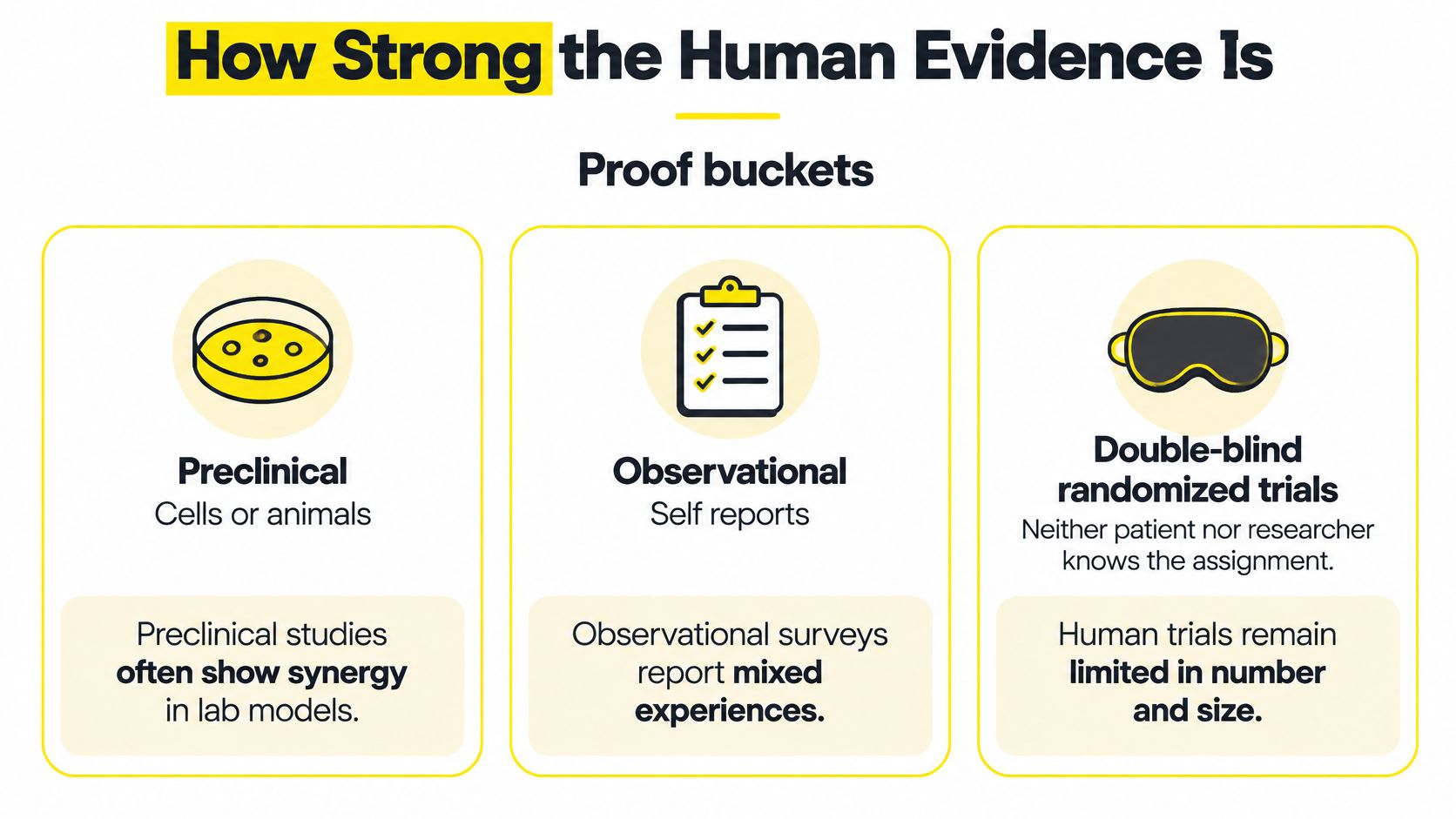
Evidence for the entourage effect falls into different categories, and they don't answer the same question. A receptor experiment can identify an interaction without demonstrating relief in a person.
- Preclinical work tests cells, isolated receptors, or animals. It helps researchers identify mechanisms worth investigating.
- Observational work records what people use and report. It can reveal patterns, but expectations, product selection, and other differences complicate interpretation.
- Double-blind randomized trials assign treatments while keeping participants and researchers unaware of the assignment. They're better suited to testing whether a particular formula causes a particular outcome.
A 2023 critical review, summarized in the critical and systematic review literature, found much of the supporting literature was preclinical, observational, or review material rather than double-blind randomized trials. One cited CB1 assay found THC produced approximately 41% of 2-AG's response, while 16 tested terpenes produced about 10% to 50% of THC's response, and some mixtures exceeded THC alone.
Those are receptor-assay measurements, not pain scores, improved memory, or better sleep. A stronger signal in a laboratory dish doesn't establish a useful benefit at a consumer dose.
What Each Kind of Entourage Evidence Can Support
| Evidence | What was found | What it cannot prove |
|---|---|---|
| Original 2-AG laboratory and animal work | Inactive companions enhanced 2-AG | That every cannabis strain has a medical entourage effect |
| CB1 receptor assay | Some terpene mixtures produced responses above THC alone | A felt benefit at consumer doses |
| Critical review | Support was mostly preclinical, observational, or review articles | A settled clinical consensus |
| Systematic review | Terpene enhancement wasn't reliably demonstrated | That full-spectrum always beats an isolate |
| Small extract-versus-isolate reports | Some pain and epilepsy signals favored whole extracts | Which molecule caused the difference |
The systematic review's conclusion is cautious:
Terpenes may influence cannabinoid effects, but additive or synergistic enhancement hasn't been reliably demonstrated. Specifically designed clinical trials are still needed.
Different Isn't the Same as Synergistic
An additive effect roughly equals the sum of the individual effects. Synergy means the combination exceeds that sum. A different subjective experience is another possibility altogether.
A controlled alpha-pinene study provides a useful reality check: adding it to THC didn't mitigate THC-related memory impairment or significantly change acute subjective, cognitive, or physiological effects, as discussed in the scoping review available through PMC. A plausible explanation about pine aroma and memory protection didn't translate into the expected human result.
Some small clinical and observational reports have favored whole extracts for chronic pain or pediatric epilepsy, but inconsistent chemical standardization made attribution difficult, as GreenState's evidence overview explains. Researchers couldn't reliably identify which ingredients caused the difference.
That's also a reason to read broad cannabis oil health-benefit claims as formulation-specific questions. The unresolved patient question remains: Which combination helps, at which dose, and by which route?
Why Route and Dose Change the Result
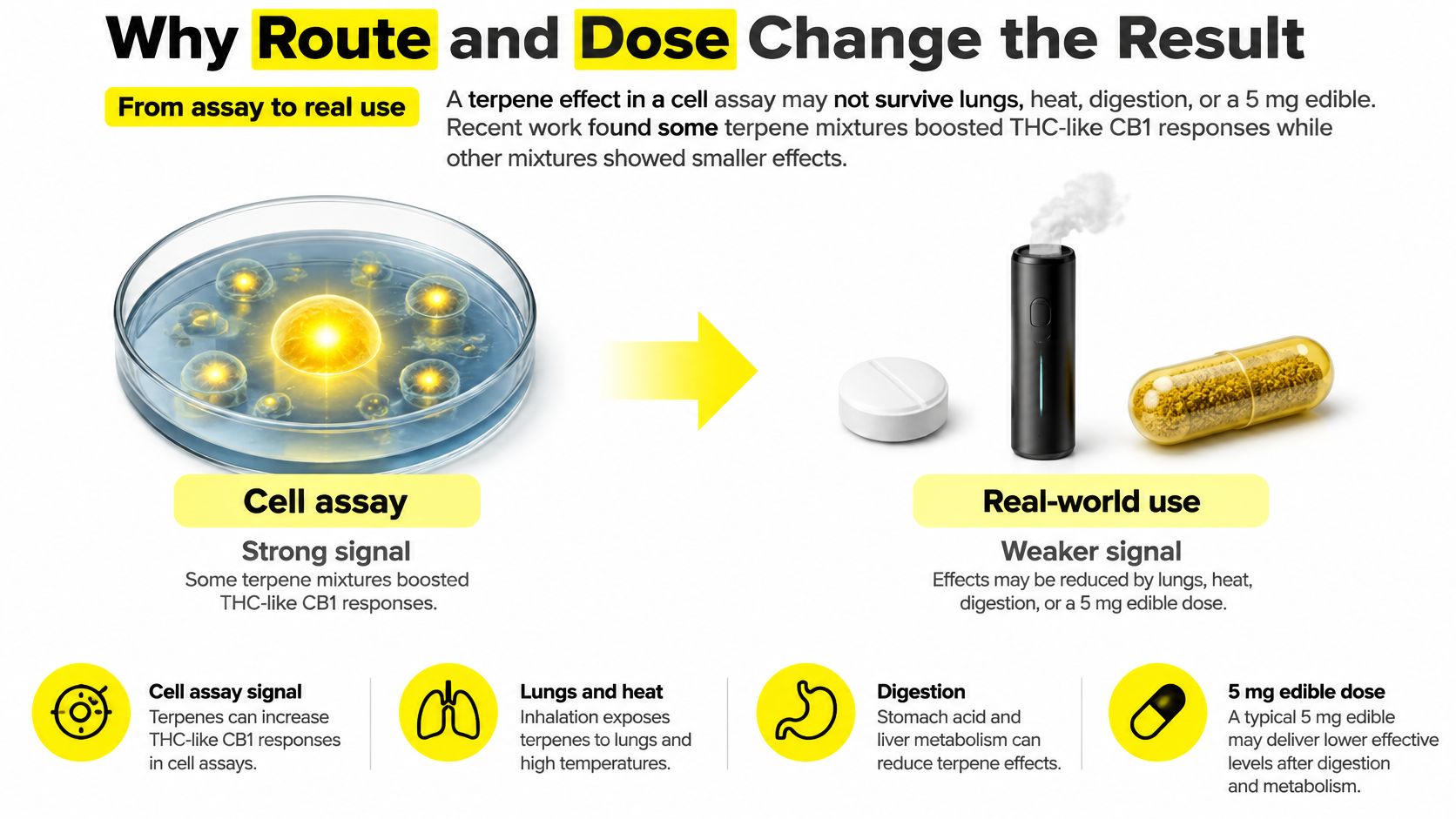
A terpene interaction in a cell assay still has to survive real-world delivery. Heating, inhalation, digestion, absorption, and metabolism can separate what researchers measure in a dish from what a person experiences.
Consider a hypothetical edible containing 5 mg THC. Its citrus flavor doesn't tell you whether enough of a particular terpene reaches the relevant body target to reproduce a laboratory interaction. The flavor and the pharmacology are different questions.
Recent receptor work described by Marijuana Moment found that some terpene mixtures enhanced THC responses at CB1, while other combinations showed synergistic activity at CB2. That supports a receptor-specific, formulation-specific interpretation, not a rule you can read from indica, sativa, or full-spectrum labels.
Compare the Delivery Method First
Flower and a gummy aren't interchangeable experiments, even when their packaging names the same strain. A vape cartridge may also contain a different chemical profile from the flower whose name appears on it.
For inhaled products, heat and storage can affect the aromatic compounds present. With oral products, digestion and metabolism introduce additional steps before the user feels the result.
How Format Changes a Possible Entourage Effect
| Format | Typical onset | Chemistry the user gets | Main risk |
|---|---|---|---|
| Inhaled flower | Relatively quick, with effects assessed as they develop | Cannabinoids plus whatever terpenes remain after drying and storage | Batch-to-batch aroma and effect swings |
| Vape cartridge | Relatively quick after inhalation | A formulated cannabinoid dose; heat can alter terpenes | Assuming the oil matches the flower it was named after |
| Edible | Delayed by digestion and absorption | Oral metabolism; high-dose CBD may raise blood THC | Taking more before the first dose peaks |
| Tincture | Influenced by whether it's held in the mouth or swallowed | Measurable liquid portions; swallowed amounts undergo oral processing | Treating the formula as clinically standardized |
A cartridge can make labeled portions easier to compare, but it doesn't make every puff identical. Device settings, puff size, and how the person inhales still matter.
Tinctures require attention to technique, too. Record whether you held the liquid in your mouth or swallowed it immediately, because changing that detail makes comparisons harder.
Why CBD Isn't a Reliable THC Antidote
The idea that CBD always balances THC is appealing, especially to someone who has felt anxious or uncomfortably intoxicated. Human findings don't support that simple rule.
In a randomized, double-blind vaporization study described in Neuropsychopharmacology, 46 participants received 10 mg THC with 0, 10, 20, or 30 mg CBD, representing CBD-to-THC ratios of 0:1, 1:1, 2:1, and 3:1. Those CBD doses didn't reliably reduce THC's cognitive, psychotic, subjective, pleasurable, or physiological effects.
A separate randomized study summarized in the same paper involved 36 participants, comparing 8 mg THC alone with THC plus 4 mg or 400 mg CBD. The lower CBD dose enhanced some intoxicating effects, while the higher dose reduced them.
These findings don't identify a universally protective ratio. They demonstrate why the actual amounts and administration conditions matter, rather than whether CBD appears on the label.
High-dose oral CBD can also increase blood THC concentrations, potentially intensifying or prolonging effects. Adding CBD isn't therefore a dependable rescue strategy after taking too much THC.
Ratios Hide the Total Dose
A ratio describes proportions, not the total quantity consumed. Two products can have the same cannabinoid balance while delivering very different amounts.
For a hypothetical example, a balanced gummy and a balanced tincture might display the same ratio. If you consume a larger labeled portion of the tincture, you haven't repeated the gummy experiment just because the ratio matches.
Write down THC milligrams and CBD milligrams separately whenever the packaging makes that possible. For flower, record the tested percentages, the amount used, and how you consumed it rather than pretending you know an exact absorbed dose.
The same discipline applies to duration. A product that feels helpful initially but leaves you impaired longer than intended may be a poor fit, even if its terpene profile sounds ideal.
Avoid Changing Every Variable at Once
A useful comparison keeps the route and approximate cannabinoid exposure steady while changing the product. Switching from flower to an edible while also changing THC strength and terpene profile makes the result difficult to interpret.
- Keep the format consistent. Compare flower with flower before comparing flower with capsules.
- Avoid rapid escalation. With oral products, don't treat the absence of an early effect as proof the dose failed.
- Record unwanted effects. Anxiety, mental fog, dizziness, or an uncomfortable duration matter as much as the effect you wanted.
- Discuss medical goals with a clinician. Persistent symptoms and medication questions need more than product experimentation.
Our edibles-versus-smoking guide offers a format-focused comparison. Choosing a manageable route first is more useful than chasing a terpene name while changing everything else.
Real Product Choices Patients Can Compare
A product label is a starting hypothesis, not a verdict. Two items with the same THC percentage can feel different, and the only honest way to learn what a formula does for you is a careful comparison under similar conditions. The scenarios below are educational examples, and no strain name or terpene profile can promise to treat a condition.
An Evening User Who Dislikes a Racy Feeling
An adult wants evening body comfort but dislikes a strong head effect. A myrcene-forward flower in the Purple or Kush family could be worth discussing, provided the current label supports that description.
The starting plan prioritizes lower THC exposure. An earthy aroma does not prevent anxiety, and myrcene prominence does not establish sedation. If inhaled cannabis suits that person, beginning conservatively and assessing effects before taking more gives the hypothesis a fair test.
A Daytime User Who Needs Clarity
Someone trying to stay clear-headed could compare a low-THC, higher-CBD flower with a measured tincture on separate occasions. The practical starting point is a clearly labeled, low-THC portion rather than a vague instruction to take a dropper.
The first trial should never happen before driving or a task requiring reliable attention. Even a balanced product cannot guarantee an absence of intoxication.
Someone Curious About Limonene and Anxiety
In a controlled human trial described by Terpenes & Testing, the highest combination tested, 30 mg THC with 15 mg d-limonene, significantly reduced ratings of anxiety or nervousness and paranoia compared with THC alone.
That result tested one dose pairing under controlled conditions. A citrus-forward product does not necessarily deliver the study's isolated limonene exposure, and its aroma does not establish the same effect. The finding suggests limonene deserves a careful trial; it does not prove the terpene always helps.
For someone who becomes anxious with THC, the cautious discussion concerns substantially lower THC exposure, suitability, and monitoring. A limonene-prominent vape might be worth evaluating, though raising THC intake to chase a proposed terpene benefit undermines the safety goal.
Make the Trial Useful
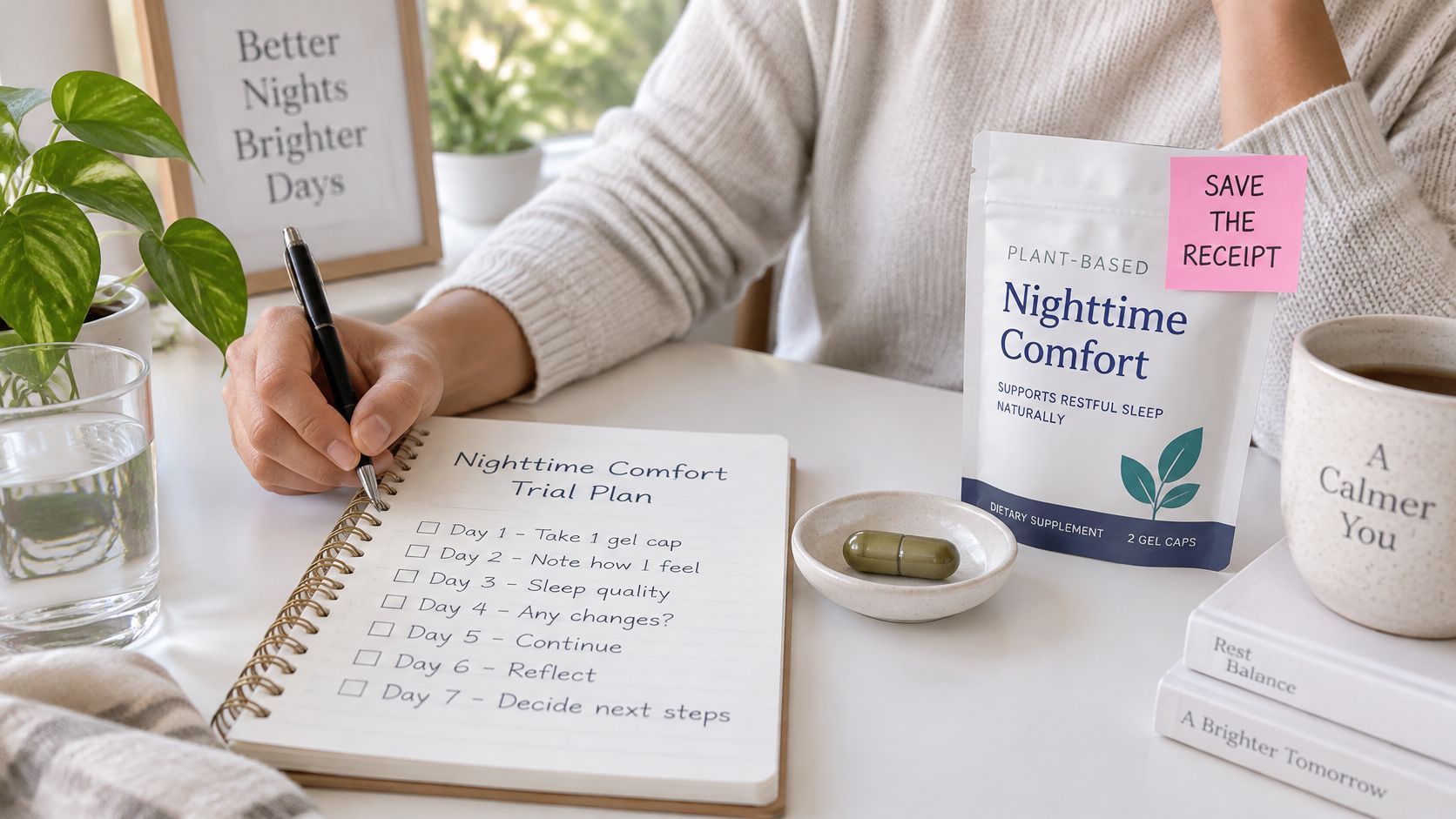
Treat each session as one measurement in a small experiment. A single use can be noise; repeating a tolerable product under similar conditions is what reveals a pattern. A session log covering product and batch name, THC and CBD amounts, printed terpene information, route, onset, duration, and unwanted effects gives those measurements something to be compared against.
For extracts, our guide to live resin versus distillate explains how formulation choices change what ends up in the product. New, severe, or persistent symptoms belong in a clinician conversation rather than a strain rotation.
Where to Apply This in Washington DC
For readers in Washington, DC, or nearby Alexandria, Bethesda, Rockville, and Silver Spring, the next step is a focused conversation, not a search for the strongest jar. Bring a product label or session log and explain what you wanted, what happened, and what you'd like to avoid.
At Mr. Nice Guys DC, our team helps first-time and experienced patients compare formats and understand product information. Our DC dispensary guide provides local context for planning a compliant visit.
Ask About the Current Formula
Ask us for the current THC and CBD numbers and any printed terpene notes. Keep the package or batch name in your log so you can identify what you tried rather than relying on a strain story.
Customers can mix and match different edible items in one order. That can support a deliberate comparison between formulas on separate occasions, rather than combining unfamiliar items in the same session.
Adults who meet applicable age and eligibility requirements should follow local rules. This guide doesn't replace individualized medical advice, and product guidance shouldn't be mistaken for a treatment prescription.
The entourage effect is a reason to pay attention to the whole formula, not a promise that the whole formula will work.
We offer flower, vapes, edibles, pre-rolls, concentrates, topicals, and tinctures, with guidance to help you compare their labeled chemistry and delivery methods. Visit Mr. Nice Guys DC with your product questions or session notes, and ask our team to help you choose a clearly described option for your next careful comparison.
Mr Nice Guys DC
At Mr. Nice Guys DC, we’re more than just a cannabis delivery service — we’re passionate advocates for quality, convenience, and community. With years of experience in the cannabis industry, our team is dedicated to educating and empowering customers across Washington, D.C. Whether you're a seasoned user or just starting your cannabis journey, our blog delivers trusted tips, product insights, and the latest updates from the world of weed. Stay informed, stay elevated.
