
Must Be 21 To Enter
By entering this site you are agreeing that you are at least 21 Years of Age or older.
I AM 21 OR OLDERCannabinoid Breakdown Guide for DC Medical Patients
.svg)

.png)
You're standing at a dispensary menu, and the numbers start to blur together. One jar says high-THC flower, another shows a balanced tincture, and a third product looks calmer but lists terms you don't fully trust yet. If you've ever wondered why one product feels steady, another feels intense, and a third seems to lose its edge after a few months in a drawer, that's the practical side of cannabinoid breakdown. For a patient in Washington, DC, the important question isn't just what a cannabinoid is, it's what happens to it before you use it, after you store it, and after your body starts processing it.
Introduction to Cannabinoid Breakdown
A DC patient looking at a menu can feel like they're decoding chemistry instead of choosing medicine. One label leans hard on THC, another highlights CBD, and a third mentions terpenes, full-spectrum extract, or decarboxylation without explaining what any of that means in plain language. That confusion matters because the plant chemistry you buy isn't always the same chemistry you eventually feel in your body, especially once heat, time, and storage enter the picture.
Cannabis is unusually complex. The plant contains more than 400 chemical entities, one review reported more than 60 cannabinoid compounds, and Health Canada says cannabis can contain over 100 different phytocannabinoids across 18 chemical classes (cannabis chemistry overview). That complexity is why two products with similar labels can behave differently. A menu line is only a snapshot, not the full story.
A better lens is cannabinoid breakdown, the way cannabinoids change in the plant, in storage, and in the body. If you want to learn the basics before choosing a product, a good starting point is this cannabis education resource. Once you understand breakdown, the menu gets easier to read, dosing gets more predictable, and the product you choose is more likely to match the desired result.
Understanding the Endocannabinoid System
The endocannabinoid system, or ECS, is easier to understand if you think in locks and keys. Receptors are the locks, cannabinoids are the keys, and the fit between them helps shape what you feel. That's why one compound can feel sedating, another can feel more alert, and a third may mainly change the way the first one behaves.
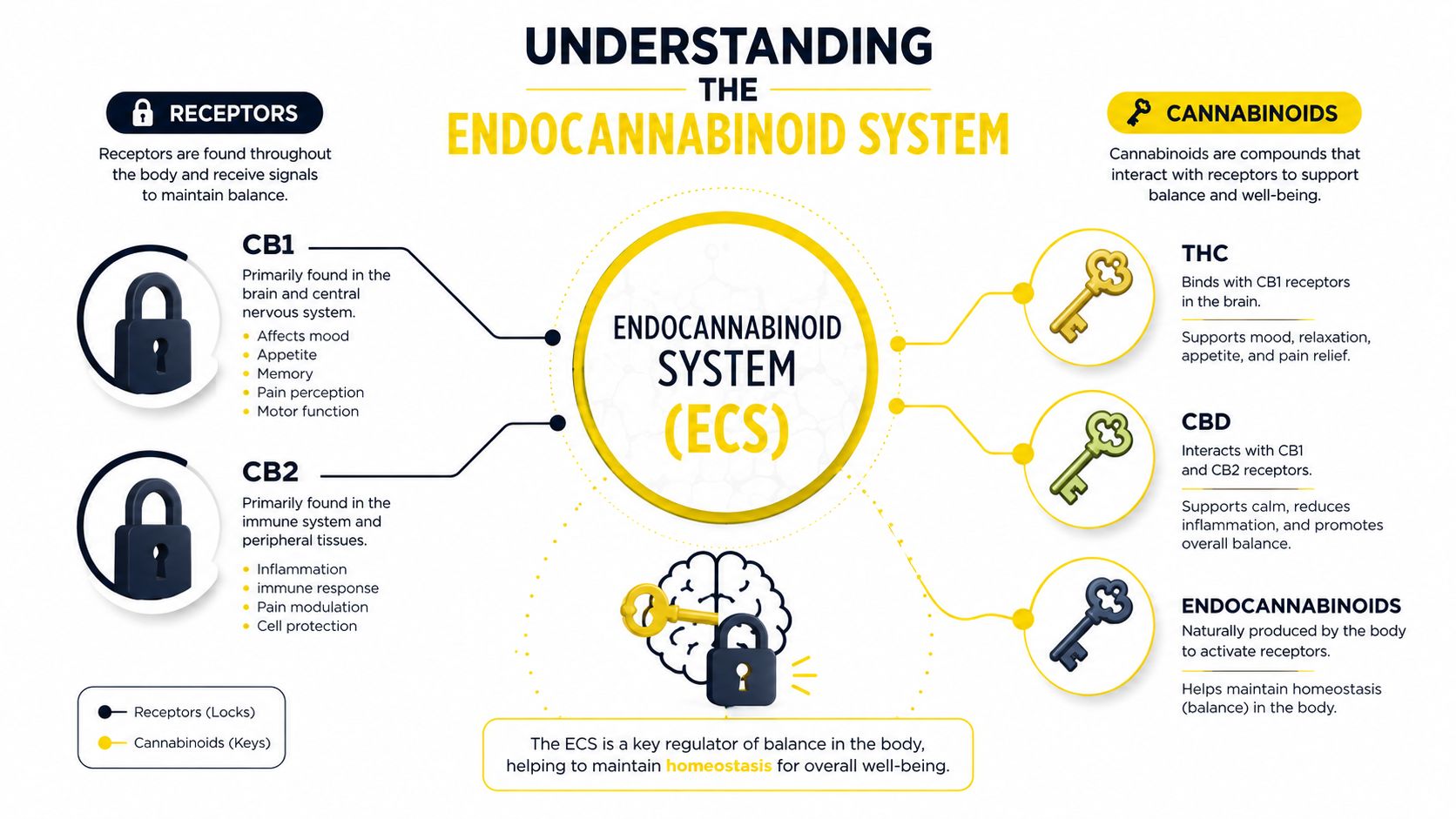
The body's own signaling system
Your body makes its own cannabinoids, called endocannabinoids, to help regulate signals tied to pain, mood, appetite, and inflammation. The two names patients hear most often are anandamide and 2-AG. You don't need a chemistry degree to use that information well, you just need to know that the ECS is already active before any flower, oil, or edible enters the picture.
That matters because different products don't just “add weed” to the body. They interact with a signaling network already trying to keep things balanced. In practical terms, a patient with pain may respond differently to a high-THC vape than to a CBD-dominant tincture because those compounds nudge the ECS in different ways.
Practical rule: if a product feels confusing, ask which cannabinoid is most likely doing the heavy lifting and which pathway it's influencing.
Why breakdown enzymes matter
Cannabinoid breakdown doesn't happen by accident. Endocannabinoids are primarily degraded by FAAH, FLAT, and MAGL, and 2-AG is metabolized by MAGL into arachidonic acid and glycerol (enzyme pathways reference). That tells you the ECS isn't one switch. It's several enzyme systems working at once.
For patients, that is more than a biochemical detail. It helps explain why one cannabinoid may feel short-lived while another seems to linger. It also explains why route matters. A tincture, an edible, and inhaled flower all meet the ECS differently because they enter the body differently and get broken down at different speeds.
If you want a fuller view of how mixtures of cannabinoids can change the experience, this full-spectrum cannabis guide is useful background. The key takeaway is simple, though. The ECS is not just where cannabinoids act, it's also where the body decides how long they act and how strongly.
Breaking Down Major Cannabinoids
The biggest source of confusion is that people talk about “cannabis” as if it were one compound. It isn't. Commercial flower shows how skewed the market has become, with average THCA levels of 148.833 mg/g and average THC levels of 4.792 mg/g, while CBG averaged 0.738 mg/g and CBN averaged 0.412 mg/g in a 2023 ACS analysis (commercial flower cannabinoid profile). That mix matters because the plant often starts acidic and becomes more active only after heat or time changes it.
THC, CBD, and the roles patients notice first
THC is the cannabinoid most patients notice first because it's the main psychoactive driver. CBD doesn't intoxicate in the same way, but it can shape how THC feels and how the body handles it. CBG and CBN are usually present in smaller amounts, yet they still matter because small concentrations can influence the overall profile of a product.
Patients often think the strongest product is the one with the highest headline THC number. That's not always how the experience plays out. A flower with moderate THC but a different cannabinoid mix can feel calmer, clearer, or more sedating than a product that chases a bigger number.
A patient picking a nighttime edible might do better with a lower THC product that feels manageable than with a stronger one that turns the evening into a waiting game.
THCA and why heat changes the picture
A lot of the cannabis in commercial flower sits in THCA, not already-active THC. When you smoke, vape, or otherwise heat the product, THCA decarboxylates into THC. That's why the profile on a lab report and the profile in your body aren't identical.
The market trend is clear in health-system data. Health Canada reports average THC potency in dried cannabis has risen from about 3% in the 1980s to around 15% today, with some strains averaging as high as 30% THC (Health Canada cannabis potency data). Oils can reach up to 3% THC, while concentrated extracts such as shatter, budder, and wax can reach up to 90% THC (same source). That shift means the practical conversation is less about “cannabis in general” and more about what form of THC exposure a product creates.
If you're comparing raw flower to a heated product, this THCA vs THC guide gives helpful context.
A plain-language comparison of common cannabinoids
| Cannabinoid | Receptor Targets | Therapeutic Effects | Common Dose Range |
|---|---|---|---|
| THC | Primarily CB1 and CB2-related activity through the ECS | Intoxication, pain relief, appetite support, sleep support for some patients | Product-dependent, start low |
| CBD | ECS-modulating activity, indirect receptor effects | Calm, symptom balancing, interaction with THC effects | Product-dependent, start low |
| CBG | ECS-related activity, often discussed for balance | Functional support, possible comfort with less intoxication | Product-dependent, often low amounts |
| CBN | Often present in aged or oxidized material | Sedating reputation, nighttime use in some products | Product-dependent, usually low amounts |
| THCV | ECS-related activity, dose-dependent effects | Distinct, sometimes more alert-feeling profile | Product-dependent, variable |
The table is intentionally cautious because dose needs depend on route, formulation, and individual sensitivity. A beginner might respond well to a 2.5 mg THC edible for sleep support, while a more experienced patient may use a CBD oil approach for daytime discomfort. Those are examples of how patients often think about these products, not universal dosing rules.
Reading Lab Reports and Profiles
A lab report can look technical, but it's mostly a map. If you know where to look, you can tell whether a product is likely to feel strong, balanced, or unexpectedly mellow. The report usually separates what's present in the plant from what's active after decarboxylation, and that distinction matters more than most patients realize.
What the numbers are really saying
The first thing to scan is the cannabinoid panel. You'll usually see lines for THCA, THC, CBD, CBDA, and minor cannabinoids. What matters is whether the report gives total content, active content, or both, because those numbers don't mean the same thing.
A simple example helps. If a product lists 100 mg/g THCA, not all of that becomes THC, because decarboxylation changes the molecule. The practical result is that active THC is lower than the original THCA number. That's why a menu or certificate of analysis can't be read as if every cannabinoid is already in its final form.
Where to focus before you buy
A good certificate of analysis usually gives you three things to check first.
- Cannabinoid profile: Look for the main compounds and whether the product is THC-heavy, CBD-heavy, or mixed.
- Contaminants screen: Confirm that the product was screened for things like residual solvents, pesticides, or microbial issues.
- Batch details: Match the product you're holding to the exact test result, not just a product family.
If the report also lists terpene data, use that as a flavor and effect clue, not as the main potency number. Terpenes can shape the experience, but they don't replace cannabinoid content.
For a deeper look at how testing works, this cannabis potency testing guide is a useful companion. The simplest habit is also the best one. Before you dose, check the label against the report, then make sure the product you bought matches the profile you expected.
Comparing Product Formats and Dosing
Two products can contain the same cannabinoid, yet feel completely different. That's because flower, vape cartridges, edibles, tinctures, and topicals deliver cannabinoids through different routes, and your body handles each route in a different way. The route changes onset, duration, and how much of the original compound survives first-pass metabolism in the liver.
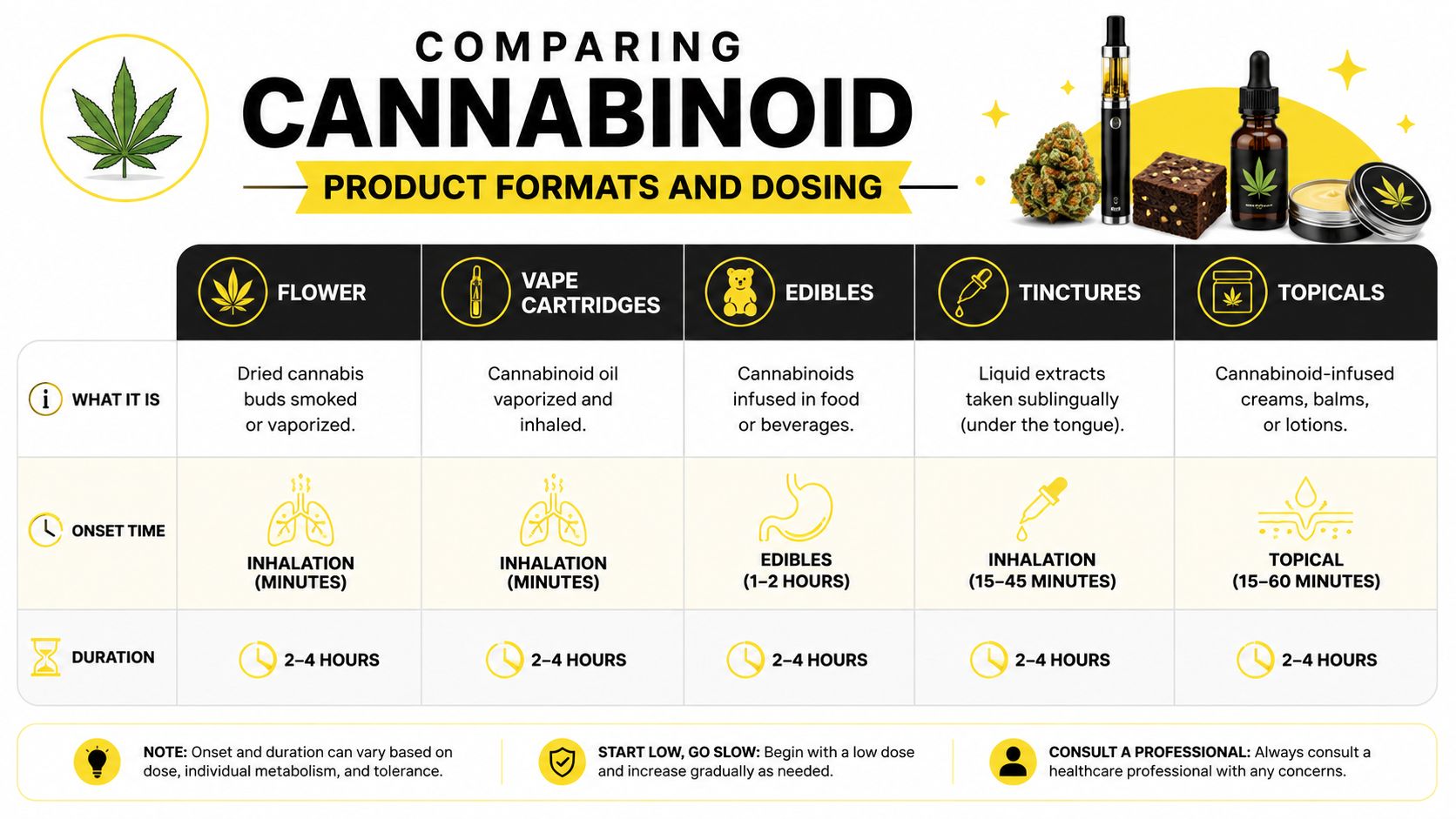
Inhaled products and oral products do not behave the same
Inhaled products, like flower and vape cartridges, tend to act faster because cannabinoids enter circulation quickly through the lungs. Oral products, especially edibles, move more slowly because the liver processes them before much of the compound reaches systemic circulation. That's why oral THC can feel stronger or last longer than inhaled THC when more parent THC gets converted into 11-OH-THC before it reaches the bloodstream (THC metabolism reference).
For patients, that difference is easy to feel even when the label looks similar. A vape can feel like a quick adjustment, while an edible can feel like a longer commitment. That's why patients who want more control often start with a route they can titrate in smaller steps.
Dose rule: if the product has to pass through the liver first, give it more time before taking more.
A practical way to compare formats
| Format | What Patients Usually Notice | Best Use Case | Caution Point |
|---|---|---|---|
| Flower | Fast onset, familiar control | Patients who want flexible inhalation | Easy to overdo when chasing relief |
| Vape cartridges | Quick, discreet, portable | Short sessions and on-the-go use | Potency can sneak up fast |
| Edibles | Slower onset, longer feel | Patients who want extended effects | Don't redose too soon |
| Tinctures | Flexible, measured use | Patients who want more precise servings | Absorption varies with formula |
| Topicals | Localized use, less systemic effect | Area-specific comfort | Can be misunderstood as “no effect” |
A person using a 1 g vape pen may be looking for fast relief in a way a 50 mg gummy never can. Those two products are not interchangeable, even if they sit in the same shopping basket. The safest way to choose is to match the route to the goal, then start with the smallest amount that could reasonably help.
For a deeper comparison of these formats, this edibles vs vapes vs flower guide can help you think through the tradeoffs.
Why oral THC deserves extra caution
The liver uses CYP2C9, CYP2C19, and CYP3A4 to metabolize THC into 11-OH-THC and then into THC-COOH (THC metabolism reference). Because 11-OH-THC is psychoactive and THC-COOH is inactive, oral THC can feel stronger or last longer than inhaled THC in ways many new patients don't expect. That's the main reason edible dosing should stay conservative.
Managing Drug Interactions Degradation and Side Effects
A lot of patients assume cannabinoids only matter on the day they're taken. In reality, their effects are shaped by metabolism, co-medications, and even the way the product is stored. That's why a product can feel different from one week to the next if the bottle sits in heat or if the patient adds another medicine to the routine.
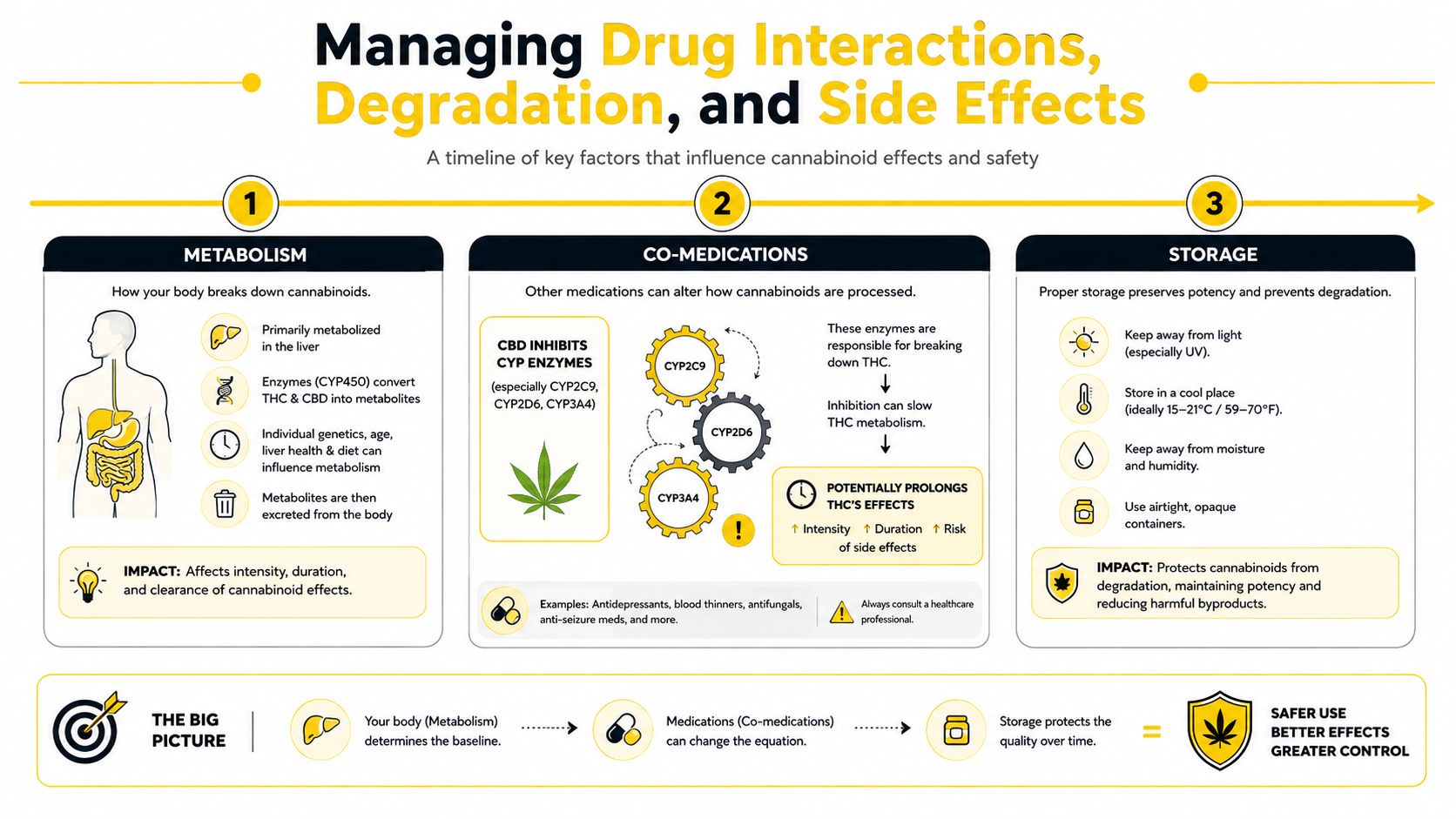
CBD can change THC handling
CBD is often described as gentler than THC, but that doesn't mean it's neutral. CBD is cleared mainly through hepatic biotransformation, with CYP2C19 and CYP3A4 playing major roles, and it can also inhibit CYP enzymes that are relevant to THC handling (CBD metabolism reference). Another review notes CBD can inhibit CYP2C9, CYP2D6, and CYP3A4 pathways, slowing THC breakdown and altering symptom duration (CBD and THC interaction reference).
That's the key correction to a common assumption. Adding CBD does not always “take the edge off” THC. In some situations, it can change how long THC lasts or how a patient experiences impairment, sedation, or interaction risk.
Storage changes the product before you even use it
Cannabinoids are labile, which means they can degrade under thermal, light-exposure, or oxidative conditions (stability review). The same source notes that under acidic conditions or light, CBD can convert to Δ9-THC and then to the more stable Δ8-THC isomer. It also says cannabinoids are biosynthesized in acidic forms and then decarboxylate during drying, storage, and thermal processing (same stability review).
That has a direct patient consequence. A jar left in a hot, bright place won't preserve the profile printed on the label. The farther the product drifts from cool, dark, and sealed storage, the more likely the actual cannabinoid ratio changes before the next dose.
A practical safety checklist
- Check co-medications: If you take other CYP-metabolized medicines, ask a clinician or pharmacist about CBD and THC interaction risk.
- Store properly: Keep products in a cool, dark, airtight container.
- Watch for changes: If a product smells stale, looks dried out, or feels different than it did at purchase, assume the profile may have shifted.
- Start low: If you switch from inhaled use to oral use, or add CBD to a THC product, treat it like a new product.
Aged flower or poorly stored concentrate can still be usable, but it may not deliver the same effect you expected when you bought it. That's the hidden side of cannabinoid breakdown, the product can change before the patient does.
DC Compliance and Usage Guidelines
Washington, DC patients need to think about more than chemistry. They also need to stay inside local rules, because a product that's legally purchased can still be used in the wrong place or carried the wrong way. The safest habit is to treat medical cannabis like any other regulated therapy, keep it secured, know where use is allowed, and avoid making assumptions when crossing into another jurisdiction.
Keep the basics of compliance simple
Medical cannabis in DC is tied to local registration and purchasing rules, and public consumption isn't the place to test the boundaries. The practical standard is straightforward. Use in private spaces where permitted, keep products out of public view, and store them discreetly at home so they're protected from heat, light, and accidental access.
Travel adds another layer. DC, Maryland, and Virginia don't operate under identical rules, so a product that's acceptable in one place may not be treated the same way in the next. If you're going to move between neighborhoods or cross a border, plan ahead before you leave rather than trying to sort it out in the car.
Situations patients often misread
A common mistake is assuming that a small amount makes public use acceptable. It doesn't change the location rules. Another mistake is carrying product loosely in a bag or glove box, where it's more visible, more likely to warm up, and easier to misplace.
A few habits lower risk fast:
- Keep packaging intact: Original labels help show what the product is and how it was sold.
- Use private storage: A locked, cool place at home is better than a countertop or window ledge.
- Plan for travel: Don't assume another jurisdiction treats possession or consumption the same way DC does.
- Ask before you use: If you're in shared housing or a guest space, confirm the host's rules first.
If you wouldn't leave a prescription bottle open on the table, don't leave cannabis that way either.
DC patients also do better when they stay updated through official local guidance, because rules can evolve. The best compliance strategy isn't memorizing every edge case, it's building a routine that already protects the product, the patient, and the people around them.
Conclusion and Key Takeaways
Cannabinoid breakdown is the difference between guessing and making a real plan. The ECS uses receptors like locks and cannabinoids like keys, THC becomes stronger or longer-lasting depending on route, and CBD can change how THC is handled instead of softening it. Storage matters too, because light, heat, oxygen, and time can change the cannabinoid profile before you ever open the jar.
Keep the next purchase simple. Check the lab report, match the product to the route you want, store it cool and dark, start low and go slow, and stay inside DC rules when you use or travel with it. Those habits do more for consistency than chasing a bigger number on the label.
Mr. Nice Guys DC helps patients compare flower, vapes, edibles, tinctures, and concentrates with the kind of product guidance that makes cannabinoid breakdown easier to understand in real life. If you want help choosing a format that fits your goals and staying aligned with DC regulations, visit Mr. Nice Guys DC and review the menu before your next order.
Mr Nice Guys DC
At Mr. Nice Guys DC, we’re more than just a cannabis delivery service — we’re passionate advocates for quality, convenience, and community. With years of experience in the cannabis industry, our team is dedicated to educating and empowering customers across Washington, D.C. Whether you're a seasoned user or just starting your cannabis journey, our blog delivers trusted tips, product insights, and the latest updates from the world of weed. Stay informed, stay elevated.
