
Must Be 21 To Enter
By entering this site you are agreeing that you are at least 21 Years of Age or older.
I AM 21 OR OLDERDC Dispensary Guide: How to Choose and What to Expect
.svg)

.png)
In 2026, a DC dispensary is a licensed medical-cannabis retailer where residents and eligible nonresidents can purchase with a valid patient registration and government-issued photo ID. Visitors age 21 and older have registration and reciprocity pathways, but age alone doesn't authorize a purchase.
You're checking a menu on your phone, wondering whether your out-of-state card works, whether you need cash, and why every shop seems to describe its products as premium. Before you compare Gelato with Wedding Cake, sort out the paperwork and decide what you need the product to do.
My recommendation is straightforward: choose the dispensary that explains eligibility, testing, and dosing clearly, not the one with the loudest promotions. Treat the visit like a regulated healthcare purchase, and you'll ask better questions before spending money.
What a DC Dispensary Actually Is in 2026
You've heard that cannabis is legal in Washington, DC, so walking into a shop and buying a pre-roll sounds simple. The missing detail is the difference between being allowed to possess cannabis and being eligible to purchase it through the District's medical program.
A DC dispensary operates under the Alcoholic Beverage and Cannabis Administration, commonly called ABCA. Licensed retailers must verify a patient credential and government-issued photo ID before completing a transaction, as explained in ABCA's licensed medical-cannabis retailer guidance. That makes the credential check part of the purchase, not an inconvenience a friendly employee can waive.
The storefront may feel familiar, but the purchase involves more than choosing something from a shelf.
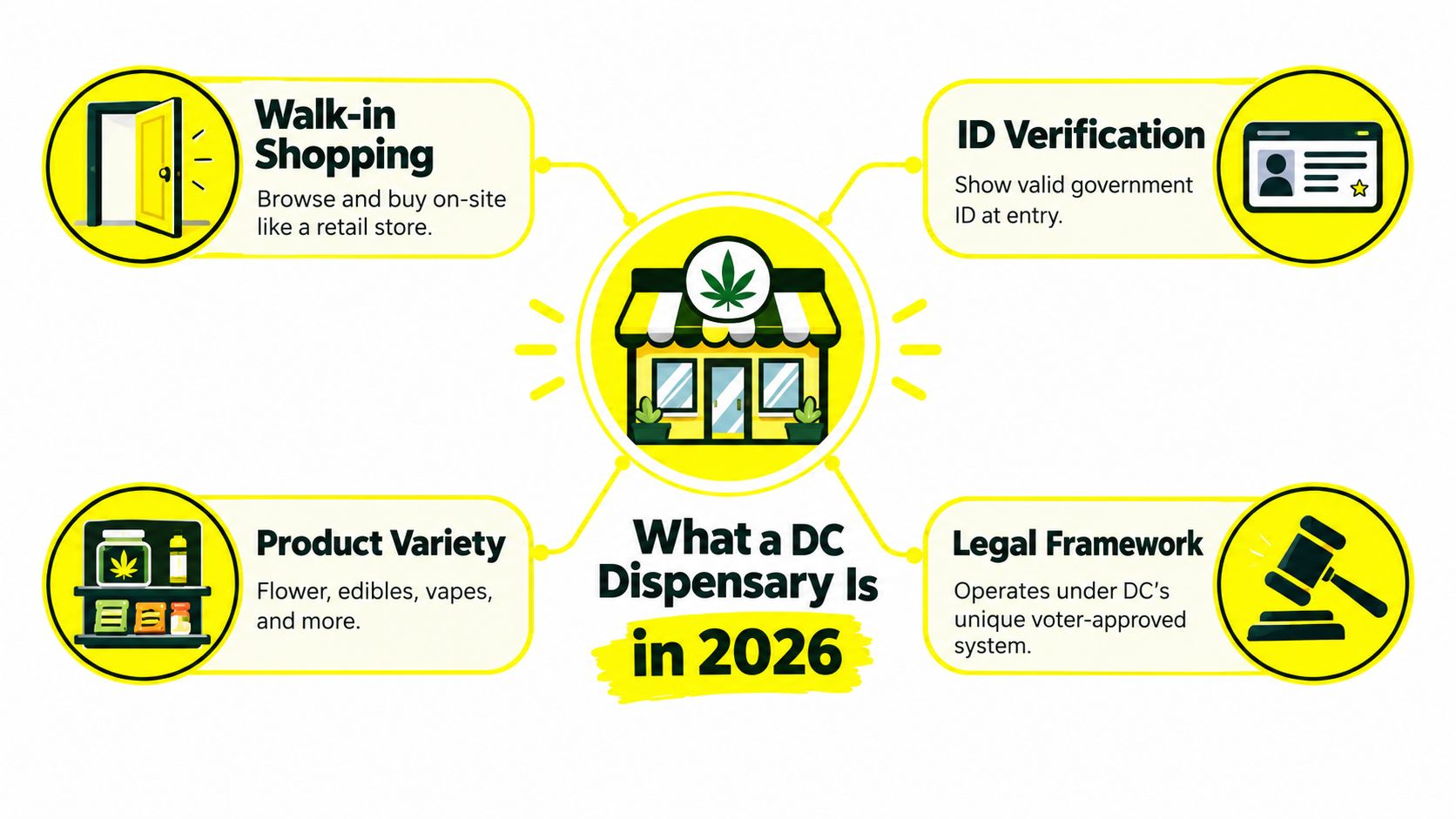
What the counter experience should accomplish
A useful visit moves through distinct tasks: staff verify your eligibility, you discuss products, and you confirm exactly what you're buying. You should leave with labeled packaging and a clear understanding of how to use the product, rather than a bag of unfamiliar names.
For example, a patient who wants an edible shouldn't receive only a recommendation for the most popular gummy. Staff should explain the amount per piece, the package total, and why taking more before the initial serving takes effect is a poor decision.
- At arrival: Have your registration and photo ID accessible instead of searching through screenshots at the counter.
- During selection: Explain your experience level, preferred administration method, and any concerns about unwanted effects.
- Before checkout: Review the label, confirm the price, and ask any remaining dosing questions.
Medical retail doesn't mean medical certainty
A knowledgeable budtender can explain product differences and help you interpret a menu. That's different from diagnosing a condition, promising treatment results, or replacing advice from your healthcare professional.
Be wary of anyone who promises that a strain will reliably solve your sleep, pain, or anxiety concerns. Good guidance explains choices and limitations. It doesn't turn a product description into a medical guarantee.
How the DC Dispensary System Came to Exist
DC's medical market didn't begin as a conventional adult-use retail industry. Local voters supported access, but congressional restrictions delayed the District's ability to implement it.
In 1998, 69% of District voters approved a medical-marijuana initiative; the federal Barr amendment blocked implementation funding until its removal in 2009, medical cannabis became legal in 2010, and dispensaries began operating in 2013, according to the Los Angeles Times account of DC's medical-cannabis rollout. By December of that launch year, the District's three dispensaries had served only 111 patients among approximately 600,000 residents, roughly 0.02% of the population, according to that same account.
Those launch conditions explain why describing today's dispensaries as ordinary recreational stores misses the point. The system originated around registered patients and restricted access, not unrestricted sales to every adult who walked through the door.
Local voting and federal oversight both shaped that history.

A larger program with a medical foundation
ABCA recorded 65,812 total unique patients and 34,535 patients served by a registered dispensary in July 2025, alongside 2,580 reciprocal patients; total unique patients had risen from 37,688 in March, a 74.6% increase, as documented in the July 2025 medical-cannabis program report.
That's a substantial expansion, but it doesn't erase the medical framework. More access and more customers don't mean a retailer can abandon patient verification.
Don't use an old gifting-shop explanation as your purchasing plan. Check how the business operates today.
The background on Initiative 71 in Washington, DC is useful context for understanding why gifting terminology still appears in conversations. It shouldn't substitute for checking a retailer's license and your eligibility.
For a practical example, consider two storefronts advertising similar flower. One clearly identifies itself as a licensed medical retailer and explains registration; the other discusses gifts without explaining patient access. Start with the business that can explain its lawful purchasing process.
Who Can Legally Buy from a DC Dispensary
Identify your patient pathway before choosing a product. Residents, visitors applying for temporary registration, and patients using reciprocity aren't all taking the same administrative route.
ABCA states that both District residents and nonresidents can obtain medical-cannabis registrations, and registered patients may purchase up to 8 ounces in a rolling 30-day period, as explained on its medical-cannabis patient access page. A government-issued photo ID accompanies the patient credential; it doesn't replace it.
These are alternative access pathways, not steps every buyer must complete.
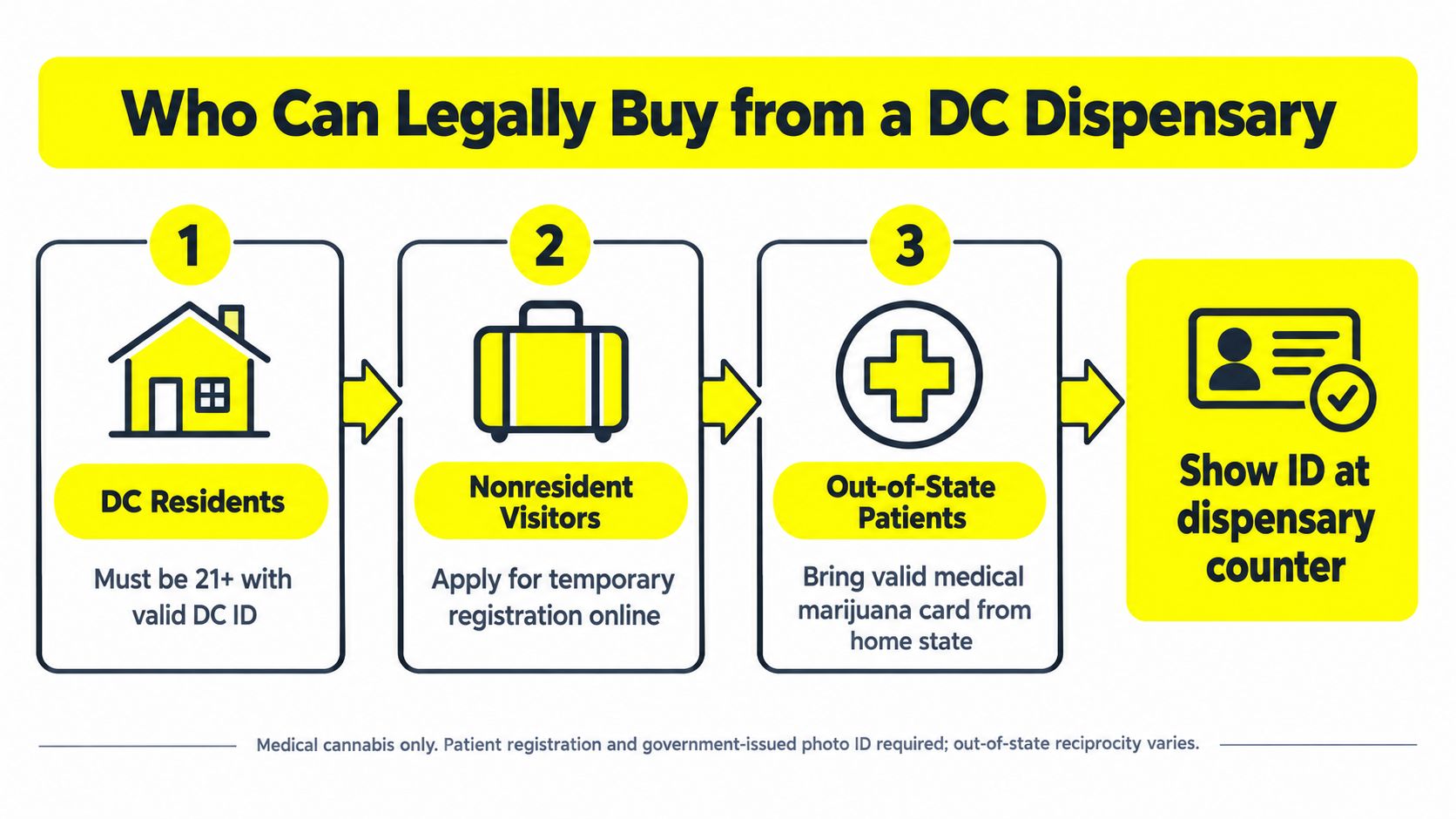
Match your documents to your situation
- DC residents: Obtain the appropriate District patient registration and bring the identification required for verification. Don't assume a DC driver's license alone establishes patient status.
- Nonresident visitors without a recognized credential: Apply for temporary registration before shopping. Confirm receipt rather than assuming that submitting an application is enough.
- Out-of-state patients: Check whether the District recognizes your existing medical-cannabis program and whether your credential remains valid.
For example, a 21-year-old Maryland patient visiting Georgetown can use a qualifying home-state registration and unexpired government-issued photo ID if the program is recognized, or obtain a DC temporary registration. ABCA permits eligible domestic and international visitors to register temporarily, allows the digital registration to be used immediately after receipt, and provides reciprocity for qualifying patients 21 and older through its medical-cannabis reciprocity guidance.
If you've encountered claims about a dispensary requiring no medical ID, distinguish not having an existing home-state card from not needing any patient credential. Those aren't the same thing.
This video provides another way to review the access process before visiting.
Purchase limits depend on product form
ABCA's patient-registration materials specify ceilings of 8 ounces of dried cannabis, 240 grams of concentrate for patients age 21 or older, or products containing a combined 600,000 milligrams of THC during a 30-day period, and note that higher-dosage edibles may require a healthcare recommendation, as detailed in the patient-registration slides.
Don't treat those figures as a shopping target or automatically additive allowances. Ask staff to check how your actual mixed-format order fits the applicable limit.
A patient buying flower and cartridges needs a transaction-level eligibility check, not a guess based on the number of packages. Registration permits access; it doesn't remove product-specific requirements.
Pickup, Curbside, and Delivery Options Compared
For a first purchase, I recommend in-store service. You can review packaging, explain what makes you nervous, and ask follow-up questions without trying to resolve everything through an order form.
Curbside and delivery can make more sense once you know the exact product and serving instructions. The right choice depends on how much guidance you need, how easily you can travel, and whether the retailer can lawfully fulfill the order at your location.
DC Dispensary Fulfillment Options at a Glance
| Option | Best For | ID Check | Guidance Level |
|---|---|---|---|
| In-store pickup | New patients or anyone comparing unfamiliar products | Expect patient and photo-ID verification | Best opportunity for a detailed conversation |
| Curbside | Patients who know their order and prefer not to enter | Confirm the retailer's handoff procedure | Useful for focused questions |
| Delivery | Patients with transport or mobility barriers | Confirm required credentials and recipient verification | Arrange guidance before dispatch |
A patient comparing tinctures with gummies benefits from discussing the labels in person. A returning patient ordering a familiar product may prefer curbside, provided the replacement batch and package details still match their needs.
Delivery requires more preparation than clicking the nearest available listing. Confirm the delivery address, recipient requirements, payment method, fees, and how the retailer handles an unavailable item before submitting the order.
Don't confuse advertised coverage with permission
Residents of Alexandria, Bethesda, Rockville, and Silver Spring may encounter delivery advertising while searching for a DC dispensary. An advertised service area doesn't establish that a particular cannabis delivery across jurisdictional boundaries is lawful. Confirm the retailer's permitted delivery scope, and don't assume DC patient eligibility authorizes delivery into Virginia or Maryland.
Use the curbside pickup and delivery guide to frame your questions, then verify the actual arrangements with the retailer. Availability and handoff procedures should be confirmed for your specific order.
Ordering rule: If you still need someone to explain how you'll use the product, resolve that conversation before requesting curbside or delivery.
For example, don't accept an automatic substitution from your familiar edible to a differently dosed package. Ask staff to explain the replacement, or decline it. Convenience is useful only when the product and instructions remain clear.
Product Formats and How to Think About Dosing
Choose the administration method before the strain name. Blue Dream flower, a Runtz cartridge, and a Wedding Cake edible aren't interchangeable experiences just because their menu descriptions sound appealing.
Inhaled and oral products differ in onset and duration, and the delayed effects of edibles make rapid redosing a particular concern. Treat any timing estimate as guidance rather than a promise about your body.
The menu categories below are a starting point for discussion, not a personalized dosing schedule.
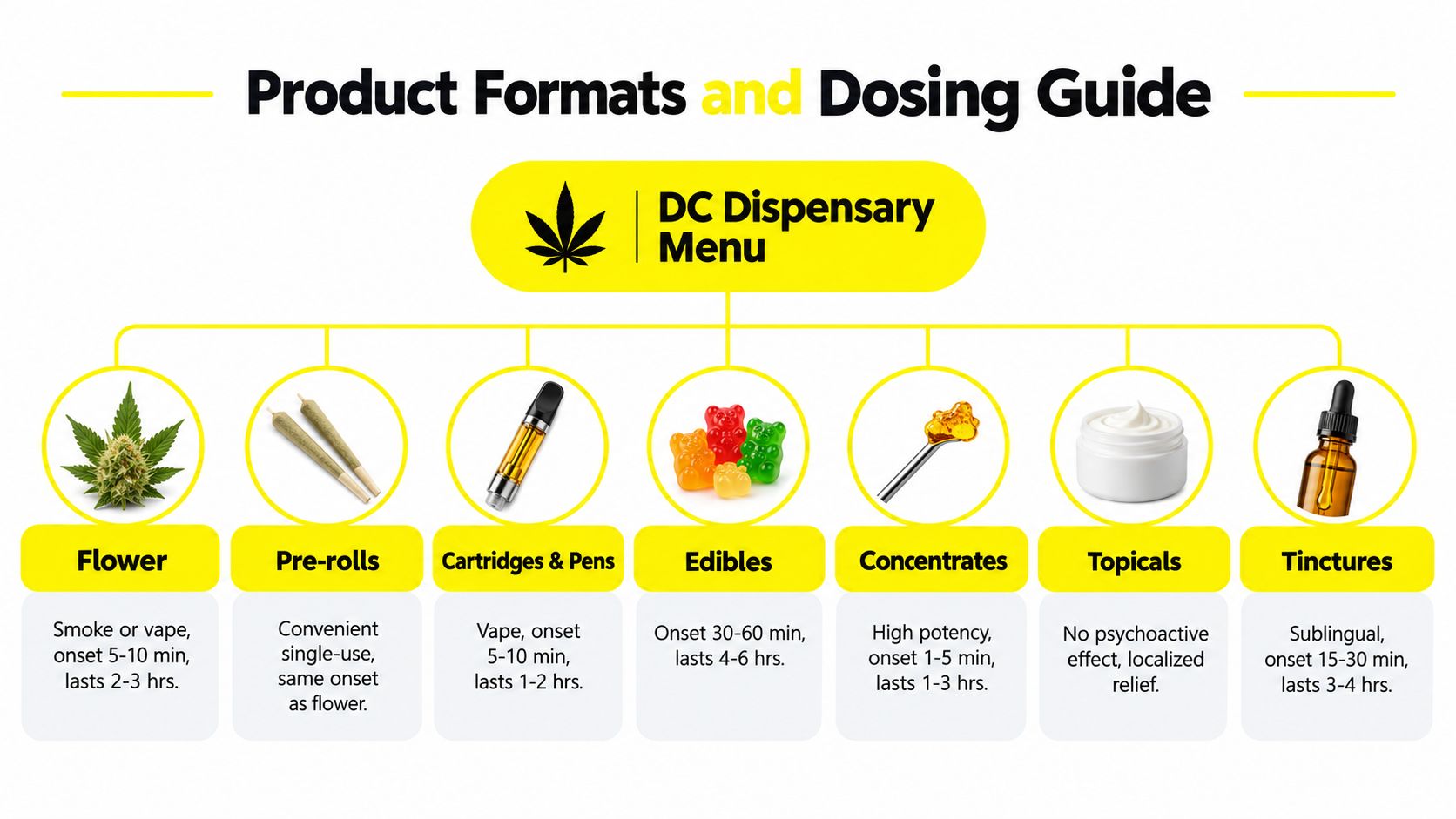
Match the format to the practical question
| Format | What to discuss before buying |
|---|---|
| Flower | Inhaled effects, potency, equipment, and how you'll control the amount used |
| Pre-rolls | Total contents and why a complete pre-roll isn't necessarily an appropriate personal serving |
| Cartridges and pens | Device compatibility, concentration, and differences in draw size |
| Edibles | THC per piece, delayed effects, and a clear plan against rapid redosing |
| Concentrates | Potency and whether your experience supports using a concentrated format |
| Topicals | Intended application and product-specific effects, without assuming every formulation behaves alike |
| Tinctures | THC per measured volume and whether the directions specify under-the-tongue use or swallowing |
Flower percentage describes concentration, not the precise dose you'll receive from an inhalation. Similarly, a cartridge's potency doesn't tell you how much a particular draw delivers.
With tinctures, ask staff to connect the label's concentration to the measuring device. A dropper without an understood measurement isn't a dosing plan.
Read edible labels at the piece level
DC rules allow no more than 20 mg THC per serving-size piece, while packages sold to patients without a valid written recommendation are limited to 200 mg THC; a package containing 200 mg at 20 mg per piece therefore contains ten serving units, under the District's medical-cannabis regulations.
Those are legal limits, not beginner recommendations. Start below the legal maximum, and ask for a product that makes a smaller serving easy to measure.
For example, a nervous first-time patient shouldn't choose a high-dose piece because the package offers more THC for the price. A clearly labeled lower-dose format can be the more useful purchase; the guide to low-dose edibles offers a relevant starting point for that conversation.
Wait for the oral product's effects rather than treating an initially quiet period as permission to take more. If you need advice about interactions or suitability for a medical condition, involve your healthcare professional.
What Separates a Good DC Dispensary from a Forgettable One
A good dispensary can explain what it's selling without leaning on strain fame. Premium isn't a safety standard, and a high potency figure doesn't answer questions about contaminants or consistency.
Once a licensed testing laboratory became operational on August 16, 2024, DC cultivation centers and manufacturers were required to test products before transfer to licensed downstream businesses; testing includes mycotoxin pass/fail results, and batches failing residual-solvent or processing-chemical testing are treated as adulterated, according to ABCA's testing-laboratory requirements notice. The same framework permits authorities to test patient-submitted samples purchased from licensed retailers.
My recommendation is to ask for batch-specific information, not accept a general statement that everything is tested. The documentation should connect to the product you're buying.
Quality shows up in the answers
Suppose you're comparing two Gelato products. One retailer can identify the batch, explain the laboratory information, and discuss a lower-potency alternative; the other only repeats that Gelato is popular.
Choose the first conversation. A recognizable name can help you locate a product, but it doesn't establish what's in that package or whether it suits you.
- Look for traceability: Staff should be able to connect the product label and lot information to relevant testing documentation.
- Expect clear dosing explanations: An employee recommending an edible should understand its serving size.
- Reject pressure: You shouldn't need to defend a preference for a smaller order or lower-dose format.
- Question vague menus: Missing potency, serving information, or meaningful product descriptions deserve clarification before payment.
Bigger sales aren't a substitute for better service
The earlier-linked ABCA retailer guidance reports February 2026 dispensary sales of $5,463,268, compared with $2,811,509 in February 2025, roughly 94% year-over-year growth. A busier market makes patient education more important, not less.
A clear explanation of a modest product is worth more than a confident sales pitch for an unsuitable one.
The dispensary customer-experience guide provides another lens for judging service. My test is simpler: can the employee explain the product, respect your budget, and admit when a question belongs with a clinician?
Don't penalize a careful verification process or a staff member who checks an answer. Penalize unsupported certainty, unexplained substitutions, and pressure to buy more than you intended.
A First-Timer's Walk Through a DC Dispensary
Consider a hypothetical patient arriving with an approved registration, a photo ID, and no experience using edibles. They've browsed the menu, but they're nervous about choosing something too strong.
At the entrance, they present their documents and let staff finish verification. There's no need to apologize for being new, and no need to pretend they understand the menu.
Say what you need plainly
A useful opening is to explain that you want a small starter order, clear serving instructions, and a product that's easy to measure. Mention concerns about unwanted effects and any questions you need a healthcare professional to address.
The employee suggests an edible, but you don't have to accept the first recommendation. Ask how it compares with another format and why it fits your stated preferences.
- Check the package: Find the serving information rather than relying on the product name.
- Ask about the batch: Request the testing information connected to the item being sold.
- Confirm the plan: Explain back how you intend to use it so staff can identify a misunderstanding before checkout.
Make checkout boring
Before paying, compare the selected package with the order and confirm the final total. Ask about debit or cash in advance rather than assuming the retailer accepts your preferred method.
If you're using cash, prepare before arriving; if you're using debit, confirm any associated payment arrangements or fees. A short payment question is less annoying than discovering a problem after you've completed product selection.
The patient leaves with a modest order and readable instructions, not a collection of products they felt pressured to try. At the parking spot, they keep the purchase packaged and save the label information for later reference.
The win is leaving without unanswered questions. For an oral product, follow the conservative serving plan established at the counter and resist taking more because effects aren't immediate.
Don't judge your first visit by how much you bought. Judge it by whether you understand the product well enough to make a careful decision at home.
Your Pre-Visit Checklist and Final Takeaways
Save a short checklist on your phone before you leave. It should help you verify access, narrow the menu, and avoid making decisions under pressure.
- Documents ready: Bring your valid patient credential and government-issued photo ID. Visiting patients should confirm their access pathway beforehand.
- Retailer checked: Verify licensing through ABCA rather than relying on storefront signage or a search result.
- Goal defined: Decide whether you need help choosing a format, interpreting a label, or comparing familiar products.
- Questions prepared: Ask about batch documentation, serving measurement, substitutions, and the complete price.
- Fulfillment confirmed: Check pickup procedures or lawful delivery availability for your actual address.
- Payment arranged: Confirm accepted methods before traveling.
- Exit standard set: Walk away from pressure, unsupported medical promises, or an inability to explain the product.
Buy for clarity, not status
Your first purchase doesn't need to impress anyone. A manageable order with understandable instructions is more useful than an expensive product chosen because it sounds prestigious.
A DC dispensary is a regulated medical retailer. Bring the credentials, ask direct questions, and give staff room to verify details. You should leave knowing what you bought and how you intend to use it.
Mr. Nice Guys DC offers flower, edibles, cartridges, pre-rolls, concentrates, topicals, and tinctures, with staff guidance and pickup options. Visit Mr. Nice Guys DC to review the menu, confirm your patient-access requirements, and ask about serving size and batch information before placing your order.
Mr Nice Guys DC
At Mr. Nice Guys DC, we’re more than just a cannabis delivery service — we’re passionate advocates for quality, convenience, and community. With years of experience in the cannabis industry, our team is dedicated to educating and empowering customers across Washington, D.C. Whether you're a seasoned user or just starting your cannabis journey, our blog delivers trusted tips, product insights, and the latest updates from the world of weed. Stay informed, stay elevated.
