
Must Be 21 To Enter
By entering this site you are agreeing that you are at least 21 Years of Age or older.
I AM 21 OR OLDERInitiative 71 Washington DC: A 2026 Legal Guide
.svg)

.png)
You’re probably here because DC cannabis feels contradictory. A friend says weed is legal. A shop window says “gifts.” Another person tells you the city is shutting those places down. Then you hear that adults can now use the medical system even if they aren’t traditional patients.
That confusion makes sense. initiative 71 washington dc created legal possession and sharing for adults, but it never created a normal recreational store system. For years, that gap produced the famous gifting market. In 2026, that workaround is no longer the smart way to handle DC.
The practical answer now is simpler than it used to be. Know what Initiative 71 allows, understand what the gifting model was, and use the regulated medical path if you want the safest, most compliant option.
The Story Behind Initiative 71
A lot of first-time DC buyers assume Initiative 71 created legal weed stores. It didn’t. It changed the risk around possession and home use, but it stopped short of a standard adult-use retail system. That distinction is the reason so many people got confused for years.
Initiative 71, formally called the Legalization of Possession of Minimal Amounts of Marijuana for Personal Use Act of 2014, passed in 2014 and took effect in 2015. The measure had strong voter support after a local petition campaign, according to the Marijuana Policy Project’s summary of D.C.’s Initiative 71. For practical purposes, the law gave adults 21 and older room to possess limited amounts, grow a small number of plants at home, and give limited amounts to another adult without payment.
That was the purpose. DC voters wanted to reduce arrests and stop treating small-scale personal cannabis use like a criminal issue.
In practice, I-71 legalized possession of up to two ounces, home cultivation within the plant limits, and true person-to-person gifting of up to one ounce. It also allowed private use on private property in ways that mattered to ordinary adults trying to stay out of trouble. If you want a quick comparison between what I-71 allowed and what people often assumed it allowed, this guide to Washington DC recreational cannabis rules helps frame the difference.
The missing piece was retail sales. I-71 did not authorize a normal recreational storefront model, and Congress kept blocking DC from building one. That gap shaped the city’s cannabis situation for years. Adults could legally hold and share cannabis in limited amounts, but they could not walk into a licensed adult-use shop and buy it the way they could in many states.
That trade-off matters even more in 2026. I-71 opened the door to legal possession, but it never gave adults a clean, regulated buying channel. The safer answer now is the medical system, which is much more accessible than many residents and visitors still realize.
Understanding DC's Cannabis Rules In Practice
A visitor lands at Reagan, checks into a hotel, and assumes the rules work like a fully legal retail state. That mistake still creates problems in DC. The practical question is simpler: what can an adult legally possess, use, grow, or give away, and what crosses the line into conduct that can still draw attention from police or regulators?
What you can legally do
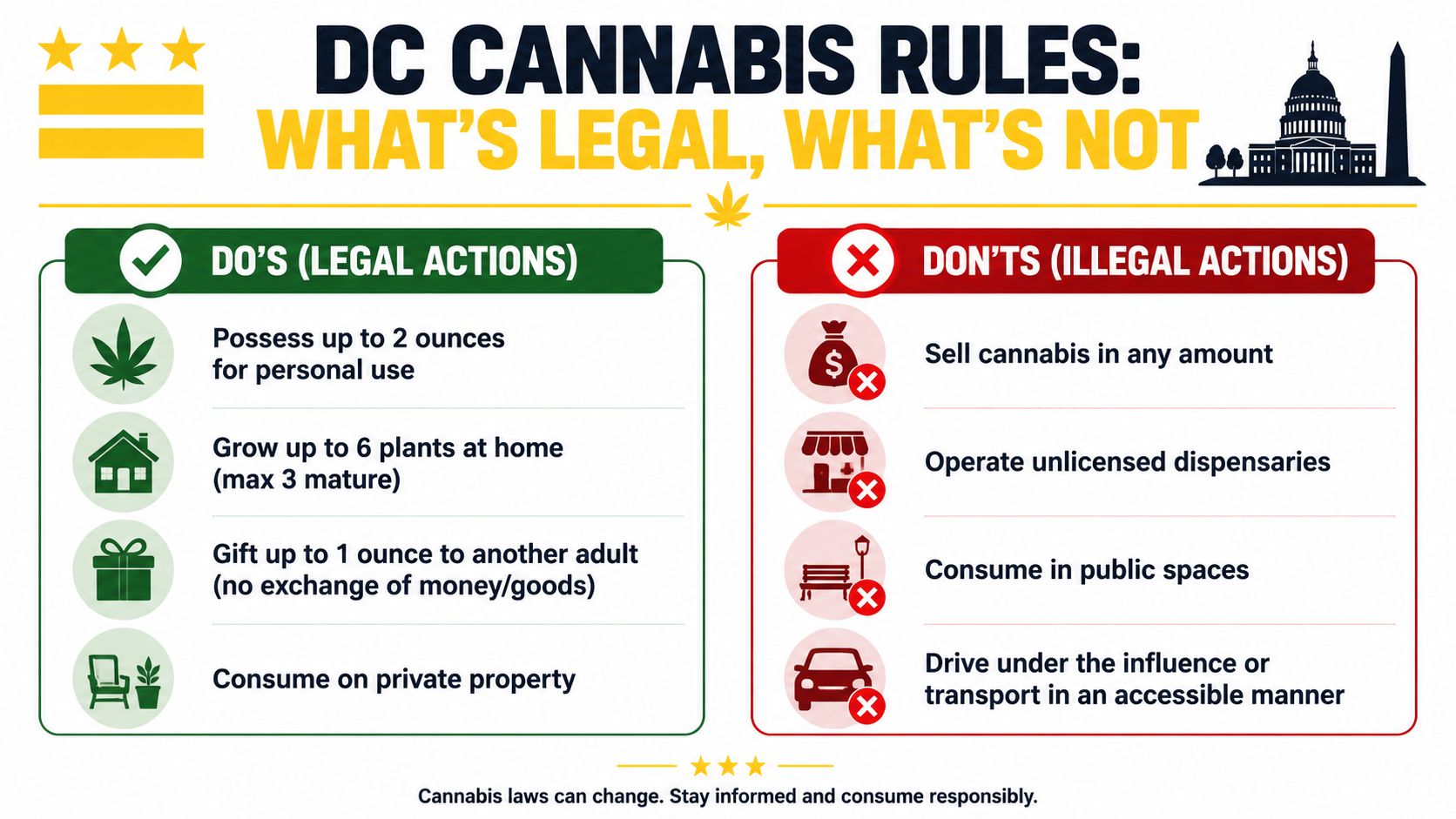
Under I-71, an adult 21 or older can possess up to two ounces, grow up to six plants at home with no more than three mature at one time, and give up to one ounce to another adult if nothing of value changes hands. Those are the basics that still matter day to day.
The clean version is straightforward:
- Possess a limited personal amount.
- Grow a small home crop within the plant cap.
- Give cannabis to another adult as a real gift.
The last part is where people get sloppy. A true gift means no cash, no Venmo later, no trade, no cover charge, no “donation,” and no purchase of some unrelated item that just happens to come with cannabis.
A practical example helps. Handing a friend a pre-roll at a private dinner with no expectation of anything back fits the rule much better than handing over cannabis after they buy your T-shirt, art print, or event ticket.
What still gets people in trouble
The safest way to read I-71 is narrowly. If an activity looks like unlicensed retail, public consumption, or impaired driving, assume the law is not on your side.
| Legal under I-71 | Not legal under I-71 |
|---|---|
| Possessing a compliant personal amount | Selling cannabis in any amount |
| Using cannabis on private property, if allowed by the owner | Smoking or vaping in public |
| Growing within the household limits | Operating an unlicensed storefront or delivery business |
| Giving cannabis away with no compensation | Driving while impaired |
Public use is a common mistake. Smoking on a stoop, outside a bar, near an apartment entrance, in a park, or while walking down the block can still create a problem even if plenty of people around you act like it is normal.
One rule of thumb works well here. If the transaction feels engineered to avoid calling a sale a sale, treat it as risky.
How the rules work in 2026
This is the part many first-time users miss. I-71 still explains possession, home grow, and gifting, but it does not give adults a standard recreational buying channel. In 2026, the safer and more compliant route for both residents and visitors is usually the medical system, which is far more accessible than it was a few years ago.
That shift matters because people used to treat the gray market as the practical answer. Regulators now expect adults to use licensed channels where products are tracked, businesses are inspected, and the rules are clearer. If you want the regulated version explained in plain English, this guide on how D.C. regulates medical cannabis dispensaries is a useful next read.
The result is a simple compliance mindset. Keep possession within the limit. Keep use private. Do not treat gifting as a disguised sale. If you want the lowest-friction legal option in DC today, use the licensed medical system instead of trying to decode gray-market workarounds.
The Rise of the Gifting Economy
A few years ago, the standard DC cannabis experience often went like this: you walked into a bright storefront, picked a sticker or T-shirt no one really wanted, and left with cannabis attached to the purchase. Customers understood the true transaction. Shops did too.
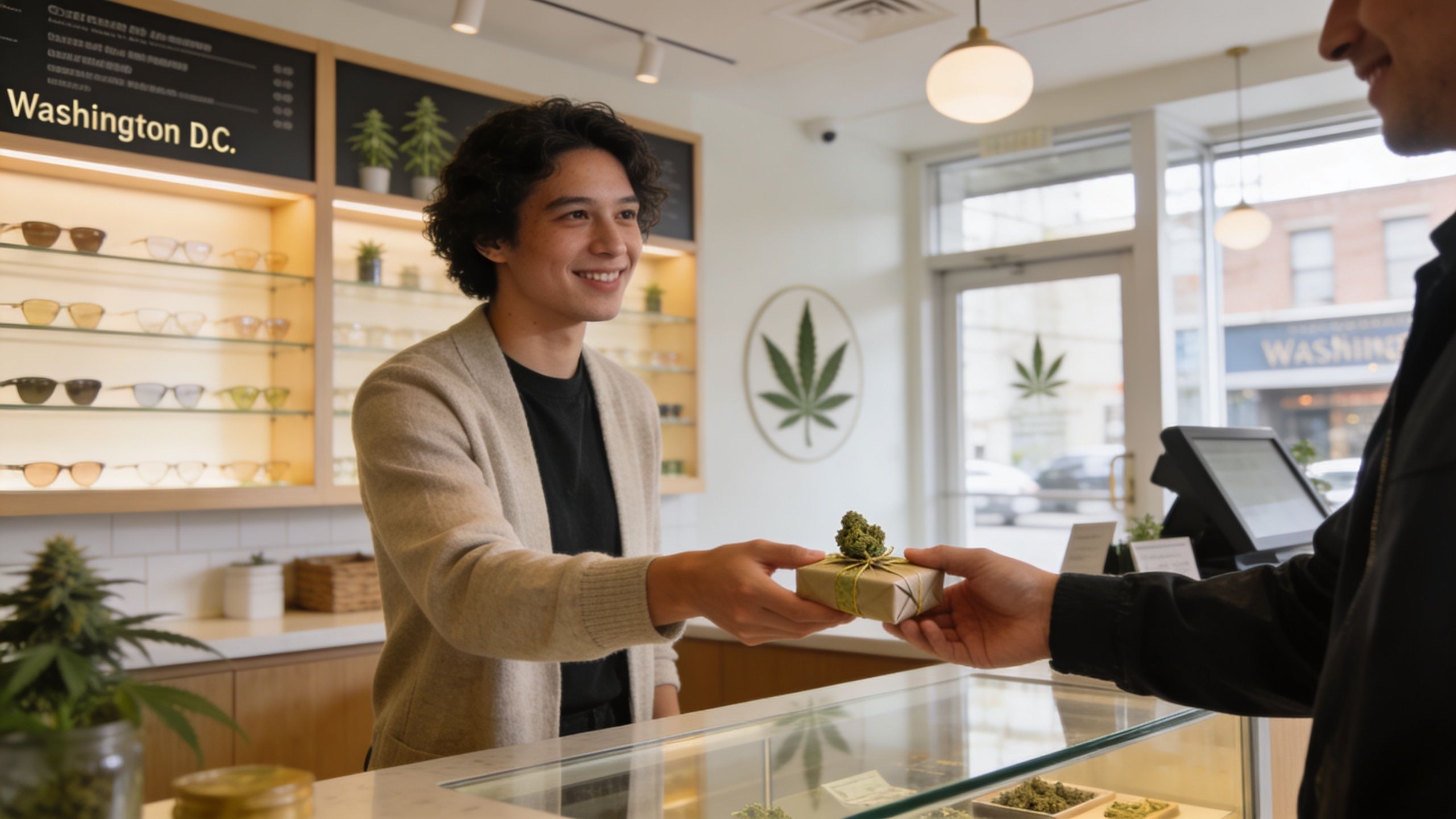
Congress blocked DC from setting up a standard adult-use retail system, so the market filled the gap with a gifting model. Under that setup, businesses paired cannabis with a separate item that was legal to sell on its own. On paper, the store sold merchandise or an experience. In practice, the cannabis drove the purchase.
How the gray-market model worked
The mechanics were simple enough. A customer bought an item such as a print, bottle of juice, event entry, or branded merch. Cannabis came with it as the “gift.”
Everybody could usually see what was happening. The listed product was often just the wrapper around the actual demand, which was flower, edibles, or a vape. That made the system easy to use, but also hard to call clean compliance.
A coffee shop comparison helps. If coffee sales were barred, but mugs were allowed, a lot of shops would suddenly start selling expensive mugs that came with “free” coffee. That was the basic logic behind many I-71 storefront transactions.
Why customers used it
The gifting economy grew because it was convenient and visible. Adults could legally possess cannabis, share it, and grow it at home, but they still did not have a normal recreational storefront system. For residents, newcomers, and visitors, gifting shops became the practical answer people saw on the street.
That convenience came with trade-offs. Customers often had no clear way to verify where a product came from, how it was handled, or whether the shop would still be operating the next month. If you were in DC during that period, that uncertainty was part of the deal.
What customers gained, and what they risked
The old model gave people access fast. It also produced a lot of inconsistency.
- Storefront access was easy: Many shops were visible and simple to find.
- Product quality could vary widely: Menus looked polished, but standards were uneven from one operator to the next.
- Staff knowledge was mixed: Some employees gave solid guidance. Others were clearly guessing.
- Customers carried the uncertainty: If enforcement changed or a shop cut corners, the buyer had very little protection.
For readers who want a closer look at how that system operated, this breakdown of EZ gifting in DC gives useful background. In 2026, though, the gifting era matters mainly as context. The safer move for adults today, including visitors and first-time users, is to use the licensed medical program instead of relying on old gray-market habits.
Why the Gifting Market is Changing in 2026
The biggest mistake you can make in 2026 is assuming DC cannabis works the same way it did a few years ago.

By September 2025, a Joint Cannabis Task Force had begun inspections of over 60 suspected illicit storefronts, and the city had already set a firm March 31, 2025 deadline for I-71 operators to apply for medical licenses, according to the D.C. mayoral fact sheet on Initiative 71 enforcement. That marked a real policy turn. The city stopped treating the gifting market as something that would just linger indefinitely.
What changed on the ground
For years, many people assumed gray-market shops would keep operating because they were so visible. That assumption doesn’t hold anymore.
The city created an on-ramp for many operators to move into the licensed medical system. Some did. Some didn’t. Once that application window closed, enforcement became the next step. In practice, that means old-style gifting storefronts are far less reliable and far more exposed.
A practical example. In the old environment, a customer might think, “If a storefront is open, it must be fine.” In 2026, that’s not a safe shortcut. A storefront can look polished and still be on the wrong side of enforcement.
On-the-ground takeaway: Visibility is not compliance. A bright menu board, security at the door, and branded packaging don’t tell you whether a shop is operating legally.
This local news segment gives useful visual context for how the city has discussed enforcement and the broader market shift:
Why this matters for buyers
Consumers often think enforcement is only a business problem. It isn’t. It changes your risk too.
If a shop is operating in a shaky legal position, you’re dealing with uncertainty around product sourcing, testing, menu accuracy, and whether the business will still be there when something goes wrong. That matters even more for first-time buyers, out-of-town visitors, and anyone using edibles or vapes where dosage and quality matter.
Here’s the short version:
- Old assumption: gifting shops are just how DC works
- Current reality: the city is pushing the market toward licensed channels
- Practical move: use the system the city is actively supporting, not the one it is actively winding down
That’s the actual 2026 shift.
Your Safest Path to Cannabis in DC Today
The safest legal path in DC is no longer the old gifting workaround. It’s the medical system.
In late 2025, the DC Council approved emergency legislation allowing adults 21+ to self-certify for a medical marijuana card without a doctor’s approval, effectively opening the regulated medical market to all adults while the city cracked down on I-71 gifting shops, as described in this DC Council coverage on YouTube. That change removed the biggest practical barrier for many adults who wanted a clearly compliant option.
Why the medical route makes more sense now
For residents, visitors, and first-time consumers, self-certification changed the equation. You no longer need to play guessing games with a gray-market transaction if you’re eligible by age and willing to use the regulated system.
The benefits are practical, not abstract:
- Clearer compliance: You’re buying through the framework DC is expanding, not the one it’s trying to phase out.
- Better product transparency: Regulated menus typically give you more confidence about what you’re choosing.
- More useful guidance: If you’re new to cannabis, staff can help you think through format and effect instead of just pushing whatever moves quickly.
A simple example. If you’re deciding between a vape and an edible for the first time, the right answer depends on how quickly you want effects, how easy dosage control needs to be, and how discreet your use needs to remain. That conversation is far more useful in a regulated setting than in a shop built around legal ambiguity.
What this looks like in real life
Instead of trying to decode whether a storefront is still operating under an aging gifting model, an adult can self-certify, shop the licensed market, and choose products based on intended use.
If you want evening flower, you can compare strains such as Gelato or Blue Dream by menu description and available product details. If you want a lower-commitment starting point, a single pre-roll or a measured edible may make more sense than buying a random “gift” package that tells you very little.
One practical resource is this guide on how to buy weed in DC, which walks through the access process. And if you want a licensed dispensary option, Mr. Nice Guys DC operates in the medical market with menu-based access for adults using the compliant system.
The old gray market asked customers to accept uncertainty as normal. The medical system doesn’t eliminate every question, but it removes the biggest legal and product-quality unknowns.
What doesn’t work anymore
What doesn’t work in 2026 is relying on old word-of-mouth like “my friend always used that spot” or “that shop has been there forever.” Longevity isn’t a compliance strategy.
It also doesn’t help to treat self-certification as a technicality you can ignore. If the city has made the regulated route accessible to adults, and enforcement is aimed at gray-market operators, the safer choice is obvious.
Practical Tips for Residents and Visitors
The legal path is clearer now, but the day-to-day details still matter. Good decisions in DC usually come down to where you are, how you’re using cannabis, and whether you’re treating local rules casually.
If you’re visiting DC
Visitors often overcomplicate this. The key question isn’t “Where can I find a gifting shop?” It’s “What’s the compliant option available to me while I’m here?”
Use the self-certification route if you’re an adult and want regulated access. Then think through logistics before you order. If you’re staying in a hotel, don’t assume the property allows smoking or vaping. Many don’t. Even if cannabis is legal under local rules, private property owners still set house rules.
A practical visitor checklist:
- Check your lodging rules: Hotels, short-term rentals, and apartment buildings may prohibit smoking.
- Choose format carefully: Edibles and tinctures are often easier for discreet use than flower.
- Keep plans simple: Don’t buy more than you can use responsibly during your stay.
If you live in DC
Residents should think beyond the purchase itself. The two biggest friction points are usually housing rules and consumption location.
If you rent, review your lease before assuming home use or home grow is problem-free. If you own or live in a private residence with permission, private use is much more straightforward. If you share walls with neighbors, discretion still matters even when your conduct is locally lawful.
For everyone using cannabis in the city
Some habits keep people out of avoidable trouble:
- Stay off federal property: DC is full of federal land, buildings, and spaces. Don’t treat a scenic spot as a legal smoke area.
- Don’t use in public: Sidewalks, parks, outside venues, and vehicles are bad choices.
- Start low if you’re new: That applies especially to edibles, where effects arrive later and last longer.
- Transport discreetly: Keep products secured and don’t make your car a consumption space.
The people who have the smoothest experience in DC aren’t the ones trying to push boundaries. They’re the ones who use legal access, stay private, and plan ahead.
Common Questions About Cannabis in Washington DC
Can I bring cannabis into DC from Maryland or Virginia
Do not cross into DC with cannabis and assume local possession rules protect you. Crossing state lines creates a separate problem. In practice, the safer move in 2026 is to wait until you are in DC and use a compliant local option through the city’s medical system.
Can I smoke in public if I’m only carrying a small amount
No. Possession and public consumption are different issues under DC rules. A small amount in your pocket does not give you permission to smoke on a sidewalk, in a park, outside a bar, or in a car.
Are edibles and vapes treated differently from flower under the basic access question
The format matters less than the source. Flower, vapes, edibles, and pre-rolls all become riskier when they come from informal sellers or are used in places where consumption is not allowed.
That is one reason more adults, including visitors and first-time buyers, are shifting away from old I-71 habits and into the regulated medical channel. It gives people a clearer chain of custody and a more consistent buying process.
What are the key differences between an old gifting shop and a licensed medical dispensary
The biggest difference is compliance. Gifting shops operated in a gray area and often relied on legal theories that did not match the customer experience at the counter. Licensed medical dispensaries operate under the framework DC is openly using in 2026.
That changes the purchase itself. Product menus, intake, and fulfillment are more standardized. Customers also have a better basis for asking practical questions about dose, format, and expected effects instead of relying on whatever a shop clerk says in the moment.
Can I get delivery in DC
Sometimes, yes, but only through the licensed system and only if the dispensary offers it. Delivery is no longer something to assume based on how the old gifting market worked. If you want details before you order, this guide to Washington DC pot delivery legality explains the current setup.
What should a first-time consumer buy
Start with something easy to control. Low-dose edibles, a single pre-roll, or a simple vape can make sense depending on how long you want effects to last and whether you can use privately.
Do not stack products early on. A common beginner mistake is taking an edible, feeling nothing after a short wait, and then adding inhalation on top. That is how people overshoot their comfort level.
Is initiative 71 washington dc still relevant in 2026
Yes. Initiative 71 still matters because it shaped DC’s rules around possession, private use, home grow, and person-to-person gifting. But if the practical question is how an adult should buy cannabis with the least friction and the lowest legal risk today, the medical program is the stronger answer.
That applies to residents, tourists, and people trying cannabis for the first time.
If you want a compliant way to shop cannabis in DC, Mr. Nice Guys DC provides access through the city’s medical framework, with menu-based ordering, pickup, and delivery options for eligible adults. If you are unsure where to start, use the regulated system, ask about dose and product type, and leave the old gifting playbook in the past.
Mr Nice Guys DC
At Mr. Nice Guys DC, we’re more than just a cannabis delivery service — we’re passionate advocates for quality, convenience, and community. With years of experience in the cannabis industry, our team is dedicated to educating and empowering customers across Washington, D.C. Whether you're a seasoned user or just starting your cannabis journey, our blog delivers trusted tips, product insights, and the latest updates from the world of weed. Stay informed, stay elevated.
