
Must Be 21 To Enter
By entering this site you are agreeing that you are at least 21 Years of Age or older.
I AM 21 OR OLDERCurbside Pickup and Delivery at Mr. Nice Guys DC
.svg)

.png)
You're standing outside a DC dispensary with your phone in hand, a product menu open, and a practical question to answer: should you walk inside, pull into a curbside space, or have the order brought to your apartment? The right choice depends less on which option sounds most convenient and more on what your day allows, what identification you have ready, and how much help you want before buying.
Curbside pickup and delivery are established fulfillment channels rather than unusual exceptions. The share of top U.S. retailers offering curbside pickup rose from 7% in December 2019 to 44% by August 2020, and curbside remained available from 24.8% of the Top 1,000 retail chains in 2024, according to Pitney Bowes' retail analysis. In DC, however, cannabis access still depends on eligibility, identity verification, payment, location, packaging, and rules governing the handoff.
Choosing How to Get Your Order
Three routes, three different experiences
A patient visiting Mr. Nice Guys DC might choose in-store service when they want a budtender to compare flower, pre-rolls, edibles, concentrates, or tinctures. A repeat customer who already knows the product may prefer curbside pickup, especially when leaving the car would be inconvenient. Delivery can make more sense for someone with limited mobility or anyone who can't easily reach the storefront.
Each path begins with the same basic responsibility: bring valid identification and follow DC cannabis rules. Adults 21 and older may qualify for adult-use purchases with a valid government-issued photo ID. Medical patients also need a valid DC medical marijuana card when purchasing through the medical channel or seeking medical patient pricing. Staff may verify those documents each time, even if the patient has visited before.
DC law also limits where cannabis may be delivered or exchanged. A retailer with a delivery endorsement may offer curbside pickup and deliver medical cannabis to a qualifying patient or caregiver at residential and commercial addresses in the District, but not on District government property, federal property, or school grounds. The permitted service window for those activities is 9:00 a.m. to 9:00 p.m., seven days per week, as stated in the District law governing delivery-endorsed retailers.
Practical rule: Choose the fulfillment method before you leave home, then keep the matching ID, payment method, and order details within reach.
Match the option to the day
Someone buying a familiar cartridge after work may value a fast vehicle handoff. A first-time visitor comparing Gelato with Blue Dream may need the conversation that only happens comfortably inside. A patient recovering at home may value a scheduled delivery more than a short trip to the store.
Patients also switch between options. The same person might walk in for a first purchase, use curbside for a repeat order, and request delivery when weather, mobility, or schedule makes travel difficult. Staff can help clarify the available route when a patient reviews what to expect at a first dispensary visit, calls ahead, or arrives at the shop.
One important boundary applies to every route: cannabis can't be consumed in the vehicle, outside the store, at the delivery address in a public area, or on the premises. The fulfillment choice changes how you receive the order, not where use is legally permitted.
Walking In for In-Store Pickup
In-store pickup remains the most useful route when you want advice before committing to a product. It gives you a chance to ask how a strain, format, or potency may fit your preferences rather than relying only on a menu description.
Bring the right documents
Have these items ready before you arrive:
- Government-issued photo ID: Adults using the adult-use channel need valid identification showing that they meet the age requirement.
- DC medical marijuana card: Medical patients should bring their current card for verification and patient purchasing.
- Order information: Keep the order name, confirmation details, and preferred payment method accessible.
The team checks identification at the entrance and may re-verify it during the visit. That isn't unnecessary friction. It helps staff keep the sale tied to the correct customer and the correct purchasing channel.
What happens inside
After check-in, a budtender can help narrow the menu. For example, a patient who wants an evening product but doesn't enjoy smoking might compare an edible with a tincture. Someone seeking a familiar inhaled format might discuss flower, pre-rolls, cartridges, or pens. The useful part of the in-store experience is the back-and-forth. You can explain what you've used before, what you want to avoid, and whether convenience or effect matters more.
Once you choose, staff scan the products, calculate the order, take payment, and place the purchase in compliant packaging. The order leaves in an opaque, resealable exit bag, and product handling remains part of the sales process rather than something to open or sample on the sidewalk.
What doesn't work: Arriving without the required ID, expecting to consume outside, or assuming a busy period will feel like a quick stop. Peak hours can create a wait, particularly when several customers need detailed guidance.
Parking near the storefront can also affect the experience. If getting out of the vehicle isn't practical, curbside or delivery may fit better. Patients who prefer to plan the order digitally can review how to order weed online before selecting in-store pickup.
Using Curbside Pickup Step by Step
Curbside is designed for the patient who already knows what they want and wants the sealed order brought to the vehicle. It removes the need to enter the store, but it doesn't remove the ID check or the compliance steps attached to the sale.
Place and confirm the order
Step one is the order. Use the dispensary's online menu or call the team. Staff confirm that the selected items are available, review the total, and note the order name or other identifying details. If a product sells out or an item needs to be changed, resolve that before driving over.
Step two is the pickup confirmation. Mr. Nice Guys DC sends or provides a text or call with an estimated pickup window and the assigned parking zone. Treat that information as part of the order. It tells the team where to look and helps prevent a handoff to the wrong vehicle.
Arrive prepared
Step three is vehicle arrival. Pull into the marked curbside spots and turn on your hazard lights. The signal helps staff identify the waiting vehicle without requiring you to stand outside or search for someone at the entrance.
Step four is document readiness. Keep your valid government photo ID at the window. Medical patients should also have their medical marijuana card ready, along with the order name or confirmation number. Don't bury the documents in a bag or leave them in another part of the car.
Step five is verification and payment. A staff member approaches the vehicle, checks the ID against the order, accepts the available payment method, and hands over the sealed exit bag. Payment may include cash, CanPay, or debit where supported. The exact options can vary, so confirm them when placing the order.
The patient should remain in the vehicle during the handoff. The product isn't opened or consumed in the parking area. If something needs to be returned or exchanged, staff must handle it according to DC rules, generally through the store rather than by improvising at the curb.
If you're running late, call. A delayed arrival can create a storage or cancellation problem if the team can't confirm when you'll reach the pickup zone.
The process is straightforward when the order, ID, vehicle, and payment are aligned. Patients looking for a nearby option can review curbside pickup near me before choosing the pickup route.
Ordering Delivery to Your Door
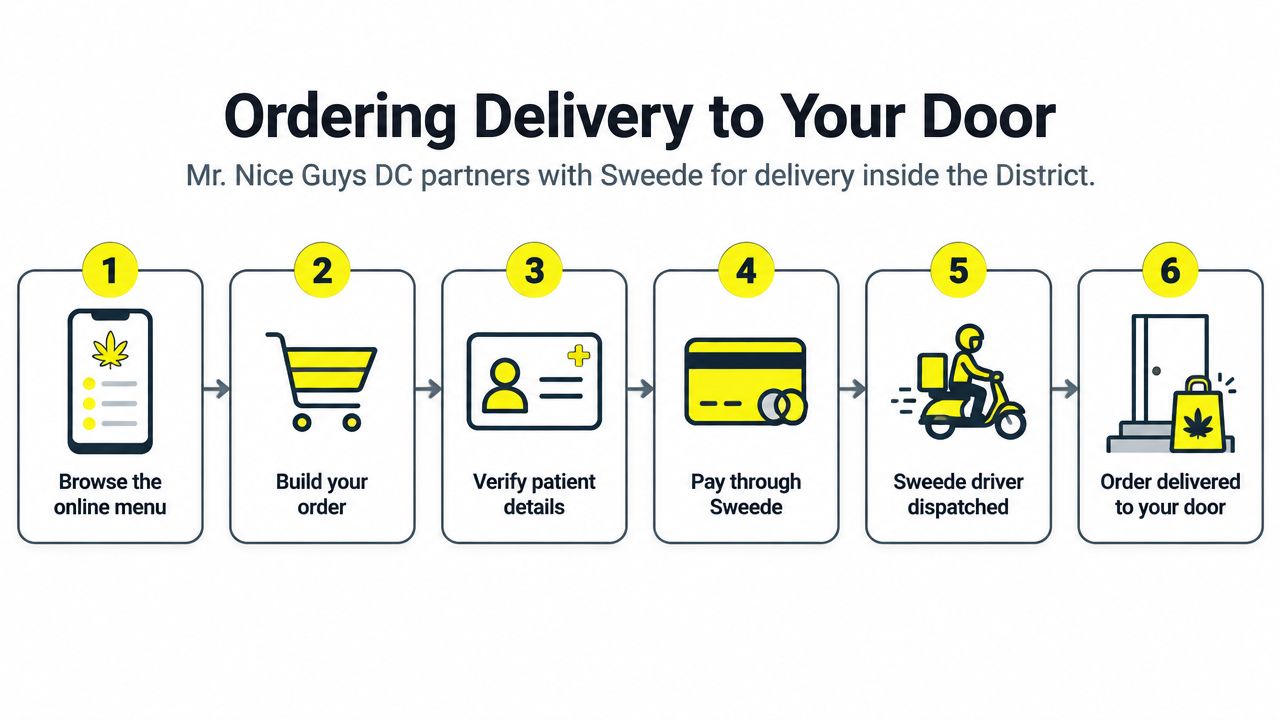
Mr. Nice Guys DC partners with Sweede for cannabis delivery within the District. Delivery follows the same core compliance logic as an in-store or curbside sale, but the final verification happens at the address rather than at the counter or car window.
Build the order and verify eligibility
Start on the online menu, select the products, and enter the requested patient or customer details. A medical patient needs a valid medical marijuana card. An adult-use customer must be 21 or older and provide valid government-issued photo ID. Adult-use and medical delivery use similar ordering mechanics, but the required identification and applicable possession limits can differ by channel.
Review the address carefully before submitting. Delivery is available to eligible residential addresses within DC. It isn't available to P.O. boxes, hotels, or non-DC locations. The order also needs to stay in its original sealed packaging until you're ready to consume it in a lawful private setting.
Follow the delivery window
Sweede provides the delivery window and communicates updates as the order moves through fulfillment. Text messages and driver-location information reduce the guesswork, but you should still keep your phone nearby. A courier may need to contact you if the address is difficult to access or the handoff needs clarification.
At the door, expect an ID check, signature, and payment at handoff. Have the required card or photo ID ready before the driver arrives. Check the bag and order contents while the driver is still present. If an item is wrong or missing, report it immediately through the delivery contact rather than waiting until the courier has left.
A useful example is an apartment order with a front-desk policy. The driver may need you to meet them at an approved residential entrance because a hotel, office, or restricted lobby isn't an eligible delivery destination. If you can't complete verification, the courier can't leave the package unattended.
Patients can review how weed delivery works in Washington, DC before placing a first order. Delivery is convenient only when the address, identification, payment, and recipient availability are all ready at the same time.
Comparing Pickup, Curbside, and Delivery
The best option depends on what you need from the transaction. In-store service provides the most interaction. Curbside reduces time outside the vehicle. Sweede delivery removes the trip, but adds address, scheduling, and handoff requirements.
Pickup, Curbside, and Delivery Compared
| Option | Typical Speed | Documentation Needed | Payment Methods | Best For |
|---|---|---|---|---|
| In-store pickup | Depends on check-in, menu questions, and store traffic | Government-issued photo ID, plus DC medical marijuana card for medical patients | Cash, CanPay, or debit where supported | First-time patients and shoppers who want detailed guidance |
| Curbside pickup | Usually efficient after the order is confirmed, but depends on arrival and handoff timing | Government-issued photo ID, medical card when applicable, order name or confirmation | Cash, CanPay, or debit where supported | Repeat buyers with a known order and a tight schedule |
| Sweede delivery | Depends on the delivery window, dispatch, route, and address access | Government-issued photo ID for adult-use customers, medical card for medical patients | Payment at handoff, with available method confirmed during ordering | Mobility-limited patients or customers who can't easily reach the storefront |
A first-time patient usually gets more value from going inside. The budtender can explain format differences, answer questions, and help avoid an order that looks right online but doesn't match the patient's experience or preferences.
Curbside works better for a repeat purchase such as the same pre-rolls or a familiar cartridge. Delivery is the practical choice when a patient can't comfortably travel, but it isn't automatically faster. Route conditions, building access, and the need to be present at the door all affect the result.
Traffic can also change curbside and delivery expectations by 15 to 30 minutes during rush hour, based on the practical planning guidance for DC service. That range should be treated as a planning consideration, not a guaranteed delay or service promise. Patients who need a precise arrival should ask the team which option is most realistic before submitting the order.
One other trade-off matters: curbside and delivery promotions may not always combine. If a rebate or delivery offer affects your decision, confirm the terms before checkout rather than assuming every discount transfers between channels.
Service Area, Hours, and Payment Rules
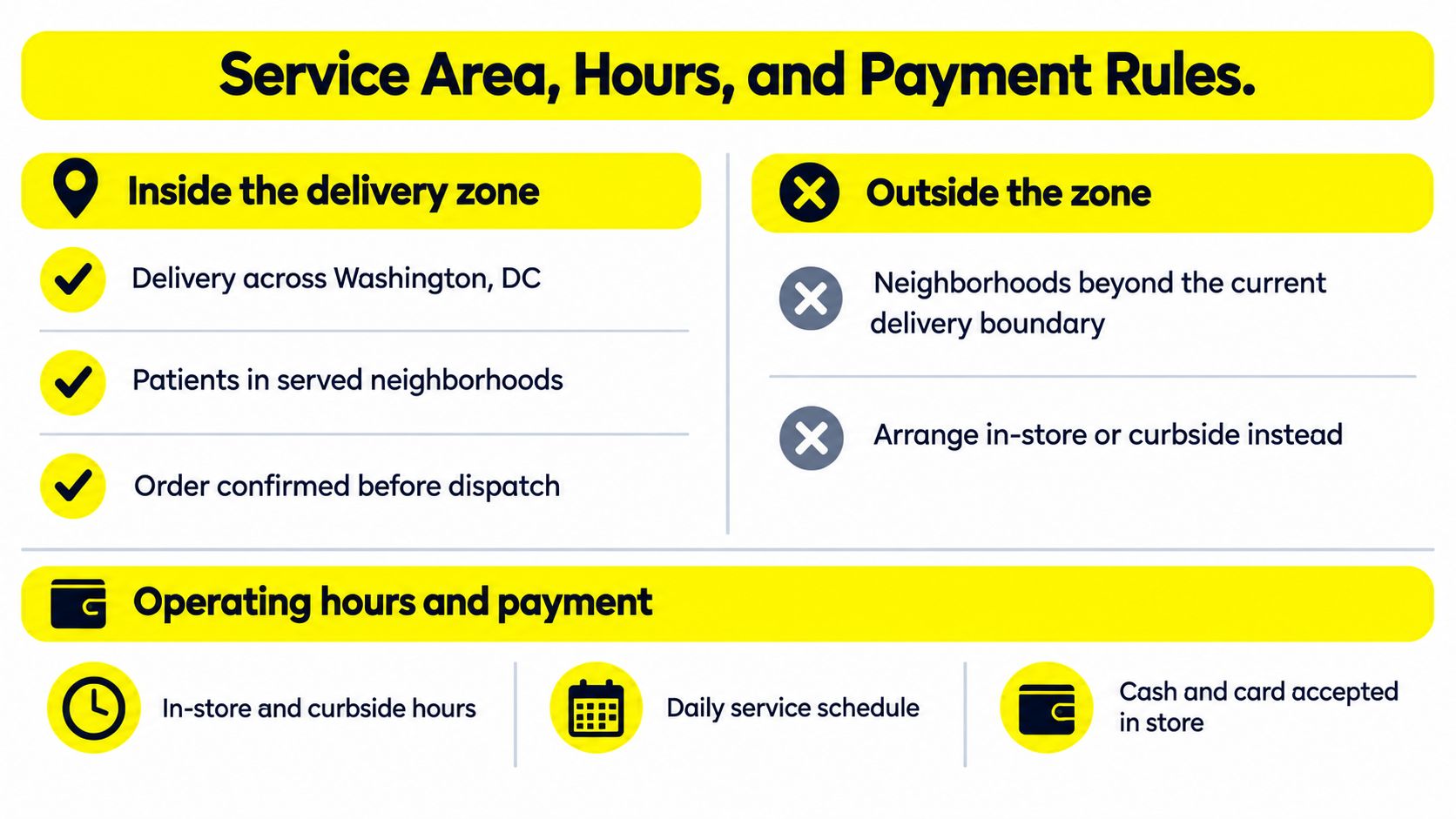
Service boundaries determine whether delivery is possible before product selection even begins. Mr. Nice Guys DC serves Washington, DC through its delivery arrangement with Sweede, while neighborhoods beyond the current delivery boundary need an in-store or curbside plan. A patient in a served DC neighborhood should still confirm the address before dispatch, especially when the residence has controlled access.
Confirm the schedule before ordering
In-store and curbside service follow the dispensary's posted operating schedule. Sweede delivery follows its own dispatch and delivery schedule, including any applicable order cutoff. Because schedules and service zones can change, check the live menu or call before relying on same-day fulfillment.
DC law permits a delivery-endorsed retailer to offer curbside pickup or delivery between 9:00 a.m. and 9:00 p.m., seven days per week. The District code for delivery-endorsed retailers also excludes District government property, federal property, and school grounds from the permitted delivery locations.
Internet retailers operate under a different rule. The District states that internet retailers can deliver but can't offer in-person or curbside pickup at their approved location, as described in the relevant internet retailer provision. That distinction matters when a patient assumes every online cannabis seller offers the same collection options.
Prepare payment and packaging expectations
Cash, CanPay, and debit-based options may be available in store or at curbside where supported. Standard credit cards generally aren't accepted by DC cannabis retailers because of banking restrictions. Confirm the payment method before leaving home, and keep a backup option ready if the selected method isn't available.
All orders must leave in opaque, resealable exit packaging. Don't transfer the product into an open bag during the trip, and don't open it in the vehicle or on public property. Adults may possess up to two ounces of flower or its equivalent, subject to the applicable DC rules and channel-specific limits.
Practical Tips and Common Patient Questions
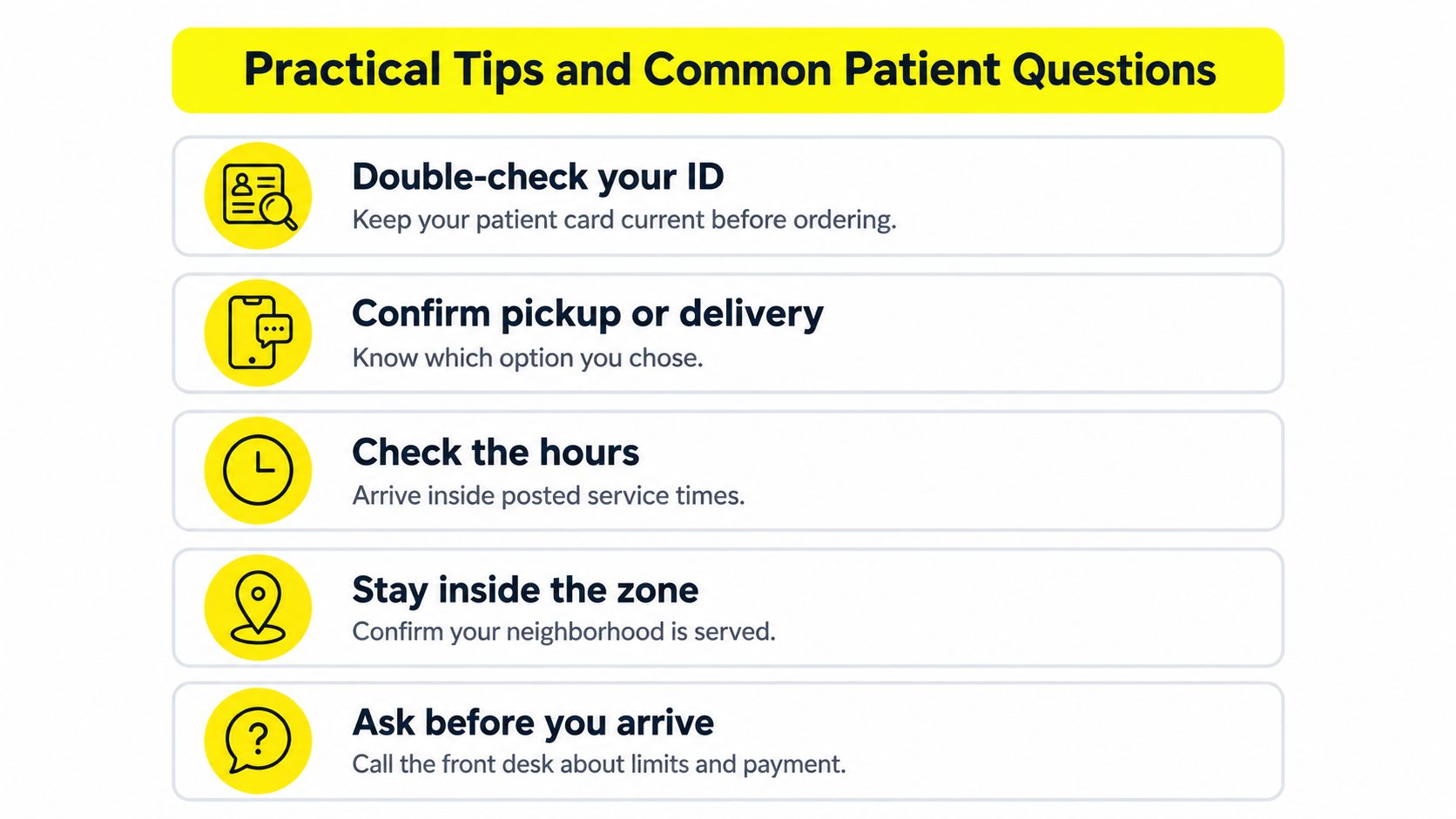
Small preparation steps prevent most avoidable delays. Check the recommendation card or medical documentation before checkout, keep a backup payment method available, and confirm whether your address is inside the current delivery zone. For curbside, use the correct side of the building and the marked vehicle area, because a perfect order can still stall if staff can't locate the car.
Questions patients ask at the front desk
Can a first-time patient register through Sweede?
The patient can begin through the delivery ordering process, but eligibility and identification still need to be verified. Have the required government ID or medical card ready, and expect the order to pause if the submitted information doesn't match.
What happens if the driver can't verify my ID?
The driver can't complete the handoff without acceptable verification. Don't ask the courier to leave the bag unattended. Contact the delivery team to determine whether the order can be rescheduled or returned under the applicable process.
What should I do after a missed delivery attempt?
Contact the delivery service promptly. A missed attempt doesn't turn into an unattended drop-off, and the address, recipient availability, and service window may need to be confirmed again.
Why does an order sometimes require cash?
Cannabis banking restrictions mean standard credit cards generally aren't accepted. Keep cash available, and ask whether CanPay or debit is supported before the order is finalized.
Can I change the order after dispatch?
Call the front desk as soon as you spot the problem. Changes are easier before the driver is dispatched. After dispatch, inventory, payment, route, and compliance constraints may prevent an adjustment.
Patients should also plan around DC's I-21 medical marijuana sales curfew when scheduling medical orders. If you're unsure whether the timing, address, payment method, or possession limit applies to your order, ask before you arrive or before the driver leaves the store. The team can explain which option fits the situation without asking you to make a second trip.
Mr. Nice Guys DC offers in-store pickup, curbside handoff, and delivery powered by Sweede, so you can choose the route that fits your schedule, mobility, and documentation. Visit Mr. Nice Guys DC to review the current menu, confirm service details, and place an order with the right fulfillment option.
Mr Nice Guys DC
At Mr. Nice Guys DC, we’re more than just a cannabis delivery service — we’re passionate advocates for quality, convenience, and community. With years of experience in the cannabis industry, our team is dedicated to educating and empowering customers across Washington, D.C. Whether you're a seasoned user or just starting your cannabis journey, our blog delivers trusted tips, product insights, and the latest updates from the world of weed. Stay informed, stay elevated.
