
Must Be 21 To Enter
By entering this site you are agreeing that you are at least 21 Years of Age or older.
I AM 21 OR OLDERHow to Avoid Greening Out with Safer Doses


The wrapper is still open, the first piece feels like nothing, and your hand is already on a second serving. That quiet minute is where most green outs start. Greening out means more THC than feels manageable. It is not a formal medical diagnosis. It usually happens because a second dose lands before the first one has peaked.
How to avoid greening out is a pacing job. Match the amount to the format in your hand, wait out that format's clock, and sort frightening symptoms from the ones that need a phone call. The steps below are the ones worth using before the package is open.
Dose and Wait Times by Product Format
Say you eat 2.5 mg THC at 7 p.m. At 7:40 the room still feels ordinary, so a second gummy looks harmless. It is not. The first portion has not failed. It has not finished arriving.
Health Canada recommends starting edible cannabis at 2.5 mg of THC or less, particularly for new or occasional users. Effects may begin 30 minutes to 2 hours after eating, and the full effect can take up to 4 hours. Someone who eats a 2.5 mg portion should not take another portion after 30 minutes. Waiting at least 4 hours is a safer basis for judging that first dose. A package can contain up to 10 mg of THC, which Health Canada identifies as a large amount for a first-time or infrequent consumer. Split a clearly labeled serving into halves or quarters.
The Windsor-Essex County Health Unit reports that edible effects may last 12 to 24 hours, and it advises waiting at least 4 hours before consuming more. Impairment may still be present up to 24 hours after smoking, vaping, eating, drinking, or using cannabis under the tongue. One low-dose gummy at 7 p.m. means no second piece, and no drive that night or early the next morning.
Why edibles use a slower clock
Edibles punish impatience more than any other format. A Colorado emergency-department study covering nearly 10,000 cannabis-related visits from 2014 through 2016, described in CDC cannabis guidance, found that edible products accounted for 10.7% of cannabis-attributable visits, despite representing only 0.32% of total cannabis sales measured by THC. Those edible-related visits were more likely to involve acute psychiatric symptoms, intoxication, and cardiovascular symptoms than inhaled-cannabis visits.
Flower and vapes show up in minutes, so the pause is several minutes, not hours. One cartridge pull is not the same thing as a 2.5 mg gummy. Concentrates are a poor first-session choice because one hit can outrun a split edible. Drinks, tinctures, and anything held under the tongue still start at the lowest labeled amount, with nothing added while you wait. Skip alcohol on the same night. A low-dose edible with milligrams printed on the piece is easier to portion than a homemade square.
Starting THC amounts and wait times by format
| Format | First amount | Wait before more | How long it can last |
|---|---|---|---|
| Low-dose edible | 2.5 mg THC or less | At least 2 hours, preferably 4 | Effects 12–24 hours |
| Labeled edible package | Up to 10 mg THC can be in one package; split it | Same 4-hour wait | Effects 12–24 hours |
| Inhaled flower | One small puff, then stop | Several minutes | Impairment up to 24 hours |
| Vape cartridge or pen | One short inhale only if already experienced | Several minutes | Impairment up to 24 hours; high THC per puff |
| Concentrate or dab | Not a first-session format | Several minutes if used at all | Intense effects that can last many hours |
| Drink, tincture, or under the tongue | Lowest labeled amount | Do not add more while waiting | Impairment up to 24 hours |
Practical rule: If you cannot point to the milligrams in the piece you just took, you are not ready for another one.
How to Pace THC Before Effects Land
Turn the table into one evening, written down before anything is unwrapped. The British Columbia cannabis edibles fact sheet lays out a measured wait. Begin with no more than 2.5 mg THC, record the time and dose, and do not redose for at least 2 hours, preferably until the 4-hour point when effects may peak.
The pacing sheet below is the same sequence in one glance.
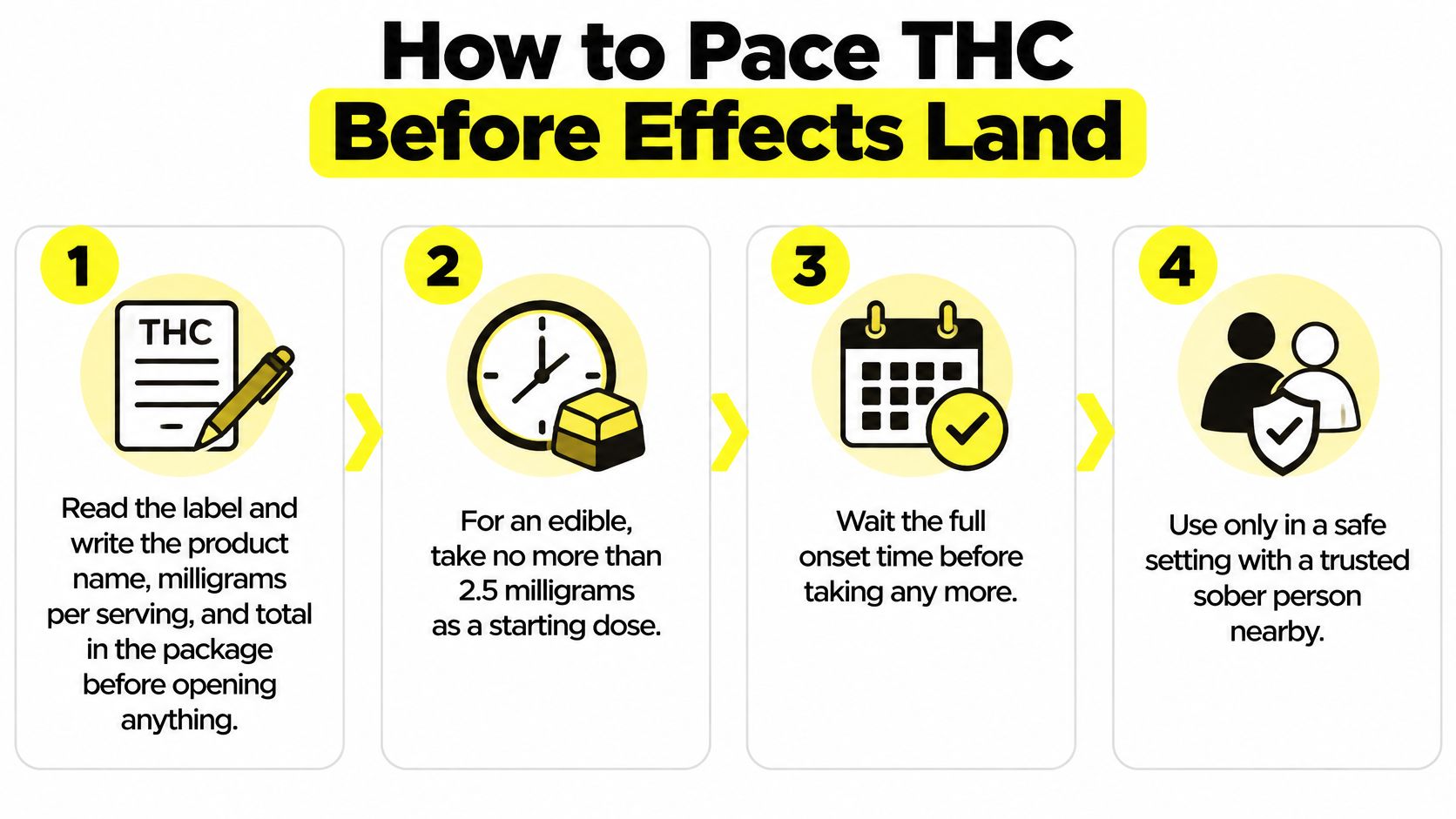
Seven actions and the mistake each one blocks
- Read the label first. Write the product name, milligrams per serving, and the total in the package before you open it. This blocks guessing from a strain name.
- Cut the edible to the number. Take no more than 2.5 mg THC, even if the scored piece is larger. Halves and quarters help only when the label is real.
- Note the clock and the food. Write the time and whether you ate. A late stomach is part of the record, not proof the dose missed.
- Hold the redose. Oral THC commonly reaches peak effects around 1.5 to 3 hours, and noticeable impairment can persist 6 to 8 hours or longer. The pitfall is deciding the edible "failed" and taking more before absorption is done. Prefer the 4-hour mark.
- If you inhale, take one small breath. Wait several minutes before you judge flower or a vape. A second pull in the first minute is the inhaled version of stacking.
- Stop when it is already enough. More will not make the night smoother once the feeling is present.
- Keep the night small. For a new or anxiety-prone session, use a private, familiar setting, avoid alcohol or other intoxicants, do not drive, and have a sober support person available.
Homemade portions, unclear labels, and high-potency products make the nominal dose unreliable. Skip them on a first try or after a tolerance break. The rest of a 10 mg pack is the failure mode, not a backup plan.
Say a patient logs 2.5 mg at 8:10 p.m. with a snack and sets a 12:10 a.m. check before even considering more. If 12:10 still feels like enough, the session is over. If you want the timing in more detail, how long edibles take is the page to read before you set that alarm.
Food, CBD, and a Safer Setting
Same milligrams land differently when the rest of the night changes. A first evening should look boring on purpose.

Health Canada advises beginning with the lowest dose, using cannabis in a safe environment, taking it in the evening so it does not interfere with daytime activities, and having someone trusted present in case a side effect needs medical attention. It also recommends using a product around the same time and under comparable conditions, such as consistently with food or consistently without it.
Food changes the clock, not the dose
A heavy meal can make an edible feel late. That delay is part of the plan. It is not a failed dose, and it is not a reason to top up. Eat a normal meal beforehand so an empty stomach is not the only variable, then sip water through the evening. Repeat later sessions with the same food pattern so the clock stays comparable.
Picture a first-time patient after dinner at home. The lowest labeled dose is already taken. Driving and childcare are off the schedule. A sober friend is on the couch, lights are low, and a note lists product, dose, time, food, and how it felt. Nobody reaches for a second piece because the note is still open.
A short video on the same idea, staying put while effects build, is worth watching before you need it.
Comfort is not a cancel button
CBD is an offset some people keep nearby for an anxious edge. A CBD tincture or a CBD-forward product will not erase a large THC dose, so it never justifies starting higher. If you are sorting those two cannabinoids, CBD versus THC is the plain comparison. Black pepper, a cool shower, and extra snacks are comfort only. They do not pull THC back out.
Lock the original child-resistant package away from children, not beside the snack bowl. The California Department of Public Health recorded 2,229 cannabis-related poison-control calls in 2024, up 162% from 850 in 2016. That rise is a storage problem as much as a dosing problem.
A calm room does not shrink the dose. It only keeps a late edible from turning into a drive, a second serving, or a night alone.
What to Do When a Green Out Starts
If the room tilts, stop all cannabis immediately. Put the rest of the package out of reach so panic cannot become another serving. Move to a quiet, familiar spot with low light and less noise. Stay with the person. If they are fully alert, offer small sips of water. Loosen tight clothes, have them sit or lie down, and talk in short, calm sentences.
The Oklahoma State Department of Health frames the same response. Stop cannabis, use a calm, low-stimulation environment, remain with the person, offer water only if fully alert, and watch breathing, responsiveness, chest symptoms, vomiting, panic, confusion, and hallucinations. Do not induce vomiting, give additional cannabis, or let the person drive. For non-urgent guidance in the United States, contact Poison Control at 1-800-222-1222. Call 911 for unresponsiveness, seizures, chest pain, severe breathing problems, or a severe psychotic reaction.
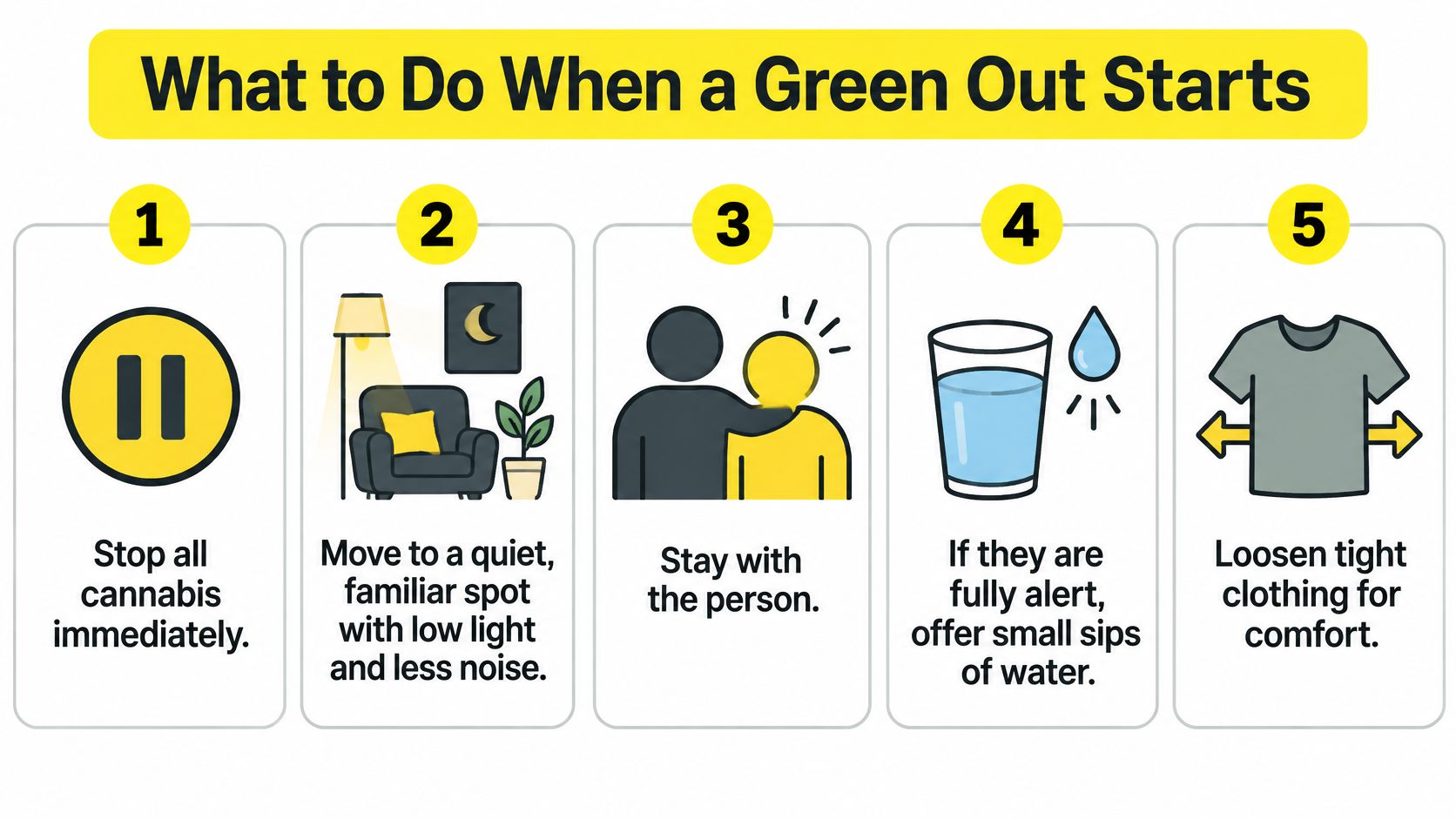
What not to add
The edible clock can keep rising for hours. More THC makes that worse. So does alcohol, a prescription sedative, or a ride home while impaired. CBD is not a cancel button in this moment either. Common failure points are treating panic as harmless without watching the person, leaving someone impaired alone, and missing co-use with alcohol or sedatives.
If they are vomiting and still breathing, place them on their side so they do not choke. Keep watching whether they answer, whether breathing stays easy, and whether confusion or hallucinations worsen. Public-health guidance treats extreme anxiety or paranoia, a very fast heart rate, hallucinations, severe nausea or vomiting, and impaired coordination as signs to escalate, not to sleep off alone. Oil products can linger in the same way. Cannabis oil side effects are worth knowing before a tincture night, not during one.
In a study of people who had an uncomfortable edible episode, 69.2% identified dose as the key contributor, and 75.8% went to bed or lay down, according to the peer-reviewed edible-experience study. Although 95.2% reported no medical problems, lying down fits only when someone stays and symptoms remain mild.
Say a friend took a second 5 mg piece at 45 minutes. The rest of the pack goes away. They get a dim room, a glass of water if they are alert, and company until the peak passes. You write the clock so nobody adds another dose out of fear.
Signs That Need Poison Control or 911
Match the action to what you can see. Strain names and "this batch feels strong" do not sort an emergency. Washington Liquor and Cannabis Board guidance on accidental use and overconsumption is built on observable effects. Anxiety, panic, paranoia, rapid heart rate, nausea, vomiting, confusion, hallucinations, and increased blood pressure can follow too much cannabis. They can also overlap with alcohol poisoning, medication interactions, panic, or a heart problem.
Stay with the person. If they are vomiting, keep them on their side. Do not let them drive. Do not promise that every episode will pass. Poison Control can give confidential, situation-specific guidance when you are unsure, including for a visitor who does not know local emergency care.
Green-out symptoms and when to escalate
| What you see | What it may be | Do this |
|---|---|---|
| Anxiety, dry mouth, still fully awake | Common overshoot that is often self-limited | Stop cannabis, quiet room, company, water if alert |
| Fast heartbeat with panic, person still responsive | Too much THC or another cause such as panic | Keep watching; Poison Control 1-800-222-1222 if unsure |
| Vomiting but awake and breathing | Overconsumption, or repeated episodes may be cannabinoid hyperemesis | On their side; no more cannabis; get advice if it continues |
| Hallucinations or severe confusion | Warning sign of too much cannabis | Urgent medical help |
| Chest pain, seizure, cannot wake, or trouble breathing | Emergency, not a wait-it-out green out | Call 911 |
Two nights can look similar and need different calls. Mild panic after one low edible, with the person awake and talking, can go to Poison Control for advice. Chest pain, trouble breathing, a seizure, inability to wake, loss of consciousness, or severe confusion on that same night goes straight to 911.
When vomiting is a different problem
Repeated vomiting with abdominal pain and brief relief from hot showers can be cannabinoid hyperemesis syndrome, not a one-night green out. Health Canada safer-use material describes chronic use, often four or more times weekly for at least a year, as a typical context. Cessation remains the only established way to resolve it. Another hydration tip will not fix that pattern. A physician visit will.
Greening out is a nickname. Chest pain, a seizure, or a person you cannot wake is an emergency whether or not cannabis is involved.
Plan a Lower-Risk Session Next Time
Use the note from this session as the only plan for the next one. Change a single variable instead of starting from scratch.
- Copy four lines. Product name, milligrams taken, whether food was eaten, and the clock time effects were first noticed.
- Circle the one miss. A second serving before four hours, any alcohol or sedative, a concentrate or high-THC cartridge, or an unlabeled homemade piece.
- Replace only that choice. The replacement is one sealed serving at 2.5 mg THC or less, or one small inhale with a several-minute pause, not both in the same hour. Our edibles are sealed and packaged to keep them fresh until delivery, so the printed milligrams are still the milligrams you logged.
- Set the stop before you open anything. Put driving, childcare, and other focus tasks outside that window, including the next morning after an evening edible.
- Keep a sober person on the plan if the last session included anxiety or a stacked dose. Ask for a package that prints THC milligrams, rather than picking from a strain name. First-time smoking tips cover the inhale side of that same one-variable rule.
If chest pain, a seizure, trouble breathing, or unresponsiveness shows up, leave this plan and use the escalation table.
Mr. Nice Guys DC helps Washington, DC patients choose a labeled format and a low starting amount before opening the package, whether that is a measured edible, a simple flower option, or a tincture with the milligrams printed. If you want that kind of pacing help in person, at the curb, or by delivery, visit Mr. Nice Guys DC and ask for a product whose label you can portion.
Mr Nice Guys DC
At Mr. Nice Guys DC, we’re more than just a cannabis delivery service — we’re passionate advocates for quality, convenience, and community. With years of experience in the cannabis industry, our team is dedicated to educating and empowering customers across Washington, D.C. Whether you're a seasoned user or just starting your cannabis journey, our blog delivers trusted tips, product insights, and the latest updates from the world of weed. Stay informed, stay elevated.
