
Must Be 21 To Enter
By entering this site you are agreeing that you are at least 21 Years of Age or older.
I AM 21 OR OLDERCannabis Oil Side Effects: What to Watch For


You measured a dose of cannabis oil an hour ago, you feel almost nothing, and you're wondering whether you should take a little more. That pause matters more than most labels explain. For many adults, cannabis oil side effects don't come from the word oil itself. They come from timing, dose, and what else is in your system.
When Cannabis Oil Side Effects Surprise Patients
A Washington, DC medical patient takes a measured oral oil in the evening. After an hour, she feels only slight relaxation, so she takes more and settles back to wait. Later, both amounts are active at once, and mild relaxation turns into dizziness, sleepiness, nausea, and anxiety with a racing heart.
She didn't take an unusually large product off the shelf. She stacked doses before the first one had finished arriving. That's the familiar mistake behind many uncomfortable nights, and it's why a guide on timing can matter as much as a cannabis edible dosage chart when you're learning how oral products behave.
Route, dose, and other medicines often matter more than the word oil on a label.
What You'll Be Able to Sort Out
You'll leave with a clearer map of what's common, what's uncommon, and what's serious. You'll also see why a THC-containing tincture and a CBD-dominant oil don't carry the same concerns, even when both come in similar dropper bottles. Some effects you can track and discuss at your next visit. Others mean you should stop and get medical care instead of waiting it out.
Practical examples run throughout this guide because abstract lists are hard to use at your kitchen counter. You'll meet a first-time patient who takes a full dropper instead of a small measured amount. You'll also see a person using several CBD servings a day who feels fine and assumes no testing is needed, and a driver who feels only mildly relaxed but shouldn't get behind the wheel.
A Clear Boundary Before You Start
This is education for adults 21 and older, not a promise that any product is risk-free. It doesn't replace a clinician who knows your medical history and current medicines. If you're pregnant, you have liver disease, you take several prescriptions, or you've had severe anxiety or psychotic symptoms, that conversation should happen before you experiment.
Think of the examples ahead as rehearsal. You're learning to spot the decision point before you redose, drive, or add another supplement. Once you see those moments clearly, you're less likely to learn the timing lesson the hard way.
How THC and CBD Oils Affect the Body Differently
The infographic below compares the two routes that cause the most confusion at home.
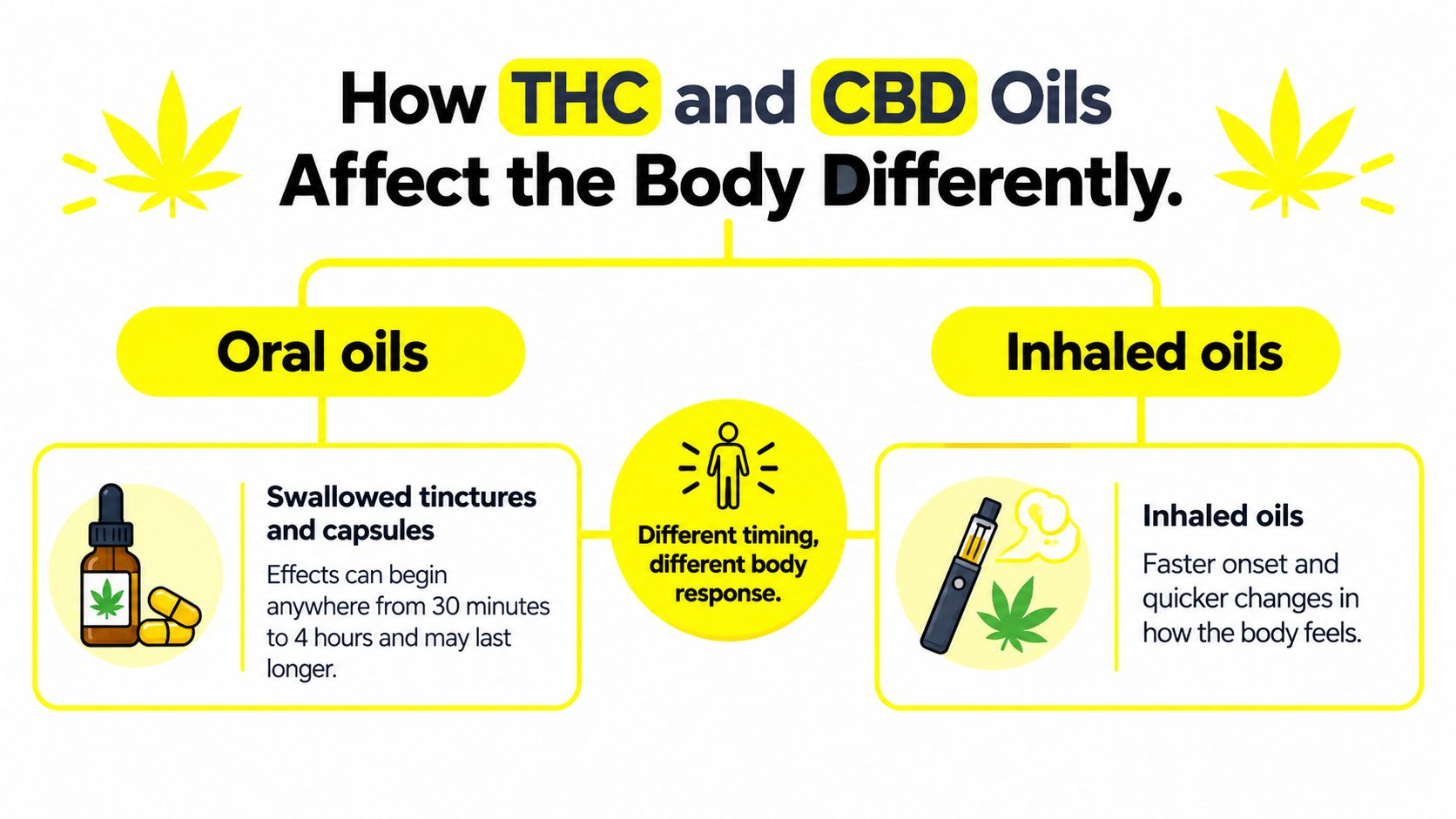
Swallowed tinctures and capsules work like a delayed train. You take the dose, the station stays quiet for a while, and you may assume nothing is coming. With oral oil, Health Canada's guidance on oral onset of 30 minutes to 4 hours and up to 4 hours to fully develop explains why that assumption gets people into trouble.
If you add a second train before the first arrives, both can enter the station together. Inhaled oils act faster, so you notice changes sooner, but they expose your lungs directly. Faster feedback doesn't mean gentler overall, especially when potency is high.
THC Changes the Experience
THC-containing oils can bring dizziness, somnolence, nausea, vomiting, anxiety, and confusion. You may also notice poor coordination or a fast heart rate, and rarely hallucinations or psychotic symptoms. Health Canada advises caution with oral products containing 2.5 to 10 mg THC and the greatest caution at 10 mg or more.
That same guidance points to inhaled concentrates above 20% THC as a high-potency concern. If you're still sorting out the basic profiles, a plain comparison of what CBD versus THC means on a label can help you read potency before you choose a serving.
Practical rule: Don't drive, drink alcohol, or take extra doses until the full effect of an oral dose is clear.
CBD Is Processed Differently
CBD-dominant oil isn't automatically gentle because it doesn't produce the same kind of high. Your liver processes it, and it can change how other medicines behave in your body. That distinction shapes the liver and interaction concerns covered later.
Try a safer pattern instead. Take the smallest labeled amount on a quiet evening at home, write down the time and amount, and wait several hours. If you want to test a slightly larger amount, do it on another day, not later that same night.
Common and Uncommon Cannabis Oil Side Effects
Numbers give you a vocabulary, but you need to know where they came from. In the FDA review of randomized trials of purified CBD reporting somnolence in 18% of patients, severe somnolence occurred in about 3%, decreased appetite in 16%, diarrhea in 9%, and decreased weight in 3%. Agitation and sedation occurred in approximately 1 to 4%.
Those figures describe studied pharmaceutical CBD, not every retail bottle at every dose. They still help you name what you're feeling. If you prefer a fixed serving over counting drops, cannabis oil capsules with labeled amounts remove one source of guesswork, though they don't remove side effects.
A Reaction That's Easy to Misread
A patient starts CBD oil and, within days, feels unusually sleepy at work. She loses focus in meetings, eats less at lunch, and develops diarrhea, but tells herself the changes prove the oil is doing something helpful. They may instead be medication-related effects worth reporting, especially if she also takes a sedating medicine.
THC effects get misread in another way. Dry mouth and mild dizziness may feel like simple inconveniences, while panic, paranoia, memory and attention problems, or a fast heartbeat can intensify with dose. New users are especially vulnerable when a serving is larger than they realized.
Cannabis Oil Effects by Profile
| Effect area | More typical with THC oils | More discussed with CBD-dominant oils | What to do |
|---|---|---|---|
| Mental state | Anxiety, panic, paranoia, confusion | Agitation in a smaller share of patients | Stop increasing, note dose and timing, seek care for severe symptoms |
| Alertness | Sleepiness and poor coordination | Somnolence and sedation | Avoid driving and review other sedating medicines |
| Digestive and appetite | Nausea or vomiting after too much | Diarrhea, decreased appetite, decreased weight | Track timing after each dose and discuss persistent changes |
| Body signals | Fast heart rate and dizziness | Fatigue that may overlap with other medicines | Record total cannabinoids and any same-day medicines |
Track three things after each dose. Note when the effect started, how much THC and CBD you took, and whether you took another sedating medicine that day. That short record turns a vague bad night into information a clinician can use.
Liver Risks That Feeling Fine Can Hide
You can feel completely well while a liver enzyme is rising. That's the uncomfortable idea many CBD labels never explain. Oral CBD is metabolized by the liver, and controlled studies have shown clinically meaningful enzyme changes, particularly at high doses or alongside medicines that also affect the liver.
In the WHO-reviewed cannabidiol data showing ALT above three times normal in 13% versus 1% on placebo, the rate was 17% at 20 mg/kg/day versus 1% at 10 mg/kg/day. Among people whose ALT was already high, 30% crossed that threshold at the higher dose, compared with 12% who started with normal ALT. Less than 1% reached ALT or AST above 20 times normal, and some needed hospitalization.
Timing Doesn't Always Protect You
Elevations usually appeared within the first two months. Some occurred as late as 18 months, especially with concurrent valproate. About two-thirds resolved after cannabidiol or valproate was stopped or reduced.
Feeling fine doesn't reliably establish that an oil is safe for your liver.
Consider a person who takes several CBD servings daily for a routine he built himself. He feels well, hasn't changed anything in months, and skips testing because nothing seems wrong. Early liver injury can appear on blood tests before obvious symptoms, so his confidence rests on the wrong signal.
Warning Signs and Limits of the Evidence
Watch for these changes and don't treat them as something to push through.
- Unusual fatigue or nausea: Especially when it's new and persistent after starting or raising a dose.
- Right-upper-abdominal discomfort: Pain or pressure under your right ribs deserves prompt attention.
- Dark urine or pale stools: Either change can signal a liver problem.
- Yellow skin or eyes: Jaundice means you should seek medical care promptly.
These data mainly concern pharmaceutical-grade, high-dose CBD, so don't copy the exact rates onto every retail oil. The principle still travels. If you use sustained high doses, you have liver disease, or you take medicines that stress the liver, ask a clinician whether baseline and follow-up liver enzymes make sense before you self-escalate.
Drug Interactions That Change the Picture
Sometimes what looks like a side effect is a collision between two medicines. The checklist below shows why your medicine list matters before your first serving.
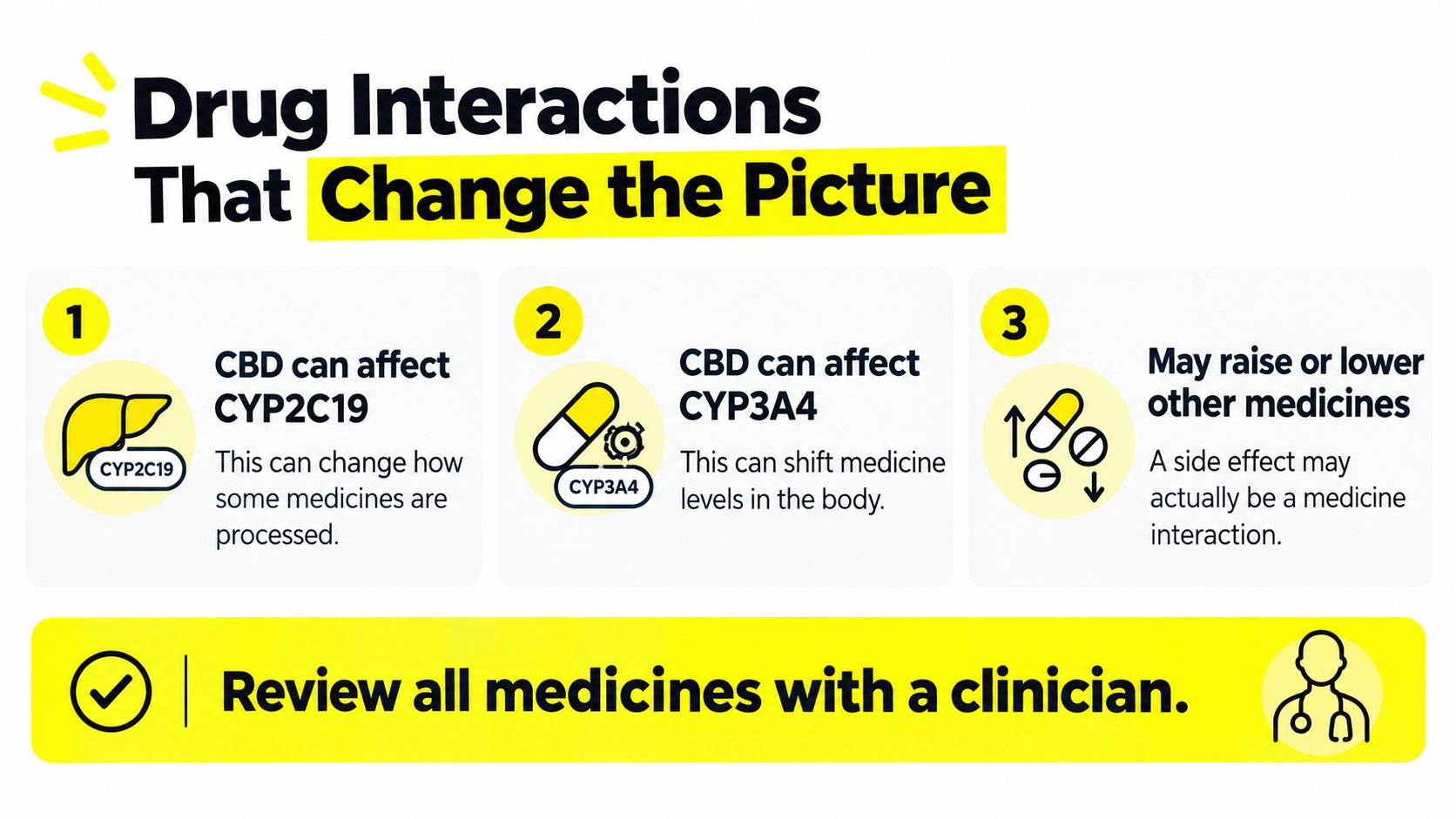
Think of CYP2C19 and CYP3A4 as processing lanes in your liver. CBD can affect those lanes, so another medicine may move through more slowly or more quickly than expected. The systematic review identifying 31 reports of cannabinoids altering drug exposure or causing adverse events includes medicines such as diazepam, antiseizure drugs, transplant immunosuppressants, opioids, benzodiazepines, warfarin, valproate, tacrolimus, and sirolimus.
Reported problems included bleeding, altered mental status, gastrointestinal distress, and difficulty inducing anesthesia. FDA materials likewise warn that CBD may increase or decrease the effects of other medicines. Natural doesn't mean interaction-free.
A Screening Framework You Can Use
An older adult in the DMV takes prescriptions for blood pressure, sleep, and pain. She adds a CBD tincture a friend recommended, then notices more fatigue, dizziness, and diarrhea. She assumes the oil alone is mildly annoying, but the pattern may reflect a combined pharmacologic effect. A structured medication compatibility check gives her better questions to bring to her clinician.
Flag these categories for particular caution before you start.
- Anticoagulants: Changes in drug levels can matter for bleeding risk.
- Seizure medicines: Shifts can affect both seizure control and side effects.
- Sedatives and opioids: Added sleepiness can impair coordination and driving.
- Transplant drugs: Tacrolimus and sirolimus levels need careful clinical oversight.
- Multiple liver-metabolized medicines: Polypharmacy raises the chance that one change affects another.
Separate two questions when you read a label. First, how much CBD could affect your other medicines? Second, how much THC could add sedation, anxiety, or impaired coordination? A CBD-forward label doesn't remove the need to check THC content and total cannabinoid exposure.
Choosing Safer Oils with Practical Examples
The photo below shows the starting point for a safer choice, a labeled bottle you can read and measure.
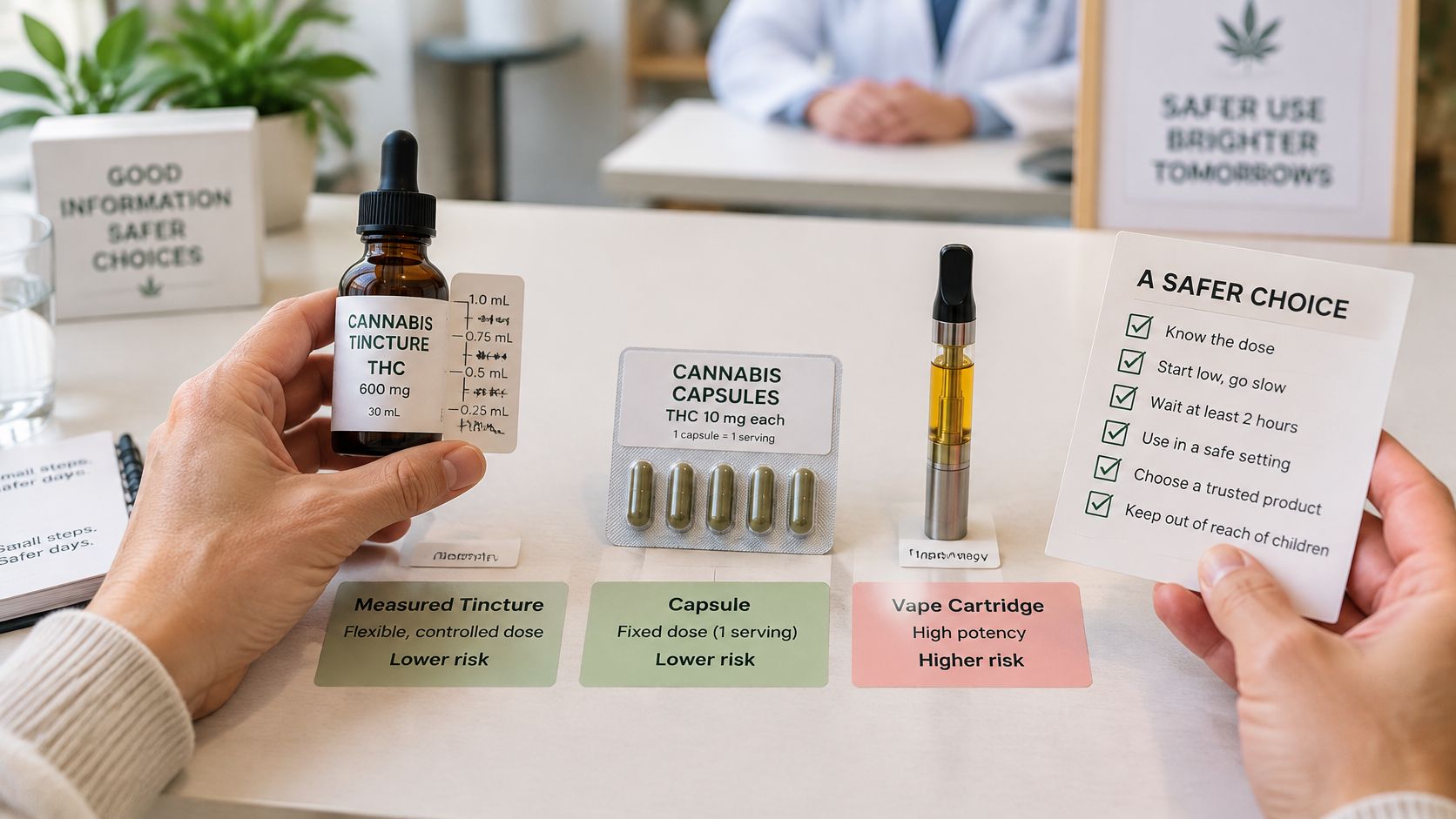
A tincture lets you adjust in small increments, but only if you measure instead of squeezing a full dropper. A capsule gives you a fixed serving, which helps consistency but makes small adjustments harder. A vape cartridge acts faster, yet an oil made to swallow isn't automatically safe to heat and inhale.
The 2019 EVALI outbreak made that distinction concrete, with most cases linked to THC vaping products containing vitamin E acetate. Heated inhalation can expose lungs to additives, thermal degradation products, or contaminants not intended for pulmonary use. Product testing matters too, which is why patients often ask about heavy metal testing for cannabis products before choosing a cartridge.
Three Decisions in Real Life
A first-time patient should start far below a full dropper of potent THC oil and wait out the full delay. A daily CBD user shouldn't stack several unlabeled servings across the day and call it one routine. A driver who took a THC tincture and feels only mildly relaxed still shouldn't get behind the wheel.
That last example carries measured risk. A National Academies review linking cannabis-impaired driving with 20 to 30% higher odds of a crash also points to effects on reaction time, divided attention, and motor performance. Alcohol can compound that impairment because each substance affects you differently.
The short video below reinforces how format and intended use should match before you buy.
At Mr. Nice Guys DC, staff walk adults 21 and older through labeled potency and the difference between tinctures and cartridges rather than handing over a bottle. Pickup, curbside, and delivery options serve DC and nearby areas. That education helps with product selection, but it doesn't replace medical advice or liver monitoring.
Warning Signs and Your Next Safety Step
Some symptoms mean you should stop experimenting and get urgent medical evaluation. Don't try to sleep these off or take another product to counteract them. Your next step is care, not dose adjustment.
Stop and Seek Care
- Chest pain or shortness of breath: Get urgent help, especially after inhalation.
- Severe confusion, hallucinations, seizure, or loss of consciousness: These require emergency evaluation.
- Rapid or irregular heartbeat: Stop use and seek care promptly.
- Persistent cough or vomiting after inhalation: Don't assume it's a normal vape reaction.
- Thoughts of self-harm: Seek urgent support right away.
- Jaundice, dark urine, pale stools, or right-upper-abdominal pain: These liver warning signs shouldn't wait.
Other changes belong in a different category. New sleepiness, diarrhea, reduced appetite, or dizziness after a dose change may not be emergencies, but you should record them and discuss them before increasing again. Patterns across several days tell a clinician more than one isolated complaint.
Your Harm Reduction Checklist
Use the smallest labeled dose and wait out the oral delay before judging it. Avoid alcohol and extra doses while effects are still developing. Don't drive, cycle in traffic, or operate machinery after THC-containing oil, particularly after an unfamiliar amount.
Before you raise a dose, write down the product name, cannabinoid amounts per serving, every medicine and supplement you take, and any symptoms you've noticed.
Bring that list to a healthcare professional and a dispensary educator. Mr. Nice Guys DC can help adults 21 and older compare tinctures and other formats and plan compliant pickup or delivery. Liver testing and interaction decisions stay with your clinician, and keeping those roles separate protects you.
If you're comparing cannabis oils and want help reading cannabinoid amounts, serving sizes, and format differences before you increase a dose, visit Mr. Nice Guys DC to review labeled tinctures, capsules, and other options for pickup, curbside, or delivery in DC and nearby areas. Bring your medicine list, start with the smallest labeled amount, and use that conversation alongside guidance from your clinician, not instead of it.
Mr Nice Guys DC
At Mr. Nice Guys DC, we’re more than just a cannabis delivery service — we’re passionate advocates for quality, convenience, and community. With years of experience in the cannabis industry, our team is dedicated to educating and empowering customers across Washington, D.C. Whether you're a seasoned user or just starting your cannabis journey, our blog delivers trusted tips, product insights, and the latest updates from the world of weed. Stay informed, stay elevated.
