
Must Be 21 To Enter
By entering this site you are agreeing that you are at least 21 Years of Age or older.
I AM 21 OR OLDERCannabis Edible Dosage Chart: Safe Mg Guide for 2026
.svg)

.png)
It is easy to treat one square, one gummy, or one bite as one dose. Edibles do not work that neatly. The number that matters is milligrams of THC, because that is the part that predicts how strong the effect can be.
A cannabis edible dosage chart only helps if you read the label first. Edibles move through the liver and become 11-hydroxy-THC, which can feel stronger and last longer than inhaled cannabis at the same nominal dose. That slower onset is why people get into trouble when they redose too soon or judge by size, color, or flavor instead of the package.
Practical rule: if you do not know the milligrams, you do not know the dose.
At Mr. Nice Guys DC, patient guidance starts with the label, then shifts to tolerance, age, and prior experience. A first-time patient may need a very different starting point from someone who already knows how their body responds. For a useful background on cannabinoids before you shop, the dispensary's breakdown of major compounds is here: cannabinoid breakdown.
Why Milligrams Matter Before Your First Bite
A first edible can go sideways fast when someone treats a package like a snack instead of a measured dose. A candy bar may break into neat squares, but each piece only means something if the product was lab-tested and evenly made. In a dispensary setting, the number that guides the first choice is the milligram amount printed on the label.
Edibles also act differently from flower or vapes because the liver changes THC before it reaches the bloodstream. That is why a person who feels steady after inhaling cannabis can feel much stronger effects from a small edible. The same process explains why a second dose taken too soon can stack on top of the first and feel far more intense than expected.
Read the package, not the piece
Two gummies can look nearly identical and still hold very different amounts of THC if they come from different product lines or markets. Lab-tested packaging matters more than shape, color, or flavor. A piece labeled 2.5 mg is a very different starting point from 10 mg, even if the gummies look the same in your hand.
Patient rule: wait on the label, not on the clock in your head.
Start with the package, choose the milligram dose before you eat anything, and give it time before deciding whether more is needed. At Mr. Nice Guys DC, that starts with the label, then moves to tolerance, age, and prior experience. For a clearer look at the compounds behind that label, see the dispensary's cannabinoid breakdown.
The Core Dosage Chart by Experience Level
A cannabis edible dosage chart works best when it groups people by experience level, not by the idea that body weight alone sets the right dose. Tolerance, age, and prior use change how a person responds, so the safest chart starts there. That matters in real product choices, because a first-time patient and a regular consumer should not be looking at the same serving size.
The cleanest framework is micro, low, moderate, and high. Each tier matches a different comfort level and a different kind of product, from measured tincture drops to gummies, mints, chocolates, and baked goods.
Microdose territory starts at 1 to 2.5 mg THC. That range can fit first-time patients, older adults, and THC-sensitive users who want a light effect without heavy intoxication. Low dose sits around 2.5 to 5 mg, and it is a common starting point for cautious adults, especially with gummies, mints, or sublingual strips. Moderate usually lands at 10 to 15 mg, where the effect becomes much more noticeable for regular users. High dosing begins at 20 mg and above, which belongs in the experienced-user lane.
Cannabis edible dosage chart by experience level
| Dose Tier | THC mg Range | Best For | Expected Effects | Onset / Duration | Product Examples |
|---|---|---|---|---|---|
| Micro | 1 to 2.5 mg | First-time patients, older adults, THC-sensitive users | Subtle relief, light body ease, minimal impairment | 30 to 120 minutes, often 4 to 8 hours total | Tiny gummies, low-dose tinctures, measured beverage servings |
| Low | 2.5 to 5 mg | Most beginners, cautious adult users, daytime use | Mild relaxation, light euphoria, easier to manage mentally | 30 to 120 minutes, often 4 to 8 hours total | Gummies, mints, low-dose chocolates, strips |
| Moderate | 10 to 15 mg | Regular users, people comfortable with mild impairment | Noticeable psychoactivity, stronger body effects, less clear-headedness | 30 to 120 minutes, often 4 to 8 hours total | Standard edibles, stronger gummies, baked goods |
| High | 20 mg to 30+ mg | Experienced consumers with known tolerance | Strong intoxication, heavier sedation, more impairment risk | 30 to 120 minutes, often 4 to 8 hours total | High-dose gummies, strong chocolates, multi-piece packs |
For DC patients, the practical read is straightforward. A 2.5 mg piece is a cautious place to begin, 5 mg is a common starter dose for many adults, 10 mg is where the effect becomes clearly stronger, and anything above that fits users who already know their tolerance. That same measured approach appears in Mr. Nice Guys DC's edible dosage calculator guide, which uses servings instead of guesswork.
How to Titrate Safely as a Beginner
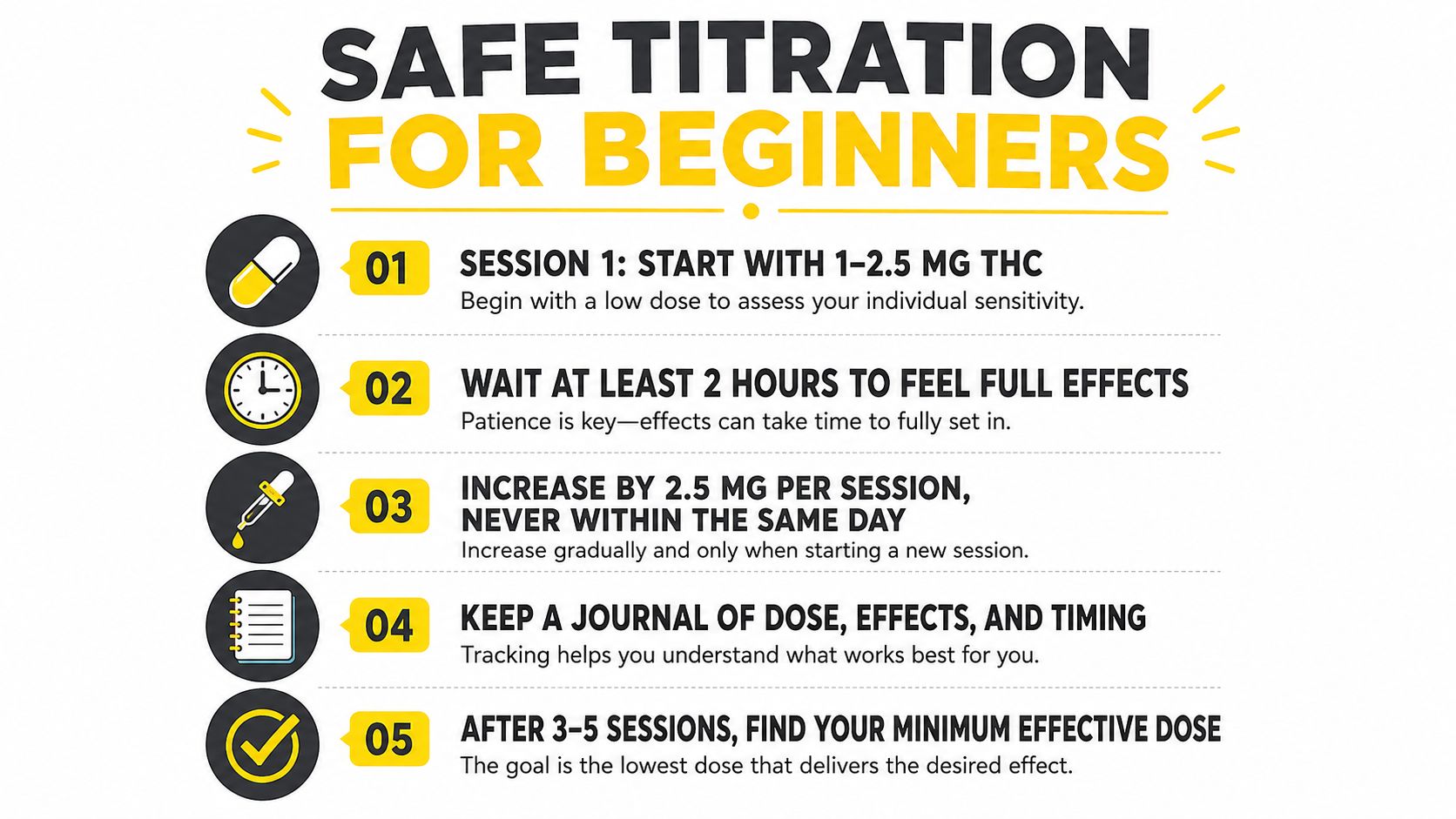
Titration means changing your dose in small, controlled steps so you can find your own minimum effective amount. The mistake to avoid is trying to learn everything in one night. A better approach is to test one dose, write down what happened, then adjust only after a full day has passed.
Use one session to learn one thing
Start with 1 to 2.5 mg THC on session one, and don't combine it with other cannabis that day. Record when you took it, when you first felt anything, when the effect peaked, and when it faded. If that dose feels comfortable and useful, session two can move up by 2.5 mg, but only if the first session was clearly tolerated.
The reason for the small step matters. Edibles can take time to show their full effect, and once you stack a second dose on top of the first, you lose track of which piece did what. That's how people end up over their comfort zone without meaning to.
Keep a simple log
Use a notebook or notes app and capture the same fields every time:
- Date and time
- Dose in milligrams
- Product type
- Time taken
- Time of first effect
- Peak intensity from 1 to 10
- Side effects
- Notes for next time
Simple rule: no redose before you've given the first dose enough time to speak for itself.
A hard 24-hour wait between dose increases keeps your comparison honest. If you're still unsure, bring the log back to the staff at Mr. Nice Guys DC and compare the numbers against the product you bought. The guide on how to microdose edibles is a good fit if you want to stay in the lower ranges while you learn your response.
Body Weight Age and Tolerance in Practice
Two people can take the same 5 mg THC and have completely different outcomes. That's why body weight alone doesn't tell you much. Age, prior use, medication use, and general sensitivity often change the result more than scale weight ever will.
Three people, one dose, very different results
A 28-year-old, 135 lb woman who has never used edibles might feel strong effects from 5 mg, with onset in the usual delayed window and a high that lasts well into the evening. The lesson there is not that she is “sensitive” in a vague way, it's that her tolerance is low and the dose is already meaningful.
A 42-year-old, 200 lb man who uses flower daily may feel almost nothing from 5 mg and only get a clear effect after moving much higher. His larger body size does not guarantee a stronger edible response, because tolerance and cannabis history can overpower weight as a predictor.
A 67-year-old, 160 lb retiree who takes a statin might get noticeable relief from 2.5 mg and need slower titration because older adults and people on other medications can react more strongly. The lesson is that age and medication review matter, especially when the goal is comfort rather than intoxication.
Three real patient profiles at 5 mg THC
| Profile | Age & Weight | Tolerance | Effect at 5 mg | Key Lesson |
|---|---|---|---|---|
| A | 28, 135 lb | Edible-naive | Strong, long-lasting effect | Low tolerance can make 5 mg feel like a lot |
| B | 42, 200 lb | Daily flower use | Mild or barely noticeable | Body size doesn't replace tolerance |
| C | 67, 160 lb | Older adult, medication use | Meaningful relief with slower ramp-up | Age and medications can matter more than weight |
The cleanest habit is to track how you respond, not how a chart thinks a body should respond. That's especially true for older adults and anyone on prescription medication, where the safest starting point often sits below what weight-based tables suggest.
Converting Edibles to Flower Vapes and Tinctures
Edible THC does not translate 1:1 into smoked or vaped THC because the body handles each format differently. Inhaled cannabis reaches you faster and with less digestive processing, while edibles go through the liver first. Sublingual tinctures sit somewhere in between, since part of the dose is absorbed under the tongue and part is swallowed.
A rough format comparison
A typical 0.5 g flower joint at 18% THC contains roughly 60 to 90 mg of decarboxylated THC, but only about 15 to 30 mg reaches the bloodstream, so the oral equivalent is closer to 10 to 15 mg edible. A 3-second vape hit at 70% potency delivers around 5 mg inhaled, which maps to roughly 8 to 10 mg edible. Sublingual tinctures absorbed under the tongue usually behave with about a 1.5x multiplier versus an edible, which means they can feel quicker and a bit more direct than something fully swallowed.
Edible equivalent of common inhaled doses
| Format | Typical Amount | Approx. THC Delivered | Oral Equivalent | Multiplier vs Edible |
|---|---|---|---|---|
| Flower joint | 0.5 g at 18% | 60 to 90 mg in the plant material, about 15 to 30 mg to the bloodstream | 10 to 15 mg edible | About 2 to 3x more oral THC needed for a similar experience |
| Vape hit | 3-second hit at 70% | About 5 mg inhaled | 8 to 10 mg edible | About 1.5 to 2x |
| Tincture under tongue | Measured dose | Between inhaled and swallowed | Slightly above a comparable edible | About 1.5x versus edible |
If you switch formats, don't copy the number straight across. Divide your inhaled intake estimate by about 2 to 3 to get a safer edible starting point, then adjust from there. The broader comparison in tinctures versus edibles helps because it reminds you that onset and potency aren't the same thing.
Why Most Weight Based Charts Miss the Point
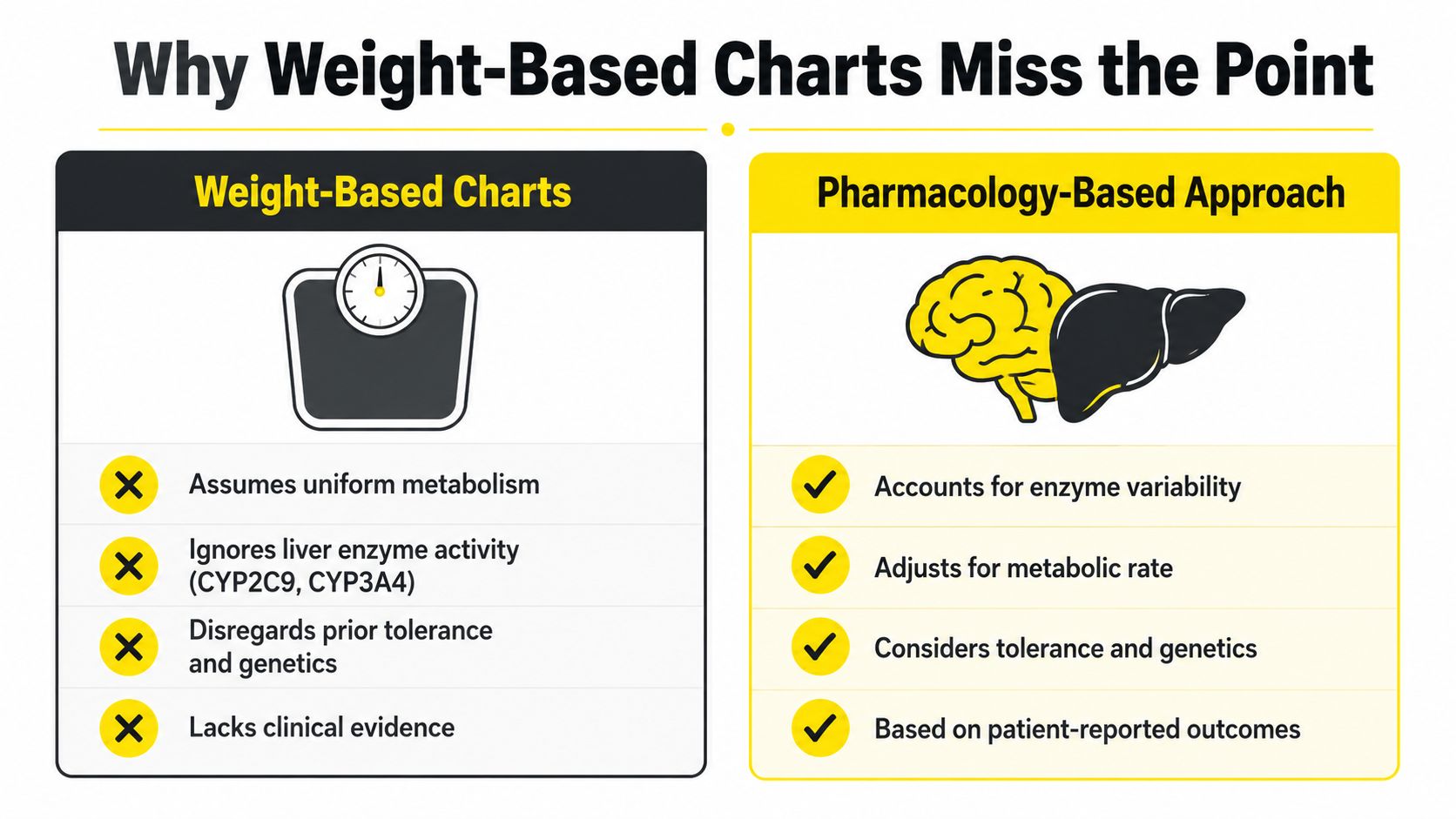
A weight-based edible chart can look neat on paper, but it gives a false sense of precision. Body size alone does not explain how someone will respond to THC. Enzymes, tolerance, sleep, and medication history all shape the experience.
Pharmacology beats pounds
Cannabinoid response changes with CYP2C9 and CYP3A4 activity, prior cannabis use, current medications, and how rested someone is. Those factors can make a lighter novice feel more from the same dose than a heavier regular user. A 250 lb person who uses cannabis often may barely notice a small edible, while a 120 lb first-timer may feel strong effects from that same amount.
Weight charts also miss the biphasic nature of cannabinoids. A low dose can feel manageable, then a higher dose can turn uncomfortable or overly impairing. That is why conservative starting points still matter more than formulas tied only to body size. A better chart keeps tolerance, age, and medication review in the center of the dose decision.
Bottom line: a safer edible chart starts with people, not pounds.
Keep the tiered milligram framework from earlier and treat weight as context, not the main rule. The product-consistency discussion in Mr. Nice Guys DC's product consistency guide fits that approach, because clear labeling matters more than guessed body-weight dosing.
Overconsumption Signs and Recovery Steps
Most edible overconsumption starts the same way. Someone takes a dose, gets impatient, and takes more before the first piece has fully kicked in. Other common mistakes are misreading the label, mixing with alcohol, or taking edibles on an empty stomach and then being surprised by the intensity.
What to do when you've had too much
The first move is simple, stop taking more THC. Sit down somewhere familiar, drink water slowly, and get away from bright noise and stimulation. If you have CBD on hand, some people find it helps take the edge off, and a sniff of black pepper is a common comfort strategy people try while they wait it out.
Avoid coffee, energy drinks, and other stimulants, because they can make anxiety feel sharper. Eat a light snack if your stomach is empty, then give the dose time to pass on its own. The body will do the work if you let it.
Red flags that need medical attention
- Chest pain
- Severe vomiting
- Panic that does not ease
- Trouble staying awake
- Symptoms that feel unsafe or out of control
Recovery checklist: hydrate, stay still, eat something light, avoid more THC, and wait.
The best prevention rule is still the oldest one. Respect the clock, read the label carefully, and never treat a delayed onset like a failed dose. If you keep those three habits, you cut most overconsumption problems off before they start.
DC Legal Limits and Package Math
DC patients need to think about dose and legality at the same time, because the package ceiling shapes what shows up on the shelf. In regulated markets, a package can contain multiple servings, so the only safe way to use it is to divide it by the serving count rather than assume the whole pack is one serving. That matters whether you're buying a chocolate, gummy, or beverage.
What the math usually looks like
A typical compliant edible package in DC-style regulated retail is often built around a 100 mg THC total with multiple servings inside. That means a patient has to divide the package carefully, especially if the serving size is 10 mg or less. In Canadian public-health guidance, the safer starter dose is 2.5 mg THC or less, while the package maximum can be 10 mg THC total in that market, which shows how closely packaging rules shape dosing behavior (Canadian public-health guidance). Canada's edible packaging cap and New York's retail rules also illustrate the broader pattern that markets define what a compliant serving looks like (Canadian edible packaging infographic).
DC edible package limits and serving math
| Market | Max THC per Package | Max Servings | Max Single Dose |
|---|---|---|---|
| Canada | 10 mg | One legal package maximum, not a large multi-dose pack | 2.5 mg public-health starting point |
| New York adult-use | 100 mg | Multiple servings allowed | 10 mg per serving |
| Regulated DC-style package math | Often 100 mg total in a multi-serving package | Divide by the label | Usually 10 mg or less per serving |
Unregulated gifting products can be less predictable, which is why patients should pay even closer attention to the printed or seller-stated milligrams. If you buy a product in DC, treat the package math as part of the dose, not a separate detail.
Quick Reference Card for Patients
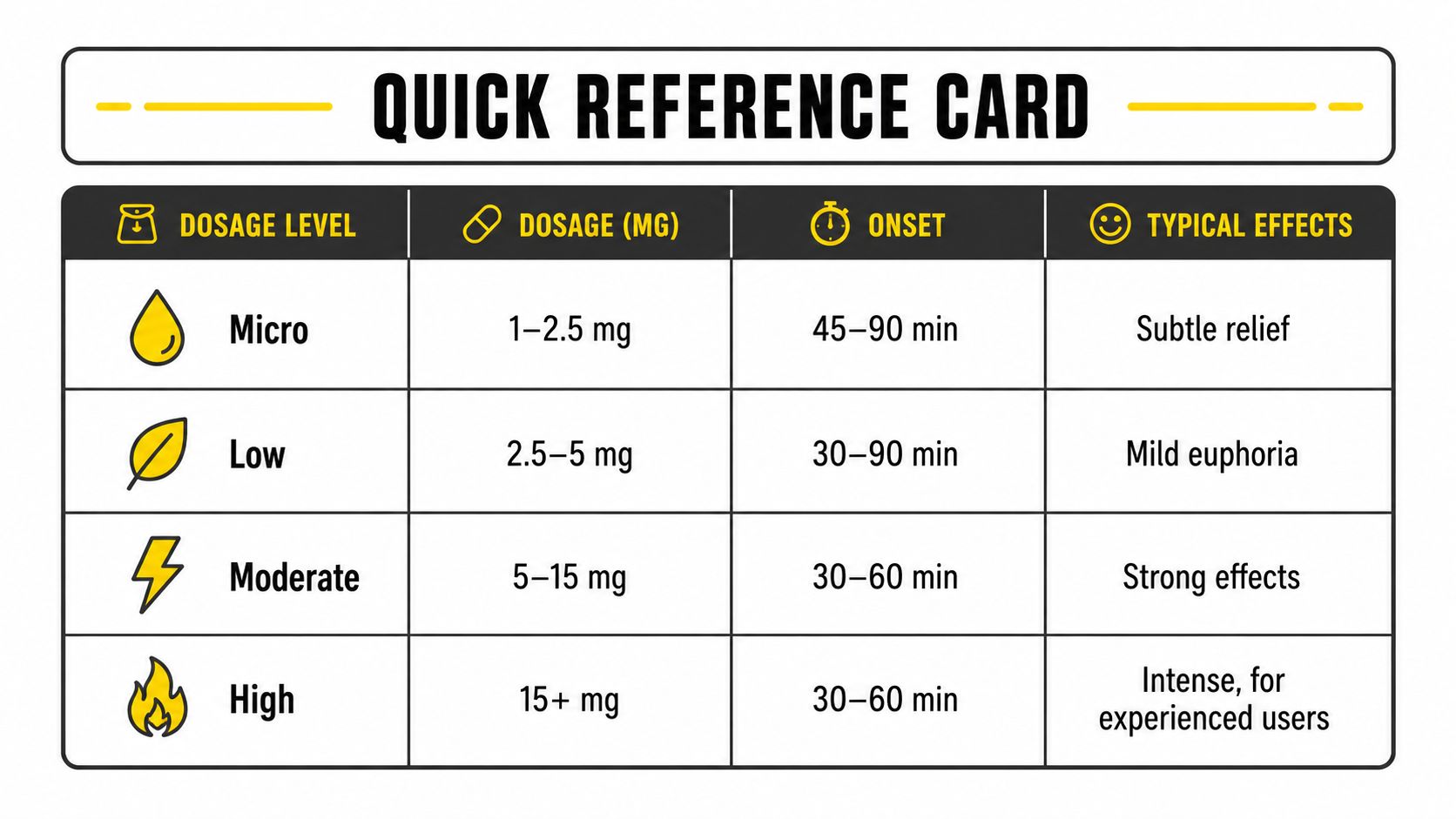
If you only remember four numbers, make them these. 2.5 mg, 5 mg, 10 mg, and 20 mg+ cover the main edible tiers most patients need to sort themselves into. The right tier depends on tolerance and experience, not on how confident the label makes you feel.
Fast scan chart
- Micro, 1 to 2.5 mg: best for first-time patients and THC-sensitive users, expect subtle relief and stay patient with the delayed onset.
- Low, 2.5 to 5 mg: best for beginners who want a mild, manageable effect, stop here if the first dose already feels clearly active.
- Moderate, 10 to 15 mg: best for regular users who know their response, expect more obvious impairment and plan your session accordingly.
- High, 20 to 30+ mg: best for experienced consumers only, expect a strong effect and don't use this range as a starting point.
Keep this rule handy: start at 2.5 to 5 mg, wait at least two hours, and never stack doses before onset.
If you save one thing from this guide, save the part that says the clock matters as much as the milligrams. A low dose with patience is usually a better first experience than a high dose with hope.
Patient Questions Answered
CBD-only or CBD-dominant edibles still deserve a dose check. If a product includes any THC, even a small amount, start with 2.5 mg THC or less and use the same wait-and-log approach from the beginner protocol. The fact that it feels “milder” doesn't mean the label stops mattering.
Alcohol and edibles don't mix well for many people because alcohol can make the edible feel stronger and less predictable. If you drink first, treat the edible like a more uncertain dose and stay extra conservative. The safest move is still to keep them separate.
Tolerance breaks of 48 to 72 hours can help some people feel a bit more sensitivity again, but they don't erase years of heavy use. If your regular dose has climbed over time, go back to the chart and test lower ranges instead of assuming a short break reset everything. The same logic applies to sublingual strips and drinks, which may feel faster or different, but still need measured milligrams and a wait period.
If a child or pet ingests cannabis, treat it as urgent and contact medical help right away. Don't try to guess the dose or wait to see if it “passes.” For adults taking benzodiazepines, sleep aids, or antidepressants, the safest answer is to use the lowest possible edible range and talk with a medical cannabis clinician before increasing. Pregnancy-related questions belong with a clinician too, not a chart.
For in-store dosing questions, Mr. Nice Guys DC can help you compare products, serving sizes, and lower-dose options before you buy.
Mr. Nice Guys DC carries measured edibles, tinctures, and other cannabis formats that make dose planning easier for first-time and experienced patients alike. If you want help reading a label, comparing mg ranges, or choosing a lower-dose starting point, visit Mr. Nice Guys DC and ask for a dosing conversation before you leave the store.
Mr Nice Guys DC
At Mr. Nice Guys DC, we’re more than just a cannabis delivery service — we’re passionate advocates for quality, convenience, and community. With years of experience in the cannabis industry, our team is dedicated to educating and empowering customers across Washington, D.C. Whether you're a seasoned user or just starting your cannabis journey, our blog delivers trusted tips, product insights, and the latest updates from the world of weed. Stay informed, stay elevated.
