
Must Be 21 To Enter
By entering this site you are agreeing that you are at least 21 Years of Age or older.
I AM 21 OR OLDERProduct Consistency in Cannabis: A Patient Guide
.svg)

.png)
You buy the same strain you trusted last month, bring it home, and expect a familiar result. Instead, the aroma is softer, the effects arrive differently, or the relief doesn't last as long. The label looks reassuring, but a strain name alone can't guarantee that two purchases came from chemically similar batches.
That difference isn't necessarily your imagination. Batch variation, terpene drift, and storage conditions can all change the experience. Product consistency gives you a practical way to investigate those differences by connecting the package in your hand to its batch records, laboratory results, and handling history.
When the Same Strain Feels Different
A patient once described the situation this way at the counter: last month, a familiar flower helped settle evening discomfort without feeling overwhelming. This month, the jar carried the same strain name from the same dispensary, but the effect felt sharper and less useful. The patient wondered whether tolerance had changed or whether they had misremembered the earlier experience.
Sometimes the answer is easier to find. Cannabis isn't a single fixed formula just because the cultivar name stays the same. Plants can vary between harvests, processing can shift the cannabinoid and terpene balance, and storage can affect aroma, moisture, and perceived freshness. A product can pass its required testing while still feeling different from an earlier lot.
Batch differences are the first factor to check. Two batches may carry the same strain name but show different THC, CBD, minor cannabinoid, or terpene results. That matters because patients respond to the complete chemical profile, not to the name printed on the front of the package.
Terpene drift is another reason. Terpenes contribute to aroma and can help distinguish one batch from another. If you want a plain-language introduction to their role, the guide on what terpenes are in weed is a useful starting point. A familiar citrus, pine, floral, or earthy character may become less noticeable as compounds change during handling and storage.
Counter conversation: “Same strain” identifies a product family. It doesn't promise that every batch has the same chemistry.
Finally, storage conditions can influence what you notice. Light, air, heat, and unsuitable humidity can affect flower quality over time, while carts, tinctures, and edibles have their own handling needs. The practical fix is to stop treating the strain name as the entire identity of the product. Check the lot, review the Certificate of Analysis, and compare your own response over time.
What Product Consistency Actually Means
Think about a bakery that makes a dependable loaf. The baker weighs ingredients, follows a recipe, controls the oven, and checks the finished bread. You don't expect every loaf to be identical in a microscopic sense, but you do expect the texture, flavor, and size to stay within a familiar range.
Cannabis product consistency works similarly. A reliable process aims to keep the cannabinoid profile, terpene profile, and contaminant results within defined limits from batch to batch. Statistical process control supports this approach by moving quality management away from checking only finished products and toward monitoring variation throughout production. Manufacturers can use random sampling and control charts to spot small process shifts before they create larger amounts of defective output, as described in this overview of statistical quality control and process monitoring.
The idea becomes easier for patients through three practical dimensions:
- Potency: The labeled THC or CBD result should correspond to the tested batch result closely enough for responsible dosing. Minor cannabinoids can matter too, especially when a patient is tracking how a broader profile affects symptoms.
- Purity: The product should meet its applicable safety criteria for pesticides, elemental impurities, microbial contaminants, foreign matter, mycotoxins, and residual solvents. Testing standards and acceptance criteria turn “clean” into something documented rather than assumed. A plain-language look at cannabis product testing standards can help explain the terminology.
- Predictability: A familiar product should produce a reasonably familiar experience because its chemistry and handling haven't drifted beyond the expected range. Predictability doesn't mean every session feels exactly the same. It means you have a trustworthy starting point.
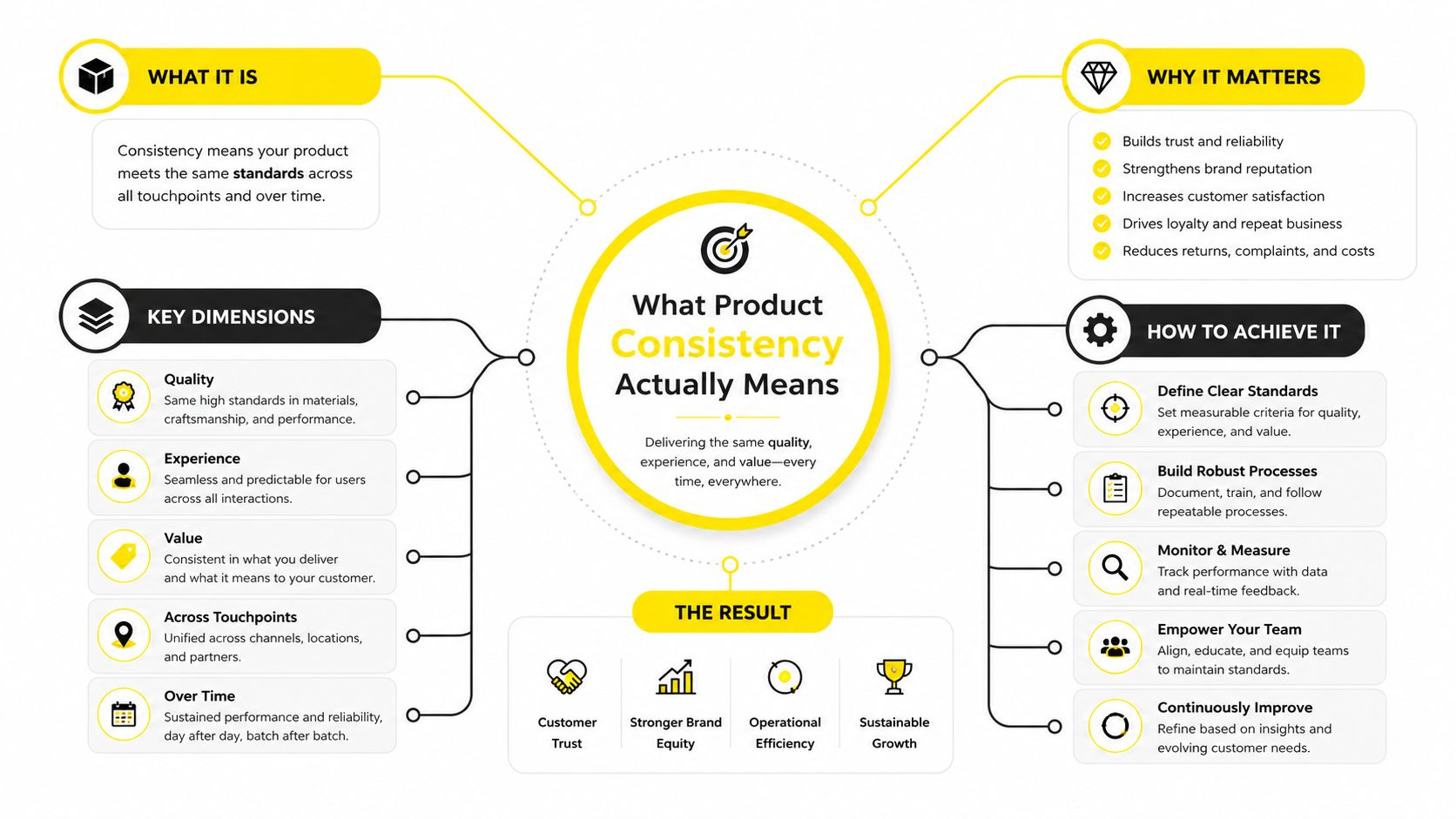
This matters most when cannabis is part of a symptom-management routine. A patient can't sensibly adjust a dose if the product's strength changes unpredictably. Consistency is the baseline that makes observation, communication, and careful adjustment possible, not an optional luxury added for appearance.
Why Consistency Matters for Patients
A patient who uses cannabis occasionally may notice variation as a preference issue. A patient using it for pain, insomnia, anxiety, or another ongoing concern faces a more practical problem. If the product changes without clear documentation, the patient can't easily tell whether a different dose, a different batch, or a different health condition caused the new result.
Dosing is the clearest example. An edible labeled 10 mg in one batch may not feel the same as a 10 mg edible from another batch if the tested potency or formulation differs. That uncertainty makes titration harder for people with low tolerance, older adults, or anyone taking other medications. Patients should discuss potential medication interactions with a qualified healthcare professional, and a dispensary's medication compatibility guidance shouldn't replace that conversation.
Therapeutic tracking also depends on repeatability. If a patient records a product, dose, timing, and response, the record becomes more useful when the next purchase has a comparable cannabinoid and terpene profile. A sudden change can make symptom notes look contradictory even when the patient's routine stayed the same.
Safety depends on batch-level screening as well. Contamination can enter at different points in cultivation, processing, or packaging, so patients need documented testing rather than confidence based only on appearance. This is especially important for people with compromised immune systems, who should ask their clinician and dispensary about appropriate product safeguards.
Different formats create different consistency questions:
| Format | Dosing Reliability | Main Consistency Risk |
|---|---|---|
| Flower | Moderate, when weighed and tested by batch | Uneven cannabinoid distribution, moisture changes, and differences between buds |
| Pre-rolls | Moderate to variable | Grind, fill, burn, and mixing can affect how evenly the contents are delivered |
| Vapes | Often easier to portion than flower | Oil formulation, cartridge filling, hardware performance, and batch variation |
| Tinctures | Potentially repeatable when measured carefully | Dropper volume, formulation uniformity, and storage |
| Edibles | Portion labels can simplify tracking | Uneven mixing, digestion differences, and formulation changes |
| Concentrates | Strong batch documentation is important | Processing can create noticeable differences in cannabinoid and terpene balance |
The key question isn't which format is universally “best.” It's whether the specific batch has clear testing, a traceable lot number, and handling practices that support the dose printed on the package.
How Dispensaries Verify and Track Quality
Quality control starts before a product reaches a display case. A dispensary can evaluate suppliers, review available documentation, consider cultivar selection, and decide whether a product fits its standards for freshness, safety, and consistency. Those decisions reduce the chance that staff will rely on a strain name or attractive packaging as a substitute for evidence.
The most useful document for a patient is the Certificate of Analysis, or COA. A COA is a laboratory record connected to a particular production lot. Depending on the product and local requirements, it can show cannabinoid percentages, terpene findings, and contaminant results covering pesticides, heavy metals or elemental impurities, mold and other microbial concerns, and residual solvents.
Third-party testing adds an important layer of separation. An independent laboratory evaluates the sample rather than confirming the manufacturer's own production notes. That doesn't make every laboratory result perfect, but it gives the patient a documented test record that can be compared with the label.
Why the batch number matters
The batch or lot number connects three things: the product made by the manufacturer, the laboratory sample, and the package sold to you. Without that connection, a generic “Gelato results” sheet may describe a different harvest or production run.
Consider a worked example:
Batch NG-0427 of Gelato flower tested at 22.4% THC, 0.8% CBD, passed all Category I and II contaminant panels, and arrived at the store on March 12.
If those details appear on the product's actual records, staff can use the batch number to pull the corresponding COA when a patient asks. The number on the label then has a documented trail instead of functioning as an unsupported promise.
Cannabis quality programs also need to account for the product itself. California's Product Quality Plan FAQ explains that a facility may have one premises-level quality control program while maintaining product-specific plans. In practical terms, flower, cartridges, and edibles can require different specifications even when they come from the same building.
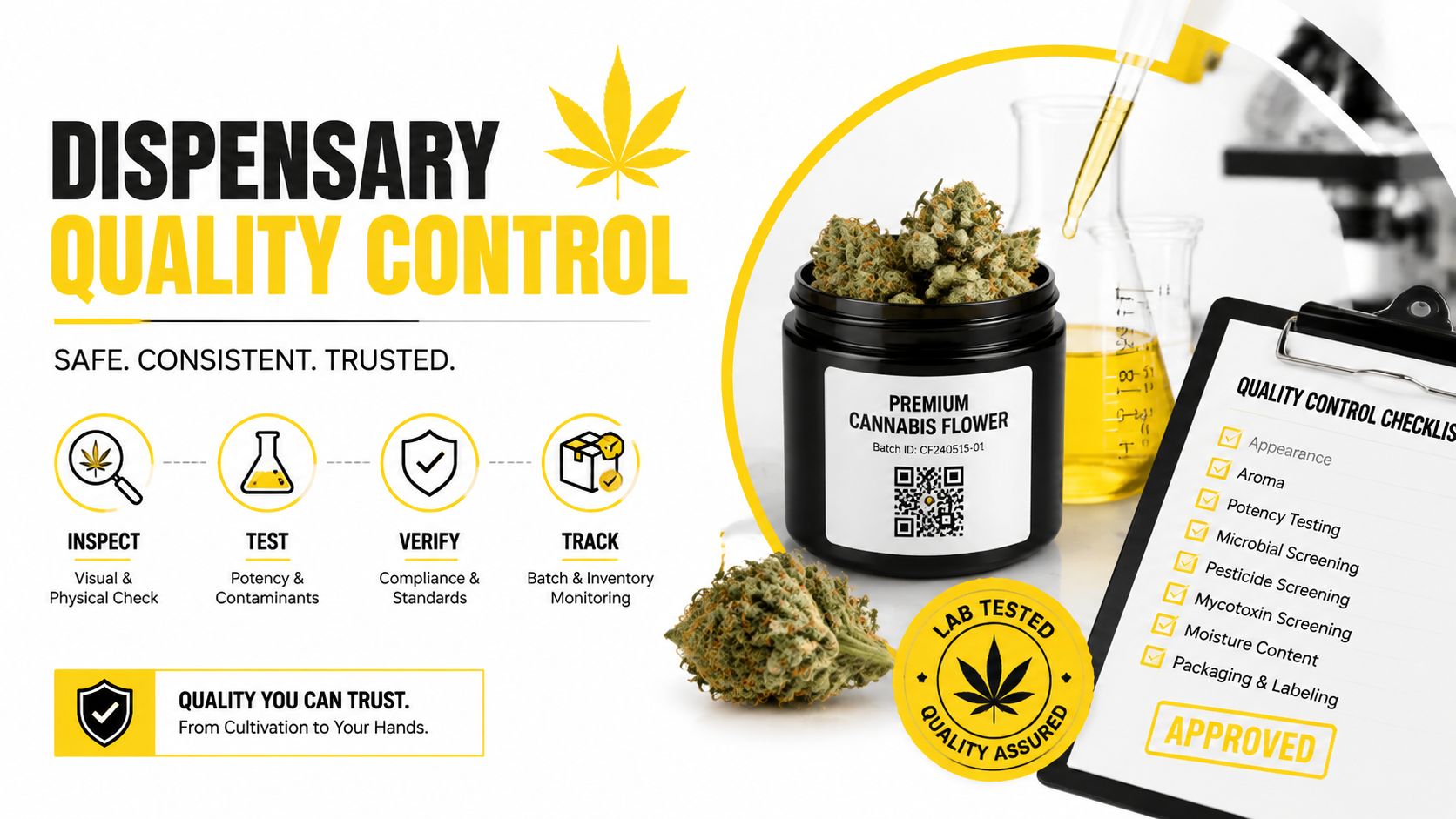
A dispensary also needs recall readiness. If a lab revises a result, packaging reveals a problem, or a supplier issues a notice, the store should be able to identify affected lots and prevent further sales. Patients can ask whether staff can provide the COA for the exact item they're considering. A clear answer is part of a credible quality process. For local regulatory context, patients can review how DC regulates medical cannabis dispensaries.
Storage, Training, and Handling Behind the Counter
A lab pass describes the product at testing. It doesn't freeze the product in time. After testing, storage, staff handling, and stock rotation influence whether the item remains close to the condition represented by its records.
Storage protects the starting point
Flower needs protection from excessive light, air, heat, and unsuitable humidity. Practical shop controls may keep temperature around 60 to 70 degrees and humidity near 55 to 62 percent, with light-limited packaging and airtight seals. Carts and edibles may need climate-controlled cases or other product-specific safeguards rather than the same container used for flower.
The right container matters because packaging is part of quality control, not decoration. Patients can learn more about the role of storage containers before deciding how to protect a purchase at home.
Training makes records useful
Staff need to know how to read a COA, locate a batch number, record inventory movement, and handle packages without introducing contamination or damage. Training should also cover first in, first out, often called FIFO, so older lots move before newer stock when their condition and dates make that appropriate.
A well-run dispensary treats these tasks as routine work. Staff should be able to explain why a package date matters, identify a mismatch between a label and a COA, and pause a sale when documentation doesn't line up.
Rotation catches change
Product rotation includes regular audits, removal of expired or degraded items, and rechecks when packaging is damaged. A product pulled for review can be red-tagged so staff don't accidentally return it to active inventory.
| Pillar | What It Covers | Why It Protects Patients |
|---|---|---|
| Storage conditions | Temperature, humidity, light exposure, seals, and product-specific cases | Helps preserve the tested product's intended condition |
| Staff training | COA reading, lot logging, FIFO rotation, and clean handling | Keeps quality information connected to the package sold |
| Product rotation | Audits, date checks, damage review, and red-tagging | Removes questionable inventory before it reaches a patient |
Mr. Nice Guys DC can serve as an example of a shop presenting consistency as a daily discipline rather than a one-time laboratory event. The same principle applies anywhere: testing establishes a reference point, while careful handling helps preserve it.
How Patients Can Check Consistency Before Buying
You don't need a chemistry background to ask useful questions. At the counter or when a delivery arrives, use the package, the COA, and your own previous notes as three pieces of the same check.
Start with the exact lot
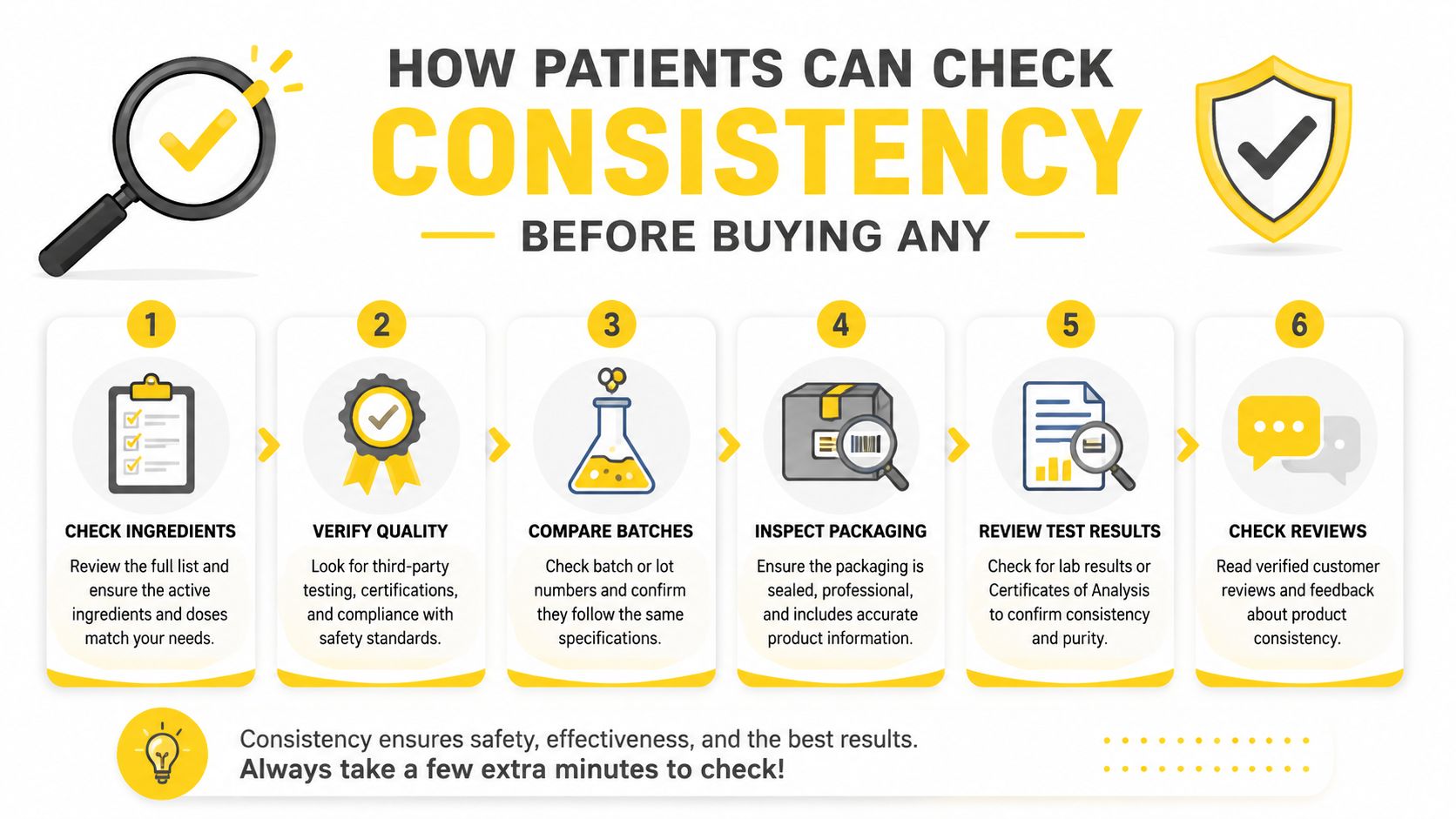
Step one is the most important: ask for the COA tied to the exact batch in your bag, not a generic strain sheet. A product name can cover multiple harvests or production runs, while the batch number identifies the material tested.
Step two: compare the batch number on the jar, cart box, or edible wrapper with the number on the COA. If the numbers don't match, ask staff to clarify before you buy or consume the product. A correct result for a different lot doesn't verify the package in front of you.
Step three: read three core areas of the document:
- Total THC and CBD results: Check the tested cannabinoid values against the label and compare them with your previous purchase. Don't treat a familiar strain name as proof of familiar potency.
- Dominant terpenes: Look for the compounds that shape the product's recognizable aroma and may help explain why two batches feel different. A major shift can be useful context when you record your response.
- Contaminant status: Confirm that the relevant panels passed. Cannabis quality guidance identifies concerns such as mycotoxins, elemental impurities, microbial contaminants, foreign matter, residual solvents, and pesticides, and recommends testing at or after the final step where contamination could be introduced. The USP cannabis quality workshop notes provide that framework.
Check freshness and condition
Step four: look at the harvest or packaging date. Dates don't tell you everything, but they help you judge how long the product has been stored and whether a change in aroma or texture might relate to age.
Step five: inspect the item without treating your senses as a laboratory. Compare color, visible moisture, texture, and aroma with your earlier purchase. A difference doesn't automatically mean the product is unsafe, but an unusual smell, damaged seal, visible contamination, or badly degraded appearance deserves a question before use.
Step six: keep a simple personal log. Write down the product, batch, labeled potency, dose, timing, dominant terpenes, and response. That record can help you identify patterns and communicate more clearly with a clinician or dispensary staff member.
Cannabis testing itself has a measurement-consistency question. Industry harmonization guidance uses less than 5% relative standard deviation as an ideal variance target for analytical measurements, which helps laboratories evaluate whether repeated results cluster tightly rather than swing unpredictably. The cannabis testing harmonization guide explains that metric in its laboratory context.
A budtender who welcomes these questions gives you more useful information than someone who insists the strain name tells the whole story. Curiosity is not difficult or confrontational. It is a practical part of choosing a product you can evaluate responsibly.
Choosing Consistent Products With Confidence
A repeatable purchase decision can be simple: verify the batch, scan the COA, and trust repeatable results. That rule keeps you focused on evidence that belongs to the package rather than assumptions based on a familiar name, attractive branding, or a previous experience.
Suppose you usually buy a Gelato flower because it has worked well for your evening routine. The next package carries the same name, but its cannabinoid panel is noticeably different and the dominant terpene pattern no longer resembles your notes. You don't have to reject the entire cultivar forever. You can ask for another verified batch, choose a product with a closer profile, or discuss the change with staff before deciding.
Let your own record guide the next purchase
A dosing diary turns memory into useful personal information. Record the batch, format, amount, timing, aroma, and effect. Over time, you may find that a particular cannabinoid range, terpene pattern, or format gives you a more dependable starting point.
That doesn't mean your response will never change. Sleep, food, other medications, tolerance, and your underlying condition can all affect an experience. A consistent product reduces one source of uncertainty, making the rest easier to evaluate.
Product consistency also improves communication. Instead of telling a healthcare provider that “the strain stopped working,” you can explain that a new batch had a different THC result, a changed terpene profile, or a later package date. Instead of asking a dispensary for the same name, you can request a product with a similar batch profile and documented testing.
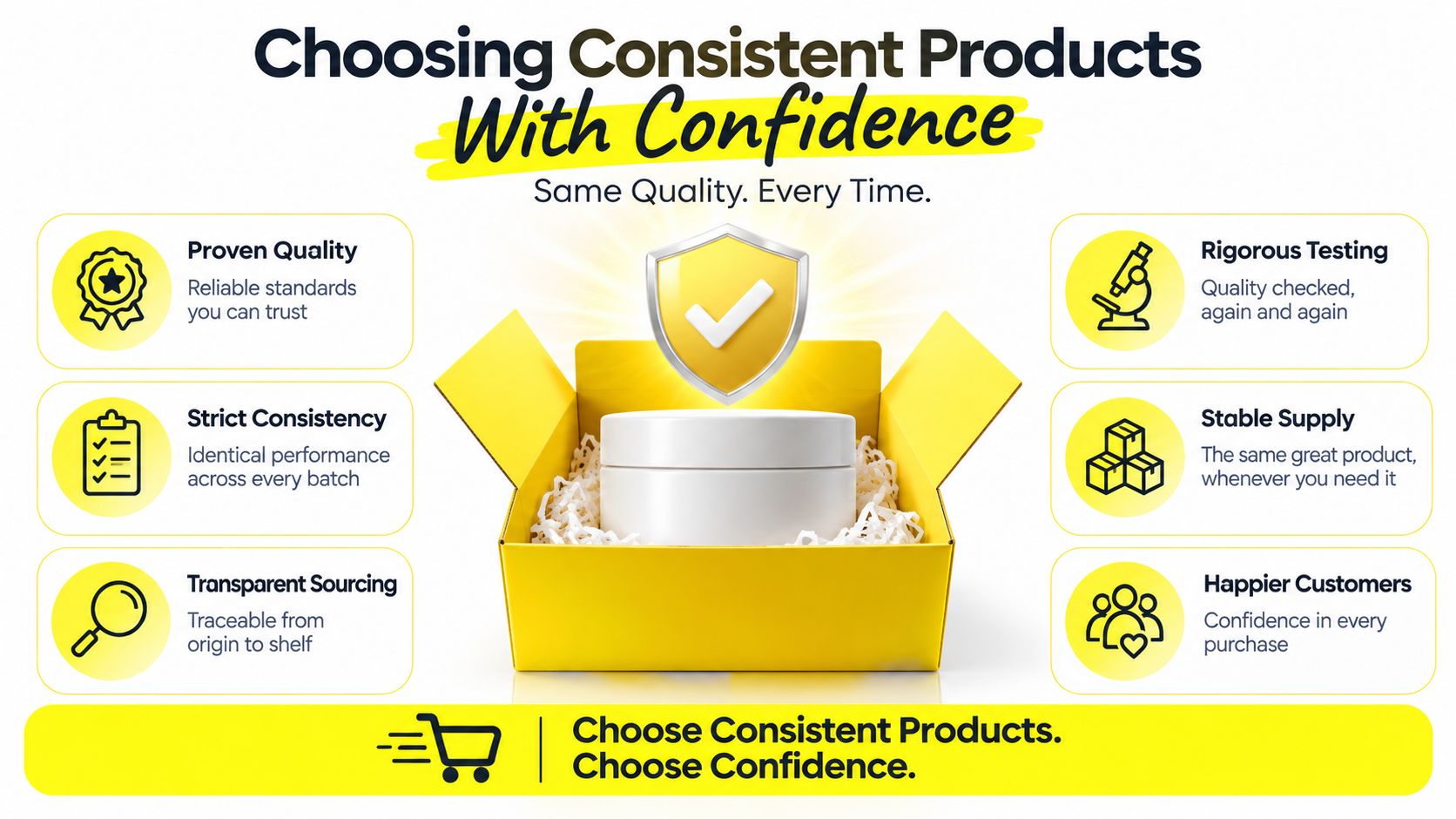
The habit becomes easier after a few purchases. You check the lot, compare the COA, inspect the date, and write down the response. That small routine can reduce anxiety, support responsible titration, and help you make decisions based on your own record rather than guesswork.
Mr. Nice Guys DC offers curated flower, edibles, cartridges, pre-rolls, concentrates, topicals, and tinctures with batch information and product guidance for patients making careful choices. Visit Mr. Nice Guys DC to review available products, ask about the COA for a specific batch, and arrange in-store pickup, curbside service, or delivery in the DC area.
Mr Nice Guys DC
At Mr. Nice Guys DC, we’re more than just a cannabis delivery service — we’re passionate advocates for quality, convenience, and community. With years of experience in the cannabis industry, our team is dedicated to educating and empowering customers across Washington, D.C. Whether you're a seasoned user or just starting your cannabis journey, our blog delivers trusted tips, product insights, and the latest updates from the world of weed. Stay informed, stay elevated.
