
Must Be 21 To Enter
By entering this site you are agreeing that you are at least 21 Years of Age or older.
I AM 21 OR OLDERCannabis Oil Capsules: A Patient's Guide for DC
.svg)

.png)
You're probably here because you want cannabis to feel more predictable.
Maybe smoking isn't your thing. Maybe gummies have been hit or miss. Maybe you want something you can take discreetly before dinner, after work, or as part of a steady routine without dealing with a strong smell, a sugary edible, or a lot of guesswork.
That's where cannabis oil capsules make sense. They're one of the simplest formats on the shelf. You swallow a measured capsule, wait for it to move through digestion, and the effects tend to feel more deliberate than a random bite of a brownie or a few puffs from a vape.
For patients and adult shoppers in DC, capsules often land in a useful middle ground. They're discreet like a supplement, cleaner to dose than homemade edibles, and easier to fit into everyday life than inhaled products. If you've ever wanted cannabis to feel more like a routine and less like an experiment, this format is worth understanding.
Your Guide to Precise and Discreet Cannabis Use
A lot of people come into a dispensary asking for the same thing in different words. They want relief, calm, or a more manageable daily experience, but they don't want to smoke, smell like cannabis, or wonder whether the next edible is going to hit way harder than the last one.
Capsules speak to that exact problem. Think of them like the cannabis version of a fish oil or vitamin softgel. You're not measuring drops. You're not breaking a gummy in half and hoping both halves contain the same amount. You're taking a set amount in a familiar form.
That matters because oral cannabis has played a major role in medical research. The U.S. National Academies review found conclusive or substantial evidence of benefit for cannabis or cannabinoids in chronic pain, chemotherapy-induced nausea and vomiting, and multiple sclerosis-related spasticity, and it noted that for nausea and vomiting and MS spasticity, the primary route examined was oral.
Practical rule: If you want cannabis to behave more like a measured routine than a fast impulse product, capsules are usually one of the first formats to consider.
A simple real-world example helps. If someone needs a discreet option before bed, a capsule may fit better than flower. If another person wants to avoid the sweet taste and unpredictability of baked edibles, a capsule may feel easier to repeat night after night. The tradeoff is patience. Capsules don't rush.
What Exactly Are Cannabis Oil Capsules
At the most basic level, cannabis oil capsules are just cannabis extract oil sealed inside a swallowable shell. That shell may be gelatin or a plant-based alternative. Inside, the oil may contain THC, CBD, or a combination of cannabinoids.
Think of them like a supplement
The easiest comparison is a standard softgel supplement. If you've ever taken a vitamin D capsule or fish oil softgel, the format will feel familiar. You swallow it with water. The shell breaks down in the digestive tract. The oil gets released and absorbed.
That simple design is a big reason people like them. There's no dropper to hold under the tongue. No smoke. No vapor. No need to carry around a package of gummies that can melt, stick together, or look like candy.
A practical example: if you already take evening medications or supplements, adding a capsule can feel natural because it fits the same routine. You line it up with the rest of your bedtime or after-dinner habits.
Why this format became so common
Capsules didn't appear out of nowhere. They grew alongside the broader rise of CBD and standardized oral cannabinoid products. In a 2022 U.S. study, 20.6% of adults reported using CBD in the previous 12 months, and 63% of CBD users also used cannabis, according to this ScienceDirect review on CBD use patterns. Earlier survey data in that same review found 18% of respondents had tried CBD, and among those users, about 40% used it at least weekly. The most common reasons included physical discomfort (41%), relaxation (33%), and general wellness (18%). It also noted that CBD oil tinctures were the most commonly used format, with nearly two-thirds of users having tried them.
That history matters because it helped normalize oil-based oral products. Once consumers got comfortable with tinctures and CBD oils, capsules became an obvious next step for people who wanted a pre-measured version of the same general idea.
If you want more context on where oils fit into the broader category, this guide on what cannabis oil is used for is a useful companion read.
What can be inside the capsule
Not every capsule is built the same. Some lean THC-forward. Some focus on CBD. Others blend multiple cannabinoids. That changes the experience.
Here's a simple way to consider it:
- THC-focused capsules usually appeal to people seeking stronger psychoactive effects.
- CBD-focused capsules are often chosen by people who want little or no intoxication.
- Balanced formulas can feel like a middle lane for people who want both symptom support and a more moderated experience.
The shell may look simple, but what's inside determines a lot.
How Capsules Compare to Other Cannabis Formats
Choosing a format is a little like choosing shoes. The right one depends on where you're going, how long you'll be there, and what kind of comfort you need. Capsules aren't automatically better than every other option. They're better for certain jobs.
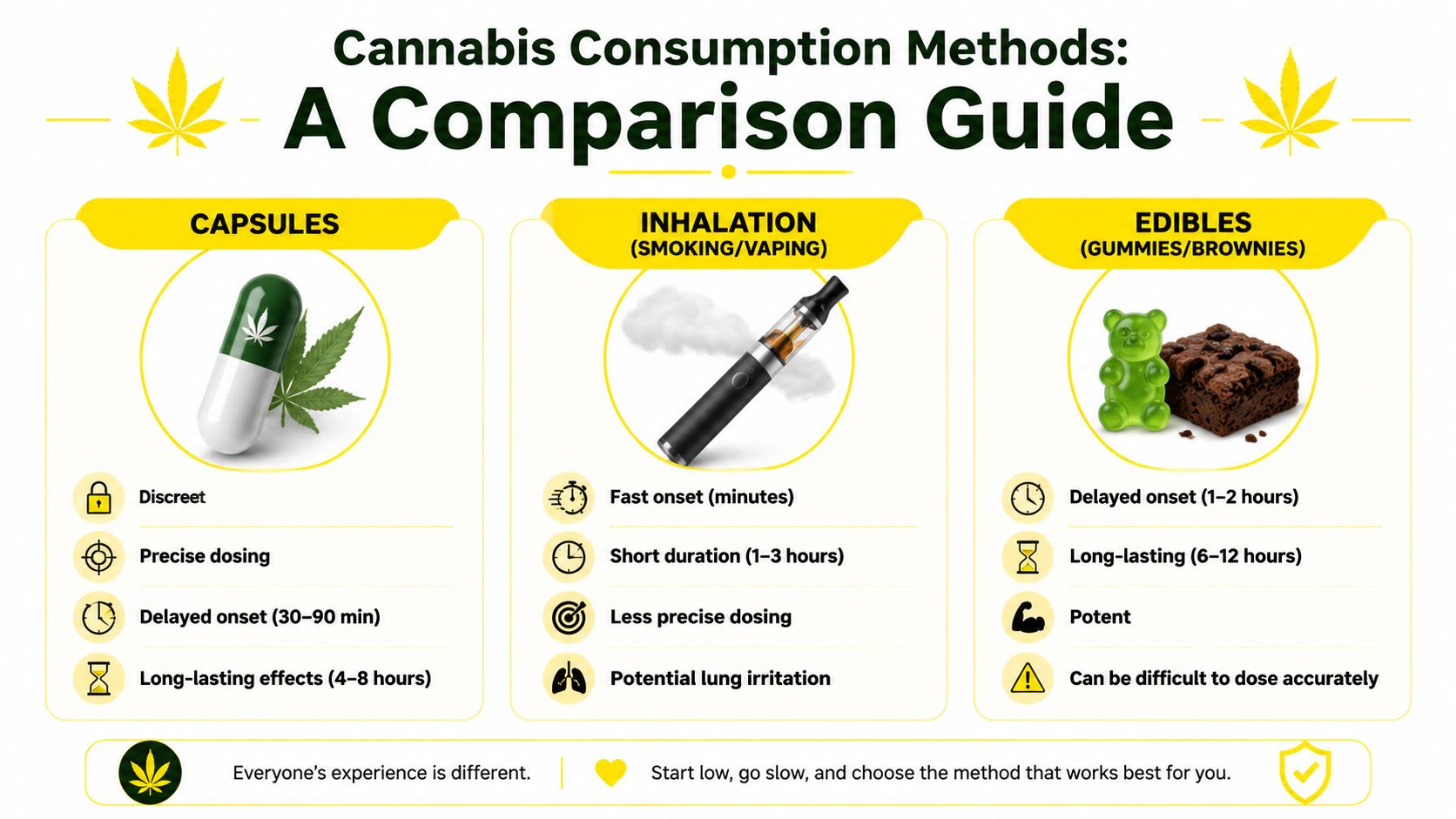
Capsules versus inhalation
Inhaled cannabis is the quick-response format. People often choose flower or vapes when they want to feel something soon and adjust in smaller, moment-by-moment steps.
Capsules work differently. You take them, wait, and let digestion handle the rest. That slower pace can be frustrating if you want immediate feedback, but it can also be helpful if your goal is steadier, less public use.
A practical example: if someone wants something for an evening routine and doesn't want to step outside, use a lighter, or carry a vape pen, a capsule may be more convenient. If someone wants rapid onset before a social event, inhalation may fit better.
Capsules versus tinctures
Tinctures can be useful because they let people adjust dose in small increments. But some patients don't love droppers. They dislike the taste, get inconsistent with measurement, or want something easier to take on a busy day.
Capsules win on simplicity. One capsule is one serving. That makes them easier for people who want repeatability.
Capsules are often the format people choose when they're tired of “a little more” or “a little less” and want the same routine each time.
The tradeoff is flexibility. A tincture can be nudged upward or downward in smaller steps. A capsule gives you less room to improvise unless the product itself comes in a low strength.
Capsules versus edibles like gummies or brownies
Capsules and edibles share one major trait. They're both swallowed. But the day-to-day experience can feel different.
A gummy may be convenient, but it can also feel like a treat, which sometimes encourages casual redosing. A capsule feels more clinical and deliberate. That's not exciting marketing language, but for many patients it's exactly the appeal.
Here's a quick comparison:
| Format | Main advantage | Main drawback | Best fit |
|---|---|---|---|
| Capsules | Precise, discreet, familiar | Slower onset | Routine daily use |
| Inhalation | Fast feedback | Less discreet | Quick effect |
| Tinctures | Flexible measuring | Taste and dropper learning curve | Fine-tuning dose |
| Gummies and baked edibles | Easy to take | Can invite impatience or uneven habits | Longer-lasting effects when timing is less urgent |
If you're weighing formats more broadly, this breakdown of edibles vs vapes vs flower helps frame the bigger choice.
Why oral formats matter clinically
Oral cannabis isn't just a consumer preference. It also has a medical footing. A recent phase 3 randomized trial of a full-spectrum cannabis extract for chronic low back pain found statistically significant pain reduction versus placebo, with a mean difference of −0.6 on the numerical rating scale in phase A and sustained improvement through later phases, according to the Nature Medicine trial report. The same report noted that adverse events were more common than placebo but were mostly mild to moderate and transient.
That gives a more realistic picture of capsules. They can support steady oral use, especially for pain, but they're not magic. You're usually trading speed for consistency.
Understanding Onset Duration and Proper Dosing
The biggest mistake people make with capsules is treating them like inhaled cannabis. They take one, wait a little, feel nothing, and then take more too soon.
That's how a manageable evening turns into a long one.
To understand dosing, it helps to understand the path a capsule takes through your body.
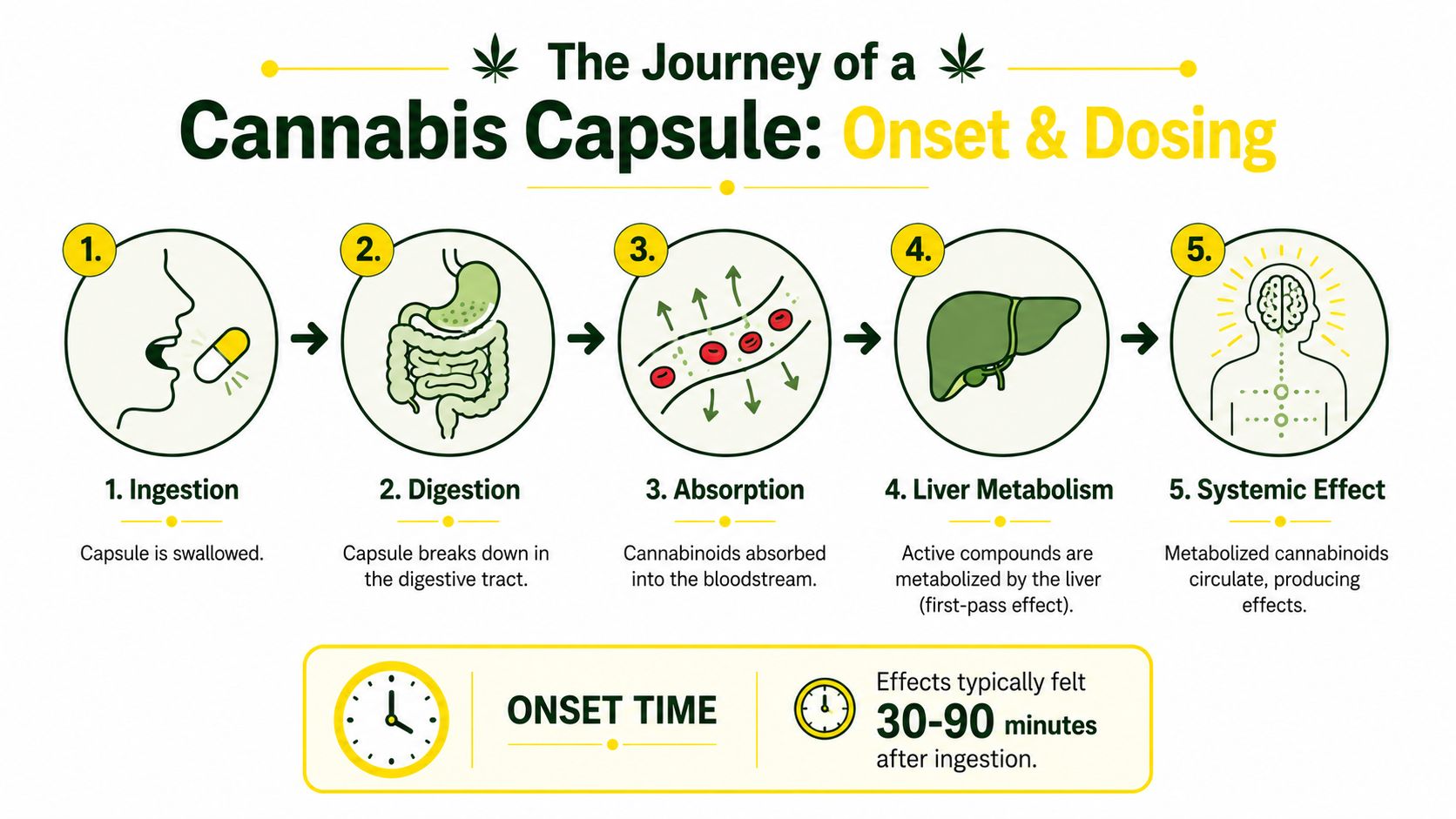
What happens after you swallow one
A capsule doesn't act at the moment it hits your mouth. First the shell has to dissolve. Then the oil moves through digestion. Then cannabinoids are absorbed and processed by the liver before broader effects are felt.
That delay is why many people experience capsules as slower and steadier than inhaled products. It's not weaker. It's just taking the long road.
For a visual explanation of how long edible-style products can linger, this guide on how long edibles last is worth reading.
A simple way to dose carefully
Use the lowest practical starting point available in the product line you choose. Then give it time. Keep notes if needed.
A real-life approach might look like this:
- Pick a quiet test window. Don't try a new capsule right before work, a flight, or a family event.
- Take one capsule only. Especially if you're new to oral cannabis or returning after a long break.
- Wait before changing anything. Let the capsule fully develop before deciding it was too weak.
- Repeat that same setup another day. Consistency helps you learn your own response.
- Adjust slowly. If you increase, change one variable at a time.
Best habit: Take notes on whether you took it with food, what time you took it, and how the effects felt. That tiny journal can save you a lot of trial and error.
Here's a plain example. Say a patient takes one capsule after dinner on Friday and feels comfortable. On Sunday, they take the same capsule on an empty stomach and feel less than expected. That doesn't necessarily mean the product changed. The meal may have changed the experience.
The food effect matters more than people think
This is one of the most important points in the whole guide. CBD's oral bioavailability is about 6% in the fasted state and about 36 to 57% in the fed state, according to the Cannabidiol entry summarizing oral bioavailability and food effect. In plain language, taking an oral cannabinoid product with food, especially a meal containing fat, can significantly increase systemic exposure.
That means the same capsule can feel different depending on whether you took it with lunch, after a full dinner, or on an empty stomach.
Here's the practical takeaway:
- If you want consistency, take your capsule under similar meal conditions each time.
- If you're sensitive, be extra careful with capsules taken after a heavier meal.
- If your first try felt weak, don't assume you need much more. The meal setup may be the missing variable.
This video gives a useful overview of edible-style onset and timing:
Potential Benefits and Important Considerations
A common DC patient scenario looks like this. Someone wants relief that fits into a normal evening routine, does not smell up the apartment, and does not call attention on the walk home from a legal dispensary. Capsules often fit that need because they feel familiar. You swallow one the same way you would take a vitamin.

Where benefits are strongest
Earlier in this guide, we covered the strongest clinical evidence for cannabis and cannabinoids. That evidence includes conditions such as chronic pain, chemotherapy-related nausea and vomiting, and multiple sclerosis spasticity. For patients who want a measured oral format instead of inhalation, capsules match that medical use pattern in a very practical way.
That matters in real life. A capsule gives you a set amount in each unit, which can make it easier to repeat what worked and avoid guessing the next time.
There are quality-of-life benefits too. Capsules do not involve smoke, visible vapor, or the lingering odor that can make some patients feel self-conscious. In DC, where many adults want privacy and a low-profile option they can purchase legally and use discreetly, that can be just as important as the cannabinoid profile.
Real-world use is changing
Research on CBD use in the United States shows that some adults are not reaching for these products only for general wellness. In one federally funded study, adults who had used CBD reported using it as an alternative or supplement to medications, with pain medicines mentioned often.
That does not mean a patient should swap out prescription treatment on their own. It does mean this choice is already happening in practice, so it deserves a careful conversation.
If you are considering capsules while also taking pain medication, sleep medication, blood thinners, seizure medication, or anything else on a schedule, bring your clinician or pharmacist in early. That step is especially important with oral products, because the effects last longer and because interactions are easier to overlook when a capsule feels as ordinary as a supplement.
The tradeoffs to respect
Capsules reward patience. They are less forgiving if you are impulsive.
A patient may take one, wait 45 minutes, feel very little, and assume they need more. Then both doses start stacking. That is one of the most common ways an oral cannabis session turns from manageable to uncomfortable.
A few practical concerns come up again and again at the dispensary counter:
- Delayed onset can lead to redosing mistakes. The slow start makes some patients think the first dose did not work.
- The effects can last for hours. That is helpful for some goals, but less helpful if the dose was too strong.
- Next-morning grogginess can happen. This is more likely with higher THC doses or late-night use.
- Product consistency matters. Clear labeling and verified testing give you a better shot at predictable results. Our guide to cannabis potency testing and what lab results actually show can help you read those details with more confidence.
At Mr. Nice Guys DC, this is usually the turning point in the conversation. Patients often come in asking, "What is the strongest capsule you have?" The better question is, "What dose fits my goal, my schedule, and my tolerance?" A capsule is a useful tool, but only when the strength, timing, and product quality all line up with the person taking it.
How to Choose High Quality Cannabis Capsules
Not all capsules are equal, even when the bottle looks polished. With oral products, small formulation details can affect how stable the oil stays, how consistent each dose feels, and whether the product remains reliable over time.
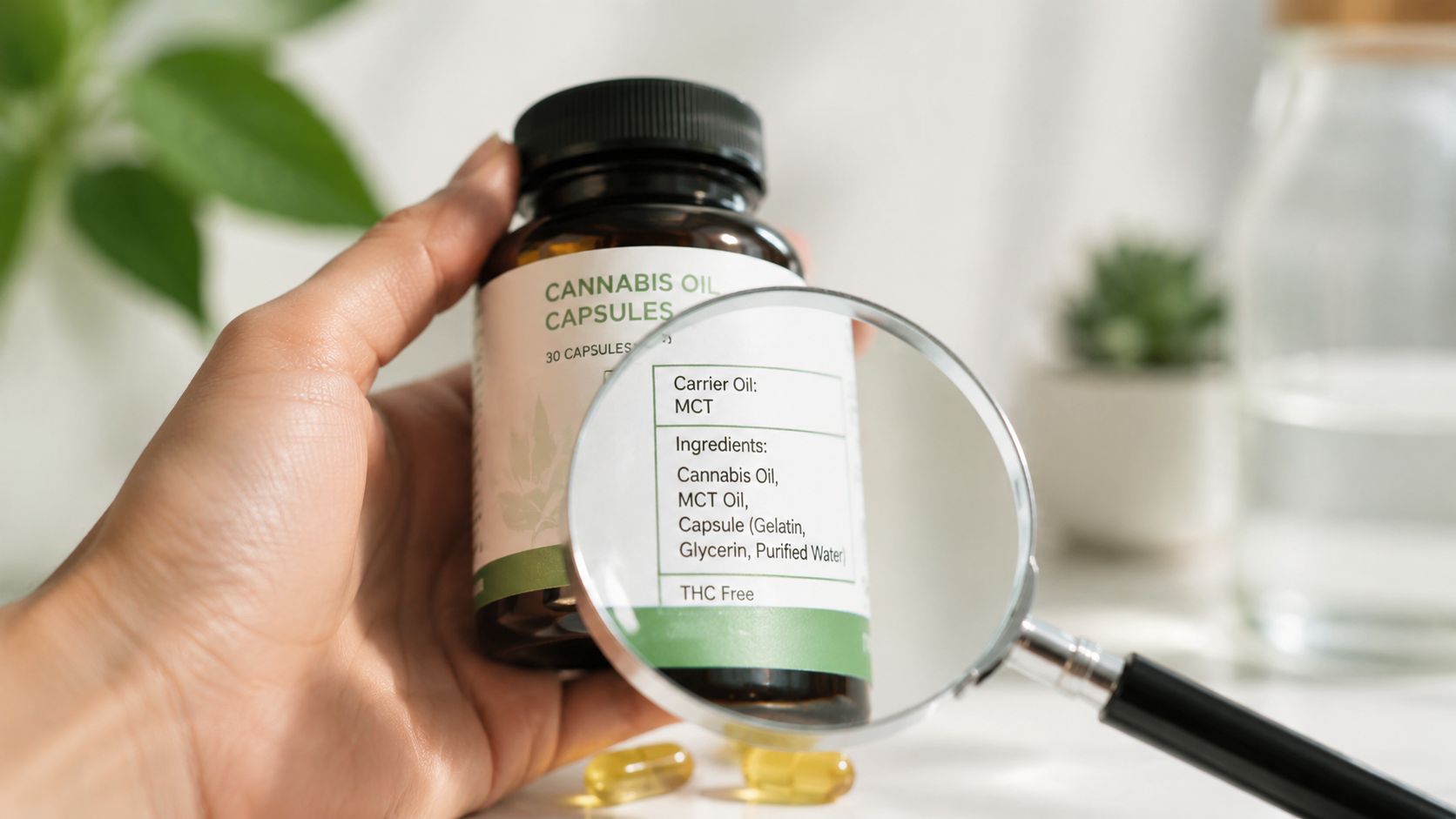
What to read on the label
Start with the basics. You want to know what cannabinoids are in the capsule, what oil carries them, and whether the product has current lab testing.
Look for:
- Cannabinoid profile. Is it THC-dominant, CBD-dominant, or balanced?
- Carrier oil. Many products use oils such as MCT or olive oil.
- Capsule material. Some shoppers prefer gelatin, while others want a vegan shell.
- Testing information. A product should clearly connect to potency and safety testing.
A practical example: if someone is very sensitive to psychoactive effects, a label that clearly separates THC and CBD content is more useful than a vague “relax” or “nighttime” name. Marketing language shouldn't be doing the heavy lifting.
Why manufacturing details matter
Capsules seem simple, but making them well is not simple. A peer-reviewed NIH/PMC study found that formulation stability depends heavily on the oil and filling process. In that study, adding olive oil first, then micronized silica was the most efficacious method, and the remaining capsule space was filled with 5 to 20 mg of micronized anhydrous silica to improve handling and mixing, according to the PMC formulation study on oil-filled capsules.
For a consumer, the lesson is straightforward. Professional manufacturing matters because oily cannabinoid formulas can leak, separate, or fill unevenly if the process is sloppy.
A buyer's checklist
Use this quick filter when you shop:
- Check the lab report first. Potency and purity should be documented, not implied.
- Read the ingredient list. The simpler and clearer it is, the easier it is to evaluate.
- Match the format to your goal. Daily routine users often prefer low-friction products with consistent serving sizes.
- Avoid mystery products. If the seller can't explain what's inside, move on.
If you want a deeper primer on what lab reports are meant to verify, this overview of cannabis potency testing helps.
In practice, this is also where a dispensary menu can save time. For example, Mr. Nice Guys DC includes capsules among the product formats patients may explore, alongside flower, tinctures, topicals, and edibles, which gives shoppers a way to compare oral options within a regulated retail context.
Buying Capsules Legally and Safely in Washington DC
DC shoppers often get confused because the local cannabis market has its own rules and habits. If your priority is accurate dosing, product transparency, and safer purchasing, licensed medical dispensary access is the cleanest lane.
That matters a lot with capsules. They're not the kind of product you want to buy casually from an unclear source. Since capsules are meant to deliver a measured oral dose, you want labeling, testing, and staff guidance that line up with that promise.
The FDA also notes, in the National Academies-linked material cited earlier, that aside from Epidiolex, Marinol, and Syndros, no cannabis-derived product has been approved as safe and effective for any patient population. In plain terms, most cannabis capsules on shelves are not FDA-approved medicines. That makes legal, tested dispensary access even more important.
What legal buying should feel like
A good buying experience in DC should be straightforward:
- You can ask specific questions about THC, CBD, onset, and daily routine use.
- You can review a transparent menu instead of guessing what's available.
- You can choose the shopping method that fits your day, whether that's pickup, curbside, or delivery where offered.
- You can verify compliance rather than relying on vague assurances.
If you're new to the local process, this guide on how to buy weed in DC clears up the basics.
For visitors and residents alike, the practical goal is simple. Buy from a legal channel where the product, label, and guidance all match up.
Frequently Asked Questions About Cannabis Capsules
You get home after a long DC day, take one capsule, and then wonder: Should I have eaten first? Is this stronger than a gummy? Can I take it with my other medications? Those are the kinds of questions patients ask at the counter all the time, especially when they want a format that feels measured, discreet, and easier to fit into a routine.
Quick answers in one place
| Question | Answer |
|---|---|
| Can I take cannabis oil capsules on an empty stomach? | Yes, but try to stay consistent. Food can change how oral cannabinoids are absorbed, so taking capsules the same way each time gives you a clearer read on the dose. |
| Are capsules better than gummies? | Capsules suit people who want a precise, no-sugar, supplement-style option. Gummies work well for people who prefer a chewable edible. The better choice depends on your routine and comfort level. |
| Do capsules feel the same as smoking? | No. Capsules come on more slowly because they pass through digestion and liver metabolism before you feel the effects. |
| Can I open the capsule and mix the oil into food? | It is usually better to use the product as labeled. Opening capsules can make dosing less tidy and less consistent unless the manufacturer specifically says it is appropriate. |
| Are cannabis capsules legal in DC? | Legal access depends on the channel you use. In practice, patients and adult consumers should verify current local rules and buy through compliant dispensary access. |
| How should I store them? | Keep them sealed in a cool, dry place away from heat, moisture, and direct light. |
| Should I make my own capsules at home? | Professionally made capsules are usually the safer choice because the dose, fill amount, and labeling are more consistent. |
| Can I use capsules instead of my regular medication? | Talk with a healthcare professional first. Cannabis products can affect treatment plans, side effects, and medication interactions. |
The questions patients usually ask in person
A lot of capsule questions come down to predictability.
Capsules work a bit like using the same measuring cup every day. If you change the meal, timing, and dose every time, it gets harder to tell what is helping. Patients in DC who want a steady evening routine often do best when they keep the basics consistent for the first few tries.
Another common question is whether capsules are "stronger" than other formats. A better way to frame it is whether they are easier to repeat. For many people, they are. The label tells you the intended amount per capsule, there is no smoke or vapor to manage, and the format travels through a normal daily routine with less fuss.
Storage is simple but easy to overlook. Keep the bottle tightly closed, and do not leave it in a hot car, on a sunny windowsill, or in a damp bathroom cabinet. Oil and capsule shells both hold up better when the environment stays cool and dry.
People also ask whether capsules are only for medical patients. They are often a good fit for medical use, but they also appeal to adults who want a smoke-free, low-profile option that feels more like taking a supplement than using a traditional cannabis product.
The medication question needs extra care. As noted earlier, some consumers use CBD products alongside or in place of other treatments. That is exactly why capsules deserve a real conversation with a clinician or pharmacist if you already take prescriptions or manage an ongoing condition.
“Start with the smallest sensible routine, keep the conditions consistent, and treat oral cannabis like something you're learning, not something you're chasing.”
If you want help choosing a capsule that fits your goals, daily schedule, and comfort level, the team at Mr. Nice Guys DC can help you compare formats, understand labels, and shop through compliant pickup, curbside, or delivery options in DC.
Mr Nice Guys DC
At Mr. Nice Guys DC, we’re more than just a cannabis delivery service — we’re passionate advocates for quality, convenience, and community. With years of experience in the cannabis industry, our team is dedicated to educating and empowering customers across Washington, D.C. Whether you're a seasoned user or just starting your cannabis journey, our blog delivers trusted tips, product insights, and the latest updates from the world of weed. Stay informed, stay elevated.
