
Must Be 21 To Enter
By entering this site you are agreeing that you are at least 21 Years of Age or older.
I AM 21 OR OLDERShatter vs Wax: Texture, Potency and Which to Buy


The familiar advice to buy shatter for strength and wax for flavor is a poor buying rule. Texture doesn't establish potency, purity, or safety, and a glassy sheet isn't automatically cleaner than an opaque scoop. A useful shatter vs wax comparison starts with how you'll handle the product, then checks what the laboratory report says about the exact batch.
For medical cannabis patients, that distinction matters more than picking a winner. The right purchase should fit your portioning method, tolerance, and treatment considerations, not just look appealing in the display.
Shatter and Wax Side by Side
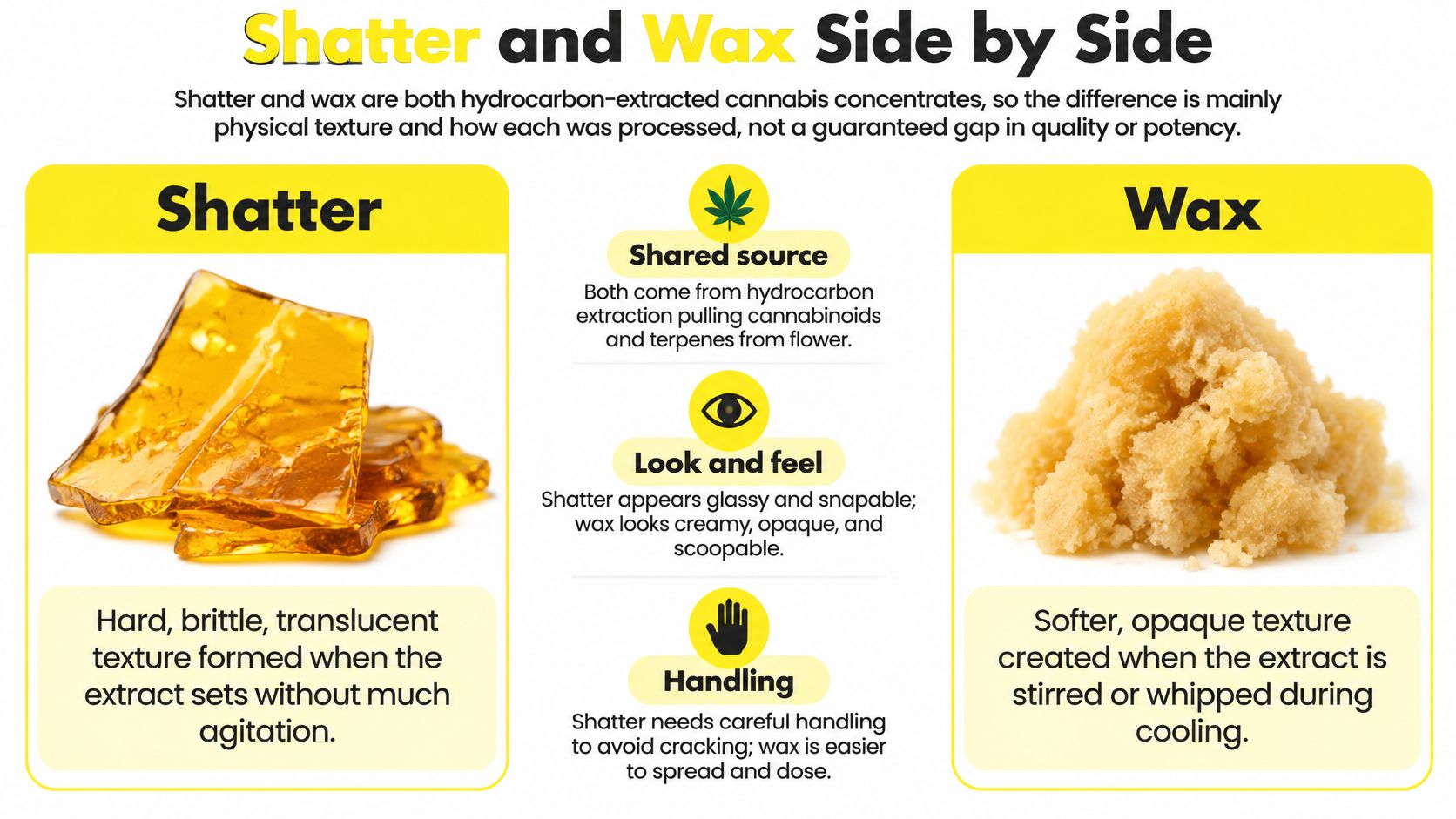
Shatter and wax are both commonly hydrocarbon-extracted cannabis concentrates. Their main difference is physical texture and processing, not a guaranteed gap in strength.
Shatter and wax at a glance
| Attribute | Shatter | Wax |
|---|---|---|
| Appearance | Golden, translucent, glass-like sheet | Opaque, softer, wax-like |
| Texture | Firm and brittle, snaps when handled | Soft and malleable, bends or scoops |
| How it is made | Oil left undisturbed under vacuum and cooled slowly | Oil agitated during purge by whipping, stirring or scraping |
| Handling | Break off pieces; resists accidental deformation | Scoop small amounts; can get messy or change consistency when warm |
| Typical use | Commonly dabbed using concentrate-compatible equipment | Commonly dabbed using concentrate-compatible equipment |
| Potency | Reported range overlaps wax; check the batch result | Reported range overlaps shatter; check the batch result |
These descriptions are useful for choosing a handling style, but they aren't quality grades. A review of cannabis concentrate use describes wax and shatter as high-potency preparations commonly consumed by dabbing, which can deliver substantial THC exposure rapidly. Neither deserves a casual approach just because its texture seems easier to manage.
What the appearance actually tells you
The table's handling rows are more useful than its appearance row. If you prefer working with a firm piece, shatter may suit your routine. If you prefer lifting a small portion with a dab tool, wax may be more convenient.
Neither description promises that the product will behave identically in every room. Temperature, storage, moisture, and composition can change consistency, and the Waterbeds ’n' Stuff concentrate guide explains why clarity and texture aren't reliable shortcuts for purity or potency.
Say a sheet becomes sticky after sitting somewhere warm. That change doesn't establish that it gained strength, lost strength, or contains a contaminant. It tells you that the physical material changed, while the chemical questions still require testing.
The questions worth asking
A productive comparison separates the purchase into distinct decisions:
- Production: What extraction and post-processing methods produced this consistency?
- Strength: What does the batch report show for total THC and CBD?
- Handling and exposure: Can you portion it reliably without taking more than intended?
- Buyer fit: Does this product suit your tolerance, equipment, and medical needs?
Those questions keep attractive packaging from doing the work of a lab report. They also leave room for a legitimate preference without turning that preference into a universal ranking.
Texture tells you how a concentrate behaves in your hands, not how strong or clean it is.
How Shatter and Wax Are Made
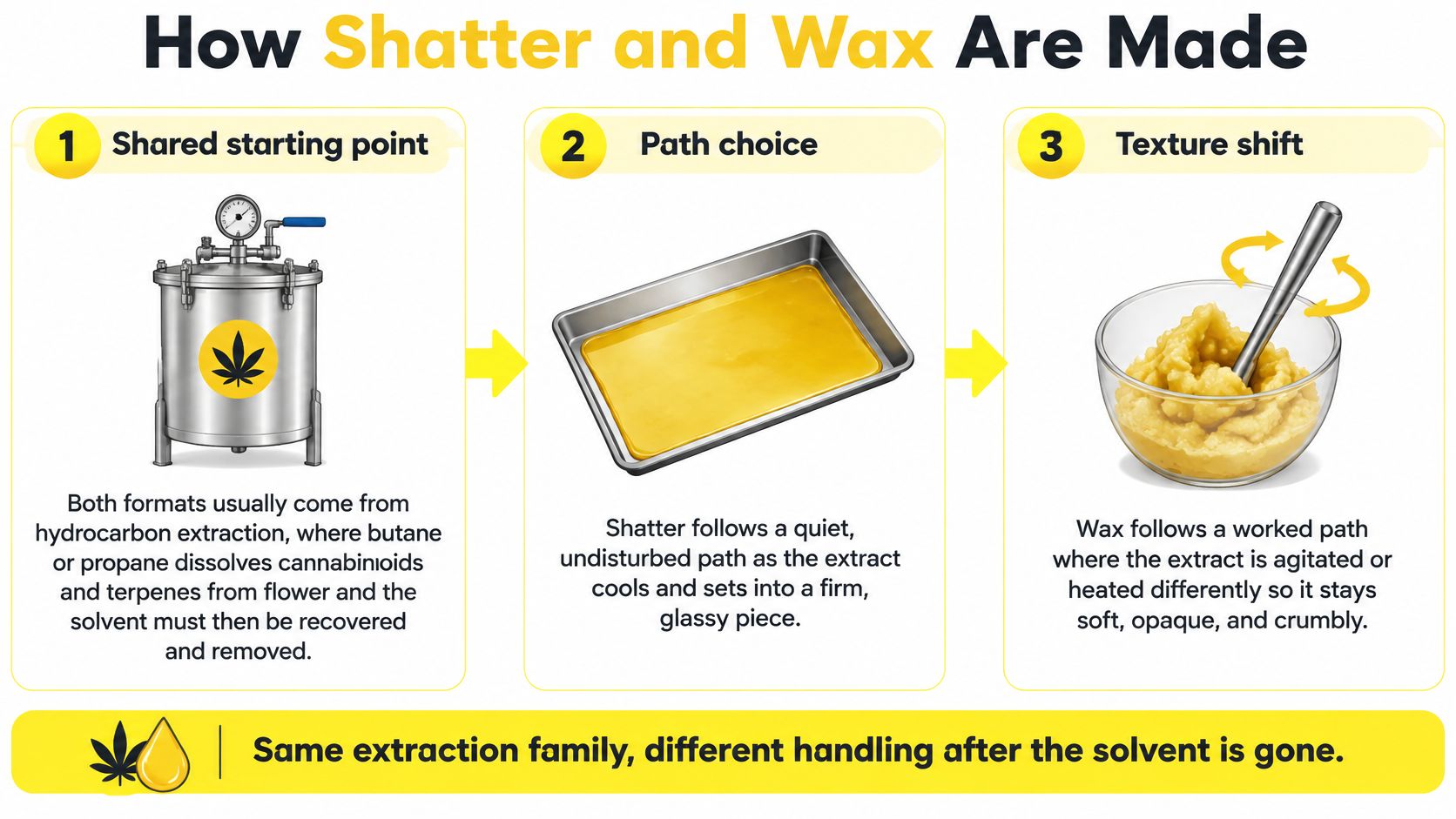
Both formats usually begin with hydrocarbon extraction. A processor uses a solvent such as butane or propane to dissolve cannabinoids, terpenes, and other compounds from cannabis flower, then removes the solvent from the extract.
That shared starting point doesn't mean the manufacturing details are interchangeable. The Vermont Cannabis Control Board's solid concentrates report describes the importance of controlled hydrocarbon extraction and solvent removal. These are commercial processing operations, not household projects.
Where the processing paths separate
The practical difference emerges as the extracted oil is purged and conditioned. Terpenes and Testing's explanation of shatter production describes how an undisturbed extract can form a translucent sheet, while agitation produces a softer, opaque consistency.
- The shatter branch keeps the oil relatively undisturbed. Under vacuum and with controlled cooling, the extract can set into a flat, glass-like sheet. For the buyer, the result is a firm material that can be broken into fragments.
- The wax branch works the oil during processing. Whipping, stirring, or scraping introduces microscopic air bubbles and disrupts the continuous structure. For the buyer, the result is generally a softer material that's easier to scoop.
These branches explain the broad distinction, not every manufacturer's exact procedure. A product name doesn't disclose the full production history, and a soft consistency doesn't necessarily identify a completely different extraction method.
What processing means for your purchase
Consider a patient who prefers separating a firm piece before preparing their equipment. Shatter's structure fits that handling preference. Another patient may find it easier to lift a small portion directly from a jar with a narrow dab tool, making wax the more practical option.
The important distinction is processing outcome versus chemical content. Whipping an extract doesn't, by itself, prove that it contains fewer cannabinoids, and leaving it undisturbed doesn't certify greater purity.
Several production variables deserve attention beyond texture:
- Extraction method: Establish how the material was separated from the plant.
- Decarboxylation and refinement: Check which cannabinoid measurements the label and report present.
- Solvent removal: Look for documented testing rather than judging by appearance.
- Storage and post-processing: Consider how the finished material was conditioned and packaged.
Our guide to types of cannabis concentrates helps distinguish texture names from broader production categories. A listing can suggest how a concentrate was processed, but only the relevant laboratory report documents the tested contents of the jar.
THC Ranges Overlap, So Labels Mislead
Reported THC ranges by format and source
| Format or sample | Reported THC | Source type | What it means |
|---|---|---|---|
| Shatter | About 70 to 90 percent | Concentrate buying guide, also used for the wax estimate below | Single guide estimate, not a batch result |
| Wax | About 60 to 80 percent | Same concentrate buying guide | Overlaps shatter; compare labels |
| Shatter | Up to about 90 percent | Medical literature comparison, also used for the wax estimate below | Ceiling figure, not typical |
| Wax | About 60 to 90 percent | Same medical literature comparison | Wide band that overlaps shatter |
| Mixed concentrate samples including shatter | Median 74.2 percent labelled vs 72.6 percent lab-observed | 2025 peer-reviewed study of 10 samples | A 1.6-percentage-point gap; prioritize the measured result over an unsupported label claim |
The overlap is the finding that matters. These ranges don't establish a reliable potency ladder with shatter above wax. They describe broad product categories, not the contents of every package sold under those names.
The mixed-sample study also requires careful interpretation. It isn't a direct shatter-against-wax contest, and it doesn't establish that every label misses its measured potency by the same amount. It demonstrates why a package claim and a laboratory measurement shouldn't be treated as automatically identical.
Compare jars, not category averages
Say you're comparing hypothetical packages labelled 78% THC shatter and 82% THC wax. If batch testing supports both claims, equal amounts of the wax contain more THC. The shatter name doesn't reverse that comparison, and neither number tells you which product better fits your medical needs.
If either package lacks a matching report, the labels alone don't settle the question. You're comparing claims without being able to verify their batch-specific basis.
Starting material, extraction, refinement, and decarboxylation all affect the cannabinoid result. That's why a single brand can sell products of the same texture with different tested profiles, and why the highest number isn't a complete description of quality.
For broader category context, our THC concentrates chart can help organize the comparison. Use category information to understand the shelf, then use the exact package information to choose a product.
Percentage isn't serving size
THC percentage describes concentration, not the amount you consume. A physically tiny portion can still carry substantial THC, while a larger portion of a less concentrated product can deliver more than expected.
Visual estimates are particularly misleading when comparing a flat shard with a rounded scoop. Their shapes don't provide a reliable comparison of mass, and a neat-looking portion isn't necessarily a small dose.
Practical rule: Compare the same cannabinoid measure on matching batch reports, then consider how much product you'll actually use.
Before debating shatter vs wax, compare packages within the same format. Check total THC, the batch date, and the intended serving information together. That exercise makes it harder to mistake a texture preference for a potency advantage.
Handling, Dosing and Consumption Differences
Dose control matters more than which format hits harder. Shatter requires separating a small fragment; wax requires lifting a small scoop, which can become harder to judge as the material warms.
Both are commonly dabbed, so choosing a softer product doesn't remove the rapid, concentrated exposure associated with inhaled concentrates. The useful handling question is whether you can prepare a controlled portion without accidentally loading more.
A cautious starting routine
For an adult who has already determined that a concentrate is appropriate, preparation should be deliberate:
- Begin with the smallest amount you can reliably measure or portion. Use a clean dab tool and prepare the portion before heating equipment. If your method can't distinguish a very small amount from a substantially larger one, don't treat it as precise dosing.
- Wait until you can assess the first dose before considering more. Don't stack inhalations because the first effect feels incomplete immediately. There isn't a universal waiting interval that makes every concentrate, device, and consumer equivalent.
- Record how the effect developed. Note the product, portion, device, and whether the experience felt manageable. A simple written record is more useful than remembering that one texture seemed stronger.
- Stop if you develop intense anxiety, agitation, paranoia, or impaired coordination. Skip further dosing, avoid driving, and move away from hot equipment. Seek urgent medical help for severe or concerning symptoms.
Our cannabis concentrates guide provides broader format context, but it can't replace an individualized medical assessment. For patients, the smallest feasible portion is a precaution, not a guarantee of a suitable response.
Why equal potency can feel different
Tolerance, prior cannabis exposure, inhalation technique, and product composition can change the experience even when the THC figure looks similar. Terpene information adds context, but it doesn't provide a dependable formula for predicting your response.
A study of cannabis concentrate users associated frequent concentrate use with higher THC exposure across cannabis forms, needing more cannabis for the desired effect, and potential dependence-related concerns. Those findings don't establish that wax is more harmful than shatter, or that texture causes the difference.
Consider someone who finds wax easier to scoop and starts taking larger portions because loading feels effortless. The practical problem is the amount consumed, not the softness of the product.
Skip concentrates when tolerance is unknown or when dose sensitivity or medication interactions are unresolved concerns. A patient taking other medicines should discuss compatibility with their treating clinician before trying a high-THC extract. Choosing a different texture doesn't resolve that uncertainty.
Safety Checks That Matter in Either Format
Clear shatter isn't a solvent test, and opaque wax isn't evidence of contamination. Manufacturing controls and batch-specific testing matter more than visual appeal.
A review summarized in the NIDA marijuana concentrates fact sheet reported contamination in more than 80% of tested solvent-extracted concentrate samples in one cited study, including residual solvents or pesticides; the safety discussion also identifies possible degradation products such as methacrolein and benzene, while Colorado public-health guidance notes that concentrates can reach about 90% THC and carry risks of unpredictable intoxication and adverse reactions. That sample finding isn't a contamination rate for every regulated product, and a laboratory contaminant pass doesn't eliminate high-THC exposure risks.
Read the certificate against the jar
Use the certificate of analysis, usually shortened to COA, as a document to verify rather than a badge to admire. A report bearing the right brand name isn't enough.
- Match the batch number: Find the identifier on the jar and confirm that it matches the report.
- Check the report date: Read it alongside the production or batch information so an older report isn't mistaken for current testing.
- Read residual-solvent results: Confirm that relevant solvents are reported and meet the applicable limits.
- Inspect pesticide results: A cannabinoid-only report doesn't answer this question.
- Compare total THC and CBD: Check that the report supports the package claims and that you're comparing the same measurements.
- Review the terpene profile: Use it to understand composition, not as proof that the product will produce a specific effect.
Our explanation of product testing standards provides context for those checks. If a panel is missing, don't interpret the omission as a pass.
Know what a report cannot establish
Say the report matches the product name but carries a different batch identifier. It isn't sufficient evidence for the jar in front of you. A report covers the tested batch, so a replacement jar needs its own match before you rely on it.
Testing also doesn't certify every condition of use. Excessive heating, unsuitable equipment, and taking too much remain separate concerns.
A transparent sheet is an appearance. A matching contaminant panel is evidence.
Avoid homemade solvent extraction. Butane-based production has caused fires, explosions, severe burns, and deaths; the safer purchasing route is a regulated product with documented solvent removal, not an improvised attempt to reproduce the process.
Buy the Right Format and Verify the Batch
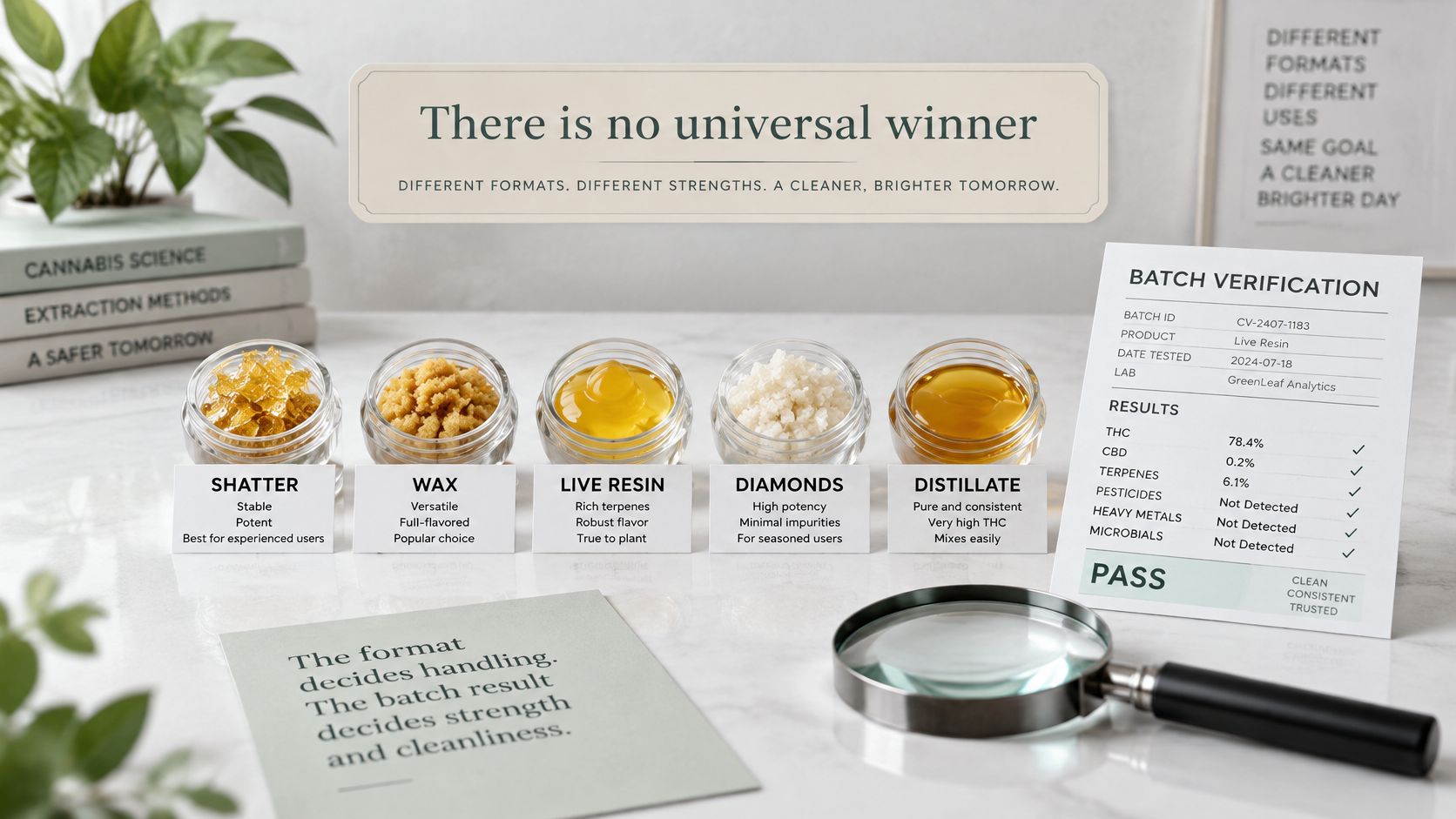
There's no universal winner in shatter vs wax. Choose the format for workable handling, then use the batch results to assess tested strength and contaminant compliance. Neither decision can substitute for the other.
Best starting format by buyer situation
| Buyer situation | Better starting fit | Why |
|---|---|---|
| First-time or low-tolerance consumer | Either format, at the smallest dose, only if a concentrate is appropriate | Both are high-potency; dose control matters more than the label |
| Buyer who wants to break off exact pieces | Shatter | Firm sheet snaps cleanly when handled carefully, but fragment size isn't a precise THC dose |
| Buyer who scoops small portions onto a tool | Wax | Soft texture is easier to scoop directly |
| Buyer who wants a stable, sealed jar for travel | Shatter | Firm form generally holds up better; warmth softens wax, though shatter isn't heat-proof |
| Medical patient with dose sensitivity | Lowest-potency product with full lab results | Tested THC and contaminant data matter more than format |
| Buyer comparing two packages of one format | Compare the batch certificate of analysis | Texture does not signal potency or purity |
The batch check applies to every row. A convenient texture doesn't compensate for missing testing, and a complete report doesn't make an unsuitable potency appropriate for a sensitive patient.
Match the product to the task
Consider a patient who wants to separate firm pieces on a clean surface before putting the container away. Stable shatter fits that workflow, provided they can handle it without scattering fragments. The pieces may be convenient, but they shouldn't be described as exact doses just because they look similar.
Another patient prefers using a narrow-ended dab tool directly from the jar. Wax may make that task easier because it doesn't require snapping a sheet. The trade-off is keeping the portion small and avoiding an oversized scoop when the material becomes softer.
For someone carrying a sealed container during lawful travel, firm shatter can offer better resistance to accidental deformation than soft wax. That's a packaging and handling advantage, not permission to transport cannabis across jurisdictional boundaries. Keep either product sealed and protected from heat; don't assume shatter will stay rigid in a hot vehicle.
A dose-sensitive medical patient has a different priority. I would favor the lowest-potency appropriate product with complete testing over a preferred texture, and I wouldn't assume that product needs to be a concentrate. At Mr. Nice Guys DC, staff can help compare flower, tinctures, topicals, capsules, or edibles based on the customer's needs.
A buying path that avoids the common mistakes
- Decide how you'll portion the product. Choose firm pieces if that method is manageable, or small scoops if a tool gives you better control. Don't choose a texture solely because someone calls it premium.
- Apply the batch checklist to the exact package. Confirm the identifier, cannabinoid results, contaminant panels, and report date. Missing information is a reason to pause rather than improvise an explanation.
- Compare packages within the same format first. Look at total THC and serving information together. This prevents a familiar texture from disguising a meaningful change in concentration.
- Plan the first portion before opening the rest of the session. Keep the remaining product sealed, and don't prepare extra because the equipment is already out.
Our guide to cannabis concentrates for sale can help you organize the available categories before choosing. Bring your handling preference and any dose concerns into the conversation instead of asking only which product is strongest.
Mr. Nice Guys DC sells shatter, wax and oils alongside flower, edibles, vape cartridges and pens, pre-rolls, topicals and tinctures, so you can compare formats in one visit. Tell the staff how you plan to portion and store the product, and let them weigh those needs against the options on the shelf. Pick the format for how you'll handle it, and pick the batch for how strong and clean it is.
We offer shatter, wax and oils, with guidance to help you compare concentrate formats against your handling preferences and potency concerns. Visit Mr. Nice Guys DC to discuss your options, and ask the staff to compare shatter, wax, and other formats against your needs before you choose.
Mr Nice Guys DC
At Mr. Nice Guys DC, we’re more than just a cannabis delivery service — we’re passionate advocates for quality, convenience, and community. With years of experience in the cannabis industry, our team is dedicated to educating and empowering customers across Washington, D.C. Whether you're a seasoned user or just starting your cannabis journey, our blog delivers trusted tips, product insights, and the latest updates from the world of weed. Stay informed, stay elevated.
