
Must Be 21 To Enter
By entering this site you are agreeing that you are at least 21 Years of Age or older.
I AM 21 OR OLDERTHC Concentrates Chart: A Guide to Potency & Use in 2026
.svg)

.png)
THC concentrates usually test around 50% to 98% THC, while typical flower is about 12% to 30% THC, so concentrates are often 2 to 8 times stronger. That's why a THC concentrates chart matters so much. It helps you compare products quickly and avoid treating a dab like it's just a stronger bowl.
A lot of patients hit this exact moment. You open a menu and see shatter, rosin, wax, live resin, distillate, hash, and kief, and suddenly the product names sound more technical than helpful. If you're trying to manage your evening, keep a clear head, or avoid taking too much, those labels need to mean something practical.
As a budtender, I like to simplify concentrates down to three questions. How strong is it, how is it made, and how do you plan to use it? Once you answer those three, the menu gets much easier to read. The rest is matching texture, flavor, convenience, and comfort level.
Navigating the World of Cannabis Concentrates
A cannabis concentrate is a refined product made to collect the plant's trichomes and active compounds while leaving behind much of the plant material. That's the basic reason concentrates feel so different from flower. You're working with a smaller amount of material that carries a much heavier cannabinoid load.
The biggest adjustment for most patients is respecting potency. Regulated concentrates can range from 50% to 98% THC, while flower typically ranges from 12% to 30% THC, according to the Montana Department of Revenue concentrate facts guide. If you've only used flower, that's a major jump.
Why a chart helps in real life
A good THC concentrates chart doesn't just tell you that one product is “strong.” It helps you compare:
- Potency range: Is this closer to hash or closer to a highly refined oil?
- Product style: Is it crumbly, sticky, glass-like, or syrupy?
- Extraction method: Was it made with solvents or mechanical methods?
- Best use: Is it better for dabbing, a vape, or sprinkling onto flower?
That turns a confusing menu into something usable.
For example, if a patient says, “I want something stronger than flower, but I don't want a huge jump,” I'm not pushing them straight toward the most refined option on the shelf. I'm more likely to talk through kief or hash first, then compare that to rosin or wax.
Practical rule: Don't shop concentrates by product name alone. Shop by potency range, texture, and how you'll actually consume it.
If you want a broader overview of formats before narrowing down, this guide to cannabis concentrate options at Mr. Nice Guys DC is a useful next read.
The mindset shift for patients
With flower, many people think in bowls, joints, or puffs. With concentrates, it helps to think in tiny amounts and faster onset. A chart gives you a reference point before you buy, not after you've already overdone it.
That's the main value here. It's not just about learning new vocabulary. It's about using potent products more safely and more intentionally.
The Quick Reference THC Concentrates Chart
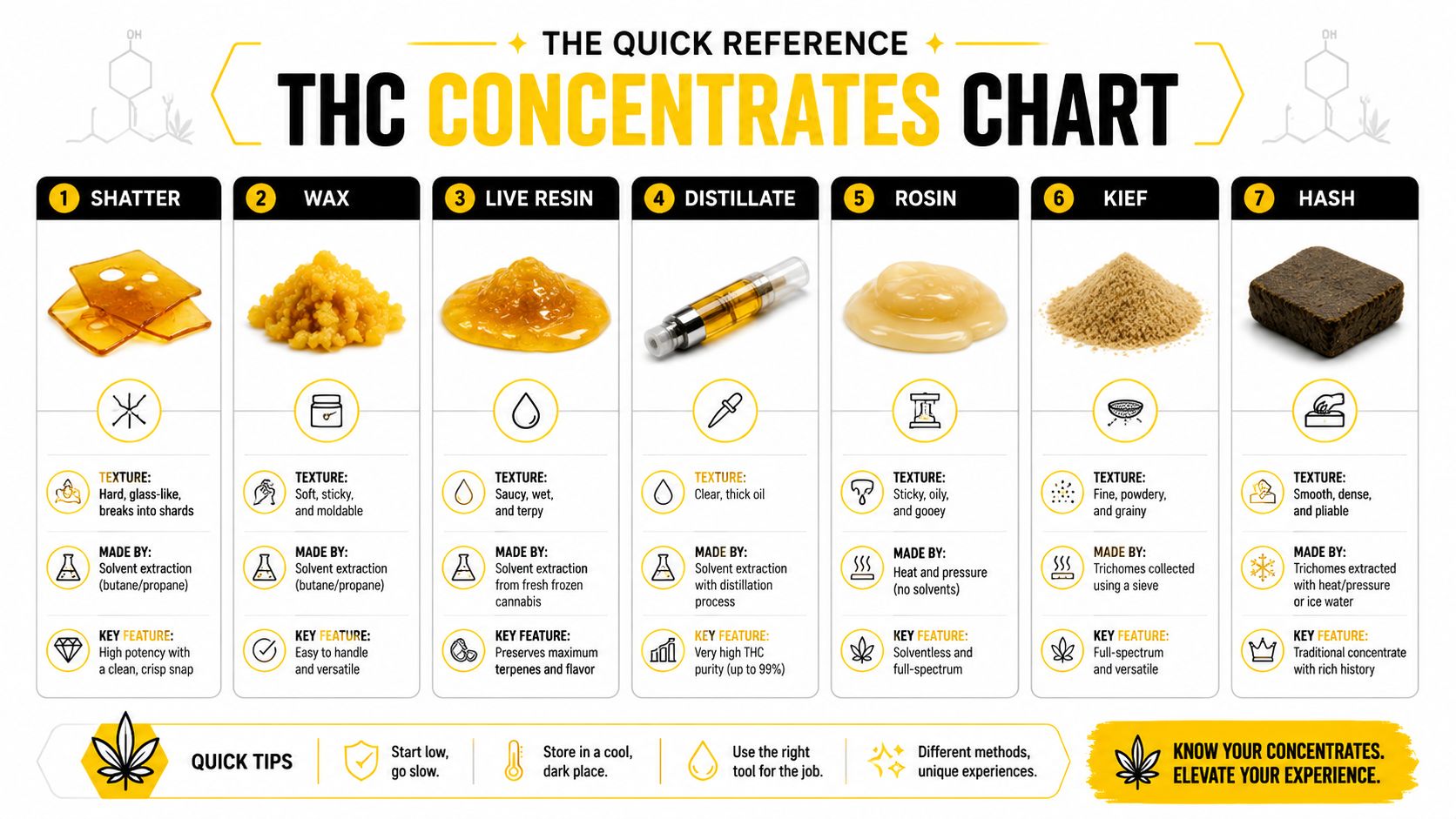
A patient in DC might look at a menu, see shatter, wax, rosin, live resin, distillate, kief, and hash, and feel like every option is just “strong.” That is where a quick chart helps. It turns a wall of product names into a short list you can use, based on strength, handling, and the kind of setup you have at home.
Use this chart like a menu translator. If you know how you want to consume, how much intensity you want, and whether you care about texture or extraction style, the chart becomes much more useful than a simple potency number.
A practical THC concentrates chart
| Product type | Typical THC range | Method | Appearance or texture | Best for |
|---|---|---|---|---|
| Shatter | 60% to 90% THC | Solvent-based | Brittle, glass-like | Patients who want a stable concentrate for dabbing |
| Wax | 60% to 90% THC | Solvent-based | Soft, whipped, crumbly, or buttery | Easier scooping and dabbing |
| Live Resin | Commonly sold in the higher-potency concentrate range | Solvent-based | Sticky, saucy, sugary, or buttery | Flavor-focused inhalation |
| Distillate | Often sold as a highly refined oil | Solvent-based | Thick oil, usually in carts or syringes | Simple, discreet use |
| Rosin | 60% to 90% THC | Solventless | Sap-like, buttery, or jam-like | Patients who prefer solventless extraction |
| Kief | 50% to 80% THC | Solventless or mechanically separated | Powdery crystals | Topping flower without a full dab setup |
| Hash | 50% to 80% THC | Solventless or mechanically separated | Pressed, dense, pliable | Traditional concentrate use |
Potency ranges above reflect common concentrate benchmarks summarized in Washington State's guide to THC concentration and potency.
How to use the chart in real life
Start with the last column, not the first. “Best for” is often the fastest way to avoid buying the wrong product.
Here is a simple example. A patient says they want something stronger than flower, but they do not own a dab rig and do not want a sticky product on a tool. The chart helps narrow that down quickly. Kief, hash, or a distillate vape usually makes more sense than live resin or shatter for that person.
Now take a different patient. They care about flavor, already know how to handle concentrates, and do not mind a messier texture. Live resin moves up the list because the texture and intended use match their routine. If you are comparing two vape-friendly formats that confuse a lot of shoppers, this guide to live resin versus distillate fills in the differences the table cannot show on its own.
One row, translated into plain English
Look at rosin. The row gives you three practical clues.
It usually sits in the same higher-potency neighborhood as many dab concentrates. It is solventless, which matters to patients who care about extraction method. Its texture is often soft or sap-like, so handling it feels different from snapping off a piece of shatter.
That tells you how to shop. Rosin often fits the patient who wants a stronger concentrate, values a solventless process, and is comfortable loading small amounts carefully. The chart is doing more than naming the product. It is helping you predict whether the product matches your routine.
What the chart can and cannot answer
A chart is a starting point. It helps you compare categories fast, but it does not replace the label on the specific jar or cart in front of you.
Two products in the same category can still feel very different. One live resin may be runny, another may be sugary. One hash may be easy to crumble onto flower, another may be better in a pipe. If you are shopping the Mr. Nice Guys DC menu, use the chart first, then check the product details for texture, format, and intended use before you buy.
Solvent Versus Solventless Extraction Methods
The cleanest way to understand concentrates is to split them into solvent-based and solventless products. That one distinction clears up a lot of menu confusion.
Imagine making coffee in two different ways. One method uses more processing to pull compounds out efficiently. The other leans on pressure, temperature, and physical separation. Both can produce excellent results, but they're not the same style of product.
Solvent-based in plain language
Solvent-based concentrates use a substance like butane, propane, or CO2 during extraction. Common examples include shatter, wax, live resin, and distillate. A technical guide from TVape notes that concentrates are commonly divided this way, and that premium examples of both solvent-based and solventless products can test around 60% to 95% THC in some cases, as outlined in its types of cannabis concentrates guide.
Patients often choose these products for texture variety and convenience. If you've seen glassy shatter, creamy wax, or a distillate cart, you've already seen how broad the solvent-based category can be.
Solventless in plain language
Solventless concentrates are made without chemical solvents. Rosin and ice-water hash fit here. Instead of using a solvent to pull out cannabinoids and terpenes, producers use mechanical separation, heat, pressure, or ice water.
Many patients gravitate toward solventless products because they like the production method itself. They want something made through pressure and separation rather than a solvent extraction process.
Some patients don't care how the concentrate was made. Others care a lot. That preference alone can narrow your options faster than any menu filter.
A simple way to choose
Use this quick lens:
- Choose solvent-based if you want more format variety, especially products like shatter, wax, live resin, or distillate.
- Choose solventless if you prefer rosin or hash and you care about mechanical extraction.
- Ask about handling if you're new. Sticky and saucy products can be harder to dose neatly than pressed or stable textures.
A patient who wants a dab tool session at home may enjoy the range of wax or live resin textures. Another patient may want a pressed rosin because the extraction style matters as much as the end result.
That's why production method belongs on any useful THC concentrates chart. It isn't trivia. It affects what you buy, how you use it, and what kind of experience you're trying to build.
Detailed Guide to Solvent Based Concentrates
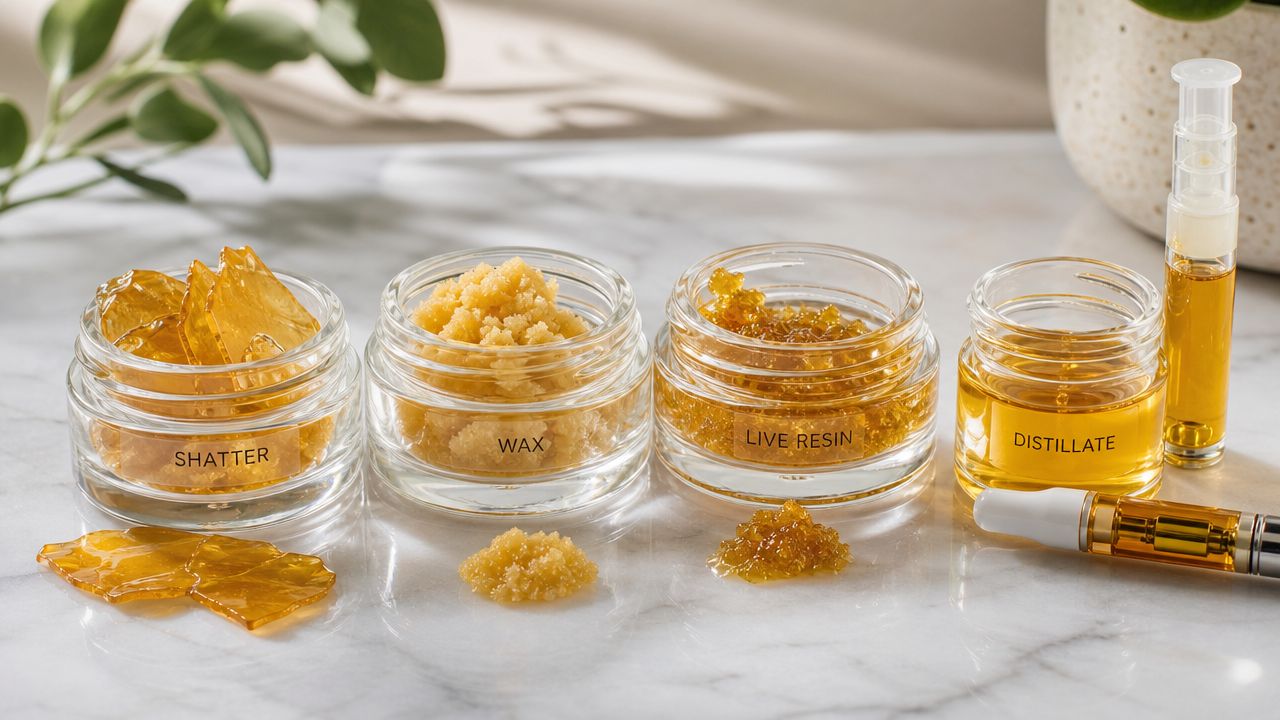
Solvent-based concentrates cover a lot of the products patients ask about first. They can look wildly different from one another, even when they come from similar extraction families. The easiest way to shop them is by texture, handling, and your intended use.
Shatter
Shatter is the one many people recognize on sight. It's thin, brittle, and glass-like.
A practical example: if you keep a concentrate at home and want something that breaks into pieces cleanly, shatter can feel more manageable than a sticky product. The tradeoff is that it can be fussy to portion if you're trying to take a very tiny amount.
Best for: patients who don't mind using a dab tool and want a more stable texture.
Wax
Wax is softer and easier to scoop than shatter. Depending on the finish, it may feel creamy, airy, or crumbly.
That makes wax approachable for a lot of regular concentrate users. If someone says, “I want something easier to work with than shatter, but I still want a strong dab,” wax is often the next thing I'd show them.
Best for: easy loading into a dab tool or concentrate-compatible device.
Live resin
Live resin usually appeals to patients who care about flavor and aroma. It tends to come in saucy, sugary, or sticky forms, and it often feels more expressive on the nose than simpler oils.
A real-world example: if your evening ritual is a small, deliberate inhale while winding down at home, live resin often fits that style better than a generic cart. It's less about convenience and more about the session.
For patients who want a deeper look at oil extraction styles, this overview of CO2 and hash oil products can help clarify where certain solvent-based formats fit.
Distillate
Distillate is a highly refined oil. Most patients encounter it in cartridges, disposables, or infused products.
Its biggest strength is simplicity. If you want something discreet, portable, and easy to dose one pull at a time, distillate often wins on convenience. A patient running errands or stepping out for a brief break usually reaches for this category before a jar concentrate.
Best for: straightforward vaping and consistency in a portable format.
Here's a visual walkthrough if you want to see concentrate formats in a more hands-on way.
Cartridges
Cartridges aren't a separate extraction method. They're a delivery format. Inside, you might find distillate or another concentrate oil depending on the product.
That distinction matters. Patients sometimes say “I want a cart, not a concentrate,” but a cart is usually just a way of consuming a concentrate.
Quick shopping cues
- If you want discreet use: start with a cartridge.
- If you want a home session with a dab rig: look at shatter, wax, or live resin.
- If you hate sticky cleanup: avoid the sauciest products first.
- If you're unsure about tolerance: pick the format that lets you take one small inhale and stop.
A product can be high quality and still be the wrong fit for your routine. The right concentrate is the one you can measure, handle, and use comfortably.
Detailed Guide to Solventless Concentrates
Some patients are drawn to solventless products right away. Others arrive there after trying wax, shatter, or carts and deciding they want a different style of concentrate. Either path is normal.
What sets this group apart is the production method. These products are made without chemical solvents, and that matters to people who prefer mechanical separation, heat, pressure, or traditional preparation methods.
Rosin
Rosin is often the first solventless product patients ask for by name. It's usually pressed into an oil that can range from sap-like to buttery, depending on how it's prepared and stored.
In practical terms, rosin fits the patient who enjoys a deliberate session and wants a concentrate that reflects a solventless process. If someone says, “I want a dab, but I want to stay in the solventless lane,” rosin is usually where the conversation starts.
A common use case: a patient at home with an e-rig takes a very small dab in the evening and values the ritual as much as the effect.
Hash
Hash is one of the older concentrate traditions, and a lot of patients appreciate that straightforward appeal. It's usually pressed, dense, and easier to reason about if the modern concentrate menu feels too technical.
Hash works well for people who don't want the glassy brittleness of shatter or the syrupy mess of sauce-like extracts. It can feel like a middle ground between flower and more modern dabbable concentrates.
Kief
Kief is often the easiest solventless-style entry point for flower smokers. It's the loose, powdery collection of trichomes that can be sprinkled onto a bowl or mixed into a roll.
That makes it practical for patients who want to increase potency without buying a dab setup. If you already know how your body responds to flower and you just want a little more punch, kief usually feels more familiar than a jar concentrate.
Three patient-friendly examples
- Rosin for a measured dab: You already own a concentrate device and want a small, intentional inhale at home.
- Hash for a traditional format: You prefer a denser, more classic concentrate that doesn't feel overly processed.
- Kief for boosting flower: You enjoy bowls or joints and want to strengthen them without changing your routine.
Solventless doesn't automatically mean “better.” It means the product was made through a different process, and that process matters to some patients more than others.
The practical takeaway is simple. If you're purity-focused, solventless products deserve a close look. If you mainly care about convenience or device compatibility, another format may fit your life better. The right answer depends less on hype and more on how you consume.
Dosing Concentrates How to Read Labels and Start Safe
Most new concentrate users get tripped up. They look at one label, see a large percentage, compare it to flower, and assume they understand the dose. Often, they don't.
The first thing to know is that labels may refer to THC, THCA, or total THC. That can make side-by-side comparisons messy. Weedmaps points out that this label difference can confuse buyers, and it gives a useful reference point: a 0.1 g dab of 80% concentrate delivers a similar THC amount to 0.5 g of 20% flower, as explained in its guide to cannabis concentrates and label reading.
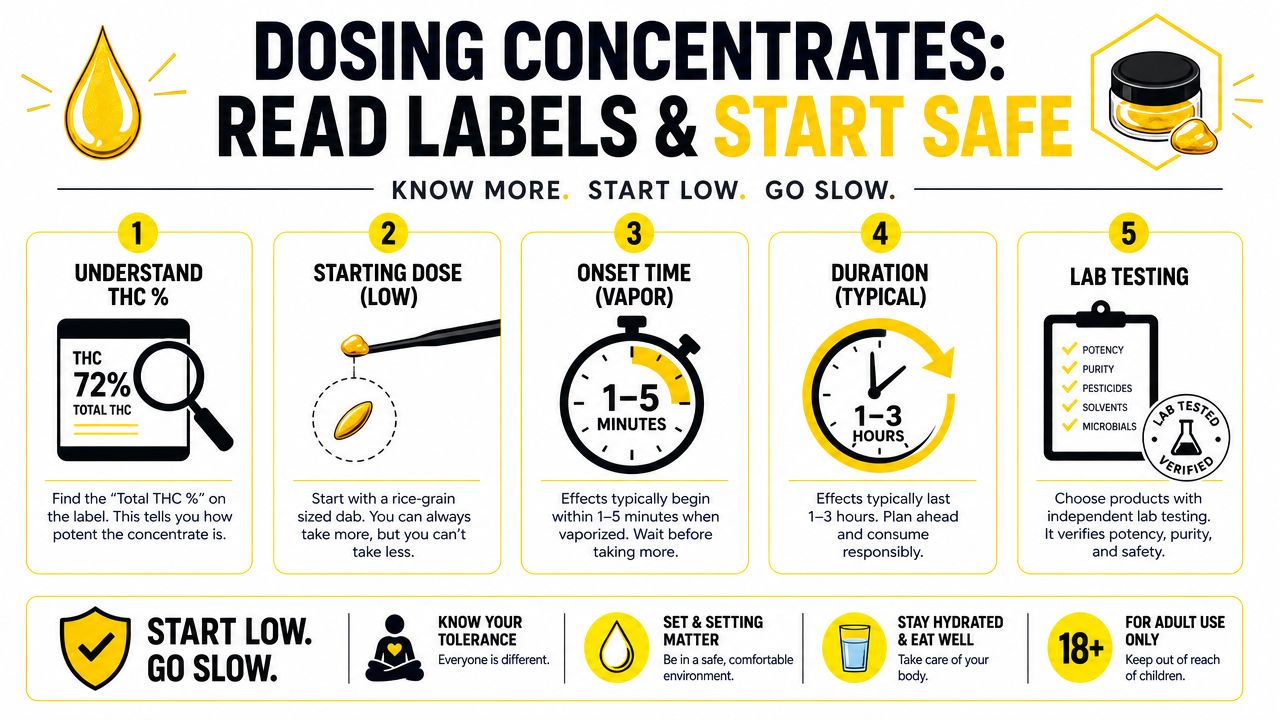
What patients should look for on the label
When you pick up a concentrate, check:
- THC: The active cannabinoid already in THC form
- THCA: The precursor that converts with heat
- Total THC: The number most patients use for practical comparison
- Product type: Rosin, wax, live resin, distillate, hash, or kief
- Intended use: Dab jar, vape cart, applicator, or topper
A chart helps you compare product families. The label helps you compare the actual item in your hand.
A safe starting approach
For a new concentrate patient, I'd keep the advice simple and conservative:
- Start with a very small amount. A rice-grain sized dab is enough for many beginners.
- Use one inhale, not several. Give yourself time to judge the effect.
- Wait before redosing. Concentrates can come on fast, especially when inhaled.
- Choose an easy format. If handling sticky concentrate stresses you out, use a cartridge first.
If you want a deeper primer on how labels and potency testing work, this article on cannabis potency testing helps decode what those numbers mean.
Where people overdo it
The usual mistake isn't buying the wrong concentrate. It's using a flower mindset with a concentrate product.
A patient may think, “I'm an experienced smoker, so I can handle this,” then load too much because the amount looks tiny. But tiny is the point. A very small dab can carry a lot more THC than people expect.
Start low and go slow matters most with concentrates because visual size can fool you. A small dab can still be a heavy dose.
If you're ever uncertain, ask the dispensary staff to help you compare label language before you buy. That one conversation can prevent an uncomfortable session later.
Consumption Methods Explained Dabbing Vaping and More
Concentrates aren't tied to one single method. That's good news, because the right product often depends on how you prefer to consume it.
The National Institute on Drug Abuse has reported that solvent-based concentrates have shown average THC levels of about 54% to 69%, with some samples exceeding 80%, while non-solvent extracts averaged about 39% to 60% THC, according to its marijuana concentrates drug facts sheet. Potency differences like that help explain why different consumption methods developed around different concentrate styles.
Dabbing
Dabbing usually involves a rig, nail or banger, a heat source or e-rig, and a dab tool.
What it feels like: fast onset, strong effects, and a more session-oriented experience.
Pro: excellent for patients who want full concentrate flavor and control over small amounts.
Con: more gear, more learning curve, and more cleanup.
A patient who uses concentrates mostly at home may prefer dabbing because it gives them more control over the experience than a casual vape pen.
Vaping
Vaping concentrates usually means a cartridge, disposable, or a portable device designed for concentrates.
What it feels like: simple, portable, and easy to repeat in small pulls.
Pro: low hassle and discreet for many patients.
Con: less hands-on control over the exact amount than carefully portioning a dab.
If you're trying to fine-tune vapor style, this guide on the best temperature for vaping weed gives helpful context.
Adding concentrate to flower
This method includes sprinkling kief on a bowl or adding a small amount of concentrate to flower.
What it feels like: familiar if you already smoke flower, but stronger.
Pro: no full dab setup required.
Con: it's easier to over-fortify your bowl if you aren't careful.
A quick choice guide
- Choose dabbing if you want the full concentrate ritual at home.
- Choose vaping if convenience matters most.
- Choose topping flower if you want a gentler transition from flower into concentrates.
Some patients never dab and still enjoy concentrates regularly. That's completely normal. The best method is the one you can use comfortably, consistently, and in a way that lets you stop before you overshoot your dose.
Your Guide to Concentrates at Mr Nice Guys DC
You are standing at the counter, looking at a menu full of carts, wax, live resin, rosin, and kief. Two products may both test high in THC, yet one fits your routine and the other ends up sitting in a drawer because it needs gear you do not own or a skill level you do not have yet.
That is the primary use of a THC concentrates chart for a DC patient. It helps you turn abstract numbers and product names into a practical buying choice.
A good shopping conversation starts with your routine, not the strongest item on the menu. If you only medicate on short breaks, a cart may fit better than a jar concentrate. If you already enjoy flower at home and want a stronger version of a familiar session, kief or another topper may make more sense than buying a full dab setup. If you care about flavor, texture, or avoiding solvent-based options, say that early so the menu gets narrower fast.
Questions to answer before you buy
- What equipment do you already have? A 510 battery, a dab rig, or just flower gear.
- How much control do you want per session? Small pulls from a cart feel different from portioning a dab with a tool.
- What is your experience level with high potency products? If your tolerance is still closer to flower, say so.
- What setting will you use it in most often? At home, on the go, or added to flower.
- Do you care more about convenience, flavor, or extraction method? Those priorities often point to different products.
Patients browsing the Mr. Nice Guys DC menu can use those answers to narrow choices before asking a budtender for a recommendation.
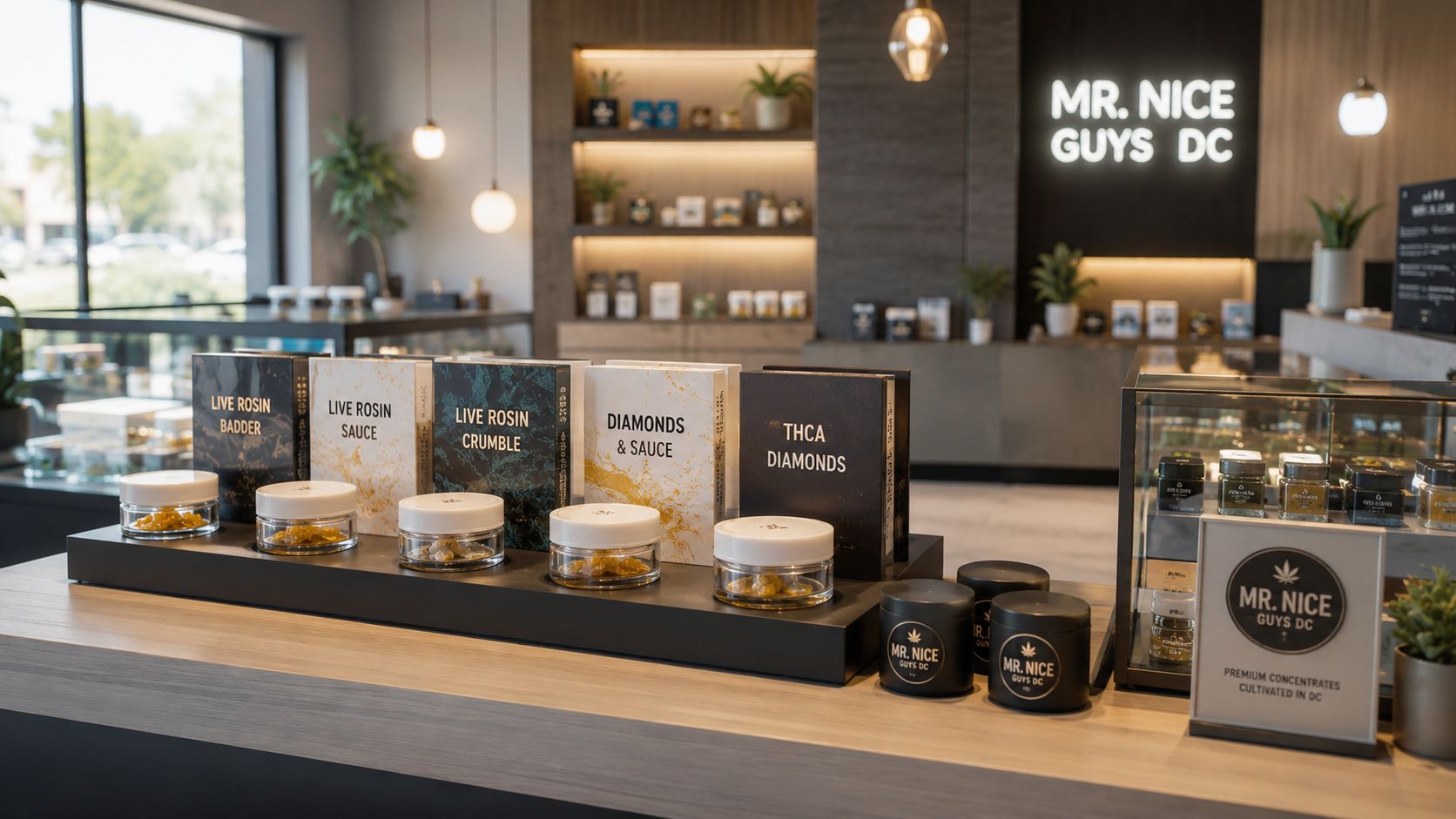
Here is a simple way to shop. Match the product to the job.
If you want the easiest learning curve, start with a cartridge. If you want stronger effects at home and do not mind more setup, ask about a dab-ready concentrate. If you want a bridge between flower and concentrates, ask for a topper that can be used in tiny amounts. The chart helps with potency, but the budtender should help translate that chart into a product you can use comfortably.
One more tip matters. Ask the budtender to compare two products in plain language. For example: which one is easier to portion, which one is stickier to handle, and which one is more forgiving for a newer patient. Those answers are often more useful than a small difference in THC percentage.
A solid dispensary visit should leave you knowing what you bought, how to use it, and how much to start with. That is the difference between shopping by label and shopping with a plan.
Frequently Asked Questions About THC Concentrates
How should I store concentrates
Store concentrates the way you would store something delicate and sticky in a summer kitchen. Keep them sealed, cool, and away from light so the texture stays workable and the aroma does not fade too quickly.
At home, the simplest routine is usually the best one. Leave the product in its original container, close it tightly after each use, and keep it out of places that heat up fast, like a car, backpack, or sunny windowsill. Warm concentrate can turn runny, messy, and harder to portion.
Do concentrates smell as strong as flower
The short answer is no, not in the same way. Burning flower tends to create a bigger, longer-lasting smell, while vaping or dabbing often produces a scent that fades faster.
Still, lower odor is not the same as no odor. Opening a jar of live resin or rosin can be quite noticeable, especially if it is rich in terpenes. For a patient trying to keep things discreet, the better question is not “Does it smell?” but “How long does the smell hang around, and what method fits my space?”
Do all concentrates have to be dabbed
Many patients assume concentrates always mean a torch, a rig, and a steep learning curve. That is only one lane.
Some concentrates are made for dabbing. Others are designed for vape carts, and some work well as a small topper with flower. It helps to read the product like you would read cooking oil labels. One bottle is for sautéing, another is for finishing a dish. Concentrates are similar. The form tells you how it is meant to be used.
What's the difference between live resin and live rosin
These two names trip people up because they sound so close, but the key difference is the extraction method.
Live resin is usually made with solvents. Live rosin is made without solvents. For a DC patient using a THC concentrates chart, that distinction matters because the chart is not only about potency. It also helps you connect the label to your priorities, such as flavor, texture, handling, and whether you prefer solvent-based or solventless products.
Is higher THC always better
Higher THC does not always mean a better fit. A concentrate with a huge potency number can still be the wrong choice if it is harsh for you, hard to portion, or stronger than your routine calls for.
A chart is most useful when you read it like a map, not like a scoreboard. One patient may want a small, predictable evening dose. Another may want stronger relief with fewer inhalations. The better product is the one you can measure, use comfortably, and repeat with confidence.
What should a first-time concentrate patient buy
A good first purchase usually starts with a good conversation. Tell the budtender three things: your current tolerance, the device you already own, and what kind of session you want. Fast and discreet. Slow and flavorful. Simple with almost no cleanup.
That approach works better than chasing a product name. A first-time patient often does best with a concentrate that matches their setup and habits, not the one with the flashiest label. At Mr. Nice Guys DC, a helpful question is, “Which option is easiest to portion and hardest to overdo for someone with my experience level?” That gives you guidance you can use right away, and it adds something a THC concentrates chart alone cannot show.
Mr Nice Guys DC
At Mr. Nice Guys DC, we’re more than just a cannabis delivery service — we’re passionate advocates for quality, convenience, and community. With years of experience in the cannabis industry, our team is dedicated to educating and empowering customers across Washington, D.C. Whether you're a seasoned user or just starting your cannabis journey, our blog delivers trusted tips, product insights, and the latest updates from the world of weed. Stay informed, stay elevated.
