
Must Be 21 To Enter
By entering this site you are agreeing that you are at least 21 Years of Age or older.
I AM 21 OR OLDERGuide to Hash Oil Co2: Vapes & Concentrates for 2026
.svg)

.png)
You're standing at the counter, looking at a row of vape carts and concentrates, and one label keeps popping up: CO2 extracted. You've probably seen it enough times that it sounds important. But if you're like a lot of patients and shoppers in DC, the key question is simpler: what does that mean for how this product will feel, taste, and fit into your routine?
That's where CO2 hash oil gets interesting. It's not just lab talk. For the person using the product, the extraction method can affect flavor, consistency, and how clean the final oil feels in a cart or concentrate.
A patient might ask for something smooth for evening use. Another might want a cartridge that feels reliable from one purchase to the next. Someone else may care most about avoiding leftover solvent concerns. CO2 extraction matters because it speaks to those real-world concerns, not because the term sounds scientific.
If you've ever picked up a cart and wondered why one oil is lighter, another tastes more botanical, and another is labeled full-spectrum, you're asking the right questions. Let's make the label easier to read.
Welcome to the World of CO2 Cannabis Oil
A common dispensary moment goes like this. You ask for a vape that's clean, effective, and not overly complicated. The budtender points to a cartridge and says, “This one is CO2 oil.” You nod, but you're still trying to decode whether that means stronger, safer, smoother, or just more expensive.
That confusion is normal.
CO2 cannabis oil sits in that category of products people recognize before they fully understand. The label sounds premium, and sometimes it is associated with cleaner processing, but the value for a patient comes from something more specific: how the oil was pulled from the plant and how that affects the final experience.
What shoppers usually want to know
Readers aren't asking for a chemistry lesson. They're asking things like:
- Will it taste like the plant: Some CO2 oils keep more of the natural aroma profile than highly stripped-down oils.
- Will it feel consistent: Patients often want a cart that behaves predictably, especially if they use cannabis for routine symptom management.
- Will it be clean: The phrase “CO2 extracted” gets attention because people connect it with a more controlled process.
A good extraction method matters, but the patient only feels the result through flavor, onset, consistency, and trust in the finished product.
A practical example helps. Say you're choosing between two vape cartridges for after-work use. One tastes flat and generic. The other has a more recognizable strain character and a cleaner finish. You may not know the extraction details on the spot, but the process behind that oil often plays a role in what ends up in the cart.
Why this topic matters in real life
For a DC medical patient, hash oil CO2 isn't just a term on packaging. It can be a clue that the extractor used a method designed for control. That doesn't automatically make every product excellent, but it does give you a smarter starting point when you're comparing concentrates and vapes.
By the end of this guide, “CO2 extracted” should feel less like marketing language and more like useful information you can shop with.
What Exactly Is CO2 Hash Oil
Hash oil is a cannabis concentrate. In plain language, that means it's an oil made by separating the plant's most desired compounds, mainly cannabinoids and terpenes, from the raw flower material.
Instead of smoking the full plant, you're using a more concentrated form of what the plant contains.
Start with the word hash oil
Hash oil can show up in several product forms:
- Vape cartridges: oil inside a 510-thread cart or disposable device
- Dab concentrates: thicker extracts used with a dab rig or electronic concentrate device
- Oil syringes: concentrated oil used in specific ways depending on the product
What makes it “hash oil” is the fact that it's an extracted concentrate, not loose flower.
What the CO2 part means
The CO2 part tells you what was used as the solvent during extraction. A solvent is the material used to pull cannabinoids and terpenes out of the plant.
If “solvent” sounds harsh, think about decaffeinated coffee. In that process, a substance is used to selectively remove certain compounds from coffee beans while preserving the parts people still want. CO2 extraction works in a similar way. The extractor uses carbon dioxide under controlled conditions to pull out target compounds from cannabis plant material.
That's one reason CO2 has become a common benchmark for high-purity cannabis concentrates. A peer-reviewed study on Cannabis indica leaves optimized supercritical CO2 extraction across 150 to 250 bar, 30 to 50°C, and 1 to 2 hours, identifying an optimum at 250 bar, 43°C, and 1.7 hours, where the experimental oil yield reached 4.9 wt%. The study also found that yield increased with pressure, showing how sensitive the process is to operating conditions in a real extraction setup, as described in this peer-reviewed study on supercritical CO2 extraction parameters.
Clearing up the biggest CO2 misunderstanding
Some shoppers hear “CO2” and immediately think about pollution or climate headlines. In extraction, that's not the issue being discussed.
The CO2 used for hash oil is an industrial feedstock, not the climate pollutant category being tracked in emissions inventories. The same molecule is useful here because under high pressure it becomes a controllable solvent. That's separate from the broader environmental story in which global CO2 emissions in 2022 were 182 times higher than in 1850, as noted by the U.S. EPA greenhouse gas overview.
So when you see CO2 on a cart label, read it as a processing method, not a climate statement.
The Science of Supercritical CO2 Extraction
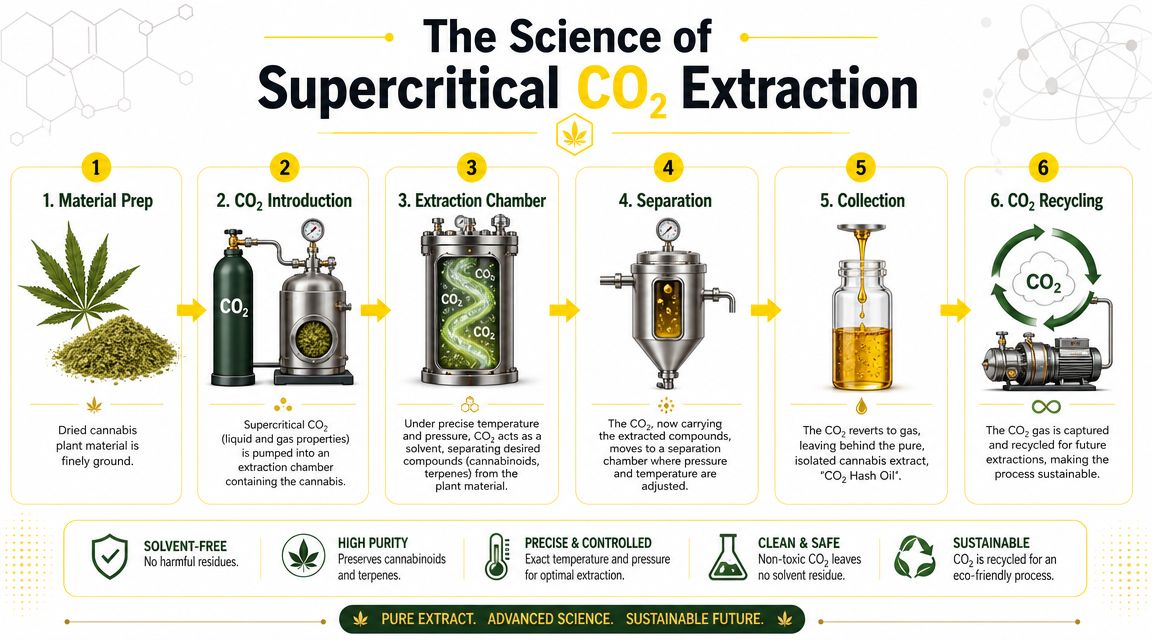
A lot of DC patients hear "supercritical CO2" and picture something harsh or overly technical. Understanding the process becomes easier if you focus on what it means for the oil in your cart or syringe. The extractor is using pressure and temperature to decide which parts of the plant end up in the final product, and that choice can affect flavor, smoothness, and overall consistency.
Stage one: preparing and pressurizing
The process starts with dried cannabis packed into an extraction vessel. CO2 is then heated and compressed until it passes its critical point. At that stage, it behaves partly like a gas and partly like a liquid, which is why processors use it to move through plant material efficiently while still dissolving desirable compounds.
A simple way to picture it is this: the CO2 can spread through the plant like a gas, but it can also pick up oils like a liquid solvent. That unusual behavior is what makes the method so useful.
For the patient or shopper, this matters because a more controlled solvent can lead to a more controlled extract. If the operator wants a cleaner starting oil before refinement, the extraction conditions matter from the first step.
Stage two: tuning what gets pulled
At this juncture, the science connects directly to the experience.
Changing pressure and temperature changes what the CO2 is better at collecting. Lighter aromatic compounds, including terpenes, can be handled differently than heavier cannabinoid-rich fractions. Operators are not just "extracting everything." They are often tuning the run to favor a certain profile, then separating fractions later.
That helps explain why one CO2 cartridge may taste closer to the original flower while another may feel more potency-focused and less expressive on flavor. The machine settings shape the raw extract, and the post-processing choices shape it even further.
If you want a related example from the cannabinoid side, this guide to CO2-extracted CBD oil shows how the same extraction family is used to make products with different end goals.
A quick process video can also help you visualize what the equipment is doing at each step.
Stage three: separating the oil from the CO2
Once the CO2 has picked up cannabinoids, terpenes, and other soluble compounds, the mixture moves into separator chambers. There, technicians lower pressure and adjust temperature so the dissolved oils fall out of solution.
The CO2 shifts back toward a gas, and the extract is collected separately.
That clean separation is one reason CO2 extraction gets so much attention. Under normal conditions, CO2 does not linger in the oil the way a liquid solvent can during earlier phases of processing. For a medical cannabis patient shopping in DC, that often translates to peace of mind about how the oil was made, especially when the brand also backs it up with solid testing.
What the shopper experiences
The science shows up on the shelf in practical ways:
- Profile control: processors can build an oil that leans more aromatic, more cannabinoid-heavy, or more balanced
- Batch consistency: tightly controlled settings can make one batch feel closer to the last
- Cleaner overall impression: well-made CO2 oil often tastes less muddy and feels more refined
At Mr. Nice Guys DC, that is the part worth paying attention to. Supercritical CO2 is not just a lab term. It is one of the reasons a product may taste cleaner, feel smoother, and give you a more predictable experience from one purchase to the next.
CO2 Oil Compared to Other Concentrates
Choosing a concentrate is a little like choosing coffee beans versus the brew method. The starting plant matters, but the extraction method still changes what ends up in your cart, dab jar, or syringe. For a DC medical cannabis patient, that usually shows up in four practical questions: How clean does it taste? How true does it feel to the strain? How consistent is it from batch to batch? How much refining did it take to get there?
Here's a quick comparison that keeps the science tied to the shelf experience.
Extraction method comparison
| Method | Purity & Safety | Flavor Profile (Terpenes) | Typical Cost | Primary Pro |
|---|---|---|---|---|
| CO2 | Often chosen for controlled extraction and no residual solvent at ambient pressure when properly processed | Can preserve a broad profile, especially when fractionation is used | Often mid to premium | Tunable extraction for balanced oil |
| BHO | Requires careful post-processing and purging | Can be very flavorful depending on process | Varies | Popular for strong concentrate textures and aroma-rich products |
| Ethanol | Effective, but usually needs more refining to remove unwanted compounds | Can pull a broad range of compounds, sometimes including more plant material | Often cost-efficient | Scales well for large extraction runs |
| Rosin | Solventless process, valued by shoppers who want mechanical extraction | Often expressive and plant-forward | Often premium | No solvent-based extraction step |
Where CO2 stands out
CO2 often appeals to patients who want a middle ground between control and a fuller plant profile. Processors can separate terpene-rich portions from cannabinoid-rich portions, then recombine them with more intention. The result can feel closer to the original cultivar than a more stripped-down oil, especially in vape products where flavor and aroma are easy to notice.
That difference matters in real use.
Two carts can carry the same strain name and similar THC numbers, yet still feel different once you inhale. One may taste flat or one-note. Another may come across as more layered, with a clearer aroma on the front end and a more distinct effect profile afterward. CO2 extraction gives producers room to shape that outcome with precision, which is part of why some shoppers at Mr. Nice Guys DC ask for it specifically.
How other methods compare in real life
BHO can produce excellent concentrates with strong flavor and popular textures, but cleanup and post-processing matter a lot. If you are shopping for a BHO cart or dab, the method alone does not tell you whether the product was handled carefully. The better question is whether the brand shows clean testing and consistent formulation.
Ethanol works well for large-scale extraction and can be very useful, especially for products that will be refined further. The trade-off is that ethanol can pull more plant compounds along with cannabinoids and terpenes, so the oil often needs more downstream cleanup. For the patient, that can mean a less strain-specific experience unless the formulation is rebuilt thoughtfully.
Rosin is a different lane. It is solventless, and many shoppers like that for simple, mechanical extraction. Rosin often shines in small-batch dabs and plant-forward flavor, while CO2 often makes more sense for patients who want a stable, controlled oil in a cartridge or similar format.
A simple way to frame it is this: rosin often attracts flavor-first concentrate shoppers, BHO attracts texture and aroma fans, ethanol supports efficient large-batch production, and CO2 appeals to people who want clean-tasting, consistent oil with more control over the final profile.
If you are also comparing vape oils by how they feel and taste after extraction, this breakdown of live resin vs. distillate helps clarify why two products can look similar on the label but perform very differently.
Choosing Your CO2 Product at Mr Nice Guys DC
Once you understand the process, the next question is practical: what form of CO2 oil fits your routine?
For most shoppers, the answer depends less on chemistry and more on when, where, and how they plan to use it.
CO2 vape cartridges
This is a commonly encountered format. A 510-thread cartridge filled with CO2 oil is simple, discreet, and easy to dose in small increments.
A practical example: if you want something for evening decompression without setting up a dab device, a CO2 cart is usually the straightforward choice. One small inhale gives you a clear read on flavor and onset without committing to a larger dose.
Start low and go slow works well here:
- Take one small puff: Keep it brief, especially if the product is new to you.
- Wait about 15 minutes: Give yourself time to judge the effect before taking more.
- Repeat only if needed: This keeps the experience controlled.
Disposable pens and all-in-one devices
Some people don't want to deal with a separate battery. A disposable or all-in-one CO2 vape can make more sense if convenience is the priority.
This format often works well for a patient who wants a ready-to-use option for travel within legal guidelines, or for someone who doesn't want to troubleshoot battery connections. The trade-off is less flexibility compared with a standard cartridge setup.
If you're sorting through device formats, this guide on cartridges, pens, and disposables makes the shelf a lot easier to understand.
Dab-ready CO2 concentrates
Some CO2 extracts are sold in forms meant for dabbing rather than cartridge use. These can appeal to experienced consumers who want larger vapor production or a more hands-on concentrate ritual.
A practical example: a patient who already uses an e-rig may prefer a dab-ready extract for home use, then keep a cart for daytime discretion. Same general extraction family, different use case.
Matching the product to the moment
A simple way to choose:
- For discretion: choose a cartridge
- For simplicity: choose a disposable
- For at-home concentrate sessions: choose a dab format
- For careful titration: pick a vape product and build slowly from one puff
Mr. Nice Guys DC is one local option where patients can compare concentrate and vape formats on the same menu, which is useful when you're trying to decide based on use case rather than just strain name.
How to Verify Quality and Read a COA
“CO2 extracted” is a helpful clue. It is not the finish line.
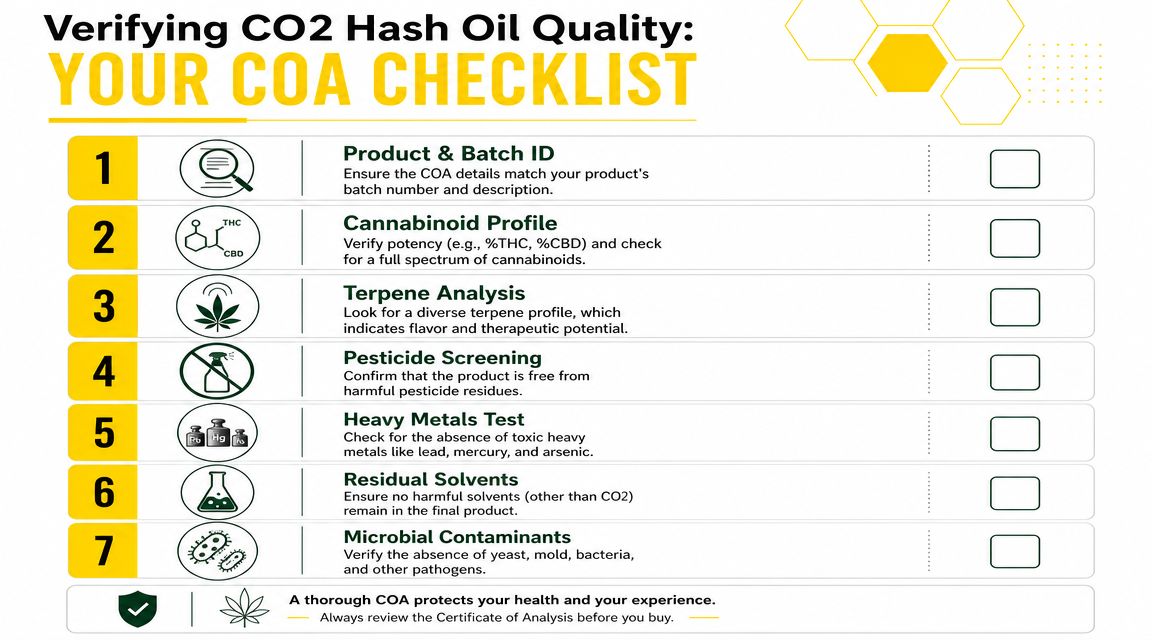
The safest habit a patient can build is asking to see the Certificate of Analysis, or COA. That lab report tells you whether the finished product matches the label and whether it passed key safety checks.
Why the COA matters more than the label alone
Independent reviews of medicinal cannabis processing emphasize that the extraction method alone does not guarantee quality. Downstream refining such as winterization, filtration, and analytical testing determine whether unwanted compounds are removed and whether cannabinoids and terpenes are preserved. Those reviews note that the final lab test is more critical for patient safety than the extraction label itself, as discussed in this review of medicinal cannabis processing and quality testing.
That means a CO2 cart can still be mediocre if the post-processing was sloppy. It also means a good shopper shouldn't stop at the phrase “CO2.”
What to check on a COA
When you look at a COA, scan for these points:
- Product match: The batch number and product name should match what's in your hand.
- Cannabinoid profile: Check THC, CBD, and any other listed cannabinoids so the potency aligns with your needs.
- Terpene profile: If flavor and strain character matter to you, this section is worth reading.
- Residual solvents: You want confirmation that the final product passed this screen.
- Pesticides and contaminants: Look for passes on pesticide, microbial, and heavy metal testing where applicable.
Ask the direct question at the counter: “Can I see the COA for this batch?” A good answer should be easy to provide.
Reading the result like a patient, not a chemist
You don't need to memorize lab terminology. Use the report to answer three practical questions:
- Is this the same product I'm buying
- Does the potency look right for my tolerance
- Did it pass the safety screens I care about
If you're trying to understand why some oils are marketed as broad or whole-plant style options, this explainer on full-spectrum cannabis adds helpful context for reading the terpene and cannabinoid sections.
Your CO2 Hash Oil Questions Answered
Is CO2 oil automatically safer than BHO
Not automatically. CO2 extraction has process advantages, but the finished product still depends on refinement and lab testing. For a patient, the smart move is to judge the actual tested product, not just the extraction label.
Why do some CO2 cartridges look darker than others
Color can change for several reasons, including the starting material, how much of the native plant compounds remain, and the way the oil was refined after extraction. A darker oil isn't automatically bad, and a lighter oil isn't automatically better. The COA and the product's intended profile tell you more than color alone.
Can CO2 oil really be full-spectrum
Yes, it can, if the extractor uses fractionation to separate and then recombine terpene-rich and cannabinoid-rich portions into a broader profile. But not every CO2 oil is full-spectrum just because it was made with CO2. You still need to read the product description and, ideally, the lab report.
If you're still deciding between hardware styles for everyday use, this guide on vape pens vs. carts can help narrow things down.
If you're shopping for concentrates, carts, or other medical cannabis formats in DC, Mr. Nice Guys DC offers a place to compare options, ask for lab information, and choose a product format that fits your routine. If you're unsure where to start, asking about extraction type, terpene profile, and the COA is a solid first conversation.
Mr Nice Guys DC
At Mr. Nice Guys DC, we’re more than just a cannabis delivery service — we’re passionate advocates for quality, convenience, and community. With years of experience in the cannabis industry, our team is dedicated to educating and empowering customers across Washington, D.C. Whether you're a seasoned user or just starting your cannabis journey, our blog delivers trusted tips, product insights, and the latest updates from the world of weed. Stay informed, stay elevated.
