
Must Be 21 To Enter
By entering this site you are agreeing that you are at least 21 Years of Age or older.
I AM 21 OR OLDERCannabis Concentrates for Sale: A Smart Buyer's Guide


You're scrolling through cannabis concentrates for sale, comparing a tiny jar of wax with a cartridge and a glossy-looking slab of shatter. The THC numbers are high, the names don't explain much, and you're trying to work out what you can use without buying the wrong gear or overdoing it.
Start with the dose you want, not the strongest label you can find. Then check the batch testing, match the product to your equipment, and confirm how you can legally buy it. That approach makes a crowded concentrate menu much easier to handle.
What Counts as a Concentrate and Who It Makes Sense For
A small jar beside a larger bag of flower can look like poor value until you understand what you're comparing. Concentrates contain extracted cannabis compounds in a smaller physical quantity. You're not buying the same material in different packaging.
Published research commonly places concentrates around 52–69% THC, with some products reaching 90–95% THC, which makes label literacy particularly important when switching from flower (review of cannabis concentrate potency and testing). Don't compare the products by package size alone.
Use this visual to orient yourself before choosing a format.

Learn the menu language first
A dab is a portion of concentrate used with compatible vaporizing equipment, not a standardized dose. Terpenes are aromatic compounds that help distinguish a product's smell and flavor. Rosin describes a concentrate produced through mechanical separation involving heat and pressure rather than chemical extraction solvents.
Those distinctions matter at checkout. A jar of rosin won't fit into a cartridge battery, and a cartridge isn't automatically compatible with every pen. Ask staff to match the exact product to the device you own.
- Experienced consumers: Concentrates can suit buyers who already understand their response to inhaled cannabis and want a compact format.
- Medical patients: Consider them when the format fits your clinician's treatment guidance, not because higher THC sounds more therapeutic.
- Curious newcomers: You can compare formats without committing to a high-potency jar. Ask about lower-THC alternatives and clearer portion guidance.
Compare the whole purchase
Flower and concentrates can involve different equipment, handling, and consumption routes. Don't assume a familiar-looking oil is meant to be swallowed, or that every concentrate has the same onset.
For example, a discounted wax jar isn't much of a bargain if you also need equipment you don't want to maintain. Compare usable sessions, compatible hardware, and handling confidence, not just price per gram.
Main Concentrate Types and How They Actually Feel Different
Texture changes handling. Extraction changes what you're buying. Neither guarantees a particular effect. A creamy concentrate might be easier to portion than brittle shatter, but that doesn't make it weaker or more suitable for a beginner.
Concentrates have been a substantial retail category for years. BDS Analytics tracked sales rising from approximately $20 million in Q1 2014 to $80 million by Q3 2016, while their share of tracked legal sales increased from 13% to 22% (BDS Analytics historical legal-market summary). The practical consequence for shoppers is choice, and plenty of terminology to sort through.
Quick Format Comparison
“Typical THC” below is deliberately qualitative. A format name isn't a substitute for the batch label.
| Format | Typical THC | Terpene Preservation | Hardware Needed | Dose Control |
|---|---|---|---|---|
| Shatter | Batch-dependent, often THC-dominant | Depends on processing | Compatible concentrate device | Brittle pieces can be awkward to portion |
| Wax | Batch-dependent | Varies by extraction | Concentrate pen or rig | Soft texture can simplify handling |
| Crumble | Batch-dependent | Varies | Compatible concentrate chamber | Loose crumbs require careful loading |
| Live resin | Check the batch result | Often chosen for retained aroma | Rig, concentrate pen, or compatible cartridge device | Depends on presentation |
| Rosin | Check the batch result | Often chosen for plant-forward flavor | Compatible rig or concentrate pen | Texture affects portioning |
| Distillate | Commonly THC-dominant | Refinement can reduce the original profile | Product-specific cartridge or device | Convenient delivery isn't a measured dose |
| Diamonds and sauce | Check components and combined label | Sauce contributes aromatic compounds | Compatible concentrate equipment | Separating crystals and sauce complicates consistency |
Choose for your hands and your setup
For a first jar, I'd favor a manageable wax or badder texture over a product you struggle to break apart or scoop. That's a handling recommendation, not a promise of gentler effects. Diamonds and sauce are a less forgiving starting point when you're still learning to keep portions consistent.
A flavor-focused buyer might choose rosin after comparing its batch profile with a distillate option. Someone prioritizing convenience might choose a compatible distillate cartridge, while recognizing that inhalation length still affects consumption.
The live resin versus distillate comparison can help narrow that choice. On a rotating menu, ask for the available batch and product form, rather than assuming every extraction type is always in stock.
Why Highest THC Is Not Always the Smartest Buy
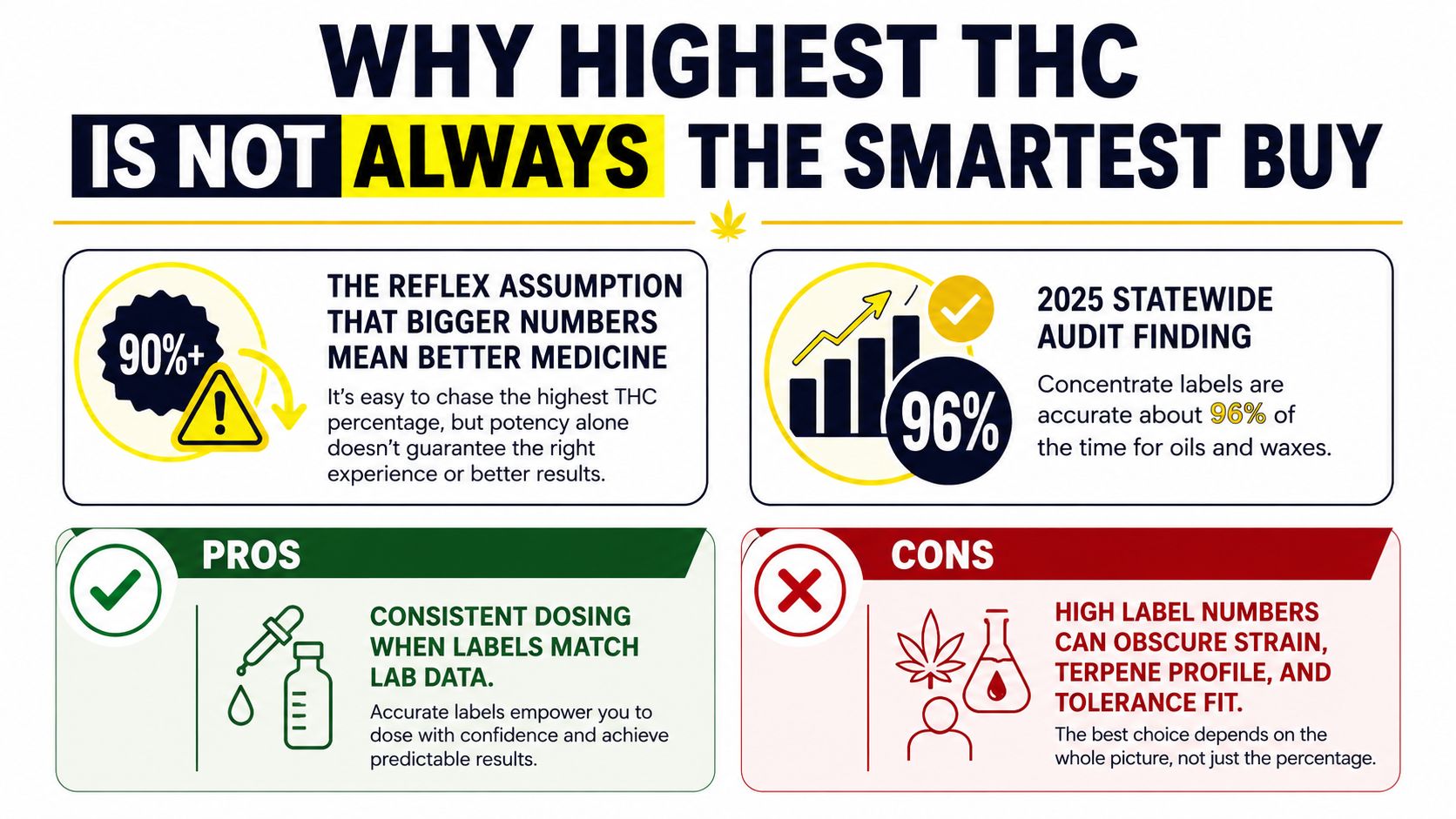
An accurate potency label can still describe the wrong product for you. A 2025 statewide audit found that 96% of concentrate oils and waxes matched their labeled THC, while flower showed greater variability (concentrate and flower label-accuracy audit). That supports taking concentrate labels seriously, not treating the highest number as a recommendation.
A product labeled 90% THC doesn't become better medicine because the number is accurate. Your tolerance, intended use, and ability to control consumption still matter. A strong product that you repeatedly overuse is a poor fit, even if the laboratory measured it correctly.
This distinction is the useful part of the potency comparison.
Compare suitability, not bragging rights
Consider an illustrative choice between a 1-gram jar labeled 70% THC and a 0.5-gram jar labeled 55% THC. These are shopping examples, not current inventory claims. The larger, stronger jar gives you more material to manage, but neither package tells you what a suitable inhalation looks like.
Don't confuse buying more THC with getting more useful sessions. If the stronger product makes it harder to stay within your intended experience, its apparent value disappears.
Buying principle: Choose the product you can use consistently at your intended dose, not the number you can brag about.
The smaller jar isn't automatically the winner either. It still needs suitable hardware, understandable directions, and verified testing. The point is to make those questions part of the comparison before price or potency settles the decision.
For flavor preferences, use a guide to cannabis terpenes to develop better questions. Don't turn terpene names into guaranteed promises about symptom relief or mood.
A useful counter conversation sounds like this: “I want a manageable inhaled option, I'm sensitive to strong THC, and I'd rather control the experience than maximize potency.” That gives staff something actionable to work with.
Reading a Certificate of Analysis Like a Budtender
A certificate of analysis, or COA, should tell you what was tested and which batch the results describe. A polished package, strong aroma, or “clean” marketing claim can't do that job.
Use the checklist below while looking at the actual package and laboratory document.

Match identity before reading results
Start with the product name, manufacturer, and package batch or lot identifier. Match those details to the report. Then check the testing date and whether you're viewing a complete document rather than a cropped potency screenshot.
- Cannabinoids: Compare the reported THC, THCA, CBD, and other measured cannabinoids with the package's labeling conventions.
- Residual solvents: Look for applicable processing-solvent results, not a vague claim that the oil was purified.
- Pesticides and heavy metals: Confirm the relevant panels and their reported status.
- Mycotoxins and moisture: Check the applicable fungal-toxin, moisture, or water-activity results rather than assuming they're included.
As a concrete regulatory example, Mississippi requires production batches of concentrates and extracts to be tested in final sale form for pesticides, water activity and moisture, THC and CBD, heavy metals, and mycotoxins. Its rule also addresses residual-solvent reporting and process-specific exceptions (Mississippi concentrate testing requirements). That's an example of testing scope, not a statement of DC requirements.
For additional viewing alongside the package check:
Don't mistake extraction language for safety evidence
Solventless doesn't mean contaminant-free. It describes the extraction process, not a substitute for relevant contaminant testing. Similarly, a high terpene figure doesn't establish that a product passed its safety panels.
For example, if a rosin package and its COA carry different lot identifiers, pause the purchase. Ask staff to produce the matching report rather than accepting “it's the same strain.”
My shopping preference is a report dated within the last year, but that's a screening preference, not a universal legal expiration rule. The stronger signal is an exact batch match, understandable results, and compliance with applicable testing requirements. This cannabis potency testing explainer provides additional context for interpreting the numbers.
Dosing and Tolerance for First-Time and Medical Buyers
Suppose you're a new patient comparing an oil cartridge with a jar of concentrate. You want something manageable, but you haven't used either format before. The sensible first order starts with that uncertainty, not with choosing the strongest available product.
Washington's regulated-market report found average reported THC concentrations of 61.7% for its broad concentrate category, compared with 20.9% for usable cannabis, including flower and non-infused pre-rolls (Washington cannabis market and potency report). That comparison is a reason to reconsider familiar flower habits before using a concentrate.
Keep your product information and session notes together.

Build a repeatable first-session plan
A 1-gram concentrate labeled 70% THC contains approximately 700 milligrams of THC by weight, but that isn't the amount automatically absorbed during use. Concentration, route, amount consumed, frequency, individual characteristics, and self-titration all affect exposure (peer-reviewed review of THC concentration versus dose).
For that hypothetical jar, don't invent a precise inhaled dose from an eyeballed scoop. Ask whether another product offers clearer portion guidance or a lower-THC, CBD-leaning profile.
- Before use: Confirm that the device and product are compatible, and read the instructions together.
- During the session: Use the smallest practical inhalation recommended by the product guidance. Set a timer for the waiting interval your clinician or instructions specify, rather than immediately repeating.
- Afterward: Record the product, device setting, amount or inhalation pattern, intended benefit, and unwanted effects.
Your first session should help you learn what to repeat, not test how much you can tolerate.
For a repeat purchase, bring those notes back. Ask for comparable potency, format, and handling characteristics rather than assuming the same strain name guarantees the same experience.
Medical patients should involve their clinician when changing treatment, managing persistent symptoms, or considering medication interactions. Budtender guidance can clarify a product and its equipment. It shouldn't replace individualized medical advice or promise a symptom outcome.
Pickup, Curbside, and Delivery Options Around Washington DC
Choose in-store pickup if you still have unanswered product questions. Being able to compare packaging, discuss equipment, and request a batch report is worth more than saving a little time on an uncertain purchase.
Curbside and delivery suit different needs, but neither removes the eligibility or documentation checks. The right channel is the one that lets you receive the correct product through a confirmed, compliant transaction.
| Purchase channel | Useful for | Confirm before ordering |
|---|---|---|
| In-store pickup | First-time buyers and equipment questions | Availability, documentation, and pickup instructions |
| Curbside | Patients with tight schedules or access needs | Service availability and handoff procedure |
| Delivery | Eligible shoppers who prefer not to travel | Exact address coverage, recipient requirements, and timing |
Confirm the order before leaving home
The publisher describes delivery powered by Sweede, with service information naming DC and nearby areas such as Alexandria, Bethesda, Rockville, and Silver Spring. Treat those names as reasons to check an address, not as blanket permission for interstate cannabis delivery. A platform listing doesn't establish that every transaction or destination is lawful.
For an apartment delivery, ask how the recipient handoff works. For a visitor, confirm eligibility before choosing a window. The curbside pickup and delivery guide is a starting point for operational questions, not a substitute for current confirmation.
Browse the live menu, identify a suitable format, verify ID requirements, confirm payment, and request the available fulfillment window. Ask staff to hold substitutions until you approve them.
Package rules also vary by jurisdiction. Washington limits a single concentrate unit to no more than 1 gram, but that isn't a DC purchasing limit (Washington concentrate packaging rule). Read the listed net weight and verify the rules governing your actual purchase rather than importing another market's limits.
DC Eligibility, Payment, and Neighborhood Coverage
Don't assume adulthood alone establishes eligibility for every cannabis transaction. Being 21 or older isn't a substitute for confirming the requirements of a particular medical program or retailer. DC shoppers and visitors should establish the lawful purchase pathway before paying.
The publisher describes service for patients 21+, medical-certification support, and cash and debit payments. Confirm those details when ordering, including whether certification must be completed beforehand and whether your chosen payment method works for the selected fulfillment channel.
Verify the details that can stop a handoff
- Eligibility and identification: Ask which current documents the retailer accepts and whether medical registration is required.
- Program allowances: Verify your applicable purchase and possession limits. Don't assume medical status automatically permits every product or quantity.
- Payment: Confirm cash or debit availability, any applicable fees, and the final amount before dispatch.
- Recipient arrangements: Make sure the eligible buyer can receive the order under the retailer's procedure.
The medical versus recreational DC shopping guide can help frame that conversation. Ask direct questions instead of relying on “adult-use” language in an advertisement.
Check your exact address
For Georgetown, Shaw, Cleveland Park, and the Howard University area, confirm neighborhood coverage and the actual delivery address. Shoppers in Arlington, McLean, Tysons Corner, and Great Falls should specifically verify whether any lawful service is available, rather than treating proximity to DC as authorization.
Regulatory details deserve the same care as delivery details. For comparison, New York requires five potency samples per concentrate batch, with a general 25% deviation allowance from the lot mean for THC and CBD amounts per dose at or above 2 milligrams (New York cannabis testing limits). Those are New York requirements, not proof that a DC product follows the same protocol.
Putting It Together and Red Flags to Walk Away From
Good concentrate shopping is a learnable skill. You don't need to memorize extraction terminology, but you do need enough information to explain why a particular product belongs in your order.
Keep this short checklist on your phone:
- Product fit: Choose a format you can handle with equipment you own.
- Dose suitability: Favor controllable use over the largest THC figure.
- Batch verification: Match the package to complete, relevant laboratory results.
- Purchase readiness: Confirm eligibility, payment, fulfillment, and address coverage.
Know when to leave it on the shelf
Pause for missing or mismatched lot numbers, vague potency claims, unavailable contaminant panels, or staff who can't explain the product. Be equally skeptical when someone uses “solventless” as the entire safety argument.
A suspiciously low price warrants questions about the product's identity, age, and documentation. It doesn't prove a problem by itself. For example, a discounted wax jar with traceable paperwork deserves a different assessment from an unlabeled jar sold on verbal assurances.
A useful recommendation explains both why a product fits and what its trade-offs are.
Make a modest, informed first purchase. Bring your observations back, adjust deliberately, and don't let a rotating menu pressure you into an unsuitable substitute.
Mr. Nice Guys DC offers concentrates, cartridges, and other cannabis formats, along with product guidance and medical-certification support. Visit Mr. Nice Guys DC to check the current menu, request batch-specific testing information, and confirm a compliant pickup or delivery option before ordering.
Mr Nice Guys DC
At Mr. Nice Guys DC, we’re more than just a cannabis delivery service — we’re passionate advocates for quality, convenience, and community. With years of experience in the cannabis industry, our team is dedicated to educating and empowering customers across Washington, D.C. Whether you're a seasoned user or just starting your cannabis journey, our blog delivers trusted tips, product insights, and the latest updates from the world of weed. Stay informed, stay elevated.
