
Must Be 21 To Enter
By entering this site you are agreeing that you are at least 21 Years of Age or older.
I AM 21 OR OLDERLive Rosin vs Live Resin: A 2026 Buying Guide


You're at the dispensary counter looking at two Wedding Cake concentrates. Both say live, both list similar THC percentages, but the live rosin costs more than the live resin. You want to know whether that difference buys better flavor, fewer contaminants, or just a different extraction process.
The useful comparison isn't premium versus ordinary. It's how the product was made, what the batch lab results show, and how much you'll consume.
Live Rosin and Live Resin Side by Side
Live means the cannabis was frozen soon after harvest instead of being dried and cured first. It doesn't guarantee higher potency, better medical results, or superior safety, as the Phytogrammes technical overview explains. The extraction method is what separates live rosin from live resin.
Live rosin vs live resin buying criteria
| Criterion | Live rosin | Live resin |
|---|---|---|
| Starting material | Fresh-frozen cannabis | Fresh-frozen cannabis |
| What live guarantees | Frozen handling, not higher potency | Frozen handling, not higher potency |
| Extraction | Ice-water bubble hash pressed with heat and pressure | Closed-loop butane, propane, or a blend, then purge |
| Added solvent | None | Hydrocarbon solvent that is recovered and vacuum-purged |
| Common formats | Badder, jam, sauce, or a rosin cartridge | Sauce, batter, shatter, diamonds, or a resin cartridge |
| Lab panel to prioritize | Cannabinoids, terpenes, pesticides, heavy metals, microbes | Those tests plus residual solvents |
| Flavor expectation | Flower compounds retained but ratios shifted by the press | Flower compounds retained but ratios shifted by the solvent run |
| Effects at a matched THC dose | No controlled proof of a stronger effect | No controlled proof of a stronger effect |
| Price posture | Premium because yields are lower | Often more product options and a lower shelf price |
What the Wedding Cake labels tell you
The Wedding Cake live resin was extracted using a hydrocarbon such as butane or propane, then purged. The Wedding Cake live rosin came from ice-water bubble hash that was pressed using heat and pressure.
Those descriptions tell you the production route. They don't tell you which jar you'll prefer, whether the batches have comparable terpene profiles, or whether either has complete contaminant testing.
Start with the extraction row, then move to the laboratory row. A solvent-extracted product needs residual-solvent results in addition to the contaminant checks you'd want for either concentrate.
Counter rule: Treat live as a description of plant handling, not a grade of quality.
What the labels can't settle
If both products deliver the same milligrams of THC, available evidence doesn't establish a controlled, head-to-head difference in subjective effects. That's not proof they'll feel identical to every person. It means a universal claim that rosin always hits harder isn't established clinical fact.
The same caution applies to claims that either format always tastes better. Cultivar, handling, processing, and the finished chemical profile matter more than a category slogan.
Don't confuse this decision with choosing between live resin and distillate, either. Our live resin versus distillate guide addresses that separate comparison. For these Wedding Cake jars, the useful columns are extraction, lab panel, flavor expectation, and price posture.
How Each Concentrate Is Actually Made
Start with one fresh-frozen lot of Wedding Cake. The producer can send it down either extraction path, but both begin before drying and curing.
Drying can reduce or alter volatile terpenes, while freezing keeps more of the original aromatic compounds available for extraction, as Jetty's explanation of live extraction describes. Freezing preserves the starting opportunity; the later processing determines what reaches the jar.
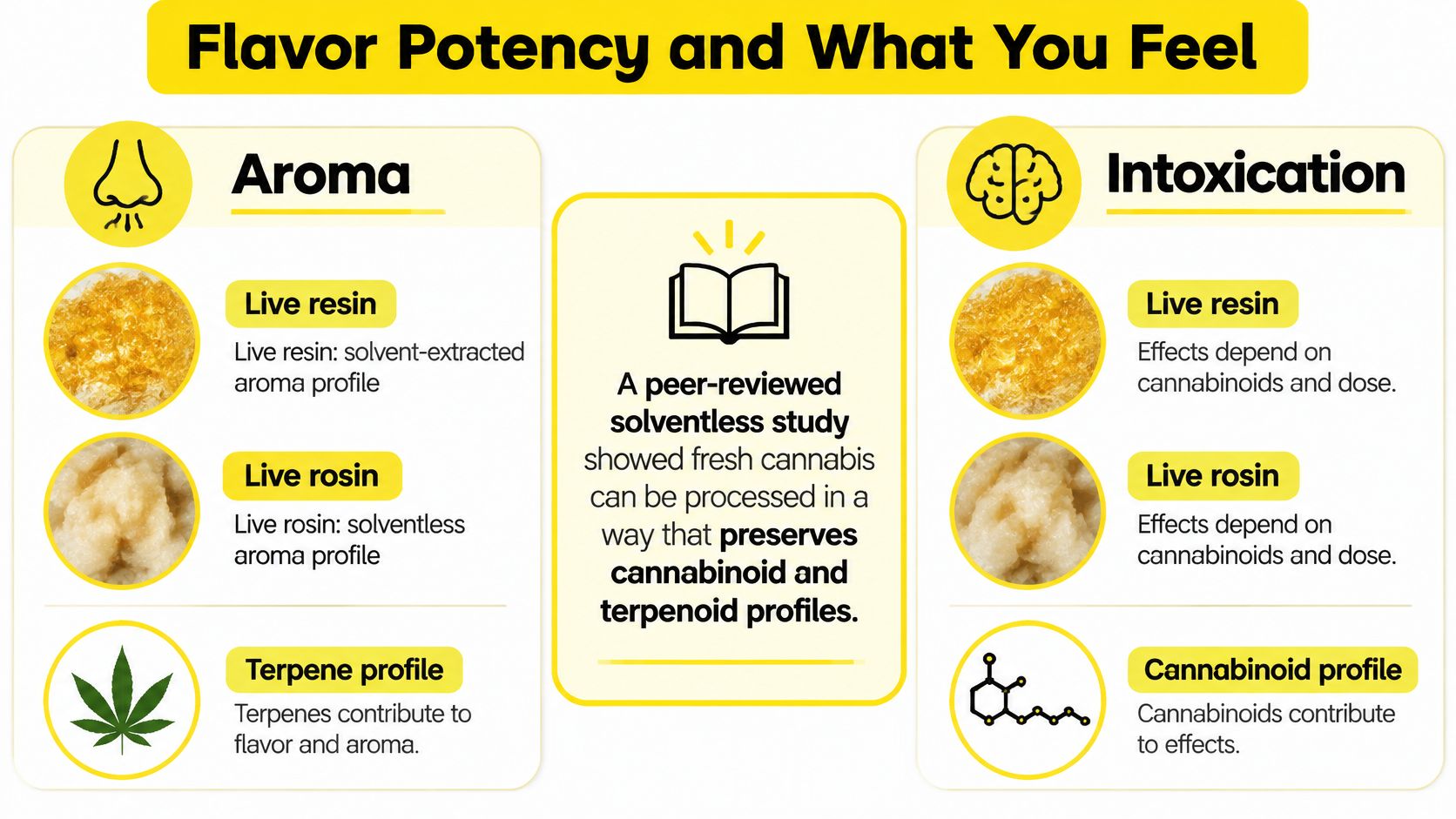
The comparison below separates the aroma profile from the cannabinoids responsible for intoxication.
The live resin route
The producer places frozen flower in a sealed extraction column. Chilled liquefied butane, propane, or a blend passes through the material and dissolves target compounds.
The resulting solution is filtered. The processor recovers the solvent, then vacuum-purges the extract to remove residual hydrocarbons.
Temperature settings matter beyond the THC number. An industry-funded n-butane study summarized by Alternative Pharm Press examined runs from approximately −46 °C to −9 °C and found that wax-derived long-chain alkanes increased as extraction temperature rose, while cannabinoid and aroma levels remained relatively stable. Colder runs reduced wax content by up to about threefold, but the work covered only two cultivars, so it isn't a universal production rule.
The live rosin route
The rosin producer takes a different sequence, described in JARS' live rosin process guide:
- Separate the trichomes. Agitate the frozen flower in ice water so resin-filled trichome heads detach.
- Collect the hash. Pass the mixture through progressively finer mesh bags.
- Dry the bubble hash. Remove moisture before pressing.
- Press the hash. Apply controlled heat and pressure between heated plates to produce rosin.
For the Wedding Cake lot, resin extraction proceeds directly from frozen flower before purging. Rosin requires water separation, filtration, drying, and pressing before there's a finished dab.
Solventless doesn't mean unprocessed. Press temperature and time can change texture and terpene retention, although systematic peer-reviewed measurements of those rosin variables remain limited.
This video offers another way to follow the extraction comparison.
A jar's consistency won't reveal every production choice. Purge quality is hidden in resin; hash dryness and press settings are hidden in rosin. Our guide to types of cannabis concentrates helps distinguish extraction names from texture names such as wax and shatter.
Flavor Potency and What You Feel
Aroma and intoxication are separate questions. A concentrate can have a vivid fragrance without delivering a larger THC dose, and a higher THC percentage doesn't tell you whether you'll enjoy its flavor.
Processing also changes the aroma profile rather than preserving a perfect chemical copy of the flower. In one comparison from Abstrax's investigation of cannabis aroma profiles, D-limonene showed approximately a 6% relative increase in rosin and a 13% relative increase in live resin versus the source flower; the rosin sample also showed roughly 2% relative decreases in beta-caryophyllene and beta-myrcene.
How processing shifted aroma versus the source flower
| Compound | Live rosin vs flower | Live resin vs flower | How to use it |
|---|---|---|---|
| D-limonene | About 6% relative increase | About 13% relative increase | Compare the batch COA, not the format name |
| Beta-caryophyllene | About 2% relative decrease | Not reported as the same decrease | Check the individual percent on each COA |
| Beta-myrcene | About 2% relative decrease | Not reported as the same decrease | A lower myrcrcene note can change the earthy side of flavor |
| Compounds from the flower | Retained, often altered or reduced | Retained, often altered or reduced | Neither is a perfect chemical copy of the flower |
These are relative changes in a particular comparison, not percentage-point changes to a retail label and not predictions for every cultivar.
Compare the aroma you actually want
Say you're choosing between Gelato live rosin and Gelato live resin. Both might suggest dessert and gas, yet one could emphasize citrus while the other has a more pronounced earthy or peppery character.
Read the certificate of analysis, usually shortened to COA. Compare total terpene percentage, then check the individual amounts of limonene, myrcene, pinene, and beta-caryophyllene.
A higher total terpene percentage is a useful clue about aromatic intensity, not a promise of better taste. The balance of compounds matters, and your preferred flavor may come from the lower-total batch. Our cannabis terpenes guide can help you interpret those names without treating them as guaranteed medical effects.
Keep potency separate from preference
A peer-reviewed solventless-extraction study demonstrated that fresh cannabis can be processed while preserving cannabinoid and terpenoid profiles, and cited earlier high-tech sieving results around 50–55% THC in concentrated material. That range illustrates concentration, not the potency you should expect on either jar in front of you.
For medical use, read the tested cannabinoids and consider the amount consumed, cultivar, and your individual response. Don't turn a laboratory percentage into a promise of symptom relief.
A strong aroma isn't a measured dose, and a measured dose isn't a guarantee of a particular experience.
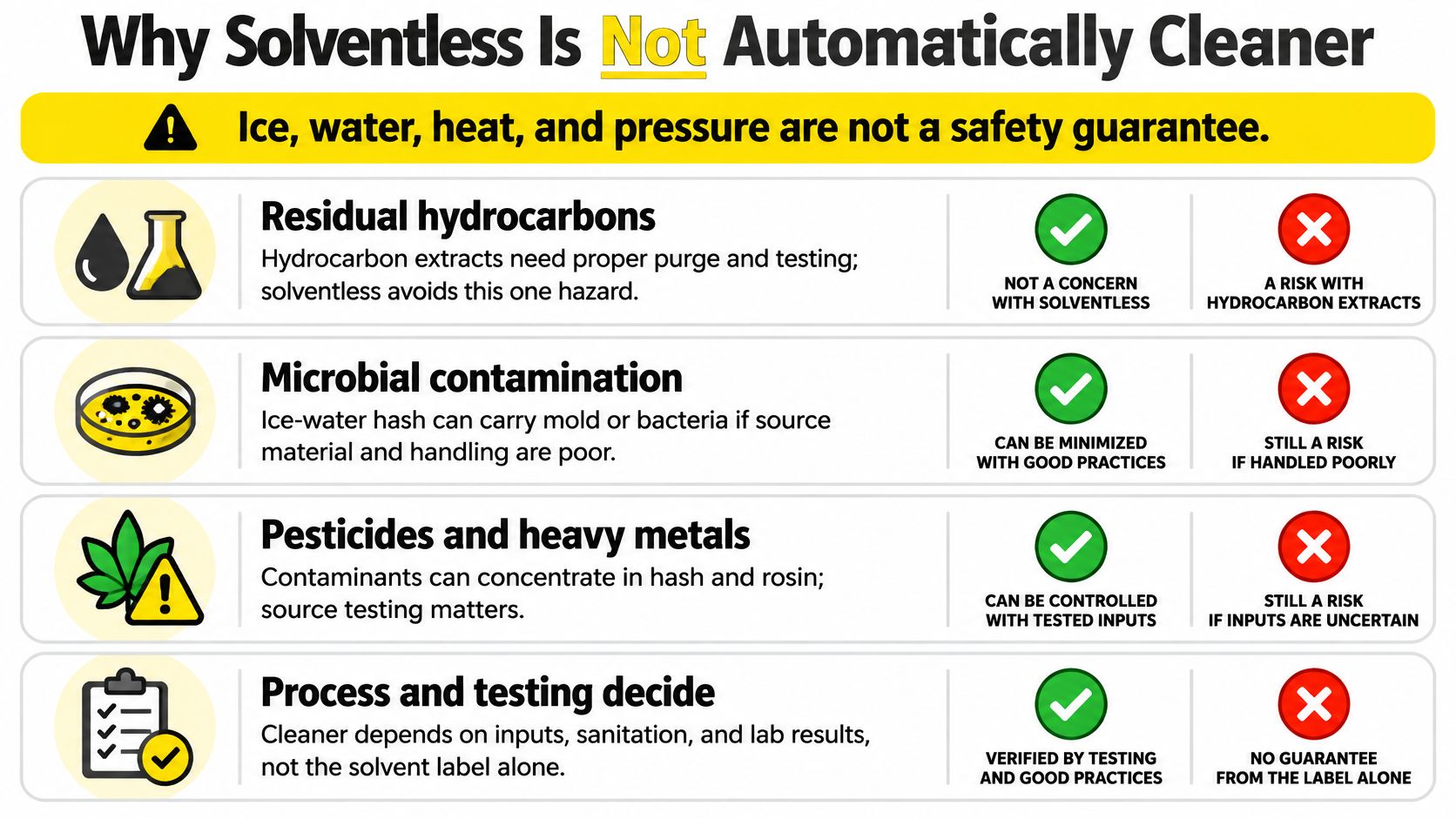
Flavor preference also doesn't establish cleanliness. This checklist separates those questions.
A higher THC percentage only increases the THC dose when the amount consumed delivers more milligrams. Without knowing dab size or cartridge delivery, percentage alone can't tell you how much you inhaled.
Why Solventless Is Not Automatically Cleaner
Ice, water, heat, and pressure aren't a safety guarantee. They avoid adding hydrocarbon extraction solvents, but they don't answer what contaminants entered with the cannabis or during handling.
A National Institute on Drug Abuse fact sheet cites a study in which 80% of tested cannabis-concentrate samples had some contamination, including pesticides and incompletely purged solvents. That finding concerns the tested samples, not a current contamination rate for every dispensary or concentrate category.
Read the actual laboratory lines
For live resin, check residual-solvent results and ask whether the production process included a completed purge. Don't accept a THC-only result as evidence that residual hydrocarbons were tested.
For live rosin, examine the contaminant panel rather than treating solventless as a substitute for it. Input quality, moisture management, and handling still matter.
- Pesticides: Confirm the batch was screened, regardless of extraction method.
- Heavy metals: Look for a separate result rather than assuming potency testing includes it.
- Microbes: Check that microbial testing appears on the panel.
- Batch identity: Match the lot or batch identifier on the COA to the package.
- Result coverage: A missing test isn't the same as a passing test.
Choosing an untested rosin gram over a tested resin cartridge doesn't buy cleanliness. A properly manufactured live resin that passes applicable residual-solvent and contaminant testing isn't unsafe merely because a hydrocarbon was used.
At our dispensary, every product is tested for pesticides, potency, and more. Our product testing standards guide helps explain why the individual test categories matter.
Consider the device and formulation
Extraction isn't the only variable affecting what you inhale. Concentrate-vaping emissions can include toxicants such as isoprene and reactive hydrocarbons, while hazardous additives in some formulations create additional concerns.
Check the ingredient information for added terpenes, thickeners, or other additives. Avoid unverified formulations, and don't assume a hotter device provides a better experience.
Practical check: Review residual solvents when a solvent was used, a full contaminant panel either way, and the device's temperature setting.
Use a lower setting within the hardware manufacturer's recommended range, rather than overheating the concentrate. That doesn't make inhalation risk-free, but it avoids treating extraction style as the only relevant safety choice.
Price is separate from all of these checks. The factors below explain why a mechanically produced concentrate can cost more without proving it's cleaner.

What the Price Premium Is Paying For
Rosin's premium positioning has a commercial history. BDSA's concentrate market analysis reported rosin at 14% of dabbable dollar sales in January 2023, double its January 2021 share, alongside the regional shares and earlier live-resin growth figures below.
How rosin and live resin grew in sales
| Measure | Figure | Where and when |
|---|---|---|
| Rosin share of dabbable dollar sales | 14% | Major US markets, January 2023 |
| Change in that rosin share | Doubled | January 2021 to January 2023 |
| Rosin share of dabbable sales | 21% | California |
| Rosin share of dabbable sales | 22% | Colorado |
| Live-resin product sales growth | 67% | Colorado, Washington, and Oregon, 2017 |
| Vaporizer sales growth | 93% | Colorado, Washington, and Oregon, 2017 |
BDSA also described nearly a doubling between late 2020 and late 2022 in the proportion of Colorado inhalable cannabis consumers reporting rosin use during the previous six months. These are purchasing and use trends, not measures of medical superiority.
Separate production cost from medical value
Live resin benefited earlier from scalable hydrocarbon extraction and vape manufacturing. Rosin later gained share as buyers placed more value on solventless processing.
Rosin generally costs more because producers must recover suitable ice-water hash, dry it, and press it, leaving material behind along the way. Lower recovery and additional handling increase the cost of the finished product.
A familiar premium-product analogy can help separate a higher price from a better fit. The illustration below is an analogy, not a cannabis price quote.

Say an OG Kush live rosin jar sits above an equal-weight live resin sauce on the menu, despite similar THC percentages. The extra money buys the production route, limited recovery, and premium positioning, not a proven stronger medical effect.
If the resin has the terpene profile you want and complete passing tests, the less expensive jar can be the rational purchase. If avoiding added extraction solvents is a firm preference, paying more for tested rosin may make sense.
Compare the same weight, not just the package price. There's no universal dollar gap, and a smaller package can hide a higher price per gram.
Which Format Fits the Session and How to Buy It
Choose the session before choosing the concentrate. A flavor-focused dab at home, a budget cartridge, and a measured medical routine don't require the same purchase.
Use this table as a starting preference, then let the actual batch overturn it.
Which format fits the session
| Situation | Lean toward | Flip it when |
|---|---|---|
| Low-temp flavor dab at home | Live rosin with the higher terpene percent | The resin COA shows more total terpenes |
| Daily cartridge on a budget | Tested live resin | The rosin cart is similarly priced and fully tested |
| Avoiding hydrocarbon residue | Live rosin | The rosin has no contaminant panel and the resin passes residual solvents |
| Measured medical dose | Either, counted in milligrams | One batch's labeled cannabinoids do not match the COA |
| Discreet carry or travel | A tested cartridge of either type | The cart lists unverified additives or runs very hot |
Match the product to the moment
For a low-temperature flavor dab, Wedding Cake rosin may be a good choice when that batch has the terpene profile you prefer and the producer handled the hash carefully. That's a batch-specific reason to choose it, not proof that rosin always tastes better.
For a daily budget cartridge, tested live resin often makes sense. Compare it against the available rosin cartridge using package weight, compatible hardware, and complete results rather than the shelf price alone.
If avoiding hydrocarbon residue is your priority, rosin removes that extraction-related concern. But if the only rosin has no contaminant panel and the resin has complete passing results, don't substitute a process preference for verification.
For a measured medical inhale, either format can work, but percentage isn't enough. In a hypothetical comparison between a 70% cartridge and an 80% concentrate, you still need the amount delivered per puff or the size of the dab to compare THC exposure. A cartridge puff isn't automatically a standardized milligram dose.
For discreet carry, a tested cartridge is more practical than an open dab setup. Discretion doesn't establish permission to travel with cannabis, so check the rules for your route and destination before carrying it.
Blue Dream illustrates why the cultivar name can't make the whole decision. You might encounter it as flower, a disposable, or a concentrate; the session and delivery method still decide the fit.
Make the counter decision in order
- Choose the session before THC. Decide whether you want a home dab, a portable cartridge, a budget option, or a solventless product.
- Read the format words. Confirm that live resin means a purged solvent extract and live rosin means pressed hash. Don't infer either from a sauce-like texture.
- Match the batch COA. Review cannabinoids, terpenes, pesticides, heavy metals, microbes, and residual solvents when applicable. Resolve any label mismatch before buying.
- Compare price per gram. Do this after the laboratory and formulation checks pass, not instead of them.
- Confirm the hardware. Identify whether you're buying a 510 cartridge, disposable, or rechargeable device. Our vape pen guide for concentrates helps with compatibility; begin with a low supported setting.
- Plan storage. Keep the concentrate cool and sealed, follow its storage directions, and retain access to the batch result.
Our Rockville product selection includes concentrates, including shatter, wax, and oils. All our products are hand-selected to ensure potency, quality, and safety, but that selection process doesn't replace your batch-level comparison.
The clearest purchase is often a single jar or cartridge with a reason attached: preferred flavor, verified testing, compatible hardware, and a price you accept. If the rosin lacks terpene information while the resin has a full panel and the profile you want, choose the better-documented product.
Mr. Nice Guys DC offers concentrates, vape cartridges, and pens, with educational guidance to help you compare formats for your needs. Visit Mr. Nice Guys DC to review the current selection and narrow your live rosin versus live resin choice by session, lab results, and budget.
Mr Nice Guys DC
At Mr. Nice Guys DC, we’re more than just a cannabis delivery service — we’re passionate advocates for quality, convenience, and community. With years of experience in the cannabis industry, our team is dedicated to educating and empowering customers across Washington, D.C. Whether you're a seasoned user or just starting your cannabis journey, our blog delivers trusted tips, product insights, and the latest updates from the world of weed. Stay informed, stay elevated.
