
Must Be 21 To Enter
By entering this site you are agreeing that you are at least 21 Years of Age or older.
I AM 21 OR OLDERBest Vape Pen for Concentrates in DC
.svg)

.png)
You're standing in a DC shop, maybe scrolling the menu on your phone, and the cart wall all looks the same. One pen promises bigger clouds, another says “live resin,” another is tiny enough to disappear in a pocket, and none of that tells you which one is worth buying. The right choice isn't the loudest device, it's the one that matches the concentrate, the hardware, and the heat control you can repeat without guessing.
| Pen type | What it does well | Main trade-off | Best for |
|---|---|---|---|
| 510-thread battery + cartridge | Flexible, easy to swap, familiar | Battery quality and cart quality are separate purchases | Patients who already know the oil style they like |
| All-in-one disposable pen | Simple, sealed, low maintenance | Less control, and cheaper ones die early | Convenience-first users |
| Portable dab-rig-style device | Stronger hits, better chamber control, sometimes water filtration | More cleaning and a steeper learning curve | Concentrate users who care about chamber performance |
What "Best Vape Pen for Concentrates" Actually Means
A lot of shoppers ask for the best vape pen for concentrates and really mean, "Which one hits hardest?" That's the wrong question. The better question is, "Which pen gives me a regulated concentrate, batch-tested hardware, and a heat profile I can repeat?"
The first screen is simple. Ask who made the concentrate, what the certificate of analysis covers, and whether the device itself adds avoidable risk. That matters because product provenance and formulation matter more than marketing claims about potency or flavor, and the EVALI evidence made that plain, with most investigated cases tied to THC vaping products from informal sources, often involving vitamin E acetate and other additives (CDC/FDA-linked outbreak testing summary).
What I'd tell a patient standing at the counter
If a cart is sealed, labeled, and backed by batch info, that's a different purchase than a refillable cartridge from an unverified source. The FDA specifically advises avoiding THC vaping products from informal sources and warns consumers not to add substances to products bought in stores (FDA guidance on THC vaping products). That's not a theoretical warning, it's the line between a product you can verify and one you can't.
Practical rule: if you can't verify the concentrate, don't assume the pen is the problem. The oil, the hardware, and the fill source all matter.
For DC shoppers, that means the “best” pen is usually the one that helps you avoid guesswork. A good pen should make the concentrate easier to use, not harder to trust.
The Three Hardware Categories Worth Knowing
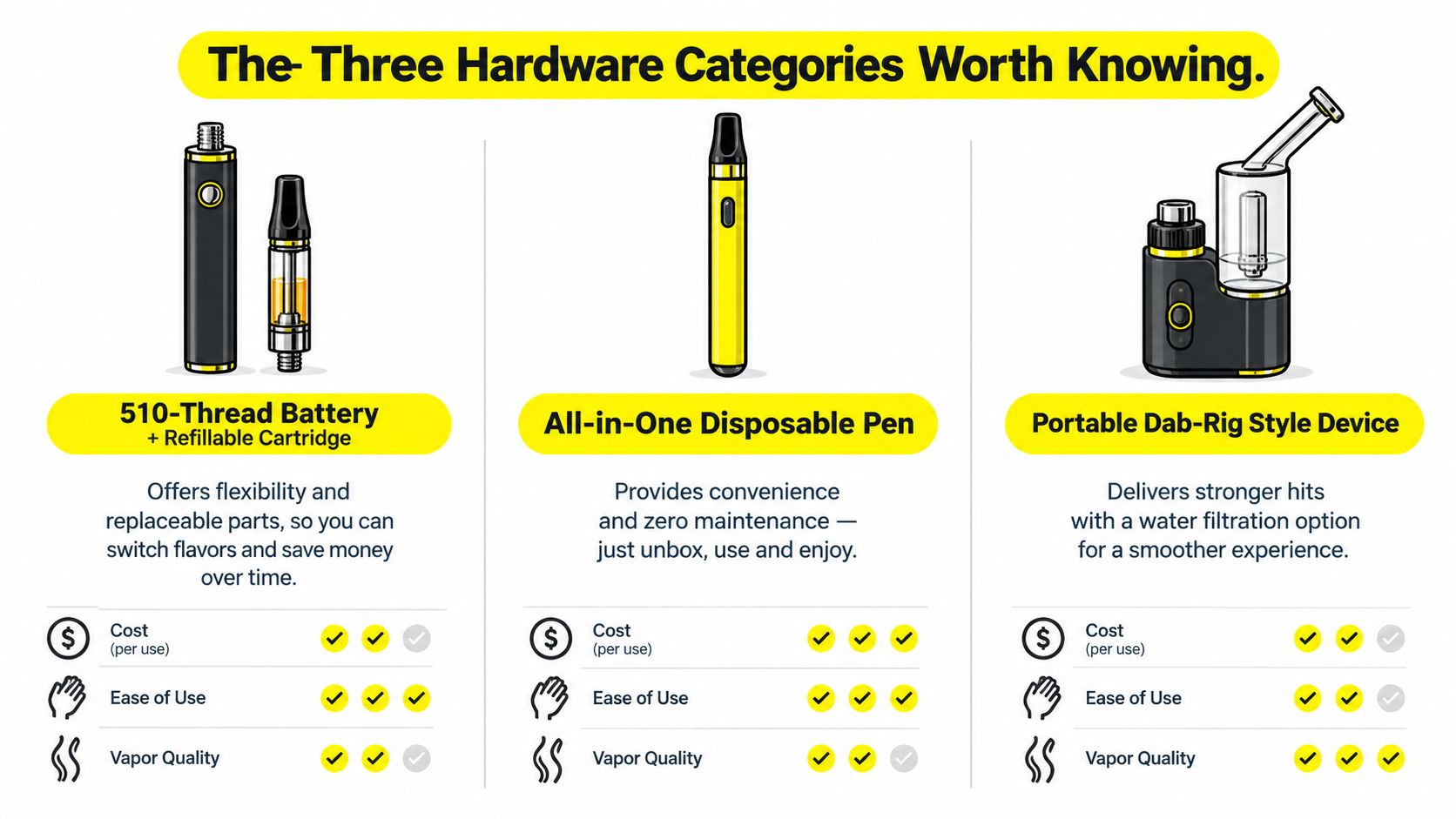
The market splits cleanly into three categories, and they're not interchangeable. If you read product pages like a buyer, not a gambler, the differences show up fast.
A 510-thread battery is the most flexible format. You buy the battery once and swap cartridges, which is why experienced patients like it, especially when they rotate between live resin, distillate, or thicker carts. The weakness is obvious, though. The battery and the cartridge are separate purchases, so a weak battery can waste a good cart, and a poor cartridge can make a great battery feel mediocre. For a flavor-first patient, a better 510 setup usually means lower, steadier voltage and a cart with known ingredients.
An all-in-one disposable is the convenience play. Battery, coil, and oil arrive as one sealed unit, and modern versions are often rechargeable so the battery doesn't die before the oil is gone. That convenience comes with less control. You can't swap hardware, you can't tune the battery as precisely, and cheaper disposables are the most likely to disappoint if the oil volume outlasts the battery or the coil runs too hot. For quick, low-fuss use, they're easy to live with. For picky users, they're limiting.
A portable dab-rig-style device sits at the other end. It's built for raw concentrates, not prefilled oil, so it gives you more chamber control and usually a stronger session. The trade-off is maintenance. You're loading material yourself, cleaning residue, and paying attention to chamber material, airflow, and heat behavior. If you want stronger hits and a more hands-on session, this category makes sense. If you want grab-and-go simplicity, it's overkill.
Types of cannabis concentrates matter here because the hardware has to match the material, not the other way around. A beginner usually tolerates a rechargeable disposable best, because the learning curve is low and the ritual is simple.
Temperature Control and Why Numbers Matter
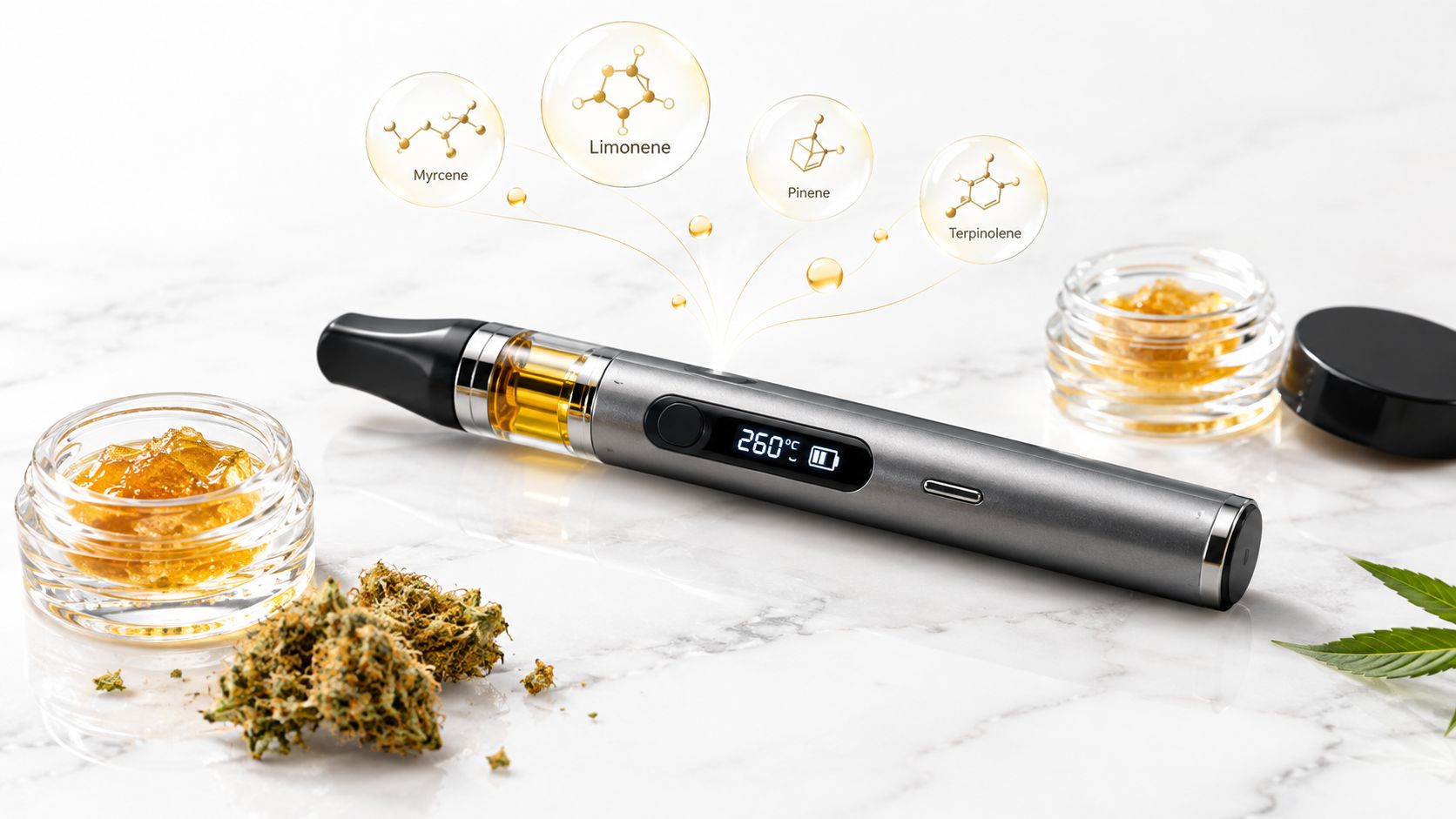
Temperature isn't a side note. It's the core of how a concentrate pen behaves, because cannabinoid vaporization and aerosol formation are temperature-sensitive, and the National Institute of Standards and Technology explains that vapor and aerosol behavior depends directly on vapor pressure, which changes substantially with temperature (NIST-informed chemistry discussion in NEJM). That's why one setting never fits every user or every concentrate.
The most useful range for terpene preservation is roughly 230–290°C, or 446–554°F, where cannabinoids vaporize while flavor and harshness stay more controlled (temperature guidance for concentrates). Once you push above about 300°C, degradation products become more of a concern, and the draw gets harsher. If you're chasing taste, lower is usually better. If you're chasing density, you'll feel the trade-off fast.
A lower band around 420–480°F fits live resin and rosin better, because those extracts are where flavor matters most. A higher band around 500–570°F makes sense for thicker concentrates when you want a denser cloud and can accept a rougher draw. That isn't marketing fluff, it's a practical choice between flavor retention and output.
What to look for on the product page
A good device doesn't just say “three presets.” It names the temperatures, keeps them stable, and uses chamber materials that don't undermine the concentrate. Inert materials like ceramic or quartz are what you want to see, not vague claims about “strong” heat.
A single max-heat button is a blunt tool. A pen that gives you low-to-mid repeatable settings is the one that actually respects the concentrate.
For DC patients, that's the cleanest rule. Start low, stay consistent, and treat temperature as the dial that decides whether your session is flavorful, harsh, or wasteful. Best temperature for vaping weed is only useful if the hardware can hold the setting you choose.
Hardware Safety and What a Certificate of Analysis Covers
A certificate of analysis is useful, but it doesn't give you a free pass. It tells you something about the concentrate, not everything about the battery, coil, or vapor path. That distinction matters because recent peer-reviewed evidence found that vape components can release nickel, chromium, lead, cobalt, cadmium, and copper into liquids and aerosols, with age, structural integrity, temperature, viscosity, and pH all affecting dissolution (peer-reviewed review on metal exposure in vape systems).
The practical move is to inspect the hardware like you're buying anything else that heats up repeatedly. Ask whether the body is intact, whether the connector looks worn, whether the chamber material is clearly stated, and whether the device has been overheated before. If the shell is cracked, the taste has changed, or the pen feels inconsistent, that's not a minor annoyance. That's a reason to stop using it.
What I'd ask the budtender
Bring these questions to the counter and ask them directly:
- Who made the concentrate? You want a manufacturer name, not just a strain name.
- What does the COA cover? It should verify the concentrate, not be mistaken for hardware testing.
- What's the lot number? Batch traceability is a real filter.
- Where did the hardware come from? Regulated, sealed product is different from mystery hardware.
- When did the menu rotate? Fresh stock matters more than stale inventory.
Do not thin oil yourself, do not refill disposable hardware, and don't add flavoring or other liquids. That's exactly the kind of improvisation the FDA warns against (FDA THC vaping safety information). If you want the cleanest buying framework, keep the concentrate and the hardware separate in your mind. One can be verified, the other can't always be assumed.
Product testing standards are only helpful if you use them to screen both the oil and the device category. A “safe” purchase starts with intact hardware, disclosed ingredients, and a lab report that applies to what you're inhaling.
Matching the Pen to the Patient
The fastest way to choose is to match the device to the person using it. Not every concentrate user wants the same thing, and pretending otherwise is how people buy the wrong pen twice.
| Patient Profile | Best Hardware | Temperature Habit | Cartridge Type |
|---|---|---|---|
| Flavor-first | 510-thread battery | Low to mid, repeatable | Live resin or live rosin cart |
| Medical relief | Adjustable 510 or portable dab-rig-style device | Start low, then step up slowly | Batch-tested concentrate or regulated cart |
| Discretion | Slim 510-thread battery or disposable | Lower setting to cut odor and cloud | Small-format, sealed cartridge |
| Value | Rechargeable disposable or durable 510 setup | Mid setting, avoid overheating | Stable, well-labeled cart |
A flavor-first patient should stay with a 510-thread battery that gives real voltage control. Live resin or live rosin belongs on a lower setting, because that's where the terpene profile stays readable. If someone is spending extra for a terpene-rich extract, a hot, fixed-voltage battery defeats the point.
A medical patient managing daytime symptoms needs repeatability more than swagger. An adjustable 510 or portable dab-rig-style device makes sense because the starting point can be low, with deliberate increases only if the first draw doesn't do enough. That's the cleanest way to avoid wasting concentrate while still keeping the session predictable. Personalized recommendations work best when the hardware lets you repeat what helped.
A discretion-first user should think small, sealed, and simple. A slim 510 battery or compact disposable is easier to carry and easier to keep low-profile on a short break. Don't chase cloud size here. Chase control and a lower-odor session.
A value-oriented daily user should be honest about use patterns. If they'll burn through oil steadily, a rechargeable disposable or a sturdy 510 setup usually beats buying a flashy device that's inconvenient to maintain. The cheapest pen is the one that doesn't force you to replace it early.
Maintenance, Dose Control, and Warning Signs
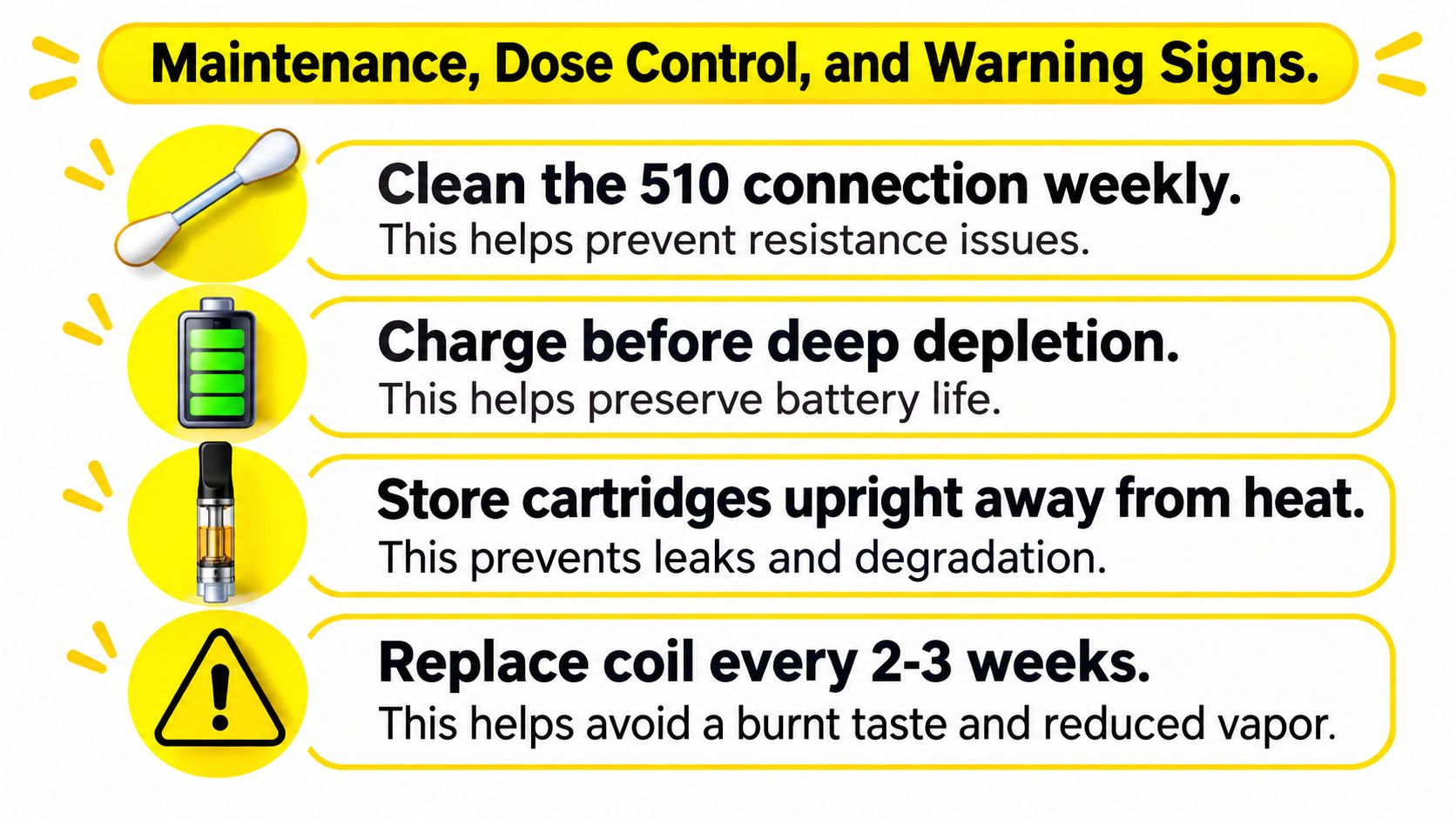
Good concentrate pens don't stay good by accident. They stay good because the user keeps the connection clean, the battery healthy, and the cartridge stored like it matters.
Clean the 510 connection regularly. Oil and dust build resistance, and resistance makes the device fire inconsistently. Charge before the battery is fully drained, because deep depletion is hard on battery life and can make performance less steady. Keep cartridges upright and away from heat, because heat thins oil, encourages leaks, and degrades flavor.
Simple dose control that actually works
Use a short timed draw, then wait. Medical patients do better when they know their own floor dose, and a symptom journal helps because it gives you a repeatable record instead of a fuzzy memory. If the first pull works, stop there. If it doesn't, step up carefully on the next session instead of taking longer and longer pulls in one sitting.
Stop using the pen if you get persistent cough, burnt residue, leaking oil, or obvious overheating. Those are device signals, not things to power through.
A smoother flavor doesn't prove lower toxicant exposure. A pen can taste pleasant and still be running too hot, especially if the chamber or coil is stressed. Your body is the final signal, not the label and not the vapor cloud.
For concentrate patients, that's the discipline that keeps the device useful. Clean it, charge it, store it upright, and replace it when the housing or taste changes.
Buying Concentrate Pens in DC with Mr. Nice Guys DC
DC shoppers have the advantage of clear access, but the same rules still apply: verify the product, verify the format, and follow location-specific restrictions. Mr. Nice Guys DC serves patients 21+ with in-store pickup, curbside, and delivery through Sweede, including Georgetown, Shaw, Cleveland Park, Kalorama, and Glover Park, plus nearby areas like Alexandria, Bethesda, Rockville, Silver Spring, Arlington, Vienna, McLean, and Tysons Corner. The menu includes cartridges, disposable pens, concentrates, and other formats, and the staff can help you ask the right questions about hardware origin, lot numbers, and rotation dates (Cannabis concentrates online).
Debit and cash are accepted, which makes checkout straightforward. Keep one more rule in mind, though, because convenience doesn't override local policy. Under DC Code §7-1671.03, a qualifying patient receiving medical cannabis at a school with a medication-administration policy must use a non-smokable form, so a vape pen can still be the wrong format in that setting (DC Code §7-1671.03).
Bring a simple checklist to your next visit. Ask who made the concentrate, what the COA covers, whether the hardware is regulated, and what temperature control the device offers. That's the difference between shopping by label and buying a pen that fits your life.
If you want help choosing a concentrate pen that fits your tolerance, your routine, and your DC access rules, visit Mr. Nice Guys DC and ask the team to walk you through hardware, concentrate quality, and the right temperature setup before you buy. They can help you compare cartridges, disposables, and concentrate devices so you leave with something you can use with confidence.
Mr Nice Guys DC
At Mr. Nice Guys DC, we’re more than just a cannabis delivery service — we’re passionate advocates for quality, convenience, and community. With years of experience in the cannabis industry, our team is dedicated to educating and empowering customers across Washington, D.C. Whether you're a seasoned user or just starting your cannabis journey, our blog delivers trusted tips, product insights, and the latest updates from the world of weed. Stay informed, stay elevated.
