
Must Be 21 To Enter
By entering this site you are agreeing that you are at least 21 Years of Age or older.
I AM 21 OR OLDERPersonalized Recommendations for Cannabis That Work in 2026
.svg)

.png)
You're standing at the counter, or staring at a menu app, trying to make one clean decision out of a wall of choices. The budtender asks what you need, you say “sleep,” and now everybody's supposed to turn that into something useful fast. That's where personalized recommendations either earn their keep or waste your time.
Good cannabis guidance isn't a random strain suggestion. It's a loop, you give the dispensary useful context, they make a call, you test it in real life, then you come back with better data. That's how a first visit stops being a guess and starts becoming a repeatable plan.
What a Personalized Cannabis Recommendation Actually Looks Like
At the counter, a weak recommendation sounds like, “Try this indica.” A real one sounds more like, “You're dealing with trouble falling asleep, you've got a low tolerance, you don't want to feel foggy in the morning, and you'd rather avoid inhaled products. Start with a modest edible or tincture, then check back after a few uses.” That's the difference between a sales pitch and personalized recommendations.

A good recommendation pulls from four things at once, your medical history, your current symptom pattern, your tolerance, and your format preference. If you've got nausea, a vape might make more sense than a gummy because onset matters. If you want overnight relief, a tincture or edible may fit better than flower because the timing is different.
Two patients can both say “I need something for sleep” and still need very different plans. One person is anxious, new to cannabis, and wakes up groggy easily. The other has used products before, wants a stronger effect, and doesn't care as much about morning clarity. Same complaint, different answer.
A one-off staff pick can work by luck. A structured recommendation works because it asks the same questions every time and uses your answers to narrow the field. If you want a quick reference for how symptom categories can translate into effects, this cannabis effects chart is a useful companion.
Practical rule: if the recommendation doesn't explain why it fits your body, your schedule, and your tolerance, it's not really personalized.
Preparing Your Medical History and Symptom Notes Before You Visit
If you walk in with vague notes, you'll get vague advice. That's not the staff's fault, it's just how bad inputs work. Bring a short, plain summary of what's going on, and you'll get a much sharper recommendation.
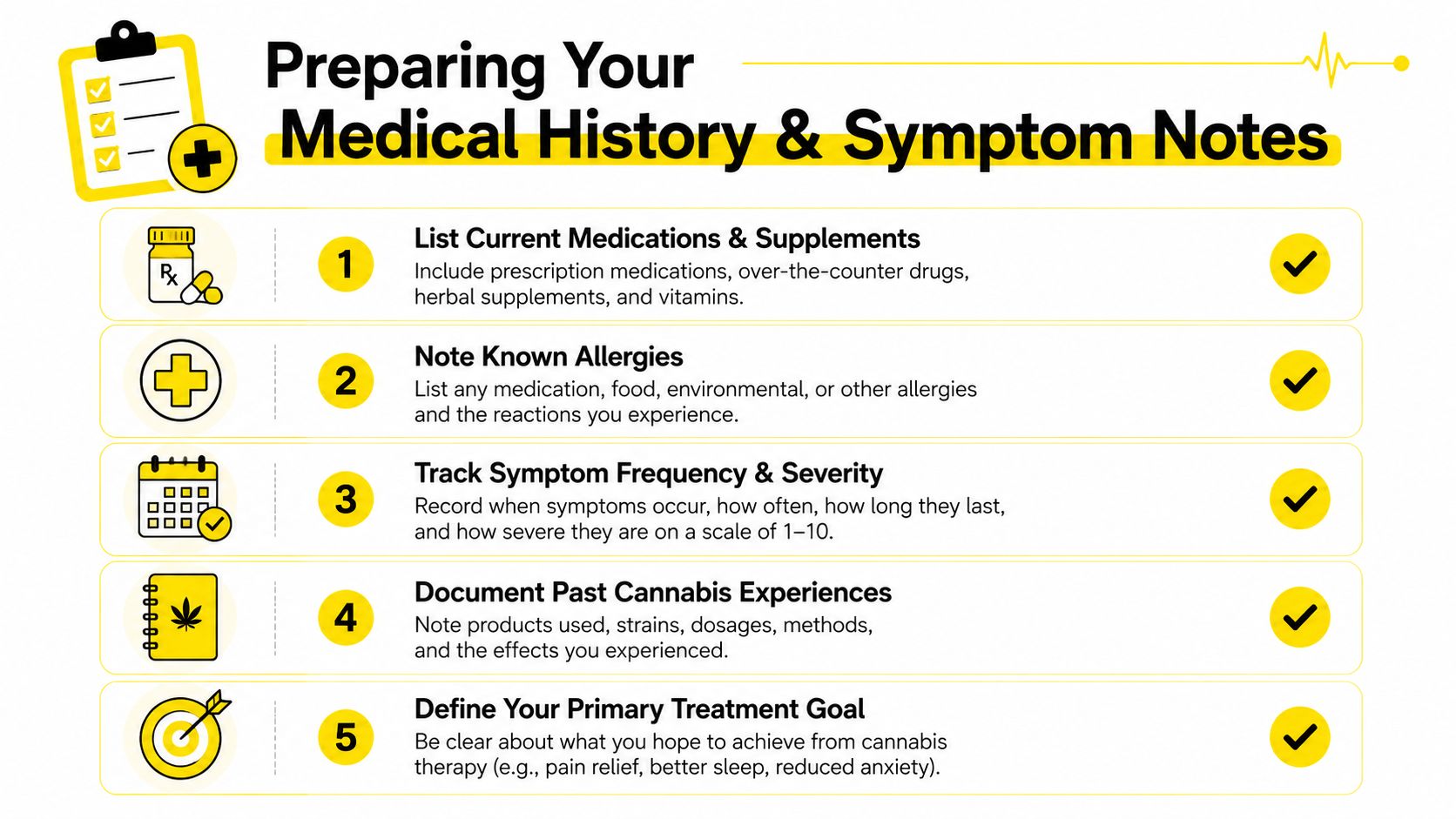
Start with the basics. Write down your current medications and supplements, any known allergies, whether you've used cannabis before, and what happened when you did. Add your main symptom, when it shows up, what makes it worse, and what you're hoping to change, sleep, pain, appetite, anxiety, or something else.
A solid symptom note looks specific, not dramatic. “Morning stiffness, 30 minutes after waking, worse on rainy days, eases after movement” is useful. “Back pain sometimes, need something strong” is not. The first gives the budtender a pattern to work with, the second gives them a guess.
Bring what you need to get through the door in DC, too. That usually means your ID, any medical recommendation you have, and your written summary. If you want a simple compatibility check before you go deeper, this medication compatibility check is the kind of thing patients should think about before they buy.
Here's a template you can copy into your phone:
- Medications: list every prescription, over-the-counter medicine, and supplement.
- Allergies: note any medication, food, or ingredient allergies.
- Cannabis experience: first time, occasional, or experienced, plus what has helped or gone wrong.
- Symptoms: what you feel, when it starts, and what makes it better or worse.
- Goal: sleep, pain relief, calmer mood, appetite support, or daytime focus.
A short note beats a long story. Staff can work with clean facts much faster than they can work with guesses. If you give them timing, triggers, and your tolerance level, you're already ahead of most first-time visitors.
Questions to Ask a Budtender or Cannabis Clinician
The best consults feel like a quick triage, not a product dump. You don't need to sound fancy. You need to ask the questions that force the recommendation to prove itself.
Start with how they think
Ask what they look at first when a new patient comes in. A good answer usually includes symptoms, past experience, potency tolerance, and preferred format. If the answer is just brand names, keep moving.
Ask what they'd start with for your specific symptom pattern, and ask why. Then ask what side effects to watch for, because a useful recommendation always includes the downside. If they can't tell you whether the product might feel sleepy, racy, heavy, or short-lived, they're guessing.
“Tell me what you're using, tell me what you want to feel, and I'll tell you where the edges are.”
Ask about the product itself
A product can look great on the menu and still be a bad fit. Ask where it was grown, how it was tested, and what the dose looks like in plain language. If it's an edible, ask how the dose is split per piece. If it's flower, ask how strong it's likely to feel for a new patient, not just what's printed on the label.
Also ask what people with a similar profile tend to report. Not for gossip, for pattern recognition. A patient who wants sleep and gets couch-locked all night does not need the same thing as someone trying to manage pain while staying functional.
Use these counter questions
- What would you start with if I'm new to cannabis?
- What's the likely downside of this product?
- How strong is this in practical terms, not just on the menu?
- How should I dose the first time?
- What should I come back and tell you if it doesn't feel right?
A good budtender or clinician won't act offended by those questions. They'll respect them. The right conversation feels calm, specific, and practical, like a working plan instead of a guessing game.
Evaluating Potency, Formats, and Strains for Your Situation
Don't chase the highest THC number just because it looks powerful. High potency is not the same thing as a better fit. For a lot of new patients, the smarter move is the product that gives the cleanest signal, not the loudest one.
Potency comes first, but not alone
Potency means different things depending on the format. In flower and vapes, people usually look at THC percentage and CBD balance. In edibles and tinctures, the key number is the milligrams per dose and how that dose is split. If you're new, the dose matters more than the bragging rights on the package.
Format should match the goal
Flower is fast and easy to titrate. Vapes are also quick, but they're not everyone's first choice. Edibles take longer, but they're often used when someone wants longer-lasting support. Tinctures sit in the middle for a lot of patients because they're easier to adjust than a gummy and less immediate than inhaled products. Topicals make sense when the goal is localized relief and you don't want an obvious head effect.
Here's a quick scan table for the menu:
| Primary Goal | Best-Fit Format | Notes for New Patients |
|---|---|---|
| Fast relief | Flower or vape | Start small, wait, then reassess before taking more. |
| Sleep support | Edible or tincture | Give it enough time, and don't assume stronger is better. |
| Daytime comfort | Lower-dose vape or tincture | Choose something that won't derail focus. |
| Localized relief | Topical | Best when you want the area addressed without a strong high. |
| First-time exploration | Tincture or low-dose edible | Easier to control than jumping straight into a heavy product. |
For a deeper look at how product styles shape the experience, this edibles vs vapes vs flower guide is worth comparing before you decide.
Strain families are a starting point, not a verdict
People still talk about sativa-leaning, indica-leaning, and hybrid options because it gives the conversation a rough direction. That's fine as a shorthand, not as gospel. Strain names like Gelato, Blue Dream, Wedding Cake, Runtz, and OG Kush can help staff narrow the shelf, but your reaction still matters more than the label.
Practical rule: pick the format that matches your symptom and your experience level first, then use strain family as a final filter.
Tracking Effects and Refining the Recommendation Over Time
Recommendation doesn't happen at the first sale. It happens after you've tried the product, felt what it did, and brought that information back. That's the part too many people skip, and it's the part that makes the next recommendation better.
One patient comes in for sleep and leaves with a 10 mg edible. It works, but the next morning feels heavy and slow. On the second visit, the conversation changes, less “stronger,” more “cleaner.” The patient switches to a 2.5 mg THC / 5 mg CBD tincture about 90 minutes before bed and gets a better fit because the goal was sleep, not sedation.
The log that makes this possible is simple. Write down the product name, dose, time used, symptom before, symptom after, mood, sleep quality, and side effects. If you want a rough way to think about edible dose math before you buy, this edible dosage calculator can help you stay grounded.

A clean tracking note can look like this:
- Product: exact name and strain.
- Dose and method: how much and how you took it.
- Time: when you used it.
- Effect: what changed, and when.
- Follow-up: what you want adjusted next time.
Be honest about bad experiences. If you felt anxious, foggy, or too sleepy, say so plainly. That doesn't mean the product was a failure, it means the recommendation needs tuning. Hydration, timing, and not mixing too many variables at once all help keep the signal clear, so you know what caused the result.
The second and third visits usually produce better recommendations because both sides have data instead of assumptions. That's the feedback loop. The patient gets more specific, the staff gets more useful, and the next choice gets tighter.
Practical rule: if you changed three things at once, you learned almost nothing. Change one thing, then judge it honestly.
Privacy, Legal Compliance, and How Mr. Nice Guys DC Supports the Process
Patients open up when they know the conversation stays professional. That matters in cannabis care, because the best recommendations depend on details people won't share if they feel exposed. A reputable dispensary should make the legal basics clear, protect your privacy, and explain exactly how your information is handled.
In DC, adults need to follow the local rules for purchase, medical certification where applicable, and possession limits. The dispensary should verify what it's required to verify and keep the consult focused on compliance, not confusion. If you're not sure whether to visit, pick up, or use delivery, the right answer is the one that feels easiest for you to complete correctly.
Mr. Nice Guys DC supports that process with in-store consultations, curbside pickup, and delivery powered by Sweede across DC, Alexandria, Bethesda, Rockville, and Silver Spring. It also helps with medical certification and compliance paperwork, which matters when you want the recommendation to be practical instead of theoretical. Their product lineup is laid out clearly on the menu, which helps you compare options without guessing.
For a closer look at what's on the shelf, this overview of what cannabis products are available at Mr. Nice Guys DC is a good place to start.
As for privacy, ask the obvious questions. Who can see your purchase history, what staff can share internally, and how they protect customer data are fair things to ask. A serious dispensary won't act weird about it, because confidentiality is part of trust, not an extra.
Putting It All Together With Mr. Nice Guys DC
The loop is simple. Prepare your notes. Have the conversation. Evaluate the recommendation. Track the result. Refine the plan. That's how personalized recommendations work when they're done right.

Keep this five-item checklist handy, because it's the whole game in one screen. Prepare your medical history. Have the consultation. Evaluate the recommendation. Track your results. Refine the process. If you do those five things, you stop buying on hope and start buying on feedback.
Mr. Nice Guys DC is built for patients who want that kind of grounded, step-by-step help. Visit Mr. Nice Guys DC, bring your notes, and let the team help you turn one good conversation into a better long-term fit.
Mr Nice Guys DC
At Mr. Nice Guys DC, we’re more than just a cannabis delivery service — we’re passionate advocates for quality, convenience, and community. With years of experience in the cannabis industry, our team is dedicated to educating and empowering customers across Washington, D.C. Whether you're a seasoned user or just starting your cannabis journey, our blog delivers trusted tips, product insights, and the latest updates from the world of weed. Stay informed, stay elevated.
