
Must Be 21 To Enter
By entering this site you are agreeing that you are at least 21 Years of Age or older.
I AM 21 OR OLDERHow to Take Cannabis Tincture Safely: A Step-by-Step Guide


You're standing at your kitchen counter holding a small amber glass bottle, squinting at a label crowded with milligram numbers and fractions of a milliliter. The glass dropper inside looks simple enough, yet you aren't sure whether to drop the oil under your tongue, stir it into tea, or count out individual drops. Most quick-start guides make it sound effortless, promising that holding a tincture under your tongue guarantees fast, predictable relief in minutes.
In practice, learning how to take cannabis tincture safely requires a bit more patience than those shortcuts suggest. Mouth absorption varies widely from person to person and bottle to bottle, which means a dose you hold under your tongue can still behave like a swallowed edible. Measuring accurately, logging your start time, and waiting through the full onset window will keep you comfortable and prevent the most common beginner mistake: taking a second dose before the first one ever arrives.
Onset and Duration by Route at a Glance
Before you twist open the cap, check the timing window for the two ways a tincture enters your system. Holding liquid under the tongue aims for sublingual absorption through blood vessels in the mouth, while swallowing sends cannabinoids through your stomach and liver. Read the table below as a practical planning range, never as a strict countdown clock.
| Route | Typical onset | Peak effects | How long effects last |
|---|---|---|---|
| Sublingual, held under the tongue | 15-40 minutes | 1.5-4 hours | 6-8 hours, up to about 12 |
| Swallowed | 60-180 minutes | 1.5-4 hours, sometimes later | 6-8 hours, sometimes longer |
Clinical dosing frameworks show why those ranges stretch so wide. According to the Utah Medical Cannabis Program general use guidelines, typical onset sits around 15 to 45 minutes for a sublingual tincture and 60 to 180 minutes for a swallowed oral tincture, with both routes lasting roughly 6 to 8 hours. The same guidance highlights a controlled human study of oral cannabis where subjective effects generally started 30 to 60 minutes after ingestion, reached a sustained peak at 90 to 180 minutes, declined over 6 to 8 hours, and left certain performance measures outside baseline for 6 to 20 hours after exposure.
Why the First Half Hour Misleads Beginners
Say a first-time user takes a small measured dose at 8:00 p.m. on a Friday night. At 8:30 p.m., the room feels completely normal, their heart rate hasn't budged, and it's tempting to assume the bottle is weak. By 10:00 p.m., however, the effects are only beginning to climb, right as they're getting ready for bed.
That delay happens because real-world absorption shifts with the carrier oil, how much saliva sits in your mouth, your individual digestion speed, and whether dinner is still in your stomach. If you've ever looked at how THC tinctures compare to edibles, you'll recognize that overlap: any oil that slips past the mouth and down the throat follows the slower digestive path.
Treat the first 30 minutes as a blank page. Feeling nothing at the half-hour mark tells you almost nothing about how strong the dose will feel two hours later.
Because subtle impairment can outlast the noticeable high, plan your first trial on an evening when you won't need to drive, operate machinery, or make high-stakes decisions. Setting aside an unhurried window removes the pressure to guess early and lets the timing work in your favor.
How to Measure a Safe Starting Dose
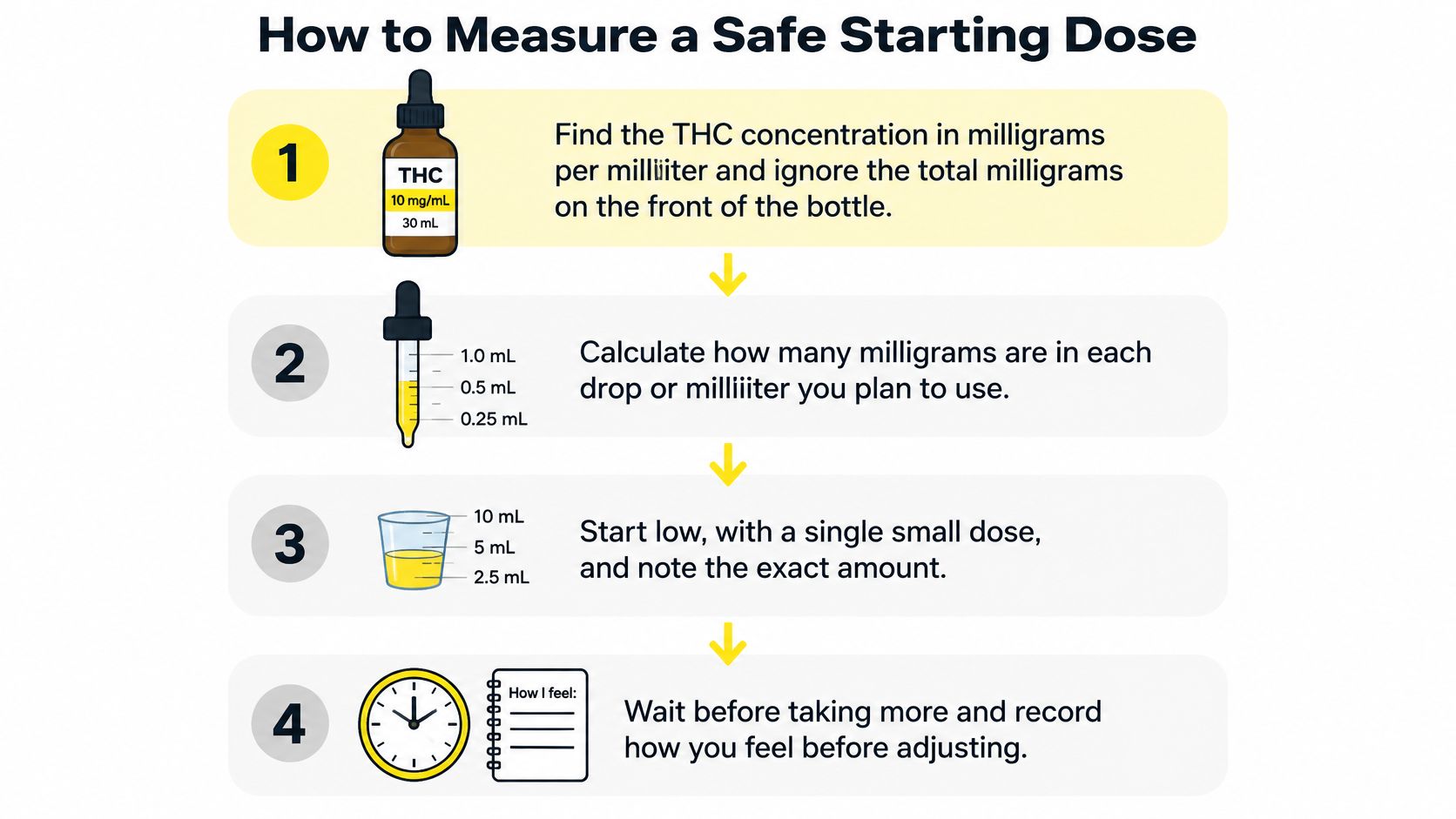
Most dosing errors happen before a single drop reaches your mouth, usually because a bottle's front label lists the total THC in the entire bottle in big bold type while tucking the per-milliliter strength into smaller print. Follow these six steps every time you open a new tincture so your math stays exact.
- Read the concentration, not the bottle total. Look for the number written in milligrams per milliliter (mg/mL) on the supplement or cannabinoid panel. A 30 mL bottle labeled "300 mg total THC" contains 10 mg/mL, and confusing those two numbers leads people to draw far too much or too little.
- Use only the supplied dropper or an oral syringe. Kitchen teaspoons vary wildly in volume and can easily deliver several times more liquid than intended. Always stick with the graduated glass dropper packed with the bottle or a pharmacy-grade 1 mL oral syringe with fine tick marks.
- Shake the bottle when the label calls for it. Some tinctures are oil suspensions where cannabinoids or plant extracts settle toward the bottom over time. Giving the sealed bottle a firm shake for several seconds keeps the first dose and the last dose consistent.
- Draw the liquid at eye level. Hold the dropper upright in good light and pull the liquid slowly until the bottom curve of the fluid lines up with your target mark. Squeezing too fast pulls air bubbles into the barrel and throws off your reading.
- Calculate your exact volume before dosing. Divide your target milligrams by the bottle's mg/mL concentration. For example, Health Canada's lower-risk cannabis guidance identifies 2.5 mg of THC or less as a low starting amount for orally consumed cannabis, which equals 0.25 mL from a 10 mg/mL bottle.
- Start at the bottom of the range. For a new or THC-sensitive adult, Health Canada's medical cannabis usage guidelines advise beginning with the lowest measurable amount, which for an oil may be one drop, while general medical guidance recognizes 2.5 mg THC once daily as a low starting dose.
The visual workflow below summarizes these label checks and measurement habits so you can glance at them before dosing.
Converting Milligrams to Milliliters by Bottle Strength
Different dispensaries and brands formulate bottles at very different potencies, so a quarter-dropper never means the same milligram amount across two products. Use this reference chart to verify the exact volume for 2.5 mg or 5 mg based on the strength printed on your bottle.
| Label strength (mg THC per mL) | Volume for 2.5 mg | Volume for 5 mg |
|---|---|---|
| 5 mg/mL | Half a milliliter | 1 mL |
| 10 mg/mL | 0.25 mL | Half a milliliter |
| 20 mg/mL | 0.125 mL | 0.25 mL |
| 30 mg/mL | One-twelfth of a milliliter | One-sixth of a milliliter |
Look closely at the 20 mg/mL row. Delivering a conservative 2.5 mg dose from that bottle requires just 0.125 mL, which sits halfway between the bottom of the barrel and the 0.25 mL line on a standard dropper. Trying to eyeball half of a quarter-milliliter on a wide glass dropper invites accidental doubling, whereas a narrow 1 mL oral syringe marked in fine fractional increments lets you measure tiny fractions cleanly.
Starting with a small measured fraction mirrors the same restraint people use when choosing low-dose cannabis edibles for predictable comfort. Before the dropper touches your mouth, jot down the product name, bottle strength, and exact volume in a notebook or phone note so you don't have to rely on memory later.
How to Take Tincture Under the Tongue
Once your dose is measured, the way you place and hold the liquid influences how much absorbs through mouth tissue versus how much goes straight to your digestive tract. Watch how careful placement and a timer keep the routine steady.
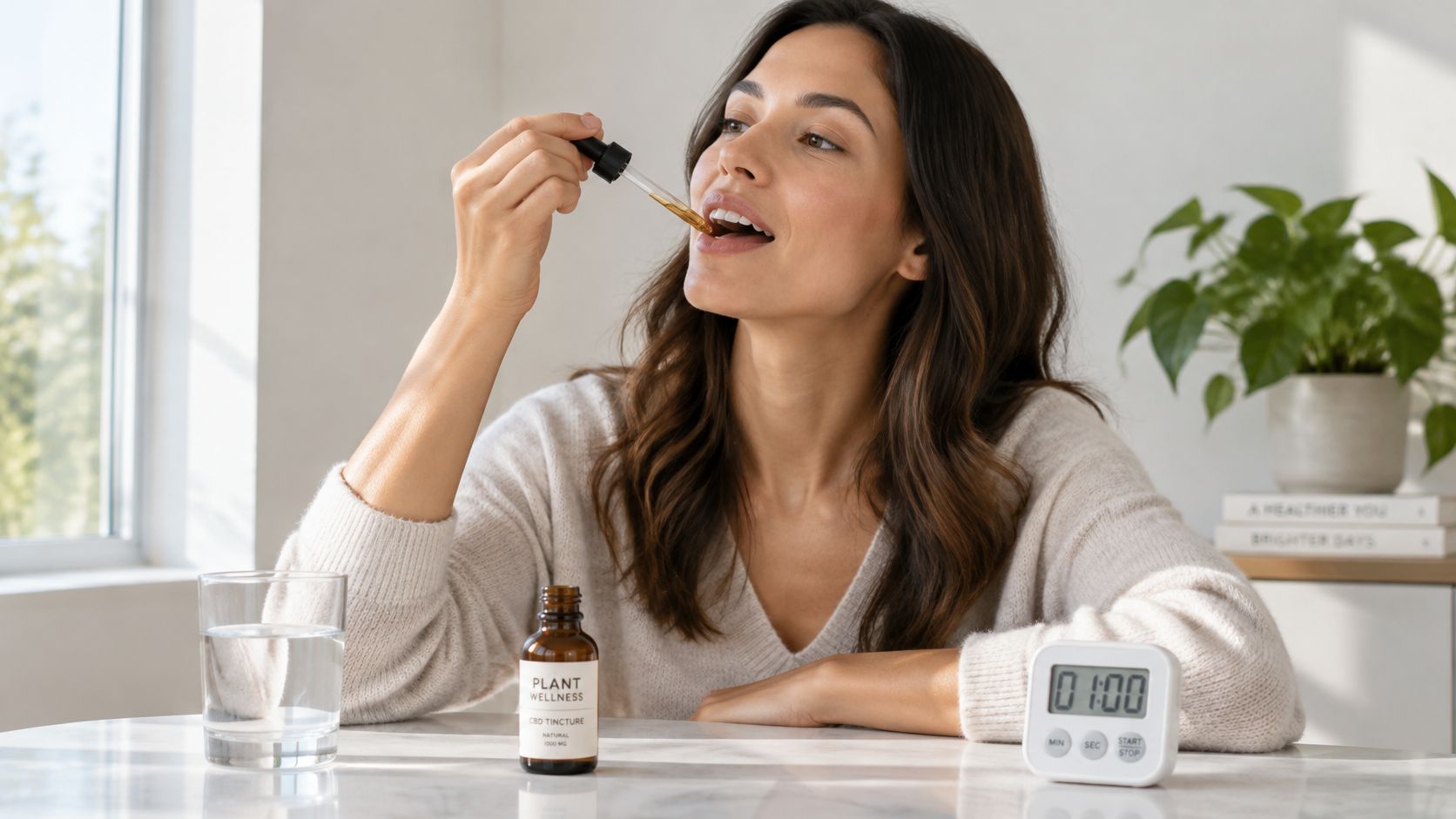
Follow a calm, repeatable sequence each time you use a sublingual bottle:
- Aim under the tongue, not down the throat. Lift your tongue and squeeze the measured dose into the soft pocket underneath, angling the tip slightly toward your inner cheek so the oil doesn't slide straight back and trigger an immediate swallow.
- Hold for the labeled interval. Keep your mouth closed, breathe through your nose, and let the oil sit for the full hold period printed on the bottle, moving it gently with your tongue so it coats the mucosal tissue.
- Swallow whatever remains. Once your timer finishes, swallow the leftover liquid normally rather than spitting it out, since cannabinoids remain in that residue.
- Log the clock time immediately. Recording the exact minute you finished gives you an honest reference point if you start wondering an hour later whether anything is happening.
If you're working primarily with non-intoxicating formulas, the mechanics of taking a CBD tincture under the tongue follow the same gentle hold-and-swallow technique. Still, even textbook technique doesn't guarantee an instant onset.
Why Holding Oil Under Your Tongue Is Not a Guarantee
Most consumer articles treat sublingual dosing as a reliable bypass around the liver, yet clinical pharmacology paints a much more cautious picture. A review in the British Journal of Clinical Pharmacology notes that while oromucosal preparations can absorb through mouth tissue faster than swallowed cannabis, a randomized crossover study in nine participants found no statistically significant differences in peak blood concentration, time to peak, or total exposure between matched oral THC and oromucosal THC/CBD spray doses.
Practical rule: Unless your bottle comes with validated clinical timing instructions, treat every sublingual dose as if at least part of it was swallowed.
Saliva builds up quickly once oil hits your tongue, washing a portion of the dose down your throat before mucosal capillaries can pull it in. Product carrier oils and recent meals shift absorption further, and swallowed portions commonly peak around 2 to 3 hours after dosing. That means the first 10 to 20 minutes never give you a dependable reading of final potency.
One everyday habit catches beginners off guard: stirring a measured dropper into morning coffee, herbal tea, or orange juice. Say someone drops their usual tincture into a 7:30 a.m. mug of coffee expecting a quick, brief lift before midday errands. Because the beverage sends the entire dose directly into the stomach, there's zero sublingual absorption; the effects arrive much later and stretch further into the afternoon than planned.
For a quick visual walkthrough of dropper handling and sublingual placement, watch this short demonstration.
A solid first session doesn't look dramatic. You measure one conservative dose, hold it calmly under your tongue, swallow the rest, record the start time, and settle into a quiet evening with plenty of space to observe how your body responds.
Why Waiting Beats Redosing
Taking a second dose because the first one feels quiet is the fastest way to turn a careful first session into an uncomfortable night. Because oral absorption lags behind expectations, stacked doses tend to collide all at once right as the first dose finally peaks.
According to Health Canada's guidance for healthcare professionals on cannabis and cannabinoids, ingested cannabis effects commonly start within 30 minutes to 2 hours, can take up to 4 hours to fully develop, and can cause acute impairment lasting at least 6 hours and sometimes longer. For any swallowed or partly swallowed tincture dose, that same clinical reference advises waiting at least 2 hours, and preferably as long as 3 hours when judging strength, before even thinking about taking more. Understanding how long cannabis edibles last reinforces why patience matters so much once cannabinoids pass through digestion.
Consider a common evening scenario. Dana measures 2.5 mg of THC tincture at 9:00 p.m. and holds it under her tongue. At 10:00 p.m., she feels completely clear-headed, assumes she undershot her sensitivity, and takes another 2.5 mg at 10:30 p.m. By midnight, both doses peak on top of each other, leaving her spinning in a heavy fog long past bedtime. Her mistake wasn't choosing 2.5 mg; her mistake was abandoning the clock before waiting until midnight to see what the first dose did.
The safest way to raise a tincture dose isn't adding more tonight. It's finishing this session, reading your notes tomorrow, and adjusting by the smallest labeled increment on a separate day.
Practical Safeguards While You Wait
A few simple habits protect you during the waiting window and make each future session easier to predict:
- Maintain a written log: Record the exact milligram amount, whether you held it or swallowed it, the start time, when you first noticed effects, and any side effects. If you're using tinctures medically, bring those notes to your clinician before increasing your dose.
- Lock bottles away from kids and pets: Store every dropper bottle clearly labeled in a high, secured cabinet, because flavored cannabis oils look indistinguishable from harmless kitchen extracts or supplements.
- Avoid alcohol and sedating drugs: Combining THC with alcoholic drinks or sedatives intensifies drowsiness, slows reaction time, and makes dizziness far more likely.
- Respect early warning signs: Recognized adverse effects include dizziness, drowsiness, fatigue, headache, and light-headedness. If any of these appear, stop taking more cannabis, sit or lie down in a quiet room, drink water, and ask for help if they don't ease.
Stay alert for signs that require urgent medical care rather than waiting at home. If someone becomes severely confused, can't stay awake, vomits repeatedly, struggles to breathe, or feels chest pain, call emergency services or your local poison control center right away, and give them the product name, the concentration in mg/mL, the amount taken, and the exact time of ingestion.
Food, Medicines and When to Check With a Professional
Everything in safe tincture use comes back to three dependable checks: confirm the mg/mL concentration on the label, measure with the supplied dropper or an oral syringe, and wait through the full onset window before deciding on more. Once those mechanics are solid, two external factors still reshape how strongly a dose lands: what you ate and what other medications sit in your cabinet.
How Meals Change Absorption
Cannabinoids dissolve in fat rather than water, so stomach contents dramatically alter both speed and intensity. A pharmacokinetic review of cannabinoids on PubMed Central cites a human study where plasma THC peaked roughly 4 to 6 hours after ingesting 15 to 20 mg of THC in sesame oil. The same review details another human study showing that taking THC alongside a high-fat meal significantly increased total exposure (measured as area under the concentration-time curve) for both THC and its active metabolite 11-hydroxy-THC, while shifting the time to peak concentration.
Think about what that looks like in real life. Suppose you take 0.25 mL of a 10 mg/mL tincture on an empty stomach Tuesday afternoon and feel a mild, brief relaxation. On Friday night, you take that exact same 0.25 mL right after a heavy dinner of creamy pasta or ribeye steak, and the effects feel noticeably stronger and arrive later into the night. Keep your meal conditions steady whenever you evaluate a new bottle so you aren't changing both food timing and dose at once.
Drug Interactions and Who Should Ask a Clinician First
Prescription medications frequently share liver enzymes with cannabinoids, which means cannabis can raise or lower the active level of another drug in your bloodstream. Sedatives, blood thinners, seizure medicines, and numerous other prescription drugs carry recognized interaction risks. Don't assume a low-THC or CBD-dominant bottle gets a free pass either; CBD may feel non-intoxicating while still altering how your body clears prescription drugs, so running a medication compatibility check and speaking with your pharmacist is essential.
Certain groups should always talk with a qualified healthcare professional before trying any cannabis tincture:
- Pregnant or breastfeeding adults: Cannabinoids can affect fetal and infant development and require medical counseling before use.
- Adults with significant cardiovascular or psychiatric conditions: THC can increase heart rate, shift blood pressure, or worsen underlying anxiety or mood symptoms.
- Anyone taking daily prescription medications: A pharmacist or prescriber can review your exact medication list for interactions and tell you whether dosing times need to be spaced apart.
In Washington, DC, instead of self-certifying, a person can consult a licensed healthcare provider to obtain a medical cannabis recommendation, which creates a straightforward opportunity to review prescriptions and health history first. When you come into our dispensary, a budtender asks what you're looking for, such as pain relief, help sleeping, or anxiety support, before recommending products. From there, our staff recommend products from flower, tinctures, topicals, capsules, or edibles based on your needs, while leaving prescription interaction calls directly to your doctor or pharmacist.
Questions to Bring to Your Next Appointment
Walking into a clinic or pharmacy with concrete questions gets you faster, more useful answers than asking whether cannabis is generally "okay." Bring your bottle or a clear photo of the label and ask:
- Medication safety: "Does this THC or CBD tincture interact with my blood thinner, seizure medication, or other prescriptions?"
- Food routine: "Should I change my dose or timing if I plan to take this tincture after dinner instead of on an empty stomach?"
- Label and tool check: "Can you confirm the mg/mL strength on this label and point out the exact syringe mark for my starting dose?"
Start a one-week dosing log tonight, noting the product name, measured volume, meal timing, start time, onset, and how you felt over the next several hours. Bringing that single page of real observations to your next appointment gives your clinician or pharmacist the exact details needed to guide your routine safely.
If you're in Washington, DC or nearby areas like Alexandria, Bethesda, Rockville, or Silver Spring and want help selecting a lab-tested tincture with clear labeling, our team at Mr. Nice Guys DC is ready to walk you through your options. We offer curated medical cannabis tinctures alongside flower, edibles, topicals, and capsules for in-store pickup, curbside service, or convenient local delivery, plus guidance on medical certification if you're getting started. Visit us online or stop by to ask questions and find a measured format that fits your routine.
Mr Nice Guys DC
At Mr. Nice Guys DC, we’re more than just a cannabis delivery service — we’re passionate advocates for quality, convenience, and community. With years of experience in the cannabis industry, our team is dedicated to educating and empowering customers across Washington, D.C. Whether you're a seasoned user or just starting your cannabis journey, our blog delivers trusted tips, product insights, and the latest updates from the world of weed. Stay informed, stay elevated.
