
Must Be 21 To Enter
By entering this site you are agreeing that you are at least 21 Years of Age or older.
I AM 21 OR OLDERHow Long Should a Tolerance Break Be for You


The popular advice to quit cannabis for a month and come back completely reset is too neat. Your break should match your goal, not somebody else's calendar. Testing dulled effects, getting through withdrawal, and changing a daily habit are different jobs. And the decision that deserves just as much attention is what you'll use when the break ends.
How Long a Tolerance Break Should Last
Circle the row that matches what you want to change. Don't automatically choose the longest break.
Tolerance break length by goal
| Goal | Suggested length | What the evidence supports | Best fit |
|---|---|---|---|
| Quick sensitivity check | About 2 days | CB1 resensitization can begin; not a full reset | Occasional users testing dulled effects |
| Past the withdrawal peak | 7–14 days | Symptoms often peak on days 2–6 and ease by about 2 weeks | Regular users who want acute symptoms to settle |
| Substantial receptor recovery | 21–28 days | Broader CB1 normalization around 4 weeks in frequent users | Daily or heavy users seeking a research-based reset |
| Change the pattern, not just sensitivity | Several weeks to months | Short resets are common but may not change use | People whose daily routine returns as soon as the break ends |
These are planning windows, not guaranteed medical outcomes. A 2025 qualitative study of tolerance breaks found that people defined breaks as anything from several hours to months, with breaks of a few days most common, and discussed withdrawal peaks around days 5–7 as a reason to plan beyond the hardest stretch when changing use patterns.
Match the calendar to the person
Say Maya hits a vape every night and wants her usual evening session to feel effective again without increasing consumption. For this hypothetical daily user, 28 days fits better than a weekend off. She's choosing a substantial recovery window, not testing whether skipping a familiar ritual feels different.
Jordan uses flower twice a week and only wants to check whether the effects have dulled. A two-day experiment is a reasonable starting point for that narrower question. It isn't evidence that Jordan's tolerance has disappeared, and no noticeable change wouldn't automatically justify stronger flower.
Those examples answer “how long should a tolerance break be?” more usefully than a universal countdown. Choose the shortest window that addresses your goal, then decide in advance what would count as useful information.
What the imaging evidence actually means
For the longer target, a human PET-imaging study of chronic cannabis smokers repeated scans after approximately 26 ± 5 days of monitored abstinence, with a 13–32-day range, and found that reduced CB1-receptor availability largely returned toward normal. That supports the longer row for frequent users, but receptor measurements aren't a promise about your next session or your medical symptoms.
Practical rule: A longer break isn't automatically a better treatment plan.
Someone trying to interrupt an automatic nightly routine may need a longer period of behavior change, not more time waiting for stronger effects. That means changing when cannabis is available, what happens during the usual session, and whether restarting still makes sense.
If you use cannabis for pain, sleep, anxiety, or seizures, plan the change with the clinician managing that condition. Resetting tolerance and keeping the underlying condition controlled are separate jobs. Don't sacrifice the second just to reach a calendar milestone.
What Changes Your Break Length
Frequency comes first, then total THC exposure. A weekend flower session and repeated cartridge use throughout the day shouldn't land on the same plan just because both people call themselves regular users.
Start with what you consume, not the product you identify with. Someone may say they use flower but also take a bedtime gummy and reach for a pen between sessions. All of that belongs in the same inventory.
Compare exposure, not product labels
Consider a hypothetical person taking 5 mg of THC at night versus someone taking 50 mg spread through the day. Those numbers aren't clinical cutoffs. They illustrate why the amount and repetition of exposure matter more than the simple statement that both people use cannabis daily.
Use these questions to sort your own pattern:
- Frequency: Are there naturally cannabis-free days, or does every day include THC?
- Amount: Can you name the edible or tincture dose, or estimate how much flower or cartridge oil you use?
- Potency: Have you moved toward stronger products while keeping the same number of sessions?
- Stacking: Does an evening include flower, a vape, and an edible rather than a single format?
- Purpose: Are you treating a symptom, following a ritual, or repeatedly adding more because the previous amount feels ineffective?
A high-THC vape, a concentrate, and a flower session aren't interchangeable units of exposure. Use our guide to cannabis potency testing to understand the label before comparing products. Potency alone won't tell you the dose you consumed.
Route matters too. Inhaled THC and edible THC have different onset and duration patterns, so don't compare a puff count directly with a gummy dose. With edibles, include later additions in your log rather than recording only what you initially intended to take.
Sort two realistic routines
Suppose Alex uses about a gram of high-THC flower every evening. For this hypothetical pattern, I'd recommend planning the 28-day row, rather than treating a skipped evening as a substantial reset.
Sam uses a low-dose tincture three nights a week. A 7–14-day starting plan is a more proportionate experiment, with extension based on whether the original goal has changed, not pressure to finish a longer challenge.
Medical needs can override that simple sorting. If stopping makes sleep or symptom control unmanageable, discuss a supervised reduction or alternative treatment plan rather than forcing an abrupt stop.
Daily use plus high potency points toward the longer target. Occasional use plus a modest dose supports a shorter test.
Individual responses still differ. A receptor scan isn't a measurement of how intoxicated you'll feel, and no product category can predict your exact recovery date.
How Withdrawal Usually Unfolds
A rough stretch doesn't automatically mean the break is failing. A daily cartridge user might feel fine immediately after stopping, then become irritable and sleepless later. That pattern can fit withdrawal rather than prove that cannabis is necessary to feel normal.
Use the timeline to prepare, not to diagnose yourself.
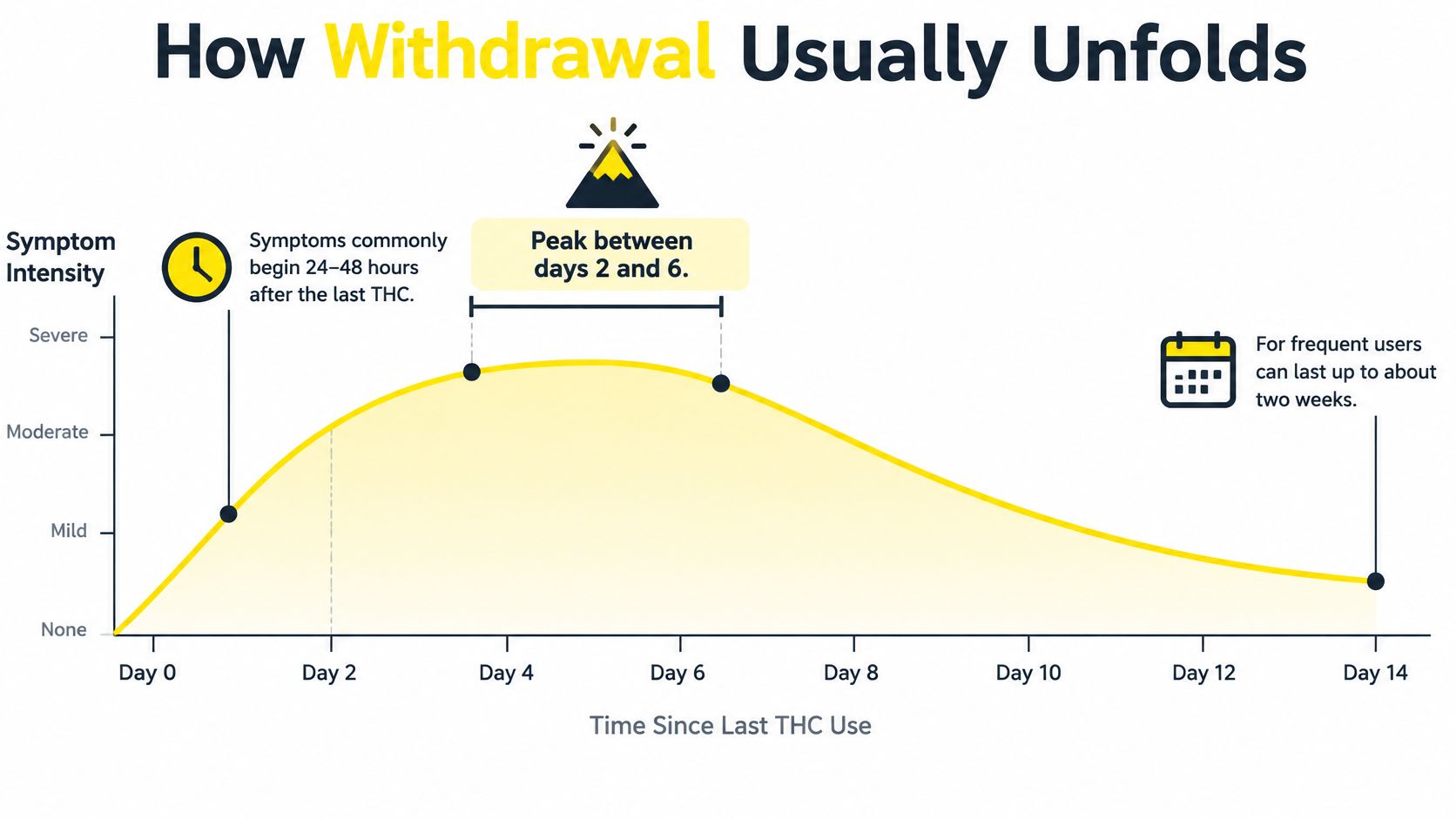
A clinical review of cannabis withdrawal describes onset at 24–48 hours, a typical peak on days 2–6, and symptoms lasting 3 weeks or longer in heavy users. The National Institute on Drug Abuse marijuana guide describes frequent users' symptoms as peaking during the first week and lasting up to about 2 weeks.
Cannabis withdrawal timeline
| Phase | Timing | What often shows up |
|---|---|---|
| Onset | 24–48 hours after the last THC | Irritability, cravings, appetite drop, or sleep changes can start |
| Peak | Days 2–6 | Symptoms are usually hardest; about half of regular or dependent users experience withdrawal overall |
| Early settle | Up to about 14 days | Frequent users often see the first-week peak ease by two weeks |
| Residual | 3 weeks or longer | Heavy users may still have sleep, mood, or dream changes |
The estimate of approximately half of regular and dependent users comes from a clinical management review, not a claim that everyone develops symptoms during the peak.
Prepare for the difficult stretch
In our cartridge-user scenario, feeling okay on day 1 and irritable and sleepless on day 4 fits the expected progression. Don't use that difficult night alone to judge the entire plan.
Common symptoms include anxiety, irritability, anger, low mood, reduced appetite, cravings, restlessness, disturbed sleep, and vivid dreams. Less common physical symptoms include chills, headache, sweating, stomach pain, and muscle tension.
Keep support simple and specific:
- Hydration and food: Keep water available and eat regular meals, even when appetite is smaller.
- Sleep routine: Protect a fixed bedtime and wake time instead of chasing sleep with changing cannabis products.
- Access: Put flower, pens, edibles, and paraphernalia out of easy reach.
- Daily notes: Record what happened and whether you could function, not just whether you felt uncomfortable.
For a visual companion, this video can sit alongside your written symptom notes.
Know when discomfort needs care
Severe depression, suicidal thoughts, psychosis, inability to function, or a serious medical complication require professional care. Seek urgent help for immediate danger rather than waiting for the break to end.
If you're treating pain, nausea, seizures, or a sleep disorder, worsening symptoms are a clinician question. Our guide to cannabis and insomnia can help frame the sleep conversation, but it can't distinguish withdrawal from your underlying condition. Feeling worse before feeling better can happen; it isn't permission to ignore dangerous symptoms.
Lock the End Date and Restart Dose
Write the plan before the last session, not while negotiating with a craving. Your end date should mark a reassessment, not permission to resume the old amount, old pen, and old evening ritual.
Use a phone note or a card you'll see. Keep it short enough to follow when you're tired.
Write a usable agreement with yourself
- Name the goal: Choose a two-day sensitivity check, a 7–14-day withdrawal observation window, or a 21–28-day recovery target.
- Set the calendar: Circle 2, 14, or 28 days, then write the actual end date rather than “sometime next month.”
- Preselect the restart: Write a smaller amount as a fraction of your previous THC exposure. Don't leave the decision to the first night back.
- Protect medical care: Agree on the plan with your clinician before stopping if cannabis treats pain, sleep, nausea, or seizures.
- Name the escalation point: If you can't follow the note because use feels out of control, contact a clinician rather than scheduling another short reset.
These are planning choices, not a standardized medical prescription. If you take other medicines, use our medication compatibility check guide to prepare questions for your clinician or pharmacist.
Make the restart concrete
For example, Maya writes April 28 as her last abstinent day and lists one small flower inhale, not her cartridge, as the first-session ceiling if restarting remains appropriate. That's a hypothetical plan, not a claim that a puff delivers a predictable dose.
Jordan writes a two-day test and plans the same flower at half the usual amount. Keeping the product consistent makes the experiment easier to interpret than changing potency and format simultaneously.
At our dispensary, a budtender asks what you're looking for, such as pain relief, help sleeping, or anxiety support, before recommending products. We recommend from flower, tinctures, topicals, capsules, or edibles according to the customer's needs.
Product guidance doesn't replace medical supervision. Tell your clinician if the condition you were treating worsens, and don't treat a dispensary recommendation as approval to change prescribed care.
How to Run a 28-Day Pause
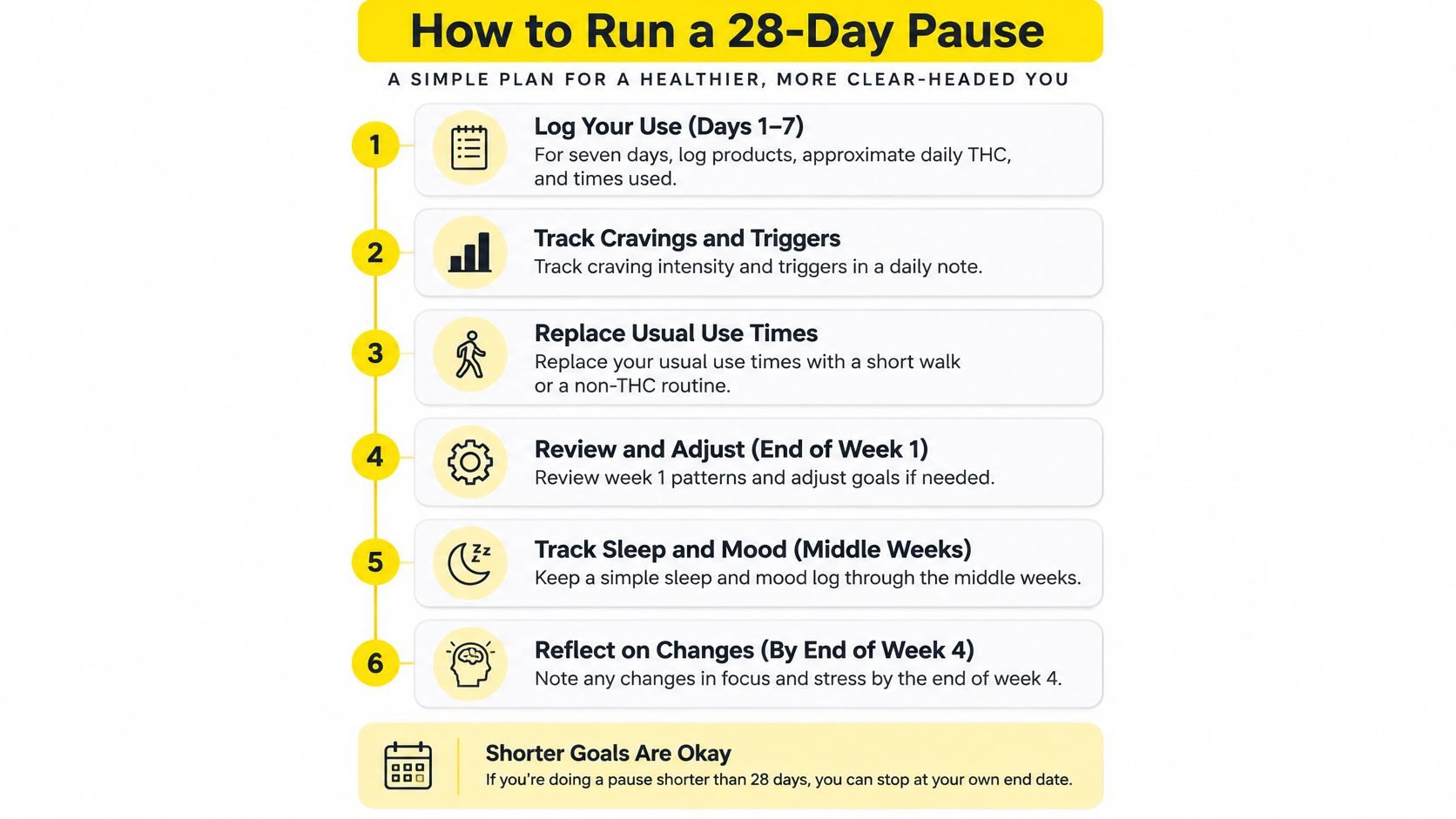
Choose this staged plan if you've selected the longer recovery window. Shorter goals can stop at their own planned end date; you don't have to turn every experiment into a month-long challenge.
The useful outcome is a clear record of exposure, symptoms, and decisions. A completed calendar without that information tells you much less.
Follow a staged plan
Log your baseline for seven days. Record products, approximate daily THC, times used, sleep, appetite, mood, and the symptom cannabis is meant to help. For flower and vapes, record product strength and consumption separately rather than pretending you know the exact absorbed dose. Include cravings and the situations that trigger an extra session.
Resolve the medical plan before stopping. If cannabis treats pain, nausea, seizures, or sleep problems, ask the managing clinician whether to taper or stop and what to do if symptoms return. Arrange that support before the abstinence period, not during a difficult night.
Stop every THC format on day 1. That includes edibles, tinctures, and vapes, not just flower. Check labels on anything you're considering as a substitute, and use our CBD versus THC guide to understand the distinction. Switching formats while continuing THC isn't the same as abstinence.
Reassess on days 2, 7, 14, and 28. Use the same log each time so you can compare like with like. Note craving intensity, sleep disruption, appetite, mood, and whether your original medical symptom is controlled. Replace habitual use times with something specific, such as a walk after dinner or making tea away from your usual smoking spot.
Protect the difficult stretch instead of grading yourself during it. Treat days 2–6 as a period to simplify commitments where possible, maintain meals, and keep bedtime consistent. Review what triggers cravings and change the setting or routine. Extend support when needed, but don't independently extend uncontrolled medical symptoms.
Restart only if cannabis still fits, and substantially reduce exposure. As a hypothetical example, someone previously taking four 10 mg gummies daily might plan one 5 mg gummy at night instead of returning to the old four. That changes a 40 mg daily routine to a 5 mg trial, but it isn't a universally appropriate dose. A medical patient should agree on the amount with their clinician.
Understand what the benchmark can prove
The PET study of 11 cannabis-dependent men found approximately 15% lower CB1-receptor availability at baseline, with recovery beginning within 2 days and continuing across 4 weeks. It did not establish a guaranteed, fully normalized response to THC by day 28.
That small, all-male, dependent-user sample matters. Occasional users, older adults, and low-dose medical patients shouldn't assume the same timetable predicts their experience.
Treat the calendar as a structure for observation, not a certificate that your tolerance is gone.
A daily user choosing the longer pause is following the imaging window more closely than someone skipping a weekend. Still, the final decision should account for symptom control, cravings, and whether lower exposure is sustainable, not just whether every box is checked.
Tips for Restarting at a Lower Dose
A 2023 feasibility study found that 62% of young adults completed a structured 21-day break, but only 48% of completers were still abstinent 10 days later, as discussed in the study of tolerance breaks and subsequent cannabis outcomes. That completion figure is encouraging, but finishing a break and changing subsequent use aren't the same outcome.
The same paper reported that breaks explicitly called T-breaks were associated with greater hazardous-use and cannabis-use-disorder severity at 6 months, while longer breaks taken for other reasons were associated with reductions in hazardous use, disorder severity, and frequency. That's an association, not proof that taking a break causes harm. It does challenge the assumption that every temporary reset improves someone's relationship with cannabis.
Make the first session smaller and simpler
Don't celebrate reduced tolerance by testing your maximum. Your first sessions should answer how little is enough, not whether you can still handle the old amount.
- Start with a fraction: Use substantially less THC than before. A previous dose is history, not a target.
- Keep formats separate: Don't pair a concentrate with a high-potency vape on the first day back.
- Wait before adding more: Allow the chosen product's effects to unfold. With edibles, follow onset information and don't redose because you feel nothing yet.
- Space sessions deliberately: Don't automatically restore every old use time.
- Keep a restart log: Track sleep, anxiety, pain, and cravings for a practical two-week observation period.
For measured oral products, our low-dose edibles guide can help you think through product strength and portion size. Don't assume “one gummy” is a consistent dose across products.
Keep these first-session principles visible when you restart.
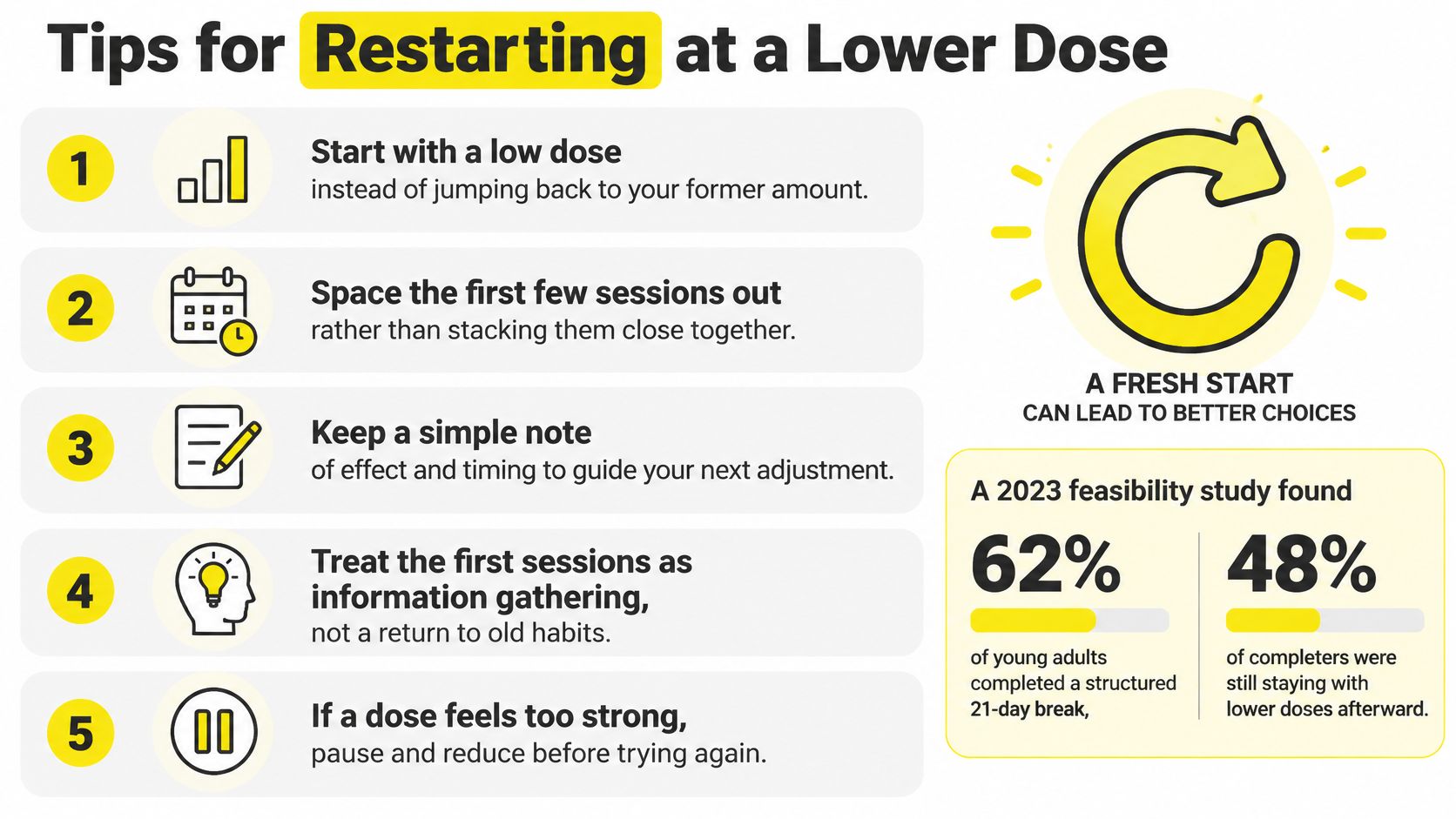
The study's 48% figure refers to continued abstinence, not to people maintaining lower doses. Those outcomes shouldn't be confused.
Judge the routine, not just the effect
Consider a hypothetical person who previously finished an 80% THC pen every evening. A more cautious return might involve one or two small flower inhales and stopping, rather than immediately reaching for the same pen. That isn't a precise THC conversion, and flower isn't automatically low potency; the point is to reduce and limit exposure deliberately.
If the old daily routine is back within a few days, the break changed the calendar more than the pattern. Adjust access, timing, and expectations rather than assuming another pause will solve the same problem.
Residual sleep trouble can occur, but a worsening medical condition needs assessment. If cutting down feels impossible, or cannabis-use disorder is a concern, a qualified clinician matters more than another dispensary schedule. You're allowed to decide not to restart.
Mr. Nice Guys DC offers needs-based guidance across flower, tinctures, topicals, capsules, and edibles to help you consider a more deliberate return. Bring your previous product, usual amount, and written restart goal when you visit Mr. Nice Guys DC, so the conversation starts with lower exposure rather than stronger products.
Mr Nice Guys DC
At Mr. Nice Guys DC, we’re more than just a cannabis delivery service — we’re passionate advocates for quality, convenience, and community. With years of experience in the cannabis industry, our team is dedicated to educating and empowering customers across Washington, D.C. Whether you're a seasoned user or just starting your cannabis journey, our blog delivers trusted tips, product insights, and the latest updates from the world of weed. Stay informed, stay elevated.
