
Must Be 21 To Enter
By entering this site you are agreeing that you are at least 21 Years of Age or older.
I AM 21 OR OLDERGummies vs Chocolate Edibles: Onset, Dosing and Timing


The most repeated advice in the gummies vs chocolate edibles debate is that chocolate hits harder and faster because cocoa butter carries fat, while a gummy is the "safe, precise" option. Neither half of that survives contact with the study data. Fat and food do change oral THC exposure, but they change it for both formats, and the size of that change depends on the meal, the formulation and the milligrams on the label, not on whether the edible is chewy or snappable. The variables that decide your evening are labeled milligrams per serving, what you ate beforehand, and whether you can reliably divide a dose. Candy shape is a weak proxy for all three.
Gummies and Chocolate Edibles at a Glance
Start with the shelf, because that's where most comparisons stop. In a 2024 content analysis of 1,229 cannabis edible packages advertised by licensed dispensaries, gummies represented 38% of products while chocolates accounted for 24%, according to the study of edible packaging in regulated markets. Demand skews even harder: in Health Canada's Canadian Cannabis Survey 2024, 91% of Canadian consumers who had eaten cannabis edibles in the previous 12 months reported consuming gummies, compared with 31% who reported consuming chocolate. Gummies are the default format, and chocolate is the familiar food-like alternative.
Popularity isn't potency. Both formats belong to the same pharmacokinetic category, oral cannabis, absorbed through the gastrointestinal tract and metabolized by the liver, which is why the Maryland Cannabis Administration's adult-use guide frames safe use around serving size and waiting rather than product type. The scorecard below therefore compares handling, not strength.
Gummies vs chocolate edibles scorecard
| Criterion | Gummies | Chocolate edibles |
|---|---|---|
| Typical dose labeling | Usually per piece | Usually per bar or package |
| Can a single dose be divided? | Rarely, unless labeled | Only when scored and accurately segmented |
| Dose consistency across pieces | Depends on manufacturer quality control | Depends on uniform mixing across the bar |
| Typical fat content | Low | Often substantial |
| Heat tolerance | Can stick together or soften in heat | Melts in warm cars and during delivery |
| Taste profile | Fruit and candy flavors | Cocoa and dessert flavors |
| Portability | High, individually packaged | Moderate, can smear or melt |
| Resemblance to ordinary candy | High | High |
| Share of products in 2024 analysis | 38% of packages | 24% of packages |
How to read the scorecard
Rank the rows that match your actual constraint before you weigh anything else. If you're new, the divisibility and labeling rows decide your product; if you're dosing after dinner, the fat row matters more; if you're carrying an edible across town in July, heat tolerance outranks flavor. Our guide to low-dose edibles walks through the small-serving end of the menu.
Practical rule: the same labeled milligrams can produce different experiences in the same person on different days, so treat this table as a handling guide and never as a strength ranking.
How Long Each Edible Takes to Hit and Fade
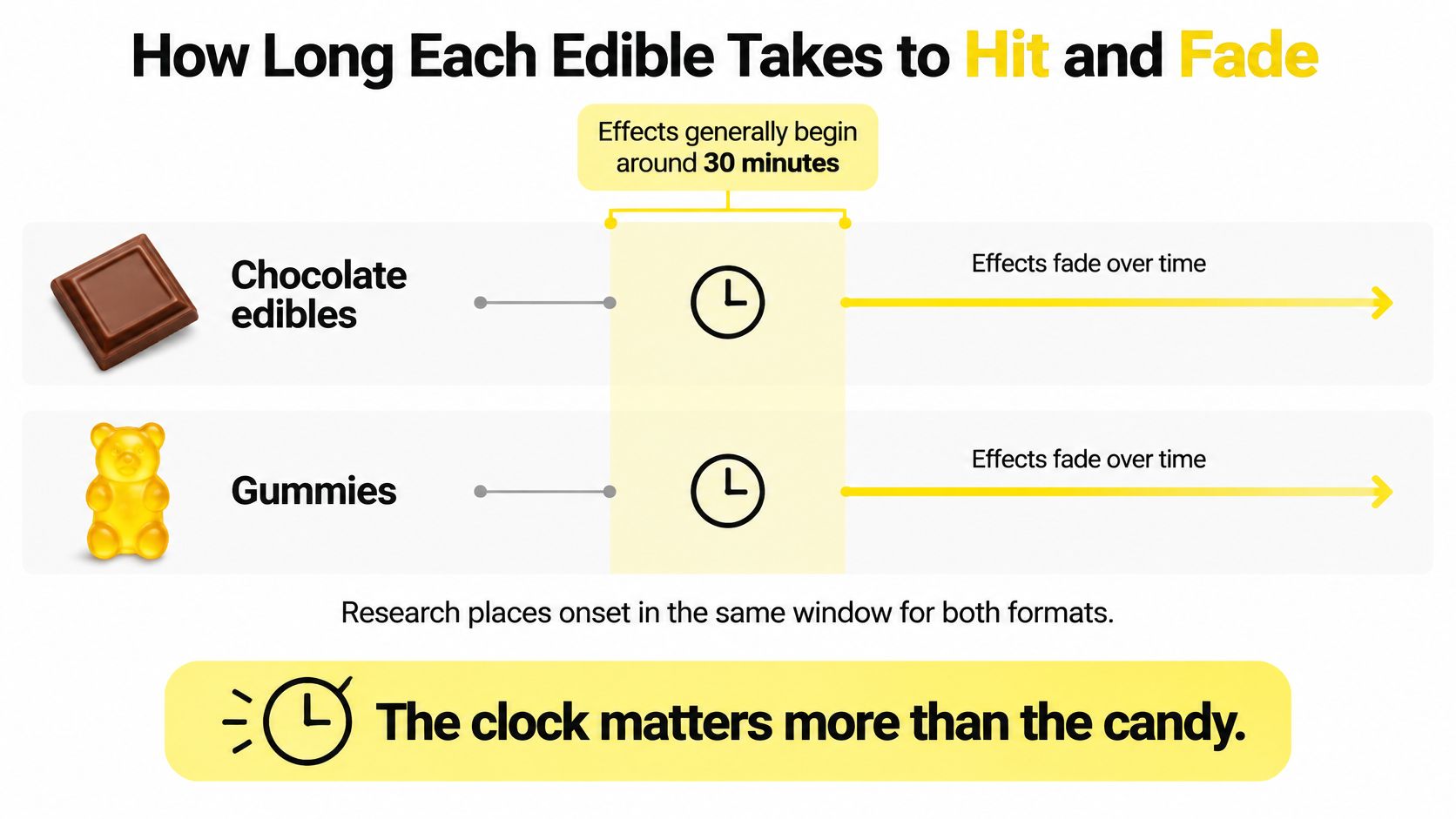
The clock matters more than the candy. A peer-reviewed review of human oral-cannabis studies reports that subjective effects generally begin 30 to 60 minutes after ingestion, reach a sustained peak approximately 90 to 180 minutes later, and commonly last 6 to 8 hours. In a controlled study within that literature, 17 adults who had abstained from cannabis for at least 60 days received brownies containing 0, 10, 25 or 50 mg THC, and active-dose effects still didn't appear until 30 to 60 minutes, with peaks at 1.5 to 3 hours. A brownie, a gummy and a chocolate square all sit inside that window.
Public-health guidance widens the margins rather than narrowing them by format. Health Canada's guidance on using cannabis products places initial effects at 30 minutes to 2 hours, the strongest point at 2 to 4 hours, and duration at roughly 4 to 8 hours.
Both formats share one onset band, which is the single most useful thing to internalize before your first dose.
Walking the 7 p.m. dose
Say a first-time patient swallows one 2.5 mg gummy at 7:00 p.m. At 7:30 p.m. they feel nothing, which is exactly what the timeline predicts, not evidence of a dud. Under Health Canada's outer margins, that same serving may not reach its strongest point until roughly 11:00 p.m. A second gummy taken at 7:45 p.m. doesn't fix a slow onset, it stacks two doses whose peaks arrive together. The identical arithmetic applies to a chocolate square eaten at the same hour.
Edible timeline after one dose
| Time after dose | Typical stage | What to do |
|---|---|---|
| 0 to 30 minutes | Nothing expected yet | Wait and do not redose |
| 30 minutes to 2 hours | Effects may begin | Keep waiting, do not add THC |
| 1.5 to 3 hours | Peak effects in controlled studies | Note intensity and any unwanted effects |
| 2 to 4 hours | Strongest point per Health Canada guidance | Rest, avoid driving |
| 4 to 8 hours | Effects fading for many users | Log duration |
| Up to 12 hours | Some effects may persist | Plan the next day around it |
What to write down
Keep three timestamps in your phone: the moment you swallowed the dose, the moment you first noticed anything, and the moment you'd call yourself back to baseline. Add the milligrams and whether you'd eaten. Two or three sessions of that log tell you more about your personal onset than any format comparison, and our breakdown of how long edibles take covers the timing questions patients ask most.
No evidence establishes that gummies always onset faster or that chocolate always lasts longer. Dose, digestion, food intake and formulation move those numbers; the confectionery label doesn't.
Dosing Accuracy from Scored Bars to Single Pieces
Ten milligrams in a bar and ten milligrams in a gummy are the same dose on paper. The practical difference is whether you can reliably reach a smaller unit. That is why format matters through two mechanisms only: the clarity of the label and the accuracy of division. Candy shape does not change pharmacology.
British Columbia's cannabis edibles safe-use fact sheet recommends starting with 2.5 mg THC or less for edible and drinkable cannabis products. The same guidance warns that effects may not be felt for 2 hours and that full effects may take up to 4 hours. That matters because a cautious start requires patience. A person who redoses before the peak window has changed the dose, even if the product itself stayed the same.
The arithmetic behind a 2.5 mg start
A 10 mg chocolate bar split into four 2.5 mg portions works only when the manufacturer's scoring marks real dose boundaries. Decorative grooves are not a dosing system. A gummy labeled 2.5 mg per piece removes the splitting step, but the per-piece label still sets the dose, not the shape.
Dose arithmetic for a 2.5 mg start
| Format example | Labeled dose | Portion for a 2.5 mg start | Label check |
|---|---|---|---|
| Scored chocolate bar | 10 mg in four segments | One segment | Confirm the scoring matches the segments |
| Unscored chocolate bar | 10 mg total | Not safely divisible | Choose a scored or smaller product |
| Single-dose gummy | 2.5 mg per piece | One piece | Confirm the per-piece label and batch |
| Gummy with 10 mg per piece | 10 mg per piece | Not reliably divisible | Choose a lower-dose product |
Those rows describe four different dosing risks. A scored bar can work when the break lines match the labeled segments. An unscored bar leaves no defensible small portion, so a knife and a guess become the dosing instrument. The 2.5 mg gummy is cleaner because there is nothing to estimate. The 10 mg gummy is easy to misread as a single modest serving, when one piece is four times the cautious start.
A gummy is a unit of packaging. A milligram is a unit of dose. Only one of them belongs in your log.
Titration that respects the peak window
Take the smallest reliable unit at a fixed hour, ideally bedtime for a first attempt, then wait through the full onset and peak window before considering more. If the effect was too subtle across two separate sessions at that dose, step up by the smallest increment the product allows, whether that is one more scored segment or a higher-strength piece. Our cannabis edible dosage chart lays out those increments side by side.
The buying rule follows from the arithmetic: compare milligrams per serving and servings per package, then choose the product whose smallest reliable unit fits the intended starting dose. Chocolate can win on precision, despite the softer image. A scored bar with clear segments can create repeatable portions. A single gummy can win when it is already dosed at the target amount. Neither format earns trust from texture alone. The label, the serving structure and the ability to repeat the same unit are what make the dose controllable.
How Food and Fat Change What You Feel
Chocolate carries fat, and fat is the most overlooked variable in this whole comparison. Two people can take the same labeled dose of the same product and report different experiences, and the explanation is often dinner, not the edible.
In a randomized, double-blind, four-way crossover pharmacokinetic study, consuming THC with a high-fat meal significantly increased the area under the blood-concentration curve for THC and 11-hydroxy-THC, and changed the time to peak concentration. Read that sentence carefully, because it describes a meal effect, not a chocolate effect. The study does not establish that every chocolate product produces a predictable increase over every gummy, since formulations differ in fat content, dose uniformity and ingredients.
The practical mechanic is simple: identical labeled milligrams can behave differently fasting versus after a high-fat dinner. A patient who eats a chocolate edible after a cheese-and-steak dinner may feel a different intensity and a different peak time than the same patient taking the same milligram dose of a low-fat gummy on an empty stomach. Neither product changed. The conditions did. The fasting side of that contrast gets a closer look in the guide to taking edibles on an empty stomach.
This is also why format comparisons mislead. If fat intake at the moment of dosing can shift both total exposure and peak timing, then the gummy-versus-chocolate question is largely a question about what else you ate. The candy is the smaller variable. The plate is the bigger one.
Running a fair personal test
Direct head-to-head research comparing chocolate and gummy formats at matched THC doses is still limited, so the evidence cannot yet crown a winner. What you can do is remove the noise from your own testing.
- Hold the dose constant: same milligrams, same product batch if possible.
- Hold the meal constant: same foods, same interval between eating and dosing.
- Hold the clock: wait at least two hours before any redose, and record onset, peak, duration and unwanted effects.
Change one variable per session or the log means nothing. A test where the dose, the meal and the timing all move at once produces a story, not data.
For a medical patient chasing repeatable symptom relief, consistency beats novelty. A format you can reproduce under the same conditions is worth more than one marketed as premium or fast-acting.
Taste, Storage and Child Safety Compared
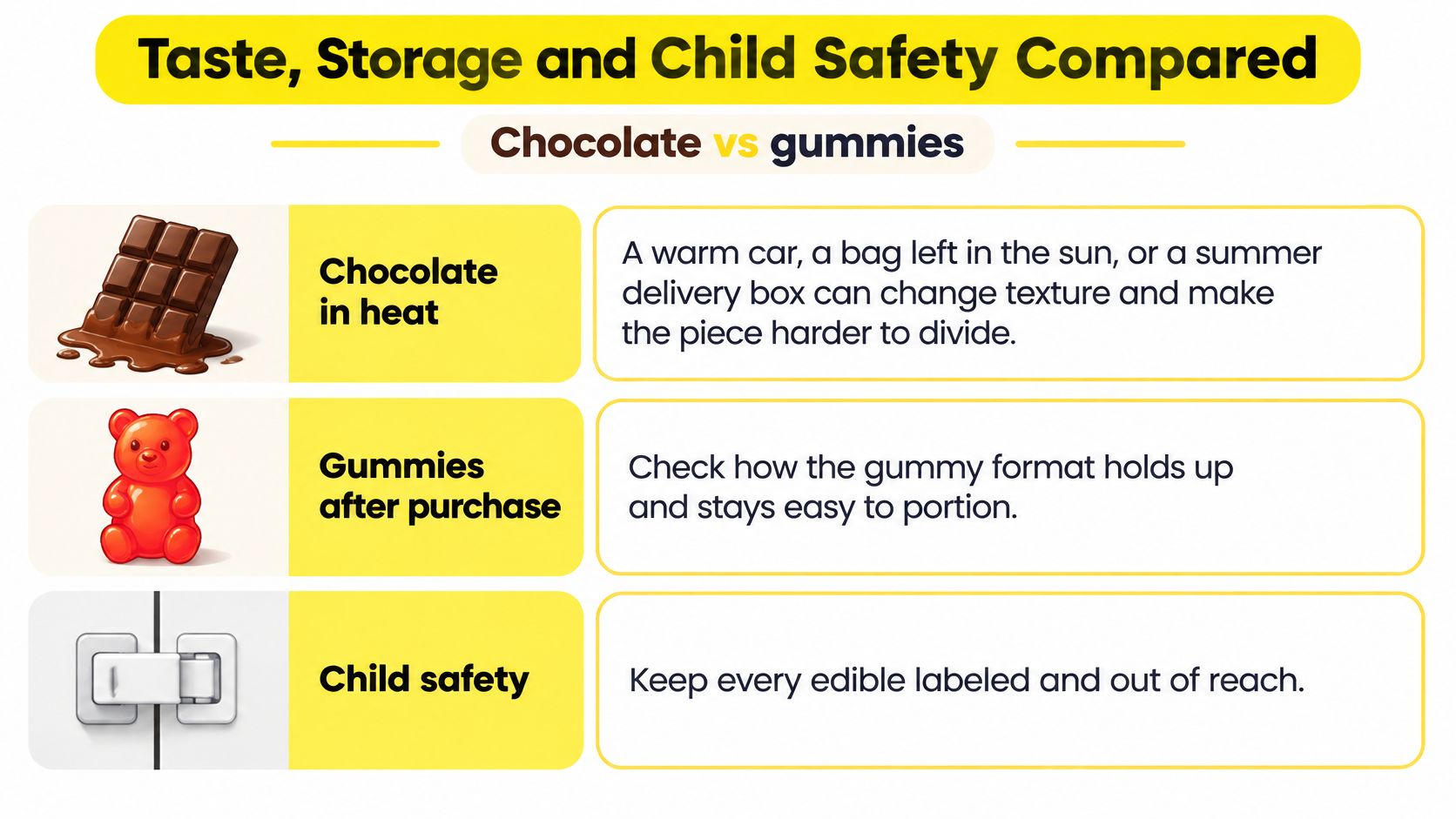
Chocolate loses its shape in a warm car, a bag left on a sunny seat, or a delivery box in August. Once a bar softens and re-solidifies, the break lines no longer describe clean portions, and a dose you planned to divide becomes a dose you have to guess at. Gummies fail differently: they stick together, soften, or dry out, and a sugar coating tells you nothing about what's inside. A cannabis edibles market analysis flags exactly these practical gaps, including warm-climate storage, melting during delivery, allergen exposure, sugar load and accidental consumption by children who see ordinary confectionery.
Ingredients worth reading twice
Dietary restrictions cut across both formats. Chocolate may contain dairy, nuts or soy lecithin; gummies may be built on gelatin or pectin, which matters if you avoid animal products. Sugar load is a real consideration for anyone managing blood glucose, and a "dessert" edible is still a dessert. Read the ingredient panel before the flavor name.
A storage checklist that works for either format
- Keep it sealed: leave the product in its original packaging until you dose, so the label and the contents stay together.
- Keep it cool and dry: a closed cabinet away from direct sun, never a windowsill or a parked vehicle.
- Keep it high and out of reach: children and pets both, ideally behind a latch rather than just above eye level.
- Keep the dose visible: confirm each product is clearly labeled with its per-serving milligrams before it goes into storage. Our guide to storing edibles covers the heat and moisture details.
All our edibles are sealed and packaged to keep them fresh until delivery, and each edible product is clearly labeled so customers know what they're getting. That labeling is the part you should protect at home, because a gummy dropped into an unmarked jar is no longer a known dose.
Store every edible as you would any candy you can't afford to lose track of.
Which Edible Fits Your Situation and What to Check Before Buying
There's no winner here, and treating the choice as a contest is how people end up with a product that doesn't match their dosing behavior. Match the format to your constraint instead.
Edible format by situation and buying check
| Situation | Better starting format | Reason |
|---|---|---|
| First-time user starting at 2.5 mg | Single-dose gummy labeled 2.5 mg per piece | No splitting needed |
| Needs 1 to 2.5 mg increments | Scored chocolate bar | Fractional dosing only if segments are accurate |
| Eats a high-fat dinner before dosing | Either, tested one at a time | Keep the same meal routine for comparison |
| Wants a food-like experience | Chocolate edible | Familiar texture and taste |
| Household with children or pets | Format with secure packaging and high storage | Both resemble candy; storage matters most |
| Wants to try both formats | Buy one low-dose product first | Test one variable at a time |
Three buyers, three different answers
A first-time buyer in Cleveland Park who wants a quiet evening should pick the per-piece low-dose gummy and stop there, because the only decision left is when to take it. A patient in Silver Spring who's already learned that a small increment works better than a full piece needs a scored bar with honest segmentation, or a lower-strength gummy line, and should reject any bar whose grooves don't correspond to labeled segments. A buyer in Alexandria who eats a substantial dinner before dosing can use either format, but should keep the meal identical across sessions so the log means something.
The household-with-children row deserves emphasis because it's the one people get backwards. Neither format is meaningfully safer by design; both look like sweets. Secure packaging, a latched box and a high shelf do the protective work, and the format choice contributes almost nothing.
A five-step check before you order
- Compare the numbers first. Look at milligrams per serving and servings per package, plus the cannabinoid ratio if the product includes CBD or other cannabinoids. Two products with the same package total can carry very different servings.
- Identify the smallest reliable unit. That might be a 2.5 mg gummy, one segment of a scored 10 mg bar with four 2.5 mg segments, or a lower-dose product entirely. If you can't name your smallest unit, you can't titrate.
- Read the ingredient panel. Check for gelatin or pectin, dairy, nuts and soy lecithin against your own dietary limits, and note the sugar content if that's a concern for you.
- Plan storage before purchase. Decide where the product will live: cool, dry, sealed in original packaging, out of reach of children and pets. A summer delivery to a hot porch shouldn't be the first place a chocolate bar sits.
- Buy one format first. Skip the mixed multi-pack for your initial test, because two formats taken in one evening make it impossible to attribute what you felt to what you ate.
Every product we carry is tested for pesticides, potency, and more, which is what makes the labeled milligrams worth trusting as your comparison unit. Our edibles menu rotates in seasonal flavors, limited editions and classic favorites, so the specific gummy or bar you liked last month may be replaced by a different formulation with different per-piece milligrams. Re-read the label each time rather than assuming a repeat purchase is a repeat dose.
You can mix and match different edible items in one order, and that flexibility is useful once you know how each format behaves for you. Before that point, it works against you: a bag containing a scored bar, a low-dose gummy and a higher-strength piece invites exactly the guesswork you're trying to eliminate. Build the assortment after you have a baseline, not before.
At Mr. Nice Guys DC, ask staff to show you the per-serving milligrams and the batch label on any gummy or chocolate bar you're considering, and confirm the smallest unit you can reliably take. That one question replaces most of the format debate. Then apply the same discipline at home: pick the smallest reliable unit, wait a full two hours before considering anything more, and log onset, peak and duration. Three sessions of that record will tell you which format fits your body far more accurately than any texture preference will.
Our edibles menu carries both gummies and chocolate bars with clear per-serving labeling, and every product is tested for pesticides, potency, and more, so you can compare milligrams instead of guessing at candy shape. Browse the current low-dose gummies and scored chocolate options at Mr. Nice Guys DC, then order for in-store pickup, curbside, or delivery across DC and nearby neighborhoods including Alexandria, Bethesda, Rockville and Silver Spring. If you're starting at 2.5 mg, bring your questions to the counter and we'll help you find the smallest reliable unit before your first dose.
Mr Nice Guys DC
At Mr. Nice Guys DC, we’re more than just a cannabis delivery service — we’re passionate advocates for quality, convenience, and community. With years of experience in the cannabis industry, our team is dedicated to educating and empowering customers across Washington, D.C. Whether you're a seasoned user or just starting your cannabis journey, our blog delivers trusted tips, product insights, and the latest updates from the world of weed. Stay informed, stay elevated.
