
Must Be 21 To Enter
By entering this site you are agreeing that you are at least 21 Years of Age or older.
I AM 21 OR OLDERHow to Store Edibles So They Stay Fresh and Safe


You've opened a pouch of gummies, put the delivery bag on the counter, and noticed the kitchen is warmer than you thought. Should the rest go in a cupboard or the fridge? And where can you put them so a roommate, visiting child, or dog won't mistake them for food?
Knowing how to store edibles means answering two separate questions: what keeps this particular food in good condition, and what keeps other people and pets from accessing it. A chocolate bar, a homemade brownie, and a sealed mint tin don't need exactly the same setup.
Cool Dry Storage by Edible Type
A warm apartment and a half-open pouch can leave gummies sticky before the printed date arrives. Start by reading the storage instructions, then choose a location that stays within them. The cupboard above the stove might be dark, but it isn't reliably cool.
For shelf-stable commercial products, a useful baseline is 50–70°F (10–21°C), with relative humidity below 60%, matching the dry-storage conditions specified in Maryland's edible-processing standard. That's a storage reference, not a promise that every edible will last until its date under those conditions.
Keep the original child-resistant package inside an opaque, airtight outer box. Use a calibrated thermometer and hygrometer to check the location rather than judging it by how comfortable the room feels.
Where to store each edible
| Edible | Best spot | Temperature | Packaging | Watch for |
|---|---|---|---|---|
| Gummies | Cool, dark cupboard | 50–70°F and humidity under 60% | Original child-resistant pouch in an opaque airtight box | Sticking, melting, or sugar clumps |
| Chocolate | Cool cupboard, or fridge only if the label allows | Cooler end of 50–70°F | Original wrap, kept closed until it returns to room temperature | Softening, fat bloom, condensation |
| Baked goods | Cool, dry cupboard, or fridge if the label allows | 50–70°F unless the maker names colder storage | Sealed original pack, separate from family snacks | Mold, dryness, stale odor |
| Hard candy and mints | Dry, dark cupboard | 50–70°F and humidity under 60% | Original sealed container | Clumping from humidity |
| Oil-based edibles | Cool, dark spot; fridge or freezer only if the label says so | 50–70°F unless the maker names a colder range | Original light-blocking bottle, opened rarely | Potency loss from light and warmth |
| Homemade edibles | Locked fridge, away from family food | Refrigerated according to the recipe's food-safety needs; shorter storage than a validated commercial product | Airtight container marked cannabis, dose, and date | No factory seal and faster spoilage |
The temperature and humidity entries use the dry-storage baseline above; product-specific directions take priority.
Gummies need protection from both warmth and humidity. A sealed pouch in a bedroom closet may work better than a kitchen drawer beside the dishwasher. Chocolate needs steadier temperatures: if refrigeration is permitted, leave its wrapping closed while it returns to room temperature so moisture doesn't collect on the surface.
Baked goods deserve closer attention to their ingredients and handling instructions. Don't give a moist brownie the same assumed storage life as a hard mint. For homemade pieces, mark the dose as approximate if it hasn't been reliably established, and never invent a commercial-style expiration date.
Oils aren't a shelf-life guide for gummies
Under dark conditions, an analytical study of cannabis oils found THC and CBD remained above 98% of their initial concentrations after 28 days at 4°C and −20°C, while daylight at about 22°C caused rapid CBD loss. Those results concern oils, not the microbial safety or shelf life of cookies and gummies.
Practical rule: Choose storage for the food you actually have, not for a different cannabis product with encouraging stability results.
Keep every format away from windows, ovens, bathrooms, and parked cars. Our guide to humidity-control packs offers additional context, but don't add a pack to edible packaging unless it's appropriate for that food and permitted by the manufacturer.
How to Seal and Label an Opened Pack
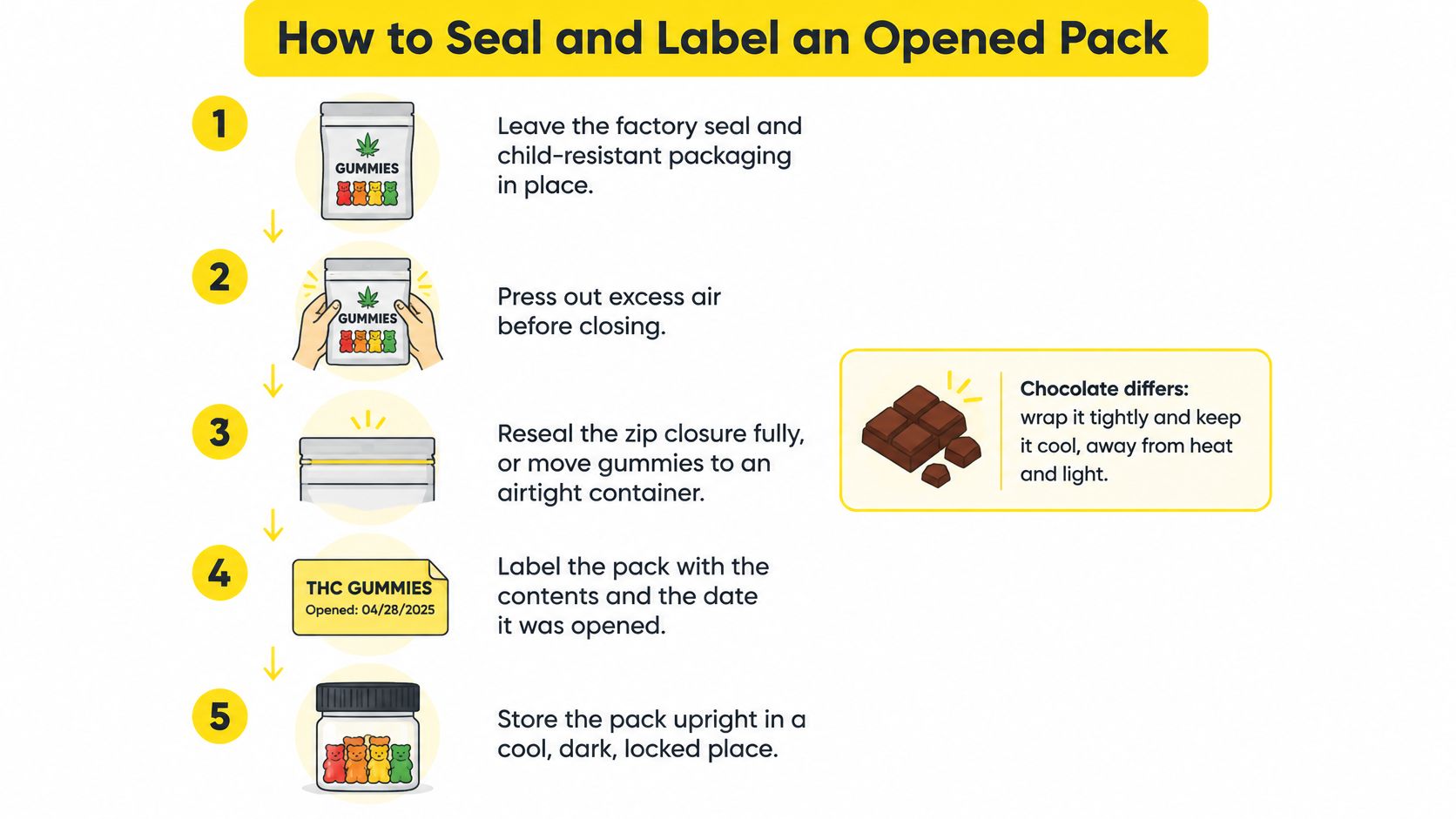
After opening a gummy pouch, close it before setting it down, even if you plan to have another piece shortly. The original label still describes the package as sold, so a brief note can help track what remains without changing the manufacturer's information.
Tamper-evident and resealable describe different things. Health Canada's edible-cannabis safety alert explains that a tamper-evident feature no longer works once the package is opened. A zipper or lid can still close afterward, but it must be secured each time.
A six-step closing routine
Keep the original packaging. Leave the factory seal intact until the first serving. Mr. Nice Guys DC seals and packages its edibles to help keep them fresh until delivery, but that seal cannot protect an opened pack. Open it at the intended tear point so you do not damage the zipper or label.
Close the zipper or lid completely. For a flexible pouch, gently press out excess air without crushing the food, then run your fingers along the full closure. Check the corners for trapped sugar or folded packaging. A screw-top jar should have its lid fully seated.
Keep the printed label readable. Preserve the THC per piece, serving information, lot number, and best-by date. Add the purchase and opening dates to removable tape, along with a note such as “eight gummies remaining.” Keep the potency information visible, and don't change the printed serving count to show what is left.
Use a separate outer container if needed. Keep each edible in its own labeled package rather than mixing flavors or strengths. A candy dish is not a substitute for packaging, even in a household with no children. If the original pouch no longer closes, keep it and its label with a suitable replacement container so the edible remains identifiable. See these cannabis storage containers for examples of storage options.
Return the pack to its usual place. Put it away as soon as you finish, rather than leaving it beside a glass or on a windowsill. A consistent spot makes it easier to remember where the labeled package belongs, including when other people share the kitchen.
Use cold storage only when the instructions allow it. Some chocolates and baked goods come with refrigeration directions. Follow the product's instructions. If a chilled package can be brought back to room temperature before opening, let it warm while still sealed so moisture is less likely to collect inside.
The routine is easiest to follow when the edible, its label, and its storage container stay together.
Chocolate needs its wrapper too
For a partly eaten chocolate bar, fold the inner wrapper around the remaining pieces and keep the labeled outer sleeve. Plain foil alone can hide what the chocolate is and remove the product information from the package.
One product, one readable label, one properly closed outer container.
Homemade edibles need a clear cannabis label, too. Note the ingredients, date made, and known or approximate dose, and keep them apart from ordinary food.
Locked Storage Away from Children and Pets
Unintentional cannabis-poisoning rates among U.S. children younger than 6 rose 1,375% between 2017 and 2021, according to federal health information on cannabis exposures. Two-year-olds represented 28% of reported pediatric exposures, and three-year-olds represented 25%; the same federal document summarizes more than 3,000 children under 6 treated for edible-marijuana exposure in 2021, compared with just over 200 in 2017.
Treat edibles like medication, not like snacks waiting on the counter. Child-resistant doesn't mean child-proof, and an open zipper removes an important barrier entirely.
A lock works when attention slips
Say your gummies resemble the fruit snacks a visiting child eats. Put the original pouch directly into a locked box after delivery, rather than into the shared fridge door. A high shelf alone isn't a dependable substitute because children can climb and adults can forget where they left a bag.
Health Canada's safe-storage guidance recommends original child-resistant packaging, separation from ordinary food and drinks, and a locked cupboard, lockbox, or safe out of children's and pets' sight and reach. Keep the key or combination under adult control, too.
The same arrangement matters when friends stay overnight or teenagers use the kitchen. A visitor shouldn't have to inspect a gummy to discover it contains cannabis. Explain the household rule to caregivers and roommates without giving unauthorized people access.
Use this visual reminder near your storage routine, not as a replacement for the lock itself.

Shared homes need a complete routine
U.S. Poison Centers managed 2,578 cannabis-edible exposure cases involving people aged 0–19 by April 30, 2025, and 39,497 from 2019 through 2025, according to its edible-cannabis exposure tracker. In California, edibles accounted for 57% of cannabis-related poison-control calls involving children aged 5 and under in 2024, according to the California Department of Public Health dashboard.
After each serving, make these actions part of putting the product away:
- Close before doing anything else. Return the pouch to locked storage before answering the door or leaving the kitchen.
- Protect refrigerated products. Use a suitable lockable refrigerator container, not a partly opened bag beside family drinks.
- Check the floor and table. Pick up dropped gummies, chocolate fragments, and crumbs before a child or pet reaches them.
- Secure the waste. Put stale, melted, or unfinished pieces in a closed waste container inaccessible to children and animals, rather than an open bin.
A smaller labeled dose doesn't make unsecured storage acceptable. Our low-dose edibles guide addresses product selection, not permission to leave products accessible.
If a child may have swallowed cannabis, contact poison control promptly rather than waiting for symptoms. Call emergency services for severe symptoms such as trouble breathing or unresponsiveness. For suspected pet ingestion, contact a veterinarian or animal poison-control service immediately, and keep the package available to identify the product.
What Heat Light and Air Do to Potency
An edible can look unchanged while its cannabinoid content changes. Appearance helps you spot some food-quality problems, but it can't confirm that the remaining THC matches the original label.
A thermometer helps you evaluate the location, although a clear countertop jar isn't an appropriate everyday substitute for labeled, secured packaging.
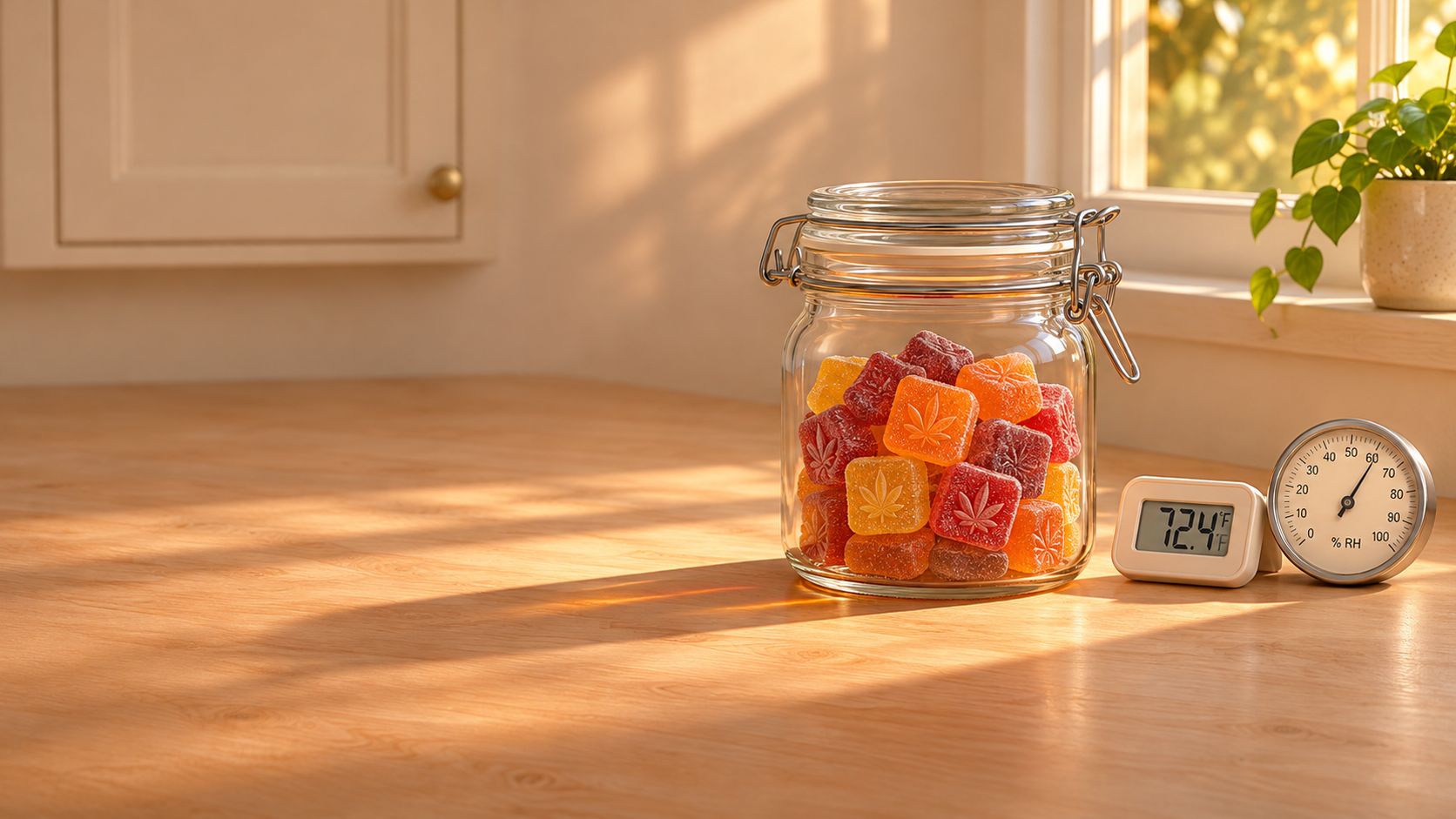
A normal room isn't neutral indefinitely
A 2025 cannabinoid-stability study found all tested CBD and THC samples degraded over 180 days, with losses ranging from 13.1% to 94.6% for CBD and 9.1% to 99.7% for THC, and especially pronounced THC degradation in some samples stored at 20°C, approximately 68°F. Both light and temperature significantly influenced the losses.
Those broad ranges don't tell you how much potency your particular brownie has lost. They show why storage duration, formulation, and exposure matter, even without extreme heat. You can't turn a laboratory range into a reliable replacement dose.
Room-temperature exposure can also encourage THC's conversion into CBN. That doesn't make an old product a predictable sleep aid or let you calculate its effects by age.
Reduce exposure without creating a moisture problem
Keep openings brief, close the pack between uses, and avoid repeatedly moving it between warm and cold locations. Freezing isn't automatically the best household choice because food texture and condensation still matter.
If the label permits freezing, avoid repeated thawing and refreezing. Keep portions sealed and thaw only what you'll use, without transferring them into unidentified bags. Oil products have their own considerations, which our THC tincture shelf-life guide discusses separately.
For another visual reference, use the video below alongside your product's written handling directions.
Discard, don't adjust the dose: Mold, an unusual odor, damaged packaging, or a major texture change calls for replacing the product, not estimating a smaller serving.
Check dates before use, but don't let an unexpired date override obvious deterioration. A chocolate bar that smells fermented belongs in secure disposal, not on a tasting spoon.
Fixes for Melted Sticky or Stale Edibles
Sticky gummies often point to warmth or humidity, but texture alone can't establish safety. Before moving the pouch, check its date, storage history, smell, and packaging. A mild quality change is different from leaking, mold, or an unexplained major change.
Don't try to rescue a fused mass by cutting it into guessed doses. Once individual portions are no longer identifiable, the original per-piece label may no longer help you portion it accurately.
Edible problems and what to do
| What you notice | Usual cause | What to do |
|---|---|---|
| Gummies stuck in a clump | Humidity or a warm room | If there's no sour smell, they're still in date, and portions remain identifiable, move the sealed pouch somewhere cooler and drier and finish sooner |
| Chocolate soft or pale on the surface | Heat or temperature swings | Bloom can be harmless; discard if the smell is rancid or sour, or you can't distinguish bloom from spoilage |
| Fuzzy spots, leak, or fermented smell | Moisture and spoilage | Discard without tasting |
| Package wet after the fridge | Condensation from opening it cold | Let the next pack warm while still sealed before opening, unless it requires continuous refrigeration |
| Effect seems weaker months later | Possible exposure to light, air, and warmth | Don't take a second dose to compensate; check the date and storage spot |
| Open bag left on a table | Forgotten after delivery or a serving | Reseal, keep the label, and lock it away immediately |
| Date passed and storage history unknown | Unreliable conditions | Discard rather than guessing the dose |
Know when a fix isn't enough
A pale film on chocolate may be fat bloom rather than mold, but don't scrape away suspicious material and assume the rest is fine. Our guide to recognizing mold on cannabis offers additional visual context; it isn't a test that can certify an edible as safe.
Likewise, putting an old cookie in the fridge won't reverse spoilage. Cooling can help prevent further quality loss in an otherwise suitable product, but it doesn't undo what happened on a hot counter.
An open delivery bag is a different problem: someone else can access it right now. Deal with that immediately, then assess freshness after the contents are secured.
Set the Lockbox Before the Next Order
Prepare the storage space before another package arrives. For a hypothetical ten-piece gummy order, the useful setup is an empty lockbox ready to receive the labeled pouch, not a plan to find somewhere later.
Tonight's checklist
- Choose the location. Put a lockbox on a dry closet shelf away from ordinary snacks, and keep its key under adult control.
- Clear out loose pieces in candy dishes or unmarked tubs. Check dates and securely discard anything with mold, leaks, or a fermented smell.
- Keep identifiable commercial products in their original containers. Add a remaining-piece note without covering the THC information.
- Match arriving products to their handling instructions. Set aside appropriate secured refrigerator space before buying anything that needs it.
- Close the box and clear the counter before you consider the delivery put away.
Our edibles include gummies, chocolates, baked goods, and specialty treats, and each edible product is clearly labeled so customers know what they're getting. Our accessories include rolling papers, grinders, and storage solutions. Eligible patients aged 21 and older in Washington, DC can arrange in-store pickup, curbside, or delivery.
The practical finish line is simple: the contents are identified, the appropriate storage is ready, and nobody has left an open bag behind.
At Mr. Nice Guys DC, we offer clearly labeled edibles and storage solutions to help you plan beyond the first serving. Visit us to choose a format that fits your needs and get guidance on keeping its packaging, label, and household storage routine together.
Mr Nice Guys DC
At Mr. Nice Guys DC, we’re more than just a cannabis delivery service — we’re passionate advocates for quality, convenience, and community. With years of experience in the cannabis industry, our team is dedicated to educating and empowering customers across Washington, D.C. Whether you're a seasoned user or just starting your cannabis journey, our blog delivers trusted tips, product insights, and the latest updates from the world of weed. Stay informed, stay elevated.
