
Must Be 21 To Enter
By entering this site you are agreeing that you are at least 21 Years of Age or older.
I AM 21 OR OLDERHow to Use Humidity Control Packs for Cannabis
.svg)

.png)
You know the moment. You open a jar that looked fine last week, and the flower inside smells flatter than it should, a little cardboard-like instead of bright, citrusy, or gassy. That's usually the point where people realize storage wasn't a background detail at all, it was part of the product.
Humidity control packs exist to keep that moment from happening. They're a two-way humidity regulation tool, which means they don't just add moisture. They release moisture when the air is too dry and absorb moisture when it's too humid so sealed contents stay closer to a preset relative humidity window, rather than swinging up and down with the room. In practical terms, that's why these packs matter for cannabis flower, and why they've also become useful in storage-sensitive categories where texture, aroma, and stability matter. A pack can't fix a bad container, though. If the jar or bag leaks, the pack is fighting the wrong battle.
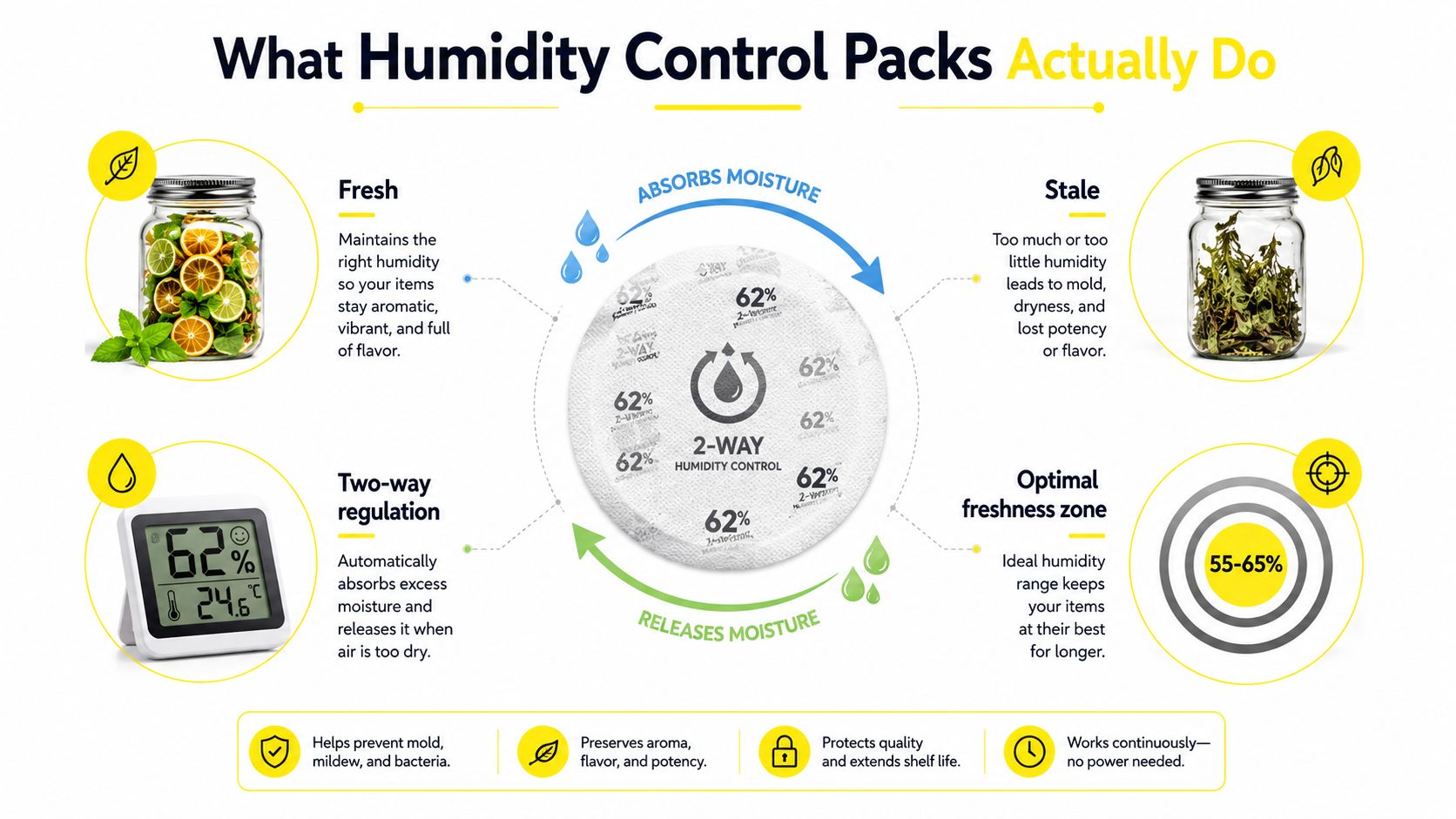
Practical rule: if the container isn't airtight, no pack will save it.
What Humidity Control Packs Do
A lot of patients picture humidity control packs as little moisture sponges. That is only part of the story. Inside a sealed container, they work more like a small balancing system that tries to hold a target RH instead of letting the contents drift every time the room gets dry, the temperature changes, or the container is opened.
The job is balance, not just hydration
That distinction matters because flower that dries out does more than feel harsh. It can turn brittle, and the aromatic compounds people bought it for can fade faster when storage swings too far in either direction. Boveda describes its packs as accurate to within ±2% RH in an airtight environment, with common target levels spanning 58% to 75% RH depending on the product, and a 62% pack meant to stabilize sealed contents around that level. Those specs show the pack is designed to work inside a sealed system, not as a loose add-on. Boveda humidity product guide
The storage system has three parts working together, the container, the seal, and the pack. If one of those pieces fails, the others cannot make up for it for long. A good jar with a bad lid can still leave flower disappointing, even if the right pack is sitting inside.
A practical way to look at it is simple, humidity control packs are there to reduce swings, not to rescue product that is already damaged. They work best on finished goods that are already cured and sealed, because the goal is to keep the environment steady enough that texture stays pleasant and aroma does not drop off quickly. If you are still figuring out how to keep flower fresh in a home setup, the basics are worth reviewing in this storage guide.
Why this is different from desiccants
Traditional desiccants only pull moisture out. That can help in some packaging situations, but it is the wrong shape of problem for finished cannabis flower that can dry out too much. A two-way pack stays steadier because it can move in either direction depending on what the sealed space needs.
That is why people notice less harshness, less brittle texture, and a more believable aroma when the environment stays in range. The pack does not create freshness. It helps the container stop damaging it.
Picking the Right RH Level and Pack Size
The most common mistake is treating RH and pack size like one decision. They're not. First you choose the humidity band that matches the product, then you size the pack to the container and moisture load.
RH target comes first
For finished cannabis flower, the practical conversation usually centers on 55% RH, 58% RH, and 62% RH. Lower targets are often chosen when someone wants a tighter, drier feel for longer storage. Mid-range targets are a middle ground for people who don't want the flower to feel too crisp or too soft. 62% RH is the familiar sweet spot for many finished flower users because it keeps the jar from feeling overdry while still aiming for stability.
For patients who want the terpene side of the story, it helps to think of humidity as part of aroma protection. If you need a quick refresher on why those aromas matter, the terpene overview at Mr. Nice Guys DC's terpene guide is a useful companion read.
Size the pack to the container
Sizing is where people get sloppy. Industry buying guidance gives a 1:500 volume-to-capacity ratio, meaning one standard 60-gram humidity pack stabilizes up to 500 cubic inches of sealed airspace. That puts a standard desktop humidor around 12" x 8" x 6" at roughly 576 cubic inches, which would call for one 60-gram pack or two 30-gram packs. Buying guidance on pack sizing
That logic translates cleanly to smaller storage, too. An 8-gram pack is commonly used for small jars, and one product listing says it's intended to protect up to 1 ounce (28 grams) of contents. Another listing describes an 8-gram 62% RH packet for sealed containers. Amazon Boveda 62% pack listing
| Humidity Pack Sizing at a Glance | ||
|---|---|---|
| Pack Size | Target RH | Best For |
| 8 g | 62% RH | Small jars, about an ounce of flower, personal medicine cabinet storage |
| 8 g | 55% to 58% RH | Smaller, drier long-term storage where a tighter feel is preferred |
| 60 g | 58% to 62% RH | Larger sealed containers, desktop humidor-style storage |
A bad habit is buying the biggest pack you can find and assuming more control is always better. Oversized packs can push the system too hard, especially in a small container, and that can create the wrong moisture balance. The smarter move is simple, pick the RH target, then match the packet to the container volume.
Placing Packs in Jars, Bags, and Bins
A pack can be the right size and still work poorly if it ends up in the wrong spot. Placement matters because the pack needs air moving around it, and it needs to stay away from sticky flower surfaces that can interfere with contact and circulation. In a sealed container, the pack is part of the system, not a loose add-on.
Jar placement that works
In a glass mason jar or similar stash jar, the cleanest setup is to keep the pack upright near the side or near the lid, not buried under the flower. You want air in the jar to move around the pack, then through the headspace, then back through the material. If the pack is pinned under heavy buds, it is not managing the sealed environment very well.
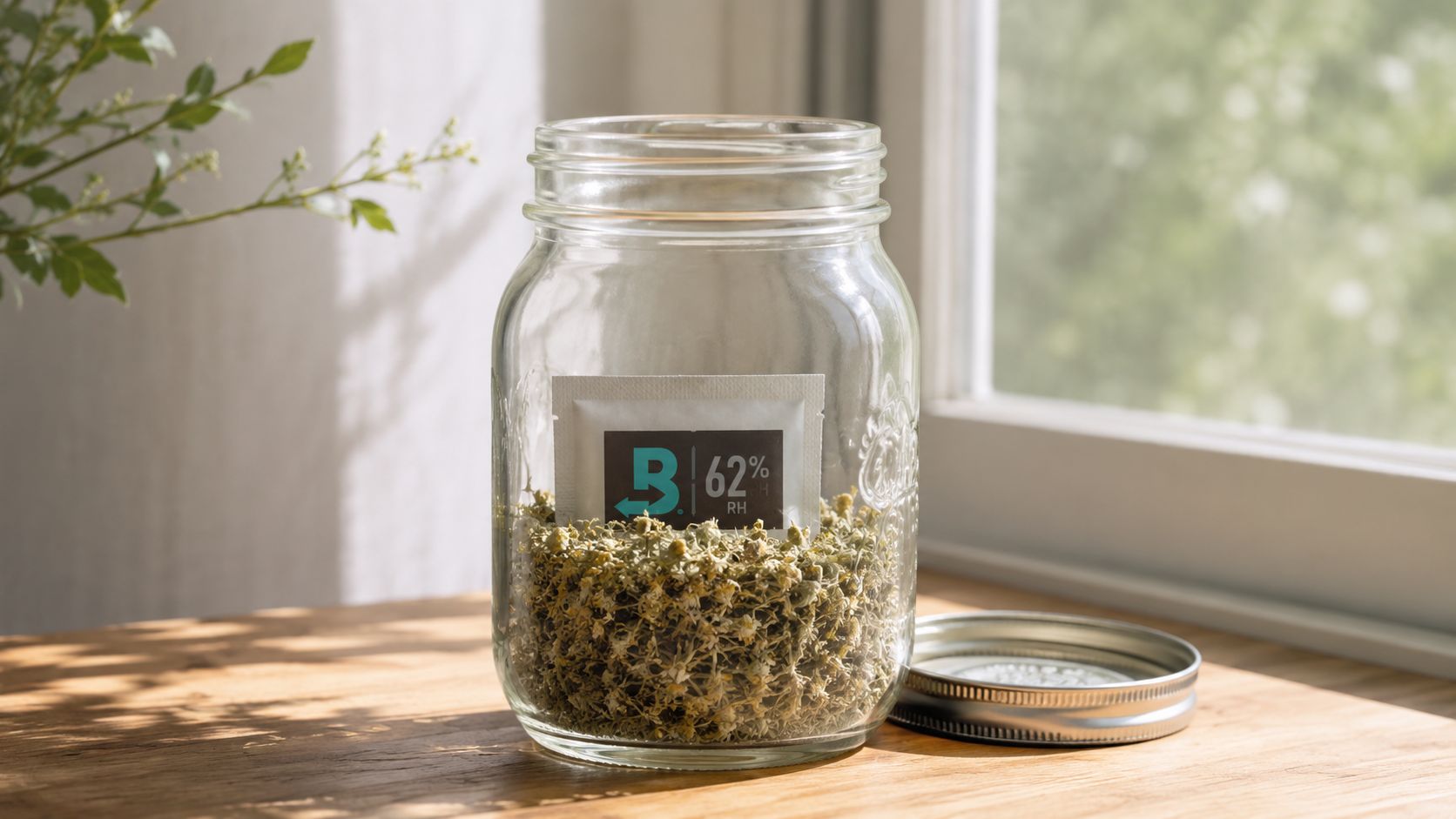
A common real-world setup is a patient transferring an ounce from a plastic pop-top into a glass jar and dropping in a single 8-gram 62% pack near the lid. That move makes sense because the jar is sealed, the amount is modest, and the pack sits close enough to influence the headspace without pressing directly into the product. The goal is stable air around the flower, not a pack crushed into the buds.
Bags and bins need a different approach
In stash bags, a loose pack can get crushed, folded, or pinned against product in a way that blocks airflow. A better pattern is to keep it in a pocket or separate compartment if the bag has one. If the bag is larger and used for storage rather than transport, the pack should be protected from direct contact with dense flower and checked more often for compression.
Large bins are a different beast. One big pack shoved into a corner usually underperforms compared with multiple smaller packs spread out so the container has more even coverage. That matters when the enclosure is wide, or when the headspace is uneven because the contents do not fill the whole volume.
Pre-roll storage needs even more care because the product is already broken down and dries faster in a loose setup. A separate container with its own pack keeps that inventory from drying out faster than intact flower, and the pre-roll handling guide is useful if you are sorting what gets jarred, bagged, or held aside.
Keep the pack where air can reach it, and keep the flower where your fingers will not crush it.
Quick setup checklist
- Verify the seal: Close the jar or bag and make sure it holds, because a leaky container makes the pack work too hard.
- Match the size: Use a pack that fits the container volume instead of grabbing the biggest option on the shelf.
- Keep it clear: Do not bury the pack inside the flower or pin it under heavy product.
- Watch for crushing: Tossed-in packs get folded, compressed, or damaged.
- Check the first day: Make sure the jar still smells like flower, not cardboard or stale closet air.
Storing Flower, Pre-Rolls, Concentrates, and Vapes
Different cannabis formats behave like different storage systems. A humidity pack can help in one container and become the wrong tool in another, so the goal is to match the pack to the product instead of treating every item the same.
Flower and pre-rolls aren't the same job
For flower, the sweet spot usually sits in the middle range, with 58% to 62% RH being the most practical zone for finished buds. Whole buds keep their structure better than broken-up material, and that structure slows drying inside the jar. Once flower is ground, the surface area increases and the margin for error gets smaller.
Pre-rolls dry out faster than intact flower because the material is already broken down and packed into paper. They do better in their own small container with their own pack, instead of sharing space with loose buds that may still be holding moisture differently. If you buy pre-rolls often, it helps to treat them as a separate inventory item rather than assuming one flower jar will protect everything. A closer look at pre-roll handling is available in this product guide.
Concentrates and vape cartridges need more restraint
With concentrates like wax, shatter, and rosin, humidity control is less about mold risk and more about preserving aroma and texture. Many of these products do better in cool, stable storage with very limited pack exposure, especially when they already live in a sealed silicone or glass container. If a pack sits too close to the concentrate itself, it can do more harm than good by changing the feel of the product or making the container harder to manage.
Vape cartridges usually need even less attention. Most are sealed units, so they generally do not need a humidity pack at all. Excess moisture is more likely to affect the electronics and oil behavior than help the cart, so the better move is to leave sealed cartridges alone and store them upright in a stable place. If you are sorting through vape options, this cartridge and pen guide can help you separate what needs humidity support from what does not.
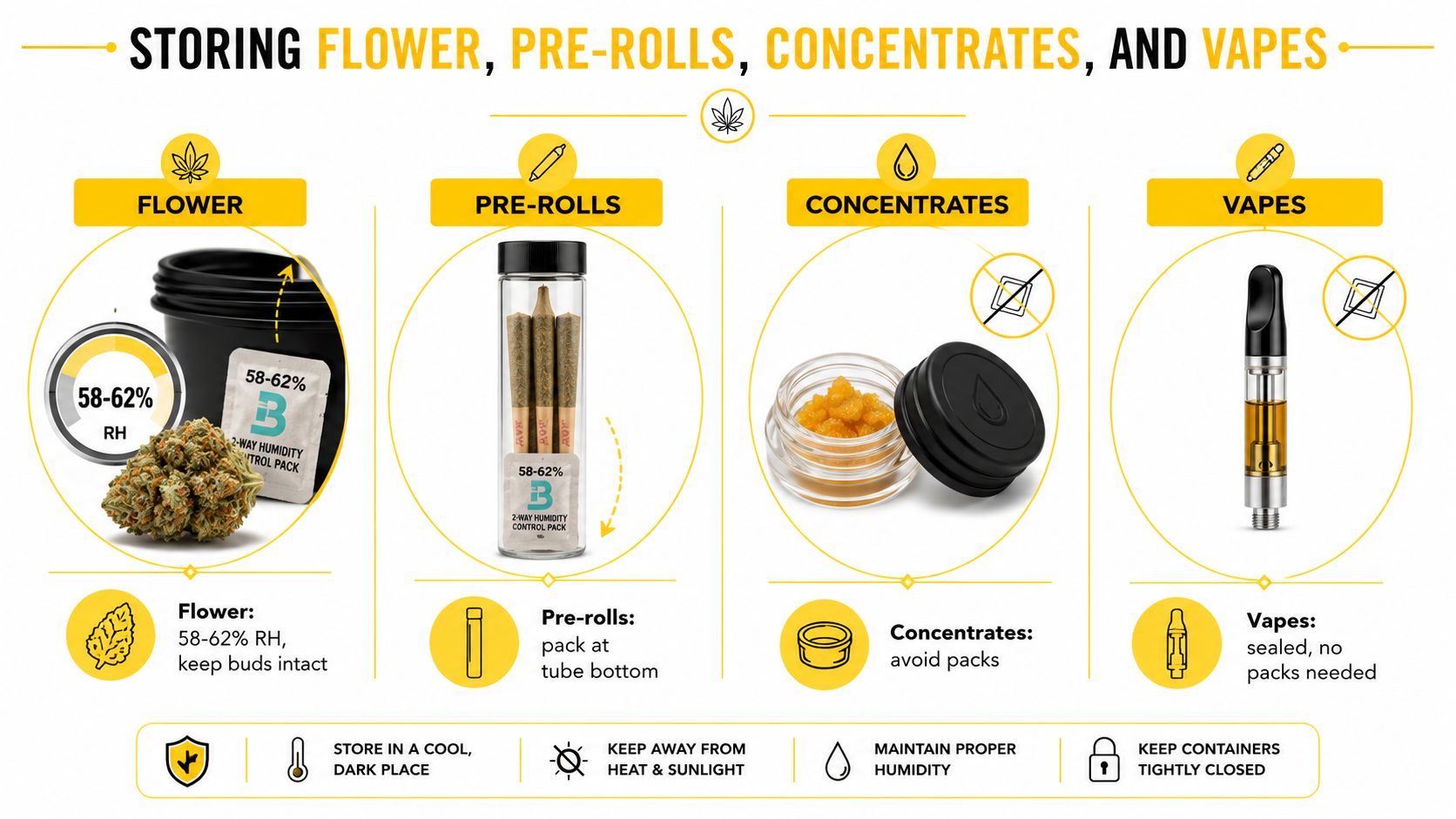
The practical takeaway is simple. Flower and pre-rolls benefit most, concentrates need a lighter touch, and sealed vape carts usually want no pack at all. Apply one rule to every format, and you end up over-managing some products while leaving others under-protected.
Replacement Schedule and Signs a Pack Has Failed
The calendar-only advice sounds tidy, but it's not the best way to manage a storage system. A pack doesn't fail because a date on the wall says so. It fails because the container, the climate, or the contents have pushed it past what it can regulate.
Look at the pack, then look at the flower
The simplest sign is physical. When a pack turns into a hard brick, it's telling you it's reached the end of useful control. Other warning signs include salt crystals forming on the outer membrane, the wrapper feeling unusually heavy or soggy, or the pack looking structurally tired even if it isn't torn.
The product itself can tell on the pack, too. Chalky, brittle flower usually points to storage that's too dry or too unstable. A flat, hay-like smell is another clue. On the other side, sticky, damp buds with no aroma can mean the environment is drifting too wet or the pack is undersized for the load.
Why a pack can look fine and still do nothing
A pack can still feel “okay” while delivering zero regulation. That happens when it's saturated, chemically exhausted, or repeatedly exposed to high-RH conditions that wear it down before the user notices. One manufacturer's usage guidance says to check packs regularly and replace them when they harden, which is a more useful rule than relying on the calendar alone. Two-way humidity control pack guidance
You can make this part of your routine without turning storage into a science project. Give the jar a 10-second sniff and texture check every time you open it, then spot-check with a digital hygrometer every few weeks if you want actual data instead of guesses. For patients who like the quality-control side of the house, that pairs well with the broader thinking in this potency-testing guide.
If the flower smells flat before the pack looks bad, trust your nose first.
Spotting Mold Before It Spreads and Staying Compliant
A warm DC weekend can expose bad storage fast. One forgotten jar in a closet, no AC, a little trapped heat, and suddenly the product smells wrong. That's the kind of moment where mold becomes a safety issue, not a storage annoyance.
What mold usually looks and smells like
Surface mold often shows up as white fuzz or gray webbing on the outside of the bud. Deeper bud rot can hide inside the flower and may not be obvious until you break the nug apart. The smell is often the biggest giveaway, a musty odor or something sharp and off, sometimes compared with urine-like notes.
If a product shows mold, the safest answer is simple, discard it. Don't try to salvage the good-looking part and don't assume a little trimming makes it safe.
Compliance still matters when the storage gets sloppy
Good storage also makes compliance easier. Keep product in its original labeled container, store it away from children and pets, and don't treat medical cannabis like an item that belongs in random pockets, glove boxes, or kitchen counters. DC medical cannabis is for personal use, and it shouldn't be transported across state lines.
A well-sealed jar is discreet in a practical way. It controls smell, keeps loose flower from spilling, and makes the medicine cabinet look like a cabinet, not a stash drawer. That's useful both for privacy and for avoiding the kind of accidental exposure that turns storage into a household problem.
A Practical Routine for Daily Use
The routine doesn't have to be complicated. It just has to be repeatable. If you make the same small checks every time you restock and every time you open the container, humidity control stops being a chore and starts being part of how you preserve what you paid for.
A simple rhythm that works
- At restock: Put the flower into a clean, airtight jar or bag with the right pack already matched to the volume.
- At daily use: Open the container, take what you need, and reseal it right away so the pack isn't fighting open-air exposure.
- Once a week: Sniff the jar, feel the texture, and glance at the flower for drying, stickiness, or discoloration.
- Once a month: Rotate out old packs, update the label with the purchase date, and retire anything that's gone hard or soggy.
Don't write directly on the pack with a Sharpie if you can help it. Keep a spare pack in a sealed bag so it stays fresh until you need it. And don't mix different RH levels in the same container, because that turns one system into two competing ones.
The difference between a flat, sad jar and a jar that still smells like the day it was packed is usually a seal, a size match, and a little attention.
If you want help choosing fresh flower, pre-rolls, cartridges, or concentrates that deserve proper storage from day one, visit Mr. Nice Guys DC. Their team can help you pick the right format for your routine, and the right product is a lot easier to protect when you start with good guidance.
Mr Nice Guys DC
At Mr. Nice Guys DC, we’re more than just a cannabis delivery service — we’re passionate advocates for quality, convenience, and community. With years of experience in the cannabis industry, our team is dedicated to educating and empowering customers across Washington, D.C. Whether you're a seasoned user or just starting your cannabis journey, our blog delivers trusted tips, product insights, and the latest updates from the world of weed. Stay informed, stay elevated.
