
Must Be 21 To Enter
By entering this site you are agreeing that you are at least 21 Years of Age or older.
I AM 21 OR OLDEREdibles on Empty Stomach: Effects, Timing and Safe Dosing


Two hours ago you ate a gummy, and the only thing in your stomach before it was coffee. Nothing has happened. You've checked the time four times. Somewhere around the ninety-minute mark the question stops being about the edible and starts being about you: did I take enough, or did I take it wrong?
The edible isn't late. It's still in transit, and the journey from your stomach to your bloodstream to the feeling behind your eyes takes longer than the first hour suggests. An empty stomach usually speeds the arrival. It doesn't make the arrival predictable, and it doesn't reliably make it stronger.
What it does do is compress your warning time. The gap between nothing and everything gets shorter, and that gap is exactly where people decide to take a second dose.
When Edibles Hit Faster on an Empty Stomach
Say it's a Thursday. You had coffee at four and nothing since, and at 7:40 you eat a 10 mg gummy on a stomach that's been empty for hours. At 8:20 you feel a faint buzz behind the eyes, then it fades. By 8:45 there's nothing at all, so you eat a second one. At 10:30 both doses are fully active at once, and the rest of the night is spent on the couch with your heart going faster than you'd like.
That sequence is common enough to be predictable, and the empty stomach is only half of it. Taking edibles on an empty stomach tends to speed up the rise of effects, because there's less food in the way slowing digestion. What it doesn't do is guarantee a stronger high, and it doesn't shorten the total window you have to wait out.
The timeline from swallowing to the point where another dose is safe looks like this.
| Phase | Typical timing | What it means for your dose |
|---|---|---|
| Onset | 30 minutes to 2 hours | Effects may still be building, so do not add more yet |
| Full intensity | Up to 4 hours | The peak can arrive well after the first noticeable change |
| Duration | 4 to 24 hours | Plan your day around the full window, not just the first hour |
| Wait before any extra dose | At least 2 hours | Gives the first dose time to show its full effect |
Read the first two rows together and the trap becomes obvious. The moment you first notice something is not the moment you've seen the dose's full hand. A gummy that produces a light buzz at 40 minutes may still be climbing at 90 minutes and peaking past the two-hour mark. Eating a second one at minute 45 doesn't top up a fading effect, because the first effect hasn't finished arriving.
The rule to carry through everything else here: plan your day around the whole window, not the first hour, and treat the first dose as still working until that window has passed.
Get that habit in place and most bad edible nights don't start. The hour-by-hour breakdown of edible timing is worth reading once before your next dose, because almost every uncomfortable story traces back to a decision made in the silent middle of the timeline, not to the dose itself.
Why Your Body Handles an Edible Differently
Swallowed THC takes a different road than inhaled THC. It passes through the stomach into the small intestine, then through the liver, where enzymes convert delta-9 THC into 11-hydroxy-THC, a psychoactive metabolite that many people experience as more pronounced and longer lasting. That liver step is the reason oral products behave so differently from a vape.
Inhaling is like a text message: it arrives at once. An edible is a parcel that goes through a sorting centre, and the delivery time depends entirely on the route, not on how much you want it to show up.

Four variables reshape that route for every person and every day:
- Body weight: the same milligram spreads through more or less tissue, so the concentration your brain sees changes.
- Metabolism: liver enzyme activity sets how fast THC converts into its active metabolite, and it varies widely between people.
- Sex: the same dose can be handled differently, which is one reason a friend's dose is a poor guide for you.
- Food in the stomach: this changes how quickly the edible is absorbed, which is the piece you can control.
Public-health guidance from BC's cannabis edibles safety fact sheet lists whether cannabis is consumed on an empty stomach as one factor affecting onset and duration, sitting alongside weight, metabolism, and sex rather than overriding them.
Try a simple comparison. Two people split a bag of 5 mg gummies. One eats hers after a full lunch, the other on an empty stomach at 4 p.m. The second person notices something first, almost every time, and the first person often messages at the 90-minute mark convinced the product is dud. Same gummy, same dose, different route.
The consequence is uncomfortable but useful: one good experience doesn't predict the next one. The details that change how cannabinoids are processed sit in a guide to how cannabinoids break down if you want the chemistry, but the practical version is simpler. Control the food variable, because it's the one you can repeat.
How Food Changes the Ride
The clearest evidence on meal timing comes from a 2019 controlled pharmacokinetic study that gave oral THC capsules to 28 healthy adults, 13 women and 15 men, at either 5 mg or 10 mg. Each participant took the dose twice: once fasted, once after a standardized high-fat meal. The 2019 oral THC absorption study measured blood levels after each condition, and the two curves behaved differently.
Here's the comparison laid out.
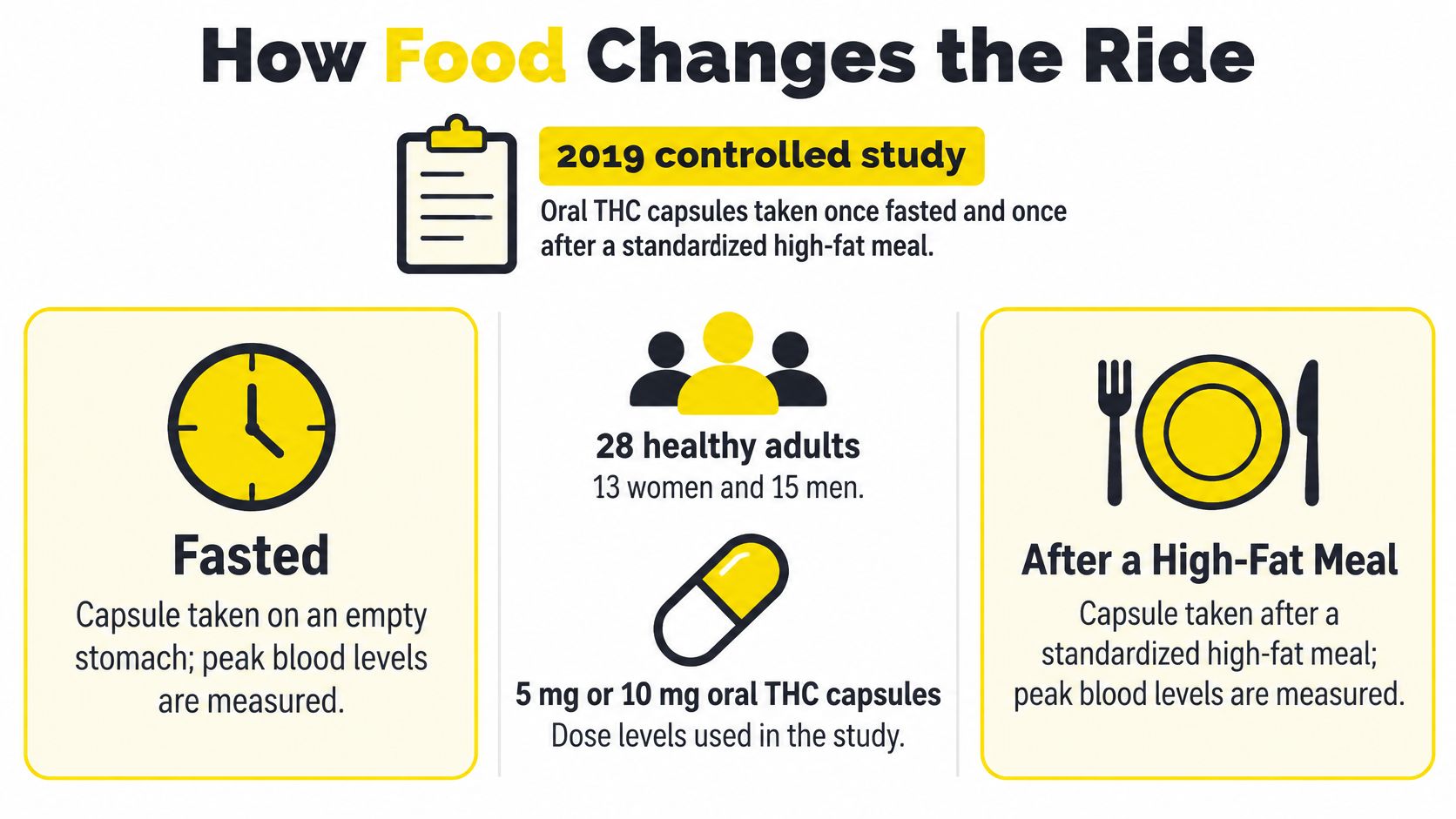
When participants took THC while fasting, peak blood concentrations arrived substantially sooner. After the high-fat meal, the time to reach that peak stretched by roughly 3.5-fold for both the 5 mg and the 10 mg dose. Food also increased overall exposure to THC and to 11-hydroxy-THC, even though the peak concentration itself didn't change significantly.
| Factor | Empty stomach | With a meal |
|---|---|---|
| Time to peak THC | Substantially sooner | About 3.5 times longer for both 5 mg and 10 mg doses |
| Total THC and metabolite exposure | Lower overall | Higher overall, even though peak level changes little |
| Rise in effects | Faster and steeper | Slower to start, with more cumulative exposure |
The trade-off is right there in the rows. An empty stomach gives you a sharper climb and a shorter wait before something happens, while a meal delays the whole curve but leaves your body absorbing more of the dose across the session. The FDA prescribing information for oral dronabinol shows the same pattern, with a high-fat meal of about 950 calories and 59 g of fat raising total exposure roughly 2.5-fold and pushing median time to peak back by about 5 hours.
State the limits plainly. The 2019 study used capsules, not gummies or baked goods, and it did not show that fasting makes an edible feel stronger in any universal way. Dose, formulation, tolerance, and your own digestion all move the result. What the data does support is a habit: consistency beats choosing a side. If you use the same product at the same rough meal pattern, day-to-day variability shrinks, and the video walkthrough on edible digestion shows the same path visually if that's easier to follow than a table.
Real Dosing Scenarios and What They Teach
A chocolate bar is labelled 10 mg total and divided into four squares. One square contains about 2.5 mg. Start with that portion, then give it time to take effect. Eating the whole bar because the squares look small means taking four portions at once.
Now consider a gummy eaten at 7 p.m. By 7:45, nothing seems to be happening. That quiet first stretch can be misleading: the dose may still be moving through digestion and developing its effects. Adding another piece at 7:45 can mean both doses take effect later, making the evening feel much stronger than intended.
A large package creates a different trap. A 100 mg bag is not a single serving. Colorado's responsible-use guidance for edibles sets a maximum of 10 mg THC per clearly identified serving and 100 mg THC per package. It advises taking less than a 10 mg serving when unsure and waiting at least 90 minutes, up to 4 hours, before consuming more.
| Product | Labelled dose | How to start |
|---|---|---|
| Starter-level serving | 2.5 mg THC | Take it whole, then wait at least 2 hours |
| Standard single serving (regulated maximum) | 10 mg THC | Take less than one serving if unsure, or split into four 2.5 mg portions |
| Full package (regulated maximum) | 100 mg THC | Treat as ten 10 mg servings or forty 2.5 mg starter portions, never as one dose |
The arithmetic changes with the person using the product. A 100 mg package contains ten 10 mg servings, or forty 2.5 mg portions. The label tells you what is in the package; it does not tell you how much to take at once.
Find the per-serving number first. The package total is a ceiling set by regulators, not a plan for your evening.
How to Dose an Edible on an Empty Stomach Safely
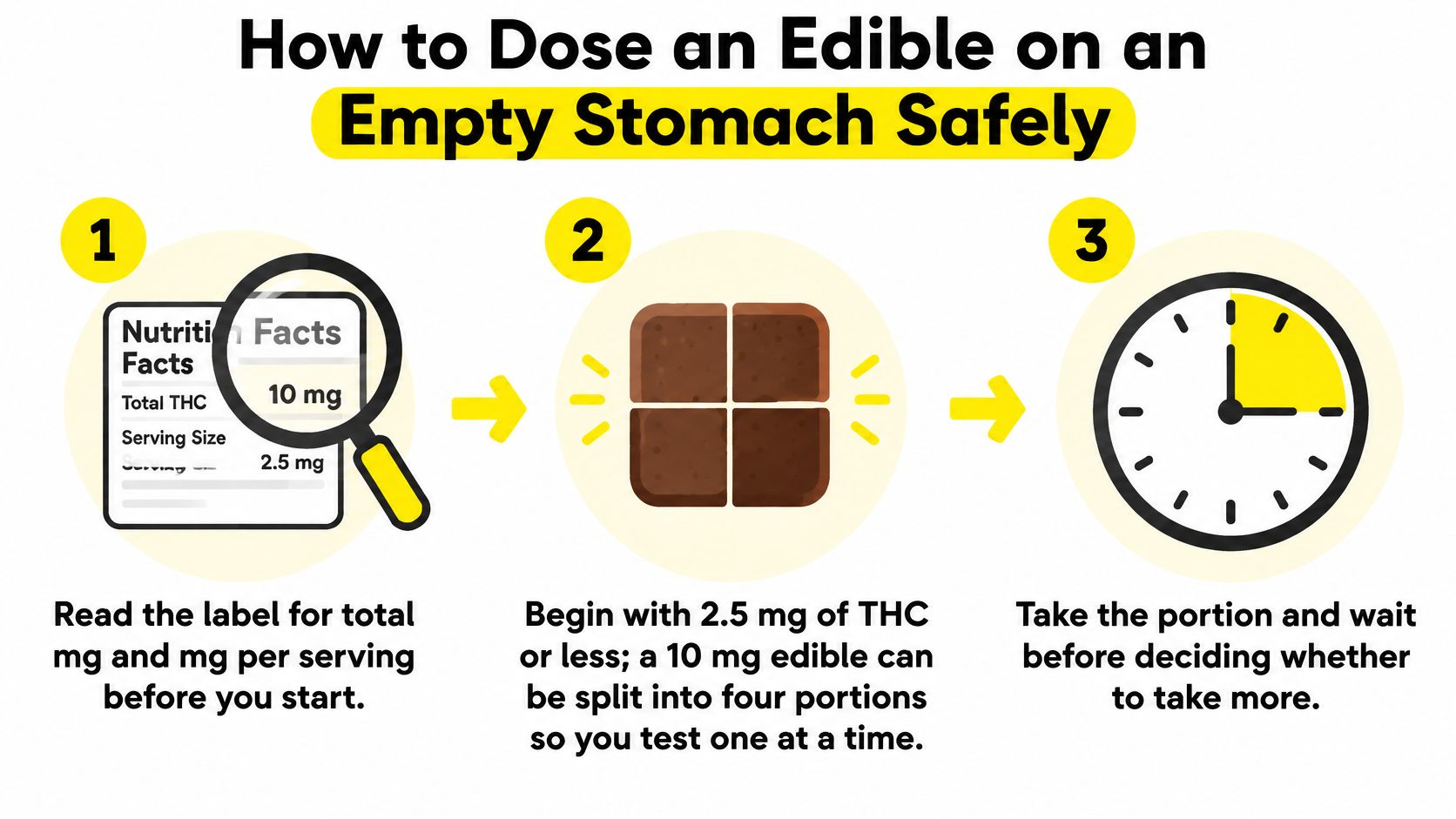
Read the label before you open anything. You need two numbers: total milligrams in the package and milligrams per serving. Skipping this is the single most common slip, because a package that looks like one treat is often four to ten servings.
Start at 2.5 mg of THC or less. A 10 mg edible splits into four roughly 2.5 mg portions, so you can test one piece at a time instead of committing to the whole product. Canadian public-health guidance collected by Nova Scotia's edibles guidance recommends beginning with 2.5 mg of THC or less and waiting until effects are felt before taking more, with onset taking up to 2 hours and full effects up to 4 hours.
Take that portion with your usual meal pattern and write down the time. Note whether you'd eaten, what, and when. Without the timestamp, you're guessing later, and guessing is what produces the second dose.
Wait at least 2 hours before taking anything more. Nova Scotia's guidance sets that minimum wait before increasing the amount, precisely because swallowed cannabis can take far longer to peak than smoking or vaping. Set a timer if you need to. The clock is more reliable than your sense of how long it's been.
If 45 minutes pass with nothing, do nothing. This is the step people break. A quiet first hour is normal, not a sign the product failed, and adding a portion during that quiet stretch is how a comfortable dose becomes a memorable one.
Don't drive or take on anything important until you know how the dose treats you. Reaction time and judgment are exactly what you can't assess from the inside. Give the first session a free evening.
Here's the routine in one image.
A manageable experience has a recognizable shape: a gradual rise you can feel building, a peak you can sit through without alarm, and a fade across several hours. If the rise feels like a step change instead of a slope, your dose or your food timing needs adjusting, and the low-dose edibles approach is the place to start rather than pushing through a dose that keeps surprising you.
Practical note: if you take the same product fasted two sessions in a row and it feels unpredictable both times, move it to a light meal. Consistency of conditions is worth more than any single trick.
When an Edible Hits Too Hard
An overshoot announces itself in a fairly consistent way: a racing heart, sudden strong anxiety, dizziness, nausea, or confusion about small things. Knowing the signs in advance helps, because the first symptom is usually fear, and fear makes the rest feel worse than it is.
The first move is to stop. Nothing more goes in, including another edible, alcohol, or anything else that might muddy what you're feeling.
Stop the product entirely. You can't un-take a dose, and adding more only lengthens the episode. The peak typically passes within about 4 hours and eases over the hours after that, so the goal is riding it out, not reversing it.
Sit or lie down somewhere quiet and safe. Dizziness and unsteadiness cause real injuries, and most of those happen on stairs or in the bathroom. Sit first, then decide what you need.
Sip water and eat something light if you can keep it down. Nausea often comes from an empty stomach meeting a concentrated dose, and a plain snack settles it more reliably than lying still and hoping.
Breathe slowly and stay with someone you trust. Slow breathing counters the physical anxiety response, and a calm person in the room is the most effective reassurance available. Ask them to keep the tone low and the conversation simple.
Call emergency services for chest pain, trouble breathing, fainting, or confusion. Those aren't edible effects to wait out. If a child or a pet has eaten the product, call immediately rather than watching for symptoms.
The pattern behind almost every difficult night is a redose taken too early, which is why the guide to avoiding a green out starts with the wait rule rather than with dose math. Prevention is the only reliable treatment.
Confirm Your Starting Dose Before Your Next Edible
Run this before every edible, especially a new product:
Confirm both label numbers. Milligrams per serving and total milligrams in the package. Write them somewhere you'll see them at the two-hour mark.
Choose a starter portion if the product is new to you. 2.5 mg or less, or split a 10 mg serving into four pieces so you test one. A new formulation absorbs differently even at the same milligram.
Decide your food plan now and keep it for this product. Whether you eat first or take it light, repeat the same pattern so your two experiences are comparable.
Set the wait rule before the first portion, not after. Decide in advance that two hours pass before any second piece. A rule made at the first sign of nothing is a rule made by an impatient person.
The checklist is about timing discipline more than strength. Almost nobody gets into trouble from 2.5 mg. Plenty of people get into trouble from a second 2.5 mg taken at minute 40.
If you'd rather work the numbers first, the edible dosage calculator turns a package label into a starting portion in a few seconds. And if you're buying in person, use the staff. Every edible product at a regulated shop is clearly labeled so you know what you're getting, and a budtender will ask what you're looking for, whether that's pain relief, help sleeping, or anxiety support, before recommending anything. Ask for the serving size and the total milligrams, then write your starter dose down before you leave the counter. Start low, wait longer than feels necessary, and treat the first dose as active until the full window has passed.
Mr. Nice Guys DC stocks edibles in different formats and strengths, from gummies to chocolates to baked treats, and every package is labeled so you can check milligrams per serving before you commit to a dose. If you're planning your first session or switching products, tell the team what effect you're after and they'll help you match a portion size to it. Visit Mr. Nice Guys DC to browse the current menu and confirm pickup, curbside, or delivery.
Mr Nice Guys DC
At Mr. Nice Guys DC, we’re more than just a cannabis delivery service — we’re passionate advocates for quality, convenience, and community. With years of experience in the cannabis industry, our team is dedicated to educating and empowering customers across Washington, D.C. Whether you're a seasoned user or just starting your cannabis journey, our blog delivers trusted tips, product insights, and the latest updates from the world of weed. Stay informed, stay elevated.
