
Must Be 21 To Enter
By entering this site you are agreeing that you are at least 21 Years of Age or older.
I AM 21 OR OLDERCured Resin vs Live Resin: Flavor, Potency and Best Uses


Most dispensary advice on cured resin vs live resin boils down to a lazy shortcut: buy live resin if you want top-shelf quality, and settle for cured resin only when you're trying to save money. That advice sounds clean at the counter, yet laboratory data and post-harvest production records don't back it up.
Calling one category premium and the other a compromise confuses a processing timeline with a quality grade. Live resin freezes freshly cut flower to capture bright, volatile aroma compounds before they evaporate. Cured resin lets the flower dry and mature first, shifting the aromatic balance toward deeper notes while leaving the core cannabinoid foundation intact.
Consider a medical cannabis patient shopping for a nighttime vape cartridge. They pick a fresh-frozen live resin pen assuming the higher shelf price means stronger relief, only to find the sharp, citrus-heavy vapor irritates their throat and tastes too intense before bed. A well-made cured resin cartridge from the same harvest would have delivered comparable cannabinoid strength with a smoother, earthier profile suited to their tolerance.
Treating this choice as a patient-centered lab comparison works far better than relying on menu hierarchy. When you match verified terpene totals, cannabinoid ratios, batch freshness, and safety panels to your own aroma sensitivity, storage habits, and budget, the right jar becomes obvious.
Cured and Live Resin Side by Side
Live resin starts from cannabis frozen immediately after harvest, while cured resin starts from flower that was dried and cured first. Every measurable difference in aroma, shelf stability, and typical pricing flows from that single split in post-harvest handling.
| Factor | Cured resin | Live resin |
|---|---|---|
| Starting material | Flower dried and cured after harvest | Flower frozen right after harvest |
| Terpene retention | Roughly 15% to 30% of original terpene content | Roughly 60% to 95% of original terpene content |
| Maximum reported terpenes | Lower, reflecting post-harvest losses | Up to 11% by weight |
| Typical THC range | 60% to 90% | 60% to 90% |
| Typical aroma | Heavier, earthy, toasted | Bright, fresh, citrus or floral |
| Storage | Easier to store, more batch consistency | Sensitive to cold-chain failure and oxidation |
| Price tendency | Potentially lower | Potentially higher |
Those retention figures come with wide batch-to-batch variation. Industry summaries compiled by Ganjapreneur report that conventional concentrates made from cured cannabis retain roughly 15% to 30% of the plant's original terpene content, whereas live-resin processing can preserve approximately 60% to 95% depending on cultivar, freezing speed, storage, extraction method, and the specific compound measured.
Potency tells a different story. A 2025 comparison published by Wallflower House notes that live resin can reach up to 11% terpenes by weight, while both live and cured resin commonly test between 60% and 90% THC. In other words, the main chemical gap is volatile aroma concentration, not raw THC strength.
What the Word Live Actually Means
Shoppers often assume "live" means a raw, unrefined, or somehow active concentrate. The history of the category clears up that misconception.
According to Luna Technologies, live resin emerged as a distinct commercial concentrate in Colorado in 2013, when cultivator William "Kind Bill" Fenger partnered with EmoTek Labs founder Jason "Giddy Up" Emo at a Colorado Springs medical cannabis facility. Their workflow ran fresh-frozen cannabis through a closed-loop extraction system at very low temperatures instead of drying and curing the crop first.
That milestone established a clear naming convention: "live" describes the condition of the starting plant material at harvest, not that the finished concentrate is alive or unprocessed. Both live and cured extracts remain full-spectrum hydrocarbon concentrates, sitting alongside solventless rosin and refined oils across the broader lineup of types of cannabis concentrates.
Take two concentrate jars sitting side by side from the same grower, one labeled cured badder and the other live badder. Color won't reliably separate them, because amber and golden hues shift with harvest timing, cultivar pigments, and post-processing. Scan the table above, pick the single row that matters most for your sessions, and let that priority guide how you read the lab sheet.
How Each Resin Is Made
Extraction hardware rarely separates cured resin from live resin. Both paths typically rely on closed-loop hydrocarbon extraction, yet the hours and weeks between cutting the plant and loading the extraction column change what survives into the finished jar.
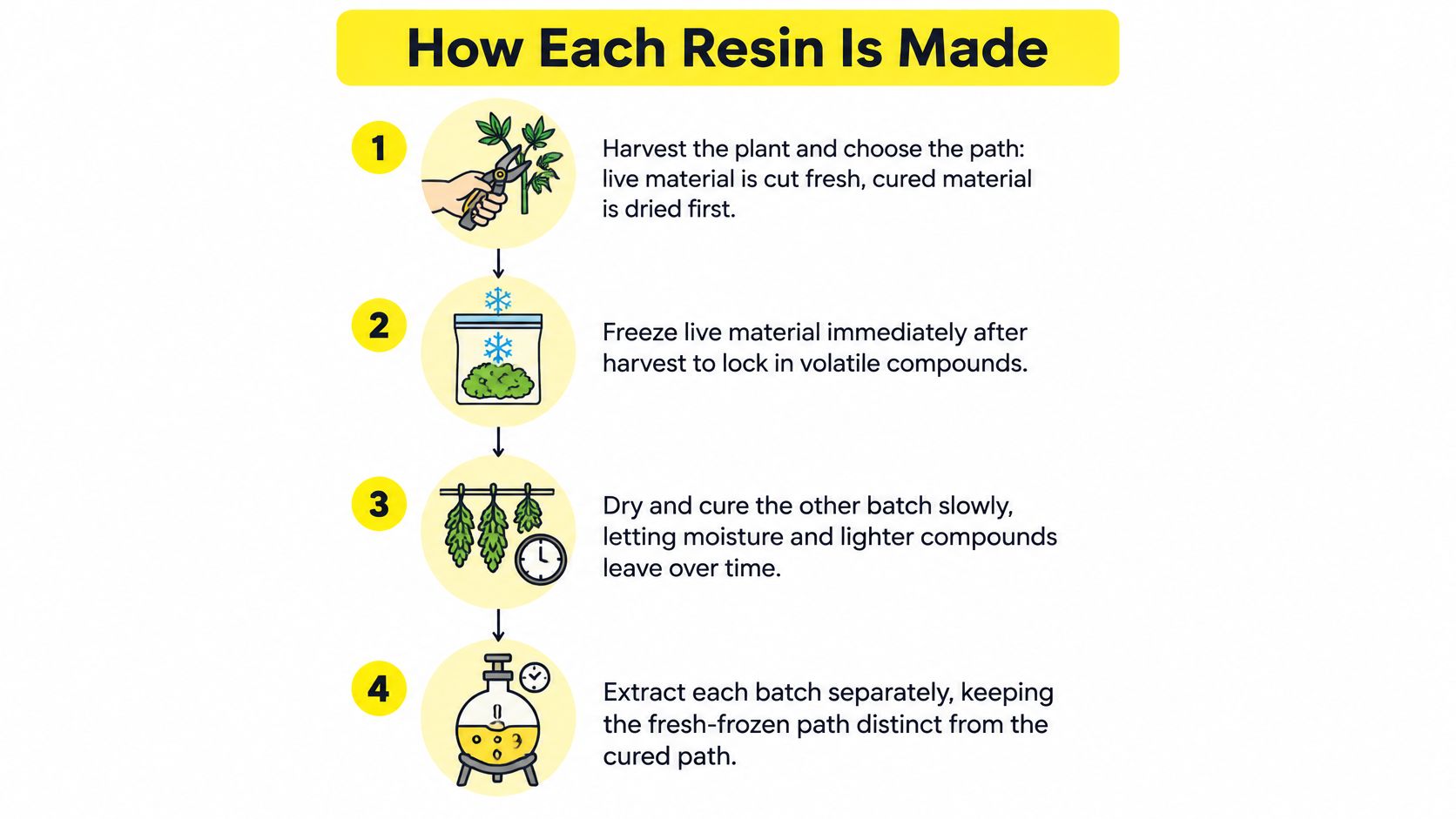
A peer-reviewed medicinal-cannabis processing review indexed on PubMed Central outlines how bypassing post-harvest drying alters chemical retention and notes that high extraction temperatures strip away terpenes and minor constituents. Here is how producers run each sequence from harvest to final testing.
- Harvest and assign the batch. Growers cut mature plants at peak trichome development and decide immediately which branches enter the fresh-frozen stream and which head to the drying room. That single choice commits the crop's aromatic trajectory before extraction ever starts.
- Freeze the live material on-site. For live resin, technicians seal freshly trimmed buds and freeze them right after harvest. Rapid freezing slows biological and chemical changes, locking fragile aromatic molecules inside the trichome heads before oxygen and warmth can pull them into the air.
- Dry and cure the cured batch. Flower destined for cured resin hangs in climate-controlled rooms so internal moisture drops gradually, followed by a curing window in sealed containers. Water leaves the plant tissue, and the lighter monoterpenes partially evaporate or oxidize, shifting the bouquet toward classic dried-flower depth.
- Extract in a cold closed-loop system. Extractors wash either the frozen or cured material with chilled hydrocarbon solvents inside sealed stainless-steel vessels. Keeping extraction temperatures low protects surviving terpenes and minor compounds from thermal breakdown.
- Purge the solvent and set the texture. Vacuum ovens and controlled agitation remove residual solvents while shaping the oil into badder, sauce, sugar, shatter, or cartridge-ready resin. Poor purging leaves harshness or solvent residue regardless of whether the plant started fresh or cured.
- Submit finished batches for laboratory panels. Accredited labs test both categories under identical safety and potency standards, issuing a certificate of analysis that verifies cannabinoid content, contaminant compliance, and optional terpene totals.
Splitting One Blue Dream Harvest
Suppose a cultivation team harvests a single room of Blue Dream and splits it evenly. Half goes straight into sub-zero freezers within minutes of cutting, preserving the fresh, sweet berry and pine top notes the living plant produced on harvest day.
The other half spends days drying and weeks curing until the buds smell like finished retail flower. When extractors run both halves through the same cold closed-loop system, Batch A yields a bright, punchy live resin, while Batch B yields a deeper, sweeter cured resin built on the same cultivar's genetics.
Check product packaging carefully to confirm which path your concentrate took. Look for explicit wording such as "fresh-frozen live resin" or "cured flower resin" rather than vague phrases like "live resin terpenes," which often signal distillate mixed with added aromatics. If the label leaves the starting material unclear, ask the dispensary staff to pull the producer's batch sheet before you buy.
Terpene Retention and the Flavor Gap
Post-harvest drying doesn't erase flavor evenly across the plant. Small, low-molecular-weight monoterpenes evaporate rapidly when exposed to airflow, light, and room temperatures, whereas heavier sesquiterpenes linger much longer in the trichomes.
To visualize why starting condition drives aroma, compare fresh-cut buds against fully dried flower side by side.

A peer-reviewed cannabis manufacturing analysis available through PubMed Central highlights how steep those evaporative losses can get. One cited manufacturing study reported losses of roughly 70% to 95% for certain volatile terpenes during drying and curing, while a separate study found room-temperature drying and curing reduced headspace monoterpenes by approximately 31% to 55.2%, depending on duration.
That doesn't automatically make cured flower defective.
| Study or source | Reported effect | What it means for the choice |
|---|---|---|
| Manufacturing study | Losses of about 70% to 95% for some volatile terpenes during drying and curing | Post-harvest processing strips the lightest notes |
| Room-temperature curing study | Headspace monoterpenes down roughly 31% to 55.2% depending on duration | Longer exposure costs more aroma |
| Controlled short drying research | Volatile light terpenes largely preserved under controlled drying conditions | Process control, not the label, decides retention |
In everyday tasting terms, imagine testing two 510 cartridges made from the same Wedding Cake harvest on a low-voltage battery. On the first draw, the live resin cartridge hits with sharp citrus zest, fresh pine, and light floral brightness. Switch to the cured resin cartridge, and the vapor lands heavier, toasted, sweet, and earthy, closer to the taste of smoking well-cured flower in a clean glass pipe.
Live resin keeps the top notes. Cured resin keeps the base.
Neither sensory direction guarantees a superior session, because execution still rules the jar. Cultivar genetics, freezing speed, oxygen exposure during trimming, extraction temperature, and retail storage all change how much aroma survives to your dab rig or vape pen. A careless live run left warm in transit can smell flatter than a carefully managed cured batch.
Watch this short breakdown for a closer look at how fresh-frozen and cured resin differ in flavor and processing.
Testing Aroma Against the Lab Sheet
You can run a quick sensory check at home to verify what a label promises. Crack open a fresh jar (or take an unheated dry pull on a clean cartridge) and write down the first two scents you notice before reading the lab panel.
Next, compare your impressions against the five dominant compounds most often highlighted on a concentrate report: myrcene, limonene, terpinolene, pinene, and caryophyllene. Reviewing a cannabis terpenes guide helps you connect bright lemon scents to limonene or spicy peppery warmth to caryophyllene. Remember that high terpene percentages tell you about chemical composition and likely flavor intensity, not proven therapeutic strength.
Potency, Effects and the Certificate of Analysis
Many buyers assume live resin hits harder because it costs more and smells louder. Laboratory records contradict that shortcut: neither cured resin nor live resin guarantees higher THC potency, and a higher THC figure on the box doesn't guarantee a better or more comfortable experience.
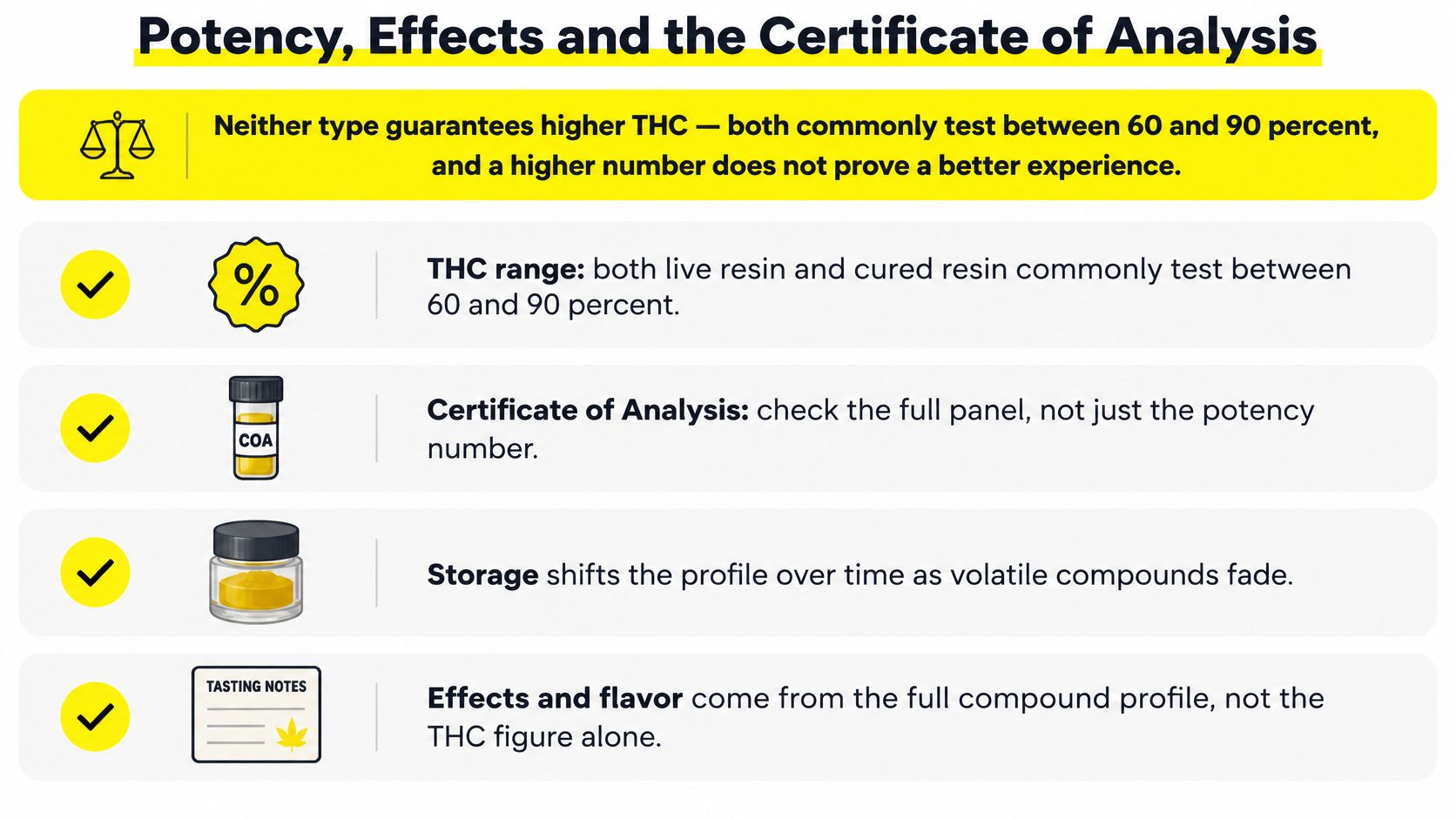
Cannabinoid numbers also shift subtly after packaging. An analysis by BudBoard cites a storage study showing that total cannabinoids changed little over 74 days, while a portion of THCA gradually converted into THC over time. That chemical stability reinforces an important buying takeaway: the main difference between cured and live batches lies in their aromatic profile rather than a simple potency advantage.
What you feel during a session depends on five interacting variables: cannabinoid ratio, terpene makeup, dose size, personal tolerance, and inhalation format (such as a low-temperature dab rig versus a high-voltage disposable pen). Product explainers often discuss potential entourage effects, yet current evidence doesn't establish predictable clinical outcomes for a specific resin type or prove that higher terpene levels deliver added medical benefits.
Consider a practical comparison between two hypothetical vape cartridges from the same dispensary shelf. Both test at 85% THC, but Cartridge A lists 3% total terpenes (cured resin) while Cartridge B lists 8% total terpenes (live resin). Cartridge B will smell much stronger and may feel noticeably different in flavor and onset character, yet its cannabinoid potency matches Cartridge A, so a new or moderate-tolerance user should still begin with a single short puff.
Analyst perspective: A lab panel isn't a scoreboard where the highest percentage wins. It's a compatibility sheet that helps you match potency and aroma intensity to your own tolerance.
Your Certificate of Analysis Checklist
Instead of buying off the words "live" or "cured," inspect every item on the certificate of analysis before finalizing a concentrate purchase. Reviewing strict product testing standards protects both safety and session predictability.
- Total THC and THCA: Check both figures together to understand true potency after heating, rather than glancing only at a single headline number.
- CBD and CBDA levels: Look for minor cannabinoid ratios if you prefer a balanced profile that tempers sharp psychoactive intensity.
- Total terpene percentage and top compounds: Scan the total percentage alongside specific leaders like myrcene, limonene, and caryophyllene so you know whether to expect bright citrus or heavy spice.
- Residual solvents: Confirm the batch passed legal safety thresholds for butane, propane, or other extraction hydrocarbons.
- Pesticides and microbial screening: Verify a clean pass for chemical residues, mold, yeast, and heavy metals, especially for inhaled concentrates.
- Batch and test dates: Compare the test date against today's date so you aren't paying top dollar for oxidized oil that sat in warm storage for months.
Treat terpene percentage strictly as a measure of chemical makeup and sensory intensity, not a clinical guarantee. Keeping this six-point checklist handy gives you an objective yardstick for every resin purchase, regardless of how the box is branded.
Which Resin Fits Your Situation
Abstract chemistry helps, yet real buying decisions happen around daily routines, budgets, and storage habits. Picture three different shoppers standing in front of the same concentrate display.
First is a weekend enthusiast planning a relaxed Friday evening with friends, where tasting fresh citrus and pine top notes on a clean quartz banger matters most. Second is a daily medical user doing a monthly restock who wants steady, repeatable effects without paying a steep markup every four weeks. Third is a cautious patient who buys two or three grams at once and stores them in a cabinet for several months between sessions.
Matching Resin Type to Buyer Priority
Each shopper solves a different problem, so the "right" resin shifts with the goal.
| Situation | Lean toward | Why |
|---|---|---|
| Flavor-first session with bright aroma | Live resin | Higher terpene retention keeps citrus and floral top notes |
| Daily use on a tight budget | Cured resin | Often lower price and more batch consistency |
| Stock held for several months | Cured resin | Easier storage and less cold-chain risk |
| Sensitive to strong aromas | Cured resin | Heavier, less volatile notes |
| Consistent dosing across batches | Cured resin | Controlled drying standardizes inputs |
| First purchase, preference unknown | Either, compare the certificate of analysis | Lab data shows terpene totals and dominant compounds |
When scanning a menu for the first time, it also helps to separate both full-spectrum resins from refined oils. Comparing live resin vs distillate shows why both cured and live resin preserve native plant chemistry, whereas distillate strips the extract down to isolated cannabinoids before flavors are reintroduced.
Selection rule: Treat category labels as a starting filter, never a final verdict. A fresh, carefully cured resin from top indoor flower beats an old, heat-exposed live resin every single time.
Personal physiology matters just as much as the menu description. Some patients experience coughing or throat tickle from ultra-terpene-rich live carts, especially when limonene or pinene spikes high. Those same patients often find a moderate-terpene cured resin smoother to inhale at low temperatures, while flavor-chasers who store jars in a mini-fridge thrive on fresh-frozen batches.
Use the table above to narrow your lane, then let real-world shelf conditions, pricing math, and lab verification confirm which specific jar earns your money.
Storage, Price and Buying Steps
Choose live resin when bright, strain-specific top notes are your top priority and you can verify fresh, properly chilled stock. Choose cured resin when shelf stability, batch-to-batch predictability, gentler aroma, or lower cost per session matter more.
Post-harvest logistics explain why cured resin holds up better across months and repeat purchases. Controlled drying and curing let processors standardize moisture content, handling, and batch inputs before extraction ever begins. Peer-reviewed controlled-atmosphere drying research published via PubMed Central found that optimized drying conditions reduced drying and curing time by at least 60% while preserving volatile terpene content, proving that "cured" doesn't automatically mean terpene-poor when producers control their environment tightly.
Fresh-frozen live resin carries a higher logistical risk. Because its value rests on fragile monoterpenes, any break in the cold chain during transport, warehouse holding, or warm retail display accelerates oxidation and flattens the exact bright aroma you paid extra to get.
Weighing Shelf Stability Against Cost
Running quick unit math keeps marketing hype in check. Suppose you're comparing two hypothetical 1-gram vape cartridges: a cured cartridge priced at $40 with 2% terpenes works out to $20 per terpene point, while a live cartridge priced at $55 with 8% terpenes works out to about $6.88 per terpene point.
On aroma efficiency alone, the live cartridge looks like a bargain. Yet cost per session depends on how many draws you get from each gram at your preferred voltage. If both cartridges last you three weeks, the cured option saves $15 every cycle. Pay the extra margin for live resin only when vibrant fresh aroma matters enough to justify a sealed, recently tested batch.
Five Checks Before You Buy
Before handing over your card on any menu of cannabis concentrates for sale, walk through these five practical checks.
- Check the batch date and packaging seal. Look for a recent test or packaging date and an unbroken tamper-evident seal, especially on live resin where age erodes bright top notes fast.
- Read total terpenes and top compounds. Verify that the dominant terpenes match the flavor direction you want, whether bright citrus or grounded spice.
- Confirm full safety and potency panels. Cross-check total THC, THCA, CBD, residual solvents, pesticides, and microbial compliance using the six-point certificate of analysis checklist so you never buy blind.
- Evaluate the aroma directly when possible. If the shop offers a display sniff jar, check whether the scent smells crisp and strain-true rather than stale or muted.
- Start low on a new concentrate. Take one short, low-temperature draw and wait ten to fifteen minutes to gauge how the specific cannabinoid and terpene ratio interacts with your tolerance.
At Mr. Nice Guys DC, every product is tested for pesticides, potency, and more, giving you clear documentation before you decide. In the showroom, a budtender asks what you're looking for, explains product options, and recommends products that fit your goals before you check out like at a regular retail store. Ask to inspect the certificate of analysis on any cured or live concentrate you're weighing so your purchase rests on lab facts rather than shelf myths.
Whether you lean toward bright, fresh-frozen live resin or smooth, consistent cured resin, Mr. Nice Guys DC carries curated, lab-tested concentrates, vape cartridges, and flower backed by knowledgeable showroom guidance in Washington, DC. Stop by to compare certificates of analysis side by side, talk through aroma and tolerance goals with a budtender, or browse the current menu online at Mr. Nice Guys DC.
Mr Nice Guys DC
At Mr. Nice Guys DC, we’re more than just a cannabis delivery service — we’re passionate advocates for quality, convenience, and community. With years of experience in the cannabis industry, our team is dedicated to educating and empowering customers across Washington, D.C. Whether you're a seasoned user or just starting your cannabis journey, our blog delivers trusted tips, product insights, and the latest updates from the world of weed. Stay informed, stay elevated.
