
Must Be 21 To Enter
By entering this site you are agreeing that you are at least 21 Years of Age or older.
I AM 21 OR OLDERCBD Topical Pain Relief: A Practical Guide


A 2023 systematic review in The Journal of Pain00582-5/fulltext) counted 16 randomized CBD pain trials across 12 pain conditions, and most of them never tested CBD on skin at all. Where topicals were studied, results were mixed. The honest starting point is narrow: topical CBD works like a spot treatment, something you aim at one sore joint or one patch of nerve pain, so a broad promise on a label tells you very little.
A better question replaces the broad one. Does your pain match the kind of localized spot tested in a topical trial? And can you verify what is in the jar? The labeled milligram amount is a claim, not a fact, until a batch lab report confirms it, and most CBD topicals miss a common accuracy bar. If your pain fits a tested pattern and the product passes a lab check, run a short, written test and judge it by your own scores.
What Topical CBD Has Shown for Pain
The number that should reset your expectations is 3 out of 16. The 2023 systematic review in The Journal of Pain00582-5/fulltext) identified 16 randomized controlled trials covering 12 pain conditions, but only 3 trials used topical CBD, while doses ranged from 6 to 1,600 mg and treatment periods ranged from a single dose to 12 weeks. Most trials used oral or buccal or sublingual CBD. A capsule study can't tell you what a balm on your knee will do.
That distinction matters at the counter. If your calf aches after a long walk and a label implies CBD is proven for pain, ask whether the evidence involved a product rubbed on skin for a similar complaint, or a swallowed product tested for something else. Route, dose, condition, and duration all change the answer.
Topical CBD Pain Trials by Condition
Each row below comes from trials tracked in a 2025 peer-reviewed review of topical CBD research, including its look at topical jaw-pain studies.
| Pain type | What was tested | Schedule | Main result | Limit |
|---|---|---|---|---|
| Base-of-thumb osteoarthritis | 6.2 mg/mL CBD gel | Twice daily for 2 weeks | Pain 5.0 to 2.2 vs placebo 4.9 to 4.0 | 18 people, short crossover |
| Peripheral neuropathy | 250 mg CBD per 3 oz cream | Up to 4 times daily for 4 weeks | Intense pain down 1.34 vs 0.59 for placebo | 29 people, high bias risk |
| Jaw muscle pain and bruxism | 5% and 10% CBD gels | 30 days | Pain down 40.8% with 5%, 57.4% with 10% | Only 1 of 5 topical jaw-pain studies showed benefit in that review |
| Chemotherapy neuropathy | 250 mg CBD cream | 2 weeks | No significant gain vs placebo | Small pilot, short trial |
| Mixed pain conditions | Mostly oral or buccal CBD | 6 to 1,600 mg, single dose to 12 weeks | Evidence mostly not topical | Only 3 of 16 trials were topical |
Read the table row by row, not as one verdict on CBD. The thumb result looks encouraging because pain fell further with CBD than with a matching placebo gel, and hand function improved. A group that small, followed for that short a stretch, can't prove lasting relief for arthritis in general, and it can't predict what a different gel will do on a shoulder, hip, or back.
The neuropathy row shrinks on a second look. A slightly larger pain drop than placebo may matter to someone whose feet burn every night, but the trial was small and carried a high risk of bias. That argues for a careful personal test rather than a promise. If numbness is spreading or balance is changing, you need a diagnosis first.
Where the Rows Stop Helping You
Jaw pain shows why one striking result needs context. The stronger gel performed better in a single trial, yet the wider set of topical jaw-pain studies in that review was mostly negative. Chemotherapy-related neuropathy is a clearer warning, because the tested cream did not significantly improve overall neuropathy symptoms versus placebo. Two products both labeled for nerve pain can target very different problems.
Practical rule: Pick the row that matches your pain location and type. If no row matches, treat product claims as unproven for you.
No row here supports broad claims for back pain, whole-body inflammation, or severe unexplained pain. A salesperson may talk about CBD in general, but you should compare formats and evidence for your specific spot, including how CBD and THC compare for pain if you're weighing cannabinoid options. A thumb gel study should not sell you a cream for a new back problem.
Even the right row carries one more condition: the jar has to contain what its label claims. Matching your pain to a tested product only works if the product on the shelf matches the one studied.
A cook whose thumb aches when gripping pans has at least one relevant trial to consider. A runner with pain spreading down both legs doesn't. The first person can test one product on one joint for two weeks and write down a daily pain score. The second should get checked before shopping.
How to Check a Topical Before You Buy
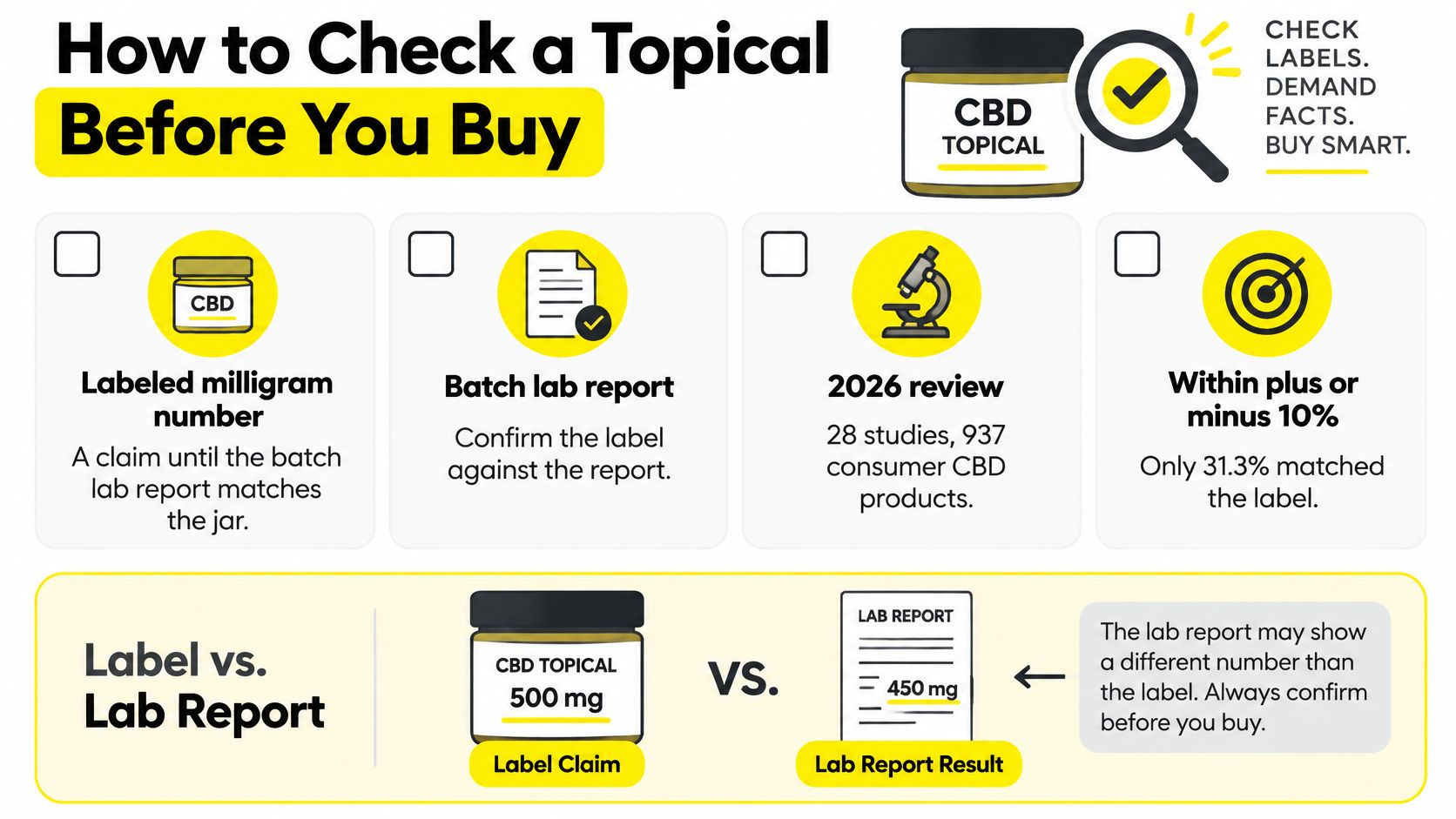
The labeled milligram number is a claim until a batch lab report matches the jar in your hand. A 2026 review held by the University of Malta library covered 28 peer-reviewed analytical studies and 937 consumer CBD products and found only 31.3% met a commonly used ±10% label-accuracy threshold, while topicals performed worst at 13.8% of 260 topical products. Problems included absent or inaccurate CBD declarations and variation within the same product.
That changes your buying question. You're not only asking what concentration to choose. You're asking whether the concentration and ingredients are real, consistent, and appropriate for your risks. The highest advertised percentage isn't automatically the safest or strongest product.
Here's a simple mix-up we see in plain terms. Two balms both say 500 mg, but one jar holds 2 ounces and the other holds 4 ounces. They aren't equally concentrated, even before you question whether 500 mg is accurate. Jar size, mg per ounce or per mL, and the batch report tell you more than the big number on the front.
This visual turns that check into a phone-friendly routine you can use before paying.
Run the Five-Point Check in the Shop
- Match the batch. Find the batch or lot number on the jar and confirm the same number appears on the certificate of analysis, because a generic brand PDF proves little about this container.
- Quantify the CBD. Look for CBD identified and measured in the report, not just listed as present, so you can compare the report with the label claim.
- Disclose the THC. Confirm THC is shown clearly, since undeclared THC changes legal, work, and personal risk decisions.
- Read the contaminant panel. Check for pesticides, heavy metals, and residual solvents, the same basic safety categories you'd expect from serious product testing standards.
- Check the date. Make sure the report date belongs to this batch, not an old production run with the same product name.
At our dispensary, every product is tested for pesticides, potency, and more. You should still do the match yourself. A good report doesn't prove CBD topical pain relief will happen for you, but it removes guesswork about what's in the jar.
Don't Skip Skin Fit
Prefer a short ingredient list with fragrances and carrier ingredients you already tolerate. A cream can have accurate CBD and still irritate your skin because of menthol, essential oils, preservatives, or another additive. If you've reacted to scented lotions before, treat that history as relevant.
If the batch number doesn't match, put the jar back. You can't compare potency when you can't verify contents.
Don't apply any topical to broken skin unless a clinician directs it. That includes cuts, cracked eczema, fresh scrapes, and skin that's weeping or infected looking. A clean lab report doesn't make damaged skin a safe test site.
How to Apply CBD Topical for Pain
Start with a routine you can repeat tonight, then use the schedule table for frequency. The goal isn't to use more cream. It's to apply the same amount, to the same intact spot, often enough to learn whether the product helps.
The best directly relevant protocol described in the review in PMC is to document baseline pain with a 0 to 10 numerical rating scale, apply the topical only to intact symptomatic skin, and reassess at weeks 2 and 4. That same summary notes a trial of 250 mg CBD per 3 oz of cream applied up to four times daily, with the total daily dose not reported. Your written record matters because the research doesn't give you a perfect grams-per-use answer.
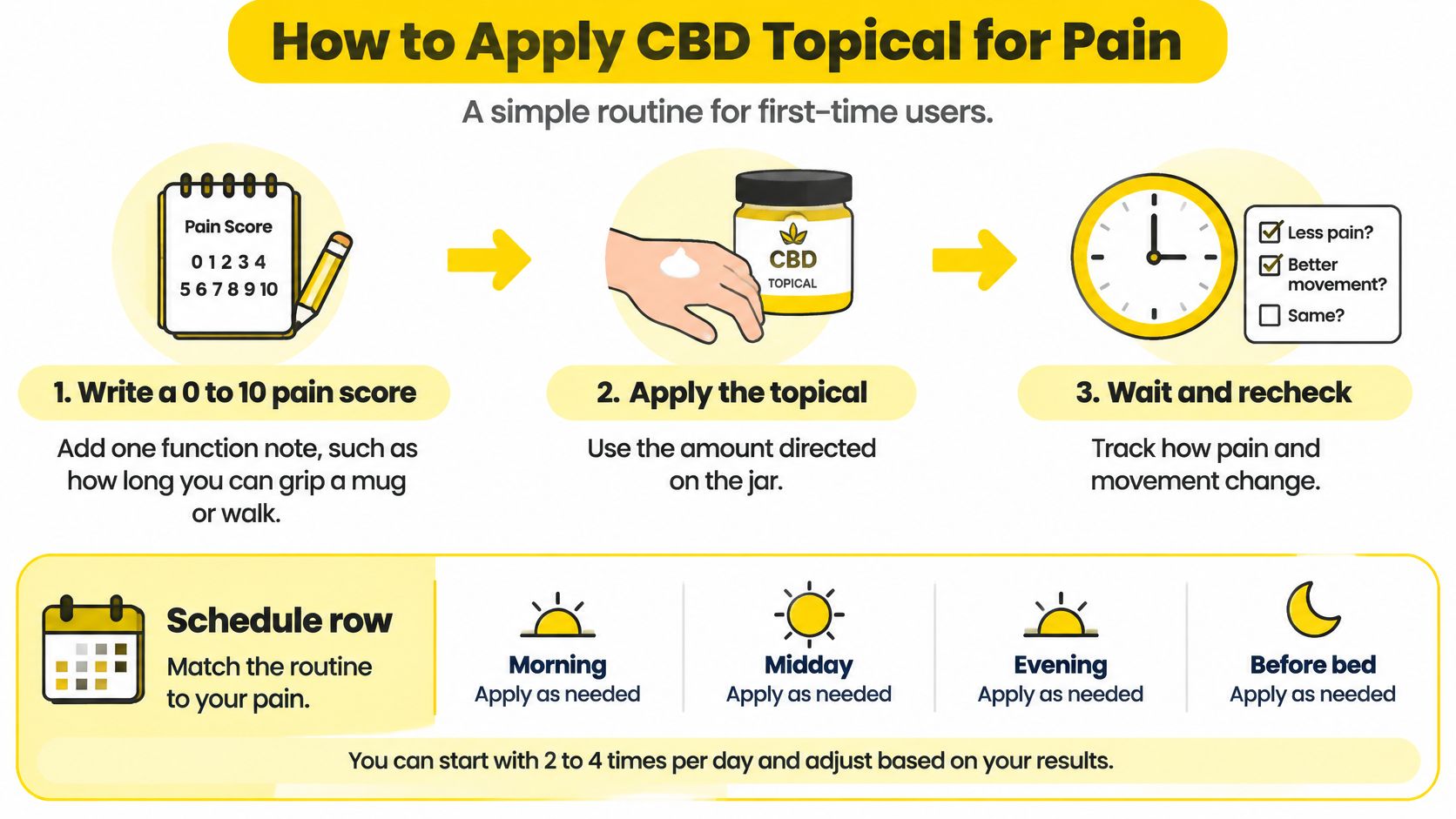
This graphic shows the first-time sequence before you get into condition-specific timing.
A First-Night Routine
- Write your baseline before opening the jar. Record a 0 to 10 pain score plus one function note, such as how long you can grip a mug, open a jar, or walk before the spot complains, so later scores mean something.
- Wash and dry the area. Use intact skin only and skip cuts, rashes, sunburn, and freshly shaved areas, because damaged skin is easier to irritate and harder to judge.
- Patch test a new product. Dab a pea-sized amount on a small area the first evening, then watch for redness, itching, burning, or swelling before wider use.
- Apply a thin layer to the sore spot only. Rub it in until absorbed instead of coating the whole limb, because the trials tested localized use and a bigger area won't clarify your result.
- Wash your hands. Soap and water keep residue out of your eyes and mouth, and they keep you from spreading the product to skin you didn't mean to treat.
- Record each use. Note product name, concentration, approximate amount, time, skin reaction, pain score, and function, so you aren't relying on memory two weeks later.
Say a bartender has thumb pain after a shift. She washes dishes, dries her hands, applies gel only over the thumb joint, and scores pain before bed. The next morning she notes whether she can grip a coffee mug without shifting her hand. That function note may tell her more than a vague feeling that it seemed better.
How Often to Apply and When to Reassess
| Pain pattern | Where to apply | How often | Reassess |
|---|---|---|---|
| Small joint such as the thumb | Intact skin over the joint | Twice daily | At 2 weeks |
| Localized nerve pain | Intact symptomatic skin only | Up to 4 times daily | At weeks 2 and 4 |
| Jaw or nearby muscle tension | Sore muscle area, not open skin | Use the amount and frequency directed on the jar | Around 30 days |
| Any other pain or new product | Small intact test patch first | Low end of label | Stop at once for rash |
Don't add extra applications to chase a faster result. If the label allows less frequent use than the table row, follow the label and write down what you did. Consistency beats improvising, because changing amount, timing, and location every day leaves you with no clear test.
This short video gives you another look at application basics before you begin.
Set your reassessment date on the first day. Put it in your phone with a note to compare the same task at the same time of day. For example, score knee pain after climbing the same flight of stairs, not once after rest and once after a long shift. That's how a two-week trial stays useful.
Pairing a Topical with Other Care
Think of a topical as an add-on for one sore spot, not a replacement for diagnosis, exercise, physical therapy, or prescribed medicine. The biology may sound impressive, but it only supports a limited idea. You're placing CBD where skin and nearby nerves may influence local pain signaling.
Reviews summarized in PMC describe activity involving CB1 and CB2 cannabinoid receptors, serotonin 5-HT1A receptors, and TRPV1 and TRPA1 channels, plus effects on anandamide uptake and inflammatory signals. In plain language, several pain-related switches sit in skin and peripheral nerves. CBD may affect some of them. That does not prove every cream reaches the right tissue or produces meaningful relief.
Two Ordinary Pairings That Make Sense
After physical therapy for a sore knee, you might ice for ten minutes, let the skin dry fully, then apply a thin layer around the joint. You still do the therapy homework, because stronger muscles and better movement aren't things a cream can supply. Your notes should separate pain score from function, such as sit-to-stand repetitions or stair comfort.
For evening calf tightness after standing at work, a warm shower can come first. Once your skin is dry, apply the topical only to the tight area and keep your stretching routine. If a clinician prescribed an anti-inflammatory or nerve medicine, it stays on the clinician's schedule. Don't stop it because three good evenings made the cream look effective.
That distinction protects you from a common mistake. Pain can feel lower while strength stays poor, or a jaw muscle can feel less tense while clenching continues. Keep the function note from your routine and judge both. A product that lowers a score from 6 to 4 but doesn't help you walk, grip, chew, or sleep may not be worth repeat purchases.
Where a Topical Doesn't Belong
A balm doesn't treat widespread pain, progressive nerve disease, or pain that's getting worse without a known cause. It also shouldn't cover up warning signs while you wait. New one-sided pain with weakness, fever, major swelling, chest symptoms, or pain after a significant injury needs medical care, not another jar.
Use the cream beside the care that addresses the cause. Don't use it to postpone finding the cause.
If you're comparing broader options, cannabis approaches for pain relief can help you separate localized topicals from products meant to affect the whole body. The more widespread or severe the pain, the less a small-area topical fits the problem. Match the format to the job, not to the strongest claim on the shelf.
For example, a gardener with one sore thumb can pair a gel with rest breaks and a splint recommended for the joint. A gardener with hand weakness, dropping tools, and numbness spreading into the forearm needs an exam. Same garden, same hand, very different next step.
When to Stop and When to Call
Less medicine reaching the bloodstream isn't the same as no risk. The U.S. Food and Drug Administration review material identifies concerns involving potential liver harm, drug interactions, possible effects on the male reproductive system, and heightened concerns for children and people who are pregnant. It also describes topical safety evidence as limited, with one transdermal-gel study reporting good tolerability and little else that's solid.
That thin safety record should change how casually you use a topical. You may be applying it to a small area, but you're still adding an active product to your routine. If you take prescription medicines, especially medicines with liver-metabolism or sedation considerations, discuss use with a clinician or pharmacist first.
Stop Rules You Can Use Today
- Rash or burning: Stop, wash the area gently, and don't reapply to test whether you can push through it.
- Swelling or worsening pain: Stop and seek clinical advice, especially if the area looks infected or function drops.
- Broken skin: Don't apply the product there unless a clinician specifically directs you, even if that skin is closest to the pain.
- No meaningful change: End the trial at your reassessment date instead of layering on a second CBD product.
- Wrong route: Don't eat, vape, or otherwise ingest a topical to make up for a weak result.
Children and people who are pregnant should skip use unless a clinician gives specific guidance. That's not legal fine print. It's a direct response to safety concerns and limited topical evidence. Store the product away from children, too, since scented balms can look and smell like ordinary lotion.
Here's a practical example. A patient taking several prescriptions for nerve pain asks a pharmacist to check the medication list before trying a cream, which is exactly the kind of review covered by a medication compatibility check. On day three a red patch appears where she applied it. She stops, washes the area, and doesn't switch to a stronger balm. The skin reaction is the answer for that product.
Call sooner, or get urgent care, for trouble breathing, facial swelling, blistering, severe pain, fever with a hot joint, new weakness, loss of bladder or bowel control, or pain after trauma. Those aren't topical problems. Waiting to see whether a cream works can delay care you need.
A topical is an adjunct for a localized spot, not a workaround for a diagnosis.
Keep that sentence in mind when a product seems harmless because it's sold beside lotions. Your decision to stop is part of the test. A cream that irritates skin, interacts with your medicines, or fails by the check-in date has given you useful information, even if it isn't the result you wanted.
Get a DC Topical Matched to Your Pain
Start with a decision, not a shopping list. If your pain is one intact spot that matches a table row, your next move is one tested topical and a two-to-four-week written trial. If it matches no row, is spreading, weakens the limb, or began after an injury, see a clinician before you shop.
For DC residents, access has two routes. DC residents can self-certify their need for medical cannabis without a healthcare provider's recommendation, or you can seek certification through a traditional healthcare provider. We help customers get a medical cannabis card in Washington DC, with clear instructions and support for both paths.
Bring the Details That Change the Recommendation
Bring your pain location, current medicine list, and any past skin reactions. Tell the budtender what you're looking for, such as pain relief, before products are recommended. That conversation is what separates a balm for a thumb from a gel you'd rather use on a calf, and it keeps fragrance or ingredient sensitivities from becoming an afterthought.
Say your left thumb hurts at the base when you open jars, your skin is intact, and scented lotions have caused redness before. That's useful information. A budtender can narrow the formats that fit, and reading about personalized recommendations beforehand helps you ask sharper questions. The batch report is still your job. Pull the lab results for the exact jar you're buying, because the milligrams on a label are a promise and the batch report is the receipt. Plenty of CBD topicals miss the mark on label accuracy, so the jar that earns your trust is the one whose batch numbers match what's printed.
Then follow the sequence:
- Confirm the fit. Your pain matches a tested localized pattern and the skin is intact.
- Get checked if it doesn't fit. Weakness, spreading numbness, fever, trauma, or unexplained worsening comes before shopping.
- Choose one topical. Select one format with a matching batch report, not three products at once.
- Score it tonight. Write the pain score, one function note, and the check-in date before first use.
- Honor the stop point. Quit for a skin reaction, worsening symptoms, or no meaningful change by that date.
One spot, one verified product, one deadline. That's a test you can actually judge.
Hold off on a second jar until you know why the first trial failed. The pain may not match the evidence, the label may not have matched the contents, or the problem underneath may need treatment. CBD topical pain relief holds up best when you keep the claim small and the record honest.
Your single action now is to score the pain tonight and decide whether it fits a row. If it does, bring that note, your medicine list, and your skin history when you come in. A budtender will ask what you're looking for, such as pain relief, and recommend a product by format and need from there.
Bring your notes to Mr. Nice Guys DC, where staff ask what you're looking for and recommend a topical format that fits your needs. If you still need a DC medical cannabis card, ask about self-certification or the licensed provider route when you visit.
Mr Nice Guys DC
At Mr. Nice Guys DC, we’re more than just a cannabis delivery service — we’re passionate advocates for quality, convenience, and community. With years of experience in the cannabis industry, our team is dedicated to educating and empowering customers across Washington, D.C. Whether you're a seasoned user or just starting your cannabis journey, our blog delivers trusted tips, product insights, and the latest updates from the world of weed. Stay informed, stay elevated.
