
Must Be 21 To Enter
By entering this site you are agreeing that you are at least 21 Years of Age or older.
I AM 21 OR OLDERCannabis Indica Tincture: Dose and Effects


The usual advice, “choose indica for sleep,” skips the most useful information on the bottle. Say you're a DC medical patient standing beside your bed with a small amber bottle marked indica. You want help sleeping, but that word doesn't tell you how much THC you're about to take, when you'll feel it, or whether you'll feel relaxed rather than uncomfortable.
A better starting point is the label panel, the marked dropper, and the batch test. Those give you something you can measure instead of a nighttime promise you can't verify.
What the Label Tells You Beyond the Indica Name
A cannabis indica tincture is a measured liquid cannabis extract in alcohol or a carrier oil, taken by dropper under the tongue or swallowed. Dispensary menus commonly use tincture for both alcohol-based extracts and cannabinoid oils. The carrier and the intended route should be printed on the package.
Indica has a botanical history, but it isn't a standardized category of medicine. The American Herbal Products Association's cannabis history describes Jean-Baptiste Lamarck naming Cannabis indica in 1785 after examining specimens from India. The name means cannabis from India, not a guaranteed sleep effect.
Today's retail designation is primarily a market and cultivar nickname. Genetics, growing conditions, extraction, and formulation all affect what ends up in the bottle. The nickname alone can't establish potency, onset, duration, or sedation.
Read the composition panel first
Turn the bottle around and look for these details:
- THC per milliliter: This tells you the concentration of the cannabinoid most closely associated with intoxication and impairment.
- CBD per milliliter: Read the actual amount, not just a prominent CBD claim on the front.
- THC:CBD ratio: Check which cannabinoid appears first. A ratio describes balance, not the total strength of a serving.
- Minor cannabinoids: Look for any listed CBG, CBN, CBC, and THCV. Their presence doesn't automatically establish a particular therapeutic effect.
- Carrier and ingredients: Identify the oil or alcohol base and any flavorings or other additives, especially if you have sensitivities.
For a hypothetical comparison, one indica bottle might contain 5 mg THC and 15 mg CBD per milliliter. Another might contain 20 mg THC and almost no CBD per milliliter. Equal dropper volumes wouldn't be equivalent servings, even if both bottles used the same strain nickname.
Treat aroma as another detail, not a promise
Terpenes are aroma compounds that shape smell and may contribute to how a formulation feels. A myrcene-forward bottle might smell earthy, while a limonene-forward formulation might smell bright and citrusy. Neither description proves that the product will make you sleepy.
Our guide to indica versus sativa effects can help separate familiar retail language from the information you need for a purchase.
Think of indica as the neighborhood name. The cannabinoid numbers are the street address.
Use the nickname to orient yourself, then use the composition panel to identify what you're buying.
How to Measure a Safe First Dose
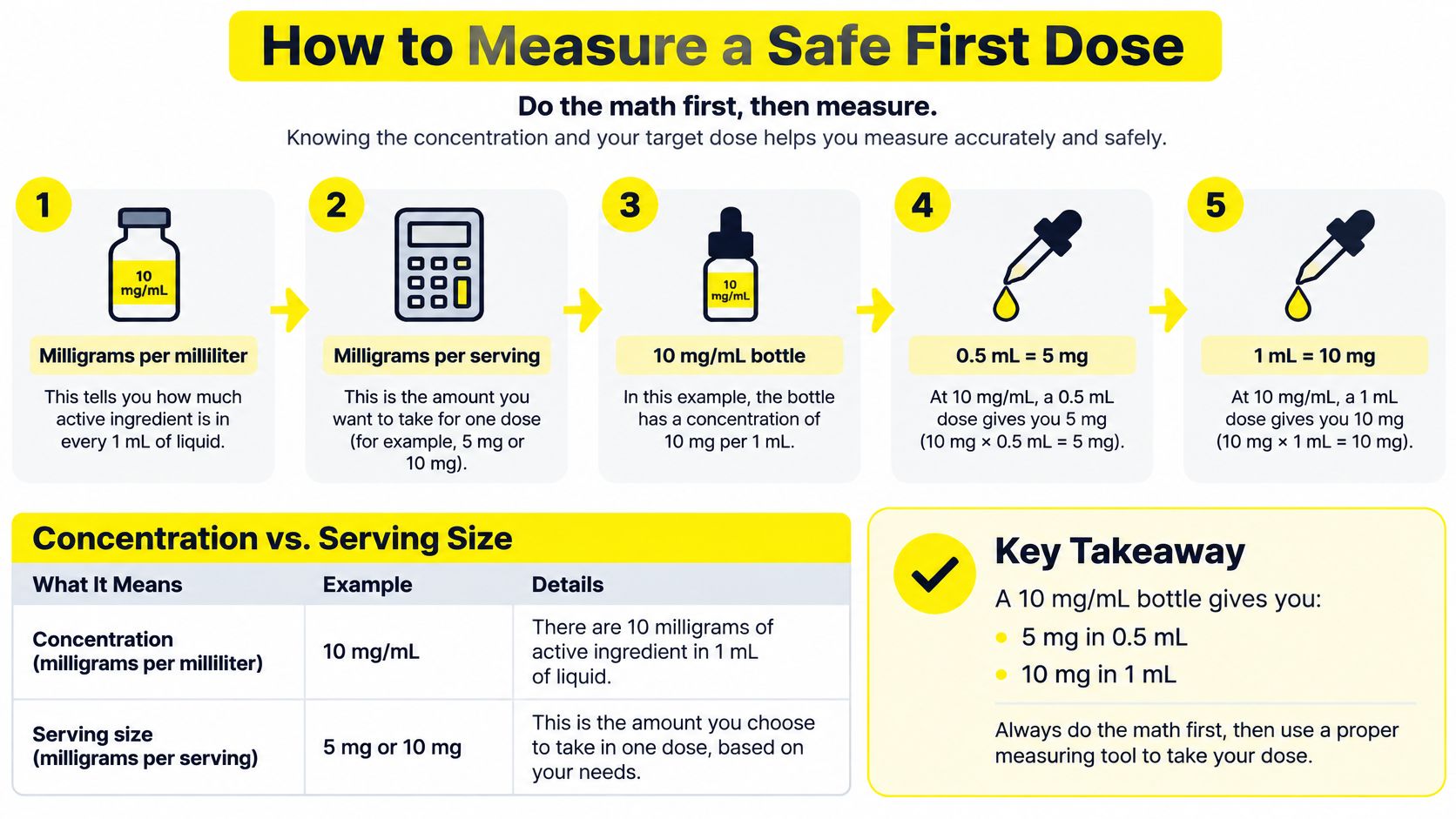
The word “indica” cannot tell you how many milligrams are in a dropper. The label can. Milligrams measure cannabinoid amount; milliliters measure liquid volume. Mixing them up is an easy way to take more than intended.
To calculate a dose, multiply the amount per milliliter by the volume you measure. Work out THC and CBD separately, and use the pipette markings rather than assuming the dropper bulb fills to its highest line.
Milligrams in a measured tincture serving
For a tincture labeled 10 mg per mL, 0.5 mL contains 5 mg, and 1 mL contains 10 mg. Those are labeled amounts, not estimates of how much your body absorbs.
| What you measure | Strength on the bottle | Cannabinoid amount |
|---|---|---|
| 0.5 mL serving | 10 mg per mL | 5 mg labeled |
| 1 mL serving | 10 mg per mL | 10 mg labeled |
| 1 mL reaching circulation in one study | 10 mg THC per mL labeled | About 1.3 mg at 13% bioavailability |
A review of cannabis pharmacokinetics describes a study in which 1 mL containing 10 mg THC had estimated maximum bioavailability of 13%, or about 1.3 mg reaching circulation under those conditions.
That estimate is not a home dosing formula. Absorption can vary with the product and how you take it, so use the labeled cannabinoid amount to measure your serving. CBD products are used in different amounts by different people; reported use does not establish a starting dose. THC can cause impairment at lower amounts, so a CBD-use figure is not a THC dosing target.
A first-night routine you can repeat
- Read the THC and CBD milligrams per milliliter. Check whether the prominent number on the package describes the whole bottle or a serving.
- Choose a small, clearly marked serving that fits the label or your clinician's plan. If the dropper cannot measure it accurately, use an appropriate oral measuring syringe or choose a lower-concentration product.
- Follow the labeled route and note the time. Hold the tincture under your tongue or swallow it as directed. Follow the product's instructions for how to take it.
- Wait through the onset window in the timing table before judging the effect. Reaching the earliest listed onset time does not mean it is time to take more.
- Record the milligrams, route, food, and effects. Include unwanted effects as well as any relief.
- If you adjust the amount, make a small change on a later day. Changing one thing at a time makes it easier to tell what helped or caused discomfort.
Taking another full dropper after 15 minutes can stack a swallowed dose onto one that has not taken effect yet. The same patience applies to low-dose edibles, even though the measuring tool differs. Follow the product label, your clinician's advice, and applicable medical-cannabis rules. Indica is a market nickname, not a dose; the right amount depends on the milligrams and the serving you measure.
Onset, Duration and Clock-Time Examples
Tincture timing by how you take it
| Route | Onset | Peak | Duration | Wait before judging |
|---|---|---|---|---|
| Held under the tongue | 15–45 minutes, sometimes up to 60 | About 45 minutes | About 4–8 hours across sources | At least 45 minutes |
| Swallowed | 30 minutes to 1 hour | No fixed peak established here | Many hours | Full 30–60 minute window, longer if labeled oral |
| Held, then partly swallowed | 15–60 minutes, with a later wave possible | No single reliable peak for the mixed route | Can feel like both routes | Don't add droppers while waiting |
A clinical review of cannabis delivery methods reports sublingual onset of approximately 15–45 minutes and duration commonly lasting 6–8 hours. Other pharmacokinetic descriptions place onset as late as an hour, peak effects around three-quarters of an hour, and duration toward the shorter end of the table's range.
For swallowed cannabis, the National Institute on Drug Abuse's marijuana guide gives an onset of 30 minutes to 1 hour and says noticeable effects can continue for many hours; it also warns that delayed effects can lead to overconsumption and that excessive amounts can cause anxiety, fear, distrust, or panic.
These are planning windows, not appointments your body will keep. A clock helps prevent premature redosing, but it can't tell you the exact moment you're unimpaired.
Why holding and swallowing aren't cleanly separate
Under-the-tongue use sits between inhalation and eating in practical timing, but it doesn't guarantee that the entire serving bypasses digestion. Some liquid gets swallowed and passes through the digestive system and liver. You may therefore notice an early change followed by a later, stronger effect.
Carrier oil, ethanol, other additives, a recent meal, metabolism, and prior cannabis exposure can all affect the experience. Two bottles used in the same way may not behave identically. Follow each bottle's directions rather than transferring a routine from another product.
Much of the clinical evidence also involves standardized nabiximols formulations, not every tincture sold commercially. That's a reason to leave room for uncertainty, not to chase an exact minute.
Practical rule: The first noticeable effect isn't necessarily the strongest effect.
Two evenings where waiting matters
Swallowed before bed. Say you swallow a hypothetical 5 mg THC serving at 8:00 p.m. At 8:15 p.m., you feel unchanged and consider adding another equal serving. The safer choice is to leave the bottle alone and allow the full initial onset window, with additional patience for an oral-labeled product.
In that scenario, first effects might appear between 8:30 and 9:00 p.m., but that doesn't establish when the full effect will arrive. Don't turn the end of that window into an automatic redose time. Keep the first trial limited to the planned serving.
Held under the tongue later in the evening. Say someone already familiar with THC uses a hypothetical 10 mg serving at 9:30 p.m. They shouldn't judge it before 10:15 p.m., and a swallowed portion may still contribute later. This is a timing example, not a recommended beginner amount.
If that patient feels only a mild change at the first check, taking another full dropper could make the rest of the night less predictable. Skipping the bedtime redose gives them a clearer record of how the original serving behaved.
Our comparison of THC tinctures versus edibles can help when choosing between formats. The practical trade-off is flexibility versus uncertainty: a liquid allows measured adjustments, but absorption still takes time.
Keep driving out of the evening's plan. Feeling less high doesn't establish that your coordination or judgment has returned, and the indica name doesn't set any of these times.
When the Printed Dose May Be Wrong
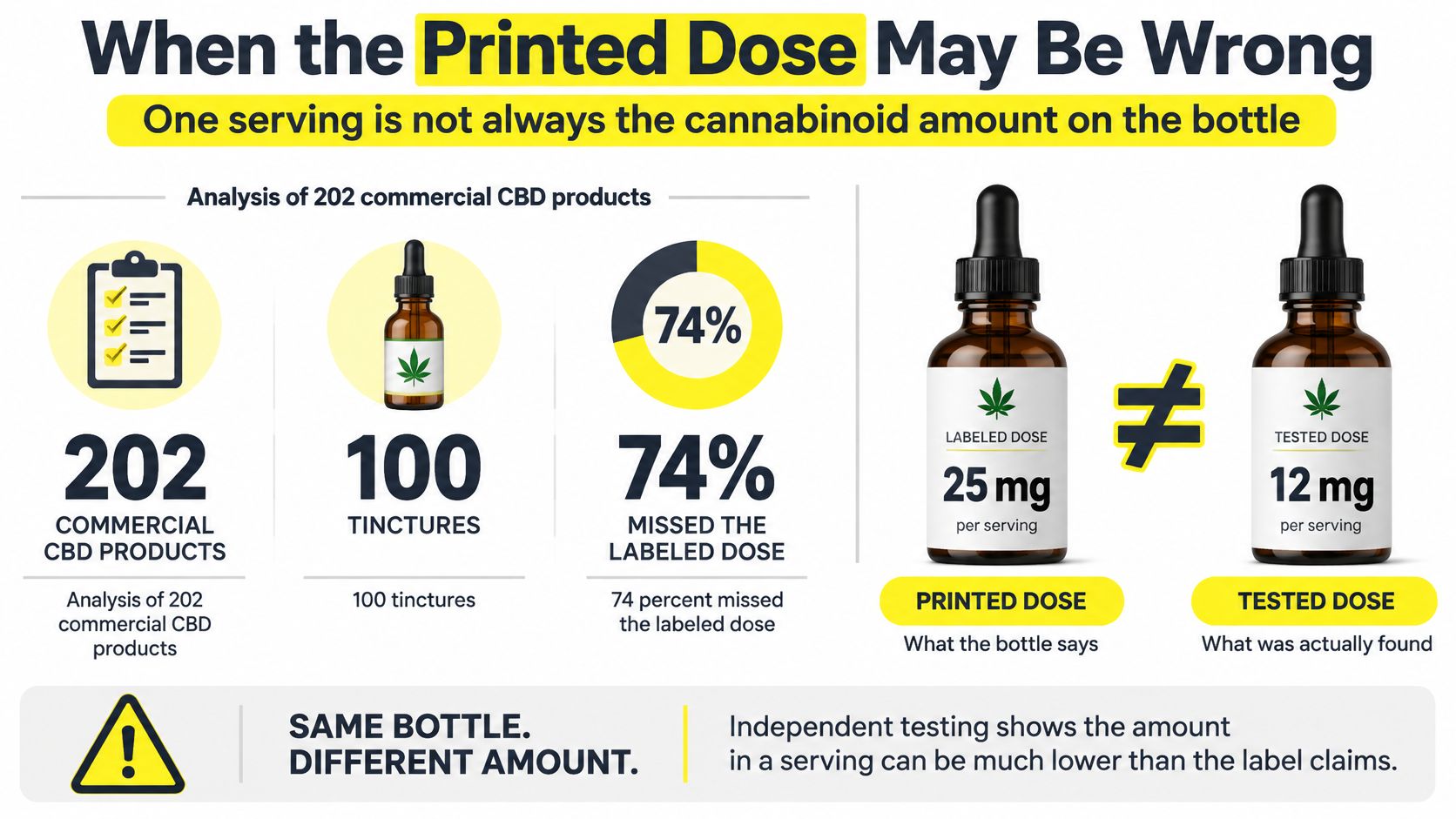
One serving isn't always the cannabinoid amount printed on the bottle. In an analysis of commercial CBD products, 74% of 202 products, including 100 tinctures, deviated from labeled CBD potency by at least 10%; 46% contained more than 110% of the claimed amount, while 28% contained less than 90%.
The graphic highlights the mismatch, but its description needs an important correction: the finding covered mixed CBD products, not tinctures alone, and errors went both above and below the label.
How often cannabinoid labels miss
| Finding | What was studied | Share | What it means |
|---|---|---|---|
| CBD at least 10% off the label | 202 CBD products, 100 of them tinctures | 74% | One serving may not match the bottle |
| More than 110% of claimed CBD | Same 202 products | 46% | Stronger than the label |
| Less than 90% of claimed CBD | Same 202 products | 28% | Weaker than the label |
| Minor cannabinoids not reported | 277 flower and concentrate products | 84% | CBG, CBN, CBC, and THCV often missing |
The final row comes from a separate analysis of cannabis product labeling, which examined 277 flower and concentrate products and found that 84% didn't report several minor cannabinoids, including CBG, CBN, CBC, and THCV. That isn't a tincture-specific error rate, but it illustrates why an absent cannabinoid listing shouldn't be read as proof of absence.
Premium packaging doesn't resolve uncertainty. Someone trying to avoid impairment needs dependable THC information, while someone taking prescription medication needs a clearer picture of cannabinoid exposure.
Check the batch before trusting the serving
- Find the batch number. Match the bottle to its certificate of analysis, not a generic report for the same product name.
- Review potency and pesticide testing. Confirm the product identity, cannabinoid results, and testing status on the matching report.
- Recalculate the serving. Use the measured concentration and the dropper's marked volume. Don't convert individual drops into milligrams unless the product provides a reliable conversion.
- Compare the report with the label. Note discrepancies and missing cannabinoid information before using the product.
Our cannabis potency testing guide explains the questions behind those checks. At our dispensary, every product is tested for pesticides, potency, and more. Testing still needs to be tied to the bottle you're considering.
For an additional visual discussion, watch the video below.
Batch-level transparency is useful, but precision shouldn't be assumed. This is education, not a personal medical plan.
When to Stop and Get Help
Stop adding doses if you develop anxiety, dizziness, dry mouth, or unusual sleepiness. Put the bottle away, sit somewhere safe, and avoid alcohol or other intoxicants. If possible, have a trusted, unimpaired person stay nearby.
Don't try to correct an uncomfortable THC experience by experimenting with another cannabis product. Adding something else makes it harder to know what you're responding to and may increase impairment.
Warning signs that need medical attention
- Chest pain, fainting, or trouble breathing: Seek emergency help immediately. Don't assume cannabis is the only possible cause.
- Severe confusion or difficulty staying responsive: Have someone contact emergency services and stay with you.
- Panic that doesn't settle: Stop using the product and seek medical guidance, especially if you can't stay safe or symptoms are worsening.
- Symptoms that return or newly appear: If a symptom starts after you thought the product had worn off, call for medical help rather than waiting longer.
Tell the clinician what you took, the labeled THC and CBD amounts, the route, and the approximate time. Bring the bottle or a clear photograph of its label if you can do so without delaying care. Never drive yourself while impaired.
Medicines and next-day responsibilities
Patients taking prescription medicines should ask a clinician or pharmacist about interactions before the first dose. That includes sedatives, blood thinners, and medicines processed by the liver. Bring a current medication list to a dispensary visit, but don't treat a retail conversation as a substitute for a medication review.
Avoid driving, operating machinery, or taking on safety-sensitive late-night work until the effects have fully worn off. Under-the-tongue use can impair you for several hours, and swallowed portions can extend the experience. If you're still sleepy, slowed, or uncertain the next morning, don't drive.
Being home for the night doesn't make an unexpected reaction something you have to manage alone.
A clinician can help determine whether a tincture suits your condition and whether the dose plan needs changing. Persistent sleep trouble, recurring anxiety, or ongoing pain deserves that broader assessment rather than repeated increases in THC.
Choose a Tested Tincture in DC
Buy a bottle you can explain before you buy a bottle with an appealing nickname. You should be able to identify its concentration, measure the intended serving, describe the route, and connect it to a matching batch report.
A purchase checklist worth bringing
- Clear concentration: THC and CBD appear in milligrams per milliliter, with enough information to calculate a serving.
- Usable measuring tool: The dropper markings let you measure the amount you intend to take without guessing.
- Transparent ingredients: The carrier, flavorings, and other additives are listed.
- Matching batch information: The bottle can be tied to potency and pesticide testing.
- A defined goal: You can describe whether you're seeking help with sleep, pain, or anxiety, and what unwanted effects you need to avoid.
Dark glass, a high price, and the word indica aren't substitutes for those checks. Our explanation of product testing standards offers a useful basis for reviewing a package.
Bring your goal to the counter
At Mr. Nice Guys DC, a registered medical cannabis dispensary, our budtender asks what you're looking for, such as pain relief, help sleeping, or anxiety support, before recommending products. Bring your medication list and explain your THC experience, including any previous uncomfortable reactions.
Medical cannabis patients can purchase up to 8 ounces every 30 days in D.C. Confirm current purchase limits and certification steps with the DC Department of Health before buying, since rules can change. A purchase allowance isn't a dosing recommendation.
Choose a concentration that allows a small, clearly measured serving rather than forcing you to estimate a tiny amount of a strong liquid. Take home a bottle suited to that smallest labeled serving, and follow the first-dose routine before making any change.
Mr. Nice Guys DC offers tinctures and needs-based guidance to help you compare cannabinoid amounts, formats, and intended effects. Visit Mr. Nice Guys DC with your goal and medication list, and ask our team to walk through the label and testing information before you choose a bottle.
Mr Nice Guys DC
At Mr. Nice Guys DC, we’re more than just a cannabis delivery service — we’re passionate advocates for quality, convenience, and community. With years of experience in the cannabis industry, our team is dedicated to educating and empowering customers across Washington, D.C. Whether you're a seasoned user or just starting your cannabis journey, our blog delivers trusted tips, product insights, and the latest updates from the world of weed. Stay informed, stay elevated.
