
Must Be 21 To Enter
By entering this site you are agreeing that you are at least 21 Years of Age or older.
I AM 21 OR OLDERWhat Is an Infused Pre Roll and Why It Hits Harder
.svg)

.png)
An infused pre-roll is a ready-to-smoke joint that combines ground cannabis flower with a concentrate such as kief, hash, distillate, live resin, rosin, or diamonds. Regular pre-rolls often test around 15% to 25% THC, while infused versions commonly reach 30% to 50% or more, with some concentrate-heavy products testing at 60% or higher (Kush Groove explains the potency difference).
You're standing at a DC dispensary, looking at a menu filled with neat cones and colorful labels. One says “single strain,” another says “infused,” and the price difference makes you wonder whether you're paying for better flower or just a stronger smoke. The answer is usually both a product and a dosing decision. An infused pre-roll has its potency engineered into the joint before it reaches you, so the way you pace the session matters as much as the strain name.
What Is an Infused Pre Roll and Why It Matters
An infused pre-roll is a pre-rolled joint containing ground flower plus cannabis concentrate. Producers may mix the extract through the flower, place it in a central core, inject it near the mouthpiece, or apply it to the outside. Common additions include kief, hash, distillate, live resin, rosin, wax, and THCA diamonds (Leafly's glossary definition).
That construction changes the shopping question. With a standard joint, the flower's cannabinoid content largely determines the experience. With an infused joint, you also need to consider the concentrate type, amount, placement, and burn behavior. A small cone coated with kief may feel different from a similar-sized cone containing a concentrated distillate core, even when the package displays a comparable THC figure.
For a first-time buyer, the most useful distinction is simple:
- Standard pre-roll: Ground cannabis flower only.
- Infused pre-roll: Ground flower plus a concentrated cannabis extract.
The concentrate raises the amount of cannabinoid material in the joint and can intensify aroma, flavor, and smoke density. It can also make the joint burn less evenly if the oil pools or the extract is distributed poorly. The product isn't automatically better because it's stronger. It's better matched to you when its intensity fits your tolerance and the kind of session you want.
Practical rule: Treat “infused” as a potency warning and a construction detail, not just a premium label.
If you're buying for a light evening, a standard flower joint may offer more control. If you're an experienced consumer or a medical patient looking for a concentrated session, an infused pre-roll may reduce the number of puffs needed. The rest of the decision comes down to understanding what's inside and how it changes the smoke.
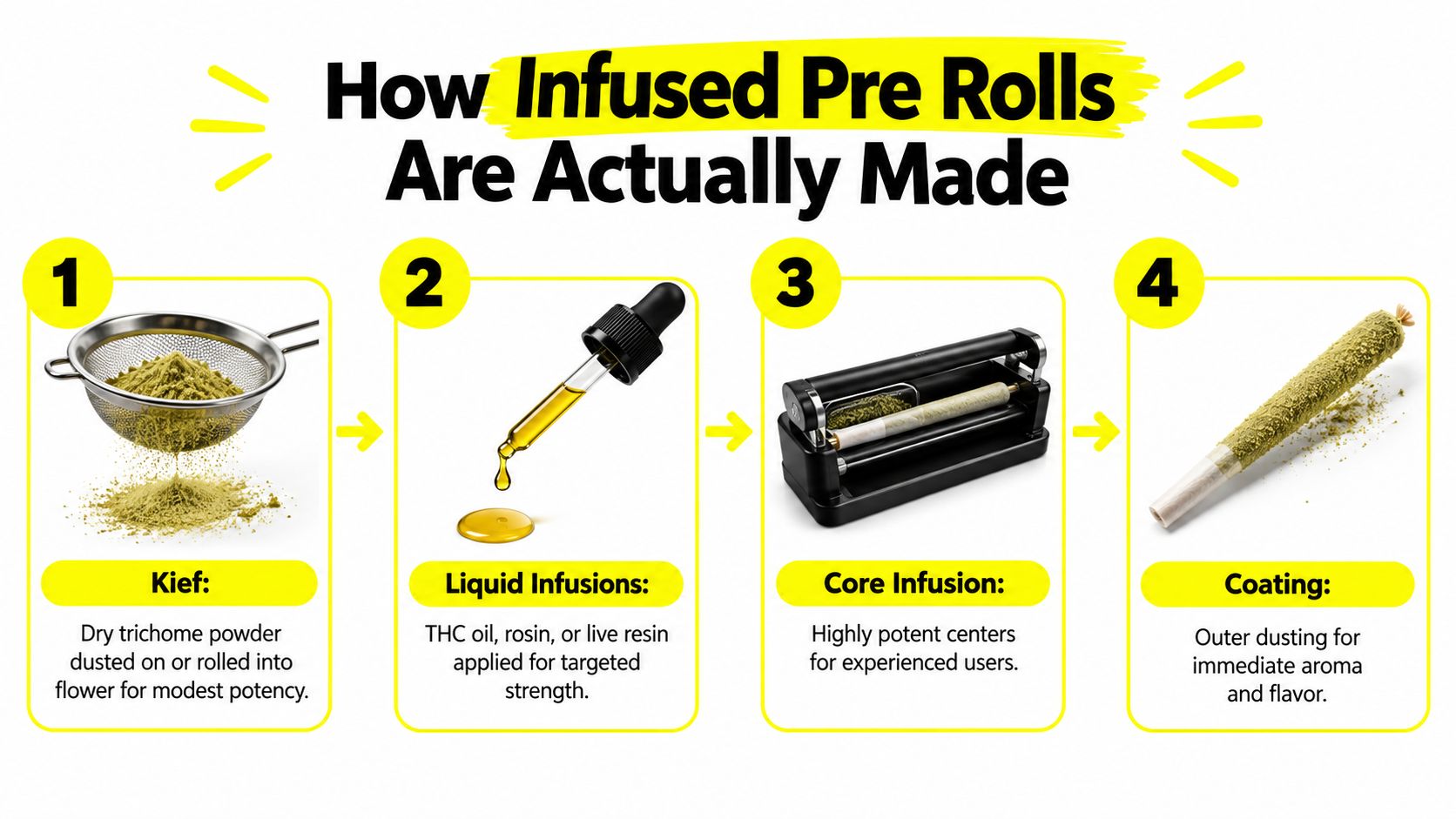
How Infused Pre Rolls Are Actually Made
Manufacturers use several methods, and each one changes the joint's flavor, texture, and combustion. The same word, “infused,” can describe products with very different experiences.
Dry additions and pressed concentrates
Kief is loose trichome material. A producer can blend it into the flower or apply a tacky layer to the outside, then roll the joint through the kief. This adds a dry, resinous coating and may increase potency without introducing much oil. The outside can feel rougher, and the burn may become harsher or less consistent if the coating is heavy.
Hash is a compressed concentrate with a denser texture. It may be mixed through the fill or placed in a line inside the joint. Compared with a simple kief dusting, a hash center can create a slower, more concentrated burn. The flavor tends to be deeper and more earthy, especially when the base flower already has a strong profile.
Rosin is a solventless concentrate valued for its terpene character. A rosin-infused joint can taste fuller and more strain-forward, but the sticky material needs careful placement. Too much in one spot can cause canoeing, oil buildup, or a difficult draw.
Oils, resin, and crystalline concentrates
Distillate is highly refined, potent, and often close to flavorless. One source describes common distillate as roughly 85% to 95% THC (Verilife's guide to infused pre-rolls). A producer may paint it along the paper, inject it into the flower, or place it near the center. The result is a sharp potency increase without necessarily overpowering the strain's original taste.
Live resin and sauce are extract formats that preserve more aromatic compounds. They can produce a louder nose and a more noticeable flavor shift than neutral distillate. For example, a citrus-forward live resin may make a familiar flower cultivar taste brighter, while a heavier sauce can add a sticky, dense smoke.
THCA diamonds and crystalline concentrates are among the most potent additions. Their hard texture makes placement important, and a diamond-heavy joint may burn unevenly unless the pieces are distributed well. A product with diamonds can feel especially intense because it combines high cannabinoid density with a concentrated section of material.
For a broader explanation of concentrate formats, compare this guide to cannabis concentrate types.
A joint can be dipped in oil, rolled in kief, and packed again, or it can contain a carefully distributed internal core. Those two products may show similar label numbers but deliver different sensations because the extract's viscosity, melt point, and location affect how quickly cannabinoids enter the smoke.
The mechanics are easier to visualize in motion:
Infused Pre Rolls vs Standard Pre Rolls
A standard pre-roll suits a relaxed evening or a shared session when you want the flower's effects to remain easier to gauge. An infused pre-roll adds concentrate to the flower, so fewer draws may feel stronger. The tradeoff is less room for casual pacing, plus a greater chance of uneven burning or leftover oil.
| Attribute | Standard Pre Roll | Infused Pre Roll |
|---|---|---|
| Contents | Ground flower only | Ground flower plus concentrate |
| Potency profile | Flower strength sets the baseline (The Hemp Doctor's comparison) | Concentrate adds a denser cannabinoid layer |
| Burn | Usually more predictable | Oil and concentrate placement may slow or disrupt the burn |
| Flavor | Primarily the flower's profile | Flower may combine with oil, resin, hash, or rosin notes |
| Session control | Easier for light or shared sessions | Better approached with measured use |
| Cost per session | Usually lower per joint | Often higher, though fewer puffs may be needed |
The most useful comparison is not always joint size. A 1-gram flower joint at 20% THC and a 0.7-gram infused cone at 40% can contain similar total THC while differing in price, burn time, and how quickly the effects arrive. Compare the label's total milligrams and the expected number of sessions, not grams alone. This comparison of pre-rolls and flower also helps separate quantity from practical value.
For a first-time or low-tolerance buyer, standard flower usually offers the clearer starting point. You can take a small draw, wait, and learn how the cultivar affects you without adding concentrate as another variable. It also works well when several people may share the joint and want more control over their portions.
An infused pre-roll fits an experienced consumer seeking a heavier session, or a medical patient following a plan that calls for stronger cannabis. It may also suit someone who prefers a few deliberate puffs instead of finishing a flower joint. Store it carefully, start slowly, and expect the format to cost more or burn less evenly. The right choice is the one that matches your tolerance and pacing, not the one with the most impressive label.
Potency Numbers and What They Mean for You
A potency label is a starting point, not a prediction of how the session will feel. Standard flower often falls around 15% to 25% THC, while infused products may reach 30% to 50% or more. Concentrate-heavy formats can reach 60% or higher, according to this strength guide for infused pre-rolls. These figures describe concentration. Your experience also depends on the joint's weight, the infusion method, the size of each draw, and your tolerance.
The math explains why a small infused cone can feel very different from a standard one. A 0.5-gram joint containing 20% THC flower contributes about 100 mg of THC. Adding 0.2 grams of concentrate at 85% THC contributes another 170 mg, putting the joint above 250 mg total THC. The flower has not changed, but the added concentrate changes how much THC is available across the session. This potency example for infused pre-rolls shows why joint size alone can mislead.
That total is not absorbed in one moment, and a pre-roll is not divided into standardized medical doses. Still, the calculation gives first-time and low-tolerance buyers a useful decision rule: treat the infusion as a major change in intensity, not a minor upgrade to ordinary flower.
| Pre-Roll Type | What the Number Suggests | What Changes the Experience |
|---|---|---|
| Standard flower pre-roll | Lower concentration than infused formats | Flower weight and draw size |
| Kief-infused pre-roll | Often around 30% to 45% total cannabinoids (Urth and Fyre's infusion guide) | How much kief coats the flower and burns |
| Rosin-heavy pre-roll | About 35% to 55% in the cited product guidance | Rosin weight, distribution, and flavor |
| Concentrate-heavy pre-roll | May reach 60% or more | Concentrate amount and how evenly it burns |
Read the label as an intensity signal, not a promise of a specific effect. Rosin may bring fuller aroma and layered flavor, while distillate may feel sharper and more THC-forward. Reviewing cannabis potency testing can clarify what the lab panel measures and what it cannot predict.
Dosing and Safety for First-Time and Low-Tolerance Users
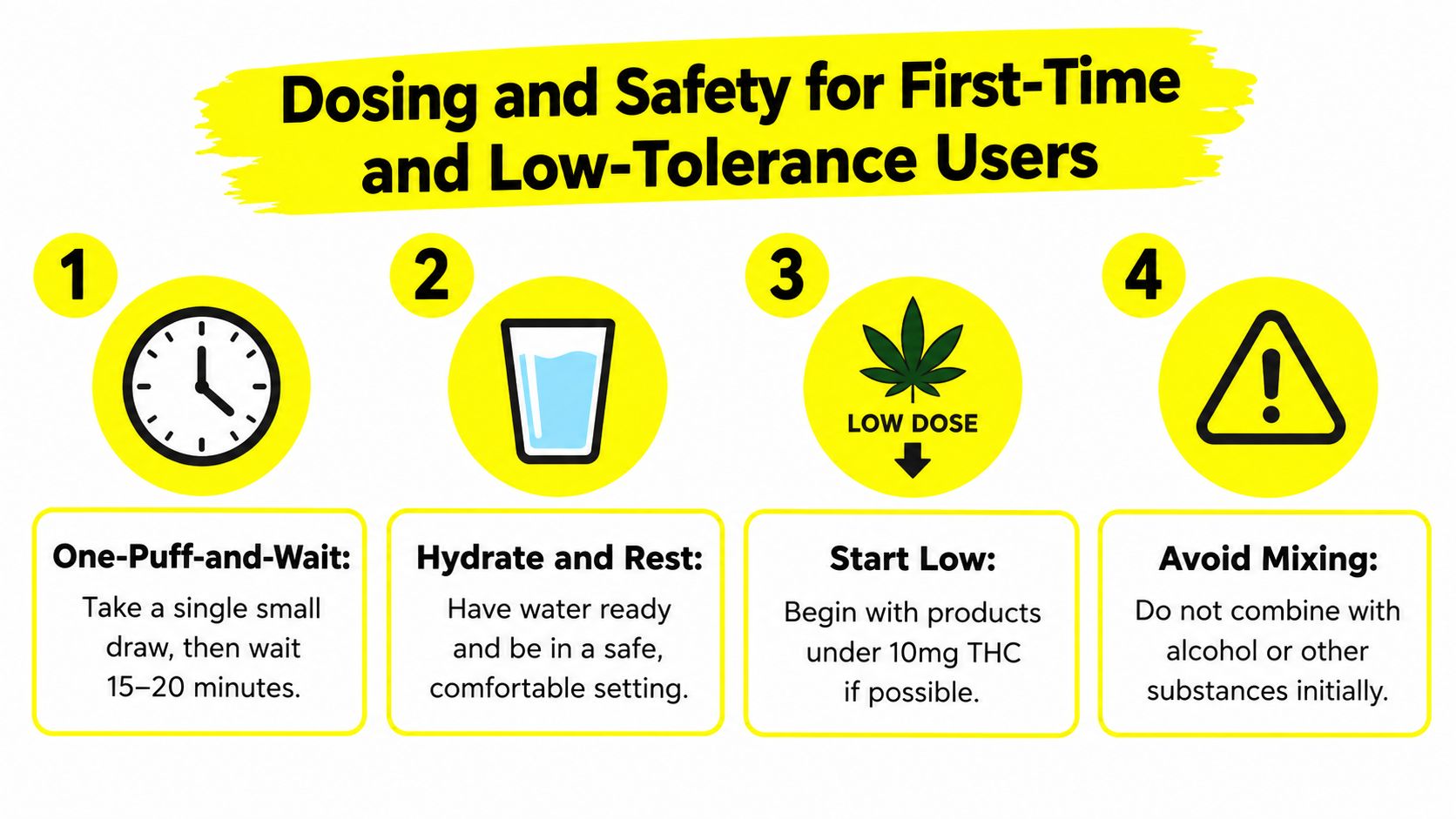
Dosing an infused pre-roll is a pacing problem, not a test of willpower. The most reliable starting point is one small draw, followed by a pause long enough to notice what's developing before you decide whether to continue.
Start with one measured draw
Take a shallow puff rather than a long pull. Set the joint down, keep water nearby, and wait 15 to 20 minutes before reassessing. Inhaled cannabis can feel immediate, but the full effect may continue building after the first sensation.
A new or low-tolerance user may want to stop after that first draw. If the product feels manageable, a second small puff can be considered later. Experienced consumers may choose a longer session, but the same principle applies: don't assume the joint is mild because the cone is small.
Pacing matters more than finishing the joint. You can relight a leftover pre-roll. You can't undo an excessive first session.
Prepare for an easier recovery
Use a calm, familiar setting where you don't need to drive, work, supervise someone, or make important decisions. Water and a snack can help with dry mouth or discomfort, while a comfortable seat gives you space to wait out an unexpectedly strong effect.
Common signs of overconsumption include a racing heart, cottonmouth, anxiety, and dizziness. Move somewhere quiet, breathe slowly, sip water, and ask someone you trust to stay nearby. If CBD is available and familiar to you, some people choose it as part of their comfort routine, but it isn't a substitute for medical care when symptoms feel severe or unusual.
Don't combine an infused pre-roll with alcohol or an edible during an initial trial. Different absorption routes can stack, and the result may be harder to predict. For more beginner-focused preparation, review these first-time smoking tips.
Never drive after using an infused pre-roll. Keep unused portions secured away from children and pets, and don't leave a lit joint unattended.
Reading Labels, Lab Results, and DC Legal Basics
The front of a package sells the experience. The back helps you manage it. Start by looking for total THC, not just THCA. Total THC reflects the potential THC after THCA conversion, making it more useful for judging the product's overall strength.
Then check the details that explain what kind of experience the number represents:
- Infusion type and weight: Identify whether the joint contains kief, distillate, live resin, rosin, hash, or another concentrate, and look for how much was added.
- Minor cannabinoids: CBG and CBN may appear alongside THC and CBD, giving you more context than a THC number alone.
- Terpene profile: Dominant terpenes can help you compare aroma and expected character across products, although they can't guarantee a specific effect.
- Batch and test information: The batch number should connect the package to a certificate of analysis and a test date.
Lab results are especially useful for extract-based products. Testing may screen for pesticides, heavy metals, microbial contamination, and residual solvents. That final category matters when a product uses an oil or sauce infusion, because the concentrate process can introduce materials that a compliant laboratory should evaluate.
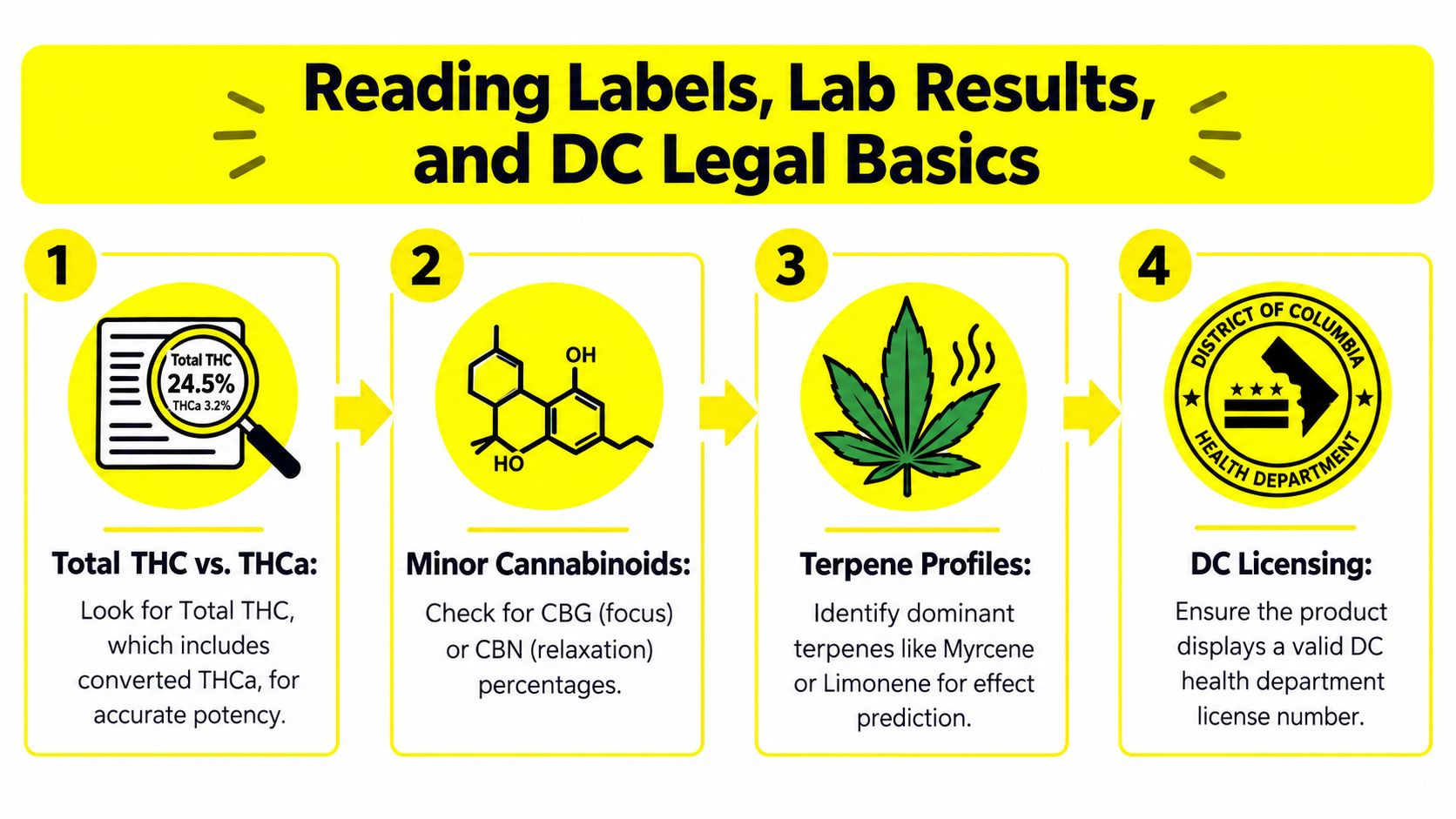
Washington, DC buyers should also remember that cannabis products fall under local rules involving Initiative 71 and the adult-use framework administered by the Alcoholic Beverage and Cannabis Administration. Possession, purchase, and gifting requirements can change, so check current official DC guidance and ask the retailer how its products are sold compliantly.
A practical workflow keeps the label from becoming decoration:
- Scan the package: Find total THC, THCA, concentrate type, and weight.
- Match the batch: Confirm that the lab report uses the same batch number.
- Review the extract data: Check cannabinoid, terpene, and residual-solvent information when available.
- Compare value: Weigh the price against total THC, flower quality, infusion method, and your intended dose.
Choosing an Infused Pre Roll at Mr. Nice Guys DC
Start with three questions before you look at strain names:
- What effect are you seeking? Relaxation, sleep support, creativity, appetite, or relief may lead you toward different cultivars and terpene profiles.
- What is your tolerance? A low-tolerance buyer should prioritize a lower-strength format and a clearly labeled infusion.
- What is your infusion budget? Decide whether you're paying for a simple kief coating, a distillate-heavy product, or a flavor-focused rosin or live resin experience.
Physical inspection can reveal construction problems. A good pre-roll should draw without excessive resistance, show reasonably even packing, and avoid obvious oil pooling at the crutch. If you can see large concentrate chunks, ask whether they're distributed through the center or likely to create a hot spot.
Price per milligram of total THC can be more informative than price per gram when comparing a kief-coated joint with a distillate-dipped one. That comparison still needs context. A rosin product may cost more because of the concentrate's character and production method, while a distillate product may emphasize high potency and a more neutral taste.
Ask the budtender direct questions:
- Which cultivar supplied the flower and concentrate?
- Was the rosin cold-cured?
- What does the terpene percentage look like on the certificate of analysis?
- Is the concentrate blended through the flower or placed in a core?
- How should someone with low tolerance pace this specific product?
Mr. Nice Guys DC offers pre-rolls and other cannabis formats through its dispensary menu, with staff who can help shoppers compare products by strain, format, and intended effect. You can also use its pre-roll shopping guide to frame your questions before ordering.
Be cautious when a package lacks a batch number, provides no accessible lab information, or uses an unusually low price to distract from weak flower or poorly handled concentrate. A strong coating can't reliably fix stale flower, uneven packing, or an extract that burns badly.
Key Takeaways Before You Buy
An infused pre-roll combines ground flower with concentrate, so the construction affects both flavor and intensity. Kief creates a dry resin coating, hash adds a denser, earthier character, and distillate can raise THC while contributing less flavor. Live resin or rosin may make aroma and terpene character more noticeable. Diamonds and other crystalline additions can increase intensity further.
Infused joints concentrate more cannabinoid material than flower-only cones. Treat the label as a dosing instruction, not a ranking. A small cone can still deliver a substantial session, and the result depends on concentrate placement, flower quality, terpene profile, and your tolerance.
Use four checks before buying:
- Match strength to experience: New and low-tolerance users should choose cautiously and avoid assuming a small pre-roll means a small dose.
- Pace the session: Take one small puff, wait 15 to 20 minutes, and reassess before taking more.
- Read the lab panel: Check total THC, infusion weight, terpene information, batch number, and test date.
- Confirm compliant packaging: Look for the information needed to identify the product's source and testing.
Choose by the experience you want, whether that means a lighter, manageable session or a stronger one suited to higher tolerance. Explore the Mr. Nice Guys DC menu, then ask the budtending team for a strain and dose recommendation that fits your tolerance, setting, and purpose.
Mr. Nice Guys DC offers pre-rolls, concentrates, flower, edibles, and other cannabis formats for adults and medical patients seeking clear product information. Visit Mr. Nice Guys DC to review the current menu and discuss an infused pre-roll that matches your experience level.
Start with the session you want, not the highest number on the menu.
Mr Nice Guys DC
At Mr. Nice Guys DC, we’re more than just a cannabis delivery service — we’re passionate advocates for quality, convenience, and community. With years of experience in the cannabis industry, our team is dedicated to educating and empowering customers across Washington, D.C. Whether you're a seasoned user or just starting your cannabis journey, our blog delivers trusted tips, product insights, and the latest updates from the world of weed. Stay informed, stay elevated.
