
Must Be 21 To Enter
By entering this site you are agreeing that you are at least 21 Years of Age or older.
I AM 21 OR OLDERPre Rolls vs Flower Guide for Smart DC Choices
.svg)

.png)
You're probably doing what half the city does before ordering. You've got a menu open, you see a pre-roll you can smoke right away, then you see flower that looks nicer on paper, and now you're stuck asking the same question: which one is the smarter buy?
That's the pre rolls vs flower decision in DC. Not some abstract debate. It's whether you want speed or control, whether you care more about convenience or flavor, and whether you know how to avoid the quality traps that menus don't spell out.
A lot of shoppers get burned by the wrong shortcut. They buy the cheapest joint on the menu and assume it's the same as buying good bud. Sometimes it is. Sometimes it's ground whole flower. Sometimes it's shake, trim, older material, or a harsh infused product that hits way harder than expected. On the flip side, plenty of people buy loose flower, then realize they don't own a grinder, don't want to roll, and end up with product sitting around getting stale.
If you're still figuring out your go-to format, it helps to compare this choice with other format decisions too, like edibles vs vapes vs flower at Mr. Nice Guys DC.
Bottom line: Pre-rolls win on convenience. Flower wins on control. The smart buy depends on what's inside the pre-roll, how fresh both options are, and how you actually consume cannabis in real life.
Introduction to Pre Rolls vs Flower in DC
A DC shopper walking in after work usually falls into one of three lanes.
One, you want something easy for tonight. No grinder, no tray, no rolling. Just open, light, done. That shopper should be looking hard at pre-rolls.
Two, you care about aroma, texture, and how the flower breaks down in your fingers. You might want to smoke a little now and save the rest, or run it through a vaporizer later. That shopper should usually buy loose flower.
Three, and this is the one I see all the time, you want the convenience of a pre-roll but the quality of premium bud. That's where people need better information, because not every pre-roll is built the same.
The choice most menus hide
The format itself isn't the whole story. A pre-roll can be solid if it's packed with fresh whole-flower input. It can also be disappointing if it's filled with dry shake. Flower can be amazing if it's fresh and terpy. It can also be a waste if you don't have the gear or patience to use it properly.
Here's the quick side-by-side most buyers need early.
| Decision Point | Pre-Rolls | Loose Flower |
|---|---|---|
| Best for | Fast, ready-to-use sessions | Customized sessions |
| Setup | Open and light | Grind, pack, roll, or vape |
| Dosing feel | More fixed per unit | More adjustable |
| Flavor potential | Depends heavily on fill and freshness | Usually easier to inspect and preserve |
| Value trap | Cheap shake-filled joints | Buying more than you'll use while fresh |
| Smart buyer check | Ask what's inside and check package dates | Inspect bud structure, aroma, and test dates |
What matters in DC
In Washington, DC, plenty of buyers are balancing convenience with compliance, pickup timing, or delivery windows. That means your format choice isn't only about effects. It's also about whether you need something simple and discreet, or something you can stretch across several sessions.
If you buy with that in mind, the answer gets a lot clearer.
What Pre Rolls and Loose Flower Actually Are
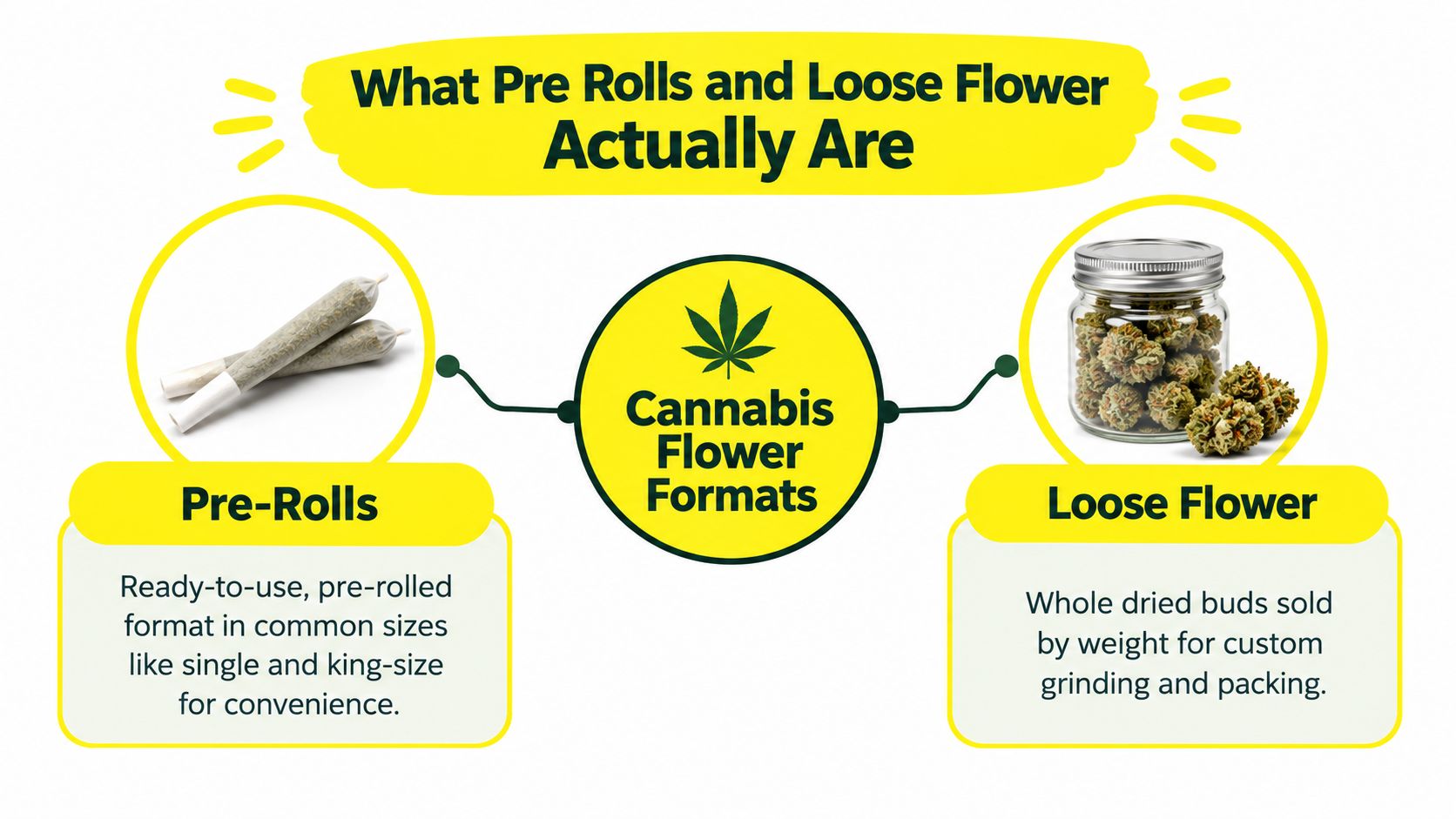
Let's clear up the basic confusion first. A pre-roll usually isn't some separate kind of cannabis. It's generally the same flower sold loose, just ground and packed into a paper cone ahead of time. Common retail sizes include 0.5 g, 1.0 g, and sometimes 0.35 g “dogwalkers” according to The Highline Dispensary's explanation of pre-roll sizes and format.
That matters because you're often choosing between the same plant material in two different forms. One is prepared for you. One is left in your hands.
Here's a simple visual.
What you're really buying with a pre-roll
You're paying for prep. Somebody already ground the flower, filled the cone, packed it, and sealed it.
That's why pre-rolls are useful for practical situations. Say you're heading to a friend's place and want a quick session before you leave home. A 1 g pre-roll works because you don't need a grinder, papers, or any rolling skill. You crack the tube, spark it, and move on.
The trade-off is simple. Once it's rolled, the decisions are already made for you. Grind consistency, pack density, airflow, and total amount are fixed.
For more on the convenience side of that equation, Mr. Nice Guys DC's guide to ready-made pre-rolls covers the format from a shopper angle.
A video helps if you want to see the category in a more visual way.
What loose flower gives you instead
Loose flower is the unrolled bud. You can grind it for a joint, pack it in a pipe or bong, or load it into a vaporizer. That flexibility is the whole point, as outlined in The Alchemy's comparison of loose flower use options.
If you like adjusting airflow, smoking speed, or session size, flower gives you room to do that. You can roll a skinny personal joint. You can pack a small bowl. You can vape a little and stop.
That control changes the experience in a real way.
- Need a quick, fixed option: Pre-rolls fit.
- Need multiple ways to consume the same purchase: Flower fits better.
- Don't own gear: Pre-rolls remove the setup problem.
- Already own a grinder or dry herb vape: Flower gets more useful fast.
One misconception worth killing
People talk about pre-rolls and flower like one is “real” cannabis and the other isn't. That's nonsense. The better question is whether the flower was handled well before it got to you.
A clean, fresh whole-flower pre-roll can smoke beautifully. A tired jar of loose flower can be flat and disappointing. Format matters, but handling matters more.
Potency Dosing Control and Consistency Compared
You buy a pre-roll because it looks simple. Then halfway through, it hits harder than expected, burns faster than expected, or tastes flatter than the jar flower you skipped. That usually comes back to two things. How much material you consumed, and whether the product was packed and stored well in the first place.
Here's the clean comparison.
| Criterion | Pre Rolls | Loose Flower |
|---|---|---|
| Portioning | Set amount per joint | You choose the amount |
| Potency range | Standard products often sit in the mid range. Infused versions run much stronger than standard joints, as noted earlier | Varies by strain, batch, and how much you pack |
| Session control | Decent if you put it out early. Poor if you tend to finish what you light | Strong. Easy to load a small bowl, tiny joint, or one vape chamber |
| Consistency check | Review label, testing date, seal, grind texture, and whether it is whole flower or shake | Review label, testing date, bud structure, moisture, and storage |
| Biggest risk | Buyers treat standard and infused pre-rolls like the same product | Buyers overpack and guess on dose |
Pre-rolls win on convenience, not precision
A pre-roll gives you a fixed starting amount. That helps if you hate rolling or want a grab-and-go option.
It does not give you exact dose control.
Once a joint is lit, a lot of people keep smoking out of momentum. That is the trap. The format feels controlled because the unit is pre-made, but your actual intake still depends on how long you smoke, how you inhale, and whether you clip it halfway or burn the whole thing down.
If you want tighter session control, flower is the better tool. Pack less. Stop sooner. Repeat only if you need to.
Flower gives you better microdosing control
This matters a lot for medical patients and anyone with a lower tolerance.
With loose flower, you can load one small bowl, take one pull from a dry herb vape, and be done. You can keep that session size consistent across the day. A pre-roll is worse for that job unless you are disciplined about taking a few hits and putting it out immediately.
That is why patients who care about repeatable intake often do better with flower than with joints.
If consistency is a deciding factor for you, read Mr. Nice Guys DC's guide to product consistency before you shop by THC alone.
The real consistency check is product verification
Format matters. Verification matters more.
A whole-flower pre-roll from fresh material can smoke very evenly and feel predictable from one unit to the next. A dry, old pre-roll packed with shake can hit harsh, canoe, and feel weaker than the label suggests. The same logic applies to flower. A pretty nug in a stale jar is still stale.
Use this checklist before you buy:
- Check the COA: Ask for the batch test, not a generic brand sheet.
- Check the test date: Older product is more likely to feel flat, especially pre-rolls because ground material loses freshness faster.
- Check the package seal: A loose cap or bad seal is a warning sign.
- Check product type: Standard pre-roll and infused pre-roll are different categories. Treat them that way.
- Check the fill language: If the label says whole flower, that means something. If it avoids saying so, ask what is inside.
Label accuracy still deserves skepticism
Big THC numbers sell products. They do not guarantee a better or more repeatable session.
A peer-reviewed analysis covered by ScienceDaily's report on THC label accuracy found that many flower products missed the regulatory potency standard used in that study. That flower category included both loose flower and pre-rolls.
The smart move in DC is simple. Use the THC number as one data point, then verify freshness, fill quality, and batch testing. If you want the easiest format, buy a standard whole-flower pre-roll from a fresh batch. If you want the most control over dose, buy flower and portion it yourself.
Price Value and Quality Differences That Matter
The cheapest pre-roll on the menu is often the most expensive mistake.
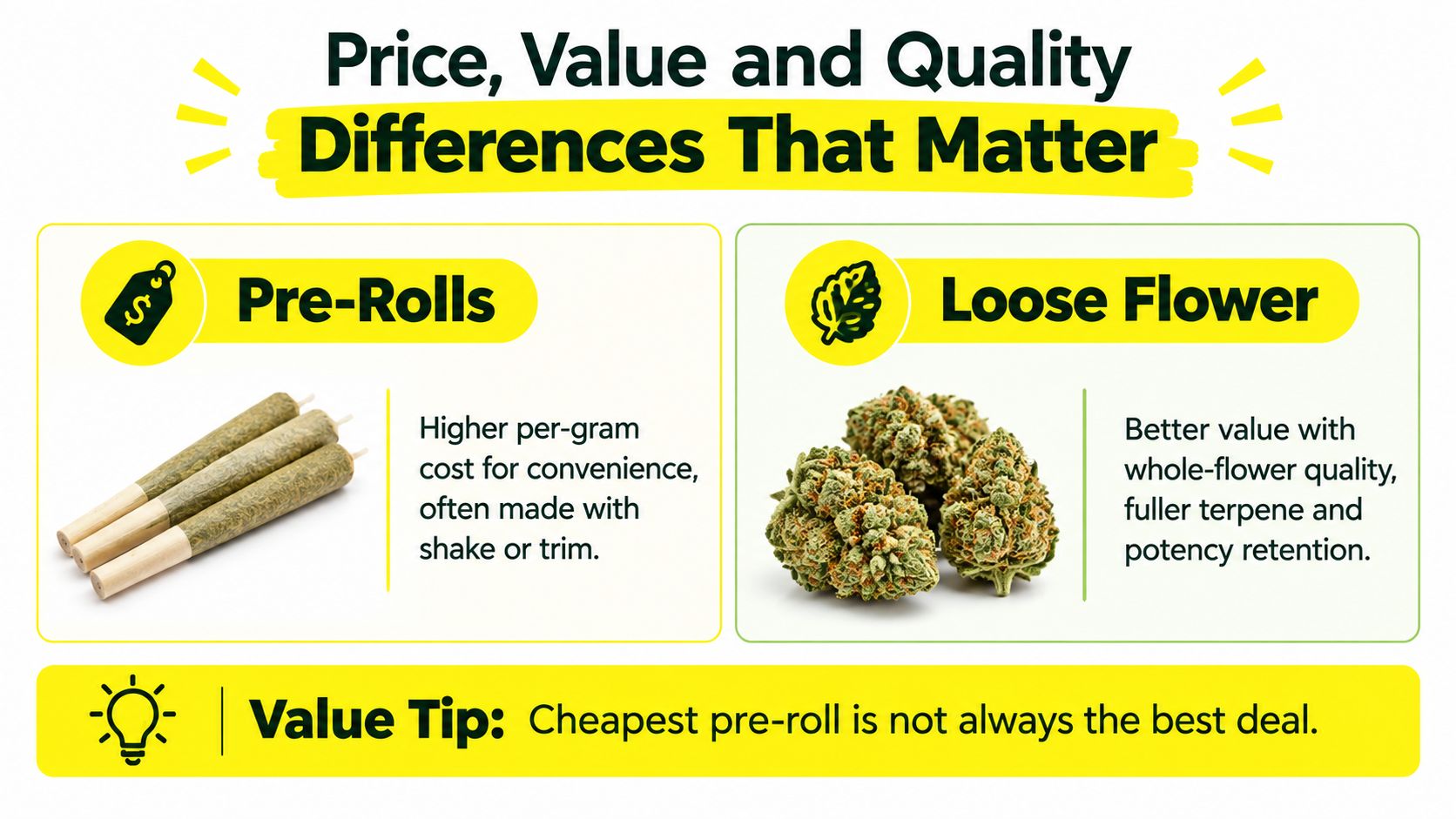
That's because value in cannabis isn't just shelf price. It's what's inside, how it burns, how much flavor you get, and whether you'd have been smarter buying flower and doing the prep yourself.
Whole flower vs shake is the first question
One of the most overlooked parts of the pre rolls vs flower conversation is what fills the joint. As explained in TribeTokes' guide to pre-rolls vs flower quality, the quality of a pre-roll depends more on the fill material than on the format itself. A whole-flower pre-roll can be very close to buying loose flower and grinding it yourself. A shake-filled pre-roll is lower quality by composition.
That difference shows up fast when you smoke.
Whole-flower pre-rolls usually give you a cleaner, more strain-specific experience. Shake-heavy pre-rolls are more likely to taste flat, burn unevenly, or feel like mystery mix material.
Here's the basic value picture.
Why pre-rolls keep growing anyway
Consumers clearly want convenience. In tracked U.S. retail data for the 12 months ending June 2026, flower remained the largest category at $9.6 billion and 39.4% of sales, while pre-rolls reached $3.84 billion and 15.8% share, growing 10.1% year over year compared with flower's -0.7% change, according to Headset's cannabis industry statistics.
That trend makes sense from behind the counter. A lot of people don't want a ritual. They want a ready-made session.
And there's another layer. Infused pre-rolls accounted for 47% of all pre-roll sales in one 2026 industry report, as discussed in the earlier TribeTokes source. That tells you the category isn't just “plain joints” anymore. A huge chunk of demand is for stronger, hybrid-style products.
The real value trap
If you smoke rarely, a single pre-roll can save you from overbuying flower that dries out before you finish it. That's good value even if the per-gram math isn't perfect.
If you smoke regularly and care about flavor, loose flower often gives you more control over freshness and a better chance to inspect quality before use. Add a grinder once, and you may get more satisfying sessions over time than cycling through random low-end pre-rolls.
Use this buying filter:
- Ask directly if it's whole-flower or shake-filled. If the answer is vague, I'd pass.
- Treat infused pre-rolls as their own category. Don't compare them to standard flower on autopilot.
- Think in sessions, not sticker price. One strong infused pre-roll may be too much. A quality eighth may stretch better for a regular user.
- Match the product to your habits. If you only smoke on weekends with friends, pre-rolls can make more sense than flower plus gear.
If you want a menu-level view of this issue, this Mr. Nice Guys DC article on pre-roll cost is a useful companion read.
Health Considerations Storage and Freshness Tips
Freshness changes the experience more than is often admitted. Dry cannabis smokes hotter, tastes worse, and usually feels less satisfying. That applies to both formats, but pre-rolls have an extra weakness. The flower is already ground.
Grinding increases surface exposure. That can affect aroma and burn if the material is old or poorly stored. The label-accuracy analysis covered earlier also pointed out a practical issue for buyers: pre-rolls add another processing step, and that can change burn behavior and increase the chance of terpene loss if the material isn't handled well.
What to check before you buy
Don't overcomplicate this. Look for signs the product has been cared for.
- Sealed package integrity: A pre-roll tube or pack should feel properly closed, not beat up or loose.
- Testing date visibility: More recent testing is a better sign than old inventory with no context.
- COA access: If you can review lot-level testing, do it.
- Aroma and bud condition for flower: If the flower smells muted or looks tired, keep moving.
For loose flower, you've got one big advantage. Whole buds generally hold up better than ground material if they've been stored correctly. You can often tell more from the look and smell.
For pre-rolls, you're trusting the pack more. That means date transparency and storage discipline matter even more.
How to store each format at home
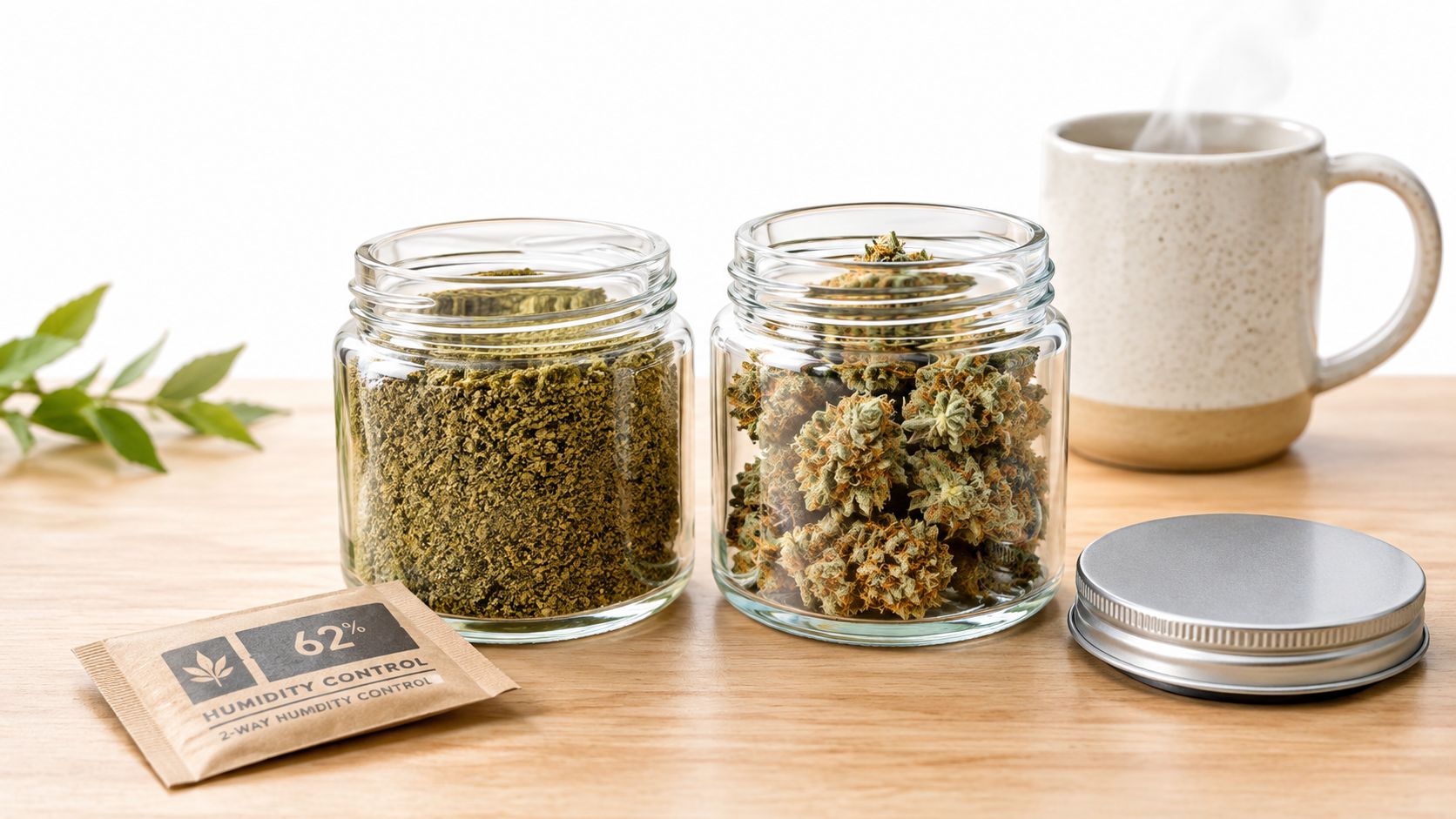
Store both away from heat, bright light, and wide humidity swings. Keep flower in a sealed container. Keep pre-rolls in their original sealed packaging if it's solid, or move them carefully to a protective airtight container if needed.
A patient buying enough for the week should think about rotation. Use older pre-rolls first. Don't let a half-open multipack bounce around in a backpack for days. Don't leave flower sitting in a hot car, either.
If freshness is a big concern for you, Mr. Nice Guys DC's flower storage guide has practical handling tips that apply right away.
Fresh product beats the “right format” every time. A well-kept pre-roll will smoke better than stale flower, and fresh flower will usually outshine a dried-out joint.
Best Use Cases for Medical Patients and Recreational Consumers
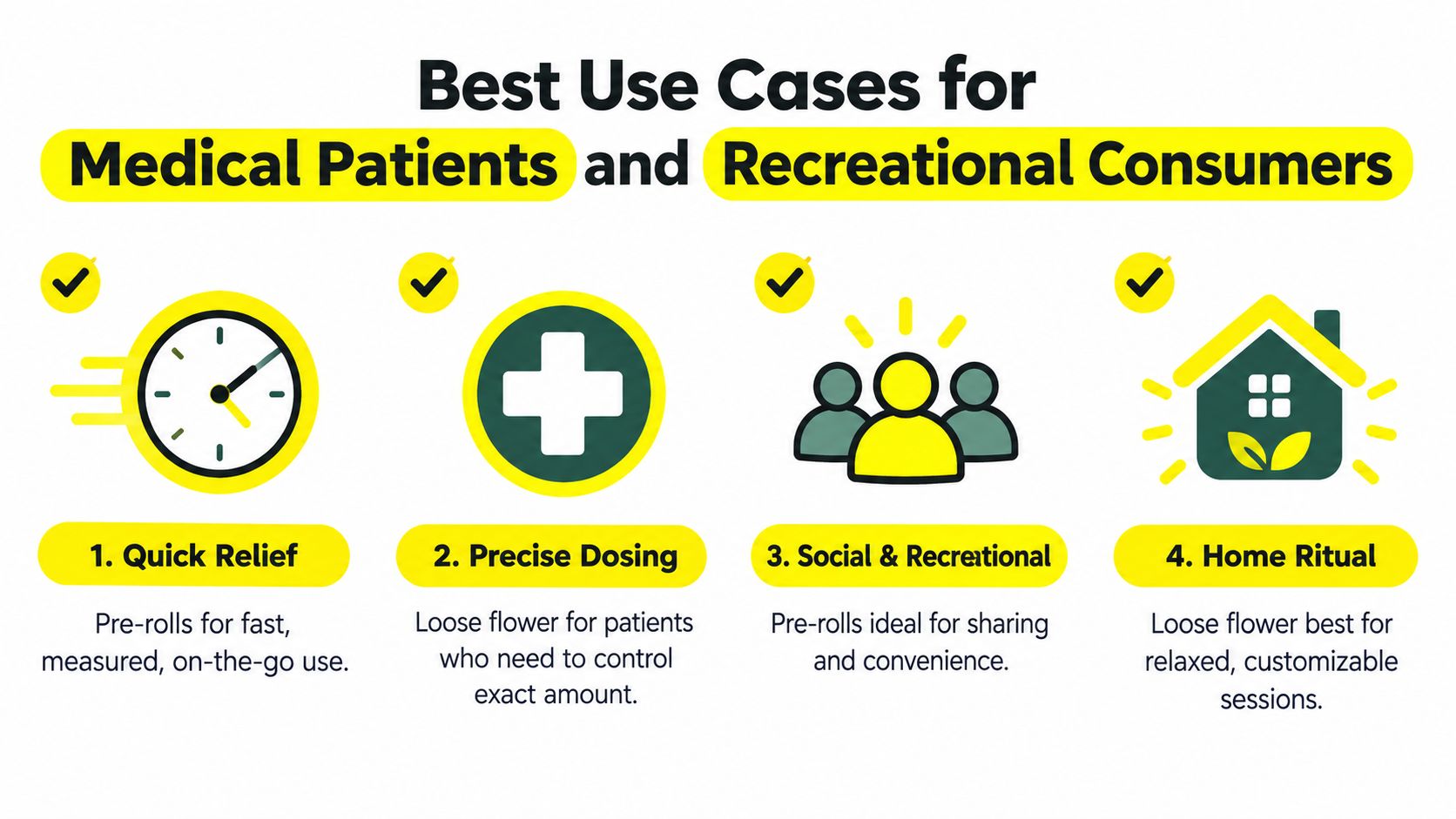
Stop asking which format is better in the abstract. Ask which format fits the session.
When pre-rolls make more sense
You want less setup and fewer moving parts. That's the clearest lane for pre-rolls.
A good example is the buyer who wants one straightforward evening session after work. They don't want to grind flower, clean a piece, or fuss with papers. A standard pre-roll is the cleanest answer.
Pre-rolls also fit social situations well. If two friends are sharing outside for a short session, one ready-made joint is simpler than breaking out a jar, grinder, papers, and lighter.
Another strong use case is the occasional consumer. If you only smoke once in a while, buying a small number of pre-rolls can be smarter than buying more loose flower than you'll finish fresh.
When flower is the better play
Flower makes more sense when you care about precision, flexibility, or flavor.
A medical patient trying to keep sessions measured often does better with flower in a vaporizer or a small pipe. They can choose a modest amount and stop there. They aren't nudged into finishing a joint because it's already burning.
Flower is also the move for flavor chasers. If aroma matters to you, whole buds usually give you a better read on quality before consumption. You can inspect structure, smell the jar, grind only what you need, and preserve the rest more effectively.
And for home users with a real routine, flower offers more options. One night you roll. Another night you use glass. Another day you vape a little and get back to work.
Quick scenario guide
- Fast relief before leaving home: Pre-roll.
- Microdosing with intention: Flower.
- Passing something around with friends: Pre-roll.
- Testing a strain's aroma and nuance: Flower.
- No grinder, no gear, no patience: Pre-roll.
- You already own a vaporizer or glass: Flower.
Buy for the session you're actually having, not the identity you think you have as a cannabis consumer.
How to Buy Pre Rolls or Flower at Mr Nice Guys DC
You walk into a DC shop after work and want to buy once, buy right, and not get burned by a pretty label. Good. Start by filtering out the value traps first.
The first question is not strain name. It is format quality. A pre-roll packed with whole flower is a different product from a pre-roll packed with old shake. A standard joint is also a different buy from an infused one, which can hit harder, burn differently, and hide weak flower under oil and kief.
Start with the session you need, then verify the product.
A simple buying framework
Buy a single standard pre-roll if you want one ready session and do not want gear, grinding, or extra cleanup.
Buy a multi-pack only after you know the shop packs them well and the flower inside stays fresh. Multi-packs look economical, but they are a bad deal if the joints are dry, loose, or filled with lower-grade material.
Buy an eighth of flower if you want the better value ceiling. You can inspect the buds, control portion size, and use it in a pipe, bong, or vaporizer. Flower also gives you a cleaner read on what you are paying for.
Strain names matter less than batch quality. Gelato from one jar can be loud, sticky, and worth it. Gelato in a stale pre-roll can smoke flat and disappoint. Buy the batch, not the hype.
What to ask before you order
Ask direct questions and wait for direct answers.
- Is this pre-roll packed with whole flower or shake?
- Is it standard or infused?
- When did this batch arrive or get packed?
- Can I review the COA or test results?
- Does this pre-roll burn evenly, or do people bring it up as a problem?
- If I want something moderate, which non-infused option would you put me in?
In DC, those questions matter more than menu size. Shops that know their inventory can answer fast. Shops that dodge the whole-flower question usually tell you enough right there.
Mr. Nice Guys DC carries both pre-rolls and flower, with pickup, curbside, and delivery through Sweede in DC and nearby areas. That is useful. The smarter move is still to verify what is inside before you order.
My direct recommendation
If you are new, skip infused pre-rolls on the first buy. Get one standard pre-roll for convenience, then come back for a small flower purchase on a different day. You will learn more from that comparison than from reading ten menus.
If you smoke regularly and care about flavor, control, and value, buy flower most of the time. Use pre-rolls for specific moments. Going out, meeting friends, short on time.
If you mainly want zero fuss, buy standard pre-rolls from batches the shop can explain clearly. Avoid bargain tubes with mystery fill. They are cheap for a reason.
The best DC buyers ask three things before spending money. What is inside it? How fresh is it? Can the shop back it up with testing? That is how you avoid paying premium prices for low-visibility product.
Mr Nice Guys DC
At Mr. Nice Guys DC, we’re more than just a cannabis delivery service — we’re passionate advocates for quality, convenience, and community. With years of experience in the cannabis industry, our team is dedicated to educating and empowering customers across Washington, D.C. Whether you're a seasoned user or just starting your cannabis journey, our blog delivers trusted tips, product insights, and the latest updates from the world of weed. Stay informed, stay elevated.
