
Must Be 21 To Enter
By entering this site you are agreeing that you are at least 21 Years of Age or older.
I AM 21 OR OLDERWhat Are THCA Diamonds? Potency, Safety and Use Explained


THCA diamonds are highly purified crystals of tetrahydrocannabinolic acid, a non-intoxicating precursor that converts into strong delta-9 THC when heated. A diamond labeled 95% THCA has a theoretical THC potential of about 83.3%, not 95%, and neither number tells you how much to use.
That distinction is the most useful starting point for understanding these concentrates. The THCA Verdict FAQ explains that the label describes potential potency before accounting for heating, device efficiency, and inhalation losses. The percentage on the jar is a ceiling, not a serving size.
For a medical cannabis patient, the important question isn't whether diamonds are strong. It's whether you can measure, verify, and comfortably manage a format that delivers substantial potential THC in a small amount of material.
Why THCA Diamonds Are Suddenly Everywhere
Concentrate use among past-year cannabis consumers increased from 17% in 2018 to 25% in 2023, a 47.1% relative increase, according to International Cannabis Policy Study figures cited by a National Academies report and summarized in this concentrates guide. Diamonds are a visually striking part of that broader shift, although those figures describe concentrates generally, not diamonds specifically.
At a dispensary counter, a small jar of crystals can look less familiar than flower and more impressive than an ordinary extract. The crystals might be loose, suspended in amber liquid, or packaged as diamonds and sauce. Their appearance naturally raises questions about what they contain and whether a larger crystal means a better product.
It doesn't. Crystal size, chemical potency, flavor, and product safety are separate characteristics.
Read the jar as a patient, not a collector
Say you're choosing between a familiar flower product and a jar of diamonds. The useful comparison isn't which package displays the largest percentage. It's which format lets you take a manageable amount, with equipment you understand, and get an effect you can tolerate.
Before buying, you should be able to answer three questions:
- What am I buying? Is it isolated crystalline THCA, or crystals mixed with terpene-rich sauce?
- What was tested? Does the certificate of analysis match the batch and include contaminant results?
- Can I use it appropriately? Do I understand the device, the product's legal status, and how I'll portion it?
Diamonds reward careful label reading, not confidence based on appearance. Understanding the chemistry, comparing formats, and checking the paperwork gives you a better basis for choosing than a headline potency claim.
What Are THCA Diamonds and How Strong Are They
THCA diamonds are highly purified crystalline formations of tetrahydrocannabinolic acid, the acidic precursor to delta-9 THC. They form when THCA separates from concentrated cannabis resin into solid crystals, leaving a terpene-rich liquid commonly called sauce, as described in this scientific discussion of THCA and thermal processing.
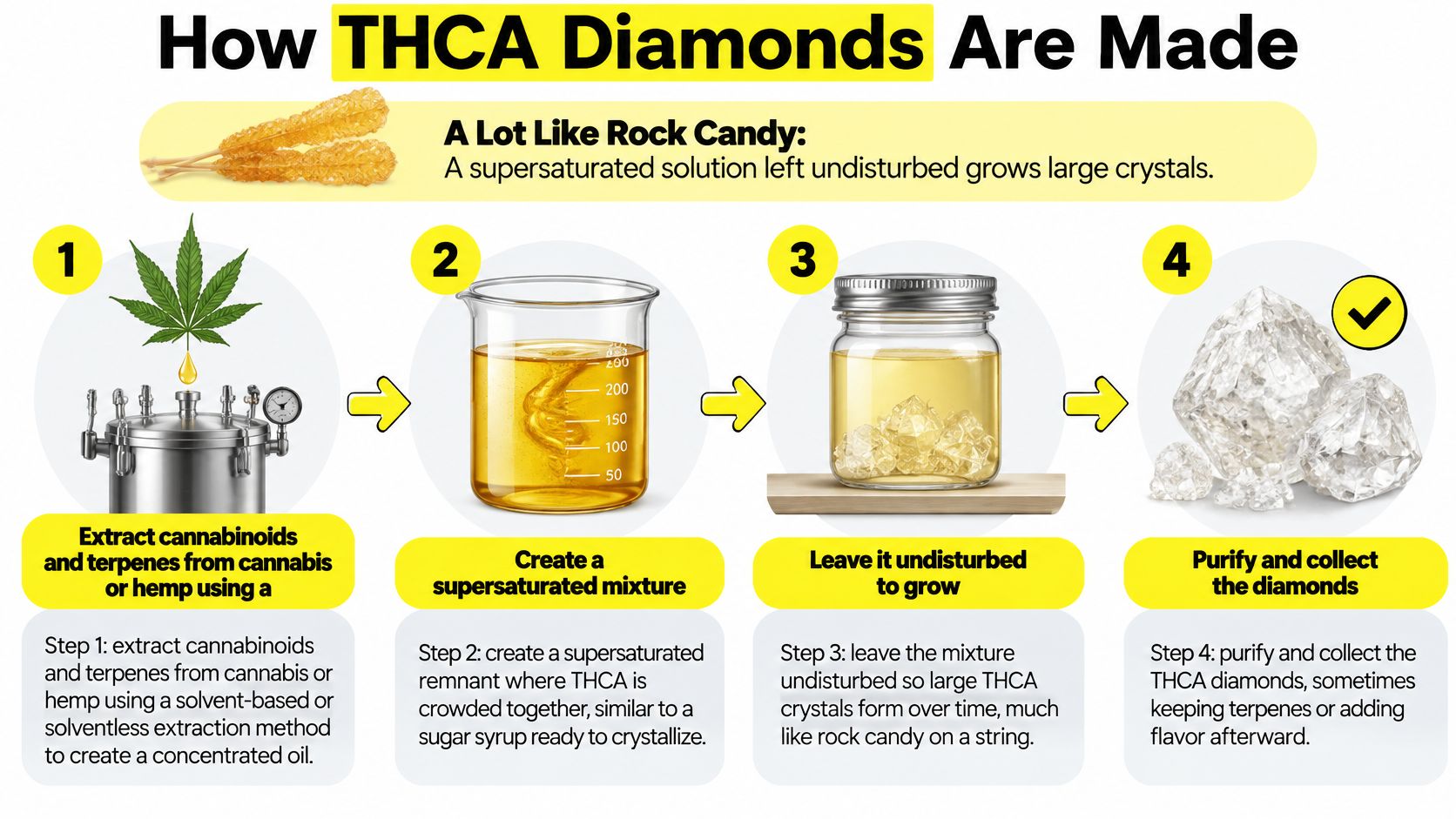
Think of rock candy growing from concentrated sugar syrup. The comparison helps explain crystallization, although cannabis extraction requires specialized processing rather than a kitchen recipe.
Raw THCA isn't meaningfully intoxicating in the way THC is. Heating triggers decarboxylation, which releases carbon dioxide and converts THCA into delta-9 THC. That's why a concentrate labeled primarily with THCA can produce strong intoxication when vaporized or smoked.
The label math that matters
The standard theoretical relationship is total THC = delta-9 THC + (0.877 × THCA); a product labeled 99% THCA therefore has a theoretical maximum near 86.8% THC from that THCA, because approximately 12.3% of the THCA molecular mass leaves as carbon dioxide, according to Nugg Notes' explanation of THC and THCA chemistry.
THCA label to theoretical THC conversion
| Label claim | Theoretical maximum THC | What it means for dosing |
|---|---|---|
| 80% THCA | About 70.2% THC | Very strong; a small dose goes a long way |
| 90% THCA | About 78.9% THC | Extremely strong; measure doses carefully |
| 95% THCA | About 83.3% THC | Common premium claim; not a beginner product |
| 99% THCA | About 86.8% THC | Near the practical ceiling; tiny doses only |
The table applies the cited conversion formula and assumes no additional measured delta-9 THC. If the laboratory reports delta-9 THC separately, that amount belongs in the total too. These calculations describe potential THC by mass, not THC absorbed into your bloodstream.
The distinction between raw material, heat, and final exposure is easier to follow visually.
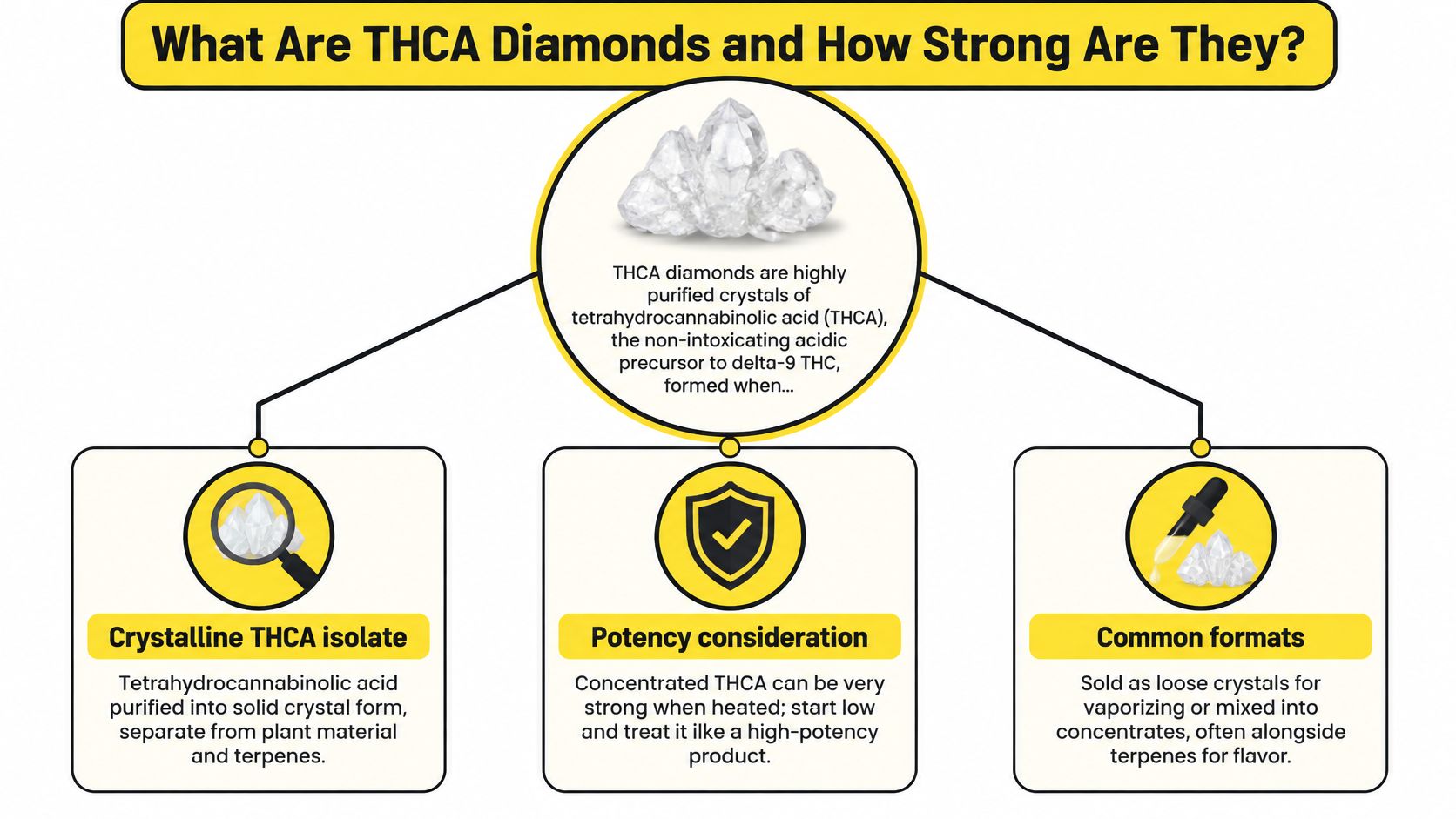
A practical example: breaking a crystal into smaller pieces changes the amount you're using, but it doesn't change the concentration of each piece. A small fragment can still be a substantial serving. Eyeballing a crystal doesn't tell you its mass, and weighing it doesn't tell you exactly how much THC your device will deliver.
The THC concentrates chart offers additional context for comparing labels across extract formats. Always distinguish a measured THCA result from a measured THC result before comparing packages.
A potency label is a ceiling, not a serving size. Diamonds are generally not a starting format for inexperienced users.
How THCA Diamonds Are Made
Manufacturers create conditions that allow dissolved THCA to organize into crystals. The rock-candy analogy still works: when a solution contains enough dissolved material under suitable conditions, some of that material can leave the liquid and form an ordered solid.
The commercial process involves more than waiting for crystals to appear. Extraction, solvent management, crystallization, separation, and testing all affect the finished product.
From cannabis extract to finished crystals
Extract cannabinoids and terpenes. A professional processor starts with cannabis or hemp and uses a suitable extraction method, such as a closed-loop hydrocarbon system. This concentrates desired compounds while separating much of the plant material.
Manage residual solvents. Where solvents are used, the processor removes them through controlled processing, which may include vacuum and heat. Solvent management must fit the production method, rather than follow a universal sequence.
Condition the concentrated extract. The manufacturer adjusts processing conditions so THCA can separate into a crystalline phase. Temperature, concentration, and the surrounding extract influence whether crystals form successfully.
Allow crystallization. THCA molecules organize into solid structures while other components remain in the liquid fraction. Depending on the method, growth can take days to weeks rather than happening immediately.
Separate or combine the fractions. The producer can collect the crystals alone or package them with sauce. That choice changes the product's texture, aroma, and overall cannabinoid concentration.
Test the finished batch. A laboratory evaluates potency and relevant contaminants. The finished product needs verification, not merely attractive starting material or an impressive manufacturing story.
The broad process is illustrated below.
Why bigger doesn't mean cleaner
Time, temperature, and seed material can influence crystal growth. A manufacturer might produce large clear pieces or smaller crystalline grains without either appearance establishing contaminant levels.
For example, two jars could look equally clear while having very different residual-solvent results. You can't inspect pesticide residues, heavy metals, or microbial contamination by holding a crystal up to the light.
Manufacturing boundary: Flammable solvents, pressure, and residual-solvent risks make diamond production laboratory work, not kitchen work.
Specialized equipment, controlled conditions, processing time, and batch testing contribute to production costs. Those are meaningful quality considerations. A spectacular crystal, by itself, isn't.
How THCA Diamonds Differ from Other Concentrates
THCA diamonds vs other cannabis concentrates
| Concentrate | Form and texture | Typical potency | Flavor and aroma | Best suited for |
|---|---|---|---|---|
| THCA diamonds | Hard clear crystals, often sold with sauce | Highly concentrated THCA; verify the batch COA | Low unless mixed with sauce | Experienced, high-tolerance users |
| Live resin and sauce | Viscous, terpene-rich extract | Read measured cannabinoids and total potential THC | Often pronounced and plant-like | Flavor-first concentrate users |
| Shatter | Glassy, brittle sheet | Verify the specific batch | Often moderate | Users comfortable handling brittle extracts |
| Wax or budder | Soft, whipped texture | Verify the specific batch | Often moderate | Easier portioning and handling |
| Live rosin | Sticky, solventless extract | Verify the specific batch | Often pronounced | Shoppers who prefer solventless processing |
| Distillate | Thick, clear oil | Read measured THC and the finished-product label | Minimal unless terpenes are added | Formulated cartridges and edibles |
| Flower | Dried and cured bud | Read THCA, THC, and total potential THC | Natural plant aroma | Consumers seeking a less concentrated starting format |
A texture name isn't a standardized potency specification. Shatter describes a physical form; live resin describes a production approach and starting material; diamonds describe crystalline THCA. Compare laboratory results, not category names alone.
The principal distinction is physical purity and phase behavior, rather than a different intoxicating cannabinoid: crystallization concentrates THCA into a solid phase while terpenes and other components remain in the liquid fraction, as explained in this technical discussion of THCA crystallization and testing.
Pick the trade-off you actually want
For a flavor-focused consumer, isolated diamonds may feel like an incomplete product. Sauce supplies aromatic components that the crystal fraction largely lacks. Combining them can add flavor, but it also means the final mixture needs its own clearly identified potency result.
Live resin and live rosin appeal to people who prioritize aroma. Rosin offers a solventless processing route, but that label doesn't eliminate the need to check other contaminants. The live resin versus distillate guide can help distinguish terpene-focused extracts from more refined oils.
Wax and budder can be easier to collect on a dab tool than loose hard crystals. That handling advantage doesn't make them low-potency products, and a soft texture doesn't establish a gentler effect.
Distillate is useful in formulated products, but precision comes from verified concentration and controlled portioning, not from being an oil. Likewise, a diamond's apparent purity doesn't make it easy to dose.
For a newer patient, lower-potency flower or a clearly labeled low-dose product generally offers more room to learn. Edibles require particular care because their delayed effects make premature redosing a separate concern.
Diamonds maximize potential potency per gram, not flavor or forgiveness. Choose them because that concentration fits an established need and tolerance, not because they occupy the top of a potency ranking.
Safety Quality and Legal Checks Before You Buy
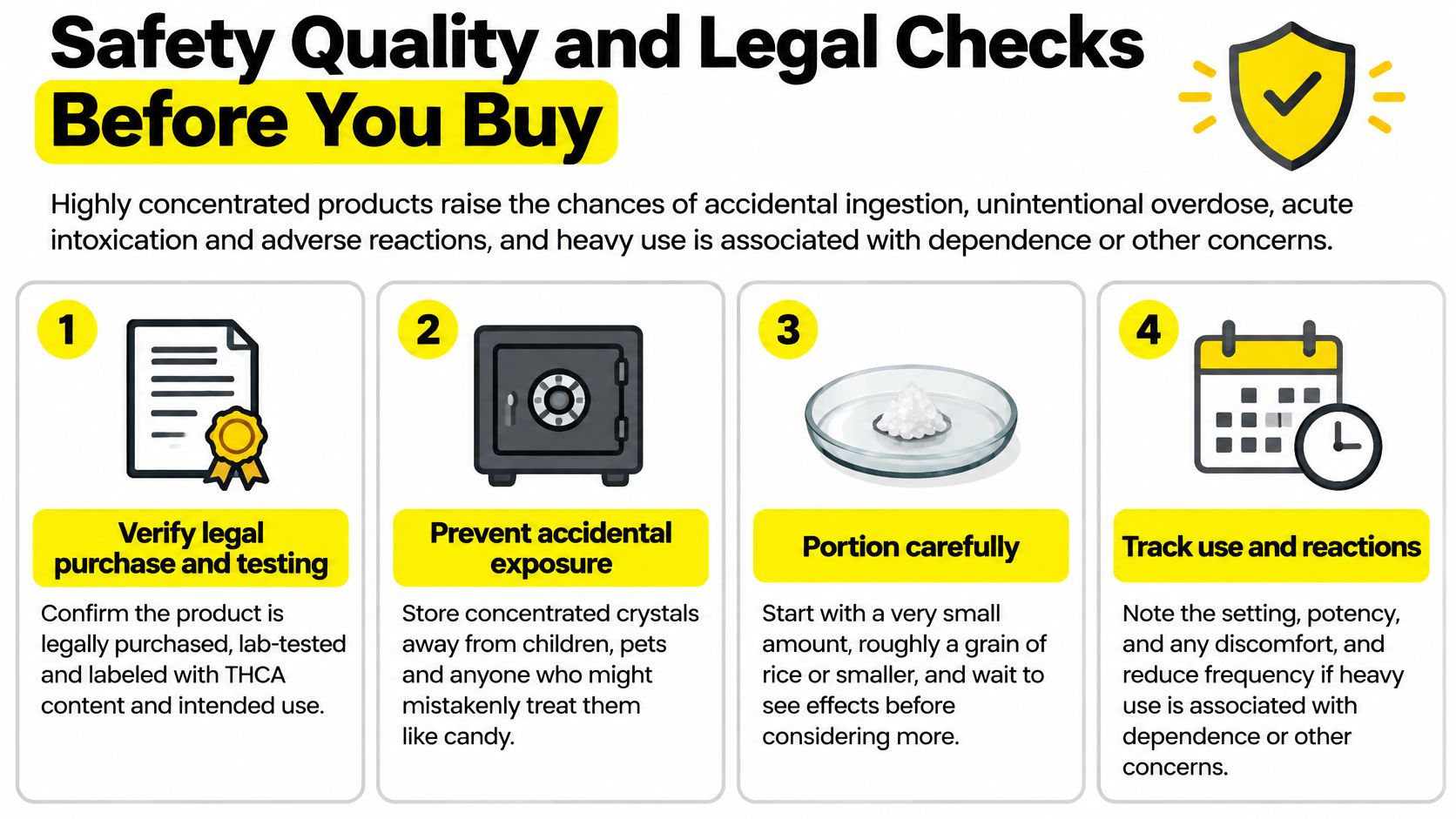
Highly concentrated cannabis deserves deliberate handling. Accidental exposure and acute intoxication are particular concerns when a small amount of product can carry substantial potential THC. Frequent heavy use also warrants attention to persistent nausea or vomiting, which requires medical evaluation rather than another attempt to adjust the dab.
The buying decision starts with documentation, not the display jar.
A certificate of analysis you can actually use
Match the batch. Look for a recent, batch-specific certificate of analysis, or COA. The product name and batch identifier should match the package, and the cannabinoid panel should distinguish THCA, delta-9 THC, and total potential THC.
Read the contaminant panels. Check residual solvents, pesticides, heavy metals, and microbial results. A potency-only report doesn't answer the safety questions that matter for an inhaled extract.
Identify the tested material. Confirm whether the result applies to isolated crystals or the finished diamond-and-sauce mixture. A crystal-only result shouldn't be presented as though it describes everything in a mixed jar.
For example, if the package contains crystals floating in sauce but the report identifies only THCA isolate, ask for clarification before buying. A QR code is useful only if it opens the correct, complete report. Our product testing standards guide explains the questions to bring to the counter.
Keep the practical checks together before opening a package.
Hemp marketing isn't a safety certification
Licensed cannabis products and hemp-marketed THCA products don't necessarily operate under identical rules. Hemp-derived doesn't mean non-intoxicating, and it doesn't establish that a product can legally be sold, shipped, or possessed everywhere.
A Budboard explanation of THCA diamonds and hemp regulation describes federal changes scheduled for 2026 that would count THCA toward total THC and impose a 0.4-milligram total-THC-per-container limit for covered finished products. Treat that as a scheduled regulatory change to verify against current official requirements, not a blanket statement about every product's present legality.
For a DC purchase, confirm medical registration, concentrate equivalencies, and current purchase and possession rules before paying. Don't assume a hemp seller's shipping policy establishes local legality.
Store concentrates securely away from children, pets, and anyone who might mistake the crystals for candy. Never attempt extraction or crystallization at home.
How to Use THCA Diamonds Safely
No routine can make a highly potent concentrate risk-free. If you're inexperienced with cannabis, choosing a less concentrated product is the safer decision than trying to make diamonds behave like beginner flower.
The National Institute on Drug Abuse cannabis overview warns that dabbing can rapidly deliver large amounts of THC and notes that dispensary concentrates can exceed 40% THC. That rapid delivery is why careful portioning matters more than producing a large cloud.
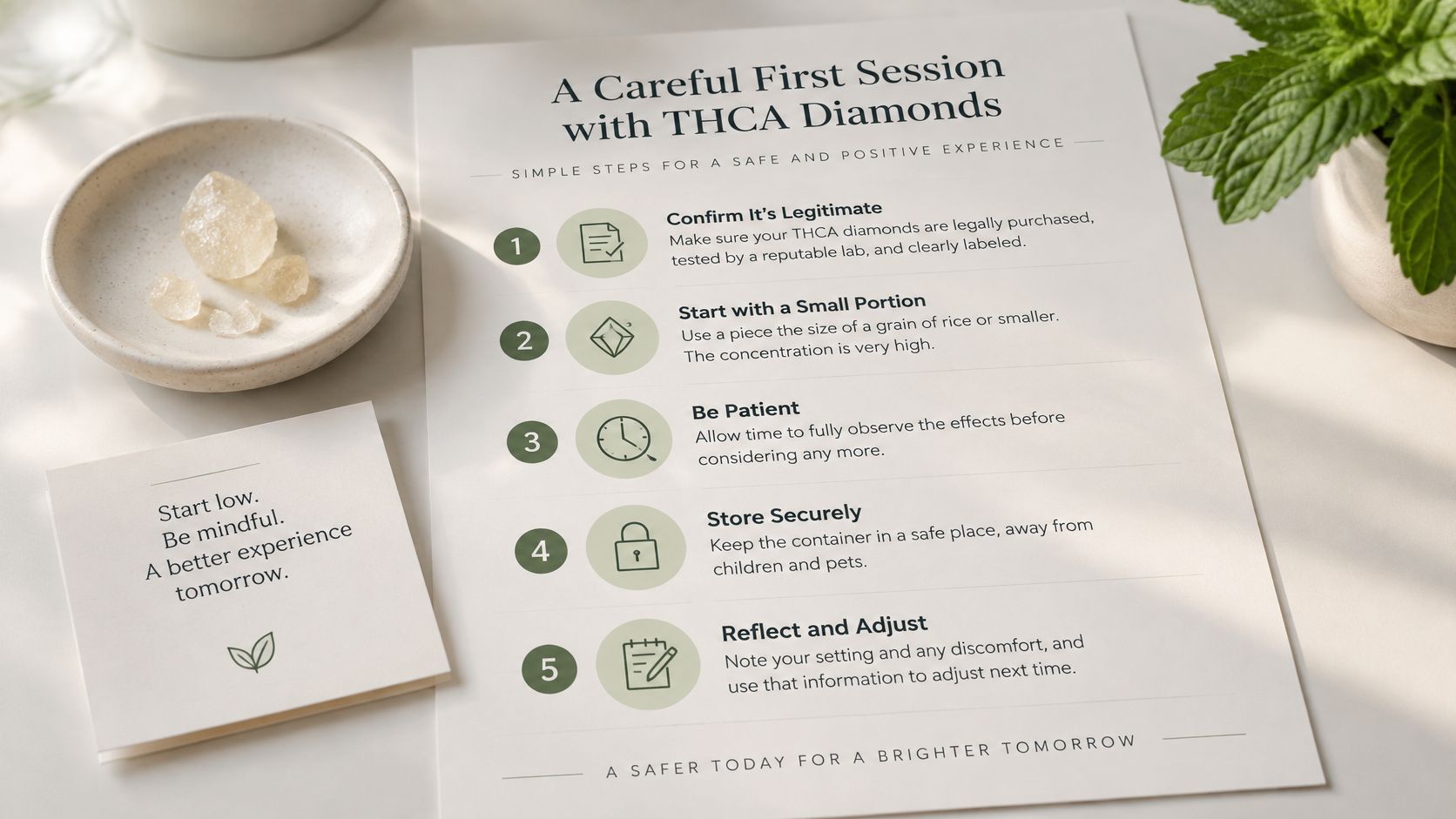
Use this visual as a reminder, not as a substitute for measuring your portion.
A conservative session routine
Check before loading. Confirm that the product was legally purchased, has matching test results, and is intended for your device. Don't put a hard crystal into a cartridge or vaporizer designed only for dry flower.
Portion separately from the jar. Use a clean dab tool and an appropriate measuring method. A fragment the size of a grain of rice or smaller is only a visual comparison, not a validated dose; crystal shape and density make appearance unreliable.
Use compatible equipment. Choose a concentrate vaporizer or appropriate dab setup and follow its operating instructions. Temperature-controlled equipment makes settings more repeatable, but there's no universal setting that guarantees a particular absorbed dose.
Avoid a large inhalation. If you proceed, inhale gently rather than trying to finish an oversized portion. Don't hold vapor in your lungs to chase a stronger effect.
Pause and assess. Inhaled effects can develop quickly. Stop using the device and notice changes in perception, coordination, comfort, and anxiety before deciding anything else.
Don't rush to redose. Wait until you can judge the effect clearly, and skip additional use if you're uncertain. If you feel uncomfortable, stop rather than trying to correct the experience with another cannabis product.
For a flavor example, an experienced consumer might place a small measured diamond fragment into a portion of sauce. The sauce adds aroma, but it isn't an inert diluent: it can contribute cannabinoids too.
The following video offers additional visual context for concentrate use.
Plan for discomfort before it happens
Use cannabis in a familiar setting, don't combine it with alcohol or other intoxicants, and don't drive afterward. If someone becomes severely confused, has trouble breathing, develops chest pain, or can't be awakened, seek urgent medical help.
The guide to avoiding greening out can help you recognize an uncomfortable experience and prepare a calmer setting. You can choose to take more later; you can't remove what you've already taken.
Your Next Step Before Trying THCA Diamonds
THCA diamonds sit at the strongest end of common cannabis formats: chemically fascinating but unforgiving, they're best reserved for experienced consumers with established tolerance rather than patients still learning their response.
Put these decisions in order
Verify DC eligibility and limits. The District medical-marijuana rule states a possession ceiling of four ounces of dried medical marijuana or its equivalent in another form. Confirm current concentrate equivalencies, purchase limits, and registration requirements directly before buying rather than treating a dried-flower allowance as a concentrate allowance.
Read before opening. Buy a tested product through a licensed dispensary and examine the matching COA. If you're using cannabis alongside medications, seek professional medical advice before choosing a highly concentrated format.
Treat the session as calibration. Start with less than you think you need, without trying to match another person's serving. Use the vaping temperature guide for equipment context, while keeping portion size and your response central to the decision.
At Mr. Nice Guys DC, we're a registered medical cannabis dispensary and hold our official medical cannabis retailer license. Our team can explain differences among formats and help newer patients consider more manageable starting points; you should independently confirm any retailer's current license status before purchasing.
You don't need to choose diamonds to make an informed cannabis decision. Sometimes the best result of understanding them is deciding that another format better suits your needs.
Respect the diamond, and it will respect your evening.
We offer concentrates, including shatter, wax and oils, along with accessories such as rolling papers, grinders and storage solutions. Visit Mr. Nice Guys DC to compare available formats and ask our team to help you read a concentrate label before choosing your next product.
Mr Nice Guys DC
At Mr. Nice Guys DC, we’re more than just a cannabis delivery service — we’re passionate advocates for quality, convenience, and community. With years of experience in the cannabis industry, our team is dedicated to educating and empowering customers across Washington, D.C. Whether you're a seasoned user or just starting your cannabis journey, our blog delivers trusted tips, product insights, and the latest updates from the world of weed. Stay informed, stay elevated.
