
Must Be 21 To Enter
By entering this site you are agreeing that you are at least 21 Years of Age or older.
I AM 21 OR OLDERTopical Cannabis for Arthritis Relief and Safe Use
.svg)

.png)
Your hands are stiff when you wake up. The first coffee mug feels heavier than it should. Twisting a doorknob, opening a jar, or typing for an hour starts to feel like a small negotiation with your joints. If you live in DC and want relief that stays focused on one sore area instead of affecting your whole body, topical cannabis for arthritis probably sounds appealing.
That interest makes sense. A cream, balm, gel, or patch feels more approachable than inhaled cannabis for many patients, especially if they want localized support and want to avoid feeling intoxicated. But this category confuses people fast. Patients mix up topical and transdermal products, assume all CBD creams work the same, or buy a product without knowing whether it's meant for skin-level comfort or deeper delivery.
A careful approach is beneficial. Some topical cannabis products may help certain patients with arthritis pain. Some don't. The differences often come down to the cannabinoid profile, the delivery format, and the type of arthritis involved. Practical details matter too, especially in DC, where buying through a compliant medical channel is very different from grabbing an untested cream from an informal seller.
Introduction to Topical Cannabis for Arthritis
A common DC patient story goes like this. Someone has knee, thumb, wrist, or knuckle pain from arthritis. They've tried heat, over-the-counter creams, braces, and rest. They want something targeted they can rub directly where it hurts, especially before work, before bed, or before a walk through the neighborhood.
That's where topical cannabis for arthritis enters the conversation. These products are applied to the skin over painful joints. They come in forms like creams, balms, gels, and patches. Some are built for surface-level relief. Others are designed to move cannabinoids through the skin more effectively over time.
The problem is that most guides flatten all of that into one category. They talk about “cannabis topicals” as if every product behaves the same way. They don't. A thick balm for sore knuckles isn't the same tool as a transdermal patch worn overnight. A CBD-only cream may not perform the same way as a product that includes THC or a broader cannabinoid profile.
Practical rule: Think of these products the way you'd think about shoes. Slippers, running shoes, and work boots all go on your feet, but they aren't for the same job.
For arthritis patients, the useful questions are more specific. Is the product meant for local comfort or deeper delivery? Is it CBD-only or does it contain THC? How do you apply it without irritating your skin? And in DC, how do you buy a product through a compliant, tested channel instead of guessing?
Understanding How Topical Cannabis Works
The skin is not a sponge. That's the first thing to understand. It's a barrier, and a good one. When you apply cannabis cream to your hand or knee, the product has to cross that barrier before it can do anything useful.
Cannabinoids interact with receptors in the body's endocannabinoid system, including CB1 and CB2 receptors found in the skin and surrounding tissues. A simple way to think about this is a lock-and-key model. The receptors are locks. Cannabinoids such as CBD and THC are keys. But even if you have the right key, the key still has to reach the lock.

Topical and transdermal are not the same
This distinction gets missed all the time.
A topical product usually works close to where you apply it. Think of a balm massaged into sore knuckles after gardening. The goal is local effect near the skin and nearby tissue.
A transdermal product is designed to move cannabinoids through the skin more effectively and maintain delivery over time. Think of it more like a steady drip than a quick rub. That's why patches often come up in conversations about longer-lasting support.
A practical example helps. If you rub a CBD balm onto a mildly sore wrist, you may mainly be looking for localized comfort during typing or cooking. If you use a transdermal gel or patch on a painful thumb joint that flares throughout the day, you're choosing a format built for more sustained delivery.
Form matters as much as ingredients
Creams, gels, balms, and patches don't just feel different. They behave differently on the skin.
- Creams often spread easily over larger areas like knees or shoulders.
- Balms tend to be thicker and stay where you place them, which some patients prefer for small joints.
- Gels can feel lighter and may absorb faster.
- Patches are typically the most “set it and leave it” option.
Other ingredients matter too. Menthol, oils, waxes, and penetration enhancers all affect how a product feels and how it moves. Even aroma compounds may shape the experience. If you want a primer on those compounds, this terpene guide is a useful companion read.
What a real study suggests
An open-label feasibility trial in hand osteoarthritis found that participants using transdermal CBD gel had significant reductions in self-reported current, average, and maximum hand pain compared with baseline, along with improved grip strength in the treated hand, as reported in this hand osteoarthritis study in Scientific Reports.
That matters because it moves the conversation beyond “it feels soothing.” Grip strength is a functional outcome. In plain language, that means a patient might not only say, “My thumb hurts less,” but also notice they can open a container more comfortably than before.
Summarizing Clinical Evidence
A patient rubs a cannabis cream onto sore knuckles, feels relief, and assumes the research must be settled. Then another patient tries a different product for knee arthritis and notices little change. Both experiences can fit the evidence we have.
The clinical picture is mixed because researchers are not always studying the same kind of product, the same kind of arthritis, or the same delivery method. That distinction matters more than many guides admit, especially for DC patients comparing a local cream, balm, gel, or patch and assuming they all belong in one bucket.
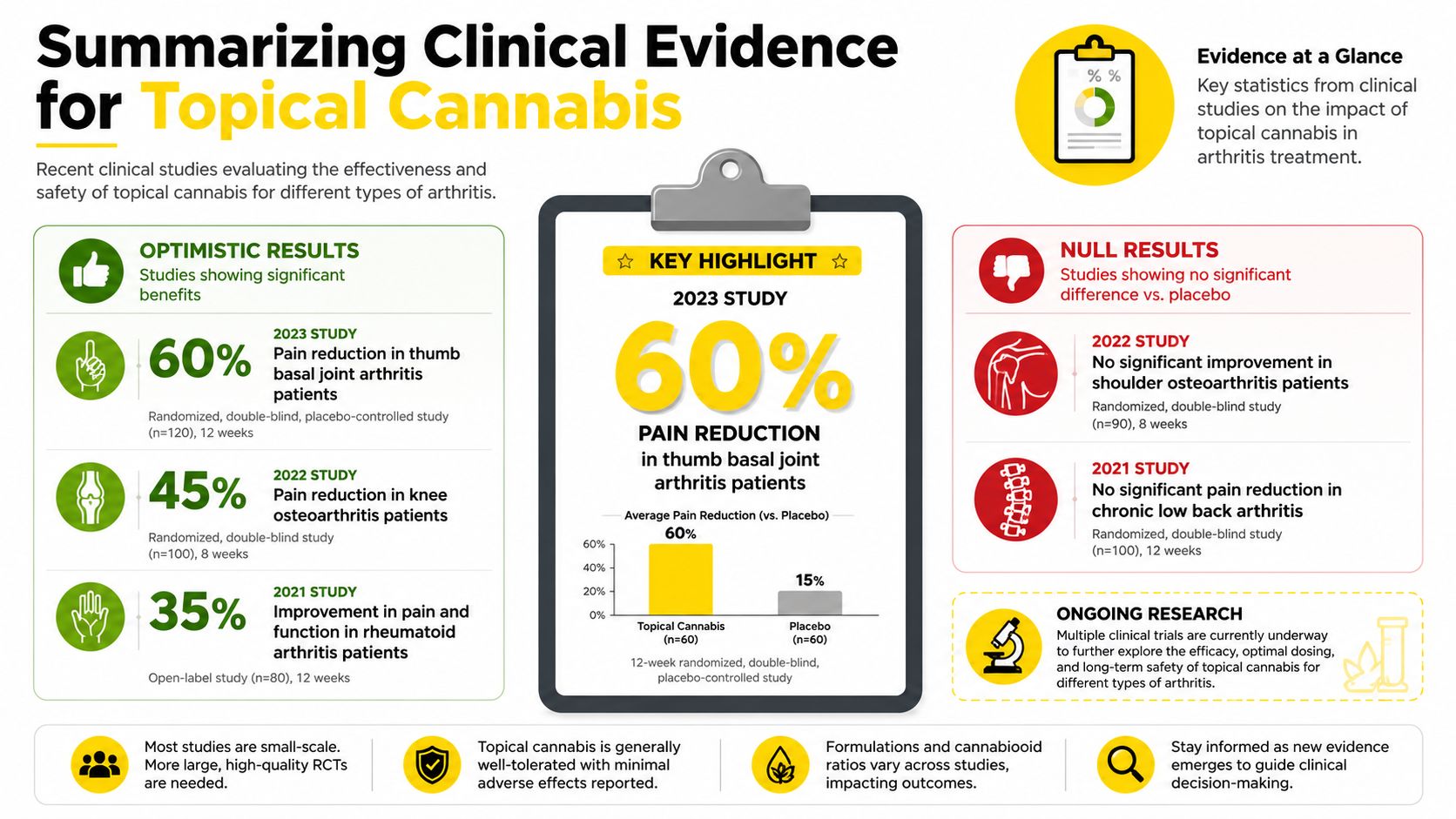
A useful way to read the evidence
The cleanest way to read this research is to sort it into smaller questions. What type of arthritis was studied? Was the product a local topical or a transdermal product designed to move cannabinoids farther through the skin? Was it CBD only, or did it include THC and other cannabinoids?
Once you sort studies that way, the mixed findings stop looking random.
For example, Harvard Health's review of CBD and arthritis pain notes that a study of topical cannabidiol for thumb basal joint arthritis reported meaningful pain improvement, while a randomized trial found topical CBD was no more effective than placebo for osteoarthritis and psoriatic arthritis, and a 2022 scoping review on cannabis for rheumatoid arthritis found little to no difference in pain reduction in the available evidence, according to Harvard Health's review of CBD and arthritis pain.
That spread of results is frustrating, but it is also instructive. Thumb basal joint arthritis, osteoarthritis, psoriatic arthritis, and rheumatoid arthritis do not behave like copies of the same disease. A product that seems helpful in one setting may not carry over cleanly to another.
The overlooked issue: topical and transdermal are not interchangeable
This is the distinction many patient guides skip.
A standard topical works mainly near the area where you apply it. A transdermal product is built to deliver cannabinoids through the skin barrier more deliberately. Those are different jobs, much like the difference between applying an ice pack to a sore joint and taking a medicine designed to absorb into the body. If a study uses a transdermal gel or patch, patients should be careful about assuming the same result applies to a basic cream bought for spot relief.
That matters in DC dispensaries too. Labels may highlight cannabinoids in large print while saying much less about delivery design. Two products can both sit on the “topicals” shelf and still behave very differently once they touch the skin.
Why studies conflict so often
A few variables can change outcomes enough to make one study sound promising and another sound flat:
| Variable | Why it changes the result |
|---|---|
| Arthritis diagnosis | Osteoarthritis, rheumatoid arthritis, psoriatic arthritis, and thumb basal joint arthritis involve different patterns of inflammation, tissue change, and symptom flare. |
| Delivery method | A local topical and a transdermal patch or gel are not tested under the same conditions, even if both are sold as skin-applied cannabis products. |
| Cannabinoid mix | CBD-only formulas answer a different question than products that also contain THC or other cannabinoids. |
| Study design | Placebo-controlled trials measure benefit differently from open-label or feasibility studies, which can be useful but less definitive. |
One practical takeaway stands out. Patients should stop asking, “Does topical cannabis work for arthritis?” and start asking, “Which product type, which cannabinoids, and which arthritis diagnosis are we talking about?”
If you want more context on how cannabinoid profiles may shape pain outcomes, this CBD vs THC for pain guide can help.
The evidence supports a careful middle ground. Some patients may get meaningful relief, but the current research does not support treating all cannabis creams, balms, gels, and transdermal products as interchangeable, and it does not support assuming one positive study applies to every form of arthritis.
Comparing Topical Cannabis Types
Once you stop treating every product as “just a topical,” choosing becomes easier. Different formats fit different routines, joint locations, and symptom patterns.
A patient with stiff knuckles before work may prefer something quick and portable. Someone whose pain wakes them at night may care more about staying power than texture. The right pick often comes down to how you want the product to behave on your skin.
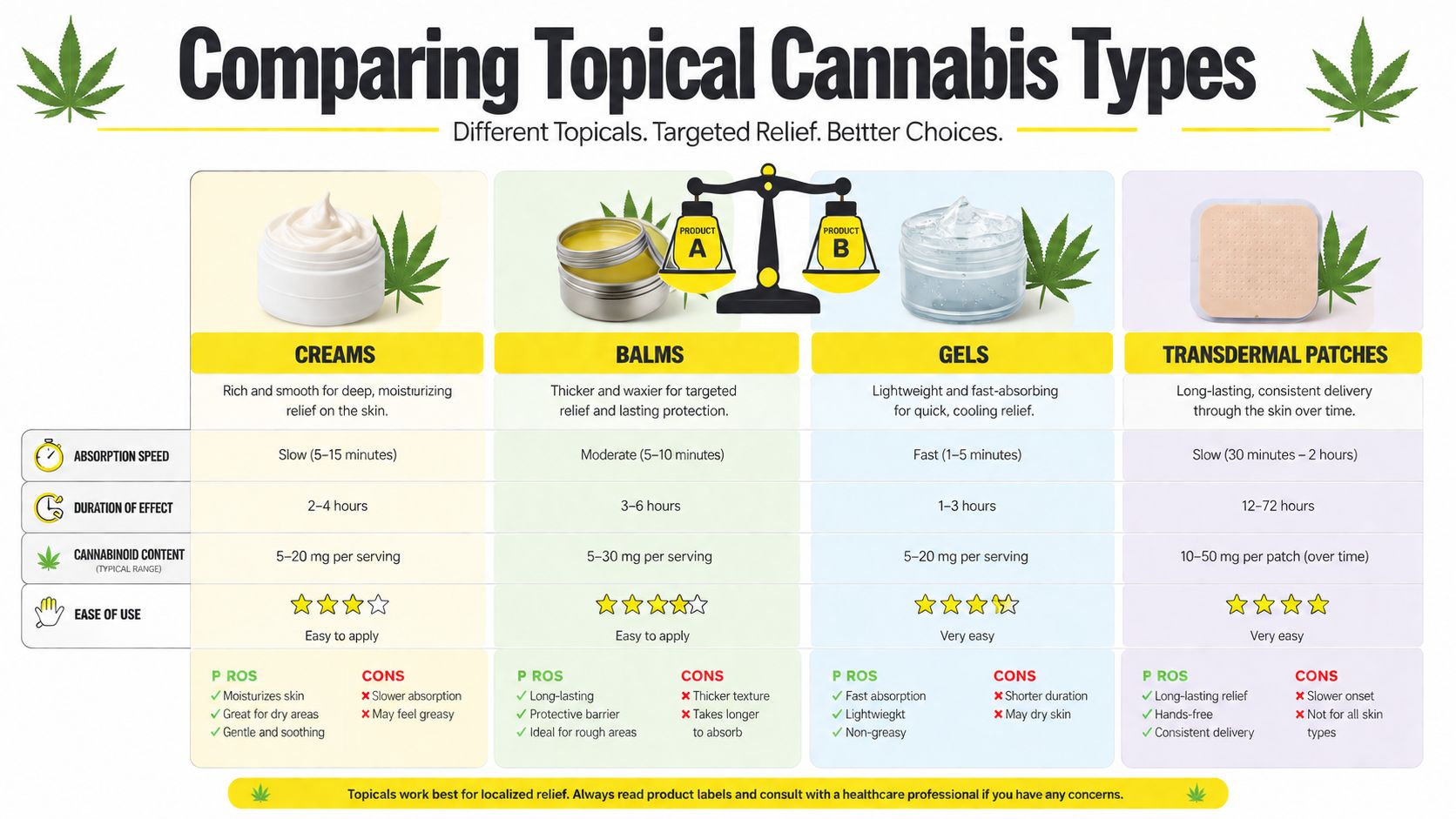
Side by side product differences
| Format | Best fit | Main upside | Main limitation |
|---|---|---|---|
| Cream | Larger joints like knees or shoulders | Spreads easily | May need reapplication |
| Balm or salve | Small joints like fingers, wrists, knuckles | Stays put, feels protective | Can feel greasy |
| Gel | Patients who want lighter texture | Often absorbs quickly | May not feel as cushioning |
| Transdermal patch | Longer wear, steady delivery | More sustained relief profile | Not ideal for every skin type or joint contour |
A practical example. If your thumb flares after hours on a phone or laptop, a gel may feel easier during the day because it absorbs faster. If your knee throbs overnight, a patch may fit better because you don't want to wake up and reapply something.
The dosing problem patients run into
Patients often ask how to get joint penetration rather than just surface relief. The problem is that guidance is thin. A 2024 review found no standardized dosing protocols for topical creams, while transdermal patches consistently delivered sustained relief with fewer skin reactions in trials, according to the RxFiles topical cannabis review.
That's why shopping by milligram number alone can mislead you. Two products can list cannabinoids on the label and still perform very differently because one is a thick balm and the other is a patch designed for steadier delivery.
A simple way to choose
Try this decision filter before you buy:
- Choose cream if you want broad coverage over a larger area and easy massage.
- Choose balm if you want a thicker product on small joints that stay irritated during repetitive use.
- Choose gel if you dislike residue and want something that fits daytime use.
- Choose patch if your main goal is prolonged relief with less hands-on reapplication.
For patients comparing textures and uses, browsing examples of a CBD salve format can make the cream-versus-balm distinction easier to picture.
Choosing and Applying Topical Cannabis Safely
You finally find a topical that sounds promising, rub it onto every sore joint, and wake up unsure what happened. Did your knee feel better because of the product, the massage, or a lighter day? Did your skin react to the cannabinoids, the menthol, or the fragrance? A safer approach gives you cleaner answers.
For arthritis patients, that first week is less like trying a miracle product and more like testing a new pair of shoes. You want to learn where it fits, where it rubs, and whether it helps enough to keep using.
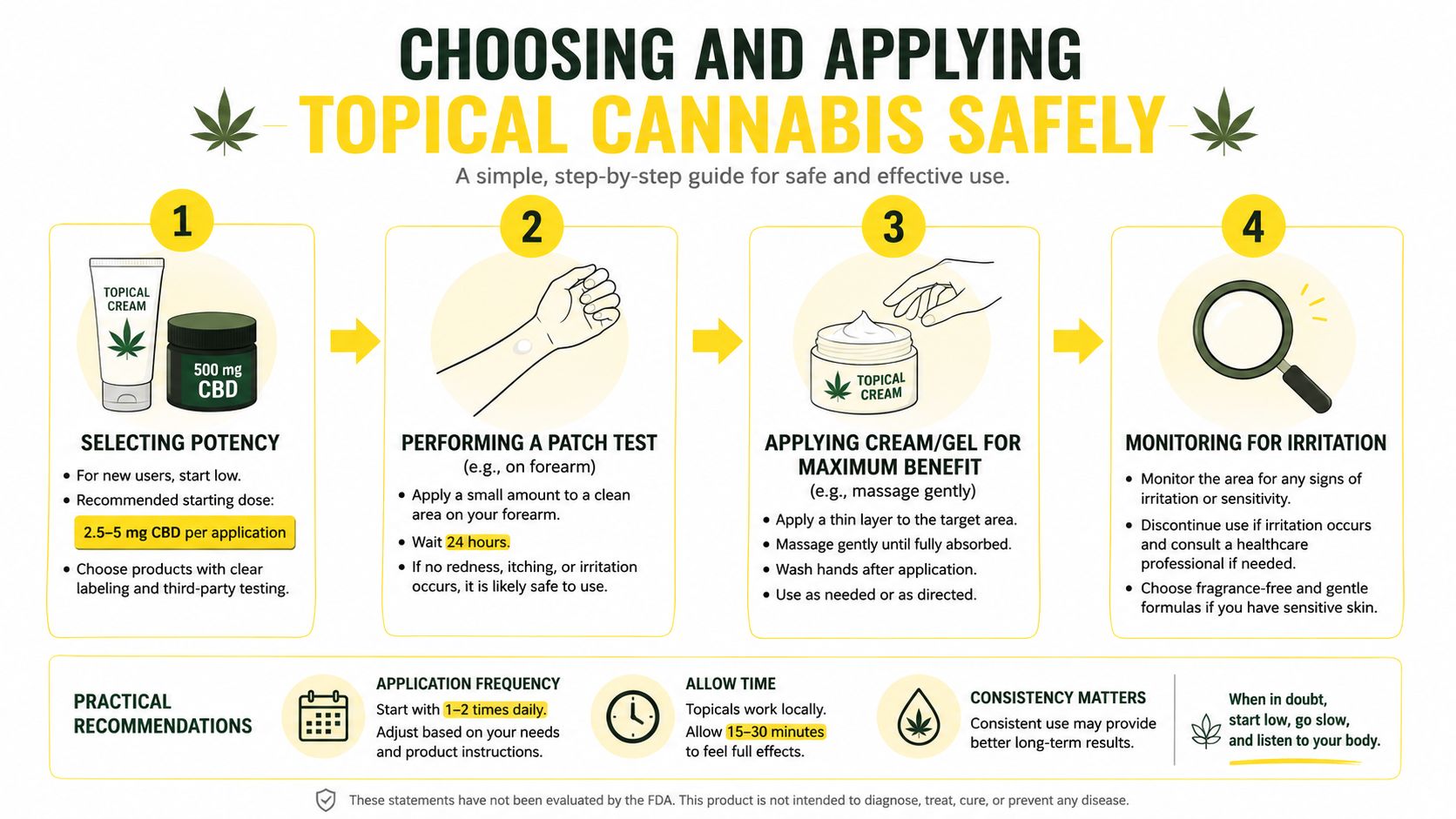
A practical application routine
- Pick one joint first
If your thumb, knee, and wrist all hurt, choose the joint that bothers you most and start there. Testing one area first makes it much easier to judge whether the product is helping localized discomfort or adding a cooling or warming sensation everywhere.
- Do a true patch test
- Start with clean, dry skin
- Apply around the joint, not only on the sore point
- Write down what changed
- Wash your hands after application unless your hands are the treatment site.
- Keep the product away from broken skin, active rashes, eyes, and mouth.
- Avoid trying two new topicals on the same joint at once because that blurs the results.
- Check the ingredient list for extras such as menthol, essential oils, or heavy fragrances if your skin reacts easily.
- Review other medications if cannabis is part of a bigger symptom plan. A medication compatibility check for cannabis and other treatments can help if you also use oral cannabis, sleep aids, or prescription pain medicine.
- What format is it. Cream, balm, gel, or patch.
- What cannabinoids are included. CBD-only, THC-containing, or a broader blend.
- How is it meant to be used. Spot application, larger-area massage, or longer wear.
- What else is in it. Menthol, essential oils, waxes, and other ingredients can affect comfort.
- Was it tested. Patients should prefer products sold through regulated channels with product transparency.
Put a small amount on a less sensitive spot such as your forearm. Then wait and check for itching, redness, dryness, or a rash before using it on thinner or more irritated skin around finger joints or wrists.
Topicals behave more predictably on skin that is free of lotion, sweat, or another pain cream. If you layer products without meaning to, it becomes hard to tell which ingredient caused relief or irritation.
Arthritis pain rarely sits in one tiny dot. Spread the product over and around the joint the way you would apply lotion to dry skin. Gentle massage is enough. Rubbing aggressively usually adds irritation, not extra benefit.
Keep a simple note on your phone or a piece of paper. Record the time, the joint, the amount used, and one practical result, such as whether opening a jar, gripping a rail, or walking stairs felt easier.
Here's a visual walkthrough of the general process:
What safe use looks like in real life
One point often gets missed. A topical and a transdermal product are not being used the same way, even if both touch the skin. A cream or balm is usually a local skin-and-joint experiment. A patch designed for transdermal delivery needs more caution about wear time, placement, and the possibility of broader body effects.
That distinction changes how you test the product. With a cream, patients often ask, "Did this help my knuckle when I typed?" With a transdermal patch, the better question may be, "How did I feel over several hours, and did I notice anything beyond that one joint?" If the label is unclear about which kind of delivery it uses, ask before you buy.
Available research on topical CBD tolerability is encouraging but still limited. In this published study on topical cannabidiol tolerability, participants generally reported only minor skin effects during use. That does not guarantee the same result for an arthritis patient with sensitive skin, but it supports a practical takeaway. Skin irritation is usually the first problem to watch for.
Treat your first few uses like a trial run. The goal is to learn how your skin responds, how long relief lasts, and whether the format fits your routine.
A few common-sense safety habits
A practical local example is a topical cream available through Mr. Nice Guys DC for targeted joint discomfort in areas such as the knee, wrist, knuckles, or elbow. Products in that category are often a reasonable starting point for DC patients because they let you test one painful area first, instead of changing your whole routine all at once.
DC Legal and Buying Tips for Topical Cannabis
Buying cannabis topicals in Washington, DC should feel boring in the best way. You want a compliant process, a labeled product, and a clear menu. If the sale feels vague, rushed, or hard to document, that's a warning sign.
For medical patients, the main advantage of using a compliant DC dispensary channel is simple. You know what product you're getting, you can ask questions about format and ingredients, and you're not relying on a homemade jar or an unverified label from a grey-market seller.
What to check before you buy
A cannabis topical for arthritis should answer a few basic questions on the label or through staff guidance:
A practical example. If you have sensitive skin and hand arthritis, a heavily scented balm might be less attractive than a simpler cream. If your pain spikes overnight, it makes sense to ask whether the menu includes a format designed for longer wear.
Why DC patients should skip informal topicals
Homemade and informal cannabis creams often sound appealing because they seem convenient or cheap. But arthritis patients need consistency. If one jar works and the next jar has a different strength, texture, or ingredient mix, you can't tell what your joint is responding to.
That matters even more with skin products because irritation may come from the non-cannabis ingredients just as much as the cannabinoids.
Buy the product you can identify later, not the one you can only describe as “that green jar someone gave me.”
How to shop more confidently in DC
If you're new to compliant purchasing, this guide to how to buy weed in DC helps explain the process.
Then use a simple shopping script when speaking with dispensary staff:
| Your need | Good question to ask |
|---|---|
| Pain in one small joint | “Do you have a topical meant for targeted application on fingers or thumbs?” |
| Pain over a larger area | “Which product spreads easily over a knee or shoulder?” |
| Sensitive skin | “What are the added ingredients besides cannabinoids?” |
| Longer support | “Do you carry a transdermal option rather than only standard creams?” |
For pickup, curbside, or delivery orders, the smart move is to review the menu before placing the order, confirm the format, and keep the packaging after purchase. If a product helps, that packaging becomes your record. You'll know what you used, instead of trying to recreate it from memory.
Next Steps and Common Patient Questions
The strongest next step is not “buy the strongest cream.” It's to build a simple, low-risk experiment around your actual symptoms. Start with one joint, one format, and one tracking note. If the product helps, you'll know what helped. If it doesn't, you'll know what to change.
Medical cannabis can play a role in symptom management, but it's not a cure for arthritis. According to the Arthritis Society's medical cannabis guidance, medical cannabis can help relieve arthritis pain and address sleep issues and anxiety, but it does not replace disease-modifying treatments.
Common patient questions
Can I use a topical cannabis product while taking my regular arthritis medications
Often, patients do. But the smarter move is to treat cannabis as one part of the overall regimen, not a substitute for prescribed care. If you take prescription anti-inflammatory or disease-modifying medication, keep that conversation open with your clinician.
What if my skin is sensitive
Start with a patch test and avoid applying to irritated or broken skin. Sensitive-skin patients should pay close attention to added ingredients such as menthol, fragrance, or essential oils, since those may matter as much as the cannabinoid content.
How do I know when to switch from a cream to a patch or gel
Switch formats when the current one fails for a practical reason. If a balm feels too messy for daytime hand use, try a gel. If a cream feels short-lived and you want steadier support, consider a transdermal option.
How should cannabis fit into a bigger arthritis plan
Think in layers. A topical may support comfort around a specific joint. It may sit alongside physical therapy, braces, heat, stretching, better sleep habits, and prescribed medications. The goal is function. Less pain when buttoning a shirt, walking stairs, cooking dinner, or sleeping through the night.
If you approach topical cannabis for arthritis with that mindset, you'll make better decisions. Not because every product works, but because you'll know what question you're trying to answer.
If you're a DC medical cannabis patient looking for a compliant way to explore topical options, Mr. Nice Guys DC offers educational guidance, transparent menus, and ordering options for pickup, curbside, and delivery so you can compare formats and choose a product that fits your routine.
Mr Nice Guys DC
At Mr. Nice Guys DC, we’re more than just a cannabis delivery service — we’re passionate advocates for quality, convenience, and community. With years of experience in the cannabis industry, our team is dedicated to educating and empowering customers across Washington, D.C. Whether you're a seasoned user or just starting your cannabis journey, our blog delivers trusted tips, product insights, and the latest updates from the world of weed. Stay informed, stay elevated.
