
Must Be 21 To Enter
By entering this site you are agreeing that you are at least 21 Years of Age or older.
I AM 21 OR OLDERCartridge vs Flower: Which Format Fits Your Needs


The usual advice is to choose a cartridge because it's cleaner, milder and easier than flower. Only the last part is reliably useful. A compact pen can simplify your routine, but less smoke doesn't mean no respiratory risk, and concentrated oil isn't automatically a gentler introduction to cannabis.
The practical cartridge vs flower decision comes down to what you can control: the material you buy, the device you use, the size of each inhalation and your ability to pause. For medical patients, those details matter more than choosing the format that looks most convenient.
Cartridge and Flower Side by Side
A cartridge contains cannabis oil in a 510-thread cartridge or disposable pen. Flower is dried bud that you grind, roll, pack into a pipe or load into a dry-herb vaporizer. That last option matters: using flower doesn't require burning it.
A peer-reviewed chemical analysis of cartridge concentrates describes products containing approximately 40–90% cannabinoids by weight, which isn't the same measure as THC alone. Read the cannabinoid breakdown rather than treating every potency number as interchangeable.
Cartridge vs flower at a glance
| Criterion | Cartridge | Flower |
|---|---|---|
| Form | Cannabis oil in a 510 cartridge or disposable pen | Dried bud for grinding, rolling or loading into a vaporizer |
| Typical potency | Often 40–90% cannabinoids by weight | Labels commonly around 20% THC; reported samples up to about 36% THC |
| Onset | Fast, typically within minutes of inhaling | Fast, typically within minutes of inhaling |
| Dose control | Discrete puffs; output changes with device and puff size | Easy to stop after one or two small puffs |
| Discretion | Compact, low odor in most devices | Stronger odor; benefits from a grinder and airtight storage |
| Portability | Pocket-sized; an assembled pen needs no separate preparation tools | Loose flower needs a grinder, jar and pipe or vaporizer |
| Main hardware risk | Clogging, leakage and battery faults | Uneven heating, plus combustion when smoked |
The flower potency examples are reference points, not a promise about every product. Likewise, a cartridge puff isn't a calibrated medical dose because the battery controls the heating cycle.
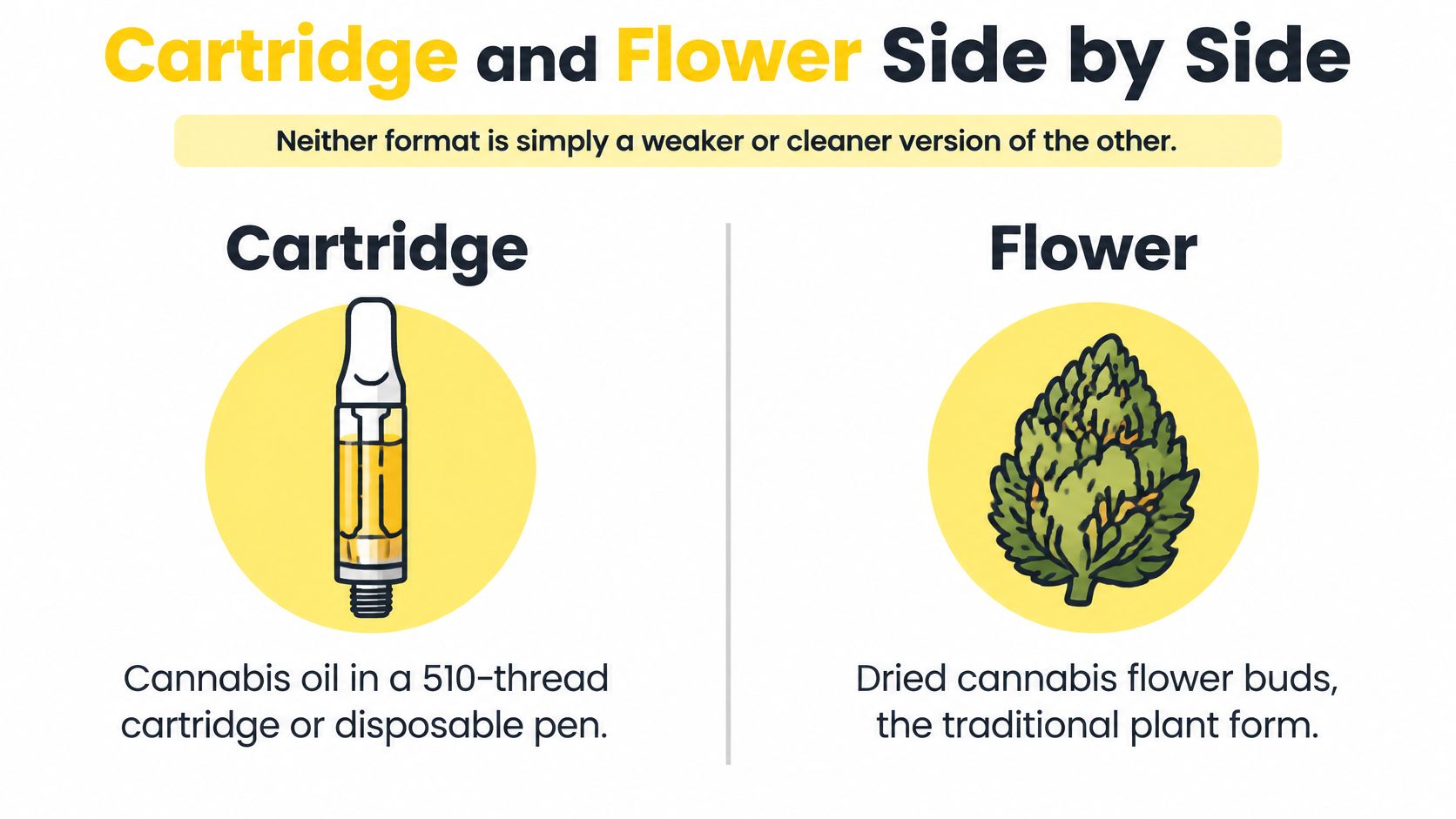
Compare the complete setup
Put a bud, grinder and storage jar on a counter beside a pocket pen that fits inside a coat. The difference is preparation, not a ranking of quality. Flower lets you inspect and portion plant material; the pen removes grinding, packing and cleanup.
At Mr. Nice Guys DC, our products include flower, edibles, vape cartridges and pens, concentrates, pre-rolls, topicals and tinctures. You can compare flower with cartridges, disposable pens and rechargeable pens in one visit; our guide to vape pen and cartridge types explains the hardware choices.
Flower gives more control over material and strain character, while a cartridge gives compact, potentially repeatable use; which rows matter most comes down to your situation.
How Much THC You Actually Get From Each
Say you compare equal portions of flower and oil. Using the concentrations described in a preclinical cannabis-inhalation study, 0.25 grams of flower at 20% THC contains about 50 milligrams, while 0.25 grams of oil at 85% THC contains about 212.5 milligrams, assuming complete extraction. Those are amounts present in the material, not amounts absorbed by a person.
The same study describes dried flower reaching 36% THC, distillate cartridges reaching 96% THC, and the study's distillate containing approximately 85% THC. These are reported concentrations, not recommended targets.
THC in the same amount of flower and cartridge oil
| Product | Amount | THC present | Note |
|---|---|---|---|
| Flower at 20% THC | 0.25 g | About 50 mg | Assumes all THC is available; real delivery is lower |
| Flower at 36% THC | 0.25 g | About 90 mg | Reported upper level for dried flower |
| Cartridge oil at 85% THC | 0.25 g | About 212.5 mg | Distillate used in a preclinical inhalation study |
| Cartridge labeled 80% THC | 1 g | About 800 mg | Before any delivery losses |
| Flower at 20% THC | 1 g | About 200 mg | Same label strength, for comparison |
These hypothetical label calculations use product mass multiplied by THC concentration. Actual absorbed amounts are lower, and puff size, inhalation technique, temperature and device efficiency affect delivery.
Product content isn't a personal dose
A cartridge's package weight can make it look modest beside a jar of flower. But equal package weights don't mean equal THC content, and equal THC content doesn't mean equal delivery. Some material remains in the device, some is lost during heating, and not everything inhaled reaches the bloodstream.
That distinction also prevents a misleading comparison between a bowl and a puff. A bowl describes how much material you loaded; a puff describes an action. Neither tells you the absorbed dose without more information.
For a practical comparison at the counter, look at:
- Product weight: Separate the weight of the oil or flower from the weight of the packaging.
- Cannabinoid breakdown: Check THC specifically rather than assuming total cannabinoids means THC.
- Formulation: Identify whether the cartridge is a distillate or another extract, and review its ingredients.
- Delivery setup: Consider the battery setting, draw resistance and how easily you can take a small inhalation.
Don't buy the biggest percentage by default
If your goal is mild evening relief, a highly concentrated cartridge may make careful pacing more important, not less. A lower-potency product can give you more room to adjust without trying to take an exceptionally tiny draw.
Our guide to how to avoid greening out is useful before trying an unfamiliar strength. The label tells you concentration in the product, not the dose your body receives.
Onset, Effects and How Easily You Can Stop
Both formats act quickly when inhaled, so onset usually isn't the deciding factor. The more useful question is whether you can take a modest inhalation, recognize its effect and stop before adding more.
In a randomized crossover study of infrequent cannabis users, vaporizing flower produced higher whole-blood THC concentrations than smoking an equivalent dose, alongside dose-related subjective effects, cognitive and psychomotor impairment, and cardiovascular responses. The experiment tested vaporized flower, not cartridge oil, so it doesn't establish a universal cartridge-to-flower conversion.
It does undermine the assumption that vapor must be weaker than smoke. Efficient delivery can produce more effect than someone expects from the labeled amount.
Make stopping part of the session
With flower, titration means adjusting the session through small inhalations rather than committing to finishing everything you loaded. You can put down the pipe or stop the dry-herb device while unused material remains.
Packing technique matters because an overly tight bowl can make airflow difficult to judge. Our guide to how to pack a bowl helps with preparation, but a well-packed bowl still isn't an instruction to finish it.
A cartridge also allows pauses. What it doesn't usually provide is a fixed milligram dose per draw: voltage, airflow, oil formulation and inhalation length all affect output. A familiar puff from a different battery may not feel familiar.
Practical rule: Treat a new product or changed device setting as a new dosing situation, even if the label looks familiar.
Use a deliberate pause
Say a patient wants mild relief in the evening without becoming heavily impaired. They take a small cartridge inhalation, put the device away and wait several minutes before deciding whether more is necessary. Leaving it in another room can help break the habit of taking repeated draws just because the pen is in hand.
For either format, make the assessment concrete:
- Notice the effect: Check whether the intended symptom has changed rather than chasing a stronger sensation.
- Check functioning: Pay attention to dizziness, anxiety, slowed thinking or a racing heartbeat.
- Stop deliberately: If the effect is sufficient or uncomfortable, don't add another inhalation.
For a first session, take one small inhalation, pause several minutes, don't drive and don't combine cannabis with alcohol. Waiting is part of dose control, not wasted time.
Discretion, Portability and Everyday Convenience
Consider a commuter who carries cannabis for use after work. A pen fits neatly into the day's bag; loose flower requires more planning. Neither format makes consumption appropriate on a train, during safety-sensitive work or in a workplace that prohibits it.
Discretion is about carrying less equipment, not permission to use cannabis anywhere. A low-odor device can still produce noticeable aerosol, and looking unobtrusive doesn't make someone unimpaired.
Follow the commuter's day
Our vape selection includes 510 cartridges, disposables and rechargeable vape pens, intended for discreet delivery and easy travel and storage. A disposable combines the oil and battery in one unit; a separate cartridge requires a compatible charged battery. Neither needs grinding or rolling papers.
Flower adds a small preparation kit. A grinder, airtight jar and pipe or dry-herb vaporizer take more space, and opening the jar can release a noticeable aroma. Smoked flower can also leave odor on clothing and inside bags.
At lunchtime, the sensible plan may be not to consume at all. If the commuter still has work responsibilities or needs to drive later, portability shouldn't become a reason to squeeze in a session.
Store for the return trip
Keep cartridges away from heat and direct sunlight, and don't leave them in a hot car. Carry them in a protective case rather than loose beside keys, and protect the mouthpiece from pocket lint. If a cartridge leaks or stops drawing normally, inspect it instead of repeatedly increasing the power.
Keep flower dry and sealed in a suitable jar, away from unnecessary heat and light. Don't add loose moisture to compensate for poor storage; our guide to keeping flower fresh explains a more controlled approach.
Before leaving home, check:
- Power: Charge the reusable battery or confirm the disposable works.
- Identification: Keep the labeled package or batch information with the product.
- Containment: Use a secure cartridge case or a small sealed flower jar.
- Backup plan: Be willing to postpone the session if the device fails or there's no appropriate place to use it.
For flights or trips across jurisdictions, verify the applicable rules before packing cannabis. A travel-friendly shape isn't authorization to transport it.
Health Risks Each Format Carries and How to Reduce Them
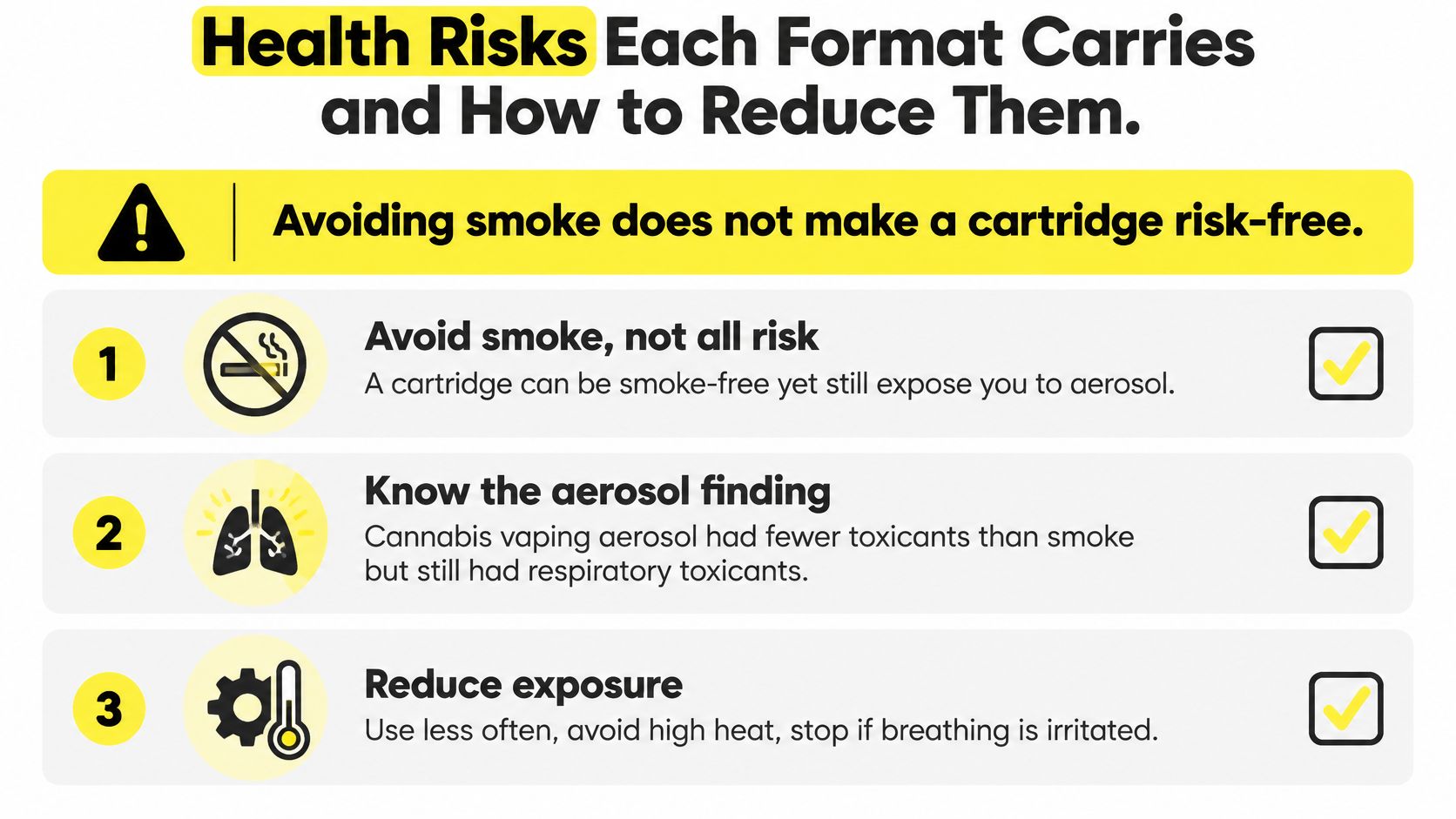
Avoiding smoke doesn't make a cartridge risk-free. The useful comparison separates combustion, the product's ingredients and the device that heats it. Otherwise, you end up comparing smoked flower with every possible vape as though all vaporizers were identical.
In human bronchial-cell research published in the American Journal of Physiology, cannabis-vaping aerosol contained fewer toxicants than cannabis smoke but still included compounds classified as respiratory toxicants, carcinogens and teratogens. The paper describes customizable vaporization temperatures of approximately 125–260°C, contrasts common vaporizer heating around 190–220°C, and notes that joints burn above 600°C.
Those findings help explain why avoiding combustion can reduce some exposures. They don't prove that every cartridge is safer than every flower setup, or establish long-term safety for an individual patient.
Compare like with like
Flower in a dry-herb vaporizer and oil in a cartridge both avoid intentionally burning plant material, but they involve different formulations and hardware. A cartridge introduces questions about oil ingredients and the heating assembly; dry-herb equipment introduces questions about packing, heating uniformity and cleaning.
An Environmental Health Perspectives assessment describes differences in contaminant rules across jurisdictions and identifies device power as a factor in metal emissions. That's a reason to examine hardware quality, not just the oil's potency label.
A batch-specific certificate of analysis should match the product's lot number. Review which contaminants the laboratory tested, including relevant pesticides, heavy metals and residual solvents, rather than accepting a potency result as a complete safety assessment.
Smoke-free describes the absence of combustion. It doesn't describe everything entering your lungs.
Reduce the risks you can control
Use this purchasing and setup checklist:
- Choose sealed, labeled products. Keep the batch number available so the test report can be matched to the package.
- Review ingredients and contaminant results. A THC percentage alone doesn't tell you what else is in the oil.
- Reject questionable formulations. Avoid cartridges without credible ingredient information, and don't use products containing vitamin E acetate or add your own thinning oils.
- Use the lowest effective heat setting. Don't compensate for clogs with repeated high-power heating.
- Reconsider combustion. If you currently smoke flower, a suitable dry-herb vaporizer may reduce combustion-related exposure without requiring cartridge oil.
For example, someone who wants to keep using a familiar flower doesn't have to switch to concentrated oil just to stop smoking it. They can evaluate a dry-herb device instead.
Our smoking vs vaping guide provides another way to compare delivery methods. If inhalation irritates your breathing, stop and discuss non-inhaled options with your healthcare professional; choosing a format is risk reduction, not a declaration that either is harmless.
Which Format Fits Your Situation
Start with the situation that matches your needs, then read the caution beside it. The better fit is the format you can use deliberately, not necessarily the one with the most THC or the smallest package.
Format fit by situation
| Situation | Better fit | Why | Watch for |
|---|---|---|---|
| First-time user with no tolerance | Flower or a low-dose cartridge | Either allows a pause after a small puff | Start with one inhalation and wait several minutes |
| Low tolerance, medical patient | Flower in a dry-herb vaporizer | Titration can give more control over the session | Confirm the flower is lab tested |
| Discreet use during travel or breaks | Cartridge or disposable pen | Compact with no grinding or papers | Check device quality, battery condition and permitted use |
| Daily use needing repeatable dosing | Tested cartridge from a known batch | Known concentration helps keep the product consistent | Label concentration isn't a guaranteed puff dose; watch for clogs, leaks and battery faults |
| Whole-plant character and aroma | Flower | Plant material with strain-specific aroma | Odor, bulk and equipment |
| Highest concentration in a small amount | Cartridge with caution | Concentrated oil provides high THC per gram | Effects can be stronger than expected |
A first-time user choosing an introduction
Say someone has never used cannabis and wants a manageable experience at home. They shouldn't choose a high-potency disposable just because it looks easy to operate. Easy hardware and easy dosing aren't the same thing.
Flower or a lower-dose cartridge can be reasonable options, provided the person understands the device and can take a modest draw. If a cartridge doesn't offer credible dosing guidance, don't interpret its small size as evidence that it's beginner-friendly.
A medical patient with low tolerance
A patient who needs careful adjustment may prefer tested flower in a dry-herb vaporizer. They can portion a small amount, control the session and retain direct visibility of the material being heated.
That preference isn't a guarantee of weaker effects. The patient should still evaluate the device's delivery and discuss relevant medical conditions or medication interactions with their healthcare professional.
A regular user seeking consistency
For a daily user, a tested cartridge from a known batch can simplify the routine. Keeping the same battery, setting and inhalation pattern makes comparisons more useful than switching between unfamiliar disposables.
If the cartridge clogs, leaks or suddenly changes output, the session is no longer comparable. Troubleshoot the equipment rather than assuming the product needs a harder pull or more heat.
Choose the format you can use consistently, then judge whether it meets your goal without unnecessary consumption.
Someone who values whole-plant material, aroma and strain character may still prefer flower despite the extra equipment. This table is a starting point, not a clinical prescription: tolerance and health conditions should take priority over pocket space or convenience.
Choose Your Format and Confirm Your Next Step
Choose flower when control over plant material, preparation and strain character matters most. Choose a tested cartridge when compact equipment and a consistent setup better match your routine. Let your tolerance and health needs decide before you compare convenience.
Verification matters for either choice. In an analysis of illicit cartridge fluids associated with pulmonary injury, vitamin E acetate appeared in 23 of 36 samples, and MCT oil was also identified as a significant additive in many samples. These were illicit products recovered during a lung-injury investigation, not a representative sample of regulated cartridges.
Make the counter conversation specific
Use this sequence to turn a preference into a considered purchase:
- Identify your situation. Decide whether your main constraint is tolerance, preparation, discretion or control over material.
- Describe your goal. Our budtenders ask what you're looking for, such as pain relief, help sleeping or anxiety support, before recommending products.
- Request verification. Review batch results and ingredient information before buying. Our products are tested for pesticides, potency and more.
- Choose the complete setup. Include the compatible battery or dry-herb device in the decision, not just the oil or flower.
- Plan the first session. Start with a small inhalation, allow several minutes to assess it, and avoid driving or alcohol.
If you also need help accessing medical cannabis in Washington, DC, we provide clear instructions and support for both self-certification and certification through a traditional healthcare provider. Bring your intended use, tolerance and equipment questions to the counter and ask for a format and batch recommendation, not just the strongest product.
Mr. Nice Guys DC offers flower, vape cartridges, disposable pens and rechargeable pens, with guidance to help you compare the material and the device together. Visit Mr. Nice Guys DC and tell our team what you want from your session so we can help you choose a suitable format and review the product's testing information.
Mr Nice Guys DC
At Mr. Nice Guys DC, we’re more than just a cannabis delivery service — we’re passionate advocates for quality, convenience, and community. With years of experience in the cannabis industry, our team is dedicated to educating and empowering customers across Washington, D.C. Whether you're a seasoned user or just starting your cannabis journey, our blog delivers trusted tips, product insights, and the latest updates from the world of weed. Stay informed, stay elevated.
