
Must Be 21 To Enter
By entering this site you are agreeing that you are at least 21 Years of Age or older.
I AM 21 OR OLDERHow to Pack a Bowl: Airflow, Pacing and DC Rules


You've got a glass pipe on the table, a lighter that's seen better days, and a bud you're about to break apart by hand. You pack it to the rim, thumb it down, light the whole surface, and the draw fights back like a milkshake through a coffee stirrer. So you pull harder, the cherry tunnels down one side, and twenty minutes later you've burned through more flower than you planned, with a headache and a full ashtray to show for it.
That sequence is a packing problem, not a flower problem. Learning how to pack a bowl is really two skills braided together: managing airflow and controlling dose. Get the pack right and the pipe does most of the work for you.
Why Packing Decides How a Bowl Burns
A bowl is a small pipe. Dried flower goes in, you draw air through it, and heat releases cannabinoids into smoke you inhale. The National Institute on Drug Abuse lists pipes and water pipes next to joints and blunts as established ways to consume cannabis. That simplicity is why packing decisions carry so much weight. Three levers control the entire session:
- Particle size. Coarse, even pieces stay where you put them and burn steadily. Powder drops through the screen and gets pulled into your mouth as ash.
- Packing density. How hard you press sets the resistance you feel on every pull, and resistance decides how hard you pull.
- Lighting method. A flame across the whole surface ignites the entire load at once. A flame at one edge keeps most of the bowl unburned for later.
A bowl is a combustion method, not a filtered device. Smoke and particulate exposure come with it whatever the pipe is made of. Laboratory research comparing vaporizers with combustion found that electrically controlled vaporizers released neutral cannabinoids efficiently, with reported THC recovery of roughly 36 to 61% in vapor under tested conditions, while combustion products were substantially suppressed in suitable vaporization conditions. Those numbers aren't a real-world efficiency rating for your pipe, since device design, draw length and flower composition all change delivery, but the direction is clear. Smoking cannabis can harm lung tissue and is associated with cough, bronchitis and mucus production. If smoke exposure is the part you'd rather reduce, the comparison between edibles and smoking is worth reading before your next session.
The goal here is modest: a loose, even pack that draws with light effort and burns slowly. That's the foundation of controlled dosing. Ahead are the packing steps, airflow fixes, pacing for the first pulls, a flower check, and the DC rules that shape where any of this happens.
Before you touch the grinder, decide one thing. Is this a single small load or a longer session? That answer sets the pack size, and every step after it follows from there.
Check Flower and Buy a Labeled Batch
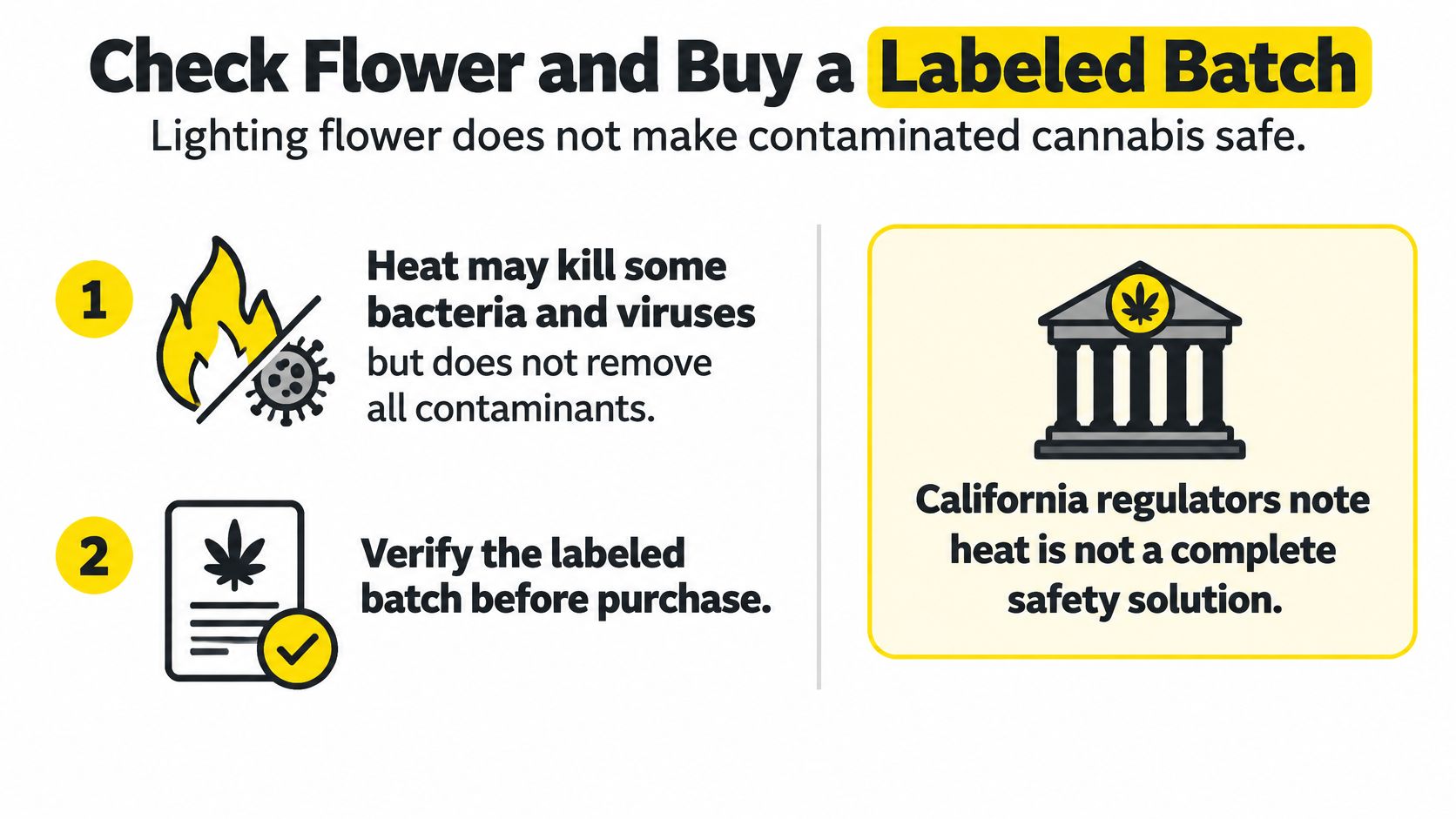
Lighting flower does not make contaminated cannabis safe. Packing tutorials often assume clean material and jump straight to grind and density, but dose control starts earlier: with flower that is labeled, traceable and fit to burn.
The Massachusetts Cannabis Control Commission identified 544 cannabis laboratory samples that had previously failed total yeast-and-mold testing, and advised consumers to check labels and batch information. A separate 2025 advisory covered products that passed earlier compliance testing but later exceeded acceptable yeast-and-mold limits. Heat can kill some microbes, but it does not remove every microbial contaminant or the toxins bacteria leave behind. A flame is not a sterilizer.
Run these checks in order, before the grinder comes out:
- Read the label. Note the labeled THC percentage and the product date; potency sets the ceiling for your first pack.
- Match the batch number. Compare it against the receipt or menu record so you know which lot you are holding.
- Inspect the surface. Fuzzy growth, webbing or unusual discoloration means stop.
- Smell it. Musty, basement-like or chemical odors are a rejection, not a preference.
- Stop if it fails. Do not grind it. Grinding spreads contamination through the whole batch, and when in doubt, discard it.
Medicinal users may be immunocompromised, so contamination is a health matter rather than a quality complaint. If illness follows use, stop, contact a clinician, and report the batch to the retailer or regulator; keeping the original package and batch number makes that report possible. Mr. Nice Guys DC lists flower, accessories, edibles, vapes and pre-rolls on its menu, which helps the labeled package stay tied to your order for pickup or delivery. For visual warning signs, use this guide on how to tell if weed is moldy before the bowl is packed.
Stay Within DC Rules When You Smoke
The setting decides whether any of this is lawful, so settle that before you settle the pack. The District's medical-cannabis law allows a qualifying patient or caregiver to possess up to 8 ounces of dried medical cannabis at one moment, and allows a qualifying patient to purchase, possess, use and administer medical cannabis, plus paraphernalia, in accordance with the law and its rules.
General adult rules are narrower and sit in a separate lane. Under general adult rules, possession is limited to a much smaller amount than medical authorization allows, and using cannabis in public is not permitted, so keep the pipe for private settings. Possession and use aren't the same permission, and a card doesn't blur the line.
The practical rule: pack and smoke in a lawful private setting, keep your supply within the authorization and quantity that applies to you, and leave the pipe at home when you go out.
A lawful session looks unremarkable. A patient packs a single small bowl at the kitchen table, keeps the jar and the rest of the supply inside the authorized amount, and puts the pipe back in the drawer before leaving the house. No bowl in the car, no bowl on the patio of a bar, no assumption that a medical card converts a sidewalk into a lounge. Staying home also helps your dosing: a bowl you can finish at your own pace is far easier to control than one you're rushing through somewhere you shouldn't be.
The other safety basics belong in the same breath. Don't drive after use, don't combine cannabis with alcohol or sedatives, and don't share mouthpieces, which is one of the simplest ways to pass along whatever else is going around. Respiratory or cardiovascular conditions deserve a conversation with a clinician rather than a workaround.
Rules and enforcement priorities shift, and DC treats general adult possession differently from medical authorization, so confirm your current status before you use. For the wider picture on where and how people consume in the District, this guide to smoking in Washington, DC covers the local ground.
Pack a Bowl Step by Step
The loading method below follows the core mechanics of a bowl: particle size, retention, packing density, airflow and controlled ignition, as laid out in this bowl-packing walkthrough. Six steps, each with the reason behind it.
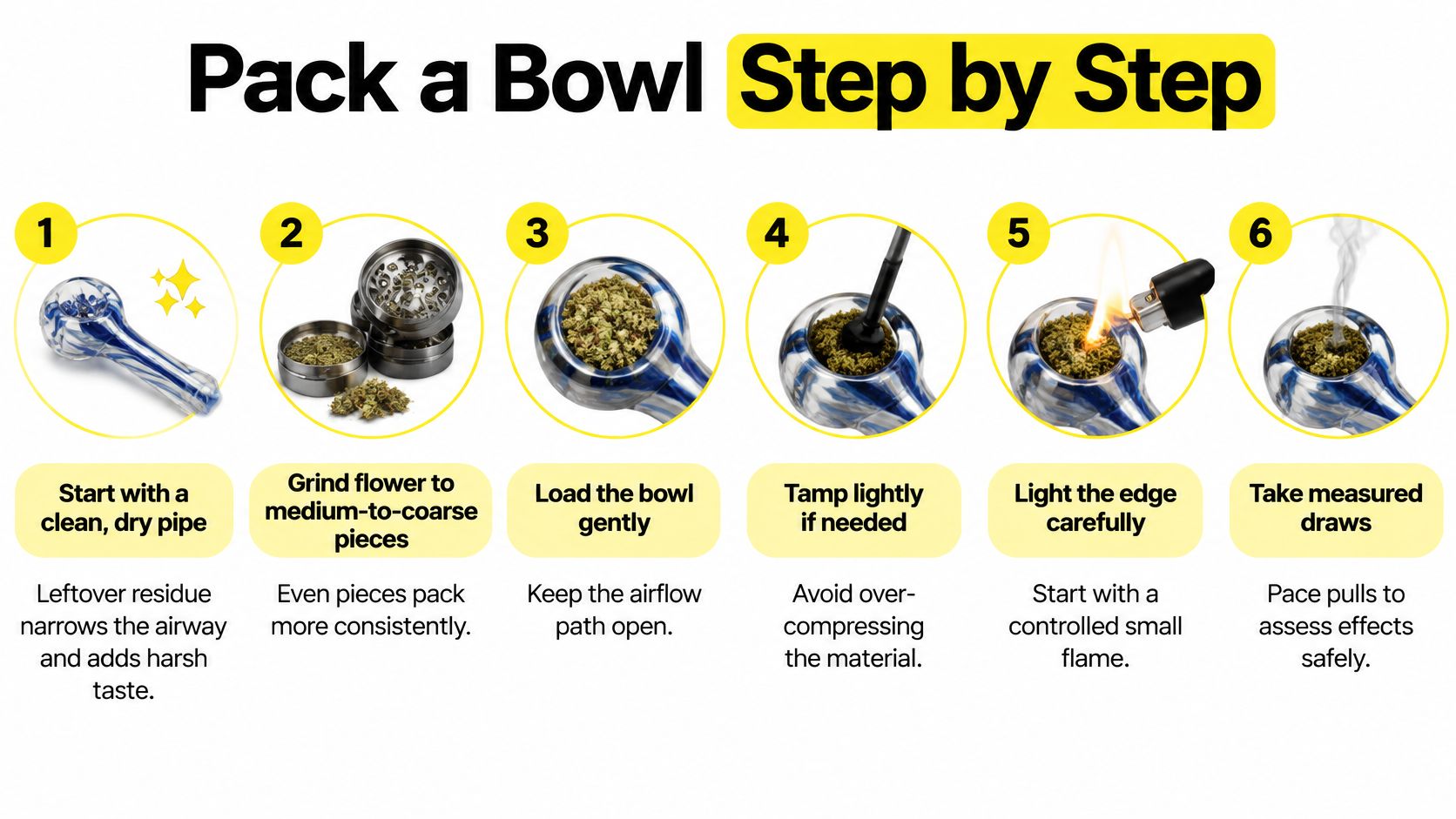
- Start with a clean, dry pipe. Residue from the last session narrows the airway and turns a mild hit harsh. Rinse glass with hot water, dry it fully, and check the bowl for leftover ash before loading. A wet pipe steams and tastes wrong.
- Grind to medium-to-coarse pieces. Hand-broken or grinder-broken flower at that size packs evenly and holds its shape. The common slip is grinding to dust so the bowl "fills better." Powder clogs the air path and pulls ash into the stem.
- Give the bowl a floor. A clean screen, or one coarse piece of flower laid across the opening, stops loose material from dropping through. If flower falls into the stem on your first pull, the floor isn't covering the hole.
- Add flower in loose pinches. Let it fall in rather than pushing it down, and keep the top level with or slightly below the rim. Piling above the rim looks generous and draws badly, because the flame has more surface to run across.
- Press once, gently. A single settling press is all the pack needs. Repeated tamping creates channels, and a channelled bowl burns in patches while the middle stays wet.
- Run a dry pull with the carb covered. Air should move with light effort. Light resistance means an open path. A nearly sealed draw means loosen the pack or clean the screen before you bring a flame anywhere near it.
What a Healthy Pack Looks Like
The surface sits level, the flower shifts freely when you tap the side of the pipe, and there's no dense core in the middle. It looks slightly underfilled, and that's correct. A well-packed bowl should feel like it might fall apart, not like a plug.
Light one edge rather than the whole surface. Keeping the flame off the rest of the bowl preserves unburned flower for later, and lifting the flame away between pulls limits how much material combusts while you're not inhaling. For someone brand new to flower, the mechanics overlap heavily with the basics of a first session.
Fix Airflow and Burn Problems
A sealed draw almost always traces to one of two things: a pack pressed too dense, or a screen clogged with resin and sticky trichomes. Diagnose it before the flame goes anywhere near the bowl. Airflow is dose control here. A bowl that draws cleanly burns at a pace you can manage, while a bowl that fights you pushes you into harder pulls and bigger hits than planned.
Screen choice deserves more attention than it gets. One sifting and screen reference identifies 60- to 80-mesh as a practical starting range for a metal screen, with the warning that finer mesh clogs quickly with sticky flower. If your screen needs poking every session, the mesh is too fine. Clean it between sessions or step up to a coarser weave.
A coarse base layer fixes most tight bowls. Rest a small pinch of coarser flower over the screen, keep the finer material above it loose, and compress nothing. The coarse pieces hold the airway open while the finer material burns on top of them.
Why the Draw Feels Sealed
A powdery or heavily tamped bowl forces you to pull harder. That harder pull drags ash and small particles through the pipe, heats the load unevenly, and leaves harsh hits at the back end. Resistance is the cause; the strained pull is the symptom.
| Symptom | Likely cause | Fix |
|---|---|---|
| Draw feels sealed or blocked | Pack too dense or screen clogged | Loosen the pack and clean or replace the screen |
| Flower falls into the stem | No screen or coarse base layer | Add a clean screen or one coarse piece over the opening |
| Harsh, ashy hits | Powdery flower or hard tamping | Grind coarser and remove the tamp |
| Burns on one side only | Uneven packing or lit across the whole surface | Repack evenly and light one edge |
| Pack burns too fast | Loose, oversized load with heavy pulls | Use a smaller load and take shallow pulls |
| Screen clogs with sticky flower | Mesh finer than 60 to 80 | Switch to 60 to 80 mesh and clean between sessions |
Repacking takes a minute. Pulling a blocked bowl through anyway wastes flower, scorches what's left, and produces a harsh hit that lingers. When resistance feels wrong, dump the load, loosen it and reload. If this is your first time loading a pipe, these first-time smoking tips cover the groundwork underneath every fix in the table above.
Pace Your First Pulls Safely
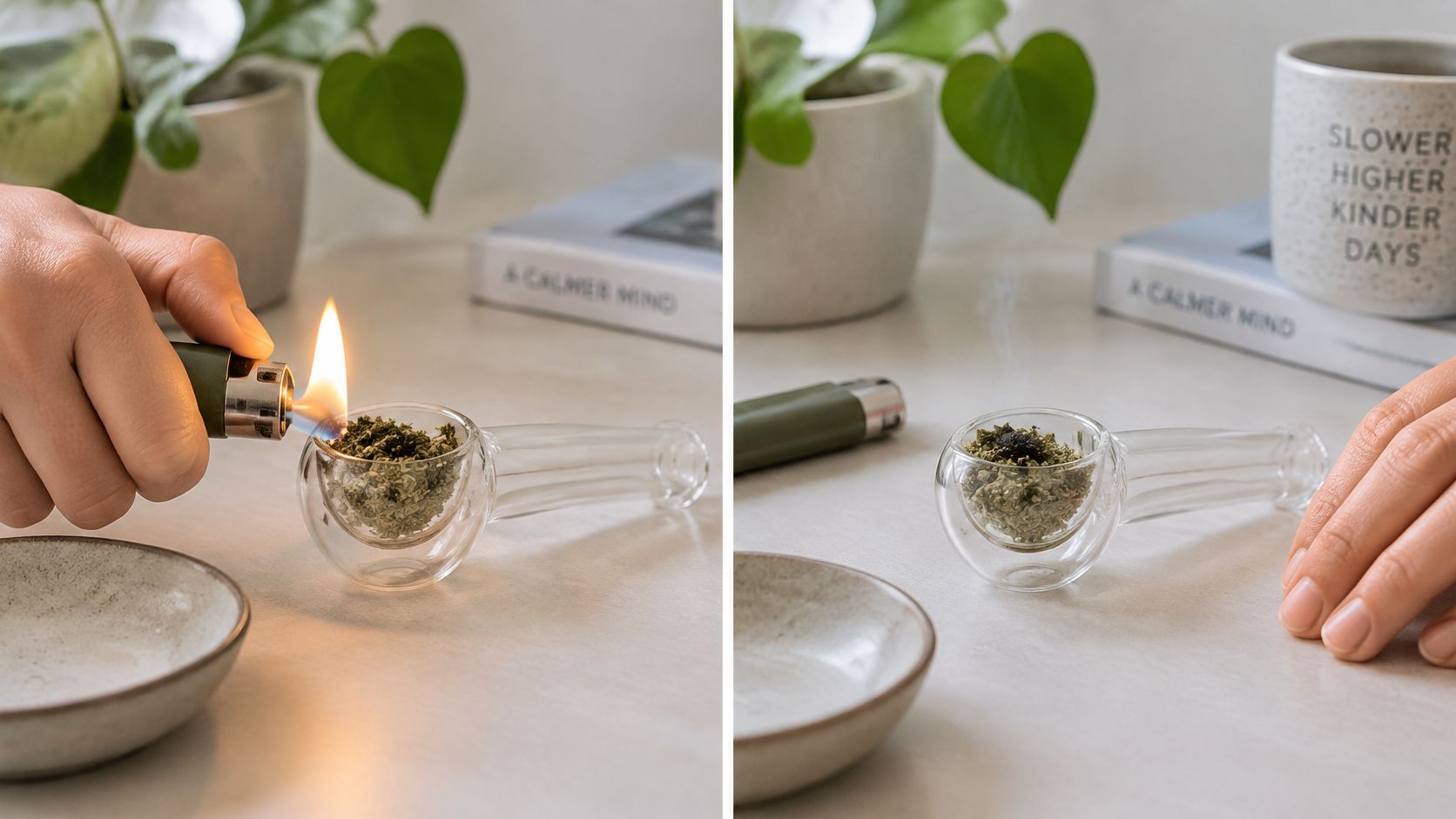
Inhaled cannabis arrives fast, which is exactly why the first minute deserves a rule rather than a vibe. Load only enough for one or two shallow puffs, light one edge, put the flame out between pulls, skip holding the smoke in, then stop and assess.
Guidance from this bowl-packing and pacing reference recommends waiting 15 to 30 minutes for effects to develop, with the longer 30-minute wait when the flower is unusually strong or its potency is unknown. It presents a labeled product at 10% THC or less as an example for a new user, and it advises against topping up while effects are already building. Labels help, but they don't replace pacing, because sensitivity and inhalation depth vary from person to person. Shallow pulls also keep the bowl from overheating and reduce the chance of drawing ash through a restricted airway.
| Situation | Load and puffs | Wait before more |
|---|---|---|
| New user, product labeled 10% THC or less | Small load, one or two shallow puffs | At least 15 minutes |
| Unusually strong flower or unknown potency | Small load, one or two shallow puffs | 30 minutes |
| Familiar product, known tolerance | Small load, one or two shallow puffs | 15 minutes, then reassess |
| Effects already building | No further puffs | Wait until effects settle before deciding |
Write the Session Down
Weigh the load before packing and log four things: the product, the amount, the number of puffs, and how the effects felt. A 2025 study of adults with HIV in Florida, indexed on PubMed, reported bowls as the flower method for 12% of participants, with a median bowl quantity of 0.3 grams. Treat that as a reference point for a single session, not a target.
A log turns the next session into an evidence-based decision instead of a guess. It's also how you catch the difference between "this flower is strong" and "I packed twice as much as last time." If you overshoot, this guide on how to avoid greening out covers what to do and why the panic usually passes.
Clean the Bowl Between Sessions
A clean bowl is the only way the next pack draws the way the last one did. Let the pipe cool completely first, then knock the ash out and wipe residue from the bowl and stem with a dry cloth or a pipe tool. Hot glass cracks under cold water, so patience here saves a pipe.
Check the screen every time. Mesh packed with sticky flower restricts airflow and adds a burnt taste to a fresh load, and no packing technique compensates for a blocked screen. Clean it, or replace it with the same mesh size that already pulls well for you.
If a dry pull still feels blocked after cleaning, look for leftover ash before you repack. Small debris hiding in the stem is a common culprit, and a partly blocked airway makes each pull harsher and each dose less predictable.
Keep flower in its original package, sealed and away from heat and moisture, so the batch stays identifiable if you ever need to report it. Then set the pipe aside clean. The next bowl starts from a known baseline, which means the amount you pack is the only variable.
If you'd rather spend your time on pacing than on sourcing, Mr. Nice Guys DC keeps a rotating menu of labeled flower, pre-rolls, vapes and the accessories that go with them, so you can pick up a batch along with the grinders and storage that go with it in the same stop. Patients 21 and older can order for in-store pickup, curbside or delivery across DC and nearby areas like Alexandria, Bethesda and Silver Spring. Visit Mr. Nice Guys DC to see what's on the shelf this week and ask the team which flower suits a small, single-session load.
Mr Nice Guys DC
At Mr. Nice Guys DC, we’re more than just a cannabis delivery service — we’re passionate advocates for quality, convenience, and community. With years of experience in the cannabis industry, our team is dedicated to educating and empowering customers across Washington, D.C. Whether you're a seasoned user or just starting your cannabis journey, our blog delivers trusted tips, product insights, and the latest updates from the world of weed. Stay informed, stay elevated.
