
Must Be 21 To Enter
By entering this site you are agreeing that you are at least 21 Years of Age or older.
I AM 21 OR OLDERCannabis Topical for Back Pain: A Step-by-Step Guide


A jar of cream can feel soothing on sore lumbar muscles, and that sensation is easy to mistake for treatment of the spine itself. Those are two different claims. A careful trial separates temporary surface relief from any change in a disc, joint, or nerve, and it gives you numbers you can check instead of impressions you have to trust.
What a Cannabis Topical Can Realistically Do for Back Pain
Patient interest is ahead of the proof. The 2022 systematic review of non-oral and non-inhaled cannabinoids identified only six human studies, and just one met its full relevance criteria for neuropathic pain, cannabinoid exposure, and a topical or otherwise non-oral route.
That review included a retrospective report on a hemp-derived CBD cream for acute and chronic back pain in adults aged 40 to 61. Pain was scored on a visual analog scale at baseline, 8 hours, and four weeks, but there was no control group. Without a comparison group, you can't credit the cream rather than natural recovery, other care, or expectation.
Topical and transdermal are not the same thing
A topical is meant to act locally in the skin. A transdermal product is designed to cross the skin and enter circulation. That distinction changes both what you can expect and which medication questions you need to ask.
Say you rub a cream over tight muscles on either side of your lower spine after gardening. The area may feel easier while you sit or walk. That outcome still doesn't show that cannabinoids reached a lumbar disc, facet joint, or nerve root, which sit much deeper than the skin surface.
Treat a cannabis topical for back pain as a localized, time-limited add-on, not as a proven stand-alone therapy.
Keep exercise and conventional care in place, and judge the product by your own pain and function scores. For the wider picture beyond creams and balms, our guide to cannabis pain relief options puts topicals alongside other formats.
How to Choose a Format and Potency
Start with what the product is designed to do, not with the biggest number on the jar. Format decides where the product sits, how long it stays in contact with skin, and how easily you can apply the same amount each time.
| Format | Designed to | Potency on label | Best fit |
|---|---|---|---|
| Cream or lotion | Local action on skin and muscle surface | Total mg per jar; verify label | Everyday sore muscles across a wide area |
| Balm or salve | Thicker layer, longer contact on a small area | Total mg per ounce or container; verify label | Localized spot pain |
| Roll-on | Targeted application to one spot | mg per roll-on or per ml; verify label | Readers who want a measured spot dose |
| Transdermal gel | Designed to enter circulation | Study used 4% CBD gel; check product strength | Only with clinician input, especially for people on medicines |
| THC-containing topical | Local effect plus possible psychoactive exposure | THC mg per container; verify label | Readers who want to avoid intoxication should skip it |
The transdermal row deserves extra care. A 2024 feasibility study of a 4% transdermal CBD gel found measurable systemic absorption after repeated application, so don't assume every product rubbed on skin stays only in skin.
What to verify before you buy
- Total mg per container: Note the full amount, and mg per application if the label lists it.
- Full ingredient list: Check fragrances, penetration enhancers, and anything you know irritates your skin.
- Batch or contaminant testing: Ask for current results rather than accepting a vague quality claim.
- Intent for dermal use: Pick a formulation made for skin, not an oral oil repurposed as a rub.
Our products are tested for pesticides, potency, and more, and you should expect that same transparency wherever you shop. If a label won't tell you what's in the container, pass.
A higher CBD or THC number doesn't produce proportionally greater relief, so start with the lowest labeled strength that fits your format. One case report described a cream containing 400 mg CBD per 2-ounce container, as noted in the Regional Anesthesia and Pain Medicine review. That's a data point from two patients, not a dosing standard for your back.
If you're weighing cannabinoids as well as formats, CBD versus THC for pain explains how the two differ before you spend money.
How to Apply a Topical Step by Step
Before your first application, record your baseline pain score, one function measure, and the condition of your skin. The patch test below doubles as your first skin check, so don't skip it to save a day.
People with broken skin or a known allergy to any listed ingredient should stop here and ask a clinician. The same applies if you're pregnant or breastfeeding.
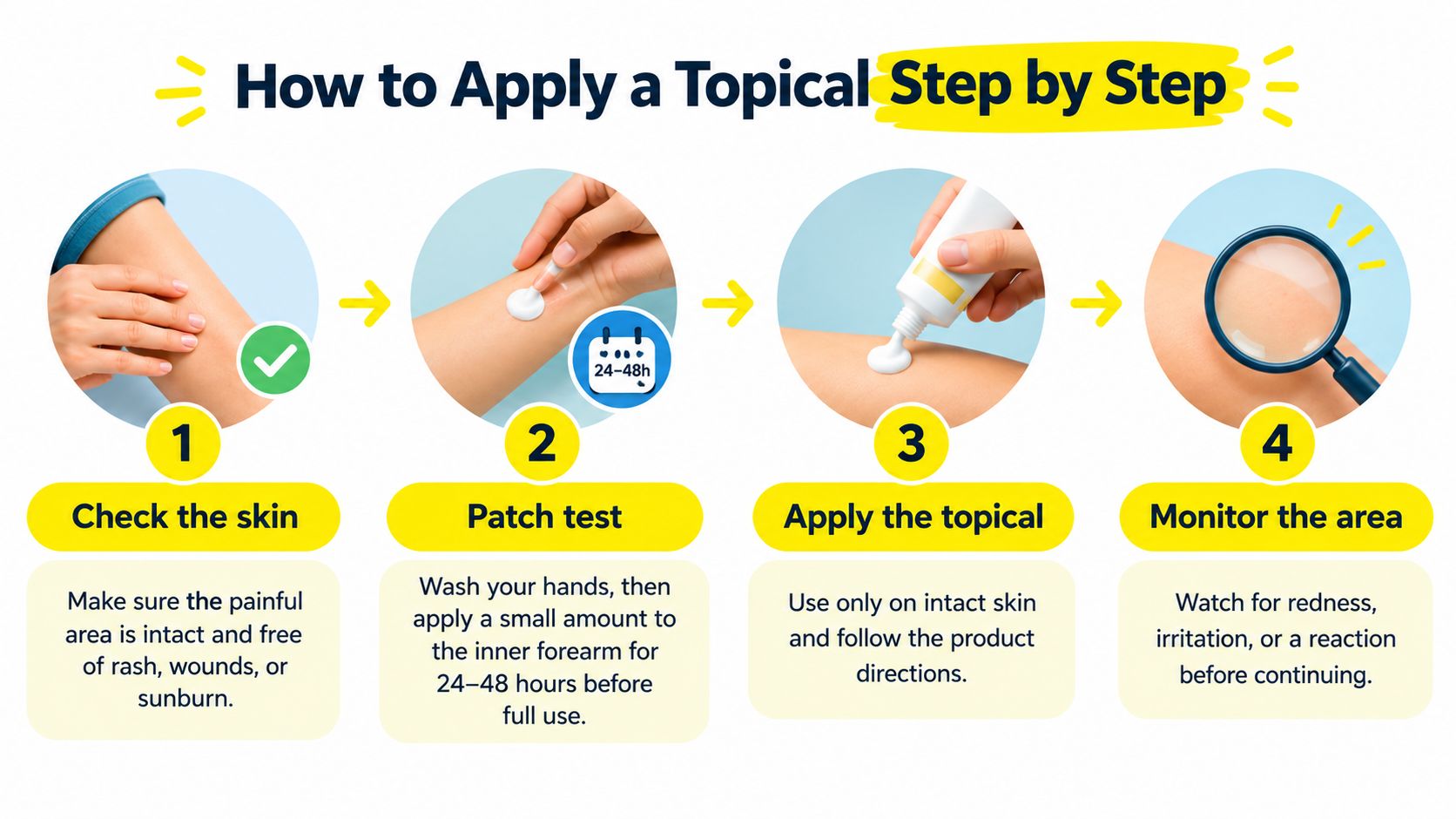
The application routine
- Check the skin. Make sure the painful area is intact, with no rash, wounds, or sunburn.
- Wash your hands and patch test. Apply a small amount to your inner forearm and wait 24 to 48 hours before full use.
- Apply a measured thin layer. Use the amount the label specifies, rubbed into a spot about the size of a coin rather than a heavy coating.
- Keep it off sensitive areas. Avoid broken skin, eyes, and mucous membranes, and don't cover the area with a bandage or heat pad, which can increase absorption.
- Follow the label frequency. Many products suggest two to four applications daily. Don't increase use just because early relief is absent.
- Wash your hands again. Avoid touching your face until you've done so.
- Log the time and amount. A short note now makes later comparisons honest.
Here's a practical example. Say morning stiffness is your main problem. You shower, dry your back, apply a measured amount to the sore spot, note the time, then take a short walk. Later you can compare how that morning felt against your baseline instead of guessing.
Consistency matters more than quantity. The same amount, on the same spot, at similar times gives you a cleaner read than occasional heavy applications.
Stop rule: Burning, itching, or a new rash ends the trial until your skin settles and you've reviewed the ingredient list.
First-time users should show the full ingredient label to a pharmacist, especially if they take prescription medicines. The routine here is similar to the approach in our guide to topical cannabis for arthritis, with the back-specific tracking added below.
Pairing a Topical With Other Back Pain Care
A topical works best as one part of a plan. Measures with stronger support do the heavy lifting while you test whether the cream adds anything.
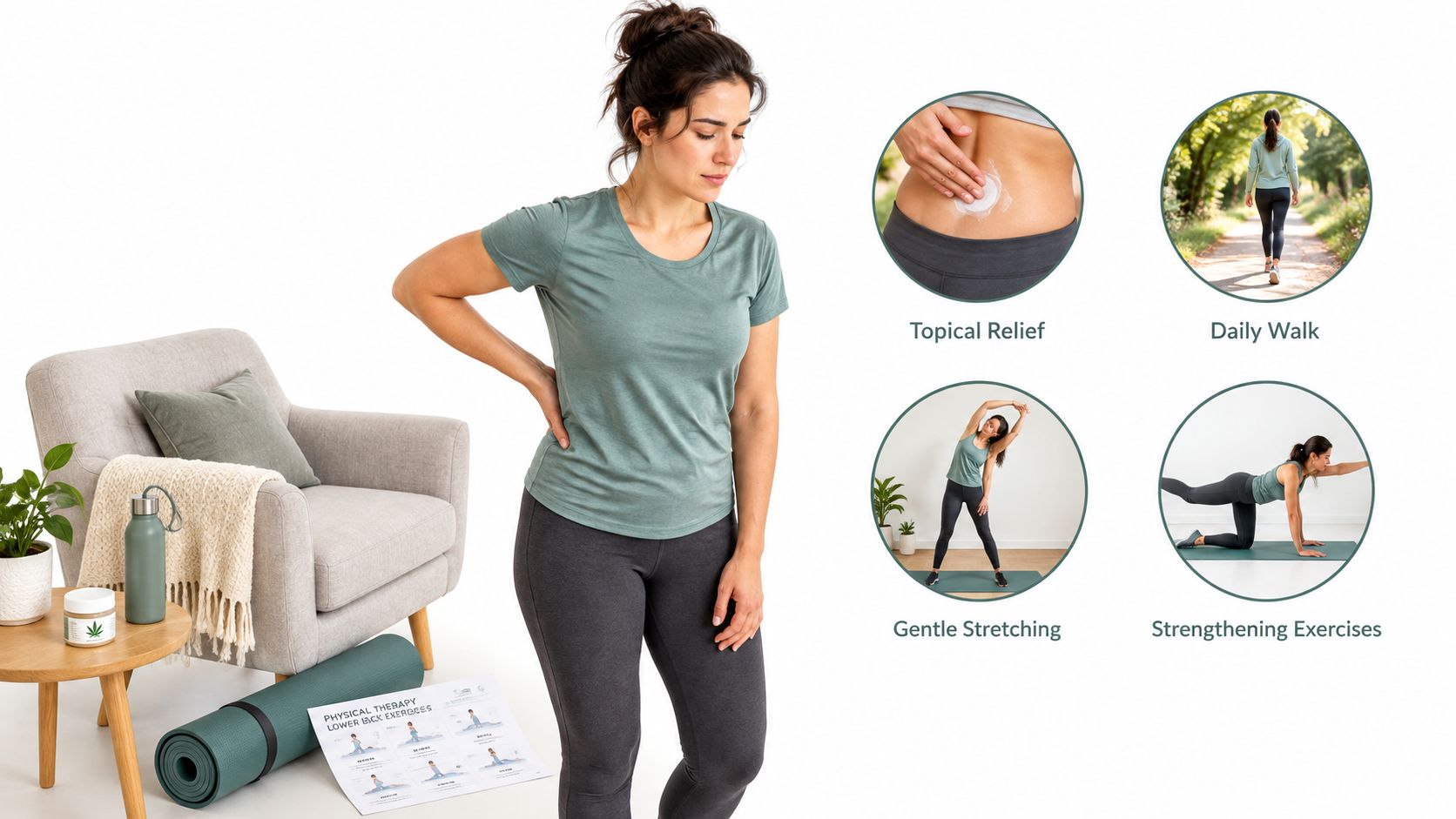
Build the base first. A daily walk or graded activity, targeted stretching or strengthening guided by a physical therapist, and heat or cold for flare-ups all help you keep moving. Over-the-counter analgesics can fit too, used as their labels allow. Our overview of topical pain relief with lidocaine shows how a non-cannabis topical sits in that same layered plan.
Keep those other treatments steady during your trial. If you start a new medicine and a new exercise program in the same week as the cream, you won't know which change deserves the credit.
This short video walks through pairing daily movement with localized care.
Review your medicines first
Don't assume a topical can't interact with anything. Clinical guidance on cannabinoid interactions notes that CBD may inhibit several CYP enzymes and may interact with narrow-therapeutic-index medicines such as warfarin, tacrolimus, and valproate.
| Medicine or substance | Why and what to do |
|---|---|
| Anticoagulants such as warfarin | Possible interaction; ask the prescriber before the first application and report unusual bruising |
| Seizure medicines such as valproate | Narrow-margin drug; prescriber review before any topical use |
| Immunosuppressants such as tacrolimus | Narrow-margin drug; prescriber review before any topical use |
| Sedatives and sleep aids | Added drowsiness; avoid driving during the trial |
| Antidepressants | Possible added sedation or interaction; prescriber review |
| Alcohol | Adds sedation and impairment; avoid during the trial |
For example, if you take warfarin and want to try a CBD cream, ask your prescriber before the first application and report any unusual bruising. A topical should never replace a prescribed treatment plan.
Timeline and Results to Track Over Four Weeks
Set a fixed four-week trial before you open the jar. An open-ended trial drifts, and drifting trials produce stories instead of answers.
Record your baseline first. Note pain on a 0 to 10 numeric scale, one functional measure such as walking distance or hours of sleep, and a brief note on skin condition.
Checkpoints that keep you honest
| Time point | What to record | Decision signal |
|---|---|---|
| Before first use | Pain 0 to 10, walking distance, sleep hours, skin check | Baseline for every later comparison |
| 1 to 2 hours | Burning, itching, warmth, dizziness | Any rash or irritation means stop |
| 8 hours | Pain score and function versus baseline | Note whether relief is meaningful, not just present |
| Day 3 | Applications used, pain trend, skin condition | Continue only if skin stays clear |
| Week 4 | Pain and function together | Keep only if both improve; otherwise stop |
Short-lived warmth or tingling doesn't prove therapeutic action. Many rubs create a sensation, and sensation alone tells you nothing about pain pathways or tissue change.
An early drop in pain can also reflect natural fluctuation. Back pain often eases and returns across a single day, so one good afternoon isn't a verdict.
Work through this example. Your morning pain starts at 6 out of 10, drops to 4 out of 10 at 8 hours, then returns to 6 out of 10 by day 3. That pattern suggests a short-term local effect rather than a lasting change.
Keep the topical only if pain and function both improve and your skin stays clear.
Check your function measure before deciding. If you're walking farther or sleeping longer at week 4, the trial earned a conversation about continuing. If only the score moved for an hour, it didn't.
When to Stop and When to See a Clinician
Some symptoms end the self-care conversation entirely. Any red flag below pauses your topical trial until a clinician has reviewed it.
| Red flag | Action |
|---|---|
| Progressive weakness in a leg | See a clinician now and do not extend the trial |
| Saddle numbness | Urgent medical evaluation the same day |
| New bowel or bladder changes | Urgent medical evaluation the same day |
| Fever with back pain | Same-day medical evaluation |
| Pain after major trauma | Emergency care |
| Unexplained weight loss | Clinician visit soon, before any further trial |

Say your pain starts radiating down one leg and your toes feel numb. Book a clinician visit now rather than extending the trial another week to see what happens.
Topicals haven't been shown to correct disc herniation, stenosis, fracture, infection, or radiculopathy. Increasing cannabis use is the wrong response to those problems, and it can delay care that addresses them.
The evidence context supports that caution. A spine-focused review of cannabinoids found a 46-patient, 12-month cannabinoid cohort with improvements in pain and quality of life, but the study was open-label and nonrandomized, so expectancy and concurrent treatments weaken any apparent success rate.
Driving and total THC exposure
Don't drive after any psychoactive effect from a THC-containing product. Don't combine a topical with intoxicating oral or inhaled THC without tracking your total exposure, either. Our medication compatibility check helps you prepare that list before an appointment.
A clinician can work on diagnosis, imaging decisions, medication review, and referral to physical therapy. Bring your four-week log, and ask for an honest view on whether continuing the topical makes sense.
Your First-Week Plan
Turn the guidance above into five concrete actions this week.
- Choose one format. Match it to where your pain sits, wide and diffuse or small and localized.
- Check the label. Confirm total mg per container, the full ingredient list, test results, and intent for dermal use.
- Record your baseline. Write down pain, function, and skin condition before anything touches your back.
- Complete the patch test. Wait the full period before your first real application.
- Watch for red flags. Book a clinician visit if any appear, and pause the trial.
Before visiting a dispensary, bring your pain pattern, current medicines, and one concrete goal, such as better sleep or longer walks. That short list makes the conversation specific instead of generic.
Our staff recommend products from flower, tinctures, topicals, capsules, or edibles based on the customer's needs. A budtender asks what the customer is looking for, such as pain relief, help sleeping, or anxiety support, before recommending products. Ask for the product's test results and total mg per container, then compare them with your label checks.
A topical is a short, measured trial. Pairing it with exercise and clinician input serves your back better than a jar alone.
Bring your baseline scores, medicine list, and one clear goal, and we'll help you compare topical formats and strengths against them. Visit Mr. Nice Guys DC to browse tested topicals and talk through a four-week trial plan that fits your back pain care.
Mr Nice Guys DC
At Mr. Nice Guys DC, we’re more than just a cannabis delivery service — we’re passionate advocates for quality, convenience, and community. With years of experience in the cannabis industry, our team is dedicated to educating and empowering customers across Washington, D.C. Whether you're a seasoned user or just starting your cannabis journey, our blog delivers trusted tips, product insights, and the latest updates from the world of weed. Stay informed, stay elevated.
