
Must Be 21 To Enter
By entering this site you are agreeing that you are at least 21 Years of Age or older.
I AM 21 OR OLDERCannabis Topical Balm: What It Does and How to Choose


The most popular advice for buying a cannabis topical balm is also the least useful: pick the jar with the highest CBD or THC percentage. That number doesn't tell you how many milligrams are in the container, how long the product stays on your skin, whether it contains an irritating fragrance, or whether it was made for one sore spot or for whole-body absorption. Two balms with identical percentages can behave very differently once they're rubbed in.
A better starting point is boring but practical. Ask what the product is made to do, read the full ingredient list, look for tested milligrams per container, and match your expectations to what human research actually supports. Itch and localized discomfort have some evidence behind them. Broad claims about curing eczema, arthritis, or inflammation don't.
What a Cannabis Topical Balm Is and How It Differs
A cannabis topical balm is a thick, wax- or butter-based product infused with cannabinoids such as CBD or THC, rubbed onto a specific area of intact skin. Think of a balm as a firm lip balm for one sore spot. A cream is closer to a lotion that sinks in and covers more ground, while a transdermal patch is a timed delivery system stuck to the skin.
Most dispensary balms are non-penetrating and sold for localized use. The word cannabis on the front label doesn't tell you how much cannabinoid is in the jar, how it was tested, or whether the formula was designed to stay near the surface. Format matters before brand names do.
| Format | Typical base | Texture and feel | Typical use |
|---|---|---|---|
| Balm | Beeswax or plant wax with oil | Thick, stays put on one spot | Targeted use on sore joints, calves or dry patches |
| Cream | Oil-in-water emulsion | Lighter, absorbs in minutes | Broader dry or itchy areas |
| Lotion | More water, less wax | Thin, spreads easily | Full-body moisturizing |
| Gel | Water or alcohol base with a thickener | Cool, fast-drying | Hairy areas or quick spreading |
| Transdermal patch | Adhesive reservoir | Sealed to skin for hours | Designed to deliver an ingredient into the bloodstream |
If you prefer a hands-free format for a small area, compare this category with a CBD topical roll-on option before you decide on texture. For example, a runner who wants something that won't migrate from a calf during a walk has a different need from someone covering both forearms.
Practical rule: If you want to treat one spot, start by looking at balms. If you want whole-body exposure, that's a different product class with different dosing and risks.
How a Balm Acts Once It Reaches the Skin
Your outer skin layer works like a brick wall. The bricks are skin cells, and the mortar between them is made of fats. Cannabinoids are fat-loving molecules, so they don't wash straight through. They move slowly through those mortar gaps, and the balm's wax and oil base decides how long they stay in contact with the surface.
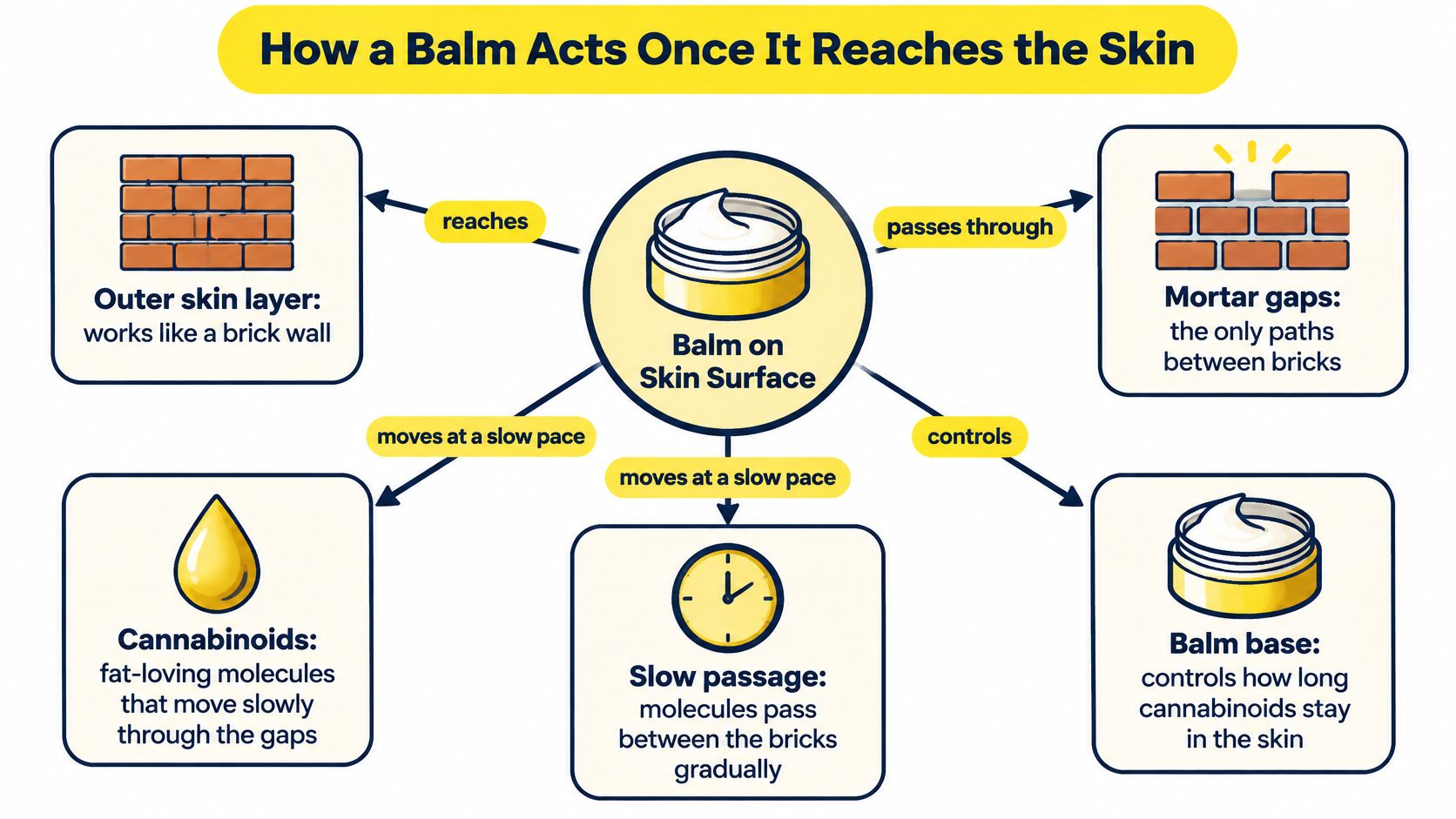
Most of a conventional balm sits on or near the surface while a small fraction moves inward. That's why it's normally used where it's applied, such as on hands, knees, or calves, rather than as a substitute for an edible or inhaled product.
What changes absorption
Delivery isn't fixed by the percentage on the front. In a human pharmacokinetic study published through Springer, participants applied 100 mg CBD plus 100 mg THC to the hand, wrist, and forearm, and both cannabinoids entered systemic circulation. Mean peak concentrations were approximately 576.5 pg/mL for CBD and 346.6 pg/mL for THC, CBD peaked at about 8 hours, and variability between people was very high.
That delayed and inconsistent pattern shows why vehicle composition, skin condition, application area, rubbing time, occlusion, and permeation enhancers matter. Covering skin with plastic or a tight wrap, using a product on broken or inflamed skin, or spreading it over a large area can change exposure.
A conventional non-penetrating balm is intended for localized use. A transdermal product is designed to move an ingredient through the skin, so it needs more conservative dosing expectations.
Consider two practical examples. A thin layer on one sore knee, left uncovered, is a local-use scenario. The same product spread across both legs and sealed under a tight wrap for hours is not the same exposure, even though the jar hasn't changed. Don't judge either case by percentage alone. Check the certificate of analysis, the cannabinoid amount per container, and whether the label states local or transdermal use.
Ingredients and Formulations That Change Results
One solvent example explains why formulation can matter as much as dose. A peer-reviewed safety review in PubMed Central reports that adding 30.8% ethanol increased CBD solubility in human skin from 5.72 to 16.2 micromol/mL, nearly a threefold increase. Cannabinoids are highly lipophilic, poorly water-soluble, and chemically unstable under some conditions, so the surrounding ingredients influence how they partition across the skin barrier.
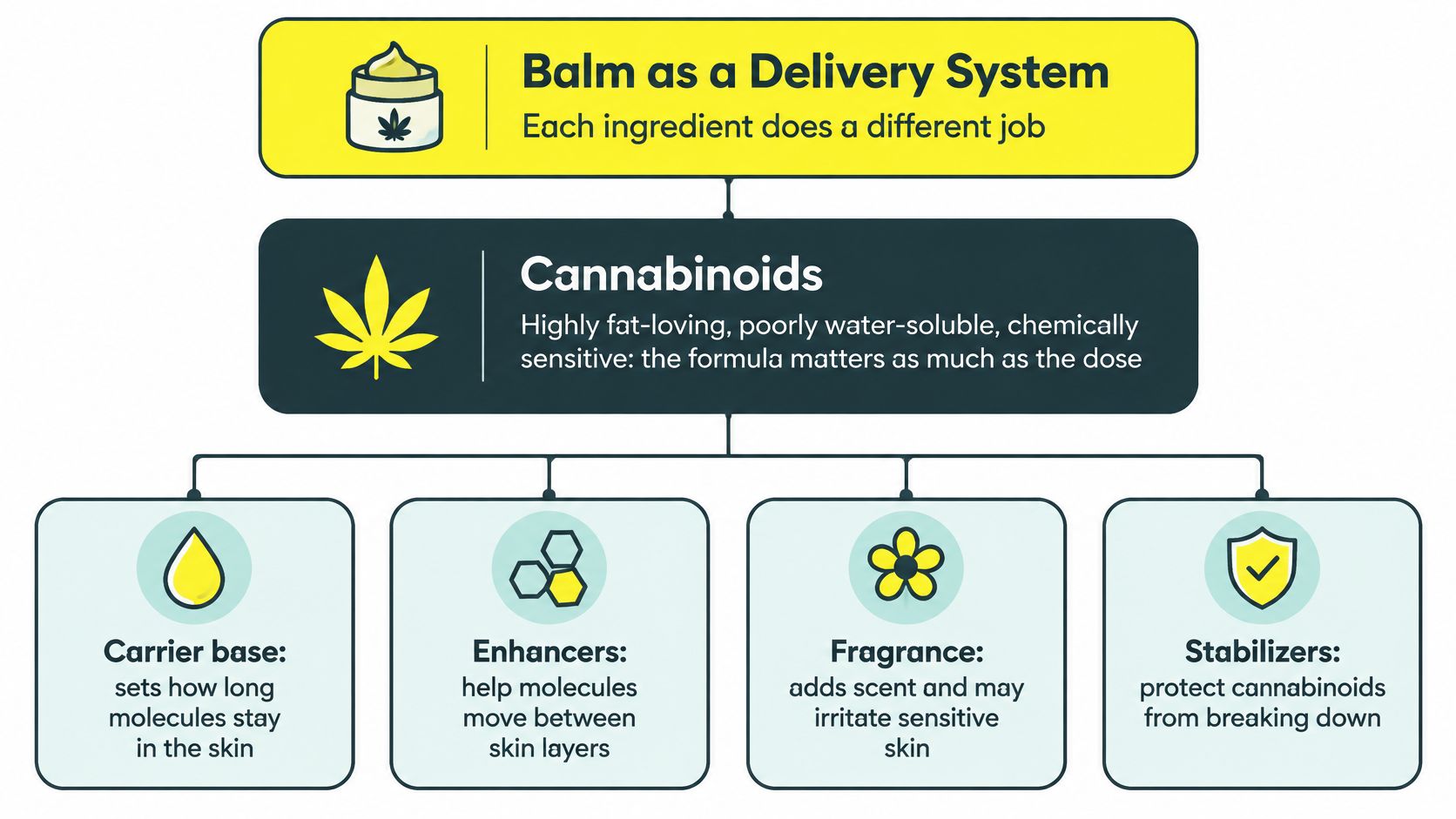
Greater penetration isn't automatically better. Ethanol can dry or irritate skin, and fragrances, essential oils, preservatives, or botanical ingredients can provoke contact dermatitis even when cannabinoids themselves aren't common allergens. In another comparison described in that review, CBD absorption varied substantially across cream, lotion, balm, gel, and patch products, and measurable concentrations generally peaked only after 7 to 10 days of repeated use.
| Ingredient | Role in the balm | Effect on results | What to check |
|---|---|---|---|
| CBD or THC extract | Active cannabinoids | Dose depends on milligrams per container, not the percentage alone | Milligrams listed per container |
| Beeswax or plant wax | Structure and barrier | Holds the balm on one spot and slows drying | Heavy feel on some skin types |
| Shea or cocoa butter | Emollient base | Softens and cushions dry skin | Tree-nut-derived ingredients for allergy-prone buyers |
| Coconut, olive or hemp seed oil | Carrier oil | Dissolves cannabinoids and changes spreadability | Allergy notes and full disclosure |
| Ethanol | Penetration enhancer | Nearly tripled CBD solubility in skin at 30.8% in one study | Can dry or irritate skin |
| Menthol or camphor | Cooling or warming agent | Creates a sensation, not stronger cannabinoid delivery | Irritation on broken or sensitive skin |
| Fragrance or essential oils | Scent | No benefit to cannabinoid delivery; common contact allergens | Fragrance-free or fully disclosed |
| Preservatives | Shelf life and microbial control | Keeps the product stable over time | Known sensitizers if you react |
A simple label comparison
Say two jars both advertise the same CBD percentage. One is a plain wax and oil balm with full excipient disclosure and sealed, stable packaging. The other adds ethanol, menthol, and an unnamed fragrance blend. The second jar may feel stronger because it tingles and smells medicinal, but that sensation proves only that menthol is present. It may also be the one that stings cracked skin.
Read the base and enhancers beside the cannabinoid number. Prefer batch-tested products that state application frequency and skin restrictions. If the label hides ingredients behind vague language, you can't predict how the balm will behave or identify what caused a reaction.
What Research Supports for Pain, Itch and Skin Problems
The broadest picture comes from a 2025 systematic review and meta-analysis of cannabinoid-based topical dermatology research, which pooled 3,359 participants across 11 randomized controlled trials, 3 quasi-experimental studies, and 3 observational studies. It found a statistically significant but modest reduction in pruritus, with a standardized mean difference of -0.29 and a 95% confidence interval from -0.52 to -0.06. It found no statistically significant improvements in skin dryness, erythema, quality of life, atopic-dermatitis disease scores, or transepidermal water loss.
Those interventions weren't all retail balms. They included cannabis-extract ointments, cannabidiol, palmitoylethanolamide-related compounds, alkylamides, and HU-210. That distinction stops a pooled itch result from becoming a promise for every jar on a shelf.
| Condition | Study evidence | Reported result | Limit |
|---|---|---|---|
| Itch (pruritus) | Pooled review: 11 RCTs, 3 quasi-experimental, 3 observational | Standardized mean difference -0.29, modest and significant | Small effect; not a cure |
| Uremic pruritus | 21 patients, 3-week open-label study, twice-daily cream | More than 38% complete relief; 52% significant improvement | Open-label, no placebo, one population |
| Emollient-based itch relief | Study cited in a PubMed Central review | Average 86% reduction in subjective itch | Single study; relies on self-reported scores |
| Hand pain and stiffness from aromatase inhibitors | Randomized pilot, 20 women, two balms, two weeks | Improved hand-function and pain scores in both groups | Small pilot; a signal, not proof |
| Atopic dermatitis (eczema) scores | Same systematic review | No significant improvement | Not supported as an eczema treatment |
| Dryness, redness and water loss | Same systematic review | No significant improvement | Skincare claims not supported by this evidence |
| General muscle soreness or joint pain | No direct trial of general soreness in this review | No established result for everyday soreness | Treat as unproven for everyday aches |
| Inflammation and wound healing | Preclinical and mechanistic reports | Human balm benefit not established | Not established in human balm products |
Reading the itch studies carefully
A review in PubMed Central on topical cannabinoids describes a three-week open-label study of 21 patients with uremic pruritus who applied an endocannabinoid-containing cream twice daily. More than 38% reported complete elimination of itching, while another 52% reported significant improvement. The same review also describes an emollient study reporting an average 86% reduction in subjective itch.
Those are encouraging numbers, but they're tied to specific formulations and patient groups. They don't establish that a commercial THC or CBD balm will produce the same result for general soreness. A reader comparing claims about topical cannabis for arthritis should keep that gap in view.
The Minnesota randomized pilot involving women with aromatase-inhibitor musculoskeletal symptoms is the main human pain-related balm trial in this evidence set. It reported improved hand-function and pain scores, but it was small and short. Treat it as a reason to discuss a trial with a clinician, not as proof for everyday aches.
Bottom line on evidence: Itch and localized discomfort are the best-supported targets. Disease treatment for eczema, arthritis, neuropathy, inflammation, or wounds isn't established by these human balm data.
Three Real Situations and the Balm Each Calls For
Hand stiffness during breast cancer treatment
Say a breast cancer survivor taking an aromatase inhibitor has hand pain and stiffness that make opening jars difficult. A randomized pilot trial summarized by HealthPartners enrolled 20 women with stage 1 to 3 breast cancer and aromatase-inhibitor-associated musculoskeletal syndrome. Participants applied 125 cc of balm to their hands three times daily for two weeks, using either a CBD-predominant balm containing 2,210 mg CBD and 0.3% THC or a THC-predominant balm containing 375 mg THC and 20 mg CBD.
Both groups reported improvements in hand-function scores, pain scores, and treatment-related symptom measures from baseline to week two, and no skin toxicity was reported. That's a useful signal, not a self-treatment plan. She should bring the product idea, ingredient list, and her current medicines to her oncology team. Success would be a specific change she can track, such as easier grip or less morning stiffness over two weeks, not a vague hope that the balm is working.
A sore calf after weekend running
Say a runner finishes a long Saturday run with one tight calf and unbroken skin. A non-penetrating, fragrance-free balm fits that narrow target better than a strongly scented product with penetration enhancers. He can patch test first, then apply a thin layer to the calf two or three times a day and note whether walking downstairs feels easier after a few days.
A practical goal is comfort while the muscle heals, not a cure for an injury. Sharp pain, swelling, bruising, weakness, or pain that keeps worsening needs medical assessment rather than more balm. Someone comparing this approach with topical pain relief products containing lidocaine should compare the active ingredient, warnings, and intended use rather than assuming all rub-on products work alike.
An itchy elbow patch while taking blood thinners
Say an adult has an itchy, dry patch on both elbows and takes a prescribed blood thinner. Itch is a more plausible target than treating the underlying skin condition, so she should look for a balm with a full ingredient list, clear milligrams per container, and no undisclosed fragrance. She should still check with the prescriber or pharmacist before use because topical interaction evidence is limited.
A practical success measure is itch easing within two weeks without new redness, cracking, or spreading rash. If the patch becomes painful, weepy, blistered, or more itchy, the experiment has failed and she should stop. The same jar could suit the runner's intact calf yet be a poor choice for her elbows if it contains a fragrance she reacts to. The person, the skin barrier, and the medicine list change the decision.
Safety Risks and Signs to Stop Using
Skin reactions are the clearest safety concern. A PubMed abstract on cannabinoid topical evidence and dermatology risks notes that published dermatology reviews describe allergic contact dermatitis, urticaria, and rare severe reactions, with greater concern for people who have allergies, compromised skin barriers, or immune problems. The culprit may be a carrier oil, fragrance, preservative, or botanical ingredient rather than CBD or THC itself.
Regulation adds another layer of uncertainty. The FDA page on regulation of cannabis and cannabis-derived products, including CBD states that unapproved CBD products, including cosmetics and products marketed with therapeutic claims, have not been evaluated to determine whether they effectively treat a particular disease, what dosage is appropriate, how they interact with medicines or foods, or whether they create dangerous side effects. The agency also notes that cosmetic products and ingredients usually do not require premarket FDA approval, except for most color additives.
Claims are not approval
A jar labeled "CBD for arthritis" or "CBD for neuropathy" hasn't received FDA approval for that use just because the claim is printed clearly. Don't infer safety from topical application alone. Anyone taking anticoagulants, seizure medicines, or other prescriptions should ask a healthcare professional before starting, and a medication compatibility check is a sensible step when the medicine list is long.
Stop using the balm and wash the area with mild soap and water if you notice:
- New rash: Spreading redness, bumps, or hives where you applied it
- Swelling or blistering: Puffiness, fluid-filled skin, or raw areas
- Worsening symptoms: Itch or burning that intensifies or doesn't fade
- Breathing symptoms: Wheezing, throat tightness, or difficulty breathing, which need emergency care
For example, say hives appear within an hour of first use. Stop, wash the area, photograph the label, note the ingredients and time of application, and contact a clinician. Don't patch test the same product on another area to see whether it happens again.
How to Patch Test and Apply a Balm Safely
A patch test can't guarantee safety, but it can catch an obvious reaction before you cover a larger area. Keep the first use small, boring, and easy to interpret.
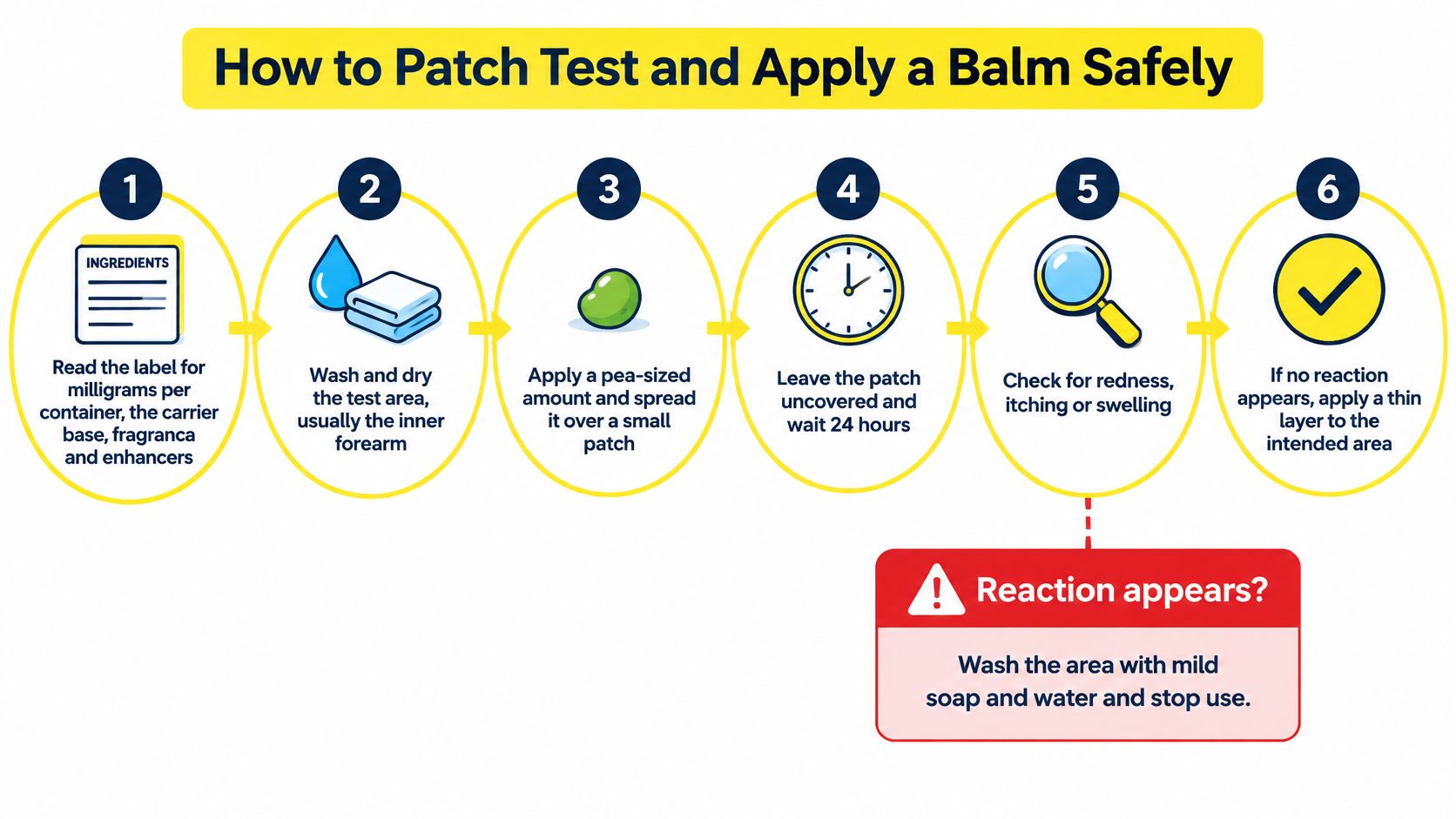
- Read the label first: Check milligrams per container, carrier base, fragrance, enhancers, warnings, and batch information. The common slip is reading only the front percentage and missing an allergen on the back.
- Wash and dry the inner forearm: Clean, dry, intact skin gives a clearer result. Don't test on eczema, a cut, sunburn, or freshly shaved skin.
- Apply a pea-sized amount: Spread it over a small patch and leave it in place for 24 to 48 hours as the product directions allow. A thick layer doesn't make the test more informative.
- Check before wider use: Look for redness, itching, hives, swelling, blistering, or burning. If any appear, wash the area and stop.
- Start thin and local: If there's no reaction, apply a thin layer to one small, intact area two or three times a day. Rub gently until absorbed and don't cover it tightly unless the instructions allow occlusion.
- Avoid high-risk sites: Keep balm away from broken skin, large areas, eyes, mouth, and genital areas. Wash your hands after application unless your hands are the treatment area.
- Keep a simple log: For 7 to 10 days, record where you applied it, how often, symptom scores, and any skin change. Repeated use can produce a delayed picture, so day one isn't the whole answer.
- Stop at the first clear reaction: Don't push through worsening itch or add a second new product to mask it. One change at a time keeps the cause identifiable.
Say you're testing a balm for a sore thumb joint. Use the forearm first, wait, then treat only that thumb for several days. If you apply it to both hands, cover them with gloves overnight, and add a new scented lotion, you won't know which change helped or irritated your skin.
Choose the Right Balm Before You Buy
Buy a balm when the label gives per-container milligrams, a full ingredient list, and recent batch testing, and when the intended use fits one localized target. Skip products that ask you to trust a percentage, a proprietary blend, or a disease claim without evidence you can inspect. Current information on product testing standards helps you know which documents to request.
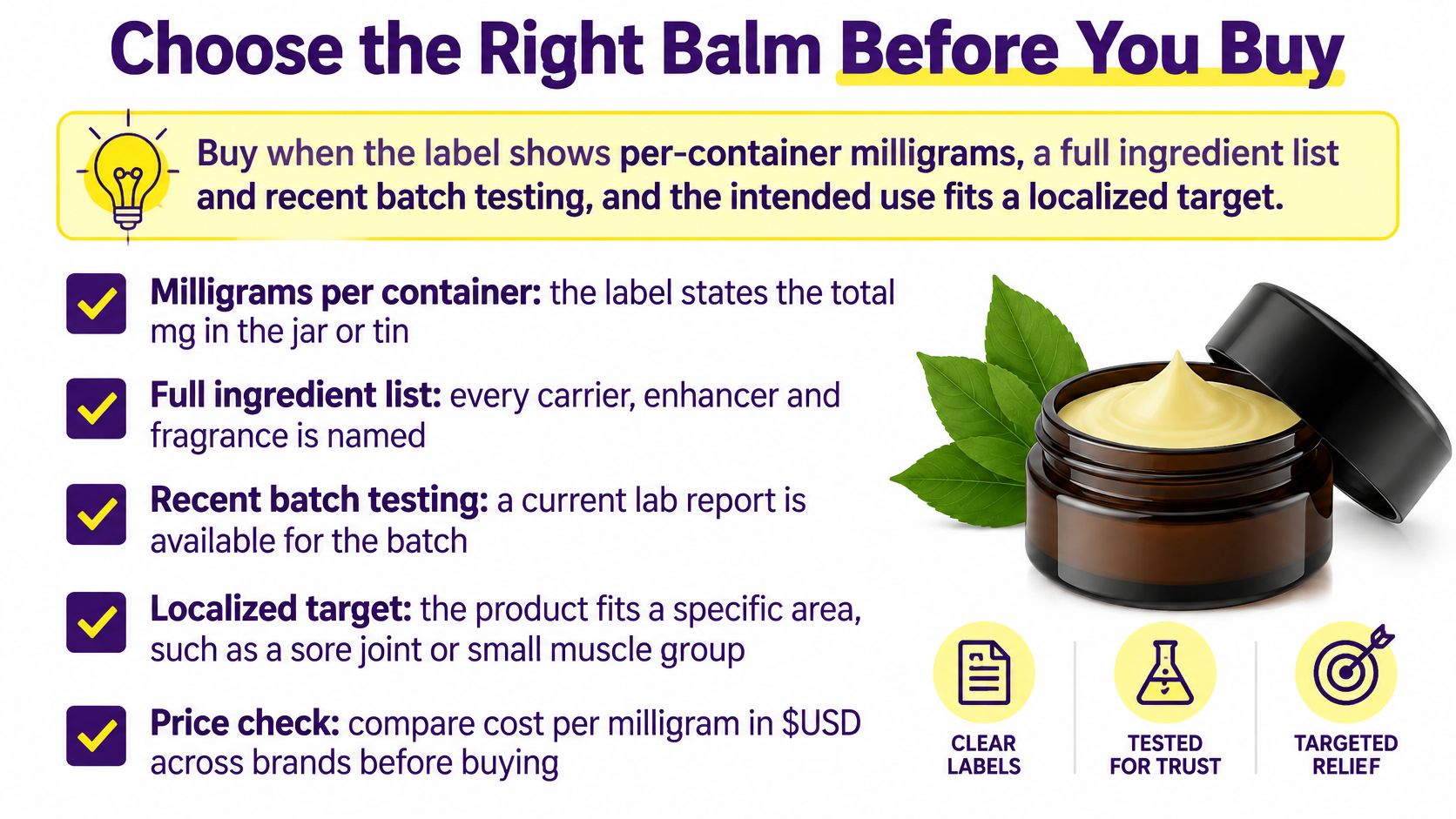
| Criterion | What to look for | Red flag |
|---|---|---|
| Cannabinoid amount | Milligrams per container with serving guidance | Only a percentage listed |
| Lab testing | Current certificate of analysis for potency and contaminants | No batch testing available |
| Ingredient disclosure | Full list, including enhancers and fragrance | 'Proprietary blend' with no detail |
| Intended use | Clear local-use labeling and application instructions | Claims of deep or whole-body effect |
| Fragrance and allergens | Fragrance-free or fully disclosed essential oils | Unlisted scent or allergens |
| Packaging | Sealed, stable container with a clear date | Open tub or no date |
District rules need the same care. The District Code section on medical cannabis possession and dispensing limits states that a qualifying patient or caregiver may possess a maximum of 8 ounces of dried medical cannabis at any moment, and retailers generally may not dispense more than 8 ounces during a 30-day period. A balm is a non-dried product, and the Mayor is responsible for establishing limits on forms other than dried cannabis, so don't assume the dried-cannabis rule alone answers how much balm you may buy or possess. Verify current non-dried product rules, keep purchase records, and use a licensed channel.
At the counter, bring three things: your target area, the label facts you need, and the test result you want to see. Say what the balm is for, and expect a budtender to ask what you're looking for, such as pain relief, help sleeping, or anxiety support, before recommending products. Mr. Nice Guys DC is a registered medical cannabis dispensary and holds its official medical cannabis retailer license, and every product is tested for pesticides, potency, and more. For example, ask, "I need a fragrance-free local balm for one knee. How many milligrams are in the container, and can I see the batch test?" That question filters out most weak options quickly.
Bring your target area, medicine list, and label questions to Mr. Nice Guys DC, where our team can help you compare tested topical options by milligrams per container, ingredients, and intended local or transdermal use. We'll help you choose a cannabis topical balm that fits your skin, your goal, and District rules, without asking you to rely on a headline percentage alone.
Mr Nice Guys DC
At Mr. Nice Guys DC, we’re more than just a cannabis delivery service — we’re passionate advocates for quality, convenience, and community. With years of experience in the cannabis industry, our team is dedicated to educating and empowering customers across Washington, D.C. Whether you're a seasoned user or just starting your cannabis journey, our blog delivers trusted tips, product insights, and the latest updates from the world of weed. Stay informed, stay elevated.
