
Must Be 21 To Enter
By entering this site you are agreeing that you are at least 21 Years of Age or older.
I AM 21 OR OLDERCBD Topical Roll on: How It Works & Where to Buy
.svg)

.png)
A CBD topical roll on is a cannabidiol product delivered through a ball-tip applicator for targeted, skin-level relief rather than whole-body effects. It's built for the kind of ache that keeps showing up in one shoulder, knee, wrist, or neck, where you want direct application instead of a product that works more broadly.
Many reach for a roll-on on a rough morning, after a workout, or when one joint has started acting up again. The appeal is simple, you can put it exactly where you need it, keep your hands cleaner than with a cream, and move on with your day. That focused format is part of why CBD topicals have become such a visible category, with U.S. sales of CBD topicals exceeding $703 million in 2019 and projected to reach $4.5 billion by 2025 in a market overview that also called topicals the second-largest CBD product category after tinctures. The same review found that 80% of topical products contained less than 500 mg of CBD, 77% were priced between $10 and $50, and the average concentration across surveyed products was 9.6 mg/mL. That tells you something important right away, most roll-ons are positioned as practical, lower-dose wellness tools, not high-concentration products meant to act like oral CBD. Market overview of CBD topicals
What Is a CBD Topical Roll On and Why It Matters
A good way to understand a CBD topical roll on is to think about a familiar morning routine. Someone wakes up with a knot in the shoulder that never quite loosens, or with knees that feel stiff until they've moved around for a while. Instead of taking a gummy or rubbing in a big layer of cream, they use a roll-on on the exact spot that feels tight, then get dressed and keep going.

Why the format matters
A roll-on is a topical CBD product delivered through a ball-tip applicator, similar to a deodorant roll-on. That design matters because it keeps the product aimed at one small area instead of spreading it across a broad surface. For people who want targeted comfort, that precision is the whole point.
The market reflects that use case. CBD topicals were already a major category in the U.S. market, and the same 2019 overview projected strong growth through 2025. It also showed that most topical products were sold at approachable price points, which fits how many shoppers use them, as a daily or as-needed wellness product rather than a luxury cannabinoid treatment. Market overview of CBD topicals
Practical rule: If you want one spot treated, a roll-on makes sense. If you want full-body support, this format probably isn't the right starting point.
For readers comparing topical formats, it helps to think of a roll-on as the product you grab for a shoulder, elbow, ankle, or knee that needs attention now. For broader topical education, see this CBD salve guide.
How CBD Roll-Ons Work Differently from Other Topicals
Roll-ons work differently because they're built for localized delivery. The rollerball puts the formula directly onto a small patch of skin, which means the user can concentrate the product where the discomfort lives instead of covering a larger area by hand.
What usually goes into the formula
Many roll-ons pair CBD with ingredients that help with spreadability or sensation. Common examples include MCT oil, alcohol, glycerin, menthol, camphor, and peppermint or eucalyptus oils. Those ingredients can change how the product feels on the skin, especially when the goal is a cooling sensation or quick, easy application. A product label in DailyMed shows a topical roll-on with 4 g menthol per 100 mL and cannabidiol listed among the inactive ingredients, which is a good reminder that the immediate sensation may come more from the cooling base than from CBD alone. DailyMed topical roll-on label
That sensory design is why roll-ons are usually presented with convenience language, not oral-style dosing language. They're meant to be applied to one area, reapplied when needed, and used in a way that feels simple enough to fit into a workday, a gym bag, or a travel kit.
How they differ from other topical types
Creams and lotions spread more broadly. Balms tend to sit heavier on the skin. Transdermal products aim for a different outcome entirely, since they're built to move ingredients deeper through the skin barrier and, in some cases, into the bloodstream. Roll-ons sit in the spot-treatment category. They're about precision, not systemic delivery.
Roll-ons are for the place you can point to with one finger. That's the cleanest way to think about them.
If you want a broader topical format comparison, this CBD topical cream overview is a useful companion read.
What the Evidence Says About CBD Roll-On Benefits
The evidence around topical CBD is promising in some settings and mixed in others, so the honest answer is more useful than the marketing answer. Some studies point toward localized comfort, while others fail to show a clear advantage over placebo. That split matters because it keeps expectations grounded.
What looks encouraging
A 6-week study in 20 volunteers found that 70% completed treatment and 30% reported only minor adverse effects, while all participants showed significant improvement in pain and quality-of-life measures over time. That doesn't prove every roll-on works the same way, but it does show that topical use can be tolerated and may be meaningful for some users. Clinical evidence on topical CBD
Peer-reviewed skin research also describes topical cannabidiol as having anti-inflammatory, anti-itching, analgesic, wound-healing, and anti-proliferative effects on skin. Another review reports topical cannabinoid actions such as local analgesic, antipruritic, anti-inflammatory, cicatrizing, and antibacterial effects in skin-focused use. Those findings line up with the way many people use roll-ons for localized comfort on skin-level issues rather than deep, whole-body pain. NIH review on cannabidiol and skin and review on skin cannabinoids
What keeps the claims in check
The clearest counterpoint is a randomized controlled trial of a 1,000 mg topical CBD ointment for delayed-onset muscle soreness. It found no statistically significant differences versus placebo at 24, 48, and 72 hours, including no meaningful change in upper-arm circumference, inflammation, strength, or soreness, with p values of 0.58 and 0.96 for key comparisons. The study concluded the product didn't confirm anti-inflammatory or analgesic claims. Clinical evidence on topical CBD
The practical takeaway is straightforward. A roll-on makes the most sense for localized, skin-level discomfort, like a muscle knot, a tender joint area, or irritated skin. Claims about deep pain, migraines, or systemic relief need a lot more skepticism than most product pages admit. For a pain-focused perspective, this cannabis pain relief guide gives helpful context.
CBD Roll-Ons Compared to Creams, Gels, and Transdermals
People often lump all topicals together, but they don't behave the same way in daily use. A roll-on is a precision product. A cream is a coverage product. A gel sits somewhere in between, and a transdermal patch is trying to do a different job entirely.
| Format | Delivery Method | Best For | Coverage Area | Absorption Type |
|---|---|---|---|---|
| CBD roll-on | Ball-tip applicator | One joint, one muscle knot, one exact spot | Small, targeted area | Localized topical application |
| CBD cream | Applied by hand | Broader areas like both knees or the lower back | Wider surface | Localized topical application |
| CBD gel | Spread or massaged on | Users who want a lighter feel over a broader area | Medium to wide | Localized topical application |
| Transdermal patch | Adhesive patch | People seeking a different delivery goal | Small but sustained site | Intended for deeper skin transport |
How to choose by discomfort pattern
If the pain sits in one place, roll-ons make the most sense. If you've got both knees barking at once, or your lower back feels generally stiff, a cream or gel may be easier to spread across the area. If your goal is systemic delivery, a transdermal product belongs in a different conversation altogether.
That distinction matters because many buyers judge a product by how strong it feels the first minute after application. A cooling roll-on can feel faster than a neutral cream, but that sensation doesn't automatically mean deeper relief. It usually means the formula was designed to be noticed right away.
What to ask yourself before buying
- Where is the discomfort? One spot points toward a roll-on, broader coverage points toward a cream or gel.
- Do you want sensory feedback? Cooling ingredients can make a product feel more active on contact.
- Do you need simplicity? A roll-on is easier to apply without using your hands.
- Are you looking for local or systemic support? That answer changes the format you should choose.
For a topical product example in the same family, see this CBD topical cream resource. The main point is to match the format to the discomfort, not the other way around.
What to Look for in a CBD Roll-On Formula
The CBD milligram number on the front of the bottle is only one part of the story. A better formula may use a lower CBD count but a smarter ingredient profile, especially if the user cares about comfort, skin feel, or sensitivity.
Read the full ingredient list
Many roll-ons are built around full-spectrum or broad-spectrum hemp extracts. In practical terms, that means the formula can include CBD plus minor cannabinoids while staying under the legal THC threshold when sold as hemp-derived products. If you're sensitive to THC or worried about testing concerns, that spectrum choice matters as much as the CBD count.
The cooling experience can also come from the supporting ingredients rather than CBD itself. DailyMed-style topical labeling shows how dominant menthol can be in a roll-on formula, and that's important because menthol, camphor, and methyl salicylate often shape the first impression on the skin. A roll-on with a strong menthol base can feel more dramatic at first application than a product with more CBD but little sensory support. Topical roll-on ingredient example
Compare formula type, not just potency
A bottle with 500 mg of CBD and a strong cooling base may suit a person who wants immediate sensation. A higher-dose product with a gentler base may suit someone who dislikes intense menthol. Product strengths in the market span from about 100 mg to 4,000 mg CBD per container, with common mid-range benchmarks around 500 mg to 1,800 mg. That spread shows how wide the category is, and why one person's “strong enough” product can feel underwhelming to someone else. CBD topical product strength range
Practical rule: Choose the formula you're likely to use consistently, not the one with the biggest number on the label.
If you're comparing extraction and formula styles in more detail, this CO2-extracted CBD oil guide can help you think about quality, not just marketing language.
How to Apply and Use a CBD Roll-On Safely
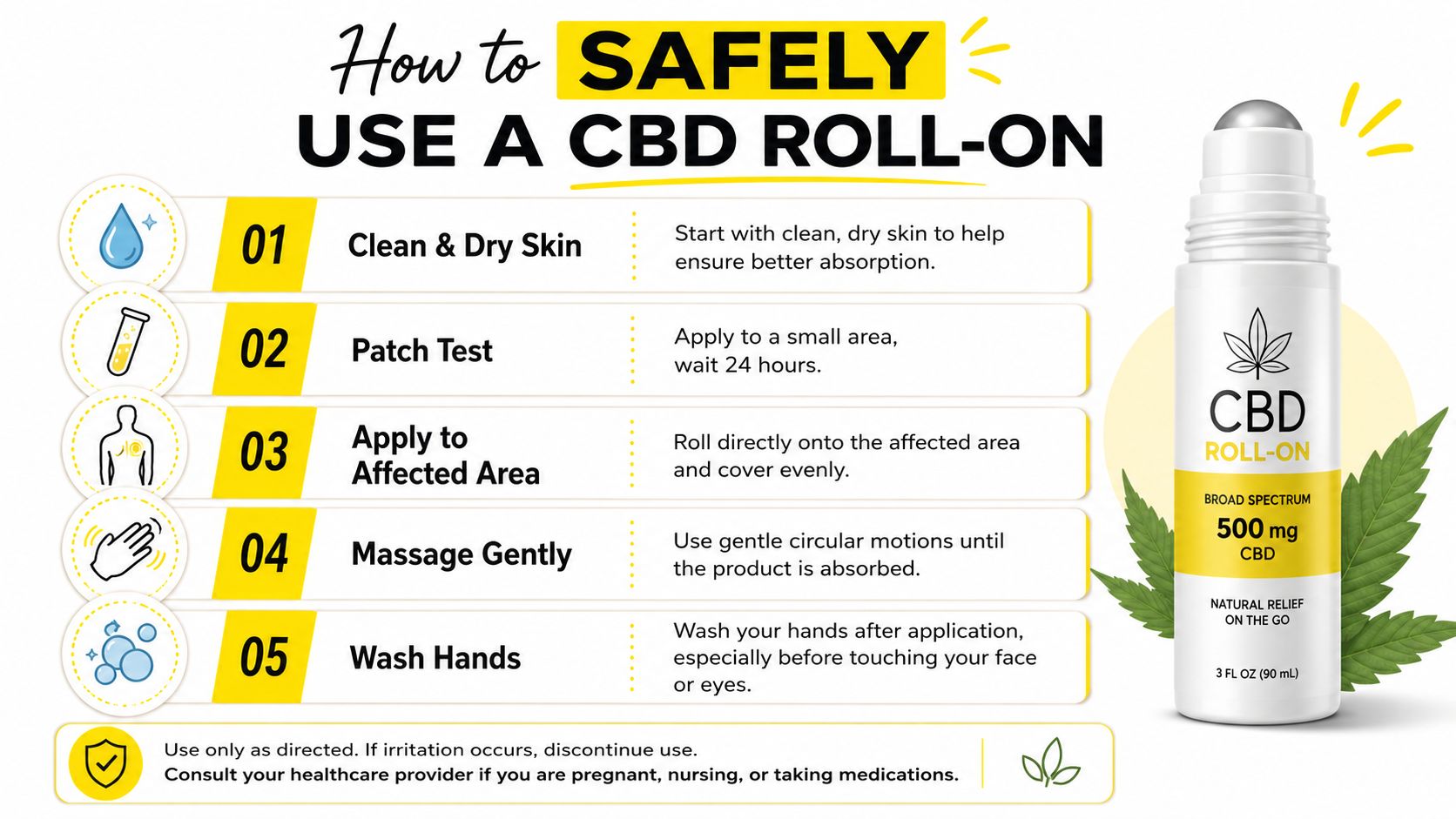
Safe use starts before the first swipe. Clean, dry skin gives you a more predictable application, and a patch test helps you find out whether the formula is comfortable on your skin before you use it more broadly. That step matters especially if the roll-on contains menthol or other cooling ingredients that can sting on sensitive areas.
A simple routine that makes sense
- Clean and dry the skin. Sweat, lotion, and residue can change how the formula feels.
- Patch test first. Apply a small amount to one area and wait 24 hours before broader use.
- Roll directly onto the target spot. Use light, even pressure, enough to coat the area without pressing hard.
- Let it sit. Don't rush to scrub or over-rub it in.
- Wash your hands if needed. That matters if you touched the formula or plan to rub your eyes later.
What people often get wrong
Overapplying doesn't make the product work faster. It usually just makes the skin feel more coated or more irritated. The same goes for using a roll-on on broken skin, on the face, or right where the formula can drift toward the eyes.
The market's average CBD concentration of 9.6 mg/mL helps explain why reapplication habits vary so much from brand to brand. A lighter formula may need more frequent use than a stronger one, while a high-strength product may be easier to overdo if you're chasing a stronger sensation. Market overview of CBD topicals
Real-World Use Cases for CBD Roll-Ons
A roll-on makes the most sense when the discomfort is easy to point to. That's why people tend to reach for it in specific, repeatable situations rather than as a broad wellness catch-all.
Three situations where the format fits well
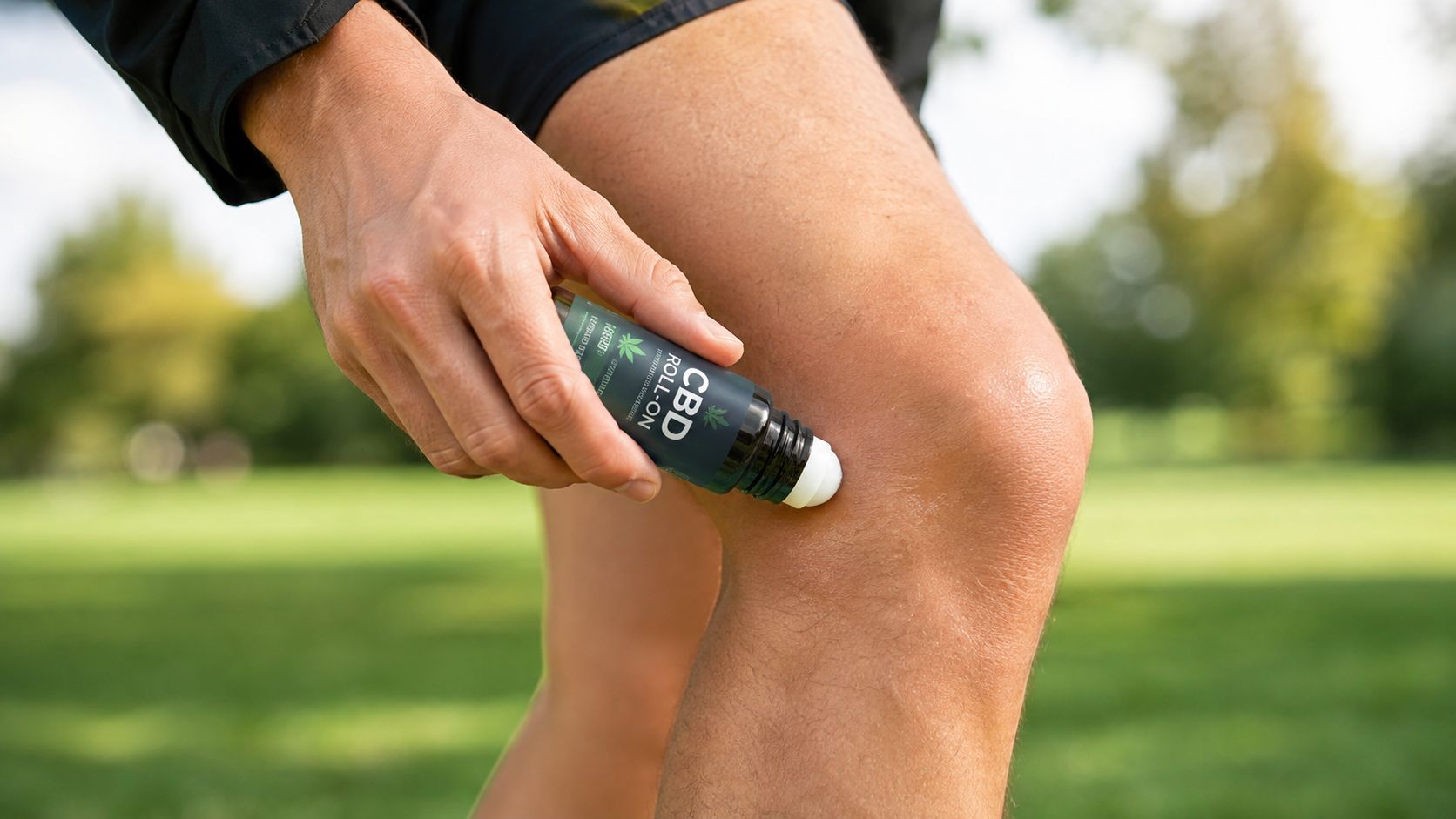
A person with an occasional knee flare-up might roll the product directly onto the joint before going for a walk or heading to work. The point isn't to treat the whole body, it's to give one specific area a bit of attention before the day puts more load on it.
A post-workout user often wants the same thing. If the shoulders, calves, or forearms feel more worked than the rest of the body, a roll-on lets them target only the sore muscle group instead of rubbing product across skin that doesn't need it.
Someone dealing with mild surface-level irritation may also find the format useful. Peer-reviewed skin research describes topical CBD as having anti-inflammatory and anti-itching properties, along with other skin-focused actions, which makes the roll-on logic fit a small irritated patch better than a general-body product. NIH review on cannabidiol and skin and review on skin cannabinoids
A roll-on is most believable when the problem is small, local, and repetitive.
That's the cleanest way to think about it. If the discomfort is diffuse, deep, or hard to locate, the format gets less convincing fast.
Where to Buy CBD Roll-Ons in DC and What to Know
In Washington, DC, the safest move is to buy from a licensed dispensary that can explain what's in the product and how it's meant to be used. That matters because CBD topical legality and availability can vary by jurisdiction, and product quality is far easier to judge when the seller is transparent about ingredients and formulation.
What to ask before you buy
Ask whether the roll-on is full-spectrum, broad-spectrum, or THC-free. Ask how strong the CBD content is, whether menthol or other cooling agents are included, and whether the formula is meant for sensitive skin or stronger sensory feedback. Those questions matter more than a shiny front label.
If you want a local option with topical products in the mix, Mr. Nice Guys DC carries curated wellness items, including topicals, and its staff can help customers compare format, strength, and ingredient style in a compliant setting. For online ordering logistics, this DC ordering guide is a useful reference.
Quick answers people usually want
How fast does a roll-on start to feel effective? The feeling is usually tied to the cooling or warming ingredients first, while CBD itself is positioned more as a supportive topical ingredient.
Can it make you feel high? A topical roll-on is designed for localized skin use, not intoxication.
Can I use it with other CBD products? Many people do, but it makes sense to think about the whole routine, especially if you're already using oral CBD or another topical.
What if my skin reacts? Stop using it, wash the area gently, and avoid reapplying until you know what triggered the irritation.
If you're in DC and want a real conversation about which topical format fits your situation, visit Mr. Nice Guys DC. Their team can walk you through topical options, help you compare ingredients, and point you toward a roll-on that matches your comfort goals without overselling what it can do.
Mr Nice Guys DC
At Mr. Nice Guys DC, we’re more than just a cannabis delivery service — we’re passionate advocates for quality, convenience, and community. With years of experience in the cannabis industry, our team is dedicated to educating and empowering customers across Washington, D.C. Whether you're a seasoned user or just starting your cannabis journey, our blog delivers trusted tips, product insights, and the latest updates from the world of weed. Stay informed, stay elevated.
