
Must Be 21 To Enter
By entering this site you are agreeing that you are at least 21 Years of Age or older.
I AM 21 OR OLDERCannabis Oil in Syringe: A Practical Patient Guide
.svg)

.png)
You're at a DC dispensary counter, holding a small syringe filled with thick amber oil. The budtender says it's for oral use, but the package doesn't look like any cannabis product you've used before. You may be wondering whether it's a vape, how much oil to squeeze out, or why the syringe is marked with such tiny lines.
Cannabis oil in a syringe is easier to understand once you stop viewing it as a simple container. It's a precision dosing tool for a concentrated extract. The syringe can help you measure repeatable amounts, but only if you verify the product's cannabinoid content, formulation, and intended route of administration first.
What Cannabis Oil in a Syringe Is
A first-time patient may receive a small syringe of cannabis oil at a DC dispensary and mistake it for injection equipment. The product is a measured cannabis extract in a needleless applicator, intended for oral or sublingual use, or for mixing into food when the label permits that use.
The package generally includes a capped oral tip, clear barrel, plunger, and printed graduations. The syringe is placed inside a child-resistant outer container, which also carries the product information. Some oils use CO2 extraction and may be refined into an oral solution or syringe format, as described in this guide to CO2 cannabis oil.
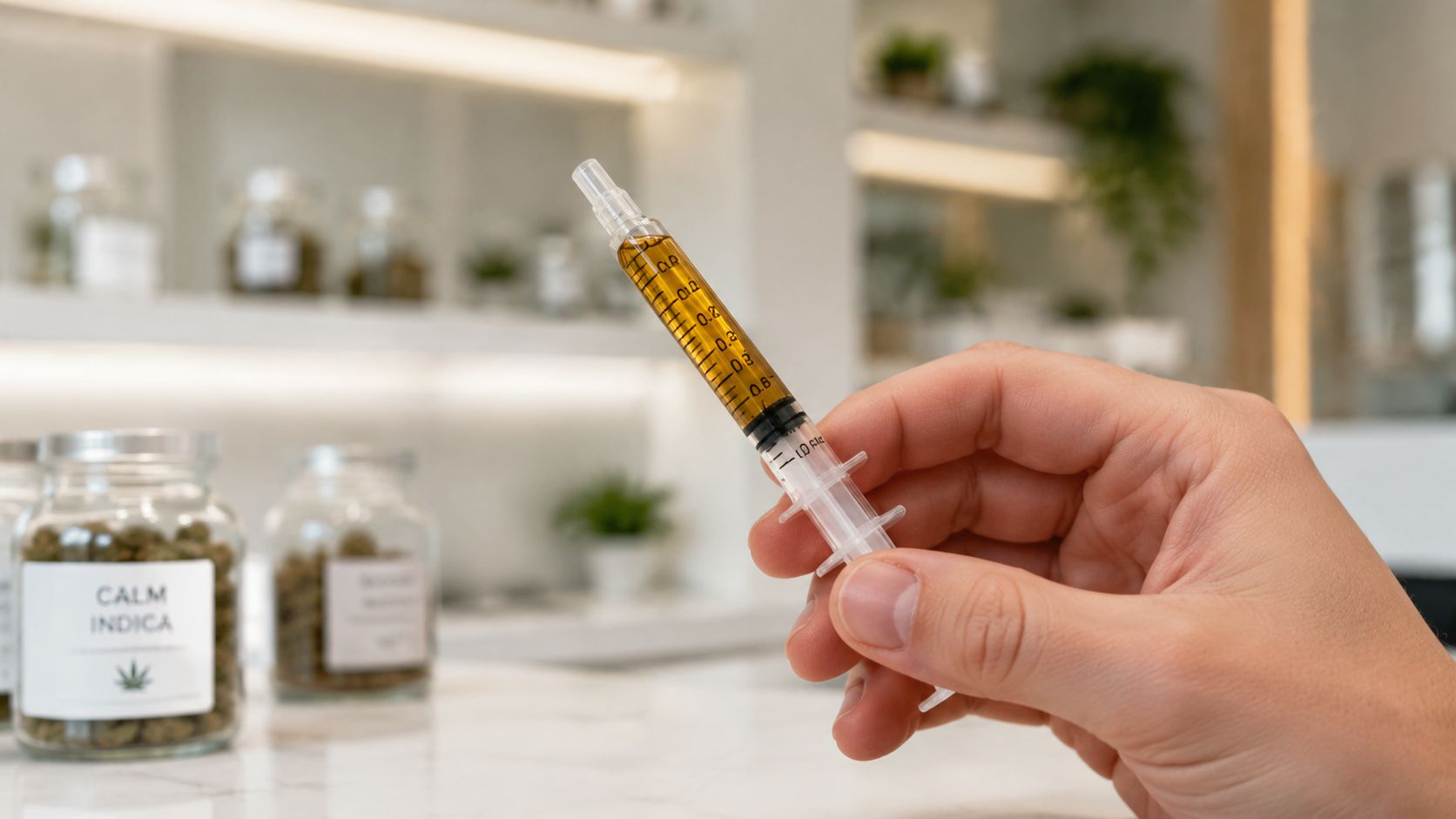
What you'll see in the package
The physical format has four main parts:
- A capped tip: It covers the opening and helps limit leaks.
- A graduated barrel: Its lines indicate volume, often in small increments.
- A plunger: You press it slowly to dispense the oil.
- A sealed outer package: It supports child-resistant storage and displays the label.
Those markings measure volume, not potency. Two syringes with the same barrel size can contain different amounts of THC, CBD, or other cannabinoids. One product reference lists about 600 to 800 mg of THC in a 1 mL syringe, while another lists about 7,500 mg of THC in a 10 mL syringe. This product concentration reference shows why barrel size alone cannot guide dosing.
Ask the dispensary to confirm the batch label, total cannabinoid content, formulation, and intended route before buying. A syringe is like a measuring tool for a concentrated ingredient. Its value comes from controlled portioning plus verified batch information, not from the tube itself.
Important distinction: An oral syringe is not an injection device. Don't inject cannabis oil into a vein, muscle, or anywhere else in the body.
How the Syringe Format Works as a Dosing Tool
A patient may buy a syringe expecting easy control, then discover that a thick oil barely moves or that a tiny line represents a strong dose. The syringe works best as a precision dosing tool, provided you read the batch information before relying on its markings.
The barrel holds the oil and shows volume lines. The plunger controls the amount dispensed. The oral tip places oil under the tongue or onto food, while the graduations make the amount repeatable. Those marks measure volume, not potency. The same volume can contain different cannabinoid amounts, so confirm the batch label, total cannabinoid content, formulation, and intended route with the dispensary.
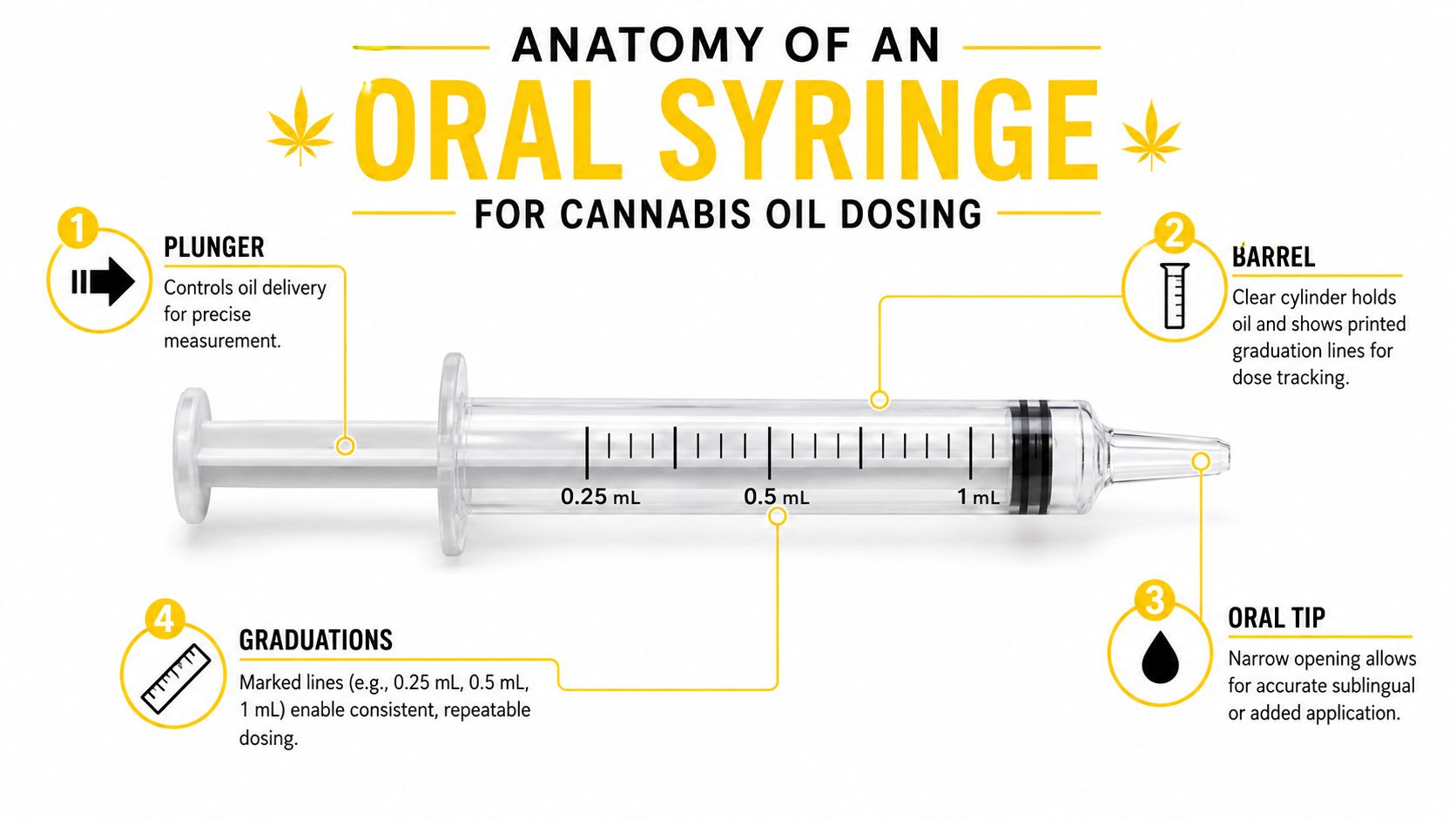
The syringe functions like a laboratory pipette: small, repeatable, and designed to move a measured amount. Its value comes from controlled portioning paired with verified batch data, not from the tube alone. For a DC patient comparing products, ask whether the label identifies the concentration for that specific batch.
Handling a thick oil
Viscosity changes the dispensing experience. A runny distillate may move with light pressure, while full-spectrum RSO can be dark and tar-like. Gentle warming in your hand or in warm water may improve flow, according to this RSO syringe handling guidance. Keep the cap on during warming and avoid overheating the oil.
Use a steady routine:
- Warm the capped barrel gently in your hand.
- Remove the cap slowly, keeping the tip pointed away from your face.
- Press the plunger at a controlled pace while watching the graduation line.
- Wipe the outside of the tip if needed, without contaminating it.
- Replace the cap and return the syringe to its packaging.
Some products use 0.01 mL graduation marks. One source reports that each increment may contain roughly 7 to 9 mg of THC, depending on the product, so a small volume change can meaningfully change exposure. Check the line at eye level rather than judging the drop by sight.
The syringe is for oral use, not injection. Do not place cannabis oil into a vein, muscle, or elsewhere in the body.
For a comparison of measured cannabis liquids, see CBD tincture versus oil.
Common Formulations and How They Differ
A syringe can hold very different kinds of cannabis oil. RSO, distillate, and full-spectrum blends may share the same package format while differing in color, texture, flavor, cannabinoid content, and how easily a patient can measure a consistent amount.
RSO, or Rick Simpson Oil, is associated with a whole-plant extract and often has a dark appearance with a strong, earthy flavor. Its dense, tar-like texture can make the product feel less forgiving during dispensing. RSO is not defined by the syringe itself. The label and batch documentation still determine its cannabinoid strength.
Distillate is more refined and commonly appears clear to pale gold. It usually flows more readily and has a more neutral flavor than a plant-rich extract. Full-spectrum blends preserve a wider mix of cannabinoids and terpenes, although their color, thickness, and effects can vary by batch.
| Formulation | Typical THC Range | Appearance | Viscosity | Best-Fit Use |
|---|---|---|---|---|
| RSO | 60% to 80% THC (RSO dosage reference) | Dark amber to nearly black | Very thick and tar-like | Patients seeking a concentrated, whole-plant-style oral product |
| High-potency distillate | 85% to 95% THC | Clear to pale gold | More fluid | Patients who want a refined, high-potency oil and can verify the dose carefully |
| Full-spectrum blend | Varies by batch and formulation | Amber, brown, or golden | Medium to thick | Patients who prefer a broader terpene and minor-cannabinoid profile |
The strongest label is not automatically the best fit. A patient who values a concentrated, earthy product may prefer RSO. Someone who wants easier flow and a more neutral taste may find distillate simpler to handle. Full-spectrum oil may suit a patient looking for a broader terpene and minor-cannabinoid profile.
Shopping in a DC dispensary should therefore focus on verification, not appearance alone. Ask for the batch's total THC and CBD content, check whether a certificate of analysis is available, and compare the formulation with your tolerance and intended use. The syringe works like a measuring tool, but its accuracy depends on knowing what is inside it.
For a closer comparison of terpene preservation and refinement, see live resin versus distillate.
Safe Dosing and Titration for New Patients
A syringe can look precise while still hiding a major dosing difference. Start with the batch label and certificate of analysis, or COA. Confirm the total THC and CBD milligrams, then calculate how much cannabinoid corresponds to each volume marking. The syringe size alone cannot answer that question. Products with the same capacity may contain very different amounts of cannabinoid, so rely on batch-specific information (batch-level potency guidance).
Here is a practical calculation. Suppose a 1 g syringe contains 70% THC. That equals 700 mg of total THC. If the oil occupies 1 mL, 0.1 mL represents 70 mg of THC. The volume may look small, but the cannabinoid amount can still be substantial for someone without an established tolerance.
A cautious first-use workflow
- Verify the product. Match the syringe label with the COA, including total THC, CBD, batch number, and formulation.
- Calculate the volume. Divide the total cannabinoid amount by the total oil volume to estimate the amount per mL.
- Choose a very small starting amount. A rice-grain-sized portion is a practical starting example, but its appearance changes with viscosity. Do not treat the visual size as a precise measurement.
- Use the labeled route. Place the oil under the tongue only when the product supports sublingual use. Otherwise, swallow it with food according to the label or professional guidance.
- Wait before adding more. Oral cannabis may take time to develop. For an under-the-tongue dose, hold it for 30 to 90 seconds before swallowing, following the product guidance (RSO administration guidance).
- Record the response. Note the volume, time, route, effects, and unwanted effects in a phone note.
Consistency makes the result easier to interpret. Keep the route, approximate timing, food, and volume similar while learning how the product affects you.
Patient rule: Do not increase the amount simply because you feel nothing immediately. Give an oral dose time to develop, and ask your clinician or dispensary pharmacist before changing the plan.
Some oral syringes support titration in 0.1 mL increments, while others show finer 0.01 mL markings (oral syringe titration guidance). Use the smallest clearly marked increment available. If your intended dose falls between markings, ask a qualified professional rather than guessing.
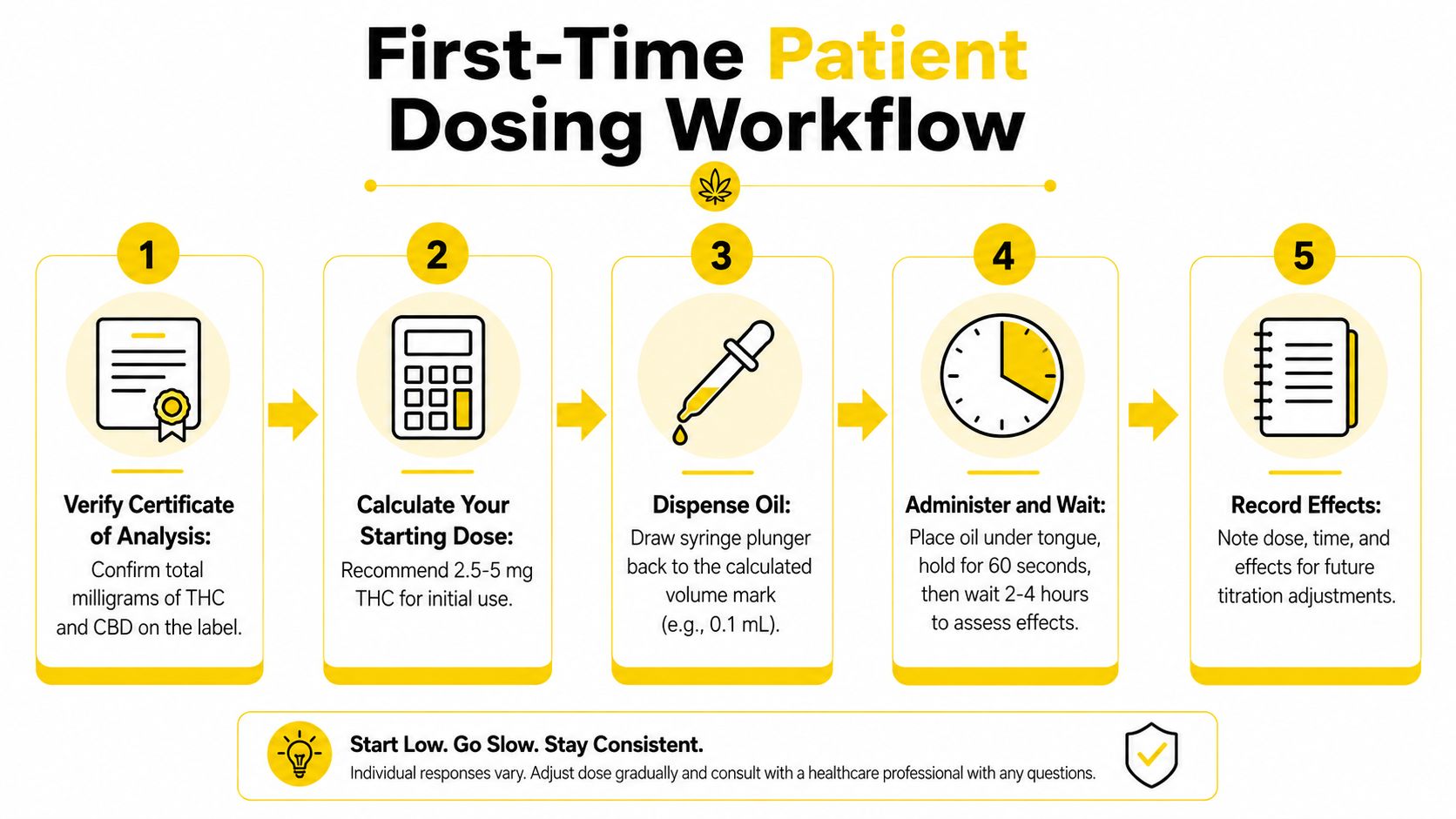
For comparable liquid-dose calculations and administration context, review this guide to cannabis tincture dosing.
Storage, Handling, and Reading the Label
Treat the label, syringe, and storage location as one safety routine. Before using the product, identify the batch or lot number, package information, total cannabinoid content, warning statement, and universal THC symbol. The batch identifier is especially important because it connects the package to the product's COA.
A regulated cannabis oil label should tell you what you're buying, how much cannabinoid it contains, and which batch it came from. Use the following fields as a quick review rather than relying on the syringe volume alone.
| Label Field | What It Tells You |
|---|---|
| Batch or lot number | Which production batch the COA applies to |
| Total THC and CBD | The cannabinoid amount in the package |
| Cannabinoids per volume | How to translate a syringe marking into a dose |
| Ingredients | What else is present in the formulation |
| Allergen information | Whether relevant allergens are disclosed |
| Harvest and package dates | Product timing and packaging history |
| Warning statement | Required safety information |
| Universal THC symbol | A clear indication that the package contains THC cannabis |
If the oil feels too thick, warm the capped syringe gently between your palms. Don't use direct high heat, and don't remove the cap while warming it. Once the oil flows, dispense onto a clean surface when measuring a very small amount, rather than touching the tip directly to your mouth.
Build a storage habit
Keep the syringe upright in its original child-resistant packaging, in a cool, dark location away from direct sunlight and humidity. Separate it clearly from food and beverages, especially if other people in the home could mistake the oil for an ordinary edible ingredient.
Reseal the applicator promptly after each use. If the cap, label, or package becomes damaged, stop and ask the dispensary how to handle it instead of trying to transfer the oil into an unmarked container.
Legal and Labeling Rules Patients Should Know
The syringe format sits inside a regulated cannabis system, so packaging details have a practical purpose. Canadian regulations, for example, require cannabis oil labels to specify THC concentration in mg/mL, and some medical programs require syringe products to use child-resistant secondary packaging with warnings (Canadian cannabis packaging regulation).
For a DC purchase, use a licensed dispensary and confirm that you meet the applicable purchase requirements. Adult-use and qualifying medical patients 21 and older may purchase through permitted channels, but possession and purchase limits still apply. Product packaging should make the source, contents, and warnings clear.
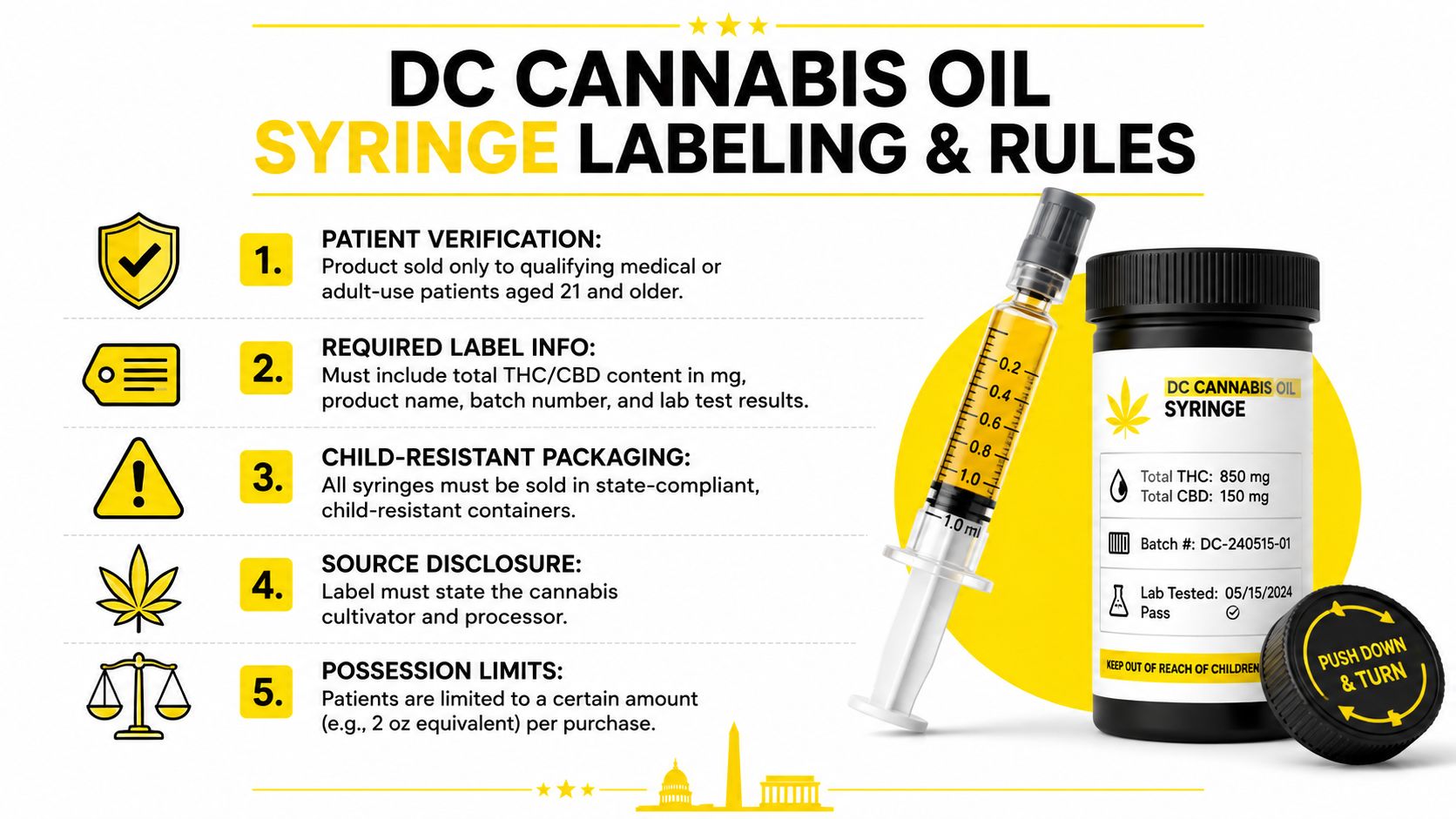
What to confirm at the counter
Ask the staff member to show you where the key information appears:
- Product identity: Confirm whether it's RSO, distillate, full-spectrum oil, or another formulation.
- Cannabinoid content: Check total THC and CBD in milligrams, plus any per-volume information.
- Batch details: Match the lot number to the available COA.
- Packaging condition: Make sure the tamper-evident seal is intact and the container is child-resistant.
- Ingredients and warnings: Review the ingredient list, allergen disclosures where relevant, and required warning statement.
- Receipt accuracy: Confirm the product name and quantity match what you received.
The batch number isn't decorative. It gives the dispensary a way to locate the specific laboratory record for that package. That record helps you evaluate potency and may provide information about testing for contaminants such as residual solvents and pesticides.
A compliant package also helps prevent accidental exposure. The syringe's appearance can resemble a medical dispenser, but the child-resistant outer container and THC warning communicate that it contains a concentrated cannabis product. Store it accordingly, and never remove the label from the original package.
Buying Cannabis Oil in a Syringe at Mr. Nice Guys DC
Start online by searching the dispensary menu for oil syringes, oral syringes, RSO, distillate, or concentrates. Product categories can change, so read the individual listing rather than assuming every syringe is intended for the same use. A broader overview of cannabis products available at Mr. Nice Guys DC can help you compare syringes with tinctures, cartridges, pens, edibles, and other formats.
Before adding a product to your cart, inspect the listing for:
- Strain or product name: This may help identify the formulation and terpene profile.
- Total milligrams: Look for total THC and CBD, not only the syringe volume.
- Total milliliters: Use this to calculate approximate cannabinoid content per measured increment.
- Batch or test information: Ask staff for the relevant COA if it isn't displayed online.
- Intended use: Confirm whether the syringe is decarboxylated and prepared for oral use, or intended for another compatible format.
At the counter, a simple script can keep the conversation focused:
“What are the total THC and CBD milligrams per syringe, and what does that equal per 0.1 mL? Is this oil decarboxylated for oral use? What terpenes are listed, and what starting volume would you recommend for someone new to this potency?”
Medical and adult-use status can affect what you're eligible to purchase and which products are available to you. Bring valid government identification, follow the dispensary's purchase process, and keep cannabis sealed and stored appropriately after leaving. Don't consume cannabis in public.
For pickup, check the label and seal before you leave, and make sure the product is placed in the required child-resistant exit packaging. For delivery, expect an identification check at the door and follow any signature requirements attached to the order. If the package arrives damaged, don't use the syringe until the dispensary confirms what to do.
Pause the purchase if:
- No COA is available: You can't verify the batch-level potency.
- The syringe is unlabeled: You don't know the contents or intended route.
- The seal is damaged: The product's handling history is unclear.
- Staff can't answer potency questions: You can't calculate a responsible starting volume.
Cannabis oil in a syringe can make precise dosing easier, but the syringe can't compensate for missing information. Choose a clearly labeled product, verify the batch details, and ask for help before you dispense.
Mr. Nice Guys DC offers cannabis oil and other regulated cannabis formats through its DC dispensary services, with options for in-store pickup and delivery. Visit Mr. Nice Guys DC to review current products and ask the team about syringe potency, oral use, and batch-level documentation before you buy.
Mr Nice Guys DC
At Mr. Nice Guys DC, we’re more than just a cannabis delivery service — we’re passionate advocates for quality, convenience, and community. With years of experience in the cannabis industry, our team is dedicated to educating and empowering customers across Washington, D.C. Whether you're a seasoned user or just starting your cannabis journey, our blog delivers trusted tips, product insights, and the latest updates from the world of weed. Stay informed, stay elevated.
