
Must Be 21 To Enter
By entering this site you are agreeing that you are at least 21 Years of Age or older.
I AM 21 OR OLDERCannabis Tincture Dosing: Your Guide to Safe Usage in 2026
.svg)

.png)
You get home from the dispensary with a new tincture bottle, a dropper, and one big question: how much should you take?
That moment is common. Tinctures feel more precise than smoking or guessing your way through an edible, but the label can still look intimidating if you haven't translated total milligrams into a real first dose. Most patients aren't worried about whether tinctures work. They're worried about taking too much, too fast, and turning a helpful product into a rough evening.
Cannabis tincture dosing works best when you treat it like a simple measurement problem, not a vibe. Read the bottle. Do the math. Start low. Wait long enough. Adjust slowly. That's how patients get predictable results instead of chasing effects and overshooting them.
A tincture can be one of the easiest formats to control once you understand what the numbers mean. If you want a deeper look at how tinctures behave in the body, this overview of the science behind marijuana tinctures and their effects is a useful companion. The rest of this guide stays focused on the practical side: the math, the first dose, the waiting, and the small adjustments that work.
Why Precise Tincture Dosing Matters
You pick up a tincture in DC for sleep, pain, or stress relief, get home, and the dropper looks simple enough. Then one full squeeze hits harder than expected, or a tiny amount does nothing at all. That swing is exactly why precise dosing matters.
For many patients, the main concern is not whether tinctures can help. It is how to avoid taking too much, wasting a dose, or repeating the same guesswork every night. A tincture is one of the few cannabis formats that lets you measure with real consistency, but only if you treat the numbers on the bottle like instructions instead of decoration.
At the shop, we see the same pattern all the time. Patients who use a measured dose and keep it consistent usually learn what works for their body much faster. Patients who pour a random amount because the dropper looks small often end up with mixed results and no clear baseline to adjust from.
Consistency beats guesswork
A repeatable dose gives you something useful to track. If 2.5 mg helps you settle in without feeling foggy, that tells you something. If 10 mg leaves you too sedated to function the way you want, that tells you something too. Either way, the lesson only helps if you know how much you took.
That matters even more with tinctures because the goal is often practical relief, not a dramatic effect. The smallest effective dose is usually the best place to build from. It keeps side effects lower, makes daytime and evening use easier to separate, and helps you stay in control of your routine.
Practical rule: A good first dose is one you can evaluate clearly the next time you use it.
There is also a real trade-off between speed and patience. Taking more too soon can turn a manageable product into an uncomfortable experience, especially for patients who are new to THC or coming back after a long break. Starting with a controlled amount gives you room to adjust without overshooting.
A real-world example
One patient buys a tincture for evening relief and takes a full dropper because it does not look like much liquid. An hour later, they are more intoxicated than they planned for and now worried about whether they can drive in the morning or function well the next day. Another patient starts with a partial measured dose, writes it down, waits properly, and learns that a much smaller amount covers the symptoms they wanted to address.
The difference is not luck. It is dose control.
For DC patients, that kind of control matters for more than comfort. It helps you use your product responsibly, talk more clearly with dispensary staff about what worked, and avoid burning through a bottle faster than necessary. If you want more background on absorption and onset, our guide to the science behind marijuana tinctures and their effects explains what is happening in the body.
Decoding Your Tincture Bottle The Simple Math
A tincture label can look busy fast. In practice, most DC patients only need to answer two questions before they dose: how many milligrams are in each milliliter, and how many milligrams are in each drop.
Start with the two numbers printed on the bottle:
- Total cannabinoids in the bottle
- Total bottle volume in mL
Once you have those, the rest is simple. First calculate potency per milliliter. Then estimate potency per drop.

Step one, find mg per mL
Use this formula:
mg/mL = Total mg ÷ Total mL
If your bottle contains 900 mg THC in 30 mL, that gives you 30 mg per mL, using the dosing example from Mankind Cannabis.
That number matters more than the marketing language on the front of the bottle. “Extra strength” does not tell you what a measured dose is. 30 mg/mL does.
Step two, find mg per drop
Many tincture guides use 20 drops per 1 mL as a practical estimate for small-dose calculations. Using the same bottle:
30 mg/mL ÷ 20 = 1.5 mg per drop
That means each drop contains about 1.5 mg THC.
Formula to keep handy: mg/drop = (Total mg ÷ Total mL) ÷ 20
This is estimate math, not lab precision. Drop size can vary a bit depending on the oil, the dropper, and how hard you squeeze. For small starting doses, though, it is useful and usually close enough to keep you from overshooting.
Put the math into a practical dose
Using that 900 mg in 30 mL bottle:
- 1 mL = 30 mg THC
- 0.5 mL = 15 mg THC
- 0.25 mL = 7.5 mg THC
- 1 drop = 1.5 mg THC
If you are aiming for a 5 mg starting dose, that works out to about 3 to 4 drops.
Patients often avoid a common mistake at this stage. A full dropper can sound small because it is only 1 mL of liquid, but on a stronger bottle that 1 mL may be far more THC than intended. The label is not abstract once you do the math. It tells you whether you are taking a light test dose or a heavy evening dose.
What helps in real use
These habits keep dosing more consistent:
- Read the label closely and confirm both total mg and bottle size
- Check whether the dropper has mL markings
- Use the same measuring method each time instead of eyeballing
- Write your numbers down once in your phone or on the box
These habits cause problems:
- Assuming a full dropper is standard
- Relying on strain names or strength claims alone
- Ignoring whether the bottle lists THC, CBD, or both
- Guessing because the product is “just a tincture”
At Mr. Nice Guys DC, we also remind patients to ask one more practical question at pickup: is this bottle designed for THC-dominant effects, CBD support, or a balanced ratio? That changes how the dose feels, even when the bottle size looks similar. If you want a clearer sense of how extract methods affect texture, labeling, and product consistency, this guide to CO-2 extracted CBD oil is a useful place to start.
Your First Dose A Step-by-Step Starting Protocol
Your first dose should feel uneventful. That's a good sign. You're trying to learn how your body responds, not prove anything.
For most new THC tincture users, the safest starting point is 2.5 to 5 mg THC. If you're using the example bottle from above, that means only a few drops, not a full dropper.

How to take it
Use this sequence:
Measure your dose
If your tincture calculates to 1.5 mg per drop, a 3 to 4 drop dose lands around that beginner range.Place it under your tongue
Don't rush this part. Sublingual use is what makes tinctures different from swallowing oil.Hold it there for 60 to 90 seconds
That gives the cannabinoids time to absorb through the tissues in your mouth.Swallow what remains
Some of the dose may still continue through digestion, but the sublingual hold is the important first step.
Why sublingual usually works better
Sublingual dosing can provide 30 to 50% higher bioavailability than the GI tract, with effects beginning in 15 to 45 minutes and peaking around 90 minutes, according to Maine Craft Cannabis's tincture dosing guide. The same source says a start-low-go-slow approach is associated with 92% avoidance of adverse events, compared with 40% avoidance in people who escalate too fast.
Those numbers line up with what budtenders see every day. Trouble usually starts when someone gets impatient.
Hold the dose, then hold your plans. Don't decide it “isn't working” while you're still inside the expected onset window.
A lot of newer patients also like reading a broader first-timer's guide to what to expect at your first dispensary visit, because dosing confidence starts with understanding the product and the process.
Here's a quick visual walkthrough of the basic technique:
The waiting rule that prevents most bad experiences
After your first dose, wait at least two hours before taking more. That rule protects you from the most common mistake in cannabis tincture dosing: stacking doses before the first one has fully declared itself.
What works is patience. What fails is taking a small dose, feeling very little at the half-hour mark, then doubling it before the peak arrives.
A practical first-night example:
- You calculate your tincture at 1.5 mg per drop
- You take 3 drops
- You hold it under the tongue
- You wait through the onset window
- You decide later, not early, whether you need an adjustment next time
That's how you build confidence. One measured dose. One clean observation.
Titrating Up How to Adjust Your Dose Safely
You take a tincture on Monday, feel almost nothing, and the temptation is to make a big jump on Tuesday. That is where patients get into trouble. Safe titration is slower than people want, but it is how you find a dose that helps without turning your evening sideways.
How to increase without overshooting
At Mr. Nice Guys DC, we usually recommend holding the same dose for a few separate sessions before changing it. One night can be misleading. Food, stress, sleep, and whether you kept the tincture under the tongue long enough can all change how it feels.
Then adjust one variable only.
A practical method looks like this:
- Use the same starting dose for 2 to 3 sessions
- If relief is still too light, increase by the smallest measurable amount
- Keep the timing and product the same while you test the new dose
- Wait until a later session to adjust again
For many THC tinctures, that small increase may be just 1 drop. If your bottle works out to 1.5 mg per drop, moving from 3 drops to 4 drops is a clean test. Moving from 3 drops to 8 drops is how patients overshoot, feel uncomfortable, and end up thinking tinctures are stronger or less predictable than they really are.
Earlier in this article, we noted that unintended highs often happen when people underestimate potency or add more too soon. The fix is not complicated. Make one small change, then give yourself enough time to judge it accurately.
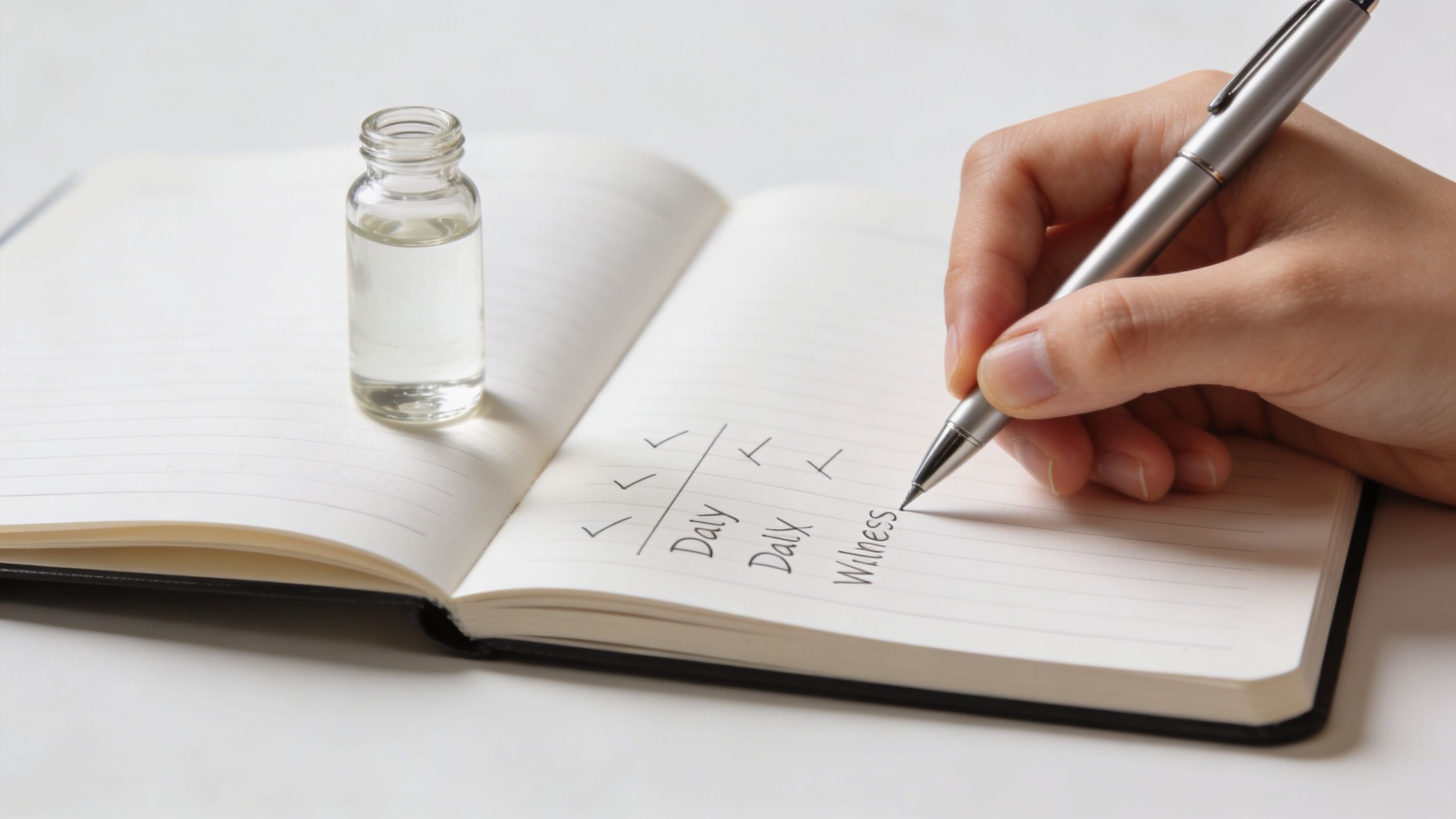
Keep a dosing journal
Memory is unreliable, especially if you are testing tinctures for sleep, pain, or evening relaxation after a long day. Write down what you took and what happened.
A simple journal can include:
| Date | Time | Product | Dose | Notes at 1 hour | Notes at 2 hours |
|---|---|---|---|---|---|
| Monday | 8:00 PM | THC tincture | 3 drops | Mild relaxation | Good relief, no discomfort |
| Wednesday | 8:00 PM | THC tincture | 4 drops | More noticeable body effect | Slightly stronger, still comfortable |
That kind of record shows whether a change helped, did nothing, or pushed the dose a little too far.
What to look for in your notes
Keep your notes practical. You do not need a spreadsheet full of theory. You need enough detail to repeat what worked.
Track these points:
Dose taken
Record the number of drops and the milligram amount if you know it.Time taken
The same dose can land differently before dinner, after dinner, or right before bed.Goal for that session
Write down whether you wanted calmer mood, body relief, or sleep support.Undesired effects
Note dry mouth, fogginess, anxiety, racing thoughts, or feeling more intoxicated than planned.Product details
If you switch from isolate to a full-spectrum cannabis tincture, note that too. The cannabinoid and terpene profile can change the feel of the dose, even when the THC math stays the same.
One clear pattern matters more than one dramatic night. If your notes show that 3 drops did too little and 4 drops felt steady and comfortable across multiple sessions, that is useful information. If 5 drops made you groggy the next morning, that is useful too.
Small increases teach faster than big jumps.
Sample Dosing Chart for Common Tincture Ratios
A dosing chart is a starting reference, not a prescription. The same milligram amount can feel different depending on your tolerance, the product ratio, and whether you're taking it sublingually or more like an edible.
Still, a simple chart can make cannabis tincture dosing less abstract, especially when you're deciding between a THC-forward bottle and a balanced formula.
Sample tincture starting dose ranges in mg
| Experience Level | Goal Microdose THC | Goal Therapeutic THC-Dominant | Goal Balanced 1:1 THC:CBD |
|---|---|---|---|
| Beginner | 2.5 to 5 mg THC | 2.5 to 5 mg THC | 2.5 to 5 mg THC + 2.5 to 5 mg CBD |
| Intermediate | 5 to 10 mg THC | 5 to 10 mg THC | 5 to 10 mg THC + 5 to 10 mg CBD |
| Experienced | 10 to 20 mg THC | 10 to 20 mg THC | 10 to 20 mg THC + 10 to 20 mg CBD |
How to use the chart
A microdose is often the right lane for patients who want a lighter touch, daytime functionality, or a cautious first experience.
A THC-dominant tincture may suit someone seeking a stronger effect and who already knows they tolerate THC comfortably.
A 1:1 THC:CBD option can be a smart middle ground. Many patients prefer it when they want a more balanced feel and less edge from THC alone.
A practical example
Say your goal is evening relief, but you don't want the experience to feel too psychoactive. Start in the Beginner row under Balanced 1:1 THC:CBD. That means a low amount of THC paired with the same amount of CBD.
If your product label shows equal THC and CBD per mL, your dropper math works the same way as in the earlier potency example. You still calculate the dose from the bottle, then count drops or partial droppers to hit your target.
A chart helps you choose a lane. Your journal helps you choose the exact spot in that lane.
This is also where product design matters. Some people do better with a balanced formula than with a straight THC tincture. There's no prize for choosing the strongest option if a gentler ratio gives you steadier results.
Safety, Legality, and When to Consult a Professional
The safest cannabis routine is the one that leaves room for caution. That means buying tested products, respecting onset times, and treating tinctures like active medication, not like a casual supplement.
Modern dosing guidance exists for a reason. Historical cannabis tincture use was much less precise, and the review published on PMC describes how earlier tincture dosing was vague and inconsistent. The same source notes that after legalization in places such as Colorado, a 2015 study saw a spike in poison center calls related to edibles and tinctures, which helped drive today's stronger education around waiting before redosing. It also notes that this focus on waiting 2+ hours before taking more has cut adverse events by 70% per dispensary reports.

If you take too much
Too much THC can feel unpleasant, even when it isn't dangerous in the way people often fear. Patients may experience:
- Anxiety or paranoia
- A rapid heartbeat
- Dizziness
- A strong sense of intoxication
- Trouble concentrating
If that happens, keep the response simple. Sit down somewhere calm. Sip water. Avoid taking more cannabis. If you have a CBD product you already tolerate, some patients find that it helps soften the experience, though responses vary.
Medication interactions matter
This part deserves more respect than it usually gets. If you take prescription medications, especially sedating medications or blood thinners, talk with a qualified healthcare professional before making cannabis tincture dosing part of your routine.
Tinctures are easy to take, which can make people underestimate them. They still have pharmacologic effects. A doctor or knowledgeable clinician can help you think through timing, interactions, and whether a THC-heavy or balanced product makes more sense.
The DC angle
For patients in Washington, DC, legality and safety go together. Buy from compliant, lab-tested channels. That helps you know what's in the bottle and gives your dose calculations a real foundation.
Patients also sometimes ask practical but risky questions about alternative use methods. If that's on your mind, read can you smoke tincture before experimenting. The short version is that tinctures are designed for oral or sublingual use, not for improvised methods.
Good cannabis use isn't just about finding a dose that feels right. It's about making sure the product, the setting, the timing, and your health situation all line up.
Frequently Asked Dosing Questions
Can I add tincture to food or a drink
Yes, you can. But once you do that, you should expect it to behave more like an edible than a sublingual dose. The onset is slower, the feel can be less predictable, and it's easier to get impatient and take more too soon.
If you want the fastest, most controlled experience, use it under the tongue first.
What if I swallow the tincture right away
It can still work, but the experience may take longer to show up and may feel different. You lose the main advantage of sublingual use, which is quicker absorption through the tissues under the tongue.
If you accidentally swallow it immediately, don't panic and don't redose early. Just wait and evaluate.
How should I store my tincture
Keep it in a cool, dark, dry place. A cabinet or drawer works well. Heat, light, and sloppy storage habits aren't helpful if you want the tincture to stay consistent from the first dose to the last.
What if my dropper isn't perfectly marked
Use the bottle label first, then the dropper markings if they're present and readable. If markings are unclear, stick to one repeatable method, such as counting drops carefully or filling to the same visual point every time after you've done the math.
Consistency beats perfection. If you take the same measured amount each session and log the result, you can still titrate safely.
If you want help choosing a tincture, understanding a label, or figuring out a practical starting dose, the team at Mr. Nice Guys DC can help you think it through clearly and safely. We work with patients who are brand new to tinctures and patients refining an existing routine, and we'll always point you toward the smallest effective dose, not the most dramatic one.
Mr Nice Guys DC
At Mr. Nice Guys DC, we’re more than just a cannabis delivery service — we’re passionate advocates for quality, convenience, and community. With years of experience in the cannabis industry, our team is dedicated to educating and empowering customers across Washington, D.C. Whether you're a seasoned user or just starting your cannabis journey, our blog delivers trusted tips, product insights, and the latest updates from the world of weed. Stay informed, stay elevated.
