
Must Be 21 To Enter
By entering this site you are agreeing that you are at least 21 Years of Age or older.
I AM 21 OR OLDERCO2 Cannabis Oil Explained for DC Medical Patients
.svg)

.png)
You're standing at a Washington, DC dispensary counter, comparing cartridges and tinctures. One label says CO2 oil, another lists ethanol extraction, and a concentrate nearby is made with rosin. The practical question isn't just which one sounds more advanced. You want to know whether the oil will deliver consistent potency, preserve useful aroma, and give you confidence that unwanted contaminants were controlled.
For a medical patient, the extraction method matters, but it doesn't tell the whole story. CO2 cannabis oil can offer precise processing and a reduced concern about flammable solvent residues, yet the finished product still depends on the source material, extraction settings, refinement, formulation, packaging, and laboratory testing. Here's how to evaluate those details without getting lost in chemistry.
What CO2 Cannabis Oil Actually Means for Patients
A patient named Maya wants something easier to measure than flower. At a Washington, DC dispensary, she sees a vape cartridge labeled CO2 oil and wonders whether that label means the product is cleaner, stronger, or safer than every other concentrate. The label has a narrower meaning: CO2 cannabis oil is a concentrate made by using carbon dioxide to pull cannabinoids and, depending on the process, terpenes and other plant compounds from cannabis material.
CO2 identifies the extraction method, not a guaranteed experience. Processors can use it to produce a light vape oil, an oral oil, or a thicker concentrate. After extraction, the material may undergo filtration, winterization, decarboxylation, distillation, terpene separation, or terpene reintroduction. Each choice changes the compounds, texture, aroma, and potency profile that reach the patient.
Practical rule: Read “CO2” as one processing detail, then check the certificate of analysis and product formulation.
For Maya, three questions matter more than whether CO2 sounds premium. Will the cannabinoid concentration remain reasonably consistent between purchases? Does the product preserve enough terpene information to explain its flavor and expected character? Does testing address contaminants that could affect a medical patient?
Those priorities can differ. A patient managing discomfort may prefer a repeatable cannabinoid profile, while another may place greater value on retaining the aroma of the source strain. The extraction method can support either goal, but it cannot guarantee both by itself.
The word “solvent” also creates confusion. In extraction discussions, carbon dioxide is often described as a solvent, while consumers may associate that word with harsh chemical residue. Under controlled pressure and temperature, CO2 interacts with plant compounds and is then separated from the collected extract. That process reduces concern about flammable solvent remaining in the finished oil, but it does not replace testing, careful formulation, or quality control.
Patients comparing oils can also review this guide to what cannabis oil is used for for product context. The practical takeaway is straightforward: extraction influences flavor, safety considerations, and consistency, while the laboratory report and formulation show what you are buying.
How Supercritical and Subcritical CO2 Extraction Work
Think about brewing coffee. Hot water, pressure, grind size, and contact time determine whether the cup tastes bright, bitter, thin, or full-bodied. CO2 extraction follows a similar principle. Processors adjust conditions to influence which cannabis compounds move into the extract.
The critical point changes CO2's behavior
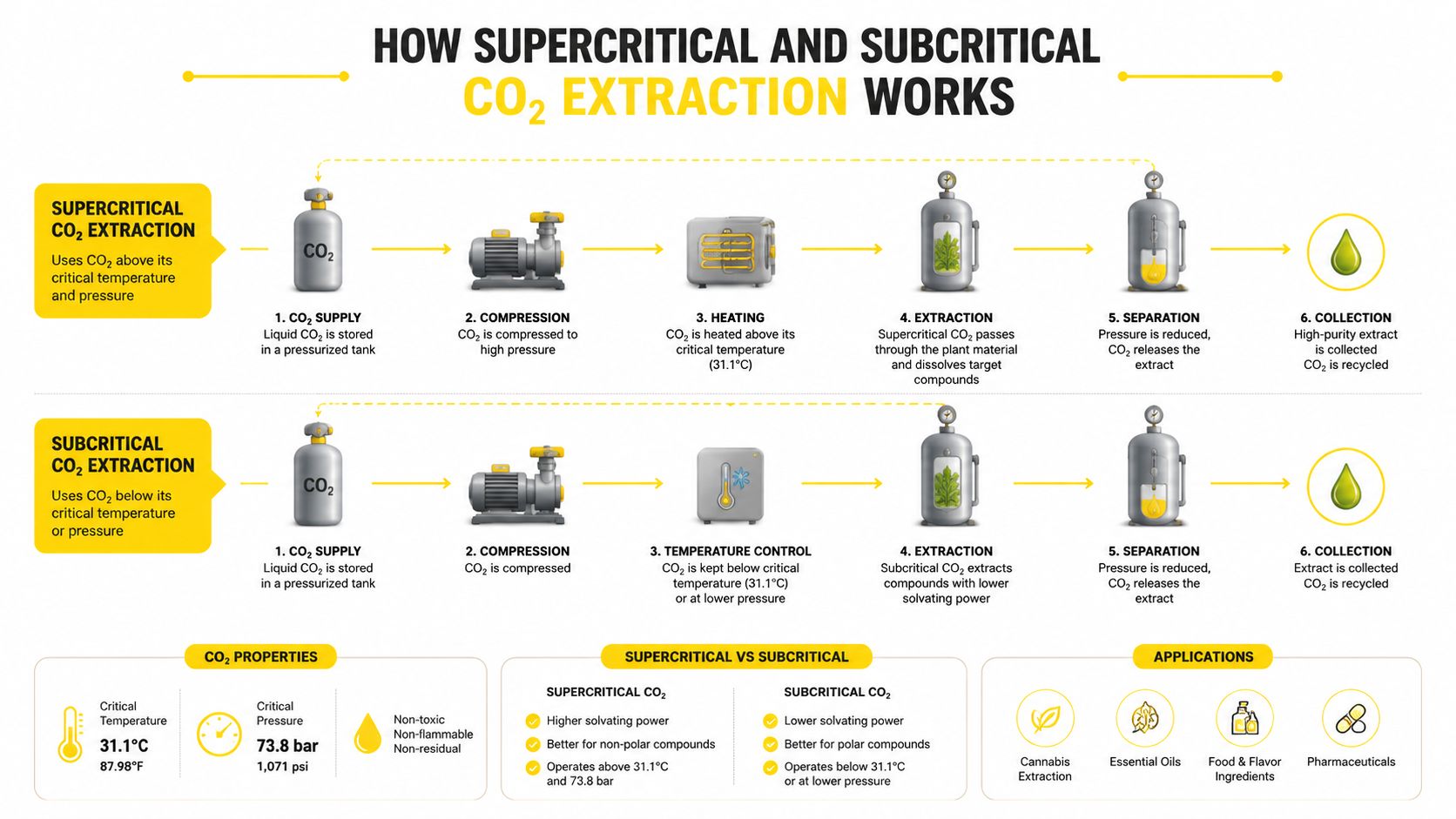
CO2 becomes usable for cannabis oil extraction at about 31.1°C and 73.8 bar, or 1,071 psi, according to a published cannabis extraction study (read the technical study on CO2 conditions). Above that critical point, CO2 can take on properties associated with both a gas and a liquid. It can move through plant material while dissolving selected compounds.
A processor generally loads prepared cannabis biomass into an extraction vessel. Pressurized CO2 passes through the material, picks up target compounds, and moves into a separator. Changes in pressure and temperature then encourage the cannabinoids, terpenes, waxes, or other materials to separate from the CO2. The CO2 can be recovered and used again, while the collected extract receives any required post-processing.
Supercritical and subcritical runs make different trade-offs
Supercritical CO2 operates at higher pressure and temperature than the subcritical approach. Published reviews summarize CO2 extraction across roughly 10–60°C and 55–300 bar, with cannabinoid recovery around 73–80% (Frontiers review of cannabis extraction). These settings give processors room to target cannabinoid-rich fractions, but stronger extraction conditions can also bring along more compounds that later require refinement.
Subcritical CO2 uses lower pressure and temperature. That can help processors favor delicate volatile compounds or selected non-intoxicating cannabinoids. A large-scale example processed 60 kg of cannabis biomass, using subcritical conditions of 10°C and 60 bar and supercritical conditions of 40°C and 100 bar over 4 hours to recover a CBD-rich extract (published large-scale extraction example).
A terpene-first process may use a lower-temperature pass, collect aromatic compounds, and then use a later cannabinoid-focused pass at different pressure and temperature. The review describes a terpene-first window of about 26–43°C and 1,000–1,300 psi, with terpene oil reported as up to 99% terpenes. That doesn't mean every CO2 cartridge contains that concentration. It means the process can be tuned to create distinct fractions before the manufacturer decides how to formulate the final product.
For a patient, those choices can change flavor, viscosity, and the balance between cannabinoids and terpenes. A thin cartridge oil and a thick syringe may both begin with CO2 extraction, but they needn't have the same composition or intended use. A practical introduction to CO2-extracted CBD oil can help if you're comparing hemp-derived and cannabis-derived products.
Comparing CO2 Oil to BHO, Ethanol, and Rosin
A dispensary menu may list CO2, BHO, ethanol, and rosin side by side. These labels answer one question, how the concentrate was produced, but patients usually need answers about several others: how easy it is to control potency, whether volatile flavor compounds remain, and what testing supports the final product.
| Method | Solvent Used | Safety Profile | Terpene Retention | Best For |
|---|---|---|---|---|
| CO2 | Carbon dioxide | Can reduce concern about flammable solvent residues, but finished-product testing still matters | Can be targeted and collected, though refinement may change the final profile | Patients seeking adjustable formulations and repeatable oil products |
| BHO | Butane | Requires careful purging and residual-solvent testing | Can preserve a strong aromatic profile when processed well | Experienced concentrate users prioritizing flavor or potency |
| Ethanol | Ethanol | Requires removal and testing for residual solvent | Can produce a broad extract, but processing may alter the final aroma | Manufacturers seeking scalable extraction and broad compound recovery |
| Rosin | None, solventless | Avoids extraction solvents, but contamination control still starts with the plant and equipment | Often valued for a fresh, strain-forward profile | Patients who prefer solventless concentrates and are comfortable with concentrate use |
CO2 and BHO answer different safety questions
BHO, or butane hash oil, uses a flammable hydrocarbon. Skilled processors can remove residual butane, but patients should still look for a laboratory report that addresses residual solvents. CO2 doesn't create the same flammability concern during extraction, and it can be separated from the collected oil, but that advantage doesn't prove the product is free of pesticides, heavy metals, microbes, or other unwanted material.
CO2 can also be highly adjustable. A processor may collect terpene-rich and cannabinoid-rich fractions separately, then formulate them for a cartridge or oral product. BHO can deliver a powerful and aromatic concentrate, but the final experience depends heavily on purging, refining, storage, and the original plant material.
Ethanol favors a different production profile
Ethanol extraction can pull a wide range of compounds from cannabis. Manufacturers may later filter, refine, or distill the material, which can produce a product with a different flavor and cannabinoid profile from the starting plant. Patients shouldn't assume “broad extraction” means “full-spectrum,” because post-processing can remove or concentrate particular components.
Rosin takes a different route. Heat and pressure separate resin from the plant without an extraction solvent. That appeals to patients who want a solventless product, although the texture, yield, potency, and shelf stability can vary with the starting material and technique. Solventless doesn't mean contamination is impossible. Cultivation inputs, handling, equipment, and packaging remain relevant.
What to compare on the menu: extraction method, cannabinoid panel, terpene panel, residual-solvent results where relevant, contaminant screening, and the product's intended route of use.
Use a THC concentrates chart as a starting point, then ask a dispensary educator to explain the specific product rather than choosing from the method name alone.
Real Benefits and Limitations of CO2 Cannabis Oil
A medical patient in DC comparing two cartridges may see the same “CO2” label and still receive products with different effects. The practical value of CO2 extraction lies in how carefully the processor controls the process, preserves the desired compounds, and documents the finished batch.
Pressure and temperature can be adjusted to collect different fractions. That flexibility may help a manufacturer produce a more consistent cannabinoid profile or retain a selected terpene composition. For patients, the benefit is potential consistency from one purchase to the next, provided the starting cannabis, formulation, filling, and testing are also controlled.
A research review describes supercritical CO2 extraction as technically promising but still “nascent” at the research level. Process optimization depends on pressure, temperature, and co-extraction design, not the CO2 label alone (research review on cannabis extraction). Two oils can therefore share the same extraction method while differing in potency, aroma, texture, and overall experience.
What patients can reasonably expect
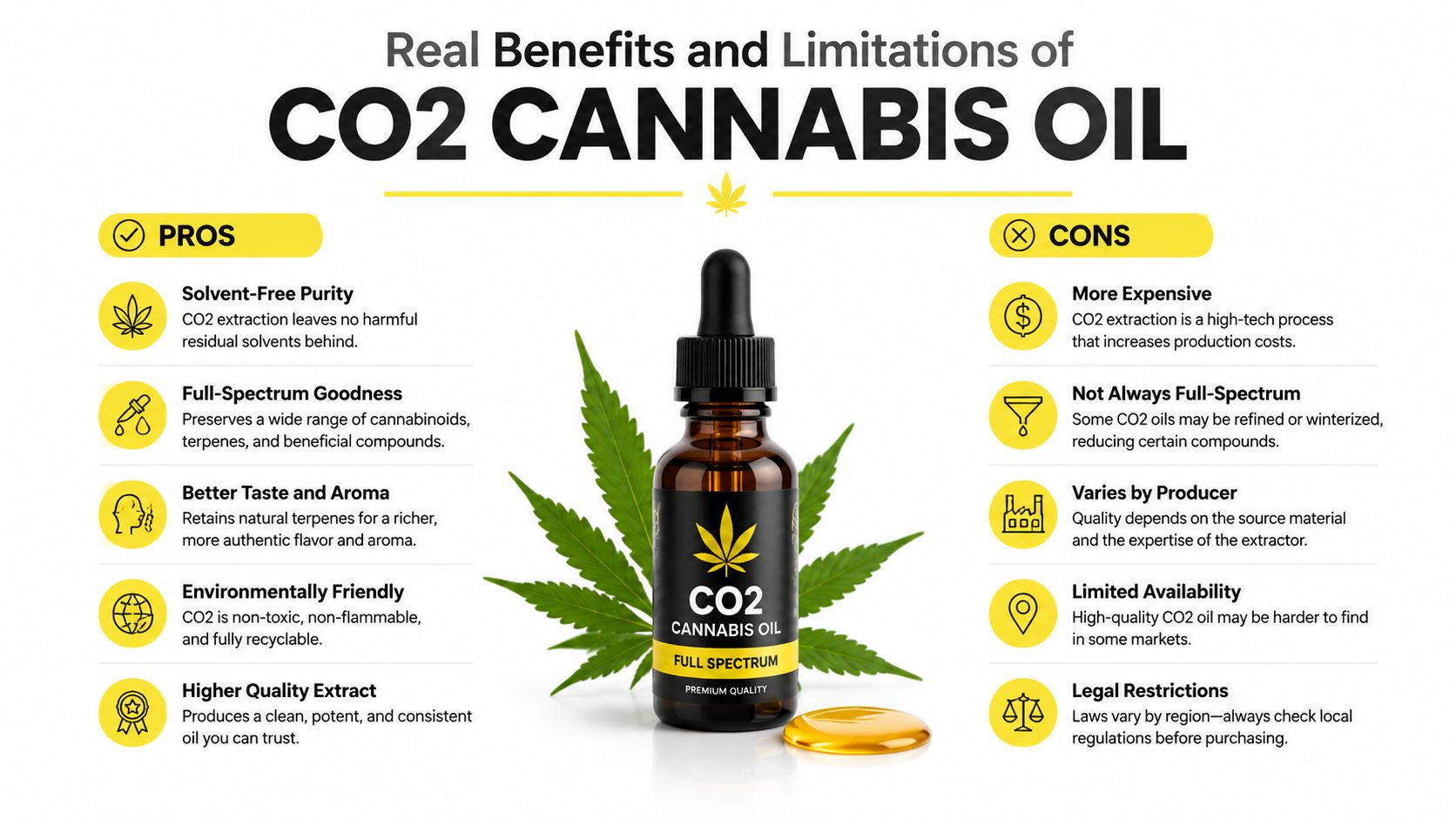
The strongest practical advantages are process flexibility, scalable production, and less concern about flammable solvent residues. CO2 can be separated from collected oil without leaving the same type of hydrocarbon residue associated with a poorly purged product. The manufacturer still must validate the finished oil, because extraction equipment alone does not prove product quality.
The limitations deserve equal attention:
- CO2 doesn't guarantee full-spectrum composition. Refinement may remove waxes, pigments, or other plant compounds.
- CO2 doesn't guarantee terpene retention. Terpenes may be separated, reduced, added back, or left out.
- CO2 doesn't guarantee potency consistency. Results depend on the biomass, equipment settings, formulation, filling process, and laboratory testing.
- CO2 doesn't replace contamination screening. Pesticides, heavy metals, microbes, and other hazards require appropriate laboratory checks.
Regulatory reviews of cannabis CO2 extracts have noted insufficient data to establish safety for proposed conditions of use, underscoring the importance of laboratory documentation. This does not mean every CO2 oil is unsafe. It does mean patients should question broad claims about long-term safety, daily dosing, or one route of administration.
Read the report, not just the front label
Look for a batch-specific certificate of analysis. Check whether the cannabinoid amounts align with the label, review terpene information if aroma matters, and confirm that contaminant testing is available. If the report does not identify what was tested, ask the dispensary before purchasing.
A patient seeking predictable oral dosing may prefer a formulated tincture with a clear cannabinoid concentration over a highly refined cartridge marketed only as “CO2.” The extraction method can support quality, but the batch record and laboratory results make the decision concrete.
Common CO2 Product Forms and How Patients Use Them
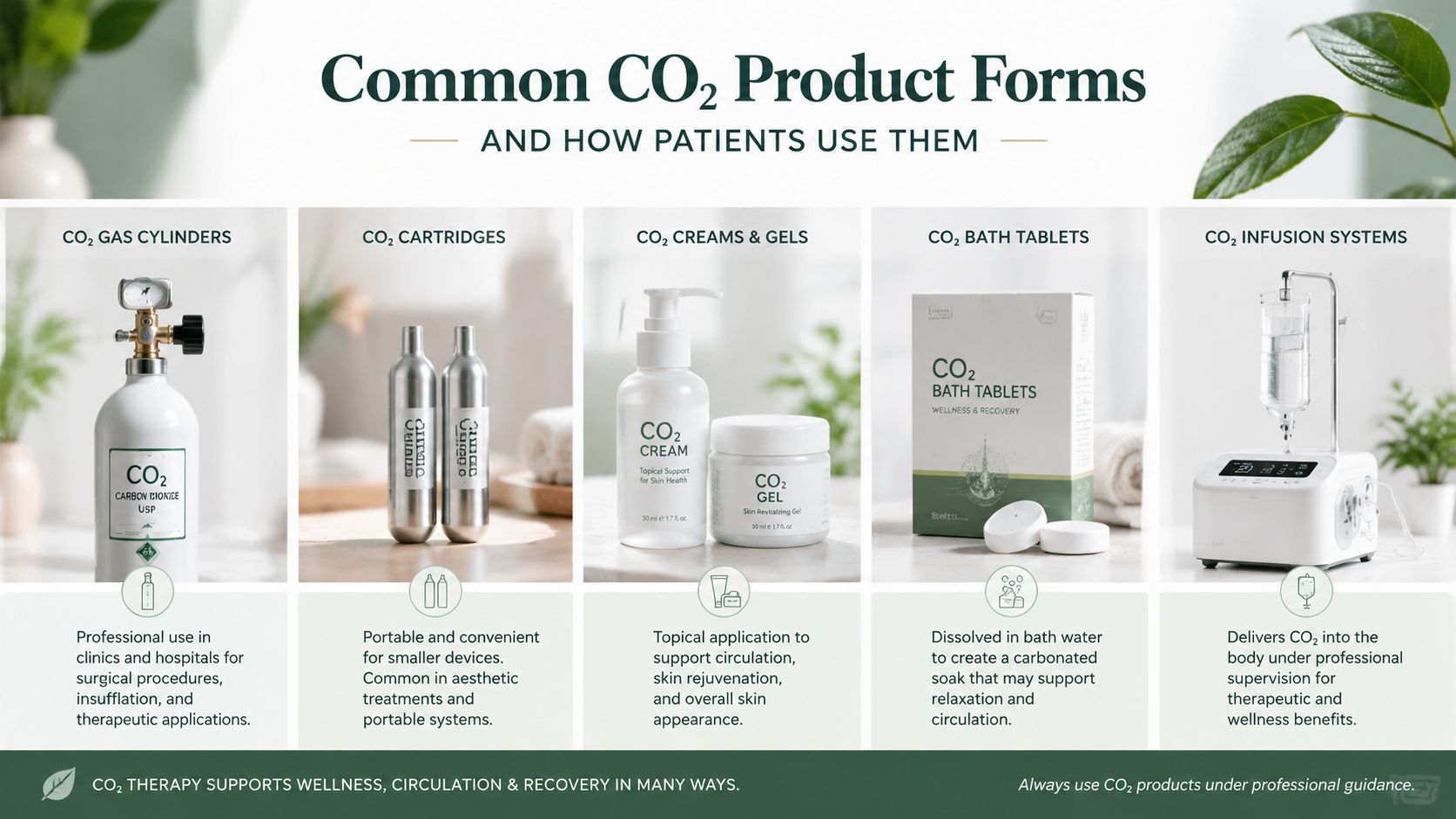
CO2 oil can appear as a vape cartridge, a tincture, an oil syringe, or a more solid concentrate. The best format depends on how quickly you want an effect, how precisely you need to measure, and whether inhalation is comfortable for you.
A patient with occasional breakthrough discomfort may choose a cartridge because it's portable and fast to use. Another patient managing symptoms across a longer period may prefer a tincture that fits a measured routine. A third patient may buy a syringe for flexible use, but that format requires more confidence with handling and dosing.
Match the format to the situation
Vape cartridges and pens are discreet, portable, and typically fast-acting compared with oral products. They can suit a patient who wants quick feedback, but inhalation may not be appropriate for everyone. A patient who has never used a vape should ask about hardware, oil ingredients, and draw technique before purchasing. This guide to vape cartridges and pens covers the format in more detail.
Tinctures allow measured servings and can work well for patients who prefer oral or sublingual use. A patient managing chronic discomfort might take a small, consistent amount as part of a routine rather than repeatedly reaching for a cartridge. Effects can take longer to appear than inhaled effects and may last longer, so patience matters.
Concentrates such as wax or shatter are more suitable for people who already understand concentrate equipment and high-potency products. They're not the simplest starting point for a first-time medical patient. An oil syringe may offer flexibility for filling a compatible cartridge, ingesting a measured amount, or another approved use, but the product label and professional guidance should determine the method.
Here's a short visual explanation of how CO2 products and extraction relate to patient use:
Start with the format that makes accurate use easiest. If you're unsure whether a cartridge, tincture, or concentrate fits your symptoms and routine, ask the dispensary staff to compare onset, measurement, ingredients, and storage requirements.
Dosing and Safety Considerations for Medical Patients
A patient choosing a CO2 oil may be comparing two products with similar potency on the label, yet experience different effects. Potency, serving size, route of administration, tolerance, medications, and individual response all matter. Start by changing one product or variable at a time, so you can tell what caused a benefit or unwanted effect.
Use a conservative starting approach
For a tincture, some medical patients begin with 2.5–5 mg of THC, then wait before deciding whether to adjust. This is a practical example, not a universal prescription. Patients who are sensitive to THC, take other medications, or have a relevant medical condition should discuss cannabis with a qualified healthcare professional first.
For a vape cartridge, one short puff provides a cautious starting point. Wait before taking another draw because inhaled effects are not always immediate. They may appear sooner than oral effects, but dizziness, anxiety, sedation, dry mouth, or impairment can still develop as the dose takes effect.
Start low and go slow: Record the product, amount, time, effects, and unwanted symptoms. This simple log gives you and your clinician a clearer basis for adjusting use.
Check the batch before you buy
Treat the certificate of analysis like a quality checklist for one specific batch. Review:
- Potency: Confirm cannabinoid concentration and serving information.
- Contaminants: Look for testing related to pesticides, heavy metals, microbes, and other applicable hazards.
- Residual solvents: Check the report when the process uses a solvent that requires this testing.
- Ingredients: Review carrier oils, flavorings, and additives, especially in inhaled products.
- Product identity: Match the package batch information with the laboratory report.
CO2 extraction can support consistent potency and help control process contaminants, but it does not make every product or route risk-free. The evidence for long-term use and real-world dosing remains limited. A safety review found that available data were insufficient to establish safety for proposed conditions of use, so patients should avoid treating the extraction method as proof of safety for daily use.

Stop using a product and seek medical guidance if symptoms are severe or persistent. Store oil securely, never drive while impaired, and keep cannabis products away from children and pets.
Where to Buy CO2 Cannabis Oil in Washington DC
A patient comparing two CO2 oils may notice similar labels but different intended uses, terpene profiles, or serving information. A reputable, compliant DC medical dispensary should explain those differences and provide batch-specific laboratory information rather than relying on front-label claims.
Ask whether the oil is made for inhalation or oral use, and whether it was refined or formulated for that route. Confirm that the cannabinoid profile matches the package. Ask whether terpenes were retained, removed, or added after extraction. These details help you judge likely consistency, flavor, and suitability for your routine.
The DC medical dispensary purchasing guide can help patients understand local options. Mr. Nice Guys DC offers in-store pickup, curbside service, and delivery powered by Sweede to DC and nearby areas, including Alexandria, Bethesda, Rockville, and Silver Spring. Patients can compare tinctures, cartridges, pens, concentrates, and other formats while asking about potency, testing, and intended use.
A consultation can be especially helpful if you are new to cannabis. Bring your symptom goals, medication questions, preferred route, and tolerance level. The strongest product is not automatically the best fit.
Mr. Nice Guys DC offers CO2 oil alongside cartridges, pens, tinctures, and concentrates. Staff can discuss potency, terpene profiles, and laboratory information. Visit Mr. Nice Guys DC to review current pickup, curbside, or delivery options and choose a format that fits your medical routine.
Mr Nice Guys DC
At Mr. Nice Guys DC, we’re more than just a cannabis delivery service — we’re passionate advocates for quality, convenience, and community. With years of experience in the cannabis industry, our team is dedicated to educating and empowering customers across Washington, D.C. Whether you're a seasoned user or just starting your cannabis journey, our blog delivers trusted tips, product insights, and the latest updates from the world of weed. Stay informed, stay elevated.
